1500 DISK
OPERATING SYSTEM
DOS.H
User's Guide
Version 2 (Upgraded to 2.5.1)
May, 1980
Document No. 50308
NOTICE
1500 DISK OPERATING SYSTEM DOS.H
User's Guide
Version 2 (Upgraded to 2.5.1)
May, 1980
Document No. 50308
Datapoint strongly recommends that its customers use Datapoint
Customer supplies. These disks, diskettes, cassettes, ribbons
and other products are certified by Datapoint to meet all Datapoint
PREFACE
The purpose of this User's Guide is to provide the user of
the Datapoint 1500 DOS that information required to generate a
system, make effective use of the available commands, and to make
user-written programs compatible with the DOS.
The Datapoint 1500 processor has a different architecture
from previous Datapoint processors (1100, 2200, 5500, etc). DOS.H
is designed to minimize these differences from the user's point of
view while providing capabilities consistent with the features of
the new processor. Wherever possible, DOS.H commands are
identical to corresponding commands in other Datapoint
"Dot-series" operating systems (DOS.A, DOS.B, etc.).
The 9320 disk system referred to in this User's Guide is
Datapoint's cartridge disk system with a Four-Port Communications
Adapter. Not all cartridge disk systems include the
Communications Adapter, and those where it is not included are
designated as 9310 cartridge disk systems. All references herein
TABLE OF CONTENTS
1. INTRODUCTION
1.1 Planning for DOS.H 1.2 Performance of DOS.H
1.3 Functional Differences Between Versions of DOS.H
1.3.1 Compatibility of Utility Programs
1.4 Hardware Support Required
2. FUNDAMENTALS OF DOS.H 2.1 Diskette Systems
2.1.1 Diskette Media
2.1.2 Loading and Unloading Diskettes
2.1.3 Drive Numbering and Switches
2.1.4 Care and Handling of Diskettes
2.1.5 Preparing Diskettes for Use
2.1.6 Suggested Diskette Organization Techniques
2.2 Cartridge Disk Systems
2.2.1 Cartridge Disk Media
2.2.2 Drive Numbering with 9320 Cartridge Disks
2.2.3 Care and Handling of Cartridge Disks
2.2.4 Preparing Cartridge Disks for Use
3. EQUIPMENT CARE
3.1 Environment 3.2 Processor
3.3 Disks and Disk Drives 3.4 System Printer
4. SYSTEM GENERATION 4.1 Initial Generation
4.1.1 Initial Loading
4.2 UPGRADE/H
4.3 Scratch Disk Generation
5. DISK FILES 5.1 File Names 5.2 File Creation
5.3 File Deletion 5.4 File Protection
6. OPERATOR COMMANDS 6.1 Command Line
6.1.1 Order-Dependency in the Command Line
6.2 General Command Characteristics
{
6.2.1 General Command Format
6.3 Signon Messages
6.4 Common Error Messages
7. ABTONOFF COMMAND 7.1 Purpose
8. APP COMMAND 8.1 Purpose 8.2 Use
9. AUTO COMMAND
10. AUTOKEY COMMAND
10.1 Introduction to AUTOKEY 10.2 The Auto-Restart Facility
10.3 Automatic Program Execution Using AUTO 10.4 Auto-Restart Facilities Using AUTOKEY 10.5 A Simple Example
10.6 Special Considerations 10.7 AUTOKEY and DATABUS
11. BACKUP COMMAND 11.1 Purpose
11.2 Use
11.3 Exact Image Copy 11.4 Reorganizing Files
11.4.1 Copying DOS to Output Disk 11.4.2 Deleting Named Files
11.4.3 Copying Named Files
11.5 Use of KEYBOARD and DISPLAY Keys 11.6 Error Messages
11.7 Reorganizing Files for Faster Processing 11.8 BACKUP with CHAIN
11.9 Clicks during Copying
12. BLOKEDIT COMMAND 12.1 Purpose
12.2 File Descriptions
12.2.1 Command Statement Lines 12.2.2 Source File
12.2.3 New File 12.3 Using BLOKEDIT 12.4 Messages
12.4.1 Informative Messages 12.4.2 Fatal Errors
12.4.3 Selective Fatal Errors
13. BOOT COMMAND
14. BUILD COMMAND 14.1 Purpose 14.2 Use
14.3 A Simple Example 14.4 Error Messages
15. CAT COMMAND 15.1 Purpose 15.2 Use
16. CHAIN COMMAND 16.1 Introduction
16.2 Tag (Parameter) Definition 16.3 Tag Substitution
16.4 Compilation Phase Directives 16.4.1 IF Directive
16.4.2 ELSE/XIF Directives 16.4.3 BEGIN/END Directives 16.4.4 ABORT Directives 16.5 Comments
16.6 Resuming An Aborted CHAIN 16.7 Notes On Usage of CHAIN 16.8 Error Messages
17. CHANGE COMMAND
18. CLOCK COMMAND
19. COPY COMMAND 19.1 Purpose 19.2 Use
19.3 Error Messages
20. DOSGEN COMMAND 20.1 Purpose
20.2 Use of DOSGEN
20.3 Special Considerations 20.4 Error Messages
21. DSKCHK15 COMMAND 21.1 Purpose
21.2 Use 21.3 Options
21.3.1 "L" Option 21.3.2 "F" Option 21.4 Program Operation
21.4.1 System Tables and Data 21.5 Execution Phases
21.5.1 Initialization 21.5.2 HDI Checking 21.5.3 CAT Che~king
21.5.4 Directory Checking 21.5.5 RIB Checking
21.5.6 Cluster Allocation Phase 1 21.5.7 Cluster Allocation Phase 2 21.5.8 Lock-out CAT Checking
21.6 Examples of Command Lines 21.7 Operational Messages
21.8 Error Messages
21.8.1 Initialization Error Messages 21.8.2 C.A.T. Errors
21.8.3 HDI Errors
21.8.4 Directory Errors 21.8.5 R.I.B. Errors
21.8.6 Lockout CAT Errors
22. DUMP COMMAND 22.1 Purpose 22.2 Use
22.3 Informational Messages Provided 22.4 Level One Commands To DUMP
22.5 Level Two Commands To DUMP 22.6 Level Three Commands To DUMP 22.7 Level Four Commands To DUMP 22.8 Level Five Commands to DUMP 22.9 Error Messages
23. EDIT COMMAND 23.1 Introduction
23.2 General Description of The 1500 Editor 23.3 Special Features of the 1500 Editor 23.4 Software Required
23.5 Operation
23.5.1 Invoking the 1500 Editor 23.5.2 Files
23.6 Parameter List 23.6.1 Margin Bell
23.6.2 Tab Key Character 23.6.3 Mode
23.6.4 Update 23.6.5 Key-click
23.6.6 Space Compression 23.6.7 Non-verification. 23.7 Examples
23.8 Data Entry and Retrieval 23.8.1 Data Entry
23.8.2 Multi-line Record Entry 23.9 Data Retrieval
23.10 EDITOR Command Format 23.11 Basic EDITOR Commands 23.12 Setting Tabs
23.13 Setting TEXT Mode 23.14 INSERTing a Line 23.15 DELETEing a Line 23.16 COPYing a Line 23.17 MODIFYing a Line 23.18 LOCATEing a Line 23.19 ENDing the EDIT
23.20 Intermediate Commands
23.21 Changing Special Characters 23.22 Changing Tabs
23.23 Changing Modes and Options 23.24 Deleting Lines
23.25 MODIFY Command
23.25.1 Line Modification 23.25.2 Field Modification 23.26 Line Splitting
23.27 Line Concatenation 23.28 File Search Commands 23.29 BYPASS End of File 23.30 Terminating the EDIT 23.31 Advanced Commands 23.32 Recovery Procedures 23.33 Glossary of EDIT Terms 23.34 Command List
23.35 EDIT ERROR MESSAGES 23.36 Configuration Sector
23.37 Example of a Definition File
24. ENCODE/DECOD~ COMMANDS 24.1 Purpose
24.2 Use
24.3 Error Messages
25. FILES COMMAND
25.1 Command Description 25.2 Default Messag~s
25.3 File Descriptions 25.4 Error Messages
26. FIX COMMAND 26.1 Purpose
26.2 Operation 26.3 Commands
26.4 Error Messages
27. FREE COMMAND 27.1 Purpose 27.2 Use
27.3 Error Messages
28. INDEX COMMAND 28.1 Introduction
28.2 System Requirements 28.3 Operation
28.3.1 Parameters
28.4 Choosing A Record Key 28.5 Preprocessing the File
28.5.1 Invoking Reformat
28.5.2 Considerations for Unattended Indexing 28.6 INDEX Messages
28.7 lSI File Structures
28.8 Examples of the Use of INDEX
29. KILL COMMAND 29.1 Description 29.2 Error Messages
30. LIST COMMAND 30.1 Purpose 30.2 Parameters
30.3 INPUT File Specification 30.4 Starting Point
30.5 OUTPUT File Specification 30.6 output Device
30.7 Output Format 30.8 Format Control 30.9 Operator Controls 30.10 Error Conditions
31. MANUAL COMMAND
32. NAME COMMAND
33. PUTIPL COMMAND
34. PUTVOLID COMMAND
35. REFORMAT COMMAND 35.1 Introduction
35.2 Operation
35.3 Output File Formats
35.4 Reasons for Reformatting 35.5 Reformat Messages
35.6 Text File Formats
36. REMAP COMMAND 36.1 Purpose
36.2 Logical Drive Mapping Table Display 36.3 Use
36.3.1 Specific Remapping 36.3.2 General Remapping 36.4 Messages
36.5 Error Messages
37. SAPP COMMAND
38. SORT COMMAND 38.1 Introduction
38.2 General information
38.3 Fundamental SORT Concepts 38.3.1 File Formats
38.3.2 The Key Options 38.3.3 How to Sort a File 38.4 The Other Options
38.4.1 Generalized Command Statement Format 38.4.2 Keys-overlapping and in Backwards Order 38.4.3 Collating Sequence File
38.4.4 Ascending and Descending Sequences 38.4.5 Input/output File Format Options 38.4.6 Limited output format option 38.4.7 TAG file output format option 38.4.8 KEYTAG File Output Format Option 38.4.9 Hardcopy output option
38.4.10 Primary/Secondary sorting considerations 38.4.11 Key file Drive Number
38.4.12 Disk space requirements 38.5 The use of CHAIN with SORT
38.5.1 How to Set up a chain file for SORT 38.5.2 Naming a repetitive SORT procedure 38.5.3 Using CHAIN to cause a merge
38.6 SORT Execution-Time Messages
39. SUR COMMAND 39.1 Purpose
39.2 About Subdirectories
39.2.1 Creation of Subdirectories 39.2.2 Deletion of Subdirectories
39.2.3 Being "in a Subdirectory" 39-2
39.2.4 Scope of a File Name 39-3
39.2.5 About Subdirectory SYSTEM 39-3
39.2.6 Files vs. the User Being "in a Subdirectory" 39-4 39.2.7 Getting a File into a Subdirectory 39-4
39.3 Usage 39-5
39.3.1 Establishing a "Current Subdirectory" 39-5
39.3.2 Creating a Subdirectory 39-5
39.3.3 Deleting a Subdirectory 39-5
39.3.4 Renaming a Subdirectory 39-6
39.3.5 Displaying Subdireotories 39-6
39.3.6 Error Messages 39-6
40. UTILITY/SYS
41. SYSTEM DESCRIPTION 41.1 System Philosophy 41.2 System Features
42. SYSTEM STRUCTURE 42.1 Disk Structure
42.1.1 Introduction
42.1.2 Disk Space Management: CAT and Lockout CAT 42.1.3 Files: HDI, Directory, Mapping Bytes, RIB 42.1.4 Sector Identification
42.1.5 Addressing Byte Structures
42.1.5.1 PDA - Physical Disk Address 42.1.5.2 RIB Address/Protection
42~1.5.3 Segment Descriptor - used in RIB to define a segment.
42.1.5.4 Physical File Number 42.2 Disk Data Formats
42.3 Memory Mapping 42.3.1 32K System 42.3.2 64K System 42.4 Disk Overlays
42.5 The Command Interpreter
43. DOS ERROR MESSAGES
44. 1500 ROMGUIDE
44.1 System ROM Functions 44.1.1 Startup Procedure 44.1.2 Display Format 44.2 The Command Interpreter
44.2.1 Command Syntax 44.2.2 Input Command List 44.3 Hardware Error Messages
CHAPTER 1. INTRODUCTION
Datapoint Corporation~s disk operating systems (DOS) are
comprehensive systems of facilities for sophisticated data management.
DOS provides the operator with a powerful set of system commands by which the operator can control data movement and data processing from
the system console. These commands allow the system operator to
accomplish tasks that often are substantially more difficult on other
computing systems. Sorting a large file, for instance, can be
accomplished in one single command line. In spite of the simplicity of
operation, a wide range of features is provided in the DOS facilities package.
To the user, DOS offers a set of facilities to simplify and
generalize his task and file management. Concepts like dynamic disk
space allocation allow programs to operate efficiently without regard to the amount of space required for the data files being used. In
addition, the disk file structure used by DOS allows for direct random
access. DOS also makes use of fully space-compressed text files.
These features, combined with the ability to support up to one million bytes of diskette storage and up to 40 million bytes of cartridge disk storage, provide a wide range of data processing and intelligent data entry capabilities.
1.1 Planning for DOS.H
There are three basic configurations for the DOS.H 1500 Disk Operating System:
--32K with two or four diskette drives --64K with two or four diskette drives
--64K with two or four diskette drives and one to four 9320 cartridge disk drives.
A serial printer may be connected to any of these system configurations, and is of great value in a business data processing system that requires
hardcopy reporting. The four-diskette-drive system is a must if larger
Greater memory is a consideration when running SORT and other programs concurrently, editing large files, and for overall system
efficiency. Note that 9320 disks are supported only on 64K processors.
If the system is configured with only diskettes, then the number of drives needed should be considered. Use of a single diskette drive is possible, but the user should at least have access to a qouble-drive system for backup purposes. Some consideration must be given to the question of copying files from one diskette to another. Since DOS.H software is distributed on diskettes from Datapoint Corporation, the user will need to have at least one two-drive system to copy the software from the diskette received from Datapoint to his working diskette(s). Single-drive systems should be considered only by those intending to use them as satellite systems--that is, as data-entry stations only--and, in this case, there should be at least one other system with two or more drives on which to ~evelop programs, create diskette backup, and perform file processing.
1.2 Performance of DOS.H
Users who are currently using Datapoint computers in cassette-based systems will find sUbstantial improvements in performance when they upgrade to DOS.H. The diskette drives are several times faster than the cassettes for ordinary sequential data transfers; random-access type operations (such as sorting and indexed sequential access
method--ISAM-- file access) can easily be two orders of magnitude faster than is attained using tape cassettes.
Even further upgrade is obtained by adding the 9320 cartridge disk system. The ten-megabyte capacity of this disk offers a capability
approaching that of the large capacity, high performance, disk operating systems while still being contained in a small-system package.
Users who are currently working with competitive disk-based
equipment will generally find that total system performance of Datapoint systems will exceed that to which they are accustomed. This improvement is due to the generally superior data handling techniques and file
structuring that are incorporated in Datapoint's DOS.H. These
characteristics stern from the fact that instead of employing a lower performance cassette-style file structure as a base for the operating system, Datapoint chose instead to adapt the same advanced and dynamic disk file access techniques that are used in its other disk operating systems to the new small-disk media. The result is a degree of software sophistication previously unavailable in business-oriented systems of this size.
/
1.3 Functional Differences Between Versions of DOS.H
The following is a list of the functional differences between DOS.H 2.4.2 and DOS.H 2.5.1.
1. Support for up to four 9320 disk controllers with four logical drives on each controller has been added to the 64K system. This system will support 16 logical drives (numbered 0-15), of which up to four may be diskettes.
2. Support for the 9320 disks has been added to the standard DOS utilities.
3. A new utility has been added to support the 9320 cartridge disks. REMAP will allow the logical remapping of drives under a 64K system with 9320 disks on-line. This permits the user to have any mix of 9320 disks and diskettes that is desired, (up to four diskettes), and to change this mix at any time.
4. The concurrent region in the 64K system has been decreased by 2K, to 10K, to allow for the 9320 disk handlers. On a 64K system with no 9320 disks spinning, the disk handlers are not present, so the concurrent region is a full 12K.
1.3.1 Compatibility of Utility Programs
The set of facilities described in this manual come as a complete package and are compatible within the 1500 DOS.H system.
Additionally, programs written in DATABUS will generally run unmodified on_DOS.H~.
1.4 Hardware Support Required
The standard configuration required for DOS.H is a Datapoint 1500 with 36K of memory (32K of RAM, and 4K of ROM), and two or four diskette drives. The 1500 is also available with 64K of memory (60K RAM, 4K ROM). This system supports both diskettes and the 9320
CHAPTER 2. FUNDAMENTALS OF DOS.H
Basic information on the hardware, the disks themselves, and the organization of data on the disk files is requisite to setting up the user~s system. A general overview of physical elements and disk organization is presented here.
A 1500 DOS.H system may be configured with diskettes only, or with
a 64K processor, diskettes, and 9320 disks. The appearance of the
system to the user is different between these two configurations. If
9320 disks are being used, reference to this chapter, the chapter on System Generation, and the appendix on Disk Comparison should be made to understand these differences. Especially important is an understanding of logical drive and controller numbering with 9320 disks.
2.1 Diskette Systems
A diskette system supports up to four diskette drives through
two integral controllers units. Each diskette controller contains 256
bytes of high speed, random access memory which buffers one sector between the diskette drives and Datapoint computer.
2.1.1 Diskette Media
The diskette drives use a flexible disk for data storage.
Thi~ diske.tte is media- and format~.com.p,a.tJ.R.J.g VIi tQ. :the,,,IBM",3Z40,...s.t..¥-~
flex
i-bie
dis kett-e:.:-· .... _~ ... ,., "', ... '" .. oJ-'~·· .' . . . . "",.~,","",-,.::"",",,~~
.,,-Data is recorded in
77
concentric circles on only one side of the diskette (according to the IBM standards for diskette data interchange). Each such circle is referred to as a track. Although each such track on the diskette actually contains 26 physical records of 128 bytes each, these are paired by the controller so that to the Datapoint computer, each track appears instead to consist of 13 records, called sectors, of256 bytes each. In Datapoint documentation, the term sector always
refers to a 256-byte logical sector unless stated otherwise.
The diskette is permanently enclosed within a durable, opaque
plastic cover. This cover aids insertion of the diskette into the
the oxide surface from accidents caused by careless handling.
2.1.2 Loading and Unloading Diskettes
The diskette loading slot is protected by a cover/handle that
slides up and down to open and to secure the loading aperture. Pushing on the rectangular pushbutton below the cover disengages the latch and permits insertion and removal of the diskette.
The opaque plastic cover on the diskette has three holes on each side through which the oxide-coated surface can be seen. Only the holes on the labelled side are relevant to this discussion.
The large, round hole in the center permits installation on the drive. A hub on the drive clamps to the diskette, causing it to spin within its plastic cover.
The longer, narrower radial slot near the edge of the plastic cover permits the read/write head in the drive to contact the diskette's oxide coating for data transfer operations.
The small, round hole near the center permits exposure of the
disk~s index hole. This is a small opening on the recording surface which is sensed by the controller for purposes of timing and control.
These holes are described in detail in order to provide reference for inserting the diskette into the drive, as follows:
1. First, hold the diskette with the label side facing up.
2. Next, insert the edge of the diskette with the long slot into the drive.
3. When the long slot is inserted first, the small hole near the center is then the last of the three holes to enter the drive.
Always ensure that the labelled surface of the diskette is facing upwards.
drive's hub engages as soon as the door is latched, bringing the
diskette online almost immediately. Diskette input/output activity is
indicated by the LED below the diskette door on the front of the diskette unit.
To remove a diskette, first ensure that all input/output activity has stopped; if the door/cover is opened in the middle of a write
operation, improper data deposition will result. When I/O activity is
complete, press the pushbutton beneath the door. The diskette will pop
out, much like toast from a toaster. As soon as the diskette is removed from the drive, place it in its protective paper envelope to keep the exposed surface safe from abrasive contaminants and mishandling.
2.1.3 Drive Numbering and Switches
--32K OR 64K SYSTEM WITH ONE OR TWO DISKETTE CONTROLLERS
Diskette drives are normally installed in the cabinet starting
from the right. The first controller electrically in-line
to the 1500 processor is controller 1. The drives are,
from right to left, drive 0 and drive 1. The second
diskette controller, if it exists, is controller 2. The
drives here are, from right to left, drive 2 and drive 3.
These .drive numbers are sometimes referred to as the logical drive
numbers, and frequently as simply the drive number. This equating of
logical and physical diskette drive numbers is only valid on a system with no 9320 disks spinning.
Power for the disk drives is provided through the cable connecting them to the processor. There is no power switch on the diskette drive cabinet.
The power switch for the system is on the 1500 processor. There are no other user controls on the diskette system.
2.1.4 Care and Handling of Diskettes
Diskettes will give long and trouble-free service if they are
handled with reasonable care. Important considerations for handling
this media are emphasized below.
1. Diskettes should always be placed in their protective
then be stored in the carton in which they were shipped.
2. Do not force too many diskettes into one box.
Avoid placing diskettes under pressure; this can warp the diskette, causing read/write errors and/or failure of the recording surface to spin.
3. Diskettes should not be rolled, folded, or
otherwise subjected to strain that could cause creasing.
4. Never touch the oxide coating of the diskette surface;
skin oils deposited through the holes in the plastic cover attract and retain dust and other contaminants.
Never permit the oxide coating to make contact with another hard surface; the smallest abrasion can scrape away the information-carrying oxide, resulting in unrecoverable errors on the disk.
5. Never subject diskettes to strong magnetic fields.
6. When mailing diskettes, ensure they are placed between
two sheets of corrugated cardboard to maintain rigidity
and provide protection through the mails. Diskettes may
be packed in a suitable protective carrier available in singles or multiples from many disk manufacturers. These carriers are specifically designed for sending diskettes through the mail.
7. Diskettes can generally be taken through airport
security X-ray and metal-detecting equipment without damaging the information recorded on the surface.
2.1.5 Preparing Diskettes for Use
When a diskette is first received from the manufacturer, it
contains formatting information recorded across all boundaries on the surface. This information is provided to allow the controller to
identify where a given sector is on the surface of the diskette, and also allows the controller to verify proper head positioning in the drive mechanism. Normal reading and writing on the diskette does not destroy the formatting information.
alternate tracks substituted cannot be used. Diskettes in System 32 format (256-byte sectors) or IBM 3600 format (512-byte sectors) also cannot be used.
Diskettes cannot be used by DOS.H until they have been initialized with the DOSGEN program described in the command section of this manual. Datapoint DOS.H uses its own unique file structure, capable of
sophisticated data and file manipulation. This structure requires
DOSGEN generation of basic system tables on the diskette before it can be used with DOS.H.
A special note regarding diskettes and cartridge disks which are to be used in the booted drive is appropriate here. ("Boot" is the term
used to describe bringing the system into a ready state. It is
discussed later in the chapter on initial generation.) All of the DOS.H
commands use DOS FUNCTIONS which are described in the DOS.D User's
Guide. These functions are resident on the disk in the file
SYSTEM7/SYS. When updated versions of DOS.H and associated utilities
are received from Datapoint Corporation, the file SYSTEM7/SYS may also
have one or more new DOS FUNCTIONS resident. In this instance,
wholesale copying of DOS.H commands from newly received disks to older disks (overwriting the older versions of SYSTEM7/SYS) should be avoided. The indiscriminate copying often results in command programs that do not work when the older version of SYSTEM7/SYS is present on the disk in the
booted drive. The user should therefore keep his DOS.H commands disk
(UTILITY/SYS, etc.) intact, using the newly-released disk to generate as many new system disks as he needs, and not supplying new commands to previously DOSGENed disks.
2.1.6 Suggested Diskette Organization Techniques
Due to the relatively small capacity of the flexible _
diskette, compared with the larger disk systems, careful consideration
should be given to placement of files. For program development, the
following convention is suggested.
1. DOS.H SYSTEM DISKETTES: These contain the system files
and whichever DOS.H commands are regularly used. This is
the diskette used in drive zero during program generation,
debugging, and other DOS system-type functions. It will
contain all of the DOS.H itself and DOS.H commands released
by Datapoint. This diskette will also frequently contain
the editor scratch file, SCRATCH/TXT.
2. SOURCE PROGRAM DISKETTES: These diskettes can be considered
DATAFORM forms, and other user text files that are used during program generation. Once these programs are finalized, they can be copied to DOS.H System disks or. User System disks, as appropriate.
3. USER SYSTEM DISKETTES: These diskettes are similar to DOS System diskettes, but differ in that they
are intended for more specific applications. They will generally be used with DATABUS 1500, or DATAFORM and/or have large numbers of user-written applications on them. These diskettes generally will not contain the more
specialized DOS.H commands such as DSKCHK15, APP, CHANGE, DUMP, and the like.
4. DATA FILES DISKETTES: These diskettes contain user dat, files. Typical characteristics of files on this typ~/ of diskette: non-executable; user information such as program output data, documentation, and data which is user-entered or user-generated, but not program code.
5. SCRATCH DISKETTES: These diskettes contain no important files. Their suggested use is for transferring files from one diskette to another, and for providing large unallocated areas to be used as scratch files for programs such as the SORT and EDIT commands.
As support for the above five basic types of diskettes, the followng cOlor-coding convention is suggested for disk labels:
Red Green Blue Yellow Grey
DOS System diskettes User System diskettes
Text files (source programs and text data) Data files
Scratch disks
For best results, users should use only diskettes provided by those manufacturers recommended by Datapoint Corporation, as these diskettes are completely tested and certified. The use of substandard media can cause intermittent problems.
2.2 Cartridge Disk Systems
The 9320 cartridge disk system is a ten-megabyte
disk-and-drive unit contained in a desk-top cabinet. Its integral
controller contains a 256-byte (one sector) memory which functions as a speed buffer between the processor and the disk. Two switches are
present on the front panel of the disk unit: RUN/LOAD and WRITE PROTECT ON/OFF.
When the RUN/LOAD switch is in the LOAD position, the controller stops the disk and unloads the heads to allow loading or unloading of cartridges. When this switch is in the RUN position, the disk is spun up and the heads are loaded.
When the WRITE PROTECT switch is ON, the disk is put in a read-only mode. The 1500 processor will hang beeping if a WRITE operation is
attempted while the disk unit is write-protected.
A three position power switch is located on the back panel of the disk unit and functions as follows:
OFF: No power is supplied to the disk unit. LOCAL: Power is supplied to the disk unit.
REMOTE: Power supply is controlled by power indication signal on the I/O bus connected to the 1500 processor. I
.A disk is considered to be spinning if the back
panel~wer
switch is REMOTE or LOCAL and the RUN/LOAD switch is RUN. Otherwise, the disk is considered not to be spinning.2.2.1 Cartridge Disk Media
A rigid, plastic cartridge, approximately 11"x11"x1", is the permanent housing for a 10.5" disk with two usable sides. Data is recorded on both surfaces of the disk, single density, 392 tracks per side. Each track is composed of 48 sectors, and each sector contains the Datapoint standard 256 bytes.
On the right front of the 9320 desk-top unit is a bottom-hinged, pull-down door. A large (1"x5") depression on the top of the door serves as a finger-pull to draw it open. As a security feature, the door cannot be opened when the drive is spinning. Nor can the door be opened when power to the 9320 System is disconnected or otherwise off.
(These precautions help to insure the integrity of I/O
To insert a cartridge, after the drive is in the LOAD mode and the door is open, hold the cartridge so that its label is facing up (and the side with the centered metal circle is facing down), and the h00k-shaped corner is at the right rear. No other orientation will be admitted to the drive cage.
Once the cartridge is inserted, drive heads access the disk through
the normally closed rear access window. This window opens when an
unseen plunger, located in the extreme left rear of the drive cage, penetrates the narrow slot on the left rear corner of the cartridge case. To bring the disk online, close the door and switch the front panel switch to RUN.
To unload the cartridge, first ensure that 1/0 activity is
complete. Then switch the front panel switch to LOAD. The door will
open only when power to the unit is on. Lift the cartridge out carefully and place it in its storage rack.
2.2.2 Drive Numbering with 9320 Cartridge Disks
--64K SYSTEM WITH ONE OR TWO DISKETTE CONTROLLERS AND ONE TO FOUR 9320 CONTROLLERS
The following discussion of drive numbering assumes that the 9320 disks are spinning. If the 9320 disks are not spinning, the system appears to be the same as a 64K system
with only diskettes. DOS informs the user that it has
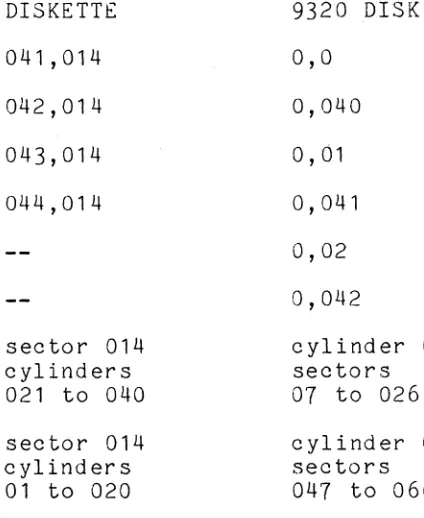
recognized 9320 disks on-line (spinning) by the message, "DOS LOGICAL DRIVES 0 THRU 11 ARE ON 9320 DISKS, 12 THRU 15 ARE ON DISKETTES" after the DOS sign-on. This reflects the difference in logical drive mapping with 9320 disks.
The diskette controller numbers are 1 and 2, as with no 9320 disks,
but the logical drive numbers are mapped differently by DOS.H. Logical
drives on controller 1 are, ,from right to left, drive 12 and drive 13. Logical drives on controller 2, if present, are, from right to left, drive 14 and drive 15.
The first 9320 disk controller electrically in-line to the
processor is controller 8, with logical drives 0-3. The second
controller is controller 9, with logical drives 4-7. The third is
controller 10, with logical drives 8-11. The fourth controller, which
This logical mapping of diskette and 9320 drives can be changed (e.g., to delete diskette controllers 1 and 2, and add 9320 controller 11) via the DOS utility REMAP.
2.2.3 Care and Handling of Cartridge Disks
Size and shape of the cartridge make it convenient to handle and store. Since the disk surface is entirely enclosed, there is maximum protection from abrasion and contaminants, and the rigid case can be
positioned book-style on a shelf when not in use. Alternatively, the
hook-shaped corner can suspend the cartridge on a horizontal rod for storage.
It is strongly recommended that a cartridge be kept in the drive at all times, even when the drive is off, to protect the heads from
airborne contaminants.
2.2.4 Preparing Cartridge Disks for Use
When the cartridge disk is received from the manufacturer,
formatting information is already recorded across all boundaries on the surface. This information is provided to allow the controller to
identify where a given sector is located on the surface of the disk, and also allows the controller to verify proper head positioning in the
drive mechanism. Normal reading and writing on the disk does not destroy the formatting information.
Only disks in the 9320 format are usable in the system. cannot be put into use until they have been initialized using command program described in a later section of this manual. cartridge disk requires the generation of basic system tables can be used with DOS.H.
Disks
CHAPTER 3. EQUIPMENT CARE
Computers, disk drives, printers, and other data processing
equipment are delicate devices that must be operated correctly, and then handled with some degree of care to perform properly.
3.1 Environment
Datapoint systems must be installed in an area with adequate air conditioning. The Datapoint 1500 and its associated peripherals require a temperature range of 50 to 105 degrees Fahrenheit (10 to 40.5 degrees Centigrade). Humidity must be kept low enough to avoid moisture condensation (below 80%), but high enough to avoid excessive static
electricity problems (above 10%).
The machine area must be reasonably clean and dust-free. While excessive cleanliness is not necessary, accumulations of dust and
cigarette ashes can seriously affect machine operation. Spilled liquids are also hazardous.
Processors and peripherals require "clean" power to avoid erratic operation. Machine room power should be supplied from a completely separate transformer when possible. Ensure that devices such as adding machines and power tools are not connected to the same power leads that are used for computer equipment. Electric motors in these devices cause severe power line noise that may interfere with machine operation.
Isolation transformers to insure a supply of clean power for Datapoint equipment should be used when necessary.
3.2 Processor
The only user-maintenance on the processor is an occasional dusting and cleaning of the cabinet, CRT screen, and keyboard.
3.3 Disks and Disk Drives
Ensure that all operators know how to insert and remove diskettes and disk cartridges in the drives. Diskettes and disk cartridges must be stored properly in an environment similar to that provided for the equipment. Refer to the chapter, "Fundamentals of DOS.H," for details on disk handling. Other publications carrying this information are the Guide to Operating Datapoint Equipment and the
Datapoint Product Specifications (green sheets).
The drives must not be subjected to bumps or jolts; this can cause head misalignment. Physical location of the drives must allow adequate air circulation for cooling purposes.
3.4 System Printer
The printer should be dusted occasionally in keeping with the
CHAPTER 4. SYSTEM GENERATION
Before a disk can be used with DOS it must first be prepared by writing onto it basic system tables. Also, a surface verification must be performed so any bad areas of the disk surface will not be used. On a new installation, the system utility programs must be placed onto the disk for use. All these operations constitute system generation. With DOS.H there are two methods of system generation. The method used depends on the condition of the disk being prepared. If the disk is a new one, the method to be used is termed initial generation. This
procedure writes the basic system tables and the directory onto the disk for the first time. If the disk has previously been in use, its tables and directory may require updating in order to accomodate a new reV1Slon of the Disk Operating System. The method is then called an upgrade.
4.1 Initial Generation
Datapoint distributes the Disk Operating System (DOS.H) and utilities on a single diskette. This diskette contains all programs necessary for generation of further system disks. In the chapter titled "Fundamentals of DOS.H," under the section, 'Preparing the Disks for Use,' there is general information about system generation. Specific procedures are found in the chapter describing the DOSGEN command.
4.1.1 Initial Loading
Initial loading of DOS.H, as described here, is known as 'hard booting.'
To load DOS.H into the 1500 processor, the diskette should be inserted into the right hand drive of diskette controller 1. The
RESTART and INT keys are then depressed simultaneously to initiate the loading of the DOS. To load the DOS from any of the other diskette
drives, the DSP key is depressed to increment the diskette drive number that is being searched for a diskette. Note that the first on-line
diskette found (starting with the right-hand drive of controller 1) will be the diskette that is loaded. Whichever of these drives loads the
system is then recognized by DOS.H as the booted drive.
designation differently in a normal system load. As above, the system is loaded from the diskette, but the booted drive will be the first on-line 9320 drive found. (Remember, with 9320 disks spinning, the diskettes are mapped as logical drives 12-15.) To inhibit the 9320 drive from becoming the booted drive, the F5 and F4 keys are held down during system loading until a click is heard. In this way, the diskette drive that the DOS was loaded from will be recognized as the booted
drive. This is useful for DOSGENing 9320 disks, or using UPGRADE/H.
The booted drive designation is valid until the next hard boot, or until the DOS utility BOOT is invoked to change the booted drive. The utility REMAP can also be used to change the booted drive.
In,most cases, the booted drive must be kept physically on-line at all times, since DOS.H searches it first when encountering a
non-specific drive command. DOS.H also sometimes places work files on the booted drive.
4.2 UPGRADE/H
An upgrade facility is available to accomodate upgrading
existing diskette systems and diskette/cartridge disk systems. The program is a standard text file called UPGRADE/H (where H is the letter specification of the DOS in use). It is used as a chain procedure by the command:
CHAIN UPGRADE/H;IN=<input drive>,OUT=<output drive>
This command upgrades the tables and directory in drive OUT from the diskette in drive IN.
Disk files are then copied with the COPY utility. Since SYSTEM7/SYS contains the sUbdirectory information, the new disk will have the same sUbdirectory information as the old one. After the system files are copied, the new utility files are copied to replace any old utilities on the output diskette. The program PUTIPL (described in a later chapter) is then run to place the necessary initial program loader (IPL) blocks on drive OUT.
Since UPGRADE is a text file, it can be edited to modify the chain procedure that is used. This allows adjustment to special needs. Care should be exercised, however; any modification performed should be very carefully considered to assure a good upgrade. System conversions are a complex process and errors made at this juncture can result in an
4.3 Scratch Disk Generation
Any diskett~ or disk cartridge that is to be used in a DOS
system must first be prepared by writing onto it the necessary system
tables and basic system files. Scratch disks or new system disks must
CHAPTER 5. DISK FILES
On all DOS-supported diskettes and cartridge disks,
information is stored in sectors, each of which contains 256 bytes of information. Sectors containing related information are organized in a single structured group called a file. All information on a diskette and cartridge disk will generally be organized in files, except for certain system tables.
5.1 File Names
When calling up or creating a file from the console keyboard,
the file is usually identified by a three-part designation consisting of a name, an extension, and a logical drive number. The first part of the name is the unique identifier. It consists of up to eight alphanumeric characters--none of the special characters are, however, allowed in a file name. Typical file names might be:
EDIT EMPLOYEE 23NOV79
PAYROLL 5500 X1
The second part of the name, the extension, identifies the type of file. This may be from one to three alphanumeric characters. If an extension is used in a file name, it is separated from the name by a slash (I). The extension further identifies the file and usually indicates the type of information contained in the file. A "TXT"
extension means text, and usually implies data. "CMD" implies an object code file to be used as a command program from the system console.
Other common extensions are lSI, DBC, OVn, SYS, PRT, and REL.
chapter.
The complete form of the name is thus:
NAME/EXTENSION:DRIVE
All three parts of the file name usually are not needed when a file name is entered as part of a command, though they can be specified. The
presence or absence of any part of a file name is determined by the special separators
"I"
and ":"~. Syntactically correct file 'names are:IABS:DR1 ITXT
NAME/ABS:DRO NAME/REL NAME:DO NAME
:DO
NAME:DOSH1
If a portion of the file name is not used, DOS and various of the
utility programs apply default values. The default value depends on the location of the name on the command line, and on the command in use.
The first field on any command line is the command program to be run. For this field, a name must be given. If no extension is given, the default is then CMD, and the default drive is any drive. (An "any drive" default usually means a search of all drives, starting with drive
zero.) If the command name is preceded by an asterisk (*), or a colon (:), the default extension and all-drive search do not apply; the
leading character indicates that the given name is to be located as a member of the UTILITY/SYS (an "absolute library") before it is searched for as a file. Thus, if the program is not found in UTILITY/SYS, the Command Interpreter attempts to load a command file by that name.
The default values for file names given as parameters to a command are described separately for each command in the chapters following.
5.2 File Creation
Files are always created implicitly. never specifically instructs ~he system to command that writes to an output file will or will automatically create a new file if
That is, the operator create a given file. Any write into an existing file necessary.
which has free space. The search for available space starts on drive zero. "Available space" means one free space in the drive's directory, in which to place the name of the new file, and at least one cluster of free space on the disk, in which to place the data the file will
contain. A "cluster" is the smallest unit of disk space that can be assigned to a file; clusters are defined in the chapter on System Structure.
5.3 File Deletion
Deletion of a file is always performed explicitly by operator command. The deletion command, KILL, is described in a later chapter. No other standard DOS command programs delete an existing file, although overwriting procedures such as system generation and BACKUP naturally destroy all files on the output disk.
5.4 File Protection
DOS files can be given three types of protection: write protection, delete protection, and no protection. If a file is
write-protected, it cannot be written into, deleted, or renamed. If a
file is delete-protected, it cannot be deleted, although it may be
overwritten, thereby effectively destroying any data perviously written into it. If a file has no protection, it may, of course, be modified in
any manner. The CHANGE command, described later, is used to set the
CHAPTER 6. OPERATOR COMMANDS
All Datapoint computers include, as a standard feature, an
integral CRT display through which the internal computer communicates
with the operator. The system console also includes a typewriter-style
keyboard which the operator uses to communicate with the computer. The
Disk Operating System is normally controlled by commands entered at this system console.
When DOS first becomes ready for commands, it displays a signon message on the CRT and says "READY". Upon completion of any job the DOS generally again displays "READY". Whenever the ready message is shown, the operator may key in a command, and this will be displayed on the bottom line of the CRT as it is keyed in. While typing a command, the BACKSPACE key will erase one character to make corrections, and the CANCEL key will erase the entire line.
6.1 Command Line
The command line is a directive that generally consists of from one to three parts, specifying first the job that is to be performed; second, the name of the disk file to be operated one, or
special system directives; and third, any options for the job. The
command programs provided with DOS are described in the following
chapters. All information that must be entered for each command is
specified in detail. A command line is always terminated by the ENTER
key.
In general, a command line is entered as:
<field> <field>,<field>,<field>;[options]
The first <field> on the line always specifies the program to be run. Fields following the program name indicate a DOS file name and possibly
a special file such as a subdirectory name. Separators between the
fields, usually the space and the comma, must be given special
attention. For readability, the first two fields are most often
separated by a space; subsequent fields are separated by a comma. A
command usually appears as:
SORT ACCTFILE,SRTFILE,:DR1;2-11
It is separated from the second field by a space. Subsequent fields, "ACCTFILE", "SRTFILE", and "DR1", are separated by commas. The fields following the program name, SORT, provide additional information to the SORT program. [Options] following the <fields> are always separated from the preceding field by a semicolon. In the above exmple, "2-11" is the option. The colon (:) within the fourth field ":DR1" is a special separator used within a file name. The slash (/) is also used in this way, as shown in the preceding chapter, "Disk Files."
Aside from the separators noted above, most special characters (0,
$,
%,
&, @, and other characters which are neither alpha nor numeric)act as separators in the same way as the space and the comma. In
general, any character that is not a syntactically valid part of a file name is interpreted as a field separator. The command example above could have been entered as:
SORT@ACCTFILE=SRTFILE$:DR1;2-11
The use of special characters is not recommended, however, since the resulting command line is confusing and difficult to interpret.
As already noted, the first field on the command line specifies the program to be executed. For any command, this first field must be
given. Any other fields mayor may not be needed for a particular command. The command program must be a loadable object file, loading above the resident operating system, or the program load will fail and the DOS will return to "READY" condition. If program specified to be run cannot be found, the the DOS displays the message "WHAT?" and waits for another command. When the program name specification is preceded by an asterisk (*), the UTILITY/SYS file will be searched for the command. If it is not found there, the Command Interpreter then looks for a
separate command file.
6.1.1 Order-Dependency in the Command Line
Fields on the command line are often order-dependent. If a
command is being used which accepts several fields and one of the fields is not wanted, skip that field by entering two separators with nothing between them. Such a command would look like:
SORT ACCTFILE,,:DR1;2-11
6.2 General Command Characteristics
Some features of the commands suplied with the Disk Operating
System apply to most of the DOS commands. These characteristics and the messages that can appear following them are discussed briefly.
6.2.1 General Command Format
When the command line is discussed, the first field is called the "command;" subsequent fields before the semicolon are called
<filespec>; characters following the semicolon are called "options" or "parameters." The general format of the command line is:
Command [<filespec>][,<filespec>][,<filespec>] .•. [joptions]
The item referred to as "Command" is required on a command line. This first field defines the command being issued to the system.
The items referred to as "<filespec>" represent one or more specifications for files. These files generally are input, output,
scratch, or other files to be used by the command program. Usually, the first such specification represents input files(s); the following
specifications represent output or scratch file(s).
A square bracket is used here to indicate fields whose presence is optional. The pointed bracket convention (as in <filespec» represents replacement fields where the replacement field name is contained within the pointed brckets. The brackets are used here as text cues only and are not keyed in on the command line.
6.3 Signon Messages
When a system command is entered, the command program being
6.4 Common Error Messages
There are basically three types of error messages that may be displayed. The error messages common to many of the DOS utilities are listed here, the DOS error messages are listed in Chapter 43, and hardware error messages are listed in Chapter 44.
INVALID DRIVE
This message appears when one of the drive specifications given by the operator is invalid. Either the drive specification was not of the correct format, or the drive number specified exceeds the range available under the resident Disk Operating System. The other
possibility is that a <volid> was specified, and the proper disk was not on any online drive.
NAME IN USE
This message generally occurs when the command's continued execution would necessarily result in a conflict of the specified file name with an already existing file.
NAME REQUIRED
This message indicates that a file specified on the command line could not be found. Generally the name as specified is misspelled or
otherwise incorrectly entered. However, the message will sometimes occur because the file desired is not in the current subdirectly. (A sUbdirectory is described later in the SUR command.)
NO! THAT FILE IS PROTECTED
This message indicates that a request was made to modify a file having write or delete protection.
WHAT?
This message means that the command name (the first item on the command line) is illegal. Most often, the command specified is not valid, or is not in the current subdirectory or the SYSTEM directory.
WRONG DOS!!
CHAPTER
7.
ABTONOFF COMMAND7.1 Purpose
Within the DOS, there is a flag which is set by several of the utilities under certain conditions. This is the ABTIF bit, which may be tested with the IIABTIF operator in a CHAIN (see the CHAIN command). If the flag is on, the chain will abort when tested by IIABTIF; otherwise it will continue. The ABTONOFF command is a means of insuring the setting of this flag. The format of the command line is as follows:
ABTONOFF [<parameter>]
CHAPTER 8. APP COMMAND
8.1 Purpose
The APP command appends two object files ~0gether creating a
third. Object files are files containing absolute object code in
a format that can be loaded by the DOS loader.
8.2 Use
APP <file spec>,[<file spec>],<file spec>
The APP command appends the second object file after the
first and puts the result into the third file. Note that neither
of the input files are disturbed. If extensions are not supplied,
ABS is assumed. The first two files (if a second is specified) must exist. If the third file does not already exist, it will be
created. The first file's transfer address, if present, is
discarded and the new file is terminated by the transfer address of the second file, if one is present. The transfer address of an object file is defined as the entry point of the program contained in the file.
Omitting the second file specification causes the first file to be copied into the third file. For example:
APP DOG"CAT
will copy the fil& DOG/ABS into the file CAT/ABS.
The first and third file specifications are required. If
either is omitted, the message
NAME REQUIRED
will be displayed. The second and third file specifications must
not be the same. If they are, the message
FILES TWO AND THREE MUST BE DIFFERENT
will be displayed. If a non-object record is encountered, the
FILE X CONTAINS A NON-OBJECT RECORD
will be displayed with the value of X being 1 or 2 to correspond with the position of the file specification on the command line.
Because the APP command recognizes the actual end of the
object module contained in a file, APPing an object file, similiar to the example above, is one technique for releasing excessive unused space at the end of an object file. However, it should be noted that the APP command cannot be used to append overlay
library files. If this is attempted, the message
YOU CANNOT APPEND OVERLAY LIBRARIES
will be displayed. If the third file specified is write protected, the message
FILE THREE WRITE PROTECTED.
will be displayed
Another use of the APP command is to append patches to object files, since the object file being APPed may load at the same
CHAPTER 9. AUTO COMMAND
AUTO - Set Auto Execution
AUTO <file spec>
The AUTO command establishes the indicated program to be
automatically executed upon the loading of DOS. If no extension
is supplied, ABS is assumed. The message
AUTO NOW SET TO NAME/EXTENSION (PFN).
will be displayed when the named file is set for auto execution. A check is made to see if the file is an object file and if the file is on the booted drive. If the specified file does not exist, the message
NO SUCH NAME
will be displayed. Note that if a program has been set to
auto-execute, its execution can be inhibited by depression of the keyboard (KBD) key when DOS is loaded. Any attempt to auto a file not on the booted drive will cause the message
YOU CAN'T AUTO THAT FILE!
to be displayed. If there was already a file set for auto-execution, the message:
AUTO WAS SET TO NAME/EXTENSION (PFN).
will be displayed ~efore the new auto-execution setting has been
made.
If no <file spec> is entered on the command line, no change
in the current auto-execute program will be made. If no program
was set for auto-execution the message:
NAME REQUIRED
will be displayed.
Note that the AUTO command does not make provIsIon for file specifications to be given to the program which is to be
programs requiring or ac~epting such parameters. AUTO also does not place anything in the DOS communications region (MCR$).
Therefore, programs which use overlays with the same name (but different extension) as the program will not run. For more
information, refer to the chapter describing the AUTOKEY command.
Auto-execution mode is cleared with the MANUAL command, described in a later chapter.
Programs contained in absolute libraries (UTILITY/SYS for example) cannot generally be "AUTO'd" directly. Use the AUTOKEY command described below, then "AUTO AUTOKEY/CMD". If an absolute library is specified for auto-execution, the first member of that library will be the program executed. System files cannot be
CHAPTER 10. AUTOKEY COMMAND
10.1 Introduction to AUTOKEY
Many users allow their Datapoint computers to run in an
unattended mode. This allows large data processing tasks, perhaps
running via the DOS command chaining facility (see CHAIN), to be
run during the evening hours when no operator is present. (An
example might be the creation of several new index files for one
or more large, ISAM-accessed data bases). However, the momentary
power failures which data processing users are being forced to contend with during times of shortage, thunderstorms and the like can bring down any computer not having special, un interruptible
power supplies. When this happens to a computer running in
unattended mode, the office staff will generally return the' next morning to find their computer sitting idle and its work
unfinished.
The Datapoint computers are all equipped with an
automatic-restart facility which can be used to cause them to automatically resume their processing tasks following such an
interruption. The purpose of the AUTOKEY (and AUTO) commands is
to provide a software mechanism for users who wish to handle such
unusua~ circumstances and provide for the restarting of a processing task.
10.2 The Auto-Restart Facility
The 1500 is provided with firmware auto-restart. Thus if the
machine ever halts, for example due to a power failure, on being started again, it will attempt to load the operating system.
10.3 Automatic Program Execution Using AUTO
In order to provide a mechanism for programs to resume
automatically following an interruption (such as a DATABUS system, for instance, which might be running unattended) DOS has a
comparable facility to enable a program to be automatiQally
executed whenever DOS comes up. (Note that any loading and
running of the DOS, whether by an auto-restart, manually
this facility).
The AUTO command is used to establish a program to receive control when DOS comes up. This setting can be cleared with the
MANUAL command. For some applications, the AUTO and MANUAL
commands are adequate to allow a programmed restart of a lengthy
data processing task. However, some programs require parameters
be specified on the command line, and these are obviously not present if no command line has been provided.
10.4 Auto-Restart Facilities Using AUTOKEY
AUTOKEY is simply a command program which can be AUTO'd. The
way it works is very simple. If it is run via the DOS
auto-restart facility, AUTOKEY supplies a command line just as if
the same one line were entered at the system console. If ~UTOKEY
is run from the system console (or likewise from an active CHAIN), it simply displays the command line it is currently configured to supply and offers the user the option of changing that stored command line.
The command line supplied to AUTOKEY could do anything
specifiable in one command line to the DOS; DATABUS could be
brought up, a SORT invoked, a user's own special restart program started or even a CHAIN begun. AUTOKEY, when used with AUTO, MANUAL, and CHAIN can therefore provide a very powerful facility.
10.5 A Simple Example
To specify a command line to be used during automatic system restart, simply enter:
AUTOKEY
at the system console. AUTOKEY will display a signon message and
display the current autokey line if there is one. It then asks if this line is to be changed. If "N" is answered, AUTOKEY simply returns to the DOS and the DOS "READY" message is displayed. If "Y" is answered, AUTOKEY requests the new command line to be configured and then returns to the DOS and "READY".