Journal of Theoretical and Applied Information Technology 20th February 2013. Vol. 48 No.2
© 2005 - 2013 JATIT & LLS. All rights reserved.
ISSN: 1992-8645 www.jatit.org E-ISSN: 1817-3195
STABILITY ANALYSIS OF NON-LINEAR STOCHASTIC
DYNAMIC SYSTEM BASED ON NUMERICAL SIMULATION
XIAOHONG LI
School of Science, Qiqihar University, Qiqihar 161006, Heilongjiang, China
ABSTRACT
The stability of nonlinear stochastic dynamical system is a theoretically prominent problem, as it is of great theoretical and practical significance to many projects in reality. Firstly, the author established the basic formula. Secondly, he researches the stability theory of non-linear stochastic dynamical system, and discusses the stability criterion of null solution stability and nonlinear stochastic dynamic system. Finally, he conducts numerical simulation analysis for kinetics response and stability status of engineer structures under seismic conditions. The simulation results provides theoretical basis for the promotion of earthquake resistance of engineer structures.
Keywords: Numerical Simulation, Nonlinear Stochastic Dynamics Simulation,Stability
1. INTRODUCTION
At present, the application of nonlinear dynamical system theory in the fields of mathematics, physics, mechanics, and economics has become hot spot in focus. Therefore, it is necessary to get to know the internal mechanism of power system nonlinear phenomena in order to conduct theoretical analysis and numerical analysis. But many problems remain to be solved due to the complicity of non-linear systems[1]. At present, researchers put much emphasis on phenomenon of definite systems. In fact, it is unavoidable that most systems are subject to the interference of stochastic noises, and definite system is idealized system, thus stochastic systems could reveal the natural laws in a more deepgoing and truer way[2]. Many researches prove that noise could determine the evolution of system due to the interactions in between, which probably totally destroy system structures, or engender the system in order instead. Therefore, it is necessary to get profound understanding of the
internal mechanism of nonlinear stochastic
phenomena and movement patterns, so as to lead it to a favorable direction. It is a research of great scientific significance and practical guidance value[3].
The existing stochastic systems can be classified to three categories: system with stochastic
stimulation, system with stochastic initial
conditions, and system with stochastic physical parameters[4]. In reality, there exists many uncertainties in installation, measuring, material and production sectors, which could be described
by stochastic variables with some statistical properties, so the number of the third category is the largest. Due to the increasing demand for precision and accuracy of actual model, stochastic system, especially those with stochastic parameters have been applied more widely to describe the dynamic relationship between various objects[5].
2. BASIC EQUATION OF NONLINEAR STOCHASTIC DYNAMIC SYSTEM
The dynamics model with multiple freedom
degree could be expressed as follows[7]:
)
(
)
(
X
F
t
f
X
C
X
M
r
r
&
r
r
&
&r
r
=
+
+
(1)Where
M
r
is mass matrix;
C
r
means damping
matrix,
f
(
⋅
)
indicates recuperability function;X
&r
&
represents acceleration;X
&
r
is speed;
X
r
is
displacement;
F
(t
)
r
is exciting force vector, and
)
(t
F
r
signifies random vector.
Set
F
(
t
)
M
I
x
&
&
g(
t
)
r
r
r
−
=
, nonlinear stochastic system model can be expressed as follows:
M
X
C
X
f
(
X
)
M
I
x
g(
t
)
&
&
r
r
r
&
r
r
&
&r
r
−
=
+
+
(2) Where TI
[
1
,
1
,
L
,
1
]
r
=
,x
&
&
g(t
)
represents theacceleration of the excitation force.
Set T T T
X
X
Y
(
&
,
)
r
=
, the state equation ofnonlinear stochastic dynamic systems can be
converted to the following form[8]:
)
(
)
,
(
Y
t
B
F
t
A
Y
r
r
r
r
&
r
+
=
(3)Where
−
−
=
− −X
X
f
M
X
C
M
t
Y
A
r
&
r
r
&
r
r
r
r
r
)
(
)
,
(
1 1 ,
=
−0
1M
B
r
r
。Set
Y
i=
X
2i−1,
f
2i−1=
X
2i−1, ij ija
g
2,=
,
0
, 1 2i− j=
g
, the mathematical model of
nonlinear stochastic system can be expressed as follows:
)
(
)
(
)
(
X
g
X
A
t
f
X
dt
d
j ij i ir
r
+
=
(4)Where
X
i represents the component of statevector;
g
ij( X
)
r
signifies Markov process vector,
)
,
(
X
t
p
r
is the corresponding probability density
function. The control equation of
p
(
X
,
t
)
r
can be expressed as follows:
0
)]
(
),
(
[
2
1
)]
(
),
(
[
2=
∂
∂
∂
−
∂
∂
X
p
X
g
xj
xi
X
p
X
f
x
i j ijr
r
r
r
(5)
The probability density function
p
(
X
,
t
)
r
is subject to the following equation:
0
)
,
(
)
(
lim
=
±∞→
f
jX
p
X
t
Xi
r
r
(6)0
)]
,
(
)
(
[
lim
=
∂
∂
±∞ → i ij Xx
t
X
p
X
G
ir
r
(7)3. STABILITY THEORY OF NONLINEAR
STOCHASTIC DYNAMIC SYSTEM
3.1 Null Solution Stability
Definition 1: set
q
>
0
,∀
X
0∈
[
0
,
1
]
,X
0 is arandom variable,
X
(
t
,
X
0)
is the solution ofequation (5). If there exists negative
q
momentindex, the expected null solution
q
moment index of equation (5) is stable; on the contrary, nullsolution
q
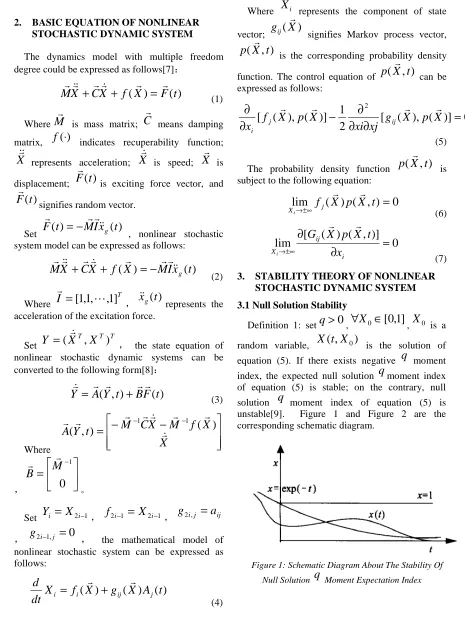
moment index of equation (5) is [image:2.612.76.541.97.741.2]unstable[9]. Figure 1 and Figure 2 are the corresponding schematic diagram.
Figure 1: Schematic Diagram About The Stability Of
Figure 2: Schematic Diagrams About The Instability
Of Null Solution
q
Moment Expectation IndexIf
X
0 is a random number, figure 1 shows thatif
t
→
∞
, the absolute expectation moment indexq
X
t
X
E
(
,
0)
of
X
(
t
,
X
0)
would decrease tozero. Figure 2 shows that if
t
→
∞
, the absoluteexpectation moment index
q
X
t
X
E
(
,
0)
of)
,
(
t
X
0X
would increase to infinity.
3.2 Stability Criterion
Lemma: for nonlinear stochastic dynamical
systems [10] :
)
(
))
(
,
(
))
(
,
(
)
,
(
0t
B
t
X
t
G
t
X
t
F
dt
X
t
dX
+
=
,
X
(
t
0)
=
X
0 (8)Solution of the equation (8) is defined
as
X
(
t
)
=
X
(
t
,
X
0)
. Assume the followingformula is true:
q q
x
d
X
t
V
x
d
1≤
(
,
)
≤
2(9)
Where
d
1andd
2are constants and greater thanzero.
V
( X
t
,
)
is a smooth function;(a) If there exists a normal number
λ
which issubject to the following
formula:
LV
(
t
,
X
)
≤
−
λ
V
(
t
,
X
)
. then the following inequality[11] is true:t q q
e
x
c
c
X
t
x
E
<
0 −λ1 2 0
)
,
(
(10)
(b) If there exists a normal number
λ
which issubject to the following
formula:
LV
(
t
,
X
)
≥
λ
V
(
t
,
X
)
. then the following inequality[5] is true:t q q
e
x
c
c
X
t
x
E
0 λ2 1 0
)
,
(
≥
(11) Where
) , ( ) , ( 2 1 ) , ( ) , ( ) , ( ) ,
(t X V t X V t X F t X G2 t X V t X
LV = t + x + xx
4. SIMULATION ANALYSES ABOUT THE
STABILITY OF NONLINEAR STOCHASTIC DYNAMIC SYSTEM
Take engineering structures earthquake for
instance,
F
(t
)
r
represents seismic excitation. The deformation of engineering structures is a point of focus. Programming simulation programs with MATLAB software, the corresponding simulation results are as follows:
4.1 The Dynamic Response of Engineering Structures Under Seismic Conditions
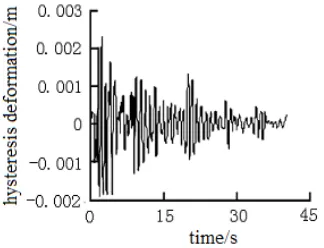
Figure 3 and 4 show the dynamics simulation results of engineering structures under seismic excitation. Figure 3 is the response result of engineering structure deformation under seismic excitation, which changes dramatically at initial stage and then stabilizes gradually. Figure 4 is the response result of engineering structure hysteresis deformation under seismic excitation, which changes dramatically at initial stage and then stabilizes gradually.
Figure 4: Response Curve Of Engineering Structure Hysteresis Deformation
4.2 Stability analysis
Stability simulation of nonlinear stochastic dynamic systems is shown in figure 5, from which we could notice that engineering structures are unstable under seismic conditions, and they are stable for long at no time. Therefore, it is required to reinforce the structure, in order to improve the seismic capacity of structures and improve the stability of structures.
Figure 5: Simulation Curve About The Stability Of Engineering Structures
5. CONCLUSION
In this paper, the author conducts systematic research on the stability of nonlinear stochastic dynamical systems. He analyses the mathematical models of nonlinear stochastic dynamical systems and stability theorem and criterion. Moreover, the author conducts numerical simulation on the engineering structures under seismic conditions. The results reveal the stability degree of structures, which provides valid theoretical basis for the improvement of seismic capacity and ensures the
safety and stability of engineering structures. Therefore, it is very promising in practices.
REFERENCES:
[1] Chen Jianbing, Li Jie, “overall sensitivity analysis of structure stochastic nonlinear response”, JCM: Journal of computational mechanics, Vol. 25, No. 2, 2008, pp. 169 ~176. [2] Xu Yong, Ma Shaojuan, Zhang Huiqing,
“Stability analysis of Stochastic Brusselator system with random parameters”, CS: Chinese Science: Physics, Mechanics, Astronomy, Vol. 42, No. 10, 2011, pp. 1203 ~1209.
[3] Wang Wenjie, Xu Wei, “Four moment center CN implicit difference decomposition of stochastic external excitation nonlinear system FPK equation”, JDC: Journal of dynamics and control, Vol. 9, No. 2, 2011, pp. 139-142 [4] E Guokang, Yao Weibin, “Subspace method to
obtain the probability density function solution of large-scale nonlinear stochastic dynamic system”, JSM: Journal of solid mechanics, Vol. 31, No. 12, 2010, pp. 164-170
[5] Jiang Guo, "Towards Automatic Analysis of
Software Requirement Stability", AISS:
Advances in Information Sciences and Service Sciences, Vol. 2, No. 4, 2010, pp. 33 ~ 42 [6] Qi Lian, Suling Jia, "Research on Two-stage
Supply Chain Ordering Strategy Optimization Based on System Dynamics", AISS: Advances in Information Sciences and Service Sciences, Vol. 4, No. 23, 2012, pp. 16 ~ 24
[7] Yan Hai , Hui Wang, "Research on QoS based
Dynamic Web Service Systems", AISS:
Advances in Information Sciences and Service Sciences, Vol. 4, No. 23, 2012, pp. 625 ~ 633 [8] Hejun Yao, Zheng Yuan, "Exponential Stability
Control for T-S fuzzy Nonlinear Stochastic
Networked Control Systems", IJACT:
International Journal of Advancements in Computing Technology , Vol. 4, No. 3, 2012, pp. 205 ~ 214
[image:4.612.114.306.382.547.2][10] Hejun Yao, Zheng Yuan, Yujie Si, "Exponentially Mean-square Stable Control for Uncertain Discrete Networked Control Systems with Stochastic Time Delay and Packet Dropout", AISS: Advances in Information Sciences and Service Sciences, Vol. 3, No. 11, 2011, pp. 405 ~ 412