© 2016, IRJET | Impact Factor value: 4.45 | ISO 9001:2008 Certified Journal | Page 1025
Video Watermarking using YCbCr and RLE
Gagandeep Singh Bhatia
1, Kamaljit Kaur
2 1M. Tech Student, CSE Department
2Assistant Professor, CSE Department
1,2
Sri Guru Granth Sahib World University, Fatehgarh Sahib, India
---Abstract –
Nowadays, digital data is easily tampered. Therefore the need of digital data protection has been increased with the advancement in the technology. Watermarking is a technique used to protect the digital data. Embedding watermark in a video is what called as video watermarking. Digital video watermarking is a technique by using which user can get the copyright of its product which prevents the data from tampering. Many techniques are available for video watermarking like Discrete Wavelet Transform, DCT etc. All these technique have some pros and cons. DWT has higher complexity and computation time is also high. DWT fails to represent the image effectively. The proposed technique uses the combination of two techniques RLE and YCbCr which is better than DWT. It proves its efficiency after simulating in MATLAB as compare to other techniques.Key Words: Watermarking, LSB (Least Significant Bit), Discrete Cosine Transform, DWT, Rayleigh Length Encoding, YCbCr
1.
INTRODUCTION
A watermark is an distinguishing image or pattern in paper that seems as numerous reminder light weightiness/darkness once viewed by transmitted light-weight (or once viewed by mirrored light, atop a dark background), caused by thickness or density variations within the paper. Watermarks are used on postage stamps, currency, and alternative government documents to discourage counterfeiting. There is a unit 2 main ways that of manufacturing watermarks in paper; the dandy roll method, and therefore the additional advanced cylinder mould method [1].
A watermark is incredibly helpful within the examination of paper as a result of it will be used for qualitative analysis, distinguishing sizes, mill logos and locations, and decisive the standard of a sheet of paper. Secret writing associate degree distinguishing code into digitized music, video, image or different file is thought as a digital watermark [15].
Watermark in a video is embedded by extracting a frame from it and then applying certain techniques. That extracted frame is again added to the video and a final watermarked video is obtained at the end. The need of
proposing new technique for video watermarking is to improve the quality and security of watermarked video.
Video watermarking is the process of embedding watermark in a video by extracting the frame of a video. A frame of the video is selected by some technique and then the watermark is hidden in that frame. The main aspects that are to be kept in mind while watermarking are capacity, security & robustness. The watermarking should be done in such a way so that the quality of the video do not degrades. The techniques of video watermarking that are developed till date like DWT, DCT & DFT had certain disadvantages so need to design new technique was felt. DCT had drawback that it degrades the video quality by increasing the visibility of the embedded watermark.
1.1 Applications of Digital Watermark
Digital watermarking has large number of applications in order to provide security to the videos from data tampering. Some of the applications of video watermarking is as follows:
Copyright protection,
Source tracking (different recipients get differently watermarked content),
Broadcast monitoring (television news often contains watermarked video from international agencies), Video authentications.
2. TECHNIQUES FOR VIDEO WATERMARKING
There are many techniques available for embedding watermarks in a video. Some techniques for video watermarking are explained as follows:
2.1 DWT Transform
© 2016, IRJET | Impact Factor value: 4.45 | ISO 9001:2008 Certified Journal | Page 1026 into four parts for converting the image into low resolution
image. The process is repeated for calculating the multiple scale wavelet decomposition. DWT is more preferable technique for watermarking because it performs computations very accurately. The positive point of this technique is that it is robust to handle the DCT noise in the image [23].
2.2 DCT Transform
DCT stands for Discrete Cosine Transform. The main feature of using this technique is that it provides the good signal approximation by using certain coefficient values. This technique is used by many algorithms for embedding the watermarking on image. The main advantage of this technique is that it is quite fast as compare to other techniques. In this technique the watermark is embedded on the centre frequency bands because of decomposition of the image. This technique is more robust to lossy compressions as compare to others. [20]
2.3 DFT Transform
Discrete Fourier Transform based watermarking technique, the brightness of the watermarked frame is obtained and the magnitude of the coefficients is taken to compute DFT. In this technique inverse DFT is also applied. This method is robust and resistant to various attacks like pixel removal and rotation [7].
3. PROBLEM FORMULATION
The techniques of video watermarking that are developed till date like DWT, DCT & DFT had certain disadvantages so need to design new technique was felt. DCT had drawback that it degrades the video quality by increasing the visibility of the embedded watermark. The disadvantage of DWT is that it fails to represent the image effectively. DWT has higher complexity and computation time is also high. So, a new technique needs to be proposed that can overcome the disadvantages of conventional techniques.
3.1 OBJECTIVES OF PROPOSED METHOD
The main objective of the proposed technique is:
1. To improve the security and quality of the watermarked video.
2. Watermark to be embedded will be first encrypted to improve the security.
3. Some compression technique will be applied to compress and secure the data that will be embedded as watermark.
4. Obtained a high quality video after watermarking using proposed technique.
4.
METHODOLOGY
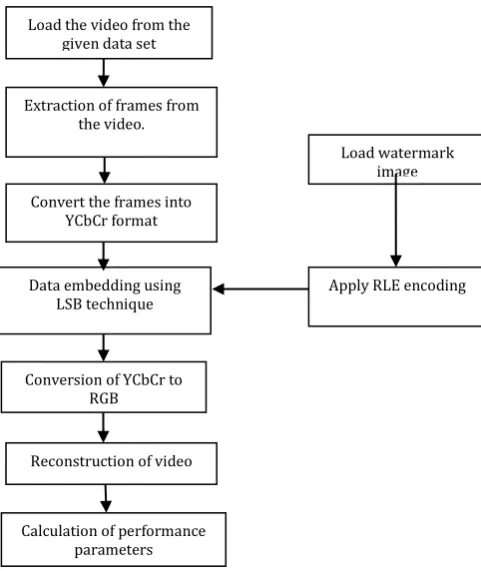
To overcome the disadvantages of the conventional techniques and to increase the data security, the watermark is first encrypted. Techniques like RLE, LZW, can be employed for securing & compressing the data. Encrypting watermark improves the security of the system. Now, more data can be saved as now embedded watermark is in compressed form. This proposed technique will be more secure and robust than the conventional techniques. YCbCr color space conversion is used. The proposed methodology is divided into two sections. One is the embedding of the data into the video and other section is the extraction of data from the video. In this proposed methodology the RLE encoding algorithm is used for the data compression and LSB technique is used for the hiding of data. Methodology of the data embedding process is as follows:
4.1 Embedding of data
1. Initially the video is loaded from the given set of video. In this video the data is hide that is send to the receiver.
2. After selection of the video, next step is to extract the frames of the video. These frames are extracted in order to hide information.
3. Next step after the extraction of frames is the conversion of the extracted frames into YCbCr format.
4. A watermarked image is loaded that is hided in the video, after the selection of the watermarked image, RLE encoding algorithm is applied on it. This algorithm will compress the watermark image.
5. In this step the watermarked image is embedded in the extracted frame of the video by using LSB technique of data hiding.
6. After this the YCbCr to RGB conversion is performed , the image is converted into RGB format and after that it is send and the video is reconstructed and is send to the receiver.
7. Finally the calculations of the performance parameters are done. These parameters will describe the efficiency of the system.
© 2016, IRJET | Impact Factor value: 4.45 | ISO 9001:2008 Certified Journal | Page 1027 Fig 1: Block diagram for embedding data
4.2 Data extraction
1. For the extraction of the data the encrypted video is loaded in which the data is hiding by the sender. 2. After selection of the video, next step is to extract
the frames of the video. These frames are extracted contain the hidden information.
3. Next step after the extraction of frames is the conversion of the extracted frames into YCbCr format.
4. In this step LSB is applied to extract the embedded watermark in the video.
5. After the data is obtained finally the RLE decoding algorithm is applied to obtain the original image that was compressed earlier by using the RLE encoding algorithm.
6. Finally the watermark image is recovered that was send by the user.
[image:3.595.47.288.114.400.2]Following is the block diagram of extracting data after embedding watermarking in video.
Fig 2: Block diagram for data extraction
5. RESULT AND ANALYSIS
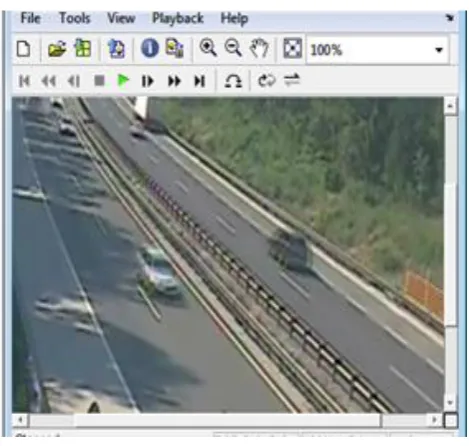
The result of proposed method is tested on the video which is shown in below Fig 3. It shows the original video without any watermark and Fig 4 shows the video after watermarked image into it. Fig 5 shows the watermarked video after embedding of watermarked image into the original video.
Fig 3. Original video Load the encrypted video
Extraction of frames form the video
Data extraction using LSB technique Convert the frames into YCbCr
format
Apply RLE decoding on the data
Final recover image Load the video from the
given data set
Extraction of frames from the video.
Data embedding using LSB technique
Load watermark image Convert the frames into
YCbCr format
Apply RLE encoding
Calculation of performance parameters Conversion of YCbCr to
RGB
[image:3.595.310.538.582.747.2]© 2016, IRJET | Impact Factor value: 4.45 | ISO 9001:2008 Certified Journal | Page 1028 Fig 4. Watermarked Image
Fig 5. Watermarked Video
5.1 PSNR
Peak Signal to Noise Ratio also called as SNR. It is defined as the ratio of power and the noise affecting the signal. Noise is the unwanted signal that degrades the quality of the signal. It is expressed in decibels. The PSNR is the important parameter for determining the quality of the signal. The quality of the output signal is better, if the value of the PSNR is higher signal that means signal is reconstructed well.
PSNR= 10 log10 (peak value) ^2/MSE
Graph representation of Video peak signal to noise ratio (PSNR) is shown below in Fig 3.
[image:4.595.37.277.96.282.2]
Fig 3: Shows the Graph relative to the value of PSNR i.e. Peak Signal Noise ration in video
5.2 MSE
MSE stands for Mean Square Error; it is used for measuring the average of the square of the errors. It is basically the difference between the desired and the estimated value of the error. For evaluating the performances of an predictor, mean squared error is considered to be an important factor
MSE= (mean (actual value-predicted value) ^2)/no of elements
Figure 5. . Shows the value of MSE (Mean Square Error) rate in video. The graph below shows the comparison of traditional and proposed technique with respect to BER (Bit Error Rate). BER is the bit error rate (BER) is the number of bit errors per unit time. The bit error ratio (also BER) is the number of bit errors divided by the total number of transferred bits
during a studied time interval. Graph representation of
[image:4.595.39.274.313.536.2] [image:4.595.308.553.471.639.2]© 2016, IRJET | Impact Factor value: 4.45 | ISO 9001:2008 Certified Journal | Page 1029
Fig 4: The value of Bit Error Rate (BER) in video.
[image:5.595.56.284.93.280.2]The propose RLE and YCbCr hybrid method is compared with traditional DWT method. As results shown below in Table 1, PSNR and Correlation of proposed method is better than the DWT method.
Table 1 Comparison between the traditional and proposed approach
Parameters DWT (old approach)
YCBCR-RLE(proposed
approach )
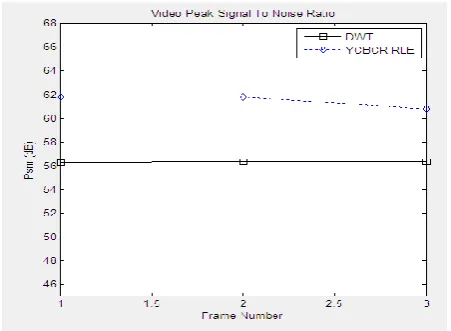
PSNR 56 62
Correlation 0.5906 1
Graph representation of comparison of Video peak signal to noise ratio (PSNR) between DWT and Proposed method is shown below in Fig 5. Results of proposed method are better than DWT method.
[image:5.595.314.547.178.372.2]
Fig 5: The comparison graph of PSNR for proposed and traditional technique.
Graph representaion of comparision of Correlation of video frames between DWT and YCbCr-RLE proposed method. Proposed method outperforms the exixtind DWT method in case of correlation of video frams. Results shown below in Fig 6.
Fig 6: The correlation graph of YCBCR-RLE and DWT
6.CONCLUSIONANDFUTURESCOPE
Watermarking is done to protect the confidential data from unauthorized access. Video watermarking is a process of hiding data in the video frames. The security of the data that is send is the major issue. Traditional may algorithm, have been proposed for the video watermarking but the results achieved were not efficient. So in this proposed work the LSB technique is used for hiding the data, in which data is firstly compressed by using RLE encoding algorithm and the frames of the video are converted into YCbCr format before the data is encrypted. From the results obtained it is concluded that this method is better than the traditional method of the video watermarking, from various parameters it was concluded that the performance of the proposed technique was better than the traditional technique. Also the security of the data is increased using this technique.
In future the work can be done on some other compression technique or by combing the various compression techniques. In addition to this various other data hiding technique can also be used. This will also increase the security of the data that is the major concern.
REFERENCES
[image:5.595.47.274.391.502.2] [image:5.595.52.278.580.745.2]© 2016, IRJET | Impact Factor value: 4.45 | ISO 9001:2008 Certified Journal | Page 1030 [2] A. Agrawal, “Securing Video Data: A Critical Review,”
International Journal of Advanced Research in Computer and Communication Engineering, Vol:3, Issue:5, 2014.
[3] Islam, “A Novel Approach for Image Steganography Using Dynamic Substitution and Secret Key,”American Journal of Engineering Research (AJER) Vol:02, Issue:09, 2013.
[4] P. Mc Kevitt, “Digital image steganography: Survey and analysis of current methods,”Signal processing,Vol:90, Issue:3, pp: 727-752, 2010.
[5] Al-Shatnawi, “A new method in image steganography with improved image quality,” Applied Mathematical Sciences, Vol:6, Issue:79, pp: 3907-3915, 2012.
[6] J. R. Iswarya, “An Overview of Digital Image Steganography,”International Journal of Computer Science & Engineering Survey (IJCSES), Vol:4, Issue:1, pp 23-31,2013.
[7] E. Chang, “A survey of digital image watermarking techniques,” InIndustrial Informatics, 3rd IEEE International Conference, pp: 709-716, Aug 2005. [8] Dong, “Journal of Chemical and Pharmaceutical
Research,”Journal of Chemical and Pharmaceutical Research, pp: 78-89, 2014.
[9] M. Mundher, D. Muhamad, A. Rehman, T. Saba, & F. Kausar, “Digital watermarking for images security using discrete slantlet transform,” Applied Mathematics and Information Sciences, pp: 2823-2830, 2014.
[10] Sharma, “A Hybrid technique of Video Watermarking in Wavelet domain and Scan based Encryption Method” IJIR, 2014.
[11] N. Deshpande, “Robust Dual Watermarking Scheme for Video Derived from Strategy Fusion,” International Journal of Image, Graphics and Signal Processing (IJIGSP), 2014.
[12] Mrs. Rashmi Soni “Digital Watermarking of Wavelet Transforms Based on Coding and Decoding Techniques”, IJCSMC, Vol: 3, Issue 3, pp: 1045 – 1051, March 2014.
[13] Ekta Miglani, “Digital Watermarking Methodologies - A Survey”, IJARCSSE, Vol: 4, Issue 5, pp: 826-832, 2014. [14] Dr. V. Seenivasagam , “A Survey on Video
Watermarking and Its Applications”, IJERA, Vol. 4, Issue 12( Part 6), pp: 39-44, Dec 2014.
[15] Pawan Singh Shekhawat , “Non Blind DWT Based Multiplicative SVD Watermarking Algorithm,” IJSRD, Vol: 3, Issue 03, pp: 1844-1848, 2014.
[16] De Li, “Robust Adaptive Video Watermarking Algorithm based on Dual Transform Domains,”
International Journal of Multimedia and Ubiquitous Engineering Vol.9, No.1, pp.391-402, 2014.
[17] Lianjie Dong, “A blind digital watermarking algorithm based on DWT,” JOCPR, Vol:6, Issue:3, pp: 78-89, 2014. [18] Myasar Mundher , “Digital Watermarking for Images
Security using Discrete Slantlet Transform”, Appl. Math. Inf. Sci. 8, No. 6, 2823-2830, 2014.
[19] Mr. Jagtap. D. V, “A Secure Data Transmission Scheme Based on Digital Watermarking (Image + Text)”, IJARCET, Vol: 3 Issue: 8, pp: 2713-2716, 2014.
[20] Ravikant S. Mendegar, “A Robust Video Watermarking Scheme Using ‘Arnold’, ‘Dwt’ And ‘Svd’ Transformations,” IJOER, Vol:2, Issue:3, pp 1-8, 2014. [21] Kumareshan S, “Estimate the Position of Pirate in
Theatre,” IJARCSMS, Vol: 2, Issue: 11, pp: 121-124, 2013.
[22] S. Sharma “An Enhanced Video Watermarking Approach for Robustness And Security Using Pixel And Transform Domain in An Uncompressed Video,” IJARSET, Vol. 2 Issue 5, pp 41-46.
[23] M. Sharma “A Hybrid technique of Video Watermarking in Wavelet domain and Scan based Encryption Method”, IJEDR, Vol: 2, Issue 3, pp: 3220-3223.
[24] N. Deshpande “Robust Dual Watermarking Scheme for Video Derived from Strategy Fusion”, I.J. Image, Graphics and Signal Processing, Vol:5, pp: 19-27 [25] I. Sivakami, “A digital watermarking system for video
authentication using the DCT,” Integrated Journal of Engineering Research and Technology (IJERT), Vol: 01, pp: 22-33, Jan-Feb 2014.
[26] Li. C, & Fucheng, “The study on digital watermarking based on word document. InMechatronic Sciences, Electric Engineering and Computer (MEC),” Proceedings 2013 International Conference IEEE, pp: 2265-2268, 2013.
[27] A. Agrawal, & V. Singh, “Securing Video Data: A Critical Review,” International Journal of Advanced Research in Computer and Communication Engineering,Vol: 3, Issue: 5,2014.
[28] S. A. Sohag, Islam, M. K, & Islam, M. B. “A Novel Approach for Image Steganography Using Dynamic Substitution and Secret Key.,” American Journal of Engineering Research (AJER) Vol: 02, Issue: 09, 2013. [29] A. Cheddad, J. Condell, K. Curran, & Mc Kevitt, P.