Soundscapes : an urban planning process
map
Adams, MD, Davies, WJ and Bruce, NS
Title Soundscapes : an urban planning process map
Authors Adams, MD, Davies, WJ and Bruce, NS
Type Conference or Workshop Item
URL This version is available at: http://usir.salford.ac.uk/2465/
Published Date 2009
USIR is a digital collection of the research output of the University of Salford. Where copyright permits, full text material held in the repository is made freely available online and can be read, downloaded and copied for noncommercial private study or research purposes. Please check the manuscript for any further copyright restrictions.
Soundscapes: an urban planning process map
Mags Adamsa Bill Daviesb Neil Brucec
Acoustics Research Centre Newton Building
University of Salford Salford M5 4WT England, UK
ABSTRACT
The concept of soundscapes is an established theme in acoustics research, most notably in the areas of environmental noise, noise control and psychoacoustics. However, many disciplines outside of traditional acoustics have recently worked together to confront epistemological assumptions regarding the place of soundscapes in an urban planning context and to develop an interdisciplinary understanding of soundscapes in that realm. Through this interdisciplinary work The Positive Soundscapes Project has identified a means whereby the concept of soundscapes might effectively be incorporated into planning. By identifying the various locations in the planning process in the UK at which the concept of soundscapes might be incorporated a Process Map is developed that will help planners and other urban planning decision makers utilise the tools and methods of soundscape assessment, evaluation and simulation created within the Positive Soundscape Project. This paper identifies where consideration of soundscapes can be considered within the current UK planning process, the way in which soundscape tools may be utilized to influence planning decisions, and how this can enhance the development of positive urban soundscapes.
1. INTRODUCTION
The objective of the process map is to provide an overview of how the concept of soundscape fits into the planning process. In order to do this we consider the scope of the current planning system in the UK, the current focus on noise control, the way in which soundscapes might be incorporated and the benefits of considering soundscapes at an early stage in the planning process. Drawing on research carried out in the Positive Soundscape Project1, including structured soundwalks in Manchester and London with urban design professionals2, focus groups with urban design professionals and lay people, listening tests to develop a soundscape simulator3 and discussions with planners, we posit a Soundscape Process Map that focuses on taking a
a
Email address: [email protected] b
Email address: [email protected] c
planning application through to obtaining consent, concentrating on the roles of the developer, architect, and Local Planning Authority.
2. THE CONCEPT OF SOUNDSCAPE A. Soundscapes Beyond Noise Control
European policy on noise and noise control has developed and progressed over the past ten years or so and Adams et al provide an outline of the evolution of noise policy in Europe and the UK highlighting the emphasis on levels of noise4. However, Schafer has highlighted that emphasizing levels of noise, which is a characteristic of sound that can be quantified, is not the only way of classifying sound5. He identifies a more subjective type of soundscape classification, which although useful, is also limited in terms of how it might apply in a planning context. Adams et al have pointed out that difficulties with recording and evaluating perceptions of sound and perceptions of positive soundscapes means that, in a planning system which is dominated by scientific rationality, there is much to be overcome in any attempt to incorporate such subjective concepts as sound aesthetics . 4
Before we can discuss how soundscapes might fit into planning it’s necessary to consider the current policy context relating to soundscapes. The way in which sound is handled in regulatory terms can alter the way in which sounds are conceptualized and assessed6,7, and often it is noise, unwanted sound, that is regulated.
Across the European Community Member States, the Environmental Noise Directive (END) influences the assessment and management of environmental noise in order to “avoid, prevent or reduce, on a prioritised basis the harmful effects, including annoyance due to exposure to environmental noise”8. Through the use of noise indicators, such as Lden and Lnight, noise maps of
large agglomerations have been and are being produced. These noise maps have been used to create action plans to prevent and reduce environmental noise in identified areas. Furthermore, the END specifically mentions “preserving environmental noise quality where it is good” and preserving ‘quiet areas’ and recommends the use of ‘supplementary noise indicators’ for ‘special noise situations’, such as infrequent noise events and combined noise sources8. Despite the continued use of the term noise rather than sound, the END affords the possibility of incorporating a soundscape approach and a positive perspective into the management and preservation of good environmental noise (sound) quality.
Furthermore, it has been shown that language and meaning play important roles, influencing how noise is considered in national contexts; in the Dutch policy context noise is considered an environmental problem while in the Swiss policy context noise is considered in relation to living conditions7. Additionally, policy practice and how policy is enforced can also influence the level of complaints about noise, which in turn is viewed by some as an indicator of noise annoyance; for example the Dutch complain more than the Swiss about aircraft noise7. Baranzini and Ramirez have looked at indirect effects such as the socio-economic costs of noise, finding that ‘quieter areas’ are highly valued and that noise has a lowering effect on rents in Geneva of around 0.7 to 1% per decibel9. It is also known that patterns of social behaviour change in response to exposure to certain sounds; the social acceptability, and unacceptability, of certain sounds become known and reacted to10. Therefore it can be recognized that the perception of sound, and soundscapes, is a subjective issue that requires tools that are not solely based on quantitative assessments.
B. Interdisciplinary Understandings Of Soundscapes
neighbours and road traffic16,17. To date, there are few, if any, examples of the concept of soundscapes directly being incorporated into policy and little understanding of how it might be incorporated, how positive evaluations of sound might be considered and how laypeople’s perception and evaluation of soundscapes might be included in the planning process4. Through the design of a soundscape process map we show how the concept of soundscape might be usefully and practically incorporated into planning, the ways in which positive evaluations of sounds might be included and the stages at which consultations might most appropriately be effected.
Soundscapes research is a diverse area with an array of disciplines, including acoustics, psychoacoustics, psychology, sociology, architecture, geography, landscape planning, engineering, music, sonic art and anthropology, amongst others, involved in conceptualizing, assessing, evaluating and designing soundscapes. Due to this there has been a range of methodological approaches taken to the study of soundscapes, including both quantitative and qualitative approaches for determining objective and subjective measures of soundscapes and perceived soundscapes. One advantage of soundscape research is that it focuses not only on the negative aspects of the sonic environment, noise, but also on the positive aspects and so it is strongly linked with sound quality research and methodologies1,4,18,19,20.
There have often been calls for both multidisciplinary and interdisciplinary research on soundscapes1,21,22,23,24,25,26,27,28. Sometimes the concepts of multidisciplinarity and interdisciplinarity have been conflated and we would argue that there has been a lack of genuinely interdisciplinary research on soundscapes, research which is characterized by disciplines operating jointly, where discipline boundaries are transgressed and where there is a need for a shared perspective on the parts of the researchers29. Many soundscapes projects, where different disciplines have worked together, have operated as multidisciplinary projects where researchers work in parallel within their own disciplines. Research grounded in acoustics assumes a positivist paradigm and takes a quantitative, objective approach to soundscapes30. Research from a psychoacoustic perspective takes a quantitative approach, using behavioural measurement techniques31 and subjective responses to presented sounds32,33. Psychologists, sociologists, and geographers may use quantitative and/or qualitative methods to ascertain subjective responses2,34 and sometimes objective and subjective measures are combined1,35,36,37. Interdisciplinary projects are needed to deal with the multidimensional experience of soundscape perception and the Positive Soundscape Project seeks to redress this through its aims of moving away from a focus on negative noise and evaluating the relationship between the acoustic/auditory environment and the responses and behavioural characteristics of people living in it1. Furthermore, it has the objective of bringing together artistic, social, psychological, physical science and manufacturing approaches.
3. SOUNDSCAPES IN PLANNING A. Planning In The United Kingdom
Local Authorities outline their LDDs and SPDs for a three year period and produce Statements of Community Involvement which outline how they will involve local communities. They must also produce a Sustainability Appraisal and a Strategic Environmental Assessment.
In the UK, planning permission must be obtained for substantive changes to a use of a property as well as for new construction. Through a system of ‘Use Classes’, changes to a different use class requires planning permission.
Planning Policy Statements, which are gradually replacing Planning Policy Guidance Notes, are statements of the Government’s national policy and principles towards certain aspects of the Town Planning framework. They are legally binding and may be treated as material considerations in planning decisions.
Therefore it can be seen that the public realm is important to a planner. However, it is usually public realm from a visual point of view, so planning is about how it looks. As one of the urban design professionals who came on a soundwalk with us said: ‘A planner is not necessarily thinking about the space holistically, much less so than an architect, and isn’t necessarily thinking about the way people will use the space, how they’ll relate to it and be affected by it. Before this soundwalk I’d not thought about it from a sound point of view’ (M1, Manchester).
It is within the context of this overall framework that we wish to situate the concept of soundscapes. With reference to work completed in Vivacity 2020, which has identified how the urban design decision making process works39, and by the Design against Crime Solution Centre40, which has demonstrated how designing against crime can be incorporated into the planning application process, it has been possible to create a first iteration of how the concept of Soundscape might effectively be incorporated into the planning process.
B. Planning And Noise
There are a number of ways in which the concept of noise has been incorporated in planning in the UK already. In each of the countries of the UK planning policy guidance notes were developed in order to guide local authorities in their consideration of planning proposals in relation to noise, and to protect citizens from any adverse impacts from noise41,42,43,44. These include consideration of the daytime and night time sound levels in the area in which a planning consent is sought for different types of industrial, transportation and mixed sources. The noise implications are considered as part of the rejection or acceptance of the proposal, along with mitigation approaches that might reduce the impact of any noise41.
In addition to the Planning Policy Guidance notes on noise, a National Ambient Noise Strategy is to be developed to include both environmental and neighbourhood noise45. London has already produced an ambient noise strategy which has the practical aim “to minimise the adverse impacts of noise on people living in and working in, and visiting London using the best available practices and technology within a sustainable development framework”46. In addition to a focus on noise and reducing transportation noise, there is a focus upon positive sound elements and a consideration of soundscapes in particular. This has led to further work on relative tranquillity and quiet areas47 as well as a review of popular soundscape indicators48 and exemplar ‘sound-conscious urban design’ in various cities49.
Individual councils are also producing local authority noise strategies and a draft report for the City of Westminster identifies the need to consider noise in the production of sustainable cities due to the cognitive and health effects it can have on people. It also acknowledges the importance of considering positive sounds and the preservation or production of positive soundscapes rather than just the mitigation of negative soundscapes50.
being complained about and the factors that influence the complaints, it is also essential to identify what satisfies people about the sounds of their urban environment; what people do value about the urban soundscape4. This is something that will be addressed in a further iteration of the soundscape process map outlined below.
C. Incorporating Soundscapes
By looking at how other process maps related to planning have been conceptualised it has been possible to identify areas that are promising with regard to the incorporation of soundscape into planning. Discussion at a focus group with urban design professionals demonstrated that the way in which the Greater Manchester Police provide an architectural liaison service to the planning department of the local authority with a view to acting as an influencing consultee on new developments in the local authority area might be a model to work from. Using Wootton’s process model, which maps this relationship between architect, developer, local authority and police architectural liaison, as a starting point it’s possible to start to visualise where soundscape expertise might fit into the process40.
Soundwalks and focus groups with urban design professionals including planners, architects, developers and consultants have helped develop an understanding of how soundscapes might be incorporated. A lot of the work that planners do is reactive to developers and so there is much scope for changing things by working with the developer and architect directly, before plans even get to the planning system (Soundwalk with L1, London). One way of doing this is to involve soundscape experts at the pre-application stage. However there is only so much that can be done by ‘encouragement’ and there may need to be a legislative (whether local or national) requirement to consider soundscape issues (Soundwalk with L1, London). Some local authorities have a very proactive planning department and give more strategic direction to what they want to see in their areas, but the majority react to what others (developers) come up with (L1). There may be some scope within the local development plans to be more proactive – for example within the Section 106 Agreements that are drawn up with major developers regarding specific large schemes there may be scope to include something related to soundscape as a condition of getting permission. Section 106 (S106) of the Town and Country Planning Act 1990 allows a Local Planning Authority (LPA) to enter into a legally binding agreement or planning obligation with a landowner in association with the grant of planning permission. This agreement is a way of delivering or addressing matters that are necessary to make a development acceptable in planning terms and are increasingly used to support the provision of services and infrastructure, such as highways, recreational facilities, education, health and affordable housing38.
This means that there could be a condition that they have to introduce certain features in a master planned area that relates to the soundscape of the location. This probably requires a ‘soundscape expert’, rather than a general acoustician, which emphasises the importance of soundscape education being more prevalent for both acoustic consultants and planners and architects. While this might work for areas that are being extensively master planned there might be less scope to influence areas where smaller developments are taking place as there would be the need for neighbouring land owners/developers to liaise to create a positive soundscape. This may be exceedingly difficult within a planning system that considers plans individually.
area, and they may not feel it’s appropriate for sound. So if the benefits can be described in a realistic way, and they can be accrued fairly cheaply, then I think there is plenty of room for soundscapes in the planning system (Soundwalk with L2M, London). This participant felt that the place to work on that is through the training and guidance to planners, although we would extend that to include architects and developers.
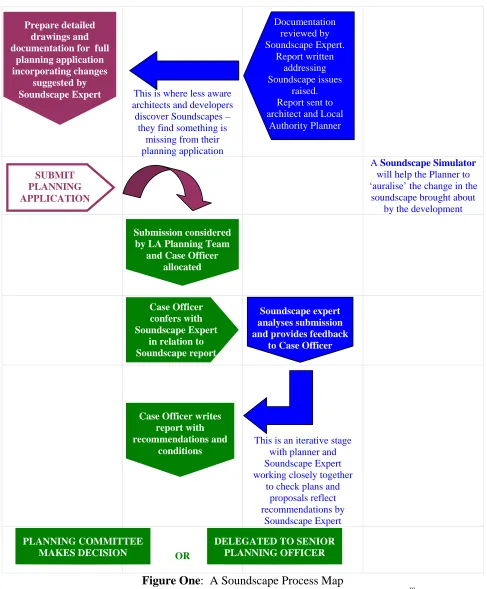
The following diagram visually represents how the concept of soundscape might be
incorporated into the UK planning process. It focuses on taking a planning application through to obtaining consent, concentrating on the roles of developer, architect, and Local Planning
Authority, and locating where soundscape expertise and soundscape tools might be incorporated.
Architect / Developer Planning / Local Authority
Soundscape Expertise Soundscape Tools
PRE-APPLICATION STAGE
The need for the architect/developer to contact a Soundscapes Expert is identified at this
stage and Soundscapes information is provided
A Soundwalk with all parties
DEVELOPMENT OF FULL APPLICATION
Report and Soundscapes recommendations included
in design development
A Soundwalk may be useful as a consultation
exercise. The use of the
Soundscape Simulator
will help architect and planners ‘auralise’ the
space Soundscape Expert
engaged by architect to discuss how to
incorporate Soundscape concept
Develop design concept
(respond to site conditions and other changing parameters including soundscape
report)
Site visits and soundwalks (Soundscape expert,
architects, developer, possibly
the public) - Soundscapes Report written
Prepare detailed drawings and send
to Soundscape Expert
Further development meetings with Local Authority Planners and others
Initial meeting with Local Authority Planners (and other
relevant bodies)
DECISION TO PROCEED OR NOT
Development of proposals Preliminary design concepts
and layouts Architect/designer
This is where less aware architects and developers discover Soundscapes –
they find something is missing from their planning application
A Soundscape Simulator
will help the Planner to ‘auralise’ the change in the
soundscape brought about by the development
Documentation reviewed by Soundscape Expert.
Report written addressing Soundscape issues
raised. Report sent to architect and Local
Authority Planner
Prepare detailed drawings and documentation for full
planning application incorporating changes
suggested by Soundscape Expert
This is an iterative stage with planner and Soundscape Expert working closely together
to check plans and proposals reflect recommendations by
Soundscape Expert
OR
SUBMIT PLANNING APPLICATION
Submission considered by LA Planning Team
and Case Officer allocated
Soundscape expert analyses submission and provides feedback
to Case Officer Case Officer
confers with Soundscape Expert
in relation to Soundscape report
Case Officer writes report with recommendations and
conditions
PLANNING COMMITTEE MAKES DECISION
[image:8.595.55.542.56.645.2]DELEGATED TO SENIOR PLANNING OFFICER
Figure One: A Soundscape Process Map
(adapted from Wootton’s ‘GMP Architectural Liaison Service – Process Model’40)
This soundscape process map shows the relationships between the architect, developer and planner throughout the planning application, from the pre-application stage through to a planning committee decision. Within these relationships we have identified the locations at which soundscape expertise would effectively be incorporated and, referring to tools and methods developed through the Positive Soundscape Project, we have highlighted the role of the soundscape expert.
commercial development. Using a structured soundwalk at this stage would be informative to the architect, developer and planner and might ultimately save time and money, especially if there was to be a statutory requirement to consider soundscapes at this early stage. Retrofitting acoustic and soundscape technology can be costly and early identification of requirements can preempt this.
At the application stage soundscape experts would be consulted by the planning authority on applications where there was a significant change of Use Class and on all major development proposals. A soundwalk could be adapted for use at this stage for public consultation purposes, enabling users of the location to contribute to the soundscape design. At this stage the soundscape simulator would be an effective tool for helping to ‘auralise’ the changes of the soundscape of the location brought about by the development and to compare the soundscape to other areas with the same Use Class.
For this process to be most effective soundscape experts would need to be statutory (or, less effectively, discretionary) consultees on planning applications. At the decision stage any applications which failed to consider soundscape implications would be refused and the applicant would be advised to consider soundscapes earlier in the process. Planning permissions might include conditions to ensure that soundscape features, and their preservation, maintenance, enhancement or elimination are understood and incorporated.
4. FUTURE DEVELOPMENTS FOR SOUNDSCAPES IN PLANNING
One professional who came on a Soundwalk with us in Manchester felt it would be useful to have a practical case study demonstrating the relevance of soundscapes, so if a developer had a particular use they wanted to bring to an area it would be possible to show examples of how the area might be designed to consider the soundscape. This is something that the final version of the soundscape simulator will enable as it will provide the opportunity to compare and contrast existing soundscapes as well as to ‘auralise’ and compare a before-and-after development soundscape experience. Additionally, the structured soundwalk developed for professionals enables them to experience soundscape differences in real-world situations and can be adapted to facilitate public consultation on new urban development proposals.
A next iteration of this process map will incorporate other tools and methods that would be useful at other stages in the process and will concentrate on the way in which soundscapes might be incorporated higher in the planning system – i.e. adaptations that might be required to Planning Policy Statements, how Regional Assemblies might include soundscapes in their Regional Spatial Strategy and how Local Authorities might include soundscapes in the development of their Local Development and Supplementary Planning Documents.
For example, incorporating the concept of soundscape into Planning Policy Guidance would make it a factor that had to be considered when designing or developing an urban environment. So in contrast to the current situation where the impact of noise is a material consideration in the determination of planning applications, the impact of a change of soundscape could be a material consideration.
5. CONCLUSIONS
ACKNOWLEDGMENTS
We gratefully acknowledge the EPSRC grant (Award No: EP/E011624/1) which has enabled this research and are indebted to the planners, architects, developers, acoustic consultants and other urban design professionals who gave up their time to come on soundwalks in London and Manchester and to attend focus groups.
REFERENCES
1
Davies, W.J., Adams, M.D., Bruce, N.S., Cain, R., Carlyle, A., Cusack, P., Hume, K.I., Jennings, P. & Plack, C.J. (2007). The positive soundscape project. Paper presented at International Congress on Acoustics, in Madrid, Spain, 2nd – 7th September.
2
Adams, M. & Bruce, N. (2008). Soundwalking as methodology for understanding soundscapes. Proceedings of the
Institute of Acoustics, 30 (2), 552-558.
3
Bruce, N., Davies, W.J., Adams, M (2009) Development of a soundscape simulator tool. Paper presented at Internoise 2009, Ottawa, Canada, 23-26 August.
4
Adams, M., Cox, T., Moore, G., Croxford. B., Refaee, M. & Sharples, S. (2006). Sustainable soundscapes: Noise policy and the urban experience. Urban Studies, 43 (13), 2385-2398.
5
Schafer, R.M. (1994). Soundscape. Our sonic environment and the tuning of the world. Vermont, USA: Destiny books. (Original work published, 1977)
6
Bröer, C. (2002). Sound meaning and politics. The social construction of aircraft noise annoyance. Paper presented at Forum Acusticum, in Sevilla, Spain, 16th – 20th September.
7
Bröer, C. (2007). Noise annoyance and policy: how policy shapes non-acoustical factors. Paper presented at Inter-Noise, in Istanbul, Turkey, 28th – 31st August.
8
European Parliament and Council. (2002). Directive 2002/49/EC of the European Parliament and of the Council of 25th June 2002, relating to the assessment and management of environmental noise. Official Journal of the
European Communities, L189.
9
Baranzini A. & Ramirez, J.V. (2005). Paying for quietness: the impact of noise on Geneva rents. Urban studies,
42 (4), 633-646. 10
Atkinson, R. (2007). Ecology of sound: the sonic order of urban space. Urban studies, 44 (10), 1905-1917. 11
Chuengsatiansup, K. (1999). "Sense, symbol, and soma: illness experience in the soundscape of everyday life." Culture, Medicine and Psychiatry 23(3): 273-301.
12
Skanberg, A. and E. Ohrstrom (2002). "Adverse health effects in relation to urban residential soundscapes." Journal of Sound and Vibration 250(1): 151-155.
13
Ohrstrom, E., Skanberg, A., Svensson, H., & Gidlof-Gunnarsson, A. (2006). Effects of road traffic noise and the benefit of access to quietness. Journal of Sound and Vibration, 295(1-2), 40-59.
14
Schulte-Fortkamp, B. (2002). The meaning of annoyance in relation to the quality of acoustic environments. Noise
and Health, 4(15), 13-18.
15
Schulte-Fortkamp, B., & Fiebig, A. (2006). Soundscape analysis in a residential area: an evaluation of noise and people's mind. Acta Acustica united with Acustica, 92(6), 875-880.
16
MORI Social Research Institute. (2006). National Noise Survey. Research study for NSCA. J26736: NSCA National Noise Survey
17
Skinner, C., Ling, M., Grimwood, C. & Raw, G. (2002). The 1999/2000 National Survey of Attitudes to
Environmental Noise – Volume 3 United Kingdom Results. Watford, UK: BRE.
18
Stockfelt, T. (1991). Sound as an existential necessity. Journal of Sound and Vibration, 151 (3), 367-370. 19
Guastavino, C. (2006). The ideal urban soundscape: Investigating the sound quality of French cities. Acta
Acustica united with Acustica, 92 (6), 945-951.
20
Cain, R., Jennings, P., Adams, M., Bruce, N., Carlyle, A., Cusack, P., Davies, W., Hume., K. & Plack, C. (2008). An activity-centric conceptual framework for assessing and creating positive urban soundscapes. Proceedings of
the Institute of Acoustics, 30 (2), 546-551.
21
Maffiolo, V., Castellengo, M., & Dubois, D. (1999). Qualitative judgements of urban soundscapes, Inter-Noise 99
pp. 1251-1254). Fort Lauderdale, USA. 22
Järviluoma, H., & Wagstaff, G. (2002). Soundscapes studies and methods. Helsinki: Finnish Society for Ethnomusicology, University of Turku, Department of Art, Literature and Music, Series A 51.
23
Schulte-Fortkamp, B. (2002). Soundscapes and living spaces: sociological and psychological aspects concerning acoustical environments, Forum Acusticum 2002. Sevilla.
24
25
Epstein, M.J. (2003). Growing an interdisciplinary hybrid: the case of acoustic ecology. History of Intellectual
Culture, 3 (1), 1-10.
26
Kull, R.C. (2006). Natural and urban soundscapes: the need for a multi-disciplinary approach. Acta Acustica united
with Acustica, 92(6), 898 – 902.
27
Schulte-Fortkamp, B. & Dubois, D. (2006). Preface: Recent advances in soundscape research. Acta Acustica
united with Acustica, 92 (6), v-viii.
28
Zhang, M., & Kang, J. (2007). Towards the evaluation, description, and creation of soundscapes in urban open spaces. Environment and Planning B: Planning and Design, 34(1), 68 -86.
29
Cooper, I. (2002). Transgressing discipline boundaries: is BEQUEST an example of ‘the new production of knowledge’? Building Research and Information, 30(2), 116–129.
30
De Coensel, B., De Muer, T., Yperman, I. & Botteldooren, D. (2005). The influence of traffic flow dynamics on urban soundscapes. Applied Acoustics, 66 (2), 175-194.
31
Plack, C.J. (2005). The sense of hearing. New Jersey, USA: Lawrence Erlbaum Associates Inc. 32
Ballas, J.A. (1993). Common factors in the identification of assortment of brief everyday sounds. Journal of
Experimental Psychology: Human Perception and Performance, 19 (2), 250-267.
33
Fastl, H. (2002). Features of neutralized sounds for long term evaluation. Paper presented at Forum Acusticum, in Seville, Spain, 16th – 20th September.
34
Job, R.F.S., Hatfield, J., Hede, A.J., Peploe, P., Carter, N.L., Taylor, R. & Morrell, S. (2007). The role of attitudes
and sensitivity in reactions to changing noise. Paper presented at Inter-Noise, in Madrid, Spain, 2 – 7th
September. 35
Berglund, B. & Nilsson, M.E. (2006). On a tool for measuring soundscape quality in urban residential areas. Acta
Acustica united with Acustica, 92 (6), 938-944.
36
Lavandier, C. & Defréville, B. (2006). The contribution of sound source characteristics in the assessment of urban soundscapes. Acta Acustica united with Acustica, 92 (6), 912-921.
37
Payne, S.R. (2008). Are perceived soundscapes within urban parks restorative? Paper presented at Acoustics’ 08, in Paris, France, 29th June – 4th July.
38
Town and Country Planning Act (1990) Town and Country Planning Act, UK. http://www.england-legislation.hmso.gov.uk/acts/acts1990/ukpga_19900008_en_1 last accessed 28.5.09
39
Boyko, C. T. and Cooper, R. (2009) Decision-making Processes in Urban Design. In: I. Cooper & M. Symes (eds.). Sustainable Urban Development: Changing Professional Practice (Vol. 4), Oxon: Routledge, pp. 78-98 40
Wootton, A (undated) ‘GMP Architectural Liaison Service – Process Model’. 41
PPG24. (1994). Planning Policy Guidance 24: Planning and Noise. London: HMSO. 42
PAN56. (1999). Planning Advice Note 56: PAN56 Planning and Noise.
http://www.scotland.gov.uk/Publications/1999/04/PAN56 last accessed 28.4.09. 43
TAN11. (1997). Planning Guidance (Wales), Technical Advice Note (Wales) 11, Noise – October 1997.
http://wales.gov.uk/topics/planning/policy/tans/tan11?lang=en last accessed 28.4.09. 44
PPS. (1996-2008). Northern Ireland Planning Policy Statements.
http://www.planningni.gov.uk/index/policy/policy_publications/planning_statements.htm last accessed 28.4.09. 45
Defra, (Department for Environment Food and Rural Affairs). (2008).
http://www.defra.gov.uk/environment/noise/ambient.htm last accessed 28.4.09 46
Mayor of London. (2004). Sounder City. Highlights of the Mayor’s Ambient Noise Strategy. London: Greater London Authority, HMSO.
47
Mayor of London. (2006). The Mayor’s Ambient Noise Strategy - progress report.
http://www.london.gov.uk/mayor/strategies/noise/docs/progress_report_20061030.pdf last accessed 28.4.09. 48
Arup Acoustics. (2007). Developing popular soundscape indicators. Greater London Authority. 49
Mayor of London. (2007). http://www.london.gov.uk/mayor/strategies/noise/index.jsp last accessed 28.4.09. 50