International Journal of Emerging Technology and Advanced Engineering
Website: www.ijetae.com (ISSN 2250-2459,ISO 9001:2008 Certified Journal, Volume 5, Issue 8, August 2015)
Implementing Hybrid Compression-Encryption based
Watermarking for Information Hiding
Rahul kumar Nayak
1, Prof. Amit Saxena
2, Dr. Manish Manoria
3 1,2,3Truba Institute of Engg. & Information Technology, Bhopal, IndiaAbstract—Watermarking is a new way of hiding secrete
information so that the data is not accessible by other users. Information Hiding enables various users to send their information in a secure manner. Although there are various techniques implemented to provide strength to this Information such as by using Spread Spectrum Technique. The Existing methodology implemented for Information Hiding takes more Error rate and fewer Watermarks Signal Strength. consequently a new and efficient technique is implemented using Hybrid Encryption-Compression based watermarking for the secrete hiding of information. The Technique implemented here for the Information Hiding takes less error rate and is more efficient as collate to existing Spread Spectrum Technique.
I. INTRODUCTION
The rising employ of Internet has allowable the patrons to without harms correct of entrance, apportion, sway, and hand out the digital media statistics, and digital media has really distorted our everyday existence for the age of the history decade. This spread of digital media information generates a scientific riot to the action and media industries, brings ground-breaking information to patrons, and establishes ground-breaking Internet ideas. On the additional hand over the huge manufacture and use of digital media also pretense pioneering disputes to the restricted human rights industries and augment noteworthy harms of cynical normal resources of digital media, in view of the fact that modern media distribution formulates illegal repetition and illegal share of the digital media much easier.
In the digital watermarking knowledge, a accurate indication is ingrained into the crowd media pleased without drastically demeaning the perceptual notability of the original media data, and the rooted in sequence can later be unconcerned for required intentions. In observation of the reality that this surrounded watermark warning sign is habitually not discernible, digital watermarking could make obtainable post-delivery fortification for the digital essence. Digital watermarking has abundant applications, and one indispensable request is information beating method. Digital data thrashing [1], where the fixed unseen memorandum should be decoded precisely at the handset surface and such concealed in sequence can be used to dish up underground statements, make possible authenticating the fidelity of the digital media in sequence, recognizing the creative supply, and make promising the exploration on illegitimate usages and exclusive rights violations.
Original Signal
[image:1.595.313.584.216.346.2]Message Noise
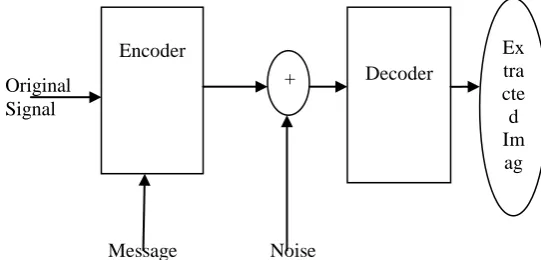
Figure 1: An Example of Digital information organization
II. TRADITIONAL EMBEDDING SCHEMES FOR DATA HIDING Anywhere every digital statistics hitting organization be supposed to accomplish some necessities: the entrenched watermark be supposed to be imperceptible, meaning that the perceptual characteristic of the only one of its kind contented be supposed to not be dishonored due to watermarking. For some applications (e.g., the entrenched memorandum should be extracted precisely smooth after unlawful distortions), sturdiness is imperative. Payload is a new apprehension which arises in the applications anywhere the digit of embedded bits should be far above the ground. Fortification of statistics is also a insignificant nervousness in data thrashing, which implies that unconstitutional festivity should not be able to expose the buried meaning, the extracted concealed information are compared with the creative in sequence in order to establish whether they are the matching. Most significant statistics beating methods used heuristic algorithms based on uncomplicated picture dispensation exploitations. Fleeting instant in time, additional tricky watermarking algorithms were proposed and used in different types of media data such as audio and video. Although many embedding schemes have been recommended, they may well be generally classified into two groups: spread spectrum and quantization based methods.
Probably the primary landmark in information thrashing using watermarking was talented by Cox et al. [2] wherever they future Spread Spectrum (SS) process. In outcome [2] two versions of SS were recommended. The original one is preservative Spread Spectrum SS in which the watermark is spread over the crowd indication time after time.
Encoder
+ Decoder
International Journal of Emerging Technology and Advanced Engineering
Website: www.ijetae.com (ISSN 2250-2459,ISO 9001:2008 Certified Journal, Volume 5, Issue 8, August 2015) The following one is the Multiplicative increase band
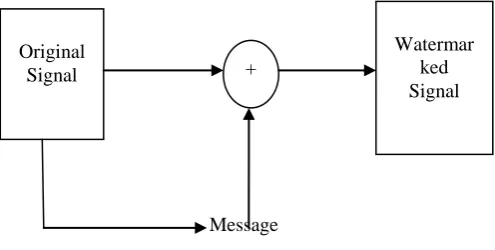
(MSS) which spreads the watermark according to the crowd material. Figure 1.2 illustrates the SS embedding method where the dashed line shows that it is possible to add the watermark depending (MSS scheme) or without depending (additive SS scheme) on the content.
[image:2.595.51.299.207.332.2]Message
Figure 1.2: An illustration of spread spectrum-based embedding schemes.
In together scheme, in arrange to augment the security events, a pinnacle clandestine autograph code for rising the out of sight memorandum bits is used. SS schemes usually have huge strength. Hidden messages embedded underneath these methods could robustly resist against lossy compressions and many supplementary types of distortions and attacks. In spite of their great robustness touching average indicator meting out operations and manipulations, the foremost negative aspect of SS-based schemes is the congregation nosiness effect. while in the SS schemes the congregation pointer itself acts like a clatter starting place at the decoder surface and since of the information that the watermark has moderately miniature influence, the crowd suggestion require a huge infringement upshot which causes a grave squalor of the decoding presentation. To decrease the obtrude effect of the crowd augury, Malvar and Florencio planned the better Spread Spectrum (ISS) system [3] by exploiting the face in progression at the encoder surface. Their result brings the expect of having a healthy embedding format with high-class decode staging. An supplementary very important marker in embedding methods was accessible by Chen and Wornell [4] where they introduced a new class of embedding method called Quantization Index Modulation (QIM). Multiply change Dither Modulation (STDM), an added peculiarity of the inventive QIM, which combines the spread spectrum and quantization tender was planned in their occupation as well [4]. The QIM move toward might get better the decoding presentation greatly by removing the interference effect of the host signal due to its quantization embedding life. On the additional pass, it experiences from thoughtful to scaling and wanting of content based embedding. Its responsiveness to scaling causes mortification degradation of its performance and lack of content based embedding makes it capable to observable watermark.
Although a number of attempts have been finished to undertake these deficiency [5, 6], additional labors are unmoving wanted for QIM to attain a system which is vigorous alongside all of these evils. At the similar occasion as automatic detection-only of the turnout of entrenched information is organism intensively investigated in the precedent few era [7], lively concealed information taking out is a moderately new-fangled section of research. In blind extraction of increase range SS entrenched information, the unidentified crowd acts as a underpinning foundation of meddling/commotion to the information to be obtain bettered and in a modus operandi the complicatedness alternative screen signal taking apart (BSS) application as they occur in the fields of range dispensation, biomedical warning sign meting out, and code-division multiple-access (CDMA) statement systems [8].
III. LITERATURE SURVEY
Inside this document, spread spectrum schemes [9] represent an early type of embedding technique. It appends a progression of pseudo-random indications hooked on the congregation signals to outward appearance the watermarked statistics According to how the watermark is supplementary into the swarm content, the multiply field procedure can be supplementary subdivided into the preservative and multiplicative spread variety i.e. ASS and MSS methods. The signals are habitually surrounded hooked on the perceptually important machinery of the swarm representation to achieve a equilibrium of perceptual excellence and heftiness. At the detector, the unique picture be supposed to be obtainable to call off the watermarked representation to remove the fixed signals. The extracted signals are after that show a association with a predefined trial product for corroboration. The discovery that necessitates the only one of its kind data is called confidential discovery.
Inside this paper [10], author has to find a problem of blindly extracting indefinite communication out of sight in representation hosts via multi-carrier/autograph spread-spectrum embedding. In this proposed work author has to guess that the original host and the embedding carriers are offered. The extraction algorithm used to extract the secreted facts from digital media and the planned algorithm is a little involvedness algorithm and it attains the likelihood of mistake revival generation to recognized crowd and embedding carriers. The innovative crowd or the embedding carriers are unspecified accessible. At this time they executed a low intricacy multi-carrier iterative simplified least-squares (M-IGLS) core algorithm.
Original
Signal +
International Journal of Emerging Technology and Advanced Engineering
Website: www.ijetae.com (ISSN 2250-2459,ISO 9001:2008 Certified Journal, Volume 5, Issue 8, August 2015) Investigational cost established that M-IGLS container
finish likelihood of blunder fairly seal to what might be achieved with recognized embedding signatures and recognized unique congregation autocorrelation surrounding substance and presents itself as an well-organized countermeasure to customary SS data embedding or information beating. The achievement of M-IGLS can attain likelihood of fault to a convinced degree safe to what perhaps makes with recognized embed signature and known original host autocorrelation medium and presents itself as well-organized and ordered countermeasure to conformist SS steganography.
In this paper [11], author tried to develop a unique multicarrier iterative generalized least squares (M-IGLS) algorithm for SS hidden information extraction that, to the most excellent of the authors’ familiarity, become visible for the first time in the broad communication theory and techniques writing. To improve augmentation arrangement, particularly for minute hidden messages that pretend to be the furthermost dispute, cautious studies point toward that a small amount of self-sufficient M-IGLS reinitializations and implementations on the host can show the way to hidden data recovery with probability of error close to what may be attained with known embedding bearers and known original host autocorrelation matrix. The cause of enlarged algorithm are positively not towering importance to derogatory steganographic concealed communications by improving the secret embedded messages. Since the delivery services are also mutually approximated with the embedded data, the extended method can also be used for entire message elimination or tampering attack as well by reinserting a manufactured message in place of the original. From the conflicting data impact move toward, the comprehensive algorithm can be amusement as an instrument to experiment security strength of SS data hiding schemes.
Tung-Hsiang Liu and Long-Wen Chang [12] has proposed a simple information hiding technique for binary images.The suggest technique embeds make secure data at the extermity portion of host binary image data. The Distance matrix method is used to locate the edge pixels of host binary image. After that the Weight procedure is utilized to think about the connectivity of the region approximately unpredictable pixels for choosing the sizeable amount appropriate one. For the safety measures and excellence thought, a random number generator is making use of to allocate the embedding data into the taken as a whole image data. This technique not only lodge large amount of data into host binary image but also can sustain image quality.
M. Carli M.C.Q. Fariasy, E. Drelie Gelascaz, R. Tedesco & A. Neri [13] has proposed a no-reference video quality metric that blindly approximations the distinction of a video.
They had used Block based Spread Spectrum embedding technique to institute a easily broken scratch into perceptually significant neighborhoods of the video frames. They used a set of perceptual characteristics to differentiate the perceptual meaning of a region that are Motion, Contrast and Color. The mark is taken out from the perceptually significant neighborhoods of the decoded video on receiver side. Then a feature determine of the video is get hold of by computing the abasement of the removed mark. So, in this approach quality of a compressed video is approximation by using simple embedding method on perceptually notable communities of the video frame.
IV. PROPOSED METHODOLOGY 1. Take an input image and a secrete image.
2. Choose alpha worth which denoted watermark indication power issue in spread spectrum algorithm, here in our work we assume alpha=5;
3. Calculate DWT of the original image which is used for the transformation of the image to be embedded. 4. Calculate total number of pixels of the original image
and watermark image.
5. Calculate aj=bj where ir <=j < (i+1) r.
6. Calculate watermark signal as wj=alpha*aj*pj, where pj= {+1,-1}.
7. Now we will find the kernel of the image by taking kernel size 31 and by taking the level of the kernel size as 3 we will find the kernel image of the original image by calculating kernel image = (1/(2*pi*s^2))*exp(-((X-m).^2 + (Y-m).^2)/(2*s^2)); 8. This watermark signal is then embedded with the
kernel image to get the final watermark image.
Spread Spectrum Watermarking
The embedding procedure is approved out by primary generating the watermark indication W by using watermark data bits, chip rate and PN sequence. The watermark information bits b= {bi}, where bi = {1,-1} are spread by r, which gives
The sequence aj is then multiplied by alpha>0 and P. The watermark signal W= {wj}, where
Where, pj={1,-1} The watermark signal generated is added to the encrypted signal , to give the watermarked signal Cw.
International Journal of Emerging Technology and Advanced Engineering
Website: www.ijetae.com (ISSN 2250-2459,ISO 9001:2008 Certified Journal, Volume 5, Issue 8, August 2015) Kernel Based Image Detection
1. ksize_image = 31;
It is the kernel size that we want to make the sie of the kernel.
2. kernel = zeros(ksize_image);
Whatever the size of the kernel make the pixel value of all zeros.
3. s = 3;
It is the segmented part from the kernel image. 4. [X, Y] = meshgrid(1:ksize_image);
Generate X and Y arrays for 3-D plots from 1 to the size of the kernel and stores rows and columns in X and Y.
5. kernel_image = (1/(2*pi*s^2))*exp(-((X-m).^2 + (Y-m).^2)/(2*s^2));
Now calculate the original kernel by reducing the total size and the size of the kernel taken.
Kernel image is used for the embedding of kernel region in the image the total effect of blurriness is pointed out so that it will be helpful for the detection of embedding part of the image.
LSBAlgorithm
The least significant bit (LSB) technique is used to embed information in a cover image. The LSB technique is that inside of a cover image, pixels are changed by bits of the secret message. These changes cannot be perceived by the human visibility system However; a passive attacker can easily extract the changed bits, since it has performed very simple operation.
After the unrevealed data gets embedded or hidden in the cover image, the original cover image will get modification to some extent with respect to the length of the secret data. At the receiving end we are not able to get back the original cover image since our traditional LSB is not providing reversibility. Reversible feature is a process of getting back the cover image from the watermarked or embedded image at the extraction phase. After getting the watermarked image, we need to create a matrix initialized with zeros, whose dimension is equal to the watermarked image. By XORing each and every pixel of both the original and watermarked image, the result will be stored in the corresponding positions in the newly created matrix. This matrix will also be sent to the extraction phase along with the watermarked image. During extraction the value of the newly created matrix will be checked. If it is 1, then watermarked image’s s LSB of each pixel must be changed, else vice versa. Finally we could get back to the original cover image.
V. RESULT ANALYSIS
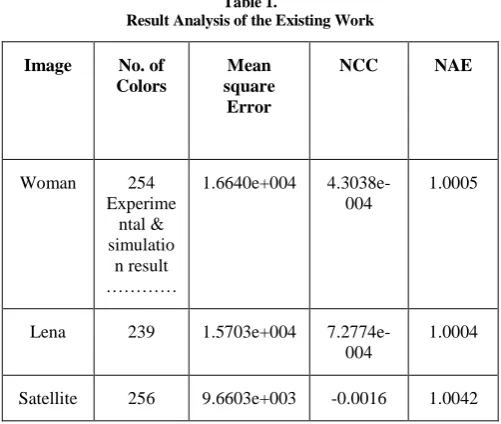
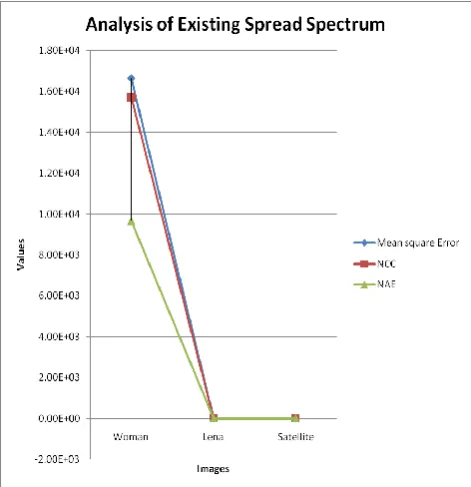
[image:4.595.306.557.192.404.2]The table show below is the result analysis and comparison of the proposed methodology on various parameters for different images.
Table 1.
Result Analysis of the Existing Work
Image No. of Colors
Mean square
Error
NCC NAE
Woman 254
Experime ntal & simulatio
n result …………
1.6640e+004 4.3038e-004
1.0005
Lena 239 1.5703e+004
7.2774e-004
1.0004
Satellite 256 9.6603e+003 -0.0016 1.0042
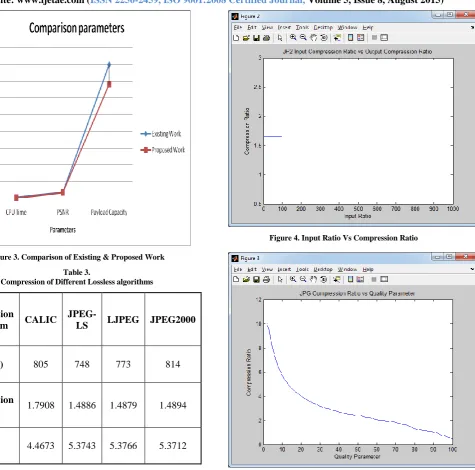
The Table shown below is the analysis and comparison of existing and proposed work on the basis of CPU Time and PSNR and Payload capacity.
Table 2.
Comparison of Existing & Proposed Work
Parameters Spread Spectrum
Work
LSB Work
CPU Time 4.493 0.218
PSNR 34.1514
db
33.396 db
Payload Capacity
[image:4.595.306.557.456.651.2]International Journal of Emerging Technology and Advanced Engineering
[image:5.595.87.563.122.592.2]Website: www.ijetae.com (ISSN 2250-2459,ISO 9001:2008 Certified Journal, Volume 5, Issue 8, August 2015)
[image:5.595.306.568.129.352.2]Figure 3. Comparison of Existing & Proposed Work
Table 3.
Compression of Different Lossless algorithms
Compression
Algorithm CALIC
JPEG-LS LJPEG JPEG2000
Time (s) 805 748 773 814
Compression
Ratio 1.7908 1.4886 1.4879 1.4894
Bpp 4.4673 5.3743 5.3766 5.3712
[image:5.595.47.280.133.444.2]Figure 4. Input Ratio Vs Compression Ratio
[image:5.595.310.566.371.590.2]International Journal of Emerging Technology and Advanced Engineering
Website: www.ijetae.com (ISSN 2250-2459,ISO 9001:2008 Certified Journal, Volume 5, Issue 8, August 2015) The Figure show below is the result analysis and
comparison of the proposed methodology on various parameters for different images.
[image:6.595.49.285.230.474.2]The analysis is done for the existing methodology implemented for watermarking using Spread Spectrum based technique. The analysis done here is on the basis of No. of colors and mean square error and Normalized Cross Co-relation and Normalized Absolute Error.
Figure 6. Analysis of Existing Watermarking Technique
VI. CONCLUSION
The digital mutiny, the outbreak of communication networks, and the increasingly growing agony of the general public for new information technologies lead to exponential growth of multimedia document traffic. The digital watermarking is a technique of authenticating the user, here the methods that are applied increases the efficiency of the security mechanism. Here in this paper we enhance the security of the watermarked images using the combinatorial method of compression and encryption. The proposed technique here provides best results as compared to the existing techniques.
Our scheme also conserve the confidentiality of content as the embedding is done on encrypted data. The homomorphic property of the cryptosystem is exploited, which allows us toperceive the watermark after decryption and control the image quality as well.
REFERENCES
[1] F. Y. Shih. Digital watermarking and steganography:
fundamentals and techniques. CRC Press, 2008.
[2] I. J. Cox, J. Kilian, F. T. Leighton, and T. Shanon. Secure spread
spectrum watermarking for multimedia. IEEE Trans. Image Process, 6(12):1673–1687, 1997
[3] H. S.Malvar and D. A. Florencio. Improved spread spectrum: A
new modulation technique for robust watermarking. IEEE Trans. Signal Process, 51(4):898–905, 2003.
[4] B. Chen and G. Wornell. Quantization index modulation: A class
of provably good methods for digital watermarking and information embedding. IEEE Trans. Inf. Theory, 47(4):1423– 1443, 2001.
[5] N. Khademi-Kalantari and S. M. Ahadi. A logarithmic
quantization index modulation for perceptually better data hiding. IEEE Trans. Signal Process. 19(6):1504–1517, 2010.
[6] F. Perez-Gonzales, C. Mosquera, M. Barni, and A. Abrardo.
Rational dither modulation: A high-rate data-hiding method robust to gain attacks. IEEE Trans. Signal Process, 53(10):3960– 3975, 2005.
[7] G. Gul and F. Kurugollu, “SVD-based universal spatial domain
image steganalysis,” IEEE Trans. Inf. Forensics Security, vol. 5, no. 2, pp. 349–353, Jun. 2010.
[8] T. Li andN.D. Sidiropoulos, “Blind digital signal separation using
successive interference cancellation iterative least squares,” IEEE Trans. Signal Process., vol. 48, no. 11, pp. 3146–3152, Nov. 2000. [9] I. J. Cox, J. Killian, F. T. Leighton, and T. Shanmoon, “Secure spread spectrum watermarking for multimedia,” IEEE Trans. Image Processing, vol. 6, no. 12, pp. 1673-1687, Dec. 1997.
[10] K.Bharath Kumar, Bhaludra Raveendranadh Singh, “Hiding and
Extracting Secret Data from Digital Media” International Journal of Computer Trends and Technology (IJCTT) – volume 16 number 2 – Oct 2014
[11] Ming Li, Michel K. Kulhandjian, “Extracting Spread-Spectrum
Hidden Data From Digital Media” IEEE TRANSACTIONS ON INFORMATION FORENSICS AND SECURITY, VOL. 8, NO. 7, JULY 2013.
[12] Tung-Hsiang Liu and Long-Wen Chang, “An Adaptive Data
Hiding Technique for Binary Images”, Proc. IEEE 17th Int.Conf. On Pattern Recognition (ICPR’04), 2004.