Improving the regulatory framework of
floodplain management and development
in the United Kingdom
Alam, B and Pathirage, C
Title Improving the regulatory framework of floodplain management and development in the United Kingdom
Authors Alam, B and Pathirage, C
Type Conference or Workshop Item
URL This version is available at: http://usir.salford.ac.uk/43982/ Published Date 2017
USIR is a digital collection of the research output of the University of Salford. Where copyright permits, full text material held in the repository is made freely available online and can be read, downloaded and copied for noncommercial private study or research purposes. Please check the manuscript for any further copyright restrictions.
754 ID 010
IMPROVING THE REGULATORY FRAMEWORK OF FLOODPLAIN
MANAGEMENT AND DEVELOPMENT IN THE UNITED KINGDOM
B.Alam1 and C.Pathirage2
1 School of the Built Environment, University of Salford, 43 Crescent, M5 4WT, United Kingdom 2 School of the Built Environment, University of Salford, 43 Crescent, M5 4WT, United Kingdom
Email: [email protected]
Abstract: Flooding is a natural disaster that most commonly impacts the United Kingdom. The frequency of flooding makes it an important focus for a researcher. The scope of flooding is wide-ranging as it can affect people, society and the economy. A particular location vulnerable are the floodplains as these are naturally prone to flooding. Such developments suffer from varying degrees of risk during times of flooding. In the United Kingdom, floodplain developments have risen leading to added risk to occupants. Property owners are thus exposed to risk with flood regulation coming into effect through planning, defences, insurance and taking precautionary measures. A deep understanding of flood response and management will be needed for this research. For this project, each stage of the regulatory process involving flooding and floodplains in the United Kingdom will be examined to provide an overview of current flood management practice. Current findings show that there are regulatory gaps with regards to flood resilience in relation to aspects such as flood insurance and though a unified strategy exists there is a disconnect with flood response. An extensive literature review will be used to showcase the challenges and barriers to flood response on the floodplains. This is with the aim of better improving the existing regulatory framework of floodplain management in the United Kingdom.
Keywords: Disaster Management, Flooding, Floodplain, Floodplain Development
1.INTRODUCTION
Flooding is a natural disaster that is ranked as the most common the affect the world. It is held as the worst threat to the UK with the danger posed by it set to increase in the future (Defra, 2015). Their frequency makes it an important focus for research. Guha-Sapir et al. (2010) noted floods being the most common natural disaster worldwide. Thus, their effect is wide ranging and communities are more likely to be affected by it. Floodplains are particularly vulnerable as they are ecologically connected to a body of water making them naturally prone to flooding. In England, rivers and coastal floodplains have been populated for centuries with floodplains making 12% of the country and 8% of those having property developments (CCC, 2012). Flooding also impacts infrastructure such as energy, water and communications (EA, 2009). Thus, damages to affected regions can be extensive with floodplains being particularly vulnerable. The Environment Agency (2015) states that floodplains, “would naturally be affected by flooding if a river rises above its banks, or high tides and stormy seas cause flooding in coastal areas”. In 2009, an estimated 2.4 million properties were already situated in a floodplain (NAO, 2014). The damage can include disruption in the community, damage to structures and the loss of human lives.
755 2.FLOODING
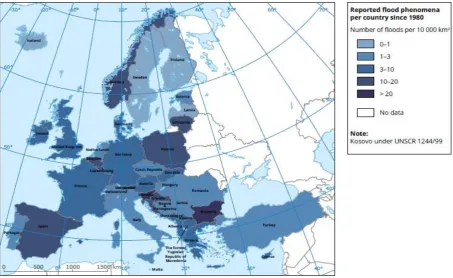
[image:3.595.75.529.319.597.2]Flooding is a natural hazard that can come from a variety of sources including river or ground water. The United Nations stated, “flooding can arise from overflowing river, heavy rainfall over the short period or an unusual inflow of sea water onto land, such as storm surge, tidal flooding, seismic events (tsunami) or large landslide” (Proverbs and Mambretti, 2012; pg. 156). Floods impact human life with them being a growing risk to populations, particularly those in floodplain areas. It has the greatest potential for damage among the natural disasters and affects large numbers of people (UN, 2004). The dangers posed by it are widespread with it capable of devastating entire communities. Fleming (2002; pg. 15) stated, "floods are a natural occurrence and the risk they pose is wide ranging. However, for society, the main focus is the risk to people and property." Thus, floodwaters can destroy both residential and commercial properties. It also affects; transportation, communication, agricultural developments and damages the environment. In addition, the after effects can lead to health risks from pollution and water-borne diseases (Marriott et al, 1999). The frequency of flooding makes it the most common of the natural disasters with is effects illustrated in Figure 25.
Figure 25: Reported Flood Phenomena (number of floods per 10,000 km), per country (since 1980) (Source: EEA, 2015)
756
volume and intensity and risk of extreme sea level rise (Evans et al., 2008). Thus, the danger posed by flood risk is only set to increase in the future.
2.1 Floodplains
An area prone to flooding are regions known as floodplains. These are, “the land next to, or hydraulically or ecologically connected to, the flowing river” (Freitag, 2009; pg. 44). These areas are naturally prone to flooding and therefore suffer from a higher degree of flood risk. However, Freitag (2009) noted human developments on floodplains can bring about a quick and deadly response from the river. Such areas are subject to urban development but suffer from extreme floods making them contested regions. Annually, extreme floods create enormous and mounting damage on floodplains (Hartmann, 2011). The IPCC (2007) noted human development on floodplains and inadequate flood response plans have led to greater potential for damage caused by flooding. Despite the dangers, there have been developments in floodplain areas (Hartmann, 2011). This is due to factors such as growing population pressures and the land being viable for development. Floodplains are among the most densely populated areas in the world with these being particularly well suited for development (Kron, 2005). However, environmental changes alongside wider societal changes can potentially alter the likelihood of human exposure to hazards and the susceptibility of people to their impacts (Few, 2007).
In England and Wales, there were approximately 1.85 million homes, 185,000 commercial properties, around 5 million people and half of agricultural land suffering flood risk (Few, 2013). In 2009, the Environment Agency (EA) noted that 2.4 million properties were situated on the floodplains in the UK (EA, 2009). A CCC (2012) report stated that floodplain development grew faster in England over the past ten years. Many developments were deemed protected but one-in-five suffered from significant flood risk. It is for this reason a framework is necessary to better manage new developments in floodplain regions and prevent inappropriate constructions. These developments expose inhabitants to the danger of flood risk as floodplains are more vulnerable to hazards. During floods, such areas can experience disruption in the community, damage to property and possible loss of life. However, due to their nature, floodplains serve as sites that are subject to development.
2.2 Floodplain Developments
757
The CCC (2012) report also were concerned on whether local authorities considered alternative developments before agreeing to construction on floodplains and whether long-term effects of climate change with regards to flooding had been considered. In 2013, local councils allowed 87 planning developments that saw 560 homes built in areas of high flood risk in England and Wales (RIBA, 2014). In 2009, an estimated 2.4 million properties were already situated in a floodplain (EA, 2009). Floodplain development had grown at a fast rate compared to the past ten years with one-in-five properties built in such areas that suffered from a significant flood risk (CCC, 2012). The number of homes stated to be built in flood risk had risen by a third in 2013 as compared to the previous year (RIBA, 2014). Despite the risks, such developments are only increasing and exposing their occupants to danger from flooding. The CCC (2014) noted that continued floodplain development leads to an increasing reliance on the use of flood defences. As such, the regulation of floodplain developments can reduce the burden placed on flood defences through the use of an effective flood risk management system that seeks to avoid inappropriate construction in these areas.
3.REGULATORY FRAMEWORK
Parliament, regulatory authorities and courts have recognised the dangers of flooding and have attempted to address this through regulatory frameworks. To combat these risks, efforts are made in order to mitigate their impact. Such mitigation takes the form of disaster management that seeks to either avoid or reduce the potential losses from the hazard. To mitigate their impact, disaster management aims to either avoid, adapt or control the hazards effect. Wisner (2003) stated that disasters are a, "complex mix of natural hazards and human action". The UNISDR noted that disaster risk is composed of multiple factors that include the occurrence of an extreme hazard event caused by natural forces/natural forces alongside human interference and that this affects something or someone (Holt, 2012).
The approach adopted by the courts established in the case of Arscott v. The Coal Authority (2004) referred to flooding as a ‘common enemy’ that needs to be prevented. This involves taking steps to reduces likelihood of flooding and mitigate its impact. The strategic overview and management of flooding lay with set regulatory bodies such as the EA (Defra, 2014). Legislation such as the Flood and Water Management Act (2010) provides the framework for flood management. Ultimately, flooding cannot be avoided though the general approach is to manage the risk (Schanze, Zeman and Marsalek, 2006). In the UK, the EA operates as the
oodplains (RIBA, 2009). It offers statutory consultee on all new developments within fl
guidance and operates as part of the regulatory framework in managing the risks in floodplain developments. It is a requirement that Local Authorities consult with the EA during planning applications when a proposed development can suffer from a risk of flooding. Despite these measures, the UK has experienced flooding on numerous occasions as detailed in the following section.
3.1 Flood Regulations
758
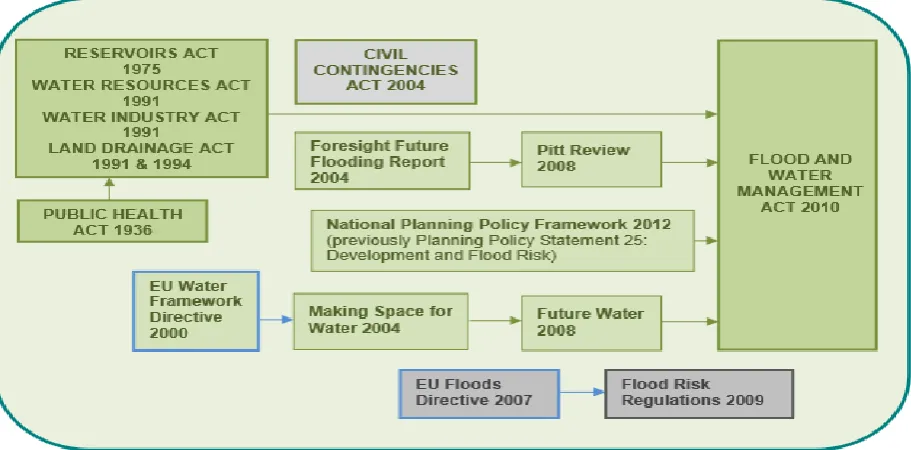
[image:6.595.80.536.187.412.2]and cope with hazards/disasters. The tools created as part of this framework include; flood risk assessments, hazard maps, management plans, improved strategic coordination and public participation. This creates an element of flood defence with the goal of protecting human lives and property from flooding events. Developments in the international landscape have also led to incorporation of such frameworks into the UK as highlighted in Figure 26. Through law, a system is introduced through which guidance and enforcement is produced to implement such a framework with the aim of mitigating the impact of flooding hazards.
Figure 26: Flood Legislation in the United Kingdom (Source: Devon County Council, 2015)
Within the UK, the EA operates as a regulatory body who provides guidance on measures needed to protect homes from floods. Effective flood risk management offers an important role for the UK in the defence against hazards and protects communities, businesses and infrastructure (NAO, 2014). Legislation is the basis through which regulatory bodies can enforce/implement means to combat flooding. Under the Climate Change Act (2008), there is a general duty to adapt and mitigate the dangers from climate change with Local Authorities taking part in ‘active strategies’ to achieve this goal. As climate change can increase flood, these strategies seek to promote a policy of adaptation. As a result, the regulatory framework operates with the goal of empowering flood management by providing guidance, policy and regulations.
3.2 Regulatory Bodies
759
Cooley (2006) stated that, “land-use management is among the most effective mitigation measure available”. Thus, proper control over its management is deemed as the best approach in managing flood risk. The Environment Agency (2009) noted that developing in such areas means being exposed to flood risk. It is for this reason that their guidance is to avoid developing in such areas as this eliminates the risk.
4. DISCUSSION
Flood risk management was identified as a national priority area of development (HM Government, 2012). Floodplains suffer from added risk of flooding that can be mitigated by implementing regulations to reduced its impact and manging the flood risk. According to Hall et al. (2003), flood risk management uses a strategy that seeks to review prior decisions made with the aim to “reduce, control, accept, or redistribute risks of flooding". Thus, it distinguishes itself from flood defence as it seeks to mitigate the impact rather than avoid it entirely. Flood risk management has been noted as moving towards a continuous holistic approach that emphasized the need to analyse, assess and mitigate risk on a catchment scale (Sayers et al., 2013). Despite such features, there have been significant cases of damage to properties as a result of flooding. The EA stated that one-in-six properties among 5.2 million such residences in England experience a risk of flooding (Abbey and Richards, 2016). In both residential and non-residential properties, expected annual damages are estimated to be more than £1 billion that are at risk from flooding (Bennett and Hartwell-Naguib, 2014). Similarly, flooding has led to 2.4 million properties at risk from river/sea, 3 million suffer from risk of flooding from surface water and 1 million are exposed to flood risk from both (Law Society, 2016). In 2007, the summer floods resulted in heavy downpours that caused 55,000 properties to be flooded (Defra, 2009; Jha et al., 2012). Similarly, the Bonfield Report has shown that sustained rain in 2016 led to extensive damage across the country with 17,000 properties being flooded and costs expected to amount to £1.3 billion (Defra, 2016). Reports indicated further research could bring about better management in order to reduce flood events (Efrac, 2008).
There exists a need from policy and law to regulate and mitigate flooding due to it being an ever-present danger. The UK Climate Projections (2009) noted floods being among the extreme events to affect the country, with greater frequency in the future (Defra, 2009). A Climate Change Risk Assessment (2012) indicated the UK being already vulnerable to extreme weather changes from flooding and heatwaves. This highlights the key goal of avoiding developments should they be made in areas designated as being inappropriate due to flooding. However, it highlights that developments could be made if safety measures, such as adaptations, were made in case of flooding. An Environmental Audit report highlighted, “planning system also has a flood defence role to play by minimising development on floodplains and maximising the use of 'sustainable drainage' techniques” (House of Commons, 2015). This system attempts to steer such developments away from areas of risk. It was noted that crucial changes in flood risk management came in two aspects; a shift from reliance on physical power to social power and that no single organisation has the power to affect change (Pender, 2011). Thus, a holistic approach combines the various organisations power for the use of effective floodplain management that can only occur through regulatory influence.
760
control flood risk management including those in the floodplain areas. Crichton (2012) noted floodplain developments have become easier through a succession of planning policies and due to reduced flood defence spending. As such, rules come into effect as they create the boundaries on the use of power. According to Pender (2011), “legal frameworks are the archetypal system of formal rules, whilst governments are the archetypal setters of formal rules”. A research gap identified from literature shows a lack of a coordinated strategy towards managing flood risk. Pender (2011) noted holistic approaches to managing flood risk is needed to better cope with impacts of flooding and climate change. The OST Future Flooding project sought to develop a holistic thinking approach to flood risk (Pender, 2011). Similarly, Surminski and Eldridge (2015) noted that there does not exist a long-term strategy to managing flood risk with flood insurance affordability being a short-term perspective. In conclusion, they said insurance was simply, “tool amongst the many that are required for a holistic strategy on flood risk management” (pg. 12). Insurance operates by covering unexpected losses but it does not prevent the risk of flooding from returning. Thus, they noted that risk reduction operates as an important element in combating flooding with the use of effective planning policy along with flood risk management playing an even more important role.
5. CONCLUSION
Whilst floodplain management has faced increased improvements over the years, research has indicated that the danger posed by flooding is set to increase in the future. Floodplain development has increased according to research and literature has shown that goal of a holistic approach towards floodplain management is in need of further improvements. Aspects such as insurance and flood adaptations operate independently from that of Flood resilience. Thus, this misses the goal of improving flood resilience, response and management. Such a gap can be better resolved through the use of regulation, legislation and policy to address this missing link. By linking policy and regulations flood resilience with a long-term strategy this could see a more holistic approach to being adopted with regards to floodplain management in the UK.
6. REFERENCES
Abbey, R. and Richards, M. (2016) A Practical Approach to Conveyancing. OUP Oxford; 18th Edition. Association of British Insurers (2004) Taking it on: developing UK sustainable development strategy together.
Retrieved from:
https://www.abi.org.uk/~/media/Files/Documents/Consultation%20papers/2004/07/sustdev.pdf
Bennett, O. and Hartwell-Naguib, S. (2014) Flood defence spending in England. House of Commons Library. Retrieved from: https://www.gov.uk/government/uploads/.../geho0609bqds-e-e.pdf
Brown, J.D. and Damery, S.L. (2002) Managing flood risk in the UK: towards an integration of social and technical perspectives. Transactions of the Institute of British Geographers, Vol.27 (4), pp.412-426. Climate Change Committee (2012) Climate change – is the UK preparing for flooding and water scarcity?
Adaptation Sub-Committee Progress Report 2012. Retrieved from:
https://www.theccc.org.uk/archive/aws/ASC/CCC_ASC_2012_bookmarked_2.pdf
Cooley, H. and Gleick, P.H. (2006) The world's water, 2006-2007 : the biennial report on freshwater resources. Washington, DC : Island Press.
Crichton, D. (2012) Floodplain Speaking 3rd Edition. The Chartered Insurance Institute: London Defra (2009) Adapting to Climate Change: UK Climate Projections. Retrieved From:
761
Defra (2013) Securing the future availability and affordability of home insurance in areas of flood risk. Retrieved from:
https://consult.defra.gov.uk/flooding/floodinsurance/supporting_documents/20130626%20FINAL%20Futur e%20of%20Flood%20Insurance%20%20consultation%20document.pdf
Defra (2014) The National Flood Emergency Framework for England. Retrieved From:
https://www.gov.uk/government/uploads/system/uploads/attachment_data/file/388997/pb14238-nfef-201412.pdf
Defra (2016) The Property Flood Resilience Action Plan. Retrieved From:
https://www.gov.uk/government/uploads/system/uploads/attachment_data/file/551615/flood-resilience-bonfield-action-plan-2016.pdf
Environment, Food and Rural Affairs Committee (2008) Flooding: Fifth Report of Session 2007–08 - Volume I. House of Commons. Retrieved from:
http://www.publications.parliament.uk/pa/cm200708/cmselect/cmenvfru/49/49.pdf
Evans, E.P., Simm, J.D., and Thorne, C.R. (2008) An Update of the Foresight Future Flooding 2004 Qualitative Risk Analysis. Cabinet Office, London.
Few, R. (2007) Health and climate change hazards: Framing social research on vulnerability, response and adaptation. Global Environment Change, 17, 281-295.
Fleming, G. (2002) Flood risk management: learning to live with rivers. London: Thomas Telford. Freitag, B (2009) Floodplain management : a new approach for a new era. Washington, DC : Island Press. Guha-Sapir, D. (2010) Health impacts of floods in Europe: Data gaps and information needs from a spatial
perspective. CRED: European Commission's Sixth Framework Programme - MICRODIS.
Hall, J.W., Meadowcroft, I.C., Sayers, P.B., and Bramley, M.E. (2003) Integrated flood risk management in England and Wales. Natural Hazards Review, Volume 4(3), pp.126-135.
Hartmann, T. (2011) Contesting land policies for space for rivers – rational, viable, and clumsy floodplain management. Journal of Flood Risk Management, September 2011, Vol.4(3), pp.165-175.
Holt, W.G. (2012) Urban Areas and Global Climate Change. Research in Urban Sociology. Bingley, U.K. : Emerald Book Serials and Monographs.
House of Commons (2015) Environmental Audit, Tenth Report. Retrieved From:
http://www.publications.parliament.uk/pa/cm201415/cmselect/cmenvaud/453/45307.htm#a11 Kron, W. (2005) Flood Risk = Hazard • Values • Vulnerability. Water International
Law Society (2016) Flood Risk. Law Society. Retrieved from: http://www.lawsociety.org.uk/support-services/advice/practice-notes/flood-risk/
Marriott, S., Alexander, J., and Hey, R. (1999) Floodplains: Interdisciplinary Approaches. Geological Society; First Edition.
National Audit Office (2014) Strategic flood risk management. Retrieved from: https://www.nao.org.uk/report/strategic-flood-risk-management-2/
Owen, J.H. (1981) Floodplain management handbook. Water Resources Council (U.S.) ; Flood Loss Reduction Associates. Washington, D.C.
Pender, G. (2011) Flood risk science and management. Oxford : Wiley-Blackwell.
POST (2001) Managing Floods. Parliamentary Office of Science and Technology. Retrieved from: http://www.parliament.uk/documents/post/pn169.pdf
Proverbs, D.G. and Mambretti, S. (2012) Flood Recovery, Innovation and Response. WIT Press. RIBA (2014) Building a Better Britain: A vision for the next Government. Retrieved
from:https://www.architecture.com/RIBA/Campaigns%20and%20issues/Assets/Files/BuildingABetterBrita inChapter6Flooding.pdf
Sayers, P. Li, Y. Galloway, G. Penning-Rowsell, E. Shen, F. Wen, K. Chen, Y. and Le Quesne, T. (2013) Flood Risk Management: A strategic approach. Paris, UNESCO, WWF, ADB, GIWP.
Schanze, J. Zeman, E. and Marsalek, J. (2006) Flood Risk Management – hazards, vulnerability and mitigation measure. NATO Science Series, IV Earth and Environmental Sciences – Vol. 67, Springer, Dordrecht, The Netherlands.
Sene, K. (2008) Flood Warning, Forecasting and Emergency Response. Springer Berlin Heidelberg. Surminski, S. and Eldridge, J. (2015) Flood insurance in England – an assessment of the current and newly
proposed insurance scheme in the context of rising flood risk. Journal of Flood Risk Management . ISSN 1753-318X.