Past, present and future of information and
knowledge sharing in the construction
industry: Towards semantic servicebased
econstruction
Rezgui, Y, Boddy, SC, Wetherill, M and Cooper, GS
http://dx.doi.org/10.1016/j.cad.2009.06.005
Title
Past, present and future of information and knowledge sharing in the
construction industry: Towards semantic servicebased econstruction
Authors
Rezgui, Y, Boddy, SC, Wetherill, M and Cooper, GS
Type
Article
URL
This version is available at: http://usir.salford.ac.uk/18526/
Published Date
2011
USIR is a digital collection of the research output of the University of Salford. Where copyright
permits, full text material held in the repository is made freely available online and can be read,
downloaded and copied for noncommercial private study or research purposes. Please check the
manuscript for any further copyright restrictions.
Past, present and future of information and knowledge
sharing in the construction industry: towards semantic
service-based e-construction?
Yacine Rezgui[1], Stefan Boddy[2], Matthew Wetherill[2], Grahame Cooper[3]
[1] Cardiff University, Queen's Buildings, The Parade, Cardiff, CF24 3AA, Wales, UK.
[2] Salford Centre for Research and Innovation in the Built and Human Environment, Maxwell Building, University of Salford, The Crescent, Salford, Greater Manchester, M5 4WT, UK
[3] Informatics Research Institute, Maxwell Building, University of Salford, The Crescent, Salford, Greater Manchester, M5 4WT, UK.
Corresponding author:
Cardiff University Queen's Buildings The Parade
CARDIFF CF24 3AA Wales, UK.
Abstract
The paper reviews product data technology initiatives in the construction sector and
provides a synthesis of related ICT industry needs. A comparison between (a) the data
centric characteristics of Product Data Technology (PDT) and (b) ontology with a focus
on semantics, is given, highlighting the pros and cons of each approach. The paper
advocates the migration from data-centric application integration to ontology-based
business process support, and proposes inter-enterprise collaboration architectures and
frameworks based on semantic services, underpinned by ontology-based knowledge
structures. The paper discusses the main reasons behind the low industry take up of
product data technology, and proposes a preliminary roadmap for the wide industry
diffusion of the proposed approach. In this respect, the paper stresses the value of
adopting alliance-based modes of operation.
Keywords:
Product Data, IFCs, Ontology, CAD, Web Services, e-Process.
1. Introduction
Construction is a knowledge intensive industry characterized by its unique work settings
and virtual organization like modus operandi [54]. The Construction sector is
fragmented and the major consequence is the difficulty to communicate effectively and
efficiently among partners during a building project or between clients and suppliers of
construction products. Several initiatives led by standardisation and / or industry
consortia have developed data / product models aimed at facilitating data and
information exchange between software applications. These efforts include STEP [33]
and European level have developed dictionaries, thesauri, and several linguistic
resources focused on Construction terms to facilitate communication and improve
understanding between the various stakeholders operating on a project or across the
product supply chain. However, these initiatives tend to be country specific and not
adapted to the multi-national nature of the sector. Also, given the vast scope of
Construction, these semantic resources tend to be specialized for dedicated applications
or engineering functions, e.g. product libraries and HVAC (Heating, Ventilation and Air
Conditioning), respectively.
A comprehensive literature review targeting Computer Integrated Construction (CIC)
was reported by the authors in [8]. This review reveals a strong focus on data and
application integration research. It is argued that whilst valuable, such research and the
software solutions it yields fall short of the potential for CIC. Thus the authors call for
re-focussing CIC research on the relatively under-represented area of semantically
described and coordinated process oriented systems to better support the kind of short
term virtual organisation that typifies the working environment in the construction
sector. Moreover, the review provides a Framework that illustrates the CIC research
landscape (Figure 1). A two dimensional representation is used, developed with respect
to two axes: (a) Semantic Focus - this axis spans the whole spectrum of past, existing,
and future applications with underlying semantics ranging from data structures
conveyed through data models to rich-semantic representations through ontology; (b)
Application Domain Focus – this axis represents the focus of research effort on a
continuum from application and API (Application Programming Interface) centric, to
Figure 1: Computer Integrated Construction research landscape [8]
This paper focuses on the right-bottom quadrant of Figure 1 and argues the case for a
change of emphasis from data and object centric applications to high-level process
driven semantic services. It builds on the results of a wide consultation led by the
authors in the context of the EU funded ROADCON project [58] that resulted in (a)
comprehensive industry requirements, (b) an ICT vision, and (c) the first ICT roadmap
for the Construction industry. In fact, the authors‘ research over the last decade (as
illustrated in Figure 2) has evolved from advanced data and information management
solutions [57], applied later in the context of CAD [13], to advanced knowledge
management systems, articulated around the use of an ontology [40] [53], and deployed
in distributed environments [52] [45]. Moreover, the emphasis on knowledge infused
applications using service-oriented architectures has been made and reported in [46]
[47] [48] [50].
As such, the paper makes four main contributions: (a) it outlines and discusses the
various approaches to integration adopted by the Construction IT community; (b) it
argues the case for ontologies as a means to address limitations faced by existing
Product / Data model standards; (c) it puts ontologies into context by promoting a
service-oriented view of the world; and (d) it discusses adoption and diffusion issues
informed by existing STEP / IFC initiatives and proposes a way forward.
The paper is organised as follows. First, the methodology that underpins the proposed
research is presented in section 2. Section 3 reviews two decades of product data
(BIM). A critical discussion on product data technology is then provided in section 4,
arguing the case for knowledge-rich ontology. Section 5 discusses industry adoption
and diffusion of IFCs, and identifies key requirements for the development and adoption
of a construction ontology. Section 6 then discusses how an ontology can play a pivotal
role in enabling seamless inter-working and interoperability between diverse
web-enabled applications, namely web-services, and identifies essential requirements for
supporting dynamic, long lasting, processes as experienced during the design stage of a
building. Section 7 provides a description of the technical infrastructure followed
finally, in section 8, by proposals for a staged roadmap, inspired from the ROADCON
project [58], to help the industry migrate from current product data centric applications
to semantic ontology-enabled services.
2. Methodology
The research presented in the paper adopts a reflective practice approach underpinned
by a participatory action research methodology [21]. There are two sorts of reflection:
reflection-in-action and reflection-on-action. The former involves a level of awareness
throughout the action, while in the latter reflection is done after the action or event. The
paper adopts a reflection-on-action approach. In fact, several case study projects that
span a period of over ten years form the focus of this study. These are depicted in
Figure 2. The value of a person's reflection can be greatly enhanced by a greater
understanding of the process. This allows the participants to create their own knowledge
and theory relevant to their own specific situation.
The paper will reflect on the authors‘ 15 years active involvement in national (UK) and
EU funded research (as illustrated in Figure 2) and propose a re-focussing of CIC
research on high-level process driven semantic services.
3. From simple Product data to complex building information models
Although the manual referencing of paper based product data and building design has
existed for centuries, it was the increasing use of CAD facilities in design offices from
the early 1980s which prompted the first efforts in electronic integration and sharing of
building information and data [8]. Here, the ability to share design data and drawings
electronically through either proprietary drawing formats or via later de facto standards
such as DXF (Drawing / Data Exchange Format), together with the added dimension of
drawing layering had substantial impacts on business processes and workflows in the
construction industry [17]. Although in these early efforts, sharing and integration was
mainly limited to geometrical information [11], effectively the use of CAD files was
evolving towards communicating information about a building in ways that a manually
draughted or plotted drawing could not [2].
This evolution continued with the introduction of object-oriented CAD in the early
1990s by companies such as AutoDesk, GraphiSoft, Bentley Systems etc. Data
―objects‖ in these systems (doors, walls, windows, roofs, plant and equipment etc.)
stored non-graphical data about a building and the third party components which it
comprises ―product data‖, in a logical structure together with the graphical
modelling of the building in three dimensions, which helped to automate many of the
draughting tasks required to produce engineering drawings.
When combined with the increasing ubiquity of electronic networking and the Internet,
this allowed many companies to collaborate and share building information and data
which in turn lead to new ways of communicating and working [15] [10]. The
opportunities presented by the move towards collaborative working and information
sharing encouraged a number of research projects in the early 1990‘s, which aimed to
facilitate and provide frameworks to encourage the migration from document centred
approaches towards model based, integrated systems: CONDOR [51]; COMMIT [57]
being examples. Similarly, the OSMOS [52] research project aimed to develop a
technical infrastructure which empowered the construction industry to move towards a
computer, integrated approach.
It became clear that in order to take best advantage of the potential for CAD and object /
product model integration, there was a need for more coordinated standards which
would simplify and encourage its uptake [29]. These standards defining efforts came in
the form of the STEP application protocols for construction [32] [24] [39]. This work,
inspired by previous work primarily in aerospace and automotive fields, formed part of
ISO 10303, the International Standard for the Exchange of Product Model Data.
Latterly, the International Alliance for Interoperability defined the Industry Foundation
Classes, a set of model constructs for the description of building elements. Preceding
and in some cases concurrent with this work, the research community produced several
integrated model definitions including GARM [27], the AEC Building Systems Model
[63], ATLAS [9], the RATAS model [5], OPIS [25], and the COMBINE Integrated
Data Model [32]. These research efforts tended to propose a data model and also
provide a suite of tools to manipulate the model (as a proof of concept), or a central
database to serve model elements to other applications used in the construction project
process via some form of adapter [6] [7] [26].One of the most recent incarnations of the
central database idea can be seen in the IFC Model Server from VTT of Finland [64]
designed to host entire building models described in the IAI IFC format.
Within the last three to four years, researchers and commercial application developers in
the construction domain have started to develop tools to manipulate complex building
models [39]. By storing and managing building information as databases, building
information modelling (BIM) solutions can capture, manage, and present data in ways
that are appropriate for the user of that data. Because the information is stored in a
logically centralised database, any changes in building information data can be logically
propagated and managed by software throughout the project life cycle [2] [34]. Building
information modelling solutions add the management of relationships between building
components beyond the object-level information in object-oriented CAD solutions. This
allows information about design intent to be captured in the design process. The
building information model contains not only a list of building components and
locations but also the relationships that are intended between those objects [37].
This new wave of BIM applications, embody much of the vision of previous academic
research such as ATLAS, and COMBINE, whilst still relying on data exchange
standards or API level customisation for interoperability/integration. Recently, the
American National Institute of Building Sciences has inaugurated a committee to look
into creating a standard for lifecycle data modelling under the BIM banner [40]. The
Comment [SCB2]: Removed
idea here is to have a standard that identifies data requirements at different lifecycle
stages in order to allow a more intelligent exchange of data between BIM enabled
applications.
4. Product data versus knowledge-rich ontology
This section discusses first the philosophical underpinnings of product data and
ontology, and then provides a critical review of their shortcomings, arguing the case for
an enhancement of product data to pave the way to more effective, user-friendly
conceptualisations of the construction domain through ontology.
4.1. Philosophical underpinnings of product data and ontology approaches
Various definitions of what forms an ontology have been formulated and have evolved
over time. A good description of these can be found in Corcho et al., (2003) [14]. From
the authors‘ perspective, the best definition that capture's the essence of an ontology is
the one given by Gruber, (1994) [28]: "an ontology is a formal, explicit specification of
a shared conceptualization". As elaborated in Studer et al., (1998) [62]:
"Conceptualization refers to an abstract model of some phenomenon in the world which
identifies the relevant concepts of that phenomenon. Explicit means that the types of
concepts used and the constraints on their use are explicitly defined. Formal refers to
the fact that the ontology should be machine processable".
People often find it difficult to see clearly how an ―ontology‖ differs from what they
already recognize as a ―data model‖, focussing on the formal nature and structuring
mechanisms that seem to be characteristic of both. Certainly, data modelling languages
generalization and specialization, they support the definition of relationships or
associations between concepts, and ideas of aggregation and composition, and in terms
of these primitives appear to offer the same support for representing concepts and the
relationships between them. However, the authors would maintain that trying to
understand the distinctions in terms of the modelling primitives that are used is a
mistake; it is the nature of the models themselves, the way in which they are derived,
and the tools that support their use that provides the differentiation. In order to
understand this, it is necessary to return to the underlying problems that make it difficult
to achieve a single agreed data model for an industry.
Returning to Gruber's definition of an ontology, a key element is the idea of a shared
conceptualization [28]. Typically, in human endeavour, shared conceptualizations are
defined over a lengthy period of time, based on the shared experience of a group of
people, sometimes referred to as a community of practice [67]. They will involve the
definition and use of abstractions that are designed to capture the important aspects of
some practical context in order to support a particular activity or type of activity. As
such, a shared conceptualization is a socially constructed model or reality that is distinct
from reality and is optimized to support the goals and activities of the community of
practice in which it was defined. Communities engaged in different activities are likely
to form shared conceptualizations that are quite different views of reality, and make up
shared ―world-views‖ [12] that provide a basis for highly effective and efficient
communications within the respective communities.
In order to understand and formalize the shared world-views of such communities in the
form of ontologies to support the integration of diverse human activities, it is important
than from a positivist, scientific/engineering one [24]. In such an approach, we try to
interpret, accommodate and model what is, rather than trying to change reality to fit a
single model. This inevitably results in different ontologies for different communities,
but the challenge then is to find ways to allow those communities to collaborate
effectively with one another whilst maintaining their existing, efficient, effective
separate world-views. The implication is that we are forced to shift our emphasis from
developing a standard representation of a single ―reality‖, towards providing
mechanisms for supporting communication between differing perceptions of reality,
focussing our attention on the overlaps at the boundaries and the specific
conceptualizations that are required for such communication to happen.
An important consequence of this shift is that it becomes possible to adopt a more
incremental approach to the integration of processes across disciplines. The single data
model approach can tend to result in the need for an ―all-or-nothing‖ approach to
implementation, and certainly practical issues have been noted regarding the size and
manageability of IFC models [4]. Even with the existence of product model servers [22],
the practical implementation of single-model-based integration seems fraught with
difficulty.
4.2. Alleviating Product Data shortcomings through ontology
The progress made so far in arriving at the BIM concept and its associated tools is
undoubtedly a sizeable step forward in the management, communication and leveraging
of construction project information. Both the BIM models used by the commercial
vendors and the international standards developed for construction such as STEP, IFC
and CIS/2 do however still exhibit shortcomings as highlighted in Rezgui et. al., (1996)
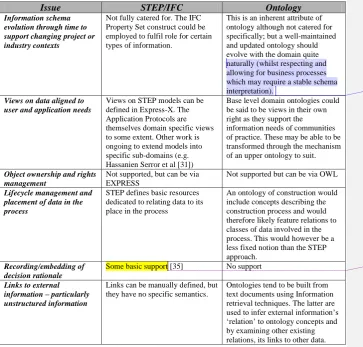
identified in table 1 along with the level of support offered by both the existing popular
standards (including IFCs) and the potential ontology based solutions.
Issue STEP/IFC Ontology
Information schema evolution through time to support changing project or industry contexts
Not fully catered for. The IFC Property Set construct could be employed to fulfil role for certain types of information.
This is an inherent attribute of ontology although not catered for specifically; but a well-maintained and updated ontology should evolve with the domain quite naturally (whilst respecting and allowing for business processes which may require a stable schema interpretation).
Views on data aligned to user and application needs
Views on STEP models can be defined in Express-X. The Application Protocols are themselves domain specific views to some extent. Other work is ongoing to extend models into specific sub-domains (e.g. Hassanien Serror et al [31])
Base level domain ontologies could be said to be views in their own right as they support the information needs of communities of practice. These may be able to be transformed through the mechanism of an upper ontology to suit.
Object ownership and rights management
Not supported, but can be via EXPRESS
Not supported but can be via OWL
Lifecycle management and placement of data in the process
STEP defines basic resources dedicated to relating data to its place in the process
An ontology of construction would include concepts describing the construction process and would therefore likely feature relations to classes of data involved in the process. This would however be a less fixed notion than the STEP approach.
Recording/embedding of decision rationale
Some basic support [35] No support
Links to external information – particularly unstructured information
Links can be manually defined, but they have no specific semantics.
[image:13.595.68.432.208.555.2]Ontologies tend to be built from text documents using Information retrieval techniques. The latter are used to infer external information‘s ‗relation‘ to ontology concepts and by examining other existing relations, its links to other data.
Table 1. Product data versus ontology.
It is clear then that the ontology approach is by no means a cure-all for the ills of
product data models as they currently stand. Indeed we would not propose to replace
data models so much as enhance them, and the applications used to create and
manipulate them, with additional semantic information based on domain and core
Comment [i4]: In response to Reviewer 4, comment 2
ontologies, as described in the following section. However, we would maintain that
ontologies have the right interpretive philosophical underpinning that is more likely to
address the information and knowledge sharing requirements of the construction user
community as argued in section 4.1.
The Web Ontology Language (OWL) is the current leading international standard
notation for the definition of ontologies in a machine interpretable fashion. OWL has
two primary constructs, namely Classes and Properties. Classes represent categories of
things, real or conceptual, and Properties define the relationships between Classes and
between instances of those classes. An OWL Class is somewhat analogous to an
Express Application Object and whereas Express really only has explicit relationships
of the ‗is a‘ inheritance hierarchy type, OWL Properties are far more flexible and
explicit in describing a richer set of possible relations between its classes. Many
Express relationships are opaquely embedded in the properties of application objects.
Similarly, the Express based IFCs define a slightly broader range of relationships but
still somewhat fewer than are routinely embedded in an OWL ontology. It is this ability
to define rich relationships between Classes that gives an OWL encoded ontology its
power.
We see other problems that render data level integration in the STEP or IFC mould less
effective than might otherwise be the case. To understand this position it is necessary to
consider the way in which data integration mandates a considerable degree of work
up-front. This is required in order to agree upon standards, construct a schema for
integration, adapt applications to the standards etc. all before any benefits are realised.
achieve (inter-organisational, national, international etc.). Finally, for large international
standards efforts, agility is something of a problem. Once the standard is agreed,
changing it can take a considerable amount of time, which in an age of rapidly evolving
business needs can turn a formerly helpful system into a hindrance [8].
The use of an ontology or multiple ontologies of the construction domain could act as a
semantic abstraction layer above current standards and models to further integrate
project data in a more intelligent fashion. For example, taking the point on views from
table 1, we believe an ontology with mappings into the underlying data models could be
used to provide a more intuitive view of project data for any given actor based on their
particular disciplinary concepts and terminology. That same ontology could also
provide the view for an actor from a different discipline, based on the relationships
explicated within the domain ontologies and between them and the core or upper
ontology providing links to the appropriate terminology for the same data items. This
type of 'translation' function becomes more compelling when used to view initial project
briefs or client constraints and later when viewing the rationale for changes as it helps
all actors to understand the reasoning involved in a language they can comprehend
easily. Indeed Yang and Zhang, (2006) [71] have proposed extensions to the IFCs to
map them into ontologies for the construction domain to improve the semantic
interoperability of BIM models in just such a way. The mapping of ontology concepts
into the current data model specifications would be performed initially in a semi
automated fashion, perhaps using tools such as those identified by Amor, (2004) [1] for
Taking the schema evolution point from table 1, we would argue for a controlled
process for the update and revision of both core and domain ontologies as suggested in
Rezgui (2007) [55]. This process of continuous refinement of the ontologies means that
at domain level and above, they should evolve naturally with use by the actors in the
domains. However, ontologies would not necessarily help with the evolution of the
design level information schema (i.e. the drawings or models created by designers), a
problem which would remain to be resolved by further research. By contrast, neither
STEP nor the IFCs address these issues directly and the relatively static release based
versions of the standards limit what might otherwise be a route to domain level
evolution to a crawl.
With respect to issues around views over model data, the Express suite of languages
employed by the STEP standards include Express-X, which can be used to create so
called ‗views‘ of Express based STEP models. These views are essentially new models
based on a new schema which has had the elements redundant for the current task or
context removed or otherwise transformed by aggregation, decomposition etc.
Express-X is used in this scenario to define the way in which the base or input schema[s] (and
models based on it) is/are related to the view schema. Language constructs allow for the
definition of rules about how to derive objects and properties in the view schema from
the input schema[s]. In the authors‘ opinion, Express-X adds nothing in terms of the
internal semantic expressiveness of either the base or view schemas and a dedicated
mapping has to be written for each set of base and view schemas.
Where unstructured project information is concerned, the use of ontologies in tandem
automatically infer links between the structured and unstructured information and
indeed between items of unstructured information, based on the links defined in the
ontology. These links lend a greater degree of context to each item relative to the project
as a whole. Benefits may also be derived from uncovering previously unseen linkages
between various elements of project data using such analysis methods. Kosovac et. al.,
(2000) [36] and Schere & Schapke, (2005) [61] have done research work in this or
closely related areas. Some elements of the authors‘ own work have developed or used
ontologies in ways similar to these. The eCognos [68] [37] project for example,
developed and used a construction oriented ontology to augment the services that it
offered as part of the collaborative knowledge management environment also developed
on the project. The FUNSIEC project reviewed numerous European semantic resources,
compiling them into an educational ‗Experience Centre‘ and further conducting a
feasibility study into the production of what the project termed an ‗Open Semantic
Infrastructure for the European Construction Sector (OSIECS) [3].
5. Adoption and Diffusion of a Construction Ontology
In the following section, we discuss the reasons behind the low adoption of IFCs,
introduce the requirements for a successful Construction ontology, and provide an
illustration of a potential ontology for the sector.
5.1. Reasons behind the low adoption of IFCs
A number of studies have been reported in the literature describing various theories and
models related to information technology adoption, diffusion, and innovation into the
mechanisms, including Rogers‘s stage model of Diffusion of Innovations (DoI) in
organizations [60]; whereas others define causality among factors to predict successful
transition of a technology, including Davis‘s Technology Adoption Model (TAM), [16].
TAM argues that end-user acceptance and use of information systems innovations is
influenced by their beliefs regarding the technology. In particular, it proposes that
perceived usefulness and perceived ease of use influence the use of information systems
innovations and that this effect is mediated through behavioural intentions to use [69].
The model highlights the critical role of extrinsic motivation and, in particular,
expectations of task-related performance gains in end-users‘ adoption and use of
Information Systems innovations [69]. Roger‘s Diffusion of Innovation Theory argues
that the rate of adoption of a technology is influenced by a number of factors, including:
Relative advantage (the degree to which potential adopters see an advantage for
adopting the innovation), Compatibility (the degree to which the innovation fits in with
potential adopters‘ current practices and values), Complexity (the degree of the
innovation‘s ease of use), Trialability (the degree to which potential adopters have the
availability of ―testing‖ before adopting), and Observability (the degree to which
potential adopters are able to see observable results of an innovation).
Considering both models (TAM and DoI) in the context of IFCs, the authors discuss the
various factors that may provide an initial explanation to the low adoption of IFCs:
Perceived usefulness of IFCs: the research community and CAD software
industry has failed in convincing the user community about the usefulness in
adopting IFCs. This can be attributed to (a) ineffective campaigning and
awareness raising from the CAD vendors who tend to be driven by market
research community and the construction end-users; (c) the nature of the
industry which is dominated by a large proportion of SMEs that operate in a
survival mode and do not have the resources to consider, investigate, or invest
in sophisticated and costly solutions.
Ease of use of the IFCs (also related to Rogers‘s complexity factor): the user
community has in its majority used CAD to mimic traditional and manual
ways of producing drawings. As such, ease of use is intrinsically linked with
the complexity associated with the adoption of an object-oriented approach to
the production of project documentation. It requires a paradigm shift whereby
users have to adopt a lifecycle approach to data and information integration
and shift from document (drawing) production to maintaining and enriching a
building information model that serves as a basis to generate various
consistent documentation, including drawings. The general feeling of the
industry is that the adoption of the IFCs would require a steep learning curve.
Relative advantage: it can be argued that, based on the above facts, the
research and CAD vendor community (as they are ultimately the ones who are
in charge of implementing the IFCs) have failed in convincing the user
community about the advantages resulting from the adoption of the IFCs. In
fact, there are limited semantic CAD solutions, and these have been mainly
used in research and academic circles. The user community does not therefore
see a relative advantage in adopting the IFCs. Indeed, there is a belief that the
technology is not yet mature and reliable and that there is an inherent adoption
risk.
Compatibility: this is also a major concern as the IFCs require a paradigm shift
oriented approaches to design. Real incompatibility concerns have been
raised, as there is a lack of preparedness and availability of a full and complete
suite of IFC compatible ICT solutions to support the complex design stages.
Trialability: whilst there are many commercial applications that can import or
export IFC format files, their native formats are entirely different and
proprietary. Thus trailability is difficult as existing demonstrators are mainly
academic prototypes that can hardly be put between the hands of practitioners
as (a) these are not stable and robust enough; (b) have mainly been developed
with open source or non-industry friendly platforms / solutions (e.g. Object
Oriented database systems); (c) require an education / training programme
prior to testing so that the users would grasp the underlying concepts.
Observability: A number of efforts have been made in this respect. For
instance, the ATLAS project team in the early nineties have released an
interesting video that illustrates the advantages of adopting product data
technology. However, this did not reach the whole user community and
should have been articulated around a training and education initiative aimed
at potential users from large, medium and small construction firms. Instead,
this was mainly released and used amongst the research and academic
community.
Addressing the above factors should facilitate (a) quicker uptake of a technology, before
attention from adopters fades away, and (b) critical mass of adoption, as there must be
sufficient users and sufficient software providers that support a standard / technology
before it becomes economically viable. Hence, ―timing‖ and ―critical mass‖ emerge as
5.2. Requirements for a successful Ontology
The authors would argue that the development of an ontology should factor in the above
considerations and, hence, be embedded in a wider initiative aimed at raising awareness
of the construction user community through education, training, demonstrations, etc.
Also, given the following factors: (a) the fragmented and discipline-oriented nature of
the construction sector; (b) the various interpretations that exist of common concepts by
different communities of practice (disciplines); (c) the plethora of semantic resources
that exist within each discipline (none of which have reached a consensual agreement);
(d) the lifecycle dimension of a construction project with information being produced
and updated at different stages of the design and build process with a strong information
sharing requirement across organizations and lifecycle stages; a suitable ontology
development methodology should accommodate the fact that the ontology should be
specific enough to be accepted by practitioners within their own discipline, while
providing a generic dimension that would promote communication and knowledge
sharing amongst these communities.
A critical analysis of the semantic resources available in construction, ranging from
taxonomies to thesauri, combined with an understanding of the characteristics of the
sector, have helped formulate a set of requirements that ought to be addressed in order
to maximize the chances of a wide adoption of any ontology project in the construction
sector. These requirements are listed below:
The ontology should not be developed from scratch but should make as much
The ontology should be built collaboratively in a multi-user environment: the
construction sector involves several disciplines and communities of practice that
use their own jargon and have specialized information needs.
There is a need to ensure total lifecycle support, as the information produced by
one actor within one discipline should be able to be used by others working in
related disciplines.
The ontology must be developed incrementally involving the end-users. This is
important given the multi-disciplinary and multi-project nature of the industry,
and the fact that each project is a one-off prototype.
The ontology should be flexible and comprehensive enough to accommodate
different business scenarios used across projects and disciplines.
The ontology should be user friendly, i.e., easy to use and providing a
conceptualization of the discipline / domain being represented that embeds the
technical jargon used in the sector.
The ontology should be a living system and should allow for future expansion.
5.3. eCognos: An example of a candidate Ontology for the Construction sector
Given the above requirements, an ontology was developed, referred to as eCognos [37];
[55]. eCognos is the acronym of an IST Framework 5 project involving the authors that
developed a knowledge management platform comprising a number of services centred
around an ontology. The latter constitutes one of the key contribution of the project.
The eCognos ontology is structured into a set of discrete, core and discipline-oriented,
sub-ontologies. Each sub-ontology features a high cohesion between its internal
organized into a layered architecture (three layers) with, at a high level of abstraction,
the core ontology that holds a common conceptualization of the whole construction
domain enabled by a set of inter-related generic core concepts forming the seeds of the
ontology. These generic concepts enable interoperability between specialized
discipline-oriented modules defined at a lower level of abstraction. This middle layer of
the architecture provides discipline-oriented conceptualizations of the construction
domain. Concepts from these sub-ontologies are linked with the core concepts by
generalization / specialization (commonly known as IS-A) relationships. The third and
lowest level of the architecture represents all semantic resources currently available,
which constitute potential candidates for inclusion into eCognos either at the core or
discipline level.
There are a large variety of available semantic resources that could form the basis for
building the eCognos core ontology. These range from classification systems to
taxonomies. The latter deserve particular attention as argued in Welty and Guarino,
(2001) [66]. One of the principal roles of taxonomies is to facilitate human
understanding, impart structure on an ontology, and promote tenable integration.
Furthermore, properly structured taxonomies: (a) help bring substantial order to
elements of a model; (b) are particularly useful in presenting limited views of a model
for human interpretation; and, (c) play a critical role in reuse and integration tasks.
Improperly structured taxonomies have the opposite effect, making models confusing
and difficult to reuse or reintegrate [66]. IFCs, being more recent and also the closest
taxonomy currently in use in the sector, are therefore the preferred candidate semantic
A particular approach is adopted for building and / or expanding the discipline-oriented
sub-ontologies. This involves selecting and making use of a large documentary corpus
used in the discipline and ideally produced by the end-users. The sub-ontologies are
then expanded and built from index terms extracted from commonly used documents
using information retrieval techniques [55]. This would allow the effective capture of
the jargon and its associated semantics used within each community of practice /
discipline. This is illustrated in Figure 3.
Figure 3: Levels of abstraction of the proposed ontology.
An ontology of the construction domain will include concepts devoted to the description
of the processes involved in construction projects, thus the relationships between the
data on the one hand, and the process within which it is used on the other become more
explicit. It is true to say that STEP and the IFCs both define high level schema elements
related to process and the use of model data within the process, elements which would
need to be duplicated in an ontology. However, certainly where STEP is concerned,
those elements are used to describe processes and data use within individual application
protocols (APs) and therefore understanding the relationships between data in the
individual disciplines (which the APs serve) and the overall project process remains
largely unsupported. The explicit links in an ontology between process and data
concepts can be used to map out a detailed context for information elements relevant to
each actor‘s role in the project and presented in terms that they would normally use. The
existence of a process directly serviced by an information system all of which is
ontologically described allows us to create interfaces to the process for individuals
working, which present relevant information in a timely manner again customised to the
needs and language of the actor.
Therefore, an ontology is not an end in itself. It should have a key and pivotal role in
enabling semantic integration across the project lifecycle and its various disciplines.
The following sections propose inter-enterprise collaboration architectures and
frameworks based on semantic services, underpinned by ontology-based knowledge
structures.
6. Integration through ontology-based semantic services
The pragmatic ontology approach naturally leads to a service-oriented view of the
world, whereby a particular discipline (and therefore the applications that support that
discipline) defines a number of services that it may offer to other disciplines, with
clearly agreed semantics that can be understood by the communicating parties without
having to change the bulk of the conceptualizations that they use in order to provide
those services. As such, ontologies should provide conceptualisations that can span
several stages of a project while factoring in non-technical (i.e. socio-cultural and
organisational) considerations. These conceptualisations can evolve and be adapted to
specific contexts that can be shared across services related to one or several design and
construction stages. The only changes are related to the applications / services used
within each stage.
The fundamental difference between a web service and a desktop application is that
while the former can be virtually accessed ―anytime, anywhere‖, the latter is only usable
from within a desktop or at best through a local / wide area network using a client
/server approach. Web services provide a more flexible middleware solution that suits
application inter-working, leveraging inter and intra enterprise information systems.
Web services are self-contained, web-enabled applications capable not only of
performing business activities on their own, but also possessing the ability to engage
other web services in order to complete higher-order business transactions [23]. The
benefits of web services include the decoupling of service interfaces from
implementation and platform considerations, the support for dynamic service binding,
and an increase in cross-language and cross-platform interoperability. The challenge of
this new form of computing is to move from its initial ―Describe, Publish, Interact‖
capability to support dynamic composition of services into reinvented assemblies, in
ways that previously could not be predicted in advance [23][47]. One of the interesting
features of web services technology is that it provides the means for traditional desktop
applications to be enhanced and upgraded to become and/or to employ web services
[47].
Given the shortcomings we have identified in the current product data centric
approaches to integration and our suggestion that the use of ontologies at this level
could go some way towards addressing them, we would further propose that in order to
have systems that actors can interact with in a more intuitive way, ontologies have more
roles to play. Here we envisage a number of elementary components, each furnishing a
small piece of functionality, usually some discipline specific function, in a fully
be further composed into higher-level business process components, again
self-contained as per the component based development typical of modern object oriented
systems. This model of arbitrary combinations of process components or e-processes as
one might call them, allows for greater flexibility in the definition and production of
business systems to support construction projects. Ontologies play their role not only at
the basic level of a semantic integration layer over the data as detailed previously, but
also (a) as a means to describe the concepts and relationships inherent in the processes
of construction projects and (b) as a means to articulate at a semantic level the precise
nature of an offered service. Working at this higher process oriented level, we begin to
see opportunities for resolving some of the lifecycle and context shortcomings of
current data models.
The OSMOS [59], C-Sand [69] and eCognos [37] [58] [68] projects in which the
authors were involved all employed architectures featuring multiple interoperating
services to furnish their functionality to varying degrees. The success of these projects
demonstrates the utility of the orchestrated service approach whilst eCognos, as
previously mentioned, also featured an ontology to augment its services with semantic
capabilities. The systems developed under the eCognos and C-Sand projects also
featured the ability to consume arbitrary web services for use ‗on the fly‘. The
development of this feature did not however extend to any automated notion of what
those arbitrary services ‗were‘ or ‗did‘, which rather limited its usefulness. Thus we
believe that extending the work to encompass services semantically described by means
of ontologies would allow for a more automated integration and orchestration to take
place, particularly when ontologies are also used to map the services to the business
6.2. Support for semantic e-Processes
The means by which to aggregate and implement a number of Web Services into a
larger business process oriented service are provided through the Business Process
Execution Language (BPEL [43]). The BPEL specification defines constructs similar to
a simple programming language such as loops, assignments, branches etc, with which to
define the flow of calls between a collection of orchestrated services involved in a
modelled process.
The whole Web Services stack comprises several other standards including those for
securing communications between services and clients (WS-Security), standards for
transaction demarcation and management (WS-Transaction) etc. One of the more
important amongst the various protocols for the future of Web Services is the Universal
Description, Discovery and Integration protocol (UDDI [42]), which allows for the
publication and discovery of services on the Web. UDDI has a problem in that whilst it
is possible to publish a service description and have it searchable by others, it does not
make explicit what the service is for in language that a machine can understand. Thus it
is that a human must currently decide whether a particular service is suitable for their
business‘ needs by manually examining both the technical and textual descriptions of a
service for compatibility. Removing this manual intervention would allow UDDI to be
much more useful than it is today and would permit the type of process oriented
services we envisage to be assembled in a more automated fashion. It is here that much
current research and development work is concentrated under the Semantic Web
Services banner. Standards to describe what a service is for and what the various inputs
and outputs actually mean in machine interpretable form are being developed with
Ontology (WSMO [65]). Both of these standards define ontological constructs for
describing services and allow external ontologies to be used in the description of service
parameters. It is in this role that domain specific ontological concepts such as those
defined by the FUNSIEC project [3] or eCognos [37] [55] can be employed to describe
services for particular business fields. Together with the lower level Web Services
protocols, these ontologies allow for the semi automated composition of aggregate
services modelled in line with the business process requirements of specific domains.
While web service technology presents some interesting and promising features, there
are a number of issues hindering the wide adoption of this technology, including data
quality assurance, quality of service (continuity and recovery plans), as well as a trust,
authentication, security, validation, and certification framework (authentication and
trust). Addressing these limitations would confer web service technology the industrial
robustness that would promote its wide adoption on projects. The next section discusses
the dynamic nature of construction project processes and the requirements this places on
the proposed e-process enabled computing environment.
7. Lifecycle dimension and support for the dynamic and long-lasting nature of e-Processes
The design stage of a project involves interesting examples of long-lasting processes.
This section (a) discusses the limitations of service-based process approaches in
addressing the complexity of architectural design, characterised by long-running
cooperative processes, (b) provides a comprehensive framework that summarises the
above shortcomings, and provides a potential e-Platform solution for the construction
(ASP) model‖ for the deployment of the e-Platform solution for the construction
industry.
7.1. Design process characteristics
The multiplicity of circumstances governing the decision making processes inherent in
architectural design leave scope for numerous misunderstandings, unforeseen
difficulties created by inappropriate or ill-conceived information, changes and decisions
which fail to propagate amongst all interested parties. Further, these circumstances are
commonly compressed into short timeframes featuring periods of intense activity in
which many decisions are made. Moreover, design is a predictive activity, that has to be
planned and instrumented, and for which actions that will be implemented are defined
beforehand. At the same time, design is a reactive activity that evolves and adapts as its
content changes with the environment and with the personality of the actors that
conduct it. All the complexity of the design therefore lies in this duality. It is therefore
agreed upon that if design steering consists of organizing and planning tasks with
already identified mechanisms and results; it also consists in managing events, actions
and situations that are not initially known and formalized. The success or failure of a
project is often explained by the manner in which these different unplanned situations
are managed and controlled.
The design process is currently supported by a number of software applications,
including CAD and related engineering software. It can be modelled as a dynamic,
long-lasting, process. However, there exist several limitations of service process
approaches that hinder the effective adoption of such a paradigm. Long running
model evolution due to change in the environment (change in the law, change in the
methodology), process instance evolution (or ad-hoc evolution) due to specific events
occurring during a given process execution (delay, newly available or missing
resources) or partnership evolution at execution time having an impact on part of the
process. These shortcomings require essential advances and improvements, including:
Tracking of history of changes: change management is an important issue in
long lasting processes. When a process model (or an abstract process) is
changed, it may be important to migrate running processes to reflect these
changes. However, this migration is sometimes only feasible under certain
conditions, and must be implemented dynamically.
Partner change during process execution (dynamic change of partner, with
partial fulfilment of choreography): during a long lasting process, a partner may
fail to complete a conversation, or even disappear. In this case, a new partner has
to be selected, dynamic re-composition has to occur and part of the execution
may have to be restarted. It is essential that change of partners be dynamically
supported in the context of the executed choreography.
Partial rollback (check pointing): events such as dynamic change of partners
may require a process to be partially rolled back and re-executed with a new
partner. This partner may even benefit from the previous partial execution.
Partial rollback or compensation may also be triggered by a change in the
process. These scenarios are unsupported or ill-supported by the current BPEL
specification. Partial rollback will require adapting the Business Activity
transaction model to allow a more flexible approach than the simple open nested
Process evolution (unpredictable event management, dynamic process
evolution): during a long lasting process, events may occur such as unexpected
delay or resources evolutions that require more or less important changes in the
process. These changes have to be done while ensuring the correctness of the
process itself. The kind of changes that have to be tackled concern adding or
removing operations in the process, change in the ordering of the steps, changes
in the relationships with the partners (policy evolution). Some work regarding
dynamic process evolution has been done already in the area of workflow
management systems, which would be of benefit if adapted to BPEL processes.
Ad hoc changes are required to ensure the reliability and the validity of the
resulting process.
BPEL as it is defined does not support these kinds of process model evolution and even
less ad-hoc evolutions. This is a real problem for long running processes as experienced
during the design stage of a project where external and internal unexpected events may
require adaptation and evolution. It is worth noting the pivotal role of a construction
ontology in resolving many of the above limitations, in particular those related to
semantic compatibility between services (as illustrated in section 7). Since individual
web services are created in isolation, their vocabularies are often rife with problems
having abbreviations, different formats, or typographical errors. Furthermore, two terms
with different spellings may have the same semantic meaning, and thus are
inter-changeable. Diverse matching schemes have been developed to address these semantic
resolution problems, including in the context of the eContent FUNSIEC project [3]. In
general, matching approaches may fall into three categories: (a) Exact match using
Jaccard, SoftTF-IDF, Jaro, or Levenstein distance); and (c) Semantic match using
ontologies. The latter is the authors‘ preferred approach as it provides the possibility to
reason about web services, and to automate web services tasks, like discovery and
composition [50].
7.2. Proposed e-Platform solution
Figure 4 illustrates a comprehensive framework that summarises the above
shortcomings and issues identified in the paper, and provides a potential e-Platform
solution for the construction industry. This has been inspired from the authors‘
research. The underlying web-service infrastructure has already been developed as
reported in [52], while some of the suggested services have already been specified and
prototyped, including the Ontology service [69] and the Semantic compatibility service
[50]. A brief explanation of each service is given below:
Semantic compatibility service: this, as described earlier, determines whether
two services can inter-work prior to invocation. In essence, the semantics of
their underlying data structures are looked up in an ontology and semantic
relatedness checks are performed.
Process monitoring service: this provides a means to monitor the various states a
process goes through and anticipate potential problems, including availability of
services.
Ontology service: this provides the functionality required to make the selected
ontology available to the other services, which may require it. It provides an
interface to query the ontology, including its concepts, and semantic
Intelligent resource discovery service: This service makes use of a categorisation
sub-service that provides a context and criteria-based categorisation of the
information held within the UDDI registry for effective use and mining by
potential business partners. It provides a standardised interface to query and
make use of the Intelligent Categorised UDDI Registry generated through the
categorisation sub-service.
Composition service: this provides the interface that enables the modelling of an
e-Process. This is achieved through the composition of discrete services.
Process execution service: this is used to execute a modelled e-Process through
the composition service, and provides an interface to control and interfere with
its execution following problems identified by the process monitoring service.
7.3. A proposed business model
We would also suggest a business model based on the application service provider
model for the deployment of the technical solution. Here we envisage three roles as
described in [8]:
Service provider – any organisation having services (specifically web services)
that they wish to monetise and offer to third parties for their consumption.
Providers register their services with the aggregator for publishing and
composition into e-Processes.
Service aggregator/host – An organisation with responsibility for hosting the
infrastructure defined in the middle layer of figure 5 below. The aggregator
service providers tailored to the requirements of particular projects or
organisations (real or virtual) and their business processes.
Service client – any organisation requiring business system functionality to
support their business processes.
It is believed that this model will aid construction sector SMEs in adopting technology
which may otherwise be out of their reach either technically or financially. We do not
however prescribe who may take on the individual roles and indeed envisage that single
organisations, particularly large technologically sophisticated ones, might encompass
elements of all of them. Centralising infrastructure in this way has the additional benefit
of providing a single point of contact for service, support and legal/contractual issues
from the point of view of service clients.
Figure 4: An Ontology-based Framework for e-Process Execution and Management.
8. Preliminary roadmap for semantic servicbased e-Construction
The construction industry is different from other large industries since it relies on a very
high proportion of SMEs involved in both off-site management, design and
procurement and on-site fabrication services. Such SME companies tend only to be
present in a project during their part of the activity and this discontinuity of involvement
is a particular challenge for the industry in relation to the adoption of the right business
models and modes of project operation. Certainly the industrialisation of construction
cannot be done in exactly the same way as in other sectors. This section proposes an
are provided, followed by a proposal for an alliance model. An initial staged roadmap is
then formulated.
8.1. A proposed alliance model for the industry
The general picture of construction is therefore of an industry that is a pyramid with
control being in the hands of large players with a large base of SMEs relatively weak in
influencing the early important decisions in projects because they are usually not
appointed and in place. The expertise of SMEs cannot therefore be brought to bear at
the conceptual and feasibility stages in construction. Also, some industry major players
are reducing the circle of specialists and sub-contractors they use. This has an impact on
the supply/value chain by forcing the emergence of transient knowledge based alliances.
However, these are highly likely to be dominated by large industry players, where
SMEs have no influential role . Hence, SMEs should anticipate this trend by forming
cooperative transient production networks [30].
The way the authors view the future is for SME alliances to be established, forming
knowledge infused virtual networked organisations that can ―punch at a higher weight‖
than the individual SMEs. The alliance brings together SMEs in a relationship of trust to
provide holistic competence to a field of activity - for instance, ―energy consumption,
energy performance monitoring and integration of energy resources‖. The alliance
would market itself with this capability and ultimately achieve a recognised industry
―branding‖ much as a ―big name‖ player. Moreover, because the alliance SMEs would
work frequently together (though not exclusively), they can (a) standardise processes
and information flows, (b) improve sharing of information and re-use of best practice,
investment in collaborative technologies highly attractive and productive. A key
function in an alliance will be to broker, manage and integrate the alliance acting as the
conduit with clients and managing the quality of solutions achieved. The authors view
an SME alliance as a kind of Virtual Factory, with different alliance members
contributing their often much specialised knowledge on particular aspects to virtually
configure a ―best‖ solution against requirements and regulations.
Thus, the authors argue a transformation of production business models for
Construction SMEs, to achieve economies of scale in the production of standardised
processes and product approaches with economies of scope in various stages of
assembly in order to provide flexibility to satisfy customer choices [49].
This is where service-oriented architectures have the ability to provide the underpinning
middleware infrastructure that can support the operations of virtual alliances.
Ontologies will have a pivotal role in this, as they will provide the semantic backbone to
enable concept integration between actors and applications.
8.2. An initial adoption roadmap
E-processes are typically designed, developed, and deployed by enterprises that want to
compose internal capabilities with third-party capabilities, either for internal use or to
expose them as (complex, value-added) e-services to customers. For both e-processes
and e-services, the need for companies to expose internal details of how they run their
business is not envisioned. Still, companies should be able to express, in a standard
format, the interaction aspects for their service offer as well as for their service needs. A
common language is crucial for the assessment of the compatibility between the
interaction processes offered by an e-service provider and those expected by the
designer of an e-process. The effectiveness and efficiency of business processes impact
directly the profitability of a company. It is in the best interest of e-service providers as
well as e-service consumers to understand the operational requirements for their
cooperation. This can best be achieved in the context of an alliance. However, as
traditional processes are designed around the operational model of customised business
applications, e-processes should be designed around e-services. A clear understanding
of the business interaction model of an e-service is paramount, and this should be
facilitated by the service provider (see section 8.3). Migrating to e-Processes involves
Phase 1: integration of existing internal assets. Enterprises (including SMEs) that form an alliance should align their processes to the business needs and
vision of the alliance and work towards reducing costs and improving business
process execution quality and speed. Process automation and management
technologies enable the separation of business, resource and application logics.
Processes can be controlled, managed, and evolved separately from the
applications. In this phase, resources remain internal to the enterprise.
Phase 2: static integration with partner processes on a case-by-case basis. By incorporating e-services provided by business partners into an e-process (within
or across alliances), an enterprise can create processes that utilize external
resources offered by other alliance members. However, in this phase, service
selection and invocation is still performed in an ad-hoc way, and requires
preliminary agreements (from business, legal, and technical perspectives)
between the cooperating alliance companies.
Phase 3: dynamic integration with negotiation, with companies. Beyond such static use of external services, fully dynamic e-processes make decisions each
time they are executed in order to invoke the best available service that can fulfil
the customer's needs. The traditional design-deploy cycle of phases 1 and 2 is
changed to e-Processes that cannot be anticipated in advanced. This will make
full use of the approach proposed in the paper, centred around the use of
ontology.
![Figure 1: Computer Integrated Construction research landscape [8]](https://thumb-us.123doks.com/thumbv2/123dok_us/8722281.884521/5.595.414.558.106.758/figure-computer-integrated-construction-research-landscape.webp)