2018 International Conference on Computer Science and Software Engineering (CSSE 2018) ISBN: 978-1-60595-555-1
Research on Application of Artificial Bee
Colony Algorithm in Facial Expression
Recognition
Jianguo Zuo, Yong Yang and Yue Sun
ABSTRACT
Emoticon classification is an important step in facial expression recognition. In order to improve the recognition rate. Ensemble Learning method use multiple classifiers to determine the expression category. However, among those classifiers in Ensemble Learning, there are some classifiers that are redundancy and poor performance. In order to solve this problem, Artificial Bee Colony algorithm is used to assign different weights to different classifiers, which gives high weight to the classifier performance better, otherwise, it gives low or zero weight to the classifier performance bad. So as to optimize the selection. Experimental results show that this method not only improves the expression recognition rate, but also reduces the computational cost.
INTRODUCTION
Face expression recognition is widely used in many fields, such as human-computer interaction, security, robot manufacturing, medical [1] [2], the subject has attracted more and more researchers to focus on[3]. Typical facial expression recognition is based on the emotion theory proposed by Ekman, which divides facial expressions into six basic emotions: anger, disgust, fear, happiness, sadness and surprise [4]. At present, The typical method of feature extraction is principal component analysis (PCA)[5] for dimensionality reduction.
The typical method of machine learning in facial expression recognition is Support Vector Machine (SVM) [6]. SVM is a pattern recognition method based __________________________
Jianguo Zuo, Yong Yang and Yue Sun
on statistical learning theory and principle of Structural Risk Minimization. However, the performance of single SVM classifier is difficult to be improved due to the complicated data. The Ensemble Learning method is to use multiple classifiers according to the theory of Bagging and then ensemble them according to an algorithm.
The Ensemble Learning constructed a large number of SVM classifiers, resulting in some redundant and poor performance classifier exist. We propose Artificial Bee Colony optimization algorithm to optimize and select of the classifier. This approach can improve the recognition rate and reduce the overhead of classifier with redundancy and poor performance.
ARTIFICIAL BEE COLONY ALGORITHM
Artificial bee colony algorithm is a kind of bionic intelligent optimization algorithm proposed by Turkish scholar Karaboga in 2005. The algorithm is a population evolutionary algorithm based on intelligent group search food randomly[7]. Artificial bees simulate the mechanism of bee mining, the artificial bee can divided into the types, employed bees, onlookers and scouts. the employed bee get a new source of nectar position through the exchange of internal information, and share it's nectar source and nectar value with onlookers through the dance area. Onlookers choose a new nectar location by probability according to the information shared by the employed bee, and also share it's nectar number and the nectar value. The scout is generated when all the bees have not find any new nectar. The motion in ABC algorithm does not completely guide by the optimal solution in the search process, and the search process balances the purpose and randomness. Therefore, its search strategy is very suitable for solving difficult multi-modal problems.
FACIAL EXPRESSION RECOGNITION BASED ON ARTIFICIAL BEE COLONY ALGORITHM
Principle of Algorithm
Training the set of face images T={S1,…,Sm}. According to Bagging ideas.
Multiple classifiers were obtained by randomly selecting sample subset. Obtained a new training set (T1'…TL'). there are m elements in Ti'. The face image was
pretreated with PCA. Classification by SVM. Obtained L classifiers C1…CL.
Use Ci to classify sample Sj into Yi={y1,…yn}, N is the number of the set. yi is
1 1 L i i L = =
∑
y y (1)
For different SVM classifiers, the features of the samples that are not at the same degree, reflection of the whole sample are also different, so we can assuming that classifiers ensemble is a process of classifiers weighted superposition, assume that the weight of each classifier is w. The identification of its ensemble classifiers is shown in formula (2).
1 L i i i w = =
∑
y y (2)
The Target Function of Selective Ensemble
The objective function in the selective integration consists of two parts, The first part is the voting, which requires the maximum concentration of weights and the accuracy, and the second part is the global error regulation part. As shown in formula (3):
1 1
max ( ) ( )
N L
i i i
J w RL w β Err
= =
=
∑
−∑
y + ⋅j
(3)
RL is the actual result of the sample set. It's a unit vector of 6 rows, and the dimension of each row is 1, and the remainder is 0, Y' is the predicted result set.
Err is the average error rate of the sample set. is the weight coefficient. w satisfies the non-negative and the constraint of one, as shown in formula (4) and (5).
0
≥
iw
(4) 1 1 =∑
= L i i w (5)Algorithm Implementation Steps
When ABC algorithm is used to optimize the solution (7), we first need to estimate the parameters of variables. In this algorithm, the weight of the SVM classifier is to be determined. The question of weight optimization for L
classifiers. Row vector of weight is w= [wi1, wi2,…wiN], in ABC search
algorithm,the encoding parameters of the bee search nectar source is (wi1,
wi2,…wiN), that means The location of each bee is an n-dimensional vector In
order to satisfy the selectivity of algorithm and satisfy the constraint of nonnegativity and sum of weight coefficients equal 1, we use parallel space mapping to transform weight vectors.
x is the position of the particle group. w is the weight, but in the L classifier, The weights obtained by some classifiers can be ignored, So a few small weights can be removed.
∑
= ′ ′ = L i i x x w 1 (7) Among them, < ≥ = ′ val x val x x x i0 , and L
x val L i i
∑
==α 1
search for the minimum value of the formula (12) by Artificial Bee Colony optimization algorithm, get the weight of selective ensemble. The specific process of the ABC ensemble selection algorithm is as follows:
Step1 Determine the dimensions of the search individual and the number of bees according to the number of SVM classifiers.
Step2 Randomly generate a certain number of search individuals within the constraints, starting with the location of employed bees and scouts.
Step3 According to the position of the employed bee or scouts, the new weight is obtained by the parallel mapping (7), then the individual's fitness value is calculated by formula (3).
Step4 search nectar source according to formula (8), update the position of employed bee and scouts.
Step5 The optimal location of the current population is obtained according to the inetnal information exchange in the population, Comparison with the optimal position of history, If the historical position is better than the historical position, then update the historical position.
Step6 If the maximum evolutionary algebra is reached, according to formula (4) and (5), select the output classifier and the weight of each classifier. Otherwise, return step 3.
(
ij j j j
x =rand up −low )+low (8)
upj and lowj represent the upper limit and the lower limit of the value of the
jth dimension of the search individual respectively. rand is random number in [-1,1]
EXPERIMENTAL DESIGN AND ANALYSIS OF RESULTS
Experiment Setting
extract LBP features from the detected face images, and reduce the dimension and eliminate the data redundancy by 2DPCA method.
The SVM classifier used is lib-svm developed by professor Lin chi-jen of Taiwan university [10]. The parameters of the Bee colony algorithm in this paper are set as following: the population size N=30, dimension of search individual
D=6, evolution generation G=200.
Experiment and Result Analysis
EXPERIMENT 1: A COMPARATIVE EXPERIMENT BETWEEN A SINGLE CLASSIFIER AND A FULLY ENSEMBLE AND OPTIMIZED ENSEMBLE CLASSIFIER
[image:5.612.118.480.326.488.2]In this experiment, two data sets of CK+, JAFFE are selected, The experiment
TABLE I. EXPRESSION RECOGNITION RATE OF JAFFE DATA SET.
Experiment Single classifier Full ensemble Optimized ensemble
1 72.53% 83.23% 86.72%
2 75.53% 86.78% 85.93%
3 78.56% 84.03% 87.78%
4 73.76% 81.66% 84.79%
5 74.56% 82.47% 85.09%
6 73.57% 82.55% 87.30%
7 75.04% 85.32% 85.91%
8 76.53% 85.22% 88.32%
9 73.67% 83.10% 87.23%
10 78.32% 83.60% 85.89%
Average 75.21% 83.80% 86.50%
TABLE II. EXPRESSION RECOGNITION RATE OF CK+ DATA SET.
Experiment Single classifier Full ensemble Optimized ensemble
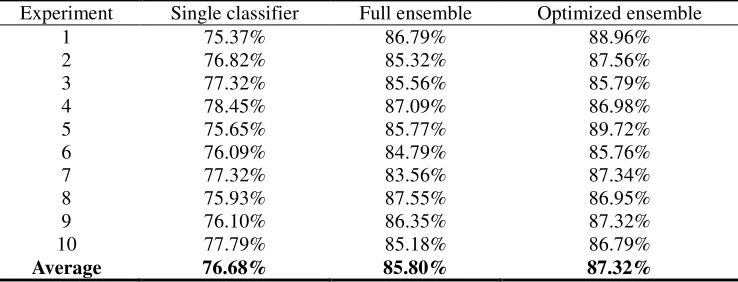
1 75.37% 86.79% 88.96%
2 76.82% 85.32% 87.56%
3 77.32% 85.56% 85.79%
4 78.45% 87.09% 86.98%
5 75.65% 85.77% 89.72%
6 76.09% 84.79% 85.76%
7 77.32% 83.56% 87.34%
8 75.93% 87.55% 86.95%
9 76.10% 86.35% 87.32%
10 77.79% 85.18% 86.79%
[image:5.612.114.483.526.667.2]TABLE III. NUMBER OF CLASSIFIER BEFORE AND AFTER OPTIMIZATION. Dataset Before Optimized After Optimized
JAFFE 30 18.2
CK+ 30 16.8
First trains 30 base classifiers, construct 30 training subsets on three datasets. Using 10-fold cross-validation method, 10 experiments carried out on each data set and each classification method.
It can be seen from table I-III, The ensemble classifier has greatly improved the recognition rate compared with a single classifier. The optimized ensemble classifier has a further improvement compared with the fully ensemble classifiers, and the number of models is reduced.
EXPERIMENT 2: COMPARISON EXPERIMENT OF DIFFERENT OPTIMIZATION ALGORITHMS.
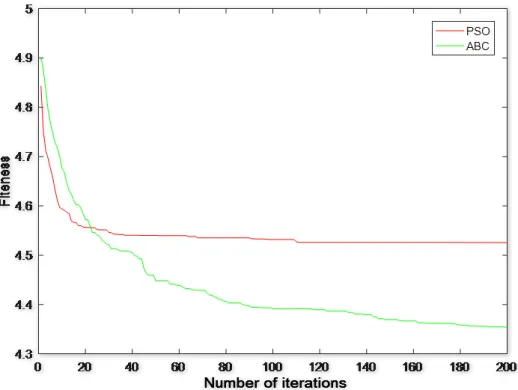
In order to prove the artificial bee colony optimization algorithm has a better global convergence, compared it with Particle Swarm Optimization (PSO). The parameters of the PSO algorithm are set as follows: The size of the population is 30, the times of iterations is 200, The result of the experiment is shown in Figure 1-2 and Table III.
[image:6.612.169.428.414.609.2]Figure 2. Evolution curve on CK+ data.
TABLE IV. THE RECOGNITION RATE OF PSO AND ABC OPTIMIZATION ENSEMBLE EXPRESSION.
JAFFE CK+ KDEF
PSO 85.36% 86.37% 86.39%
ABC 86.50% 87.32% 87.11%
It can be seen from table IV that the recognition rate of the ABC optimization is higher than the recognition rate of PSO optimization, and the stability is relatively good. From the evolutionary curve of Figure 1-2, it is known that PSO has converged around 60 generations, and is trapped in local convergence. The ABC is convergent in the 180 generation and slowly converges around the 100 generation. Although ABC is less than PSO in convergence speed, its ability to overcome global convergence is better than that of PSO. From the analysis of the graph and the table, the artificial bee colony algorithm has a higher recognition rate and better global convergence than the particle swarm optimization.
CONCLUSION
[image:7.612.139.454.317.362.2]Compared with Particle Swarm Optimization (PSO), the accuracy of the algorithm is higher and the global convergence is better.
REFERENCES
1. Su, Zhang, and Wang Wensheng. "Optical correlation recognition of the moving target in cluttered background." Acta Optica Sinica 32.1 (2012): 0107001.
2. Biao, Jin, Hu Wenlong, and Wang Hongqi. "Moving-objects interaction recognition based on
the spatial-temporal semantic information." Acta Optica Sinica 32.5 (2012): 0515002. 3. Guo Feng, Zou, et al. "New research advances in facial expression recognition." 2013 25th
Chinese Control and Decision Conference (CCDC). IEEE, 2013.
4. Ekman P, Friesen W V. Constants across cultures in the face and emotion[J]. Journal of personality and social psychology, 1971, 17(2): 124.
5. Wold S, Esbensen K, Geladi P. Principal component analysis[J]. Chemometrics and
intelligent laboratory systems, 1987, 2(1-3): 37-52.
6. Suykens J A K, Vandewalle J. Least squares support vector machine classifiers[J]. Neural processing letters, 1999, 9(3): 293-300.
7. Karaboga D, Basturk B. A powerful and efficient algorithm for numerical function
optimization: artificial bee colony (ABC) algorithm[J]. Journal of global optimization, 2007, 39(3): 459-471.
8. Lyons M, Akamatsu S, Kamachi M, et al. Coding facial expressions with gabor
wavelets[C]//Automatic Face and Gesture Recognition, 1998. Proceedings. Third IEEE International Conference on. IEEE, 1998: 200-205.
9. Kanade T, Cohn J F, Tian Y. Comprehensive database for facial expression
analysis[C]//Automatic Face and Gesture Recognition, 2000. Proceedings. Fourth IEEE International Conference on. IEEE, 2000: 46-53.
10. Ding Shifei, Qi Bingjuan, Tan Hongyan. An Overview on Theory and Algorithm of Support