2018 2nd International Conference on Modeling, Simulation and Optimization Technologies and Applications (MSOTA 2018) ISBN: 978-1-60595-594-0
Rectifying the Misinformation in Social Network
Shi-xin WANG
1,2and Wen-guo YANG
1,21School of Mathematical Sciences, University of Chinese Academy of Sciences, Beijing, China
2Key Laboratory of Big Data Mining and Management, Chinese Academy of Sciences, Beijing,
100049, China
Keywords: Rumor propagation, Influence maximization, Social networks, Heuristic algorithms.
Abstract. This paper proposes a rumor rectification model considering the context when rumor in the social network has propagated for a period of time such that it is too late to block the rumor. We give an explanation that existing models on rumor blocking are not appropriate in this case. TIM+ is an efficient approximation algorithm in influence maximization problem, however it handles the case when there is only one influence cascade in the network. We modify it to suit the two cascades case in our problem and find obvious effect comparing with the random solution.
Introduction
Misinformation, or rumor spreading in the social network may cause damage to a company or an individual’s reputation, or even worse, bring about negative impact on society. At present, there are several works about rumor blocking [2,3,4], which aims at blocking rumor or misinformation spreading in the social network. While blocking rumor in the social network makes sense only in the context when rumors are just beginning to spread, in other words, most of people in the network are not influenced by rumor at present. As for the situation when victims of the rumor take measures is too late, blocking the rumor is meaningless since the rumor has diffused thoroughly. On this occasion, treatment is more important than prevention. What mainly need to be done at this moment is not blocking the rumor but trying to send truth to those who are misled so that they can realize what is true.
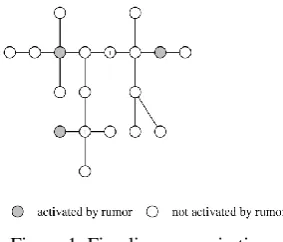
Figure 1. Fingding rumor in time.
Classical rumor blocking models give a proper description to the rumor blocking under the condition that the proportion of initial rumor activated nodes is small. However, if the rumor is discovered too late, it spreads thoroughly in the network. Then most of the nodes in the network have been influenced by the rumor already. Blocking is meaningless under this circumstance and models for rumor blocking are no longer suitable. In our work, we study the case when the rumor is discovered too late and the social network is almost filled with rumor. Under this assumption, rumor blocking is ineffective as Figure 2 shows, since there is not enough space to block rumor.
Figure 2. Too late to block the rumor.
Background and Related Work
This section introduces some existing works related to rumor blocking.
Influence maximization problem is to find the most k influential nodes in a network 𝐺 = (𝑉, 𝐸). Kempe first gives the two well-known influence propagation model IC and LT. Influence maximization problem has been extensively studied in [7].
Greedy algorithm has good approximation (1 −1𝑒) for this problem but is very inefficient. Great number of researches [10,11,12] has been taken on this problem to reduce the running time of greedy. All these algorithms either trade approximation guarantees for practical efficiency or vice versa. However, inspired by Borgs et al. [11] drastically different method (referred to RIS by Tang), Tang et al [12] gives TIM and TIM+ algorithms which are usually referred to a polling method satisfied both approximation guarantees and practical efficiency in scalable network. TIM and TIM+ solve RIS’s shortage and are widely adopted in later studies [4], [13], [14].
Bharathi et al [5] first study two or more competitive cascades diffusing in a social network. In their work, they study when multiple companies competing in a market, what is the best strategy for the first or the last company entering into the market. They show that for the last player the occasion is similar to the original influence maximization problem while for the first player things is quite different. The key feature in their model is that once a user chooses one product, he will never change his choice. What this means in a network is that once a node is activated by one cascade of influence, it will never be reactivated by other cascades of influence. That’s the very point which is different from us.
example to show this. Nevertheless, they solute their EIL problem in a simplified version, namely the number of the initial misinformation node is single one. Besides, the high-effectiveness property in their model which makes it simplified to solute is not that necessary.
Bharathi and Budak study the competing problem in IC model, while He X et al [3] study it in LT model. Though both IC and LT model describes the process of influence diffusion, they have quite different property. In LT model, randomness is described by the threshold in each node. Their CLT model not only guarantee the two set of parameters for two different competing influence but also keeps the problem to be submodular.
Rectification of Rumor
What is particular different from rumor blocking model is that in our model if a node knows the fact, it can spread the information of fact to its neighbors. In addition, if its neighbors containing rumor misled nodes, then it has chances to rectify them when the spreading process happens. Considering the situation that rumor is discovered late, a great number of people in the network are misled by rumor and things have become serious. We can make a reasonable assumption that the rectification information we spread is convincingly enough so that the truth activated nodes in the network can change the rumor nodes into truth activated nodes.
Two cascades of information propagate in the network. If a node is activated by the truth information, we call it +active. Similarly, we call it -active if it is influenced by rumor.
We propose Rumor Rectification model which is based on the IC model. Given a node set 𝑅0
which represents the source of rumor in the network. Let 𝑅 to be the set of nodes that will be influenced by 𝑅0. 𝑅0 is fixed while 𝑅 may change since the randomness of IC model. However, in a
specific case, 𝑅0 has finished its propagation and hence 𝑅 is fixed. Let 𝑆 to be a seed set of nodes
spreading fact information. We suppose that rumor has spread thoroughly before S begins to propagate.
Below we give rules to describe the mutual interaction of the two influence (rumor and fact): 1. –active node can be rectified by +active node when –active node receives truth information from +active neighbors.
2. Each node activated by +active will not be reactivated again.
If a node 𝑢 in 𝑅 is activated by +active node, u turns to +active and we call this process is a rectification
The Problem
Define 𝑓(𝑆) to be the expected whole times of rectification with respect to the random result 𝑅 happens in the spread process of 𝑆. Then the rumor rectification problem is:
Given a network 𝐺, 𝑅 and 𝑅0. 𝑅 is a node set composed of all rumor nodes in the network, with source 𝑅0. Then the optimization problem is finding a node set 𝑆(|𝑆| = 𝑘) in 𝐺 such that 𝑓(𝑆) is maximized.
This problem is NP-hard.
Heuristic Algorithms
Though the calculation of 𝑓(𝑆) is based on 𝑅, we select 𝑆 before 𝑅0 starts spreading. In other words, we don’t care what 𝑅 is in the algorithm. According to [14], the nodes in a random 𝑅𝑅 set of 𝑢 (denoted as 𝑅𝑅(𝑢)) are nodes that can activate 𝑢. In fact, each 𝑅𝑅 set is a nodes set of a directed tree with root 𝑢. Since we want to maximize the number of rectification, this inspires us to consider trying to generate a new type 𝑅𝑅 set of 𝑢 (denoted as 𝑅𝑅+(𝑢)) from the origin 𝑅𝑅 set. The nodes in our
𝑅𝑅+(𝑢) set stands for those nodes that will rectify 𝑢.
If 𝑅𝑅(𝑢) ∩ 𝑅0 = ∅, then we ignore this 𝑅𝑅 set.
We generate 𝜃𝑅𝑅 sets and ignore those which doesn’t contain 𝑅0’s nodes, where 𝜃 is calculated by TIM+ algorithm. Then we modify the remain sets to be 𝑅𝑅+ sets. Finally, selecting the top 𝑘 nodes that covers 𝑅𝑅+ sets most.
The selecting process is in fact to deal with a maximum coverage problem, we can easily solve it by greedy algorithm according to TIM+.
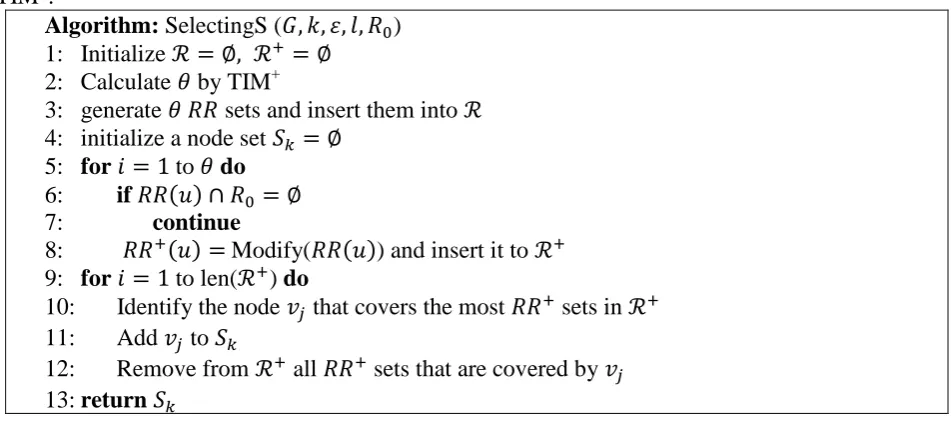
Below is the heuristic algorithm proposed in this paper. In particular, 𝐺 is a network, 𝑘 is the budget, 𝑅0 is a node set which represents the source of rumor and 𝜀, 𝑙 are the parameters needed in TIM+.
Algorithm: SelectingS (𝐺, 𝑘, 𝜀, 𝑙, 𝑅0) 1: Initialize ℛ = ∅, ℛ+ = ∅
2: Calculate 𝜃 by TIM+
3: generate 𝜃 𝑅𝑅 sets and insert them into ℛ 4: initialize a node set 𝑆𝑘 = ∅
5: for 𝑖 = 1 to 𝜃 do
6: if 𝑅𝑅(𝑢) ∩ 𝑅0 = ∅
7: continue
8: 𝑅𝑅+(𝑢) = Modify(𝑅𝑅(𝑢)) and insert it to ℛ+ 9: for 𝑖 = 1 to len(ℛ+) do
10: Identify the node 𝑣𝑗 that covers the most 𝑅𝑅+ sets in ℛ+ 11: Add 𝑣𝑗 to 𝑆𝑘
12: Remove from ℛ+ all 𝑅𝑅+ sets that are covered by 𝑣𝑗 13:return𝑆𝑘
Experiments
[image:4.595.59.535.180.391.2]We evaluate our algorithm on two real world datasets NetHEPT and Epinion. The basic information of the two datasets are as follows:
Table 1. Information of Networks.
NetHEPT Epinion
# Nodes 15k 76k
# Edges 62k 509k
We set the propagation probability of each directed edge 𝑢 to 𝑣 as 𝑡ℎ𝑒 𝑖𝑛𝑑𝑒𝑔𝑟𝑒𝑒 𝑜𝑓 𝑣1 . First, we use
TIM+ algorithm to generate 𝑅0 as the source of rumor (|𝑅0| = 50). Then we calculate its expected spread by Monte Carlo method and this number is record as the number of rumor nodes in the graph. After that, we use our algorithm to select the seed set 𝑆. Let 𝑘 varies from 1 to 50, 10 increase each time. The results of expected rectification are showed below:
Figure 3. Expected rectifications results.
[image:4.595.100.488.597.743.2]The code is written in Python and is run on a Macbook Pro 2016 with core 2.6GHz CPU and 16GB memory.
Acknowledgement
This research was financially supported by the National Nature Science Foundation of China 11571015.
Summary
In this paper, we mainly consider a case when it’s too late to find the rumor or misinformation in the network. As a result, the network is enriched with rumor so that blocking the rumor is not appropriate. Then we design a heuristic algorithm based on TIM+ and find it works well. Noticing that when
𝑘 = 50, the proportion of rectifications is around 17, which is not a big proportion. Perhaps this is relevant to the structure of network and the parameters of propagation probability. Besides, we can see that if a misinformation is spreads extensively among people, then proportionately, it is hard to send the fact to the most of misled crowd.
References
[1] Kempe D, Kleinberg J. Maximizing the spread of influence through a social network[C] ACM SIGKDD International Conference on Knowledge Discovery and Data Mining. ACM, 2003: 137-146.
[2] Budak C, Agrawal D, Abbadi A E. Limiting the spread of misinformation in social networks[C] International Conference on World Wide Web, WWW 2011, Hyderabad, India, March 28 - April. 2011:665-674
[3] He X, Song G, Chen W, et al. Influence Blocking Maximization in Social Networks under the Competitive Linear Threshold Model Technical Report[J]. Computer Science, 2011.
[4] Tong G A, Wu W, Guo L, et al. An efficient randomized algorithm for rumor blocking in online social networks[C] INFOCOM 2017—IEEE Conference on Computer Communications, IEEE. IEEE, 2017:1-9.
[5] S. Bharathi, D. Kempe, and M. Salek. Competitive influence maximization in social networks. In WINE, pages 306-311, 2007.
[6] Zhu Y, Lu Z, Bi Y, et al. Influence and Profit: Two Sides of the Coin[J]. 2015:1301-1306.
[7]W. Chen, Y. Yuan, and L. Zhang. Scalable influence maximization in social networks under the linear threshold model. In ICDM, pages 88–97, 2010. A. Goyal, F. Bonchi, and L. V. S.
[8] Lakshmanan. A data-based approach to social influence maximization. PVLDB, 5(1):73–84, 2011.
[9] K. Jung, W. Heo, and W. Chen. Irie: Scalable and robust influence maximization in social networks. In ICDM, pages 918–923, 2012.
[10] J. Kim, S.-K. Kim, and H. Yu. Scalable and parallelizable processing of influence maximization for large-scale social networks. In ICDE, pages 266–277, 2013.
[11] C. Borgs, M. Brautbar, J. T. Chayes, and B. Lucier. Maximizing social influence in nearly optimal time. In SODA, pages 946–957, 2014.
[13] Lu W, Chen W, Lakshmanan L V S. From competition to complementarity: comparative influence diffusion and maximization[M]. VLDB