https://doi.org/10.5281/zenodo.1186399 Research Article
Frida Gjermeni Departament of Information Technology, Faculty of Information Technology, “Aleksander Moisiu” University of Durres. Albania. Biljana Percinkova International University of Struga, Macedonia.
The e-learning platforms combining both digital contents and knowledge management, are taking an important role in education at the same being used by many enterprises on employee‘s training to promote competitiveness. Their characteristics of learning anytime and anywhere, making use of the mobile technology and cloud applications, give them superiority compared to traditional teaching methods in the classroom. Since the students and teachers are on different time and space in an e-learning environment, the learning status of a student is difficult to be controlled by teachers. Also the majority of the existing formation platforms are generally conceived as contents distribution systems, with few concerns about the interests and the immediate reaction ofsingular learners in the virtual classroom. In order to achieve efficiency and trying to avoid the above mentioned disadvantages, there is a need for gathering information regarding each learner‘s profile, and building a personalized path of learning for each student or students with similar profile progress in the learning process. In order to get information about the students' profile, meaning the way he wants and is able to gather knowledge, questionnaires to evaluate his/her psychological profile can be of great help. In this paper we address the issue of e-learning personalization through implementing Intelligent Algorithms based on Intelligent Agentsin an e-learning environment. The IAELS Algorithm and the Agent System Based Algorithm are compared in a qualitative and quantitative way. Results are presented based on students‘ opini¬ons and their performance achieved in the Microsoft Office Suite 2010 e-learning course. Further developing this kind of intelligent evaluating system we propose development of a questionnaire, so that based on different learners' profiles, we could incorporatea starting point in building e-learning ennvironment for gathering virtual knowledge by the e-student.
1. Introduction
The development of Internet technologies and growing interest in distance learning are the main reasons for the fast growing field of e-learning. The most popular platforms are Tutor (http://www.atutor.ca) Moodle (http://moodle.org), Claroline (https://www.claroline.net), OLAT (http://www.olat.org) or Sakai (http://sakaiproject.org) are equipped with hundreds of modules with specialized functionalities dedicated to users and courses management, schedulespreparation, payments, etc. However, there is still a strong need of further development (Pahl, 2003), which is oriented towards personalization of e-learning students experience and content. The first issue (personalization of systems) is available in almost every e-learning platform, but the personalization of learning content is much more sophisticated issue (Sehring et al.,2005). It depends on many individual features e.g. motivation, cognitive aspects, intentions,emotions or learning history (Martinez, 2002). Taking into consideration of these features for the purpose of improving the learning process, learners obtain possibility to acquire knowledge much more efficiently. Unfortunately, most of the reviewed e-learning systems suffer from lack of modules that would be able to personalize the learning content based on a suitable criterion. In fact, theconcepts of personalizedintelligent algorithms do exist, however, they are not popularized in mostcommonly used e-learning platforms. Chosen representative approaches are described inthe next subsection.
Combining Intelligent Algorithms and E-Learning Styles to Create an Improved
Intelligent System in Evaluating an E-Learning Student’s Profile
Computer Science
Keywords: E-learning platform,
Intelligent algorithms, Agent based algorithm, IAELS Algorithm, e-learning
path.
2. Related Work
Recent publications in the domain of artificial intelligence applied in e-learning are dominatedby a number of directions. Proposed approaches analyze mainly behavioral and cognitive models of learners. Then, they try to apply sophisticated algorithms able to support interactions with users inside e-learning platforms. The examples of such methodologies are proposed by Chen et al. (2005), and Mor, Minguillon (2004). Chen presented application of Item Response Theory, which is used to determine learners‘ abilities and course materials difficulties in reasoning process. Similar approach by Mor and Minguillon facilitates navigation through e-learning system using history of users‘ interactions and behavior.
Other approaches to learning content personalization utilize semantic web technologies. Most of such methods use ontologies to standardize student‘s model, monitor progress, notes and passed exams (Gomes et. al, 2006; Gascuena et. al, 2006). Such model is used mainly to predict; which part of knowledge should be learnt by a student as a next one. More advanced approaches are developed as well (Henze et. al, 2004). Their functionality is extended in most cases with logical layer that is implemented in dedicated TRIPLE language. The algorithm proposed by Dolog et. al (2004) uses both aforesaid technologies, i.e. Semantic Web and AH, and is based on web-services architecture. Dolog implemented the dedicated Personal Learning Assistant, which integrates personalization and other supported web services published bydifferent e-learning platforms. Further on, it provides personalized access to required learning resources in distributed e-learning environment. Recently, the research on agent-oriented programming has begun because of the intelligent agent technique being developed rapidly. For example, Roda et. al [9] presented an agent-based system designed to support the adoption of knowledge sharing practices within communities. The system is based on a conceptual framework that, by modeling the adoption of knowledge management practices as a change process, identifies the pedagogical strategies best suited to support users through the various stages of the adoption process.
3. Explaining and defining Intelligent Algorithms Agent System based Algorithm
The main goal of the presented agent-based algorithm (Figure 1) is to select elements of courses from database that are crucial and indispensable for further student‘s education. The selection is based mainly on the history of education and this results in form of new personalized courses.
The basic unit of created agent system represents one SCO object and the whole system is organized in form of recurrent structure. Such architecture allows agents to have set of links to other agents, which makes them able to represent the courses according to SCORM standards. Every agent in this system includes content of represented object and meta knowledge which describes it. Connections between agents correspond to connections between SCO objects and courses.
Meta-knowledge includes information about access to given course‘s elements such as date of last access by particular students, time spent on this element and grades obtained in the tests verifying the contentlearnt. Each agent is characterized by activation threshold and weights of connections with other agents. Values of those properties are equal to corresponding values in related course elements.
In the first step of algorithm, the initial agents (courses elements) are marked as active. Then, these agents send signals to connected agents with the calculated strength value. The sum of all signals, which reach agent, is compared to the activation threshold due to the following rules:
If the value of sum is higher than the threshold, the agent is marked as active. If the sum is lower than the threshold, the agent is marked as inactive.
If the sum is equal to the threshold, the state of agent remains unchanged.
|
Figure 1. Scheme of algorithm dedicated to selection of SCO objects represented by agents, where N is a number of all agents and C is a variable denoting change in system of agents [6]
If the system of agents has changed in current iteration, then all signals are recalculated recursively one more time. This process is repeated until no further changes in the state of agents occur. At the end of the selection, elements represented by active agents are returned as part of the personalized course.
Personalized courses are created by concatenation of returned elements into new courses stored in platform‘s database. The new courses are equipped with parameter used to determine the final recipient. Individual SCO objects (elements of new courses) are stored in database with the information about their original parent course. These records are removed if new personalized courses of the same owner are created.
The IAELS Algorithm
Figure 2. The architecture of IAELS [9]
In the architecture of IAELS there are three layers. The application layer includes learning module, discussion module and management module; it integrates the component layer‘s function for learners and teachers to use this system easily. The component layer shows this system‘s functions; it includes adaptive learning and test, personal learning and test, material management and account management. The adaptive learning and tests are generated according to learner‘s level; they differ depending on the personal learning style. Tests are generated based on analyzing the causes of learning inefficiency. The database layer includes test-portfolio database, portfolio database, learning material database and test material database; it is used to save the learner information and teaching material.
Four intelligent agents are designed in IAELS to collect precise portfolios and test-portfolios for each learner while a learner is learning and being tested. They find an appropriate learning path for the learner guiding the learning process and monitoring the discussing board. It helps the learner to spend less time while learning useful course materials. The system learning flow is shown in Figure 3.
Step 1: User agent gets the learner‘s level after a learner has done the pre-test.
Step 2: Learning agent searches adaptive course and adaptive test for the learner from database according to the learner‘s level.
Step 3: The precise portfolio and test-portfolio are collected by user agent and data mining agent to analyze the learning path and learning inefficiency of the learner.
Step 4: Passesthe analyzed information to feedback agent and learning agent to provide the personal course and update the learner‘s level for the learner.
Step 5: Feedback agent makes the personal course according to analyzed information past by Data mining agent to improve the learner‘s learning efficiency.
Step 6: When a new course is selected by the learner, the learning flow for the learner repeats step 2 to Step 6.
Figure 3. The system learning flowchart [11]
3. Defining e-learning environment
The e-learning environment an adaptive course with path personalization is created.
Adaptive course
The adaptive course can help the learner to avoid learning confusedly and help him to learn easily. The process ofgenerating adaptive course is shown in the figure bellow (Fig. 4).
Firstly, each learner has pre-test in order to accurately find each learner‘s level. The user agent then passes learner‘s information to learning agent. Learning agent searches corresponding course in teaching material database and test material database for the learner based on the
obtaining information; finally,it generates an adaptive course for the learner. The level of database materials is predefined by the teacher.
Figure 4. The process for generating an adaptive course [8]
Personal course
The process of generating personal course is shown in Figure 5. The purpose for it is to meet learners‘ requirement and adapt the learners‘ level. The data mining agent firstly analyzes the requirement and the causes of learning inefficiency of the learner from the portfolio database and test-portfolio database, and then passes the information to the feedback-agent. When the feedback agent gets the information, it will search suitable courses course material database and test material database to generate personal course for the learner.
Figure 5. The process for generating personal course [4]
The e-learning course we are creating is Microsoft Office Suite 2010, taken by the students of Information Technology. We have used Moodle as an appropriate software for integrating the algorithms in the personalized course.As a reference for comparing, the algorithms for Microsoft
Office 2010 Suite Course that our students are taking at the Faculty of Information Technology in Durres are being used.
We use the two first chapters of the courses forWord Basics and Excel Basics. Each chapter contains description of algorithm and set of definitions related to the corresponding method. The front-end script language Java Server Pages (JSP), Microsoft SQL Server 2000 and Aglet 2.0.2 are used to implement the system.
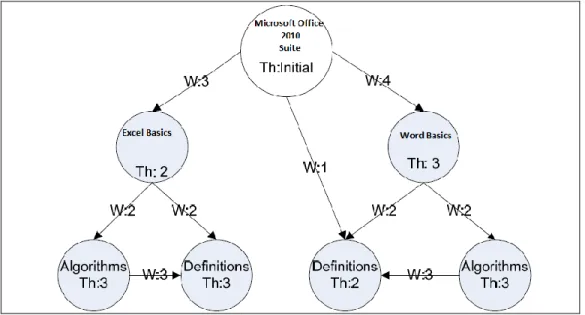
Figure 6. Structure of agent system based on the course of Microsoft Office 2010 Suite
Connections between elements suggest that:
to accomplish this course user should acquire knowledge from both chapters (Word Basics and Excel Basics),
understanding of each chapter requires knowledge of associated algorithms and definitions,
understanding of each algorithm requires knowledge of associated definitions,
understanding of main part of course requires knowledge of definitions associatedwith Word Basics.
Processing of this course by created agent system starts by selection of main element (Microsoft Office 2010 Suite) as active. This element is connected with three other elements i.e.
Excel basics, Word Basics and Definitions (from simplex chapter). Depending on weights assigned to those connections, next elements are selected as active. In this example only weights associated with Word Basics and Excel Basics methods are high enough to activate corresponding elements. At this moment all elements are connected with active elements and receive signals. Definitions element from Word Basics chapter receives now signals from two sources i.e. Word Basics and Microsoft Office 2010 Suite. Because sum of these elements is higher than its activation threshold, this element is marked as active. Signals reaching the
remaining elements are not sufficient enough to activate them, and no further changes occur in the state of system. In result, personalized course consists of following elements: Microsoft Office 2010 Suite + Word Basics + Excel Basics + Definitions (from simplex chapter).
The same environment was used for IAELS, incorporated in the same course.
4. Results and discussion
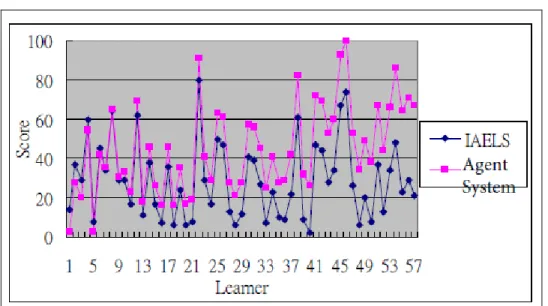
We had the students take the same course (basically the two chapters we are talking about) and we did test their achieved knowledge, first with the agent based algorithm and then with the IAELS approach. We had 57 students that did take both courses. Here there are their results, graphically presented.
Figure 7. Students Test Scores using IALES and Agent System
As we can see the results of the students taking the course while there implemented the IAELS algorithm have scored higher results in the test. This indicates that the algorithm of IAELS approach gives better adaptation into the efficiency of the e-learning personalization of the course.
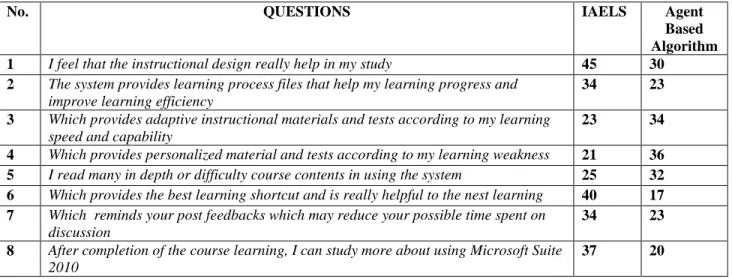
In the table below we present the questionnaire used to assess the learning efficiency and learning satisfaction of IAELS versus the Agent System among the students.
Table 1. Students answers for the questionnaire
No. QUESTIONS IAELS Agent
Based Algorithm
1 I feel that the instructional design really help in my study 45 30
2 The system provides learning process files that help my learning progress and improve learning efficiency
34 23
3 Which provides adaptive instructional materials and tests according to my learning speed and capability
23 34
4 Which provides personalized material and tests according to my learning weakness 21 36
5 I read many in depth or difficulty course contents in using the system 25 32
6 Which provides the best learning shortcut and is really helpful to the nest learning 40 17 7 Which reminds your post feedbacks which may reduce your possible time spent on
discussion
34 23
8 After completion of the course learning, I can study more about using Microsoft Suite 2010
37 20
Also here IAELS wins over the Agent Based Algorithm as we can see from the results of the students answers of our questions.
5. Future development
Algorithms will be further developed by adding modules for recognizing specifics in student‘s learning style based on the steps passed in the learning process. Namely, individuals study in different ways: someone by reading books, others by using different activities, yet others by learning from their mistakes, etc. As the learning process goes on, preferences for certain learning styles are created. Recognizing someone‘s learning style is the first step towards increasing the power of learning, that is, reaching a stage in which the individual gets the most out of the learning process. The following distinction could be made based on the steps passed in the learning process:
(1) Gaining experience – Activist;
(2) Consideration of experience – Reflector;
(3) Conclusions from experience – Theoretician;
(4) Planning on the next step – Pragmatist.
Questionnaires will be introduced and given to the future learners in other to make our model more adaptive to the individual needs (Honey & Mumfordexperience might be used and further developed.) For example, the following definitions could be given for above mentioned learning styles:
Activists are fully involved in their work without any prejudice about engaging in new experiences. They enjoy the moment ―here and now‖ and want to act instantaneously. They are not skeptical and all of them make enthusiasts from the aspect of trying out everything that's new. It is not coincidence that their philosophy is: ―I will try everything. ―
Reflectors prefer to sit in the background while carefully scrutinizing and studying from different perspectives. They collect data and do not bring any conclusions before reviewing all the data. They are rather tactful; they study for a prolonged period of time postponing as much as possible in order to consider all possible implications. Their philosophy could be summarized as:
―Be careful.‖
Theoreticians adapt and integrate observations and insights in complex but logical theories, that is, they try to assimilate even incompatible facts in a coherent theory. They approach the problems step by step according to their logical ideas and want to know the theory behind the actions. They tend to be perfectionists and want to bring things into a proper and rational scheme. Their philosophy moves within rationality and logic: ―If it's logical then it's okay.‖
Pragmatists are keen to examine if new ideas, theories and techniques work in practice. After achieving a particular idea that they like instantaneously they start looking for a way to experiment or apply it in certain applications and practical solutions. They always seek connection of what they have learnt to some practical aspect that will bring benefit not only in their work but in other activities as well (how to save time, how to leave a good impression, how to deal with complicated people, etc.). Their philosophy is: ―If it works in practice then it's good.‖
6. Conclusions
In this project we did compare two intelligent algorithms implemented in to improve the efficiency of the e-learning courses by personalizing the approach to the learning process.
The first proposed algorithm is based on the agent system. Every agent represents a single SCO object of the available courses in platform‘s database. The algorithm works using connections between agents to exchange information about learner‘s progress and history of education. Such architecture allowscreating new courses constructed from various SCO elements, which are indispensable in learner‘s further education. Thus, each student obtains new learning content, which is personalized to its needs and abilities, and improves efficiency of learning process. Created software is prepared to be used in distributed environment of e-learning platforms, however it requires implementation of web services, which would publish the courses from different platforms on the Internet.
The second is IAELS also based in intelligent agents, which objective is to improve learner‘s learning and reduce their overloading. Teachers can spend less time making the teaching materials as well. We did compare them and show the results as we did explain.
To conclude we can say that it‘s quite important to provide the correct knowledge as learners look for answers through discussion. If the intelligent agent is like teachers or experts who provide correct knowledge to learners, we believe that it will greatly improve the work of studying. Therefore, the agent-based approach will be developed in the future.
References
Brusilovsky P. (1996), Methods and techniques of adaptive hypermedia, User Modelling and User Adapted Interaction, vol. 6, no. 2-3, pp. 87-129.
Brusilovsky P., Eklund J., Schwarz E. (1998), Web-based education for all: a tool for development adaptive courseware, Computer Networks and ISDN Systems, vol. 30, no. 1-7, pp. 291-300. Chen C., Lee H., Chen Y. (2005), Personalized e-learning system using Item Response Theory,
Computers & Education, vol. 44, pp. 237-255.
Cheung B., Hui L., Zang J., Yiu S.M. (2003), SmartTutor: An intelligent tutoring system in web-based adult education, The Journal of Systems and Software, vol. 68, pp. 11-25.
Conlan O., Lewis D., Higel S., O'Sullivan D., Wade V. (2003), Applying adaptive hypermedia techniques to semantic web service composition, Proc. International Workshop on Adaptive Hypermedia and Adaptive Web-based Systems, Budapest, Hungary.
Conlan O., Dagger D., Wade V. (2002), Towards a Standards-based Approach to e-learning Personalization using Reusable Learning Objects, Proceedings of E-Learn 2002 World Conference on E-Learning in Corporate, Government, Healthcare, & Higher Education. Dolog P., Henze N., Nejdl W., Sintek M. (2004), Personalization in Distributed e-learning
Environments, Proceedings of the Thirteenth World Wide Web Conference, New York City.
Gascuena J.M. (2006), Fernandez-Caballero A., Gonzales P., Domain Ontology for Personalized E-Learning in Educational Systems, Sixth IEEE International Conference on Advanced Learning Technologies, pp. 456-458.
Gomes P., Antunes B., Rodrigues L., Santos A., Barbeira J., Carvalho R. (2006), Using Ontologies for e-Learning Personalization, 3rd E-learning Conference – Computer Science Education, Coimbra, Portugal.
R. Agrawal and R. Srikant, ―Mining sequential patterns,‖ Paper presented at the 11th
International Conference on Data Engineering (ICDE), March 6-10, 1995, Taipei, Taiwan.
L. Bobin, Wakefield, Identifying knowledge agents in a KM strategy: the use of the structural influence index, Information & Management, vol.42, 2005, pp. 935-945.
C. C. Chang, ―Building A Web-Based Learning Portfolio for Authentic Assessment,‖ ICCE’02, 2002.
C. K. Chang, G. D. Chen and K. L. Ou, ―Student portfolio analysis by data cube technology for decision Support of web based classroom teacher,‖ Journal of Educational Computing
Research, Vol.19 No.3, 1998, pp. 307-328.
C. M. Chen, C. M. Hong, S. Y. Chen and C. Y. Liu, ―Mining Formative Evaluation Rules Using Web-based Learning Portfolios for Web-based Learning Systems,‖ Educational Technology
& Society, Vol.9 No.3, 2006, pp. 69-87.
D. G. Dewhurst, H. A. Macleod and T. A. M. Norris, ―Independent student learning aided by computers: an acceptable alternative to lectures?‖ Computers & Education, Vol.35, 2000, pp. 223-241.
D. McIlroy, B. Bunting, K. Tierney and M. Gordon, ―The relation of gender and background experience to self-reported computing anxieties and cognitions‖.
![Figure 1. Scheme of algorithm dedicated to selection of SCO objects represented by agents, where N is a number of all agents and C is a variable denoting change in system of agents [6]](https://thumb-us.123doks.com/thumbv2/123dok_us/618462.2574153/3.918.202.724.440.1003/figure-scheme-algorithm-dedicated-selection-represented-variable-denoting.webp)
![Figure 2. The architecture of IAELS [9]](https://thumb-us.123doks.com/thumbv2/123dok_us/618462.2574153/4.918.203.719.371.687/figure-the-architecture-of-iaels.webp)
![Figure 3. The system learning flowchart [11]](https://thumb-us.123doks.com/thumbv2/123dok_us/618462.2574153/5.918.202.718.425.779/figure-the-system-learning-flowchart.webp)
![Figure 4. The process for generating an adaptive course [8]](https://thumb-us.123doks.com/thumbv2/123dok_us/618462.2574153/6.918.261.660.163.411/figure-process-generating-adaptive-course.webp)