R E S E A R C H
Open Access
Parallel hybrid viscosity method for fixed
point problems, variational inequality
problems and split generalized equilibrium
problems
Qingqing Cheng
1**Correspondence:
1Department of Science, Tianjin
University of Commerce, Tianjin, P.R. China
Abstract
In this paper, we first propose a new parallel hybrid viscosity iterative method for finding a common element of three solution sets: (i) finite split generalized equilibrium problems; (ii) finite variational inequality problems; and (iii) fixed point problem of a finite collection of demicontractive operators. And we prove that the sequence generated by the iterative scheme strongly converges to a common solution of the above-mentioned problems. Also, we present numerical examples to demonstrate the effectiveness of our algorithm. Our results presented in this paper improve and extend many recent results in the literature.
Keywords: Split generalized equilibrium problems; Variational inequality problems; Fixed point problems; Parallel hybrid viscosity method; Lipschitzian mappings
1 Introduction
LetH1andH2be two infinite dimensional real Hilbert space with inner product and norm
denoted by·,·and · , respectively. LetCandQbe a nonempty closed convex subset
ofH1 andH2, respectively. LetT:C→Cbe a mapping. The set of fixed points ofT is
denoted byF(T), that is,F(T) ={x∈C:Tx=x}.
In what follows, we recall some definitions of classes of operators often used in fixed point theory.
Definition 1.1 LetT:C→Cbe a mapping. Then
(i) T isρ-Lipschitzianwithρ> 0if
Tx–Ty ≤ρx–y, ∀x,y∈C;
Ifρ∈(0, 1), thenTisρ-contractiveand ifρ= 1, thenTisnonexpansive. (ii) T isfirmly nonexpansiveif
Tx–Ty2≤ x–y2–(I–T)x– (I–T)y2, ∀x,y∈C;
(iii) Tisκ-strictly pseudo-contractivewithκ∈[0, 1)if
Tx–Ty2≤ x–y2+κ(I–T)x– (I–T)y2, ∀x,y∈C.
Definition 1.2 LetT:C→Cbe a mapping withF(T)=∅. Then
(i) Tisdirectedif
Tx–z2≤ x–z2–x–Tx2, ∀z∈F(T),x∈C;
(ii) Tisquasi-nonexpansiveif
Tx–z ≤ x–z, ∀z∈F(T),x∈C;
(iii) Tisβ-demicontractivewithβ< 1if
Tx–z2≤ x–z2+βx–Tx2, ∀z∈F(T),x∈C.
Note that the class of demicontractive operators contains important classes of operators:
directed operator (firmly nonexpansive operator with nonempty fixed points set) forβ=
–1, quasi-nonexpansive operator (nonexpansive operator with nonempty fixed points set)
forβ = 0, and strictly pseudo-contractive operator with nonempty fixed points set for
β∈(0, 1); the class of quasi-nonexpansive operators also contains nonspreading mappings
with nonempty fixed point set andN-generalized hybrid mappings with nonempty fixed
point set.
It is well known that every nonexpansive operatorT:H1→H1satisfies the following
inequality;
(I–T)x– (I–T)y,Ty–Tx≤1
2(I–T)y– (I–T)x
2
,
for allx,y∈H1. Therefore, for allx∈H1,y∈F(T),
(I–T)x,y–Tx≤1
2(T–I)x
2
. (1.1)
We also know thatF(T) of nonexpansive mappingTis closed and convex.
The fixed point problem (FPP) for the mappingTis to findx∈Csuch that
Tx=x.
Many iterative algorithms has been introduced for finding fixed points of nonexpansive mappings, quasi-nonexpansive mappings, firmly nonexpansive mappings,
demicontrac-tive mappings (see [1–6]), including the since recently popular viscosity iterative
algo-rithms, which formally consist of the sequence{xn}given by the iteration
xn+1=αnf(xn) + (1 –αn)Txn, ∀n≥0, (1.2)
wheref is a contraction,{αn} ⊂(0, 1) is a slowly vanishing sequence, i.e.,limn→∞αn= 0
whenf =μ(μbeing any given element), in 1967 by Halpern [7] (forμ= 0). There is an
extensive literature regarding the convergence analysis of (1.2), with several types of
oper-atorT, in the setting of Hilbert spaces and Banach spaces. This procedure can be regarded
as a regularization process for fixed point iterations which is supposed to induce the con-vergence in norm of the iterates. Another advantage of this method is that it allows one to
select a particular fixed point ofTwhich satisfies some variational inequality.
Given a nonlinear mappingB:C→H1. Recall thatBis said to be monotone if
x–y,Bx–By ≥0, ∀x,y∈C;
Bis said to beα-strongly monotone if there existsα> 0 such that
x–y,Bx–By ≥αx–y2, ∀x,y∈C;
Bis said to beα-inverse strongly monotone (for short,α-ism) if there existsα> 0 such
that
x–y,Bx–By ≥αBx–By2, ∀x,y∈C.
We can easily see that
(i) ifBis nonexpansive, thenI–Bis monotone;
(ii) ifBis anα-inverse-strongly monotone mapping, then it must be aα1-Lipschitz operator. Moreover,I–rBis nonexpansive when0 <r≤2α.
The variational inequality problem (VIP) is to findx∈Csuch that
Bx,y–x ≥0, ∀y∈C. (1.3)
The solution set of (1.3) is denoted byVI(C,B). In fact,
x∗∈VI(C,B)
Bx∗,y–x∗≥0, ∀y∈C
–λBx∗,y–x∗≤0, ∀λ> 0,∀y∈C
I–λBx∗x∗–x∗,y–x∗≤0, ∀λ> 0,∀y∈C
I–λBx∗x∗–x∗,x∗–y≥0, ∀λ> 0,∀y∈C
x∗=PC(I–λB)x∗, ∀λ> 0.
It is well known that ifBis strongly monotone and Lipschitz continuous mapping onC,
this problem in finite dimensional and infinite dimensional spaces see [8–14] and the re-search in this direction is intensively continued.
The equilibrium problem for a bifunctionf :C×C→Ris to find a pointx∈Csuch
that
f(x,y)≥0, ∀y∈C. (1.4)
We denoteEP(f) by the solution set of (1.4). It is easy to see thatEP(f) =VI(C,B) when
f(x,y) =Bx,y–xfor allx,y∈C. Leth:C×C→Rbe a nonlinear bifunction, then the
generalized equilibrium problem (GEP) is to findx∗∈Csuch that
fx∗,x+hx∗,x≥0, ∀x∈C. (1.5)
We denote the solution set of generalized equilibrium problem (1.5) byGEP(f,h). Note
that this problem reduces to the equilibrium problem when the bifunction his a zero
mapping; this problem reduces to the mixed equilibrium problem when the bifunction
h(x∗,x) =ϕ(x) –ϕ(x∗), whereϕ:C→R∪ {+∞}is for proper lower semicontinuous and
convex functions.
The split generalized equilibrium problem (SGEP) introduced by Kazmi and Rizvi [15]
in 2013 is the following problem: findx∗∈C
fx∗,x+hx∗,x≥0, ∀x∈C,
such that
y∗=Ax∗∈Q solves Fy∗,y+Hy∗,y≥0, ∀y∈Q,
wheref,h:C×C→RandF,H:Q×Q→Rare four nonlinear bifunctions andA:H1→
H2is a bounded linear operator. The solution set of the split generalized equilibrium
prob-lem SGEP is denoted by
Ω=x∗∈GEP(f,h) :Ax∗∈GEP(F,H) .
IfH= 0 andF= 0, then the split generalized equilibrium problem reduces to the
gener-alized equilibrium problem considered by Cianciaruso et al. [16]; Ifh= 0 andH= 0, then
the split generalized equilibrium problem reduces to the split equilibrium problem
intro-duced in 2011 by Moudafi [17]; ifh=ϕ(·,·) andH=φ(·,·), whereϕ:C→R∪ {+∞}and
φ:Q→R∪ {+∞}are proper lower semicontinuous and convex functions, then the split
generalized equilibrium problem reduces to the split mixed equilibrium problem (SEP). In this paper, we are interested in finding the common solution for a finite family of the
split generalized equilibrium problems, that is, find ax∗∈C,
fi
x∗,x+hi
x∗,x≥0, ∀x∈C,
such that
y∗=Aix∗∈Q solves Fi
y∗,y+Hi
wherefi,hi:C×C→RandFi,Hi:Q×Q→Rare nonlinear bifunctions,Ai:H1→H2
is a bounded linear operator, for 1≤i≤N1.
In 2017, Majee and Nahak [18] introduced a hybrid viscosity iterative method to
ap-proximate a common solution of a split equilibrium problem and a fixed point problem of
a finite collection of nonexpansive mappings; Onjai-uea and Phuengrattana [19] studied
iterative algorithms for solving split mixed equilibrium problems and fixed point
prob-lems of hybrid multivalued mappings in real Hilbert spaces; Sitthithakerngkiet et al. [20]
proposed an iterative method for finding a common solution of a single split generalized equilibrium problem, variational inequality problem and fixed point problem of nonex-pansive mapping in Hilbert spaces. For recent developments in the analysis technique and
algorithm design, see [21–25] and the references therein.
Motivated by the above related results in this field, in this paper, we first propose a new parallel hybrid viscosity method for finding a common element of the set of solutions of a finite family of split generalized equilibrium problems, variational inequality problems and the set of common fixed points of a finite family of demicontractive operators in Hilbert spaces.
The rest of the paper is organized as follows: Sect.2describes several definitions and
lemmas which will be used in proving our main results; Sect.3presents a new parallel
hy-brid viscosity method for finding a common element of the set of solutions of a finite family of split generalized equilibrium problems, variational inequality problems and the set of common fixed points of a finite family of demicontractive operators in Hilbert spaces, and establish the corresponding strong convergence theorem under suitable conditions.
Section4gives numerical examples to demonstrate the convergence of our algorithm.
2 Preliminaries
Throughout the paper, let the symbol→and denote strong convergence and weak
convergence, respectively. In addition,F(T) and ωw(xn) denote the fixed point set ofT
and the weakω-limit set of the sequence{xn}, respectively, that is,F(T) ={x:Tx=x}and
ωw(xn) ={u:∃xnju}. In order to prove our main results, we recall some basic definitions and lemmas, which will be needed in the sequel.
Definition 2.1([26]) Assume thatT:H→His a nonlinear operator, thenI–T is said
to be demiclosed at zero if for any sequence{xn}inH, the following implication holds:
xnx and (I–T)xn→0 ⇒ x∈F(T).
Lemma 2.2([27]) Let C be a nonempty closed convex subset of a real Hilbert spaceH,and let U:C→C be aβ-strict pseudo-contractive.Then I–U is demiclosed at0.
Lemma 2.3 ([28]) Suppose that U:H→His aβ-demicontractive mapping.Then the fixed point set F(U)of U is closed and convex.
Recall thatPC is the metric projection fromHintoC, then, for each pointx∈H, the
unique pointPCx∈Csatisfies the property:
x–PCx=inf
Lemma 2.4([29]) For a given x∈H:
(i) z=PCxif and only ifx–z,z–y ≥0,∀y∈C;
(ii) z=PCxif and only ifx–z2≤ x–y2–y–z2,∀x,y∈C;
(iii) PCx–PCy,x–y ≥ PCx–PCy2,∀x,y∈H.
It is obvious thatPCis nonexpansive and monotone.
Lemma 2.5([30]) Let f :C×C→R be a bifunction satisfying the following assumptions:
(i) f(x,x)≥0,∀x∈C;
(ii) f is monotone,that is,f(x,y) +f(y,x)≤0,∀x,y∈C; (iii) f is upper hemicontinuous,that is,for each∀x,y,z∈C,
lim sup
t→0
ftz+ (1 –t)x,y)≤f(x,y);
(iv) For eachx∈Cfixed,the functiony→f(x,y)is convex and lower semicontinuous.
Suppose that h:C×C→R is a bifunction satisfying the following assumptions:
(i) h(x,x)≥0,∀x∈C;
(ii) for eachy∈Cfixed,the functionx→h(x,y)is upper semicontinuous;
(iii) for eachx∈Cfixed,the functiony→h(x,y)is convex and lower semicontinuous.
Then,for fixed r> 0and z∈C,there exist a nonempty compact convex subset K ofH1 and x∈C∩K such that
f(y,x) +h(y,x) +1
ry–x,x–z< 0, ∀y∈C\K.
Lemma 2.6 Assume that f,h:C×C→R satisfying Lemma2.5.Let r> 0and x∈H1,
Then there exists z∈C such that
f(z,y) +h(z,y) +1
ry–z,z–x ≥0, ∀y∈C.
Lemma 2.7([31]) Assume that f,h:C×C→R satisfying Lemma2.5and h is monotone.
For r> 0and x∈H1,define the mapping Trf,h:H1→C as follows:
Trf,h(x) :=
z∈C:f(z,y) +h(z,y) +1
ry–z,z–x ≥0,∀y∈C
.
Then the following statements hold:
(i) Trf,his single-valued;
(ii) Trf,his firmly nonexpansive,that is,
Trf,h(x) –Trf,h(y)2≤Trf,h(x) –Trf,h(y),x–y, ∀x,y∈H1;
(iii) F(Trf,h) =GEP(f,h);
(iv) GEP(f,h)is compact and convex.
LetF,H:Q×Q→Rsatisfying Lemma2.5. From the previous lemma, we can define a
mappingTsF,H:H2→Qas follows:
TsF,H(w) :=
d∈Q:F(d,e) +H(d,e) +1
se–d,d–w ≥0,∀e∈Q
where s> 0 and w∈H2, Then TF,H
s :H2 →Q also satisfies the same properties in
Lemma 2.7. Further, it is easy to prove thatΩ is a closed and convex set. We see that
Lemma 3.5 in [16] is a special case of Lemmas2.6and2.7; for more details see [32].
Lemma 2.8([33]) Let{Bi}Ni=1be a finite family of inverse strongly monotone mappings from C toHwith the constants{βi}Ni=1 and assume that
N
i=1VI(C,Bi)=∅.Let B=
N i=1αiBi, {αi}Ni=1⊂(0, 1)and
N
i=1αi= 1.Then B:C→His aβ-inverse strongly monotone mapping
withβ=min{β1, . . . ,βN}andVI(C,B) =
N
i=1VI(C,Bi).
A linear bounded operatorA:H→His calledstrongly positiveif and only if there exists
γ > 0 such thatAx,x ≥γx2for allx∈H. and we call such anAa strongly positive
operator with coefficientγ.
Lemma 2.9([34]) LetHbe a Hilbert space and let A be a strongly positive bounded linear operator onHwith coefficientγ > 0.If0 <δ≤ A–1,thenI–δA ≤1 –δγ.
Lemma 2.10([18]) LetHbe a Hilbert space.Let f :C→C be aρ-Lipschitzian mapping and A:H→Hbe a strongly positive bounded linear operator with coefficientδ> 0.If
μδ>ηρ,then
(μA–ηf)x– (μA–ηf)y,x–y≥(μδ–ηρ)x–y2
for all x,y∈H.That is,μA–ηf is strongly monotone with coefficientμδ–ηρ.
Lemma 2.11([35]) The following inequality holds in a Hilbert spaceH:
x+y2≤ x2+ 2y,x+y, ∀x,y∈H.
Lemma 2.12([36]) For each x1, . . . ,xm ∈Handα1, . . . ,αm∈[0, 1]with
n
i=1αi= 1,we
have the equality
α1x1+· · ·+αmxm2= m
i=1
αixi2–
1≤i<j≤m
αiαjxi–xj2.
Lemma 2.13([37]) Let{an}be a sequence of non-negative real numbers,such that there
exists a subsequence{anj}of{an},such that anj<anj+1 for all j∈N.Then there exists a
nondecreasing sequence{mk}of N,such thatlimk→∞mk=∞,and the following properties
are satisfied by all(sufficiently large)numbers k∈N:
amk ≤amk+1 and ak≤amk+1.
In fact,mkis the largest number n in the set{1, 2, . . . ,k},such that an≤an+1.
Lemma 2.14([38]) Let{sn}be a sequence of non-negative real numbers satisfying
sn+1≤(1 –αn)sn+αnβn+γn, n≥0,
(i) {αn} ⊂[0, 1],
∞
n=1αn=∞,or equivalently,
∞
n=1(1 –αn) = 0;
(ii) lim supn→∞βn≤0;
(iii) γn≥0(n≥0),
∞
n=1γn<∞.
Thenlimn→∞sn= 0.
3 Main results
Theorem 3.1 LetH1andH2be two real Hilbert space.Let C and Q be nonempty,closed
and convex subsets ofH1 andH2, respectively. Let Ai:H1→H2 be a bounded linear
operator and A∗i :H2→H1 be the adjoint of Ai. Assume that fi,hi:C×C→R and
Fi,Hi:Q×Q→R are bifunctions satisfying Lemma2.5;hi,Hiare monotone and Fiis upper
semicontinuous for1≤i≤N1.Let Sj:C→C be aκj-demicontractive mappings such that
Sj–I is demiclosed at0for all1≤j≤N2.Bl:C→H1is aσl-inverse strongly monotone
operator for all1≤l≤N3.Suppose thatΓ =N1i=1Ωi∩(
N2
j=1F(Sj))∩(
N3
l=1VI(C,Bl))=∅.
Let f :H1→H1 be a Lipschitzian mapping with coefficientρ≥0.Let L:H1→H1 be a strongly positive bounded linear operator with coefficientδ> 0.Let{xn}be a sequence
generated from an arbitrary x1∈H1by the following algorithm:
⎧ ⎪ ⎪ ⎪ ⎪ ⎪ ⎪ ⎪ ⎪ ⎨ ⎪ ⎪ ⎪ ⎪ ⎪ ⎪ ⎪ ⎪ ⎩
ωn,i=Trfin,,hii(xn+ξn,iA∗i(T Fi,Hi
rn,i –I)Aixn),
ωn=ωn,in, in=arg max1≤i≤N1{ωn,i–xn},
zn,j=βn,jωn+ (1 –βn,j)Sjωn,
yn=PC(I–λn(
N3 l=1μlBl))(
N2 j=1νn,jzn,j),
xn+1=αnγf(xn) + (I–αnηL)yn.
(3.1)
Also,the following conditions are satisfied:
(i) ηδ>γρ; (ii) μl∈(0, 1),
N3 l=1μl= 1;
(iii) {αn} ⊂(0, 1),limn→∞αn= 0,
∞
n=1αn=∞;
(iv) rn,i⊂(0,∞),lim infn→∞rn,i> 0;
(v) {βn,j} ⊂(0, 1),{νn,j} ⊂(0, 1),
N2
j=1νn,j= 1,for∀n≥1.
lim infn→∞νn,j(1 –βn,j)(βn,j–κj) > 0for∀j∈ {1, . . . ,N2};
(vi) 0 <lim infn→∞ξn,i≤lim supn→∞ξn,i<A22 for1≤i≤N1;
(vii) 0 <lim infn→∞λn≤lim supn→∞λn< 2σ,σ=max1≤l≤N3{σl}.
Then{xn}converges strongly to a point x∗∈Γ,which is the unique solution of the following
variational inequality:
(ηL–γf)x∗,x∗–x≤0, ∀x∈Γ. (3.2)
Equivalently,we have x∗=PΓ(I–ηL+γf)x∗.
Proof First, we show the uniqueness of the solution of the variational inequality(3.2). We
show it by contradiction. Supposexˆ∈Γ andx˜∈Γ be two solution of (3.2) withxˆ=x˜.
Then we have
and
(ηL–γf)x˜,x˜–xˆ≤0.
We can obtain
(ηL–γf)xˆ– (ηL–γf)x˜,xˆ–x˜≤0.
Fromηδ>γρand Lemma2.9, we can get
(ηL–γf)xˆ– (ηL–γf)x˜,xˆ–x˜≥(ηδ–γρ)ˆx–x˜2≥0.
This leads to a contradiction. Hence, the variational inequality problem (3.2) has a unique
solution and we denote it byx∗∈Γ.
We have
(ηL–γf)x∗,x∗–x≤0 ⇔ xˆ– (I–ηL+γf)x∗,x∗–x≤0, ∀x∈Γ.
It is easy to verifyΓ is closed and convex. From Lemma2.4, we obtainx∗=PC(I–ηL+
γf)x∗.
Next, we show that the sequence{xn}is bounded. Letp∈Γ, that is,p∈Ωi, for∀i∈
{1, 2, . . . ,N1}, and we havep=Tfi,hi
rn,i pandAip=T Fi,Hi
rn,i Aip. Observe that
ωn,i–p2 =Trfin,,hii
xn+ξn,iA∗i
TFi,Hi
rn,i –I
Aixn
–p2
≤xn+ξn,iA∗i
TFi,Hi
rn,i –I
Aixn–p
2
=xn–p2+ 2ξn,i
A∗iTFi,Hi rn,i –I
Aixn,xn–p
+ξn2,iA∗iTFi,Hi rn,i –I
Aixn
2
≤ xn–p2+ 2ξn,i
TFi,Hi
rn,i –I
Aixn,Aixn–Aip
+ξn2,iAi2TrFni,,iHi–I
Aixn2.
DenotingΛ= 2ξn,i(TrFni,,iHi–I)Aixn,Aixn–Aipand using (1.1), we get
Λ= 2ξn,i
TFi,Hi
rn,i –I
Aixn,Aixn–Aip
= 2ξn,i
TFi,Hi
rn,i –I
Aixn,Aixn–Aip
+TFi,Hi rn,i –I
Aixn–
TFi,Hi
rn,i –I
Aixn
= 2ξn,i
TFi,Hi
rn,i –I
Aixn,TrFni,,iHiAixn–Aip
–TFi,Hi rn,i –I
Aixn
2
≤2ξn,i
1
2T
Fi,Hi rn,i –I
Aixn
2
–TFi,Hi rn,i –I
Aixn
2
≤–ξn,iTrFni,,iHi–I
Aixn
2
.
Therefore, for∀i∈ {1, 2, . . . ,N1}, we have
ωn,i–p2≤ xn–p2+
ξn2,iAi2–ξn,iTrFni,,iHi–I
Aixn
2
From the condition (v), we obtain
ωn–p=ωn,in–p ≤ xn–p. (3.4)
From Lemma2.12and the definition ofSj, we have
zn,j–p2=βn,jωn+ (1 –βn,j)Sjωn–p
2
=βn,jωn–p2+ (1 –βn,j)Sjωn–p2
–βn,j(1 –βn,j)ωn–Sjωn2
≤βn,jωn–p2+ (1 –βn,j)
ωn–p2+κjωn–Sjωn2
–βn,j(1 –βn,j)ωn–Sjωn2
=ωn–p2+ (1 –βn,j)(κj–βn,j)ωn–Sjωn2.
It follows from the condition (iv) that
zn,j–p ≤ ωn–p ≤ xn–p, ∀j∈ {1, 2, . . . ,N2}. (3.5)
LetB=N3l=1μlBlandσ=min{σ1, . . . ,σN3}, by Lemma2.8, we know thatBisσ-ism, and
from the condition 0 <λn< 2σ, we see that I–λnBis nonexpansive, andPC(I–λnB)
is also nonexpansive. We havep∈Γ, that is,p∈N3l=1VI(C,Bl) =VI(C,B). Then from
Lemma2.12, we have
yn–p2 =
PC(I–λnB)
N2
j=1
νn,jzn,j
–p
2
=
PC(I–λnB)
N2
j=1
νn,jzn,j
–PC(I–λnB)p
2
≤ N2
j=1
νn,jzn,j–p
2
≤ N2
j=1
νn,jzn,j–p2
≤ xn–p2. (3.6)
From the conditionlimn→∞αn= 0, we may assume, with no loss of generality, thatαn<
1
ηL for alln. It follows from Lemma2.9that
xn+1–p =αnγf(xn) + (I–αnηL)yn–p
=αn
γf(xn) –ηLp
+ (I–αnηL)(yn–p)
≤αnγf(xn) –ηLp+I–αnηLyn–p
≤αnγρxn–p+αnγf(p) –ηLp+ (1 –αnηδ)xn–p
=1 –αn(ηδ–γρ)
xn–p+αnγf(p) –ηLp
=1 –αn(ηδ–γρ)
xn–p+αn(ηδ–γρ)
γf(p) –ηLp
ηδ–γρ
≤max
xn–p,
γf(p) –ηLp
ηδ–γρ
≤ · · ·
≤max
x1–p,
γf(p) –ηLp
ηδ–γρ
.
That is,{xn}is bounded, and{yn},{zn,j},{ωn,i},{f(xn)}and{Sjωn}are also bounded.
Next, we showωω(xn)⊆Γ. To see this, we takeq∈ωω(xn) and assume thatxnlqas
l→ ∞for some subsequence{xnl}of{xn}. Observe that
xn+1–p2=αnγf(xn) + (I–αnηL)yn–p
2
=αn
γf(xn) –ηLp
+ (I–αnηL)(yn–p)
2
=αn2γf(xn) –ηLp
2
+(I–αnηL)(yn–p)
2
+ 2αn
γf(xn) –ηLp, (I–αnηL)(yn–p)
≤αn2γf(xn) –ηLp2+ (1 –αnηδ)2yn–p2
+ 2αn(1 –αnηδ)γf(xn) –ηLpyn–p
≤αn2γf(xn) –ηLp2+ (1 –αnηδ)2yn–p2
+ 2αn(1 –αnηδ)γf(xn) –ηLpxn–p. (3.7)
From (3.4), (3.5) and (3.6), we obtain
xn+1–p2≤αn2γf(xn) –ηLp
2
+ (1 –αnηδ)2 N2
j=1
νn,jzn,j–p2
+ 2αn(1 –αnηδ)γf(xn) –ηLpxn–p
≤αn2γf(xn) –ηLp
2
+ (1 –αnηδ)2 N2
j=1
νn,j
ωn–p2
+ (1 –βn,j)(κj–βn,j)ωn–Sjωn2
+ 2αn(1 –αnηδ)γf(xn) –ηLpxn–p
≤αn2γf(xn) –ηLp
2
+ (1 –αnηδ)2 N2
j=1
νn,j
xn–p2
+ξn2,inAin2–ξn,inT Fin,Hin rn,in –I
Ainxn
2
+ (1 –βn,j)(κj–βn,j)ωn–Sjωn2
+ 2αn(1 –αnηδ)γf(xn) –ηLpxn–p
=αn2γf(xn) –ηLp
2
+ (1 –αnηδ)2
ξn2,inAin2–ξn,inT Fin,Hin rn,in –I
Ainxn
2
+ (1 –αnηδ)2 N2
j=1
νn,j(1 –βn,j)(κj–βn,j)ωn–Sjωn2
+ 2αn(1 –αnηδ)γf(xn) –ηLpxn–p. (3.8)
Then we have
(1 –αnηδ)2
ξn,in–ξ
2
n,inAin
2TFin,Hin rn,in –I
Ainxn
2
≤αn2γf(xn) –ηLp2
–xn+1–p2
+ (1 –αnηδ)2xn–p2
+ 2αn(1 –αnηδ)
×γf(xn) –ηLp
× xn–p (3.9)
and
(1 –αnηδ)2 N2
j=1
νn,j(1 –βn,j)(βn,j–κj)ωn–Sjωn2≤αn2γf(xn) –ηLp2
–xn+1–p2
+ (1 –αnηδ)2xn–p2
+ 2αn(1 –αnηδ)
×γf(xn) –ηLp
× xn–p. (3.10)
Next, we analyze the inequality (3.9) and (3.10) by considering the following two cases.
Case 1. Assume that there existsn0large enough such thatxn+1–p2≤ xn–p2for
all n≥n0. Sincexn–p2 is bounded, we see that limn→∞xn–p2 exists. From the
conditions (iii) and (v), we obtain
TrFnin,in,Hin–I
Ainxn→0 (n→ ∞)
and
ωn–Sjωn →0 (n→ ∞),∀j∈ {1, 2, . . . ,N2}.
Then we have
Sincep=Tfi,hi rn,i pandT
fi,hi
rn,i is firmly nonexpansive, we obtain
ωn,i–p2 =Trfin,,hii
xn+ξn,iA∗i
TFi,Hi
rn,i –I
Aixn
–p2
=Tfi,hi rn,i
xn+ξn,iA∗i
TFi,Hi
rn,i –I
Aixn
–Tfi,hi rn,ip
2
≤ωn,i–p,xn+ξn,iA∗i
TFi,Hi
rn,i –I
Aixn–p
= 1
2
ωn,i–p2+xn+ξn,iA∗i
TFi,Hi
rn,i –I
Aixn–p
2
–ωn,i–xn–ξn,iA∗i
TFi,Hi
rn,i –I
Aixn
2
= 1
2
ωn,i–p2+xn–p2+ξn2,iA∗i
TFi,Hi
rn,i –I
Aixn
2
+ 2ξn,i
xn–p,A∗i
TFi,Hi
rn,i –I
Aixn
–ωn,i–xn2+ξn2,iA∗i
TFi,Hi
rn,i –I
Aixn
2
– 2ξn,i
ωn,i–xn,A∗i
TFi,Hi
rn,i –I
Aixn
= 1
2
ωn,i–p2+xn–p2–ωn,i–xn2
+ 2ξn,i
Aiωn,i–Aip,
TFi,Hi
rn,i –I
Aixn
≤1 2
ωn,i–p2+xn–p2–ωn,i–xn2
+ 2ξn,iAiωn,i–AipTrFni,,iHi–I
Aixn .
Then we get
ωn,i–p2≤ xn–p2–ωn,i–xn2+ 2ξn,iAiωn,i–AipTrFni,,iHi–I
Aixn.
From (3.8), we have
xn+1–p2≤αn2γf(xn) –ηLp2+ (1 –αnηδ)2 N2
j=1
νn,j
ωn–p2
+ (1 –βn,j)(κj–βn,j)ωn–Sjωn2
+ 2αn(1 –αnηδ)γf(xn) –ηLpxn–p
≤αn2γf(xn) –ηLp
2
+ (1 –αnηδ)2ωn–p2
+ 2αn(1 –αnηδ)γf(xn) –ηLpxn–p
≤αn2γf(xn) –ηLp2+ (1 –αnηδ)2
xn–p2–ωn–xn2
+ 2ξn,inAinωn–AinpT Fin,Hin rn,in –I
Ainxn
+ 2αn(1 –αnηδ)γf(xn) –ηLpxn–p.
Then
(1 –αnηδ)2ωn–xn2≤αn2γf(xn) –ηLp
2
+ (1 –αnηδ)2xn–p2
× Ainωn–AinpT Fin,Hin rn,in –I
Ainxn
+ 2αn(1 –αnηδ)γf(xn) –ηLpxn–p.
Sinceαn→0,(T
Fin,Hin
rn,in –I)Ainxn →0, asn→ ∞, andlimn→∞xn–pexists, we obtain
ωn–xn →0 (n→ ∞). (3.12)
From (3.11), we have
zn,j–xn →0 (n→ ∞).
Letzn=
N2
j=1νn,jzn,j, thenyn=PC(I–λnB)zn, and we have
zn–xn ≤
N2
j=1
νn,jzn,j–xn
≤ N2
j=1
νn,jzn,j–xn
→0 (n→ ∞). (3.13)
SinceBisσ-ism, we obtain
yn–p2 =PC(I–λnB)zn–p2
=PC(I–λnB)zn–PC(I–λnB)p
2
≤(I–λnB)zn– (I–λnB)p
2
=zn–p2+λ2nBzn–Bp2– 2λnzn–p,Bzn–Bp
≤ zn–p2+
λ2n– 2λnσ
Bzn–Bp2.
From (3.7), we have
xn+1–p2≤αn2γf(xn) –ηLp
2
+ (1 –αnηδ)2yn–p2
+ 2αn(1 –αnηδ)γf(xn) –ηLpxn–p
≤αn2γf(xn) –ηLp
2
+ (1 –αnηδ)2
zn–p2
+λ2n– 2λnσ
Bzn–Bp2
+ 2αn(1 –αnηδ)γf(xn) –ηLpxn–p.
Then
(1 –αnηδ)2
2λnσ–λ2n
Bzn–Bp2≤αn2γf(xn) –ηLp
2
+ (1 –αnηδ)2zn–p2
×γf(xn) –ηLpxn–p ≤α2nγf(xn) –ηLp
2
+ (1 –αnηδ)2xn–p2
–xn+1–p2+ 2αn(1 –αnηδ)
×γf(xn) –ηLpxn–p.
Since 0 <lim infn→∞λn≤lim supn→∞λn< 2σ,αn→0, asn→ ∞, andlimn→∞xn–p
exists, we obtain
Bzn–Bp →0 (n→ ∞).
SincePCis firmly nonexpansive, we obtain
yn–p2 =PC(I–λnB)zn–p
2
=PC(I–λnB)zn–PC(I–λnB)p
2
≤yn–p, (I–λnB)zn– (I–λnB)p
= 1
2
yn–p2+(I–λnB)zn– (I–λnB)p
2
–yn–zn+λn(Bzn–Bp)
2
= 1
2
yn–p2+zn–p2+λ2nBzn–Bp2
– 2λnzn–p,Bzn–Bp–
yn–zn2+λ2nBzn–Bp2
+ 2λnyn–zn,Bzn–Bp
= 1
2
yn–p2+zn–p2–yn–zn2
– 2λnyn–p,Bzn–Bp
≤ 1 2
yn–p2+zn–p2–yn–zn2
+ 2λnyn–pBzn–Bp .
Then
yn–p2≤ zn–p2–yn–zn2+ 2λnyn–pBzn–Bp.
From (3.7), we have
xn+1–p2≤αn2γf(xn) –ηLp
2
+ (1 –αnηδ)2yn–p2
+ 2αn(1 –αnηδ)γf(xn) –ηLpxn–p
≤αn2γf(xn) –ηLp
2
+ (1 –αnηδ)2
zn–p2–yn–zn2
+ 2λnyn–pBzn–Bp
+ 2αn(1 –αnηδ)
≤αn2γf(xn) –ηLp
2
+ (1 –αnηδ)2
xn–p2–yn–zn2
+ 2λnxn–pBzn–Bp
+ 2αn(1 –αnηδ)
×γf(xn) –ηLpxn–p.
Then we have
(1 –αnηδ)2yn–zn2≤αn2γf(xn) –ηLp
2
+ (1 –αnηδ)2xn–p2
–xn+1–p2+ 2λn(1 –αnηδ)2
× xn–pBzn–Bp+ 2αn(1 –αnηδ) ×γf(xn) –ηLpxn–p.
Sinceαn→0,Bzn–Bp →0, asn→ ∞, andlimn→∞xn–pexists, we obtain
yn–zn →0 (n→ ∞).
Sincexnl qasl→ ∞for some subsequence{xnl}of{xn}. from (3.12), we haveωnlq
asl→ ∞for some subsequence{ωnl}of{ωn}. Again sincelimn→∞ωnl–Sjωnl= 0 and
Sj–I are demiclosed at 0, for eachj∈ {1, 2, . . . ,N2}, it follows from Definition2.1that
q∈N2i=1F(Sj).
Sinceyn=PC(I–λnB)znandλn> 0 is bounded, with no loss of generality, we may assume
that
λnl→λ (l→ ∞).
Then we have
znl–PC(I–λB)znl = znl–PC(I–λnlB)znl
+PC(I–λnlB)znl–PC(I–λB)znl
≤ znl–ynl+(I–λnlB)znl– (I–λB)znl
= znl–ynl+|λnl–λ|Bznl
→0 (n→ ∞).
From (3.13), we haveznl qasl→ ∞for some subsequence{znl}of{zn}. Again since
PC(I–λB) is nonexpansive and we have Lemma2.2, we obtainq∈VI(C,B). It follows from
Lemma2.8thatq∈N3l=1VI(C,Bl).
From (3.1) and (3.12), we have
ωn,i–xn →0 asn→ ∞, 1≤i≤N1,
and from (3.3), we obtain
TFi,Hi rn,i –I
Letωn,i=Trfin,,hiiυn,i, whereυn,i=xn+ξn,iA∗i(T Fi,Hi
rn,i –I)Aixn, and we have
υn,i–xn = ξn,iA∗i
TFi,Hi
rn,i –I
Aixn
≤ ξn,iAiTrFni,,iHi–I
Aixn
→0 (n→ ∞).
Then we haveωn,i–υn,i →0 asn→ ∞, 1≤i≤N1.
Sinceωn,i=Trfni,,hiiυn,i, we have
fi(ωn,i,ω) +hi(ωn,i,ω) +
1
rn,i
ω–ωn,i,ωn,i–υn,i ≥0, ∀ω∈C,
then
hi(ωn,i,ω) +
1
rn,i
ω–ωn,i,ωn,i–υn,i ≥–fi(ωn,i,ω)≥fi(ω,ωn,i), ∀ω∈C.
Sinceωn,i–νn,i →0,ωn,iq,fiis lower semicontinuous in the second argument and
hiis upper semicontinuous in the first argument, we obtain
hi(q,ω)≥fi(ω,q), ∀ω∈C.
Then we have
fi(ω,q) +hi(ω,q)≤fi(ω,q) –hi(q,ω)≤0, ∀ω∈C.
Letωˆ=tω+ (1 –t)q∈C, we haveωˆ∈Candfi(ω,ˆ q) +hi(ω,ˆ q)≤0. Observe that
0 =fi(ω,ˆ ω) +ˆ hi(ω,ˆ ω)ˆ
=tfi(ω,ˆ ω) +hi(ω,ˆ ω)
+ (1 –t)fi(ω,ˆ q) +hi(ω,ˆ q)
≤tfi(ω,ˆ ω) +hi(ω,ˆ ω)
.
Hence
fi(ω,ˆ ω) +hi(ω,ˆ ω)≥0, ∀ω∈C.
Sincefiis upper hemicontinuous andhiis upper semicontinuous in the first argument, we
have
fi(q,ω) +hi(q,ω)≥0, ∀ω∈C.
That is,q∈GEP(fi,hi), for∀i∈ {1, . . . ,N1}.
Next, we show that Aiq∈GEP(Fi,Hi). Sincexnl q and continuity ofAi, we have
Aixnl Aiq. Letϑn,i=Aixn–T Fi,Hi
rn,i Aixn, from (3.14), we havelimn→∞ϑn,i= 0, for∀i∈ {1, . . . ,N1}. And sinceTFi,Hi
rn,i Aixn=Aixn–τn,i, for∀ε∈Q, we have
Fi(Aixn–ϑn,i,ε) +Hi(Aixn–ϑn,i,ε) +
1
rn,i
ε– (Aixn–ϑn,i), (Aixn–ϑn,i) –Aixn
SinceFiandHiare upper semicontinuous in the first argument, we have
Fi(Aiq,ε) +Hi(Aiq,ε)≥0, ∀ε∈Q.
Then we obtainAiq∈GEP(Fi,Hi), for∀i∈ {1, . . . ,N1}. Therefore we conclude thatq∈Γ.
Next, we show that
lim sup
n→∞
(ηL–γf)x∗,x∗–xn
≤0. (3.15)
Indeed, take a subsequence{xnj}of{xn}such that
lim sup
n→∞
(ηL–γf)x∗,x∗–xn
=lim
j→∞
(ηL–γf)x∗,x∗–xnj
.
Since{xn}is bounded, without loss of generality, we may assume thatxnjx¯∈Γ. Then
we obtain
lim sup
n→∞
(ηL–γf)x∗,x∗–xn
=(ηL–γf)x∗,x∗–x¯≤0.
Finally, we show thatxn→x∗(n→ ∞). From Lemma2.9, Lemma2.11and (3.6), we have
xn+1–x∗2 =αnγf(xn) + (I–αnηL)yn–x∗
2
=αn
γf(xn) –ηLx∗
+ (I–αnηL)
yn–x∗2
≤(1 –αnηδ)2yn–x∗
2
+ 2αn
γf(xn) –ηLx∗,xn+1–x∗
= (1 –αnηδ)2yn–x∗2+ 2αn
γf(xn) –γf
x∗,xn+1–x∗
+ 2αn
γfx∗–ηLx∗,xn+1–x∗
≤(1 –αnηδ)2yn–x∗
2
+ 2αnγρxn–x∗xn+1–x∗
+ 2αn
γfx∗–ηLx∗,xn+1–x∗
≤(1 –αnηδ)2xn–x∗
2
+αnγρxn–x∗
2
+xn+1–x∗ 2
+ 2αn
γfx∗–ηLx∗,xn+1–x∗
.
Thus
(1 –αnγρ)xn+1–x∗ 2
≤(1 –αnηδ)2+αnγρxn–x∗
2
+ 2αn
γfx∗–ηLx∗,xn+1–x∗
.
Sinceηδ>γρand 0 <αn≤η1L≤
1
ηδ, we have 1 –αnγρ> 1 –αnηδ≥0. Hence
xn+1–x∗ 2
≤(1 –αnηδ)2+αnγρ
1 –αnγρ
xn–x∗
2
+ 2αn
1 –αnγρ ×γfx∗–ηLx∗,xn+1–x∗
=
1 –2αn(ηδ–γρ) 1 –αnγρ
xn–x∗2+
2αn
1 –αnγρ
×γfx∗–ηLx∗,xn+1–x∗
+ α
2
nη2δ2
1 –αnγρ
xn–x∗
2
≤
1 –2αn(ηδ–γρ) 1 –αnγρ
xn–x∗
2
+2αn(ηδ–γρ)
1 –αnγρ
γf(x∗) –ηLx∗,xn+1–x∗
ηδ–γρ +αnM
,
whereMis the constant satisfying
M=sup
n≥0
η2δ2
2(ηδ–γρ)xn–x
∗2
.
From the condition∞n=0αn=∞,limn→∞αn= 0 and (3.15), we have
∞
n=0
2αn(ηδ–γρ)
1 –αnγρ
>
∞
n=0
2αn(ηδ–γρ) =∞
and
lim sup
n→∞
γf(x∗) –ηLx∗,xn+1–x∗
ηδ–γρ +αnM
≤0.
By Lemma2.14, we obtainxn–x∗ →0 asn→ ∞.
Case 2. Assume that there exists a subsequence{xnj –p
2} of{x
n–p2} such that
xnj–p
2<x
nj+1–p
2for allj∈N. Then it follows from Lemma2.13that there exists a
nondecreasing sequence{mk}ofN, such thatlimk→∞mk=∞, and the following
inequal-ities hold for allk∈N:
xmk–p
2≤ x
mk+1–p
2 and x
k–p2≤ xmk+1–p
2. (3.16)
Similarly, we get
ωmk,i–xn →0 (k→ ∞),∀i∈ {1, 2, . . . ,N1}, ωmk–Sjωmk →0 (k→ ∞),∀j∈ {1, 2, . . . ,N2}, zmk,j–ωmk →0 (k→ ∞),∀j∈ {1, 2, . . . ,N2}, zmk–xmk →0 (k→ ∞),
ymk–zmk →0 (k→ ∞),
ωmk,i–υmk,i →0 (k→ ∞),∀i∈ {1, 2, . . . ,N1},
Aixmk–T Fi,Hi
rmk,iAixmk→0 (k→ ∞),∀i∈ {1, 2, . . . ,N1}.
Also, we obtain
lim sup
k→∞
(ηL–γf)x∗,x∗–xmk
≤0
and
xmk+1–x
∗2
≤
1 –2αmk(ηδ–γρ) 1 –αmkγρ
xmk–x
∗2
+2αmk(ηδ–γρ)
1 –αmkγρ
γf(x∗) –ηLx∗,xmk+1–x
∗
ηδ–γρ +αmkM
,
whereMis the constant satisfying
M=sup
k≥0
η2δ2
2(ηδ–γρ)xmk–x
∗2
.
By a similar argument to that in Case 1, we obtainxmk–x∗ →0 ask→ ∞. By (3.16),
we getxk–x∗ ≤ xmk–x∗,∀k∈N. Therefore,xk→x∗ask→ ∞.
Remark3.2 We present several corollaries of Theorem3.1and we can consider the fol-lowing cases:
(i) Ai=A, for1≤i≤N1;
(ii) hi=ϕi(·,·)andHi=φi(·,·), whereϕi:C→R∪ {+∞}andφi:Q→R∪ {+∞}is
proper lower semicontinuous and convex functions, for1≤i≤N1;
(iii) hi= 0andHi= 0, for1≤i≤N1;
(iv) Hi= 0andFi= 0, for1≤i≤N1;
(v) N1=N2=N3= 1.
(vi) Sjisκj-strict pseudo-contractive for anyj. From Lemma2.2, we can remove the
condition thatSj–Iis demiclosed at 0 of Theorem3.1;
(vii) Sjis a nonspreading mapping or anN-generalized hybrid mapping. We note that
nonspreading mappings with nonempty fixed point set andN-generalized hybrid mappings with nonempty fixed point set are quasi-nonexpansive operators.
4 Numerical examples
In this section, we give two numerical examples to demonstrate the convergence of our algorithm. All codes were written in Matlab 2010b and run on Dell i-5 Dual-Core laptop.
Example4.1 We consider the case thatN1=N2=N3= 1.
LetH1=H2=R,C=Q= [–20, 10] and letf1,h1:C×C→RandF1,H1:Q×Q→Rbe
defined byf1(z,y) =y2+ 3zy– 4z2,h1(z,y) =y2–z2andF1(z,y) = 3y2+ 2zy– 5z2,H1(z,y) = 0.
DefineS1,A1,B1,f,Las follows:
S1(x) =
⎧ ⎨ ⎩
x, x∈(–∞, 0),
–2x, x∈[0,∞).
A1x= –x,B1x=12xandf(x) =L(x) = 2x. Putαn=n+11 ,βn,1=12+n1+2,ξn,1= 1 –n1+1,λn=15
all the conditions of Theorem3.1. Then, by Lemma2.7, we see thatTrf1,h1 andTrF1,H1 are
single-value mappings onH1 andH2, respectively. Hence, forrn=r> 0,x∈H1andx∈
H2, there existz1∈Candz2∈Qsuch that
f1(z1,y) +h1(z1,y) +1
ry–z1,z1–x ≥0, ∀y∈C,
and
F1(z2,y) +H1(z2,y) +
1
ry–z2,z2–x ≥0, ∀y∈Q.
We can reform the above inequalities to standard quadratic form in the variableyas
fol-lows:
P1(y) = 2ry2+ (2rz1+z1–x)y+
xz1– 5rz12–z21
≥0, ∀y∈C,
and
P2(y) = 3ry2+ (2rz2+z2–x)y+xz2– 5rz22–z22≥0, ∀y∈Q.
It is easy to check that the discriminants of the above two quadratic inequalities are
non-negative. And since P1(y)≥0 for all y∈CandP2(y)≥0 for all y∈Q, we see that the
discriminant must be zero. Then we obtainz1=Trf1,h1(x) =1+7xr andz2=TrF1,H1(x) =1+8xr.
It is clear thatΓ ={0}.
In what follows, we observe the convergence of the Algorithm3.1by considering the
following three cases:
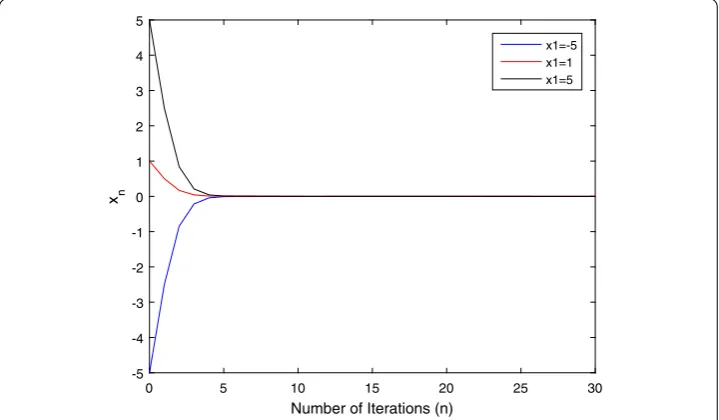
Case 1. Taking the different initial pointx1= –5, 1, 5 withη= 1,r= 4, Fig.1presents the
[image:21.595.118.478.498.708.2]convergence behaviors of{xn}for Algorithm3.1.
Figure 2Behaviors of{xn}with differentr= 4, 0.4, 0.04,x1= 1 andη= 1
Figure 3Behaviors of{xn}with differentη= 1, 10, 50, 100, 200,x1= 1 andr= 4
Case 2. Taking the differentr= 4, 0.4, 0.04 withx1= 1,η= 1, Fig.2presents the
conver-gence behaviors of{xn}for Algorithm3.1.
Case 3. Taking the differentη= 1, 10, 50, 100, 200 withx1= 1,r= 4, Fig.3presents the
convergence behaviors of{xn}for Algorithm3.1.
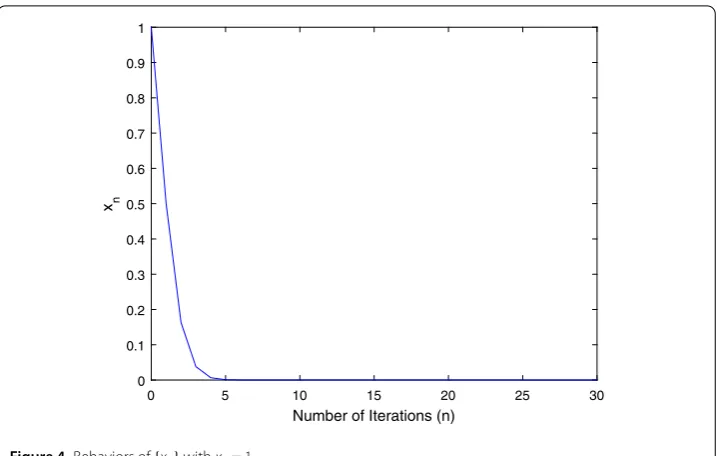
Example4.2 We consider the case thatN1=N2=N3= 2.
LetH1=H2=R,C=Q= [–20, 10] and letfi,hi:C×C→RandFi,Hi:Q×Q→Rbe
defined byf1(z,y) =y2+ 3zy– 4z2,h1(z,y) =y2–z2,F1(z,y) = 3y2+ 2zy– 5z2,H1(z,y) = 0 and f2(z,y) =y2–z2,h2(z,y) = 0,F2(z,y) =y2+ 3zy– 4z2,H2(z,y) =1
Figure 4Behaviors of{xn}withx1= 1
L,αn,βn,1,ξn,1,λn,γ be the same as that of Example4.1, and defineS2,A2,B2byS2x=45x,
A2x= 2xandB2x= 2x. Putβn,2=21–n1+2,ξn,2=12(1 – n1+1),νn,1=12 –n+21 ,νn,2=12+n+21 , rn,1=rn,2=r= 4,μ1=μ2=12andη= 1. It is easy to verify that they satisfy all the conditions
of Theorem3.1.
Following an argument similar to that of Example 4.1, we obtain Trf1,h1(x) = 1+7xr,
TrF1,H1(x) = 1+8xr,Trf2,h2(x) = 1+2xr andTrF2,H2(x) = 1+6xr andΓ ={0}. Figure4presents the
convergence behaviors of{xn}for Algorithm3.1.
5 Conclusion
In this paper, we first propose a new parallel hybrid viscosity method for finding a common element of the set of solutions of a finite family of split generalized equilibrium problems, variational inequality problems and the set of common fixed points of a finite family of demicontractive operators in Hilbert spaces. And then we establish the corresponding strong convergence theorem under suitable conditions. We study more general split
equi-librium problems and fixed point problems of operators than those in [18]. Our results
in this paper improve and extend many recent results in the literature. Finally, we present numerical examples to demonstrate the effectiveness of our algorithm.
Acknowledgements
The author is most grateful to the referees and the editor for their helpful comments and advice which helped to improve the contents of this paper.
Funding
Not applicable.
Availability of data and materials
All data generated or analysed during this study are included in this published article.
Competing interests
The author declares to have no competing interests.
Authors’ contributions
Publisher’s Note
Springer Nature remains neutral with regard to jurisdictional claims in published maps and institutional affiliations. Received: 27 February 2019 Accepted: 30 May 2019
References
1. Takahashi, W., Wen, C.-F., Yao, J.-C.: The shrinking projection method for a finite family of demimetric mappings with variational inequality problems in a Hilbert space. Fixed Point Theory19(1), 407–419 (2018)
2. Dehaish, B.B., Qin, X., Latif, A., Bakodah, H.: Weak and strong convergence of algorithms for the sum of two accretive operators with applications. J. Nonlinear Convex Anal.16, 1321–1336 (2015)
3. Qin, X., Cho, S.Y.: Convergence analysis of a monotone projection algorithm in reflexive Banach spaces. Acta Math. Sci.37(2), 488–502 (2017)
4. Chang, S.-S., Wen, C.-F., Yao, J.-C.: Common zero point for a finite family of inclusion problems of accretive mappings in Banach spaces. Optimization67(8), 1183–1196 (2018)
5. Zhao, X., Ng, K.F., Li, C., Yao, J.-C.: Linear regularity and linear convergence of projection-based methods for solving convex feasibility problems. Appl. Math. Optim.78(3), 613–641 (2018)
6. Ansari, Q.H., Babu, F., Yao, J.-C.: Regularization of proximal point algorithms in Hadamard manifolds. J. Fixed Point Theory Appl.21(1), 25 (2019)
7. Halpern, B.: Fixed points of nonexpanding maps. Bull. Am. Math. Soc.73(6), 957–961 (1967)
8. Cho, S.Y., Dehaish, B.B., Qin, X.: Weak convergence of a splitting algorithm in Hilbert spaces. J. Appl. Anal. Comput. 7(2), 427–438 (2017)
9. Cho, S.Y., Qin, X., Yao, J.-C., Yao, Y.: Viscosity approximation splitting methods for monotone and nonexpansive operators in Hilbert spaces. J. Nonlinear Convex Anal.19, 251–264 (2018)
10. Cho, S.Y., Qin, X., Wang, L.: Strong convergence of a splitting algorithm for treating monotone operators. Fixed Point Theory Appl.2014(1), 94 (2014)
11. Zhang, L., Zhao, H., Lv, Y.: A modified inertial projection and contraction algorithms for quasi-variational inequalities. Appl. Set-Valued Anal. Optim.2019(1), 63–76 (2019)
12. Yao, Y., Liou, Y.-C., Yao, J.-C.: Iterative algorithms for the split variational inequality and fixed point problems under nonlinear transformations. J. Nonlinear Sci. Appl.10(2), 843–854 (2017)
13. Yao, Y., Liou, Y.-C., Yao, J.-C.: Split common fixed point problem for two quasi-pseudo-contractive operators and its algorithm construction. Fixed Point Theory Appl.2015(1), 127 (2015)
14. Yao, Y., Liou, Y.-C., Kang, S.M.: Approach to common elements of variational inequality problems and fixed point problems via a relaxed extragradient method. Comput. Math. Appl.59(11), 3472–3480 (2010)
15. Kazmi, K.R., Rizvi, S.H.: Iterative approximation of a common solution of a split generalized equilibrium problem and a fixed point problem for nonexpansive semigroup. Math. Sci.7(1), 1 (2013)
16. Cianciaruso, F., Marino, G., Muglia, L., Yao, Y.: A hybrid projection algorithm for finding solutions of mixed equilibrium problem and variational inequality problem. Fixed Point Theory Appl.2010(1), 383740 (2009)
17. Moudafi, A.: Split monotone variational inclusions. J. Optim. Theory Appl.150(2), 275–283 (2011)
18. Majee, P., Nahak, C.: A hybrid viscosity iterative method with averaged mappings for split equilibrium problems and fixed point problems. Numer. Algorithms74(2), 609–635 (2017)
19. Onjai-uea, N., Phuengrattana, W.: On solving split mixed equilibrium problems and fixed point problems of hybrid-type multivalued mappings in Hilbert spaces. J. Inequal. Appl.2017(1), 137 (2017)
20. Sitthithakerngkiet, K., Deepho, J., Martínez-Moreno, J., Kumam, P.: An iterative approximation scheme for solving a split generalized equilibrium, variational inequalities and fixed point problems. Int. J. Comput. Math.94(12), 2373–2395 (2017)
21. Qin, X., Yao, J.-C.: Weak convergence of a Mann-like algorithm for nonexpansive and accretive operators. J. Inequal. Appl.2016(1), 232 (2016)
22. Ram, T., Lal, P., Kim, J.K.: Operator solutions of generalized equilibrium problems in Hausdorff topological vector spaces. Nonlinear Funct. Anal. Appl.24, 61–71 (2019)
23. Qin, X., Yao, J.-C.: Projection splitting algorithms for nonself operators. J. Nonlinear Convex Anal.18(5), 925–935 (2017) 24. Kim, J.K., Salahuddin, S.: Extragradient methods for generalized mixed equilibrium problems and fixed point
problems in Hilbert spaces. Nonlinear Funct. Anal. Appl.22, 693–709 (2017)
25. Qin, X., Petrusel, A., Yao, J.-C.: CQ iterative algorithms for fixed points of nonexpansive mappings and split feasibility problems in Hilbert spaces. J. Nonlinear Convex Anal.19, 157–165 (2018)
26. Goebel, K., Reich, S.: Uniform Convexity, Hyperbolic Geometry, and Nonexpansive Mappings. Dekker, New York (1984) 27. Marino, G., Xu, H.K.: Weak and strong convergence theorems for strictly pseudo-contractions in Hilbert spaces.
J. Math. Anal. Appl.329, 336–349 (2007)
28. Chidume, C.E., Maruster, S.: Iterative methods for the computation of fixed points of demicontractive mappings. J. Comput. Appl. Math.234, 861–882 (2010)
29. Takahashi, W.: Nonlinear Functional Analysis. Fixed Point Theory and Its Applications. Yokohama Publishers, Yokohama (2000)
30. Mahdioui, H., Chadli, O.: On a system of generalized mixed equilibrium problems involving variational-like inequalities in Banach spaces: existence and algorithmic aspects. Adv. Oper. Res.2012, Article ID 843486 (2012) 31. Censor, Y., Elfving, T.: A multiprojection algorithm using Bregman projections in product space. Numer. Algorithms8,
221–239 (1994)
32. Katchang, P., Kumam, P.: A new iterative algorithm of solution for equilibrium problems, variational inequalities and fixed point problems in a Hilbert space. J. Appl. Math. Comput.32(1), 19–38 (2010)
33. Wang, S., Gong, X., Abdou, A.A., Cho, Y.J.: Iterative algorithm for a family of split equilibrium problems and fixed point problems in Hilbert spaces with applications. Fixed Point Theory Appl.2016(1), 4 (2016)
34. Marino, G., Xu, H.K.: A general iterative method for nonexpansive mappings in Hilbert spaces. J. Math. Anal. Appl.318, 43–52 (2006)
36. Zegeye, H., Shahzad, N.: Convergence of manns type iteration method for generalized asymptotically nonexpansive mappings. Comput. Math. Appl.62, 4007–4014 (2011)
37. Maingé, P.E.: A hybrid extragradient-viscosity method for monotone operators and fixed point problems. SIAM J. Control Optim.47, 1499–1515 (2008)