http://www.scirp.org/journal/ajor ISSN Online: 2160-8849 ISSN Print: 2160-8830
DOI: 10.4236/ajor.2018.82008 Mar. 23, 2018 92 American Journal of Operations Research
The Pivot Adaptive Method for Solving Linear
Programming Problems
Saliha Belahcene
1, Philippe Marthon
2, Mohamed Aidene
31Mouloud Mammeri Universityof Tizi-Ouzou, Tizi-Ouzou, Algeria
2Site ENSEEIHT de l’IRIT, Université Fédérale Toulouse Midi-Pyrénées, Toulouse, France 3L2CSP Laboratory Design and Control Systems Production, Tizi-Ouzou, Algeria
Abstract
A new variant of the Adaptive Method (AM) of Gabasov is presented, to mi-nimize the computation time. Unlike the original method and its some va-riants, we need not to compute the inverse of the basic matrix at each itera-tion, or to solve the linear systems with the basic matrix. In fact, to compute the new support feasible solution, the simplex pivoting rule is used by intro-ducing a matrix that we will define. This variant is called “the Pivot Adaptive Method” (PAM); it allows presenting the resolution of a given problem under the shape of successive tables as we will see in example. The proofs that are not given by Gabasov will also be presented here, namely the proofs for the theorem of the optimality criterion and for the theorem of existence of an op-timal support, and at the end, a brief comparison between our method and the Simplex Method will be given.
Keywords
Optimization, Linear Programming, Simplex Method, Adaptive Method
1. Introduction
As a branch of mathematics, linear programming is the domain that had the most successful in optimization [1] [2] [3] [4] [5]. Since its formulation from 1930 to 1940 and the development of the Simplex method of Dantzig in 1949 [1] [6], re-searchers in various fields have been led to formulate and solve linear problems.
Although, the Simplex algorithm is often effective in practice, the fact that it is not a polynomial algorithm, as shown by Klee and Minty [7], has incited re-searchers to propose other algorithms and led to the birth of the interior point
How to cite this paper: Belahcene, S., Marthon, P. and Aidene, M. (2018) The Pivot Adaptive Method for Solving Linear Programming Problems. American Journal of Operations Research, 8, 92-111.
https://doi.org/10.4236/ajor.2018.82008
Received: February 13, 2018 Accepted: March 20, 2018 Published: March 23, 2018
Copyright © 2018 by authors and Scientific Research Publishing Inc. This work is licensed under the Creative Commons Attribution International License (CC BY 4.0).
DOI: 10.4236/ajor.2018.82008 93 American Journal of Operations Research
algorithms.
In 1979, L. Khachiyan proposed the first polynomial algorithm for linear pro-gramming [8]; it is based on the ellipsoid method, studied by Arkadi Nemi-rovski and David B. Yudin, a preliminary version of which having been intro-duced by Naum Z. Shor. Unfortunately, this ellipsoid method has a poor effi-ciency.
In 1984, N. K. Karmakar published an interior point algorithm which has a polynomial convergence [9], and this caused a renewed interest to interior point methods, as well in linear programming that in nonlinear programming [10] [11] [12] [13] [14].
Gabasov and Kirillova have generalized the Simplex method in 1995 [15] [16] [17], and developed the Adaptive Method (AM), a primal-dual method, for li-near programming with bounded variables. As the Simplex method, the Adap-tive Method is a support method, but it can start from any support (base) and any feasible solution and can move to the optimal solution by interior or boun-dary points; this method was extended, later, to solve general linear and convex problems [18] [19] [20], and also optimal control problems [21].
In linear programming, several variants of the AM have been proposed. They generally address the problem of initialization of the method and the choice of the direction [22] [23].
In this work, a new variant of the adaptive method called “Pivot adaptive me-thod” (PAM) is presented. Unlike the original method and its variants, we need not to compute the inverse of the basic matrix at each iteration [16], or to solve the linear systems with the basic matrix [23]. In fact, to compute the new feasible solution and the new support, we only need compute the decomposition of vec-tors columns of the matrix of the problem in the current basis. For this compu-tation we use the simplex pivoting rule [4] by introducing a new matrix GAMMA which allows to minimize the computation time. This new variant of adaptive method allows us to present the resolution of a given problem under the shape of successive tables (as is done with the Simplex method) as we will see in example. The proofs for the theorem of the optimality criterion and for the theorem of existence of an optimal support that are not given by Gabasov [16]
will be presented here, and without giving too many details a brief comparison between our method and the Simplex method will be given at the end of this ar-ticle.
DOI: 10.4236/ajor.2018.82008 94 American Journal of Operations Research
2. Statement of the Problem and Definitions
In this article we consider the primal linear programming problem with bounded variables presented in the following standard form:
( )
(
1 2)
1
1
max , , ,
,
, .
j n
n j j
j j n
ij j i j
j j j
F x x x c x
P
a x b i I
d x d j J
=
= =
=
− +
=
= ∈
≤ ≤ ∈
∑
∑
(1)
where: J=
{
1,,n}
is the index set of the variables x x1, 2,,xn, I={
1,,m}
is the index set of the parameters b b1, 2,,bm (corresponds to the constraints),
put: J=JBJN, JBJN = ∅, JB =m, and introduce the vectors:
•
( )
(
j,)
(
1, 2, , n)
B Nx x x J x j J x x x
x
= = ∈ = =
, with:
( )
(
,)
B B j B
x =x J = x j∈J , xN =x J
( )
N =(
xj,j∈JN)
.•
( )
(
j,)
(
1, 2, , n)
B Nc c c J c j J c c c
c
= = ∈ = =
, with:
( )
(
,)
B B j B
c =c J = c j∈J , cN =c J
( )
N =(
cj,j∈JN)
.• T T
( ) (
) (
)
1 2
, , , ,
i m
b =b J = b i∈I = b b b .
• d− =d−
( )
J =(
d−j,j∈J) (
= d1−,d2−,,dn−)
; d− <+∞.• d+ =d+
( )
J =(
d+j,j∈J) (
= d1+,d2+,,dn+)
; d+ < +∞.and the
(
m n×)
matrix•
( )
(
)
(
)
T 1
1 2
T
, ij, , , , , n
m
A
A A I J a i I j J a a a
A
= = ∈ ∈ = =
, w i t h :
1j j
mj
a a
a
=
,
j∈J (aj: the jth column of the matrix A), and
(
)
T
1, 2, , ,
i i i in
A = a a a i∈I
( T
i
A : the ith row of the matrix A), A=
(
AB AN)
, AB =A I J(
, B)
,(
,)
N N
A =A I J .
We assume that rank A
( )
= <m n. Then the problem (1) takes the followingform:
( )
( )
T
maxF x c x
P Ax b
d− x d+
= = ≤ ≤
(2)
Ax=b are called the general constraints of (P).
Denote the feasible region of (P) as:
{
n, ,}
H= x∈R Ax=b d−≤ ≤x d+ .
2.1. Definition 1
Each vector of the set H is called a feasible solution of (P).
2.2. Definition 2
Any vector n
prob-DOI: 10.4236/ajor.2018.82008 95 American Journal of Operations Research
lem (P) is called a pseudo-feasible solution.
2.3. Definition 3
A feasible solution 0
x is called optimal if:
( )
0 T 0 max T x HF x c x c x
∈
= = .
2.4. Definition 4
For given value ≥0, the solution x is called an -optimal (or suboptimal) if:
( ) ( )
(
0)
F x −F x ≤, where 0
x is an optimal solution for the problem (P).
2.5. Definition 5
The set of m indices JB⊂J (JB =m) is called a support of (P) if the submatrix
(
,)
B B
A =A I J is non-singular (detAB≠0), then the set JN =J J\ B of (n−m)
indices is called non-support, AB is the matrix support, and AN = A I J
(
, N)
isthe matrix non-support.
2.6. Definition 6
The pair
{
x J, B}
formed by a feasible solution x and the support JB is calleda support feasible solution (SF-solution).
2.7. Definition 7
The SF-solution
{
x J, B}
is called non-degenerate if: dj xj dj, j JB−< < + ∀ ∈ .
Recall that, unlike the Simplex Method in which the feasible solution x and the basic indices JB are related intimately, in the adaptive method there are
independent.
3. Optimality Criterion
For the smooth running of calculations, in the rest of the article, we assume that the sets JB and JN are vectors of indices (i.e.: the order of indices in these
sets is important and must be respected).
3.1. Formula of the Objective Value Increment
Let
{
x J, B}
be the initial SF-solution of the problem (P), and( )
BN
x
x x J
x
= =
an arbitrary pseudo-feasible solution of (P). We set
B N
x x x x x
∆ = ∆ + ∆ = − , then the increment of the objective function value is
given by:
( )
( )
( )
T T T T TB B N N
F x F x F x c x c x c x c x c x
∆ = − = − = ∆ = ∆ + ∆ (3)
and since:
0 B B N N
A x∆ =A ∆ +x A ∆x =Ax−Ax= (4)
then
1
B B N N
x A A− x
DOI: 10.4236/ajor.2018.82008 96 American Journal of Operations Research
Substituting the vector ∆xB in (3) we get:
( )
(
T T 1)
N B B N N
F x c c A A− x
∆ = − ∆
(6) Here, we define the m-vector of multipliers y as follows:
T T 1
B B
y =c A− (7)
In [16], Gabasov defines the support gradient and noted it ∆ as:
T T T
y A c
∆ = − , but he also recognizes that for every k∈JN, the kth support
de-rivative is equal to T
k ck y ak
−∆ = − , in fact, −∆k is the rate of change of the
objective function when the kth non-support components of the feasible solution
x is increased and all the other non-support components are fixed, at the same time the support components are changed in such way to satisfy the constraints
Ax=b.
Then, in the pivot adaptive method, we define the n-vector of reduced gains (or support gradient) δ as follows:
(
)
(
)
T T T T T T T T T T
, , , where : 0,
j j J c y A B N B N cN y AB
δ
= −∆ =δ
∈ = − =δ δ
δ
=δ
= − (8)To reduce the computation time in the adaptive method of Gabasov [16], we define the (m×n) matrix Γ as follows:
(
)
1 , , where: , 1
B B N B m N B N
A A− I A A−
Γ = = Γ Γ Γ = Γ = (9)
which is the decomposition of the columns of the matrix A on the support JB.
We have: Γ = ΓN
(
I J, N)
= Γ ∈(
ij,i I j, ∈JN)
, Γij is the product of the ith rowof the matrix 1
B
A− and the jth column of the matrix AN. Then the n-vector of
support gradient given in (8) can be computed as follows:
(
)
(
)
T T T 1 T T T T
T T T T
, , ,
where: 0,
j B B B B N
B N N B N
j J c c A A c c
c c
δ δ δ δ
δ δ
−
= ∈ = − = − Γ =
= = − Γ (10)
We see that, to compute the quantity T 1
B B
c A A− , we begin to compute 1
B
A A−
Γ =
and not T T 1
B B
y =c A− ; therefore we need not to compute the inverse of the basic
matrix AB.
From (6) and (10) we obtain
( )
TN
N N j j
j J
F x δ x δ x
∈
∆ = ∆ =
∑
∆(11)
3.2. Definition 8
For an given support JB, any vector
( )
B NJ
χ
χ χ
χ
= =
of
n
R that satisfies
(
)
(
)
1
, if 0
, if 0
or , if 0
j j j
j j j
N
j j j j
B B N N
d d
j J
d d
A b A
χ δ
χ δ
χ δ
χ χ
−
+
− +
−
= < = >
∈
= =
= −
DOI: 10.4236/ajor.2018.82008 97 American Journal of Operations Research
is called a primal pseudo-feasible solution accompanying the support JB.
3.3. Proposition 1
A primal pseudo-feasible solution accompanying a given support JB, χ, verifies
just the general constraints of the problem (P), ie Aχ =b. If more, the support
components χB of the vector χ verifies: dB χB dB
−≤ ≤ +, then χ is feasible and
optimal solution for (P).
3.4. Theorem 1 (The Optimality Criterion)
Let
{
x J, B}
be an SF-solution of the problem (P), andT
δ be the support
gra-dient computed by (10), then the relations
(
)
0, for
0, for
0, for
j j j
j j j N
j j j j
x d
x d j J
d x d
δ δ δ
−
+
− +
< =
> = ∈
= ≤ ≤
(13)
are sufficient, and in the case of non-degeneracy of the SF-solution
{
x J, B}
alsonecessary for the optimality of the feasible solution x. Proof
1) The sufficient condition:
for the SF-solution
{
x J, B}
, suppose that the relation (13) are verified, we mustproof that x is optimal, it amounts to show that:
( )
( )
( )
, 0
x H F x F x F x
∀ ∈ ∆ = − ≥
(14)
Let x∈H, and ∆ = −x x x, then:
( )
( )
( )
(
)
(
)
(
)
(
)
(
)
0 0 0
0 0
0
N
N N N
j j j
N N
j j
j j
j J
j j j j j j j j j
j J j J j J
j j j j j j
j J j J
F x F x F x x
x x x x x x
d x d x
δ δ δ
δ δ
δ
δ δ δ
δ δ
∈
∈ ∈ ∈
≤ ≥ =
− +
∈ ∈
≤ ≥
∆ = − = ∆
= − + − + −
= − + − ≥
∑
∑
∑
∑
∑
∑
then x is optimal.
2) The necessary condition:
Suppose that
{
x J, B}
an SF-solution non-degenerate, i.e.:,
B j j j
j J d− x d+
∀ ∈ < < (15)
and that x optimal, i.e.:
( )
( )
( )
, 0.
N
j j j J
x H F x F x F x
δ
x∈
∀ ∈ ∆ = − =
∑
∆ ≥
(16) Reasoning by absurdity:
Suppose that the relations (13) are not verified, thus we have, at least, one of the following three cases:
1) k JN δk 0 andxk dk
−
∃ ∈ ≤ > . 2) k JN δk 0 andxk dk
+
DOI: 10.4236/ajor.2018.82008 98 American Journal of Operations Research
3) ∃ ∈k JN δk =0 andxk =dj−orxk =d+j.
Suppose then we have the first case, i.e.
0 and
N k k k
k J δ x d−
∃ ∈ ≤ > (17)
(the proof uses the same reasoning for the second and the third cases). Construct the n-vector
( )
(
(
( )
)
1,(
( )
)
2, ,(
( )
)
)
n
x θ = x θ x θ x θ as follows:
( )
(
)
{ }
( )
(
)
( )
(
)
, \, 0, ,
j N
j
k k k
k
j jk B
j
x x j J k
x x x d
x x j J
θ
θ θ θ θ θ − = ∀ ∈ = − ∈ −
= + Γ ∀ ∈
(18)
where Γjk is the product of the j
th row of the matrix 1
B
A− and the kth column
of the matrix AN. Let θ1 xk dk 0
−
= − > . we have
( )
B(
( )
)
N(
( )
)
0B N
Ax θ =A x θ +A x θ =
(19) and
( )
(
)
,
N j j j
j J d− x
θ
d+∀ ∈ ≤ ≤
(20) For B,
(
( )
)
j jkj
j∈J x
θ
=x + Γθ
, then for have:( )
(
)
,
B j j j
j J d− x
θ
d+∀ ∈ ≤ ≤
(21) a value of θ is chosen such that:
,
B j j jk j
j J d− x θ d+
∀ ∈ ≤ + Γ ≤
(22)
i.e.
(
)
0 , for 0
0 , for 0
j j jk jk B j j jk jk d x j J d x θ θ + − −
< ≤ Γ >
Γ
∈
−
< ≤ Γ < Γ
(23)
Put: 2 0 min jk B j j jk j J d x θ + Γ > ∈ − =
Γ , 3 0 min jk B j j jk j J d x θ − Γ < ∈ − = Γ .
we have: θ >2 0, θ >3 0, because
{
x J, B}
is non-degenerate.Let *
(
)
1 2 3
min , ,
θ = θ θ θ , then
( )
* x θ ∈H
(24) or
( )
(
( )
*)
* 0N
j j k k k
j J
F x F x θ δ x δ x δ θ ∈
− =
∑
∆ = ∆ = <(25) then
( )
(
*)
( )
F x θ >F x
DOI: 10.4236/ajor.2018.82008 99 American Journal of Operations Research
3.5. Definition 9
The pair
{
0 0}
, Bx J satisfying the relations (13) will be called an optimal
SF-solution of the problem (P).
3.6. The Suboptimality Criterion
Let 0
x an optimal solution of (P), and x a feasible solutions of (P).
From (11) we obtained:
( )
( )
( )
(
)
(
)
(
)
(
)
0
0 0
0 0
max
max max
N N
j j
N N
j j
x H
j j j j j j
x H j J x H j J
j j j j j j
j J j J
F x F x F x
x x x x
d x d x
δ δ
δ δ
δ δ
δ δ
∈
∈ ∈ ∈ ∈
> <
+ −
∈ ∈
> <
∆ = −
= − + −
≤ − + −
∑
∑
∑
∑
Let
(
)
(
)
(
)
0 0
,
N N
j j
B j j j j j j
j J j J
x J d x d x
δ δ
β δ + δ −
∈ ∈
> <
=
∑
− +∑
−
(27)
(
x J, B)
β is called the suboptimality estimate of the SF-solution
{
x J, B}
since
( )
( )
(
0)
(
)
, B
F x −F x ≤β x J
(28) We have the following theorem of suboptimality.
3.7. Theorem 2 (Sufficient Condition of Suboptimality)
For a feasible solution x to be -optimal for given positive number , it is suffi-cient of the existence of a support JB such that β
(
x J, B)
≤.3.8. Proposition 2
From (12) and (27) we deduce:
(
)
T(
)
T(
)
, B N N N
x J x x
β =δ χ − =δ χ−
(29)
3.9. The Dual Problem
The dual of the primal problem (P) is given by the following linear problem
( )
(
)
T( ) ( )
T T Tmin , ,
, 0, 0. m
y v w b y d v d w
D A y v w c
y R v w
φ − +
= − +
− + =
∈ ≥ ≥
(30)
where
T 1 T
T
n
a A
a
=
, with ∀ ∈j J, aTj is the transpose of the j
th column
j
a of
DOI: 10.4236/ajor.2018.82008 100 American Journal of Operations Research
Like (P), the problem (D) has an optimal solution 0
(
0 0 0)
, ,
y v w
λ
= , and( ) ( )
0 0F x =
φ λ
, where 0x is the optimal solution of (P).
3.10. Definition 10
Any
(
m+2n)
-vector λ =(
y v w, ,)
satisfying all the constraints of the problemD is called a dual feasible solution.
3.11. Definition 11
Let JB be a support of the problem (P), and δ the corresponding support
gra-dient defined in (10), the
(
m+2n)
-vector λ =(
y v w, ,)
which satisfies:(
)
T T 1
, 0 if 0
0, if 0
B B
j j j j
j j j j
y c A
v w j J
v w
δ δ
δ δ
−
=
= − = ≤ ∈
= = >
(31)
is called the dual feasible solution accompanying the support JB.
3.12. Proposition 3
• A dual feasible solution λ =
(
y v w, ,)
accompanying a given support JB, isdual feasible, i.e.: T
, 0, 0, m
A y− + =v w c v≥ w≥ y∈R .
• For any support JB we have
( )
T
c χ φ λ= (32)
where λ and χ are respectively the dual feasible solution and an primal pseu-do-feasible solution accompanying the support JB.
3.13. Definition 12
Let y be dual feasible solution: T
, 0, 0
A y− + =v w c v≥ w≥ . The
(
m+2n)
-vector(
)
* * *
, ,
y v w
λ
= such that:(
)
(
)
(
)
(
)
(
)
* * T T
* T * T
0, if 0
, 0 if 0
j j j j j j
j j j j j j
v w c a y c a y
j J
v c a y w c a y
= = − − ≥
∈
= − − = − ≤
(33)
is called a coordinated dual feasible point to the m-vector y.
3.14. Proposition 4
The coordinated dual feasible point *
(
* *)
, ,
y v w
λ
= to y is dual feasible, i.e.:T * *
A y− +v w =c, v*≥0, w*≥0.
3.15. Decomposition of the Suboptimality Estimate of an
SF-Solution
{
x J
,
B}
Let
{
x J, B}
be a SF-solution of the problem (P),β
(
x J, B)
be itssuboptimali-ty estimate calculated by (27), λ =
(
y v w, ,)
be the dual feasible solutionac-companying the support JB, χ the primal pseudo-feasible solution
accompany-ing the support JB,
0
x be the optimal solution for the problem (P), λ0 be
DOI: 10.4236/ajor.2018.82008 101 American Journal of Operations Research
From (9), (10), (29), (32), and proposition 1 we have:
(
)
(
)
(
)
(
)
(
)
( )
( )
( )
( ) ( )
( )
T T T T
T T T 1 T 1 T T
0 0
, B N N N B
B B B B
x J x x c c x
c c x c A A c A Ax c c x
F x F x F x
β δ χ δ χ χ
χ χ χ
φ λ φ λ φ λ
− −
= − = − = − Γ − = − − + = − = − = − + −
.
then
(
x J, B)
( )
x( )
JBβ =β +β
(34) where:
( ) ( )
( )
0B
J
β
=φ λ φ λ
− is the degree of non-optimality of the supportB
J , and
β
( )
x =F x( )
0 −F x( )
is the degree of non-optimality of the feasiblesolution x.
3.16. Proposition 5
• The feasible solution x will be optimal if β
( )
x =0, and the support JB willbe optimal if β
( )
JB =0, but the pair{
x J, B}
will be an optimal SF-solutionif β
( )
x = 0β( )
JB = , so the optimality of the feasible solution x can be notidentified if it is examined with an unfit support, because in this case there will be β
( )
JB ≠0, and β(
x J, B)
≠0.• As
( ) ( )
( )
0B
J
β
=φ λ φ λ
− , then the support JB will be optimal if itsac-companying dual feasible solution λ is optimal solution for the dual problem D.
3.17. Theorem 3 (Existence of an Optimal Support)
For each problem (P), there is always an optimal support. Proof
As (P) has an optimal solution, its dual (D) given by (30) has also an optimal solution, let λ =
(
y v w, ,)
this solution, and define the sets:(
)
{
T}
/ j j 0
I+= j∈J c −a y ≥ ,
{
(
T)
}
/ j j 0
I−= j∈J c −a y ≤ ,
and
(
)
(
)
{
T T}
/ 0, and 0,
m
j j j j
C= y∈R c −a y ≥ ∀ ∈i I+ c −a y ≤ ∀ ∈i I− ,
we have y∈C.
Let y∈C, and define the following linear problem:
( )
min( )
T j(
j Tj)
j(
j Tj)
j J j J
m
y b y d c a y d c a y
D
y C R
ψ
+ −
+ −
∈ ∈
= + − + −
∈ ⊂
∑
∑
(35)
We have ψ
( ) (
y =φ y v w, ,)
, where(
y v w, ,)
is the coordinated dual feasiblepoint to the vector y, and y is an optimal feasible solution of the problem (D).
On the other hand, there exists a “vertex” *
y of the set C that is an
optim-al feasible solution for (D), and this vertex is the intersection of at least m
hyperplane T *
(
)
,
j j
a y =c j∈ I+I− .
Put
{
(
)
T *}
/
B j j
DOI: 10.4236/ajor.2018.82008 102 American Journal of Operations Research
Then: T
(
,)
*B B
A I J y =c , and so: y* c ABT B1
−
= , further the coordinated dual
feasible point to *
y is the dual feasible solution accompanying the support JB,
and its optimal feasible solution for the problem (D), then, according to the proposition (4), we conclude that JB is an optimal support for (P).
4. The Description of the Pivot Adaptive Method “PAM”
As the Simplex Method, to solve the problem (P), the adaptive method (and therefore also the pivot adaptive method) has two phases: the initialization phase, and the second phase, we will detail each one in the following.1) The initialization phase:
In this phase an initial support feasible solution SF-solution
{
x J, B}
will bedetermined, and thus the matrix Γ defined in (9). We assume that bi≥ ∀ ∈0, i I , and dj 0, j J
−= ∀ ∈ .
Remark 1
Notice that each problem (P) can be reduced to this case, i.e.: bi≥ ∀ ∈0, i I, and
0, j
d−= ∀ ∈j J, in fact:
a) if 0
0
/ 0
i
i I b
∃ ∈ < then both term of the corresponding constraint is mul-tiplied by (−1).
b) if k J d/ k 0
−
∃ ∈ ≠ , then we do the change of variable:
( )
x k xk dk−
′ = − , then:
( )
0 k k
k
x′ d+ d−
≤ ≤ −
(36)
and the general constraints Ax=b of (P) will be write as:
(
)
1 1 1 1 k1 k1 k k k k 1 k 1 n n
a x +a x + + a−x− +a x′+d− +a+x+ + + a x =b
(37)
where ∀ ∈j J, aj is the jth column of the matrix A, from this relation we
ob-tain:
1 1 1 1 k1 k1 k k k1 k 1 n n k k
a x +a x + + a−x− +a x′+a+x+ + + a x = −b a d− (38)
in (36), if
(
b a d− k k−)
<0 we multiple the two terms by (−1).Then to determine an initial SF-solution to the problem (P), define the artifi-cial problem of (P) as follows:
( )
( )
1max
, 0 j m
j j
F x x
P
Ax x b
d x d x b
=
=
− +
= −
+ =
≤ ≤ ≤ ≤
∑
(39)
where bi≥ ∀ ∈0, i I, and x =x J
( ) (
= x ii, ∈I) (
= x x 1, 2,,xm)
are the martifi-cial variables added to the problem (P).
We resolve the artificial problem P with the “pivot adaptive method”
start-ing with the obvious initial feasible solution:
( )
, , 0 ,nR
x x x= x=b, and the
ca-nonical support (determined by the indices of the artificial variables), and we take the matrix Γ =A.
DOI: 10.4236/ajor.2018.82008 103 American Journal of Operations Research
so x is a feasible solution of (P), and the optimal SF-solution of the problem P
can be taken as the initial SF-solution for the problem P. 2) The second phase:
Assume that an initial SF-solution
{
x J, B}
of the problem (P) is found in theinitialization phase, and let Γ the correspondent matrix computed by (9), ≥0
an arbitrary number, the problem will be solved with the pivot adaptive method that we describe in the following.
At the iterations of the pivot adaptive method the transfer
{
x J, B}
→{
x J, B}
from one SF-solution to a new one is carried out in such a way that:
(
x J, B)
(
x J, B)
β ≤β
(40) the transfer will be realized as two procedures making up the iteration:
i) The procedure of the feasible solution change x→x:
During this procedure we decrease the degree of non-optimality of the feasible solution: β
( )
x ≤β( )
x , and then improve the primal criterion F x( )
≥F x( )
:i.1) compute the support gradient δ by (10), and the suboptimality estimate by (27).
i.2) If
β
(
x J, B)
≤ε
, then stop the resolution with: x is an -optimal feasiblesolution for (P) (P).
i.3) If
β
(
x J, B)
>ε
, we compute the non-support components χN of theprimal pseudo-feasible solution accompanying the support JB by (12), and the
search direction l=
(
l lB, N)
with:N N N
B N N
l x
l l
χ
= −
= −Γ
(41)
i.4) Find the primal step length θ0 with:
{ }
0 0(
)
0
, if 0;
min 1, , where : min ,
, if 0;
; if 0.
B
j j j j
j j j J j j j j B
j j
j
d x
l l
j J
d x
l l
l
θ θ θ θ θ
+
− ∈
−
>
= = = − ∈
<
∞ =
(42)
Let j00 such that: JB
( )
j00 = j0 which is the position of j0 in the vector ofindices JB.
i.5) Compute the new feasible solution: 0 x= +x θ l, and
( )
( )
0(
,)
B
F x =F x +θ β x J .
i.6) If 0
1
θ = , then stop the resolution with:
{
x J, B}
is the optimalSF-solution of (P). i.7) If 0
1
θ < , then compute:
(
)
(
0)
(
)
, B 1 , B
x J x J
β
= −θ β
(43) i.8) If β
(
x J, B)
≤, then stop the resolution with:{
x J, B}
is the -optimalSF-solution of (P).
DOI: 10.4236/ajor.2018.82008 104 American Journal of Operations Research
ii) The procedure of the support change JB→JB:
During this procedure we decrease the degree of non-optimality of the sup-port: β
( )
JB ≤β( )
JB , and then improve the dual criterionφ λ
( )
≥φ λ
( )
,where λ is the dual feasible solution accompanying the support JB, and
λ
isthe dual feasible solution accompanying the support JB.
In this procedure there are two rules to change support: rule of “the short step”, and rule of “the long step”, the two rules will be presented.
ii.1) to the j0 found in (i.4), compute χj0 =xj0+lj0, and α0=χj0−xj0.
ii.2) compute the dual direction t with:
( )
{ }
0 0
0
T T
;
0, \ ;
. j
j B
N B N
t sign
t j J j
t t
α
= − = ∈
= Γ
(44)
ii.3) compute:
(
)
, if 0;
0, if 0, 0, ; 0, if 0, 0, ;
, in other cases. j
j j j
j j j j
j N
j j j j
t t
t d j J
t d
δ
δ
δ ξ
σ
δ ξ
−
+
>
= < =
= ∈
= > =
∞
(45)
and arrange the obtained values in increasing order as:
{
}
1 2 p, , k , 1, , .
j j j jk JN j k p
σ ≤σ ≤≤σ ∈ σ ≠ ∞ ∈ (46)
As was said before, the change of support can be done with two different rules, to use the “short step rule” go to a), and to use the “long step rule” go to b).
a) Change of the support with the “short step rule”: a.1) From (46) put:
* 1
0
min .
N
j j j
j J
σ
σ
σ
σ
∈
= = =
(47) Let j** such that:
( )
* **
N
J j = j which is the position of j* in the vector of
indices JN.
Put:
(
{ }
)
{ }
* 0\
B B
J = J j j , JN =
(
JN \{ }
j*)
{ }
j0 , then( )
* 00B
J j = j ,
( )
** 0N
J j = j .
a.2) Compute:
(
)
(
)
0
0 0
,
, B , B
t
x J x J
δ δ σ
β
β
σ α
= −
= +
(48) go to ii.4).
b) Change of the support with the “long step rule”: b.1) for every j kk, ∈
{
1,,p}
of (47) compute(
)
00
k k k k
j j j dj dj
α + −
∆ = Γ −
(49) b.2) as *
DOI: 10.4236/ajor.2018.82008 105 American Journal of Operations Research
1
1
0 0
1 1
0, 0
q k q k
k q k q
j j j j
k k
α
−α
= −α
α
α
=α
= =
= + ∆ < = + ∆ ≥
∑
∑
(50)Let j** such that:
( )
* **N
J j = j which is the position of j0 in the vector of
indices JB.
b.3) put: *
0
j
σ =σ , and
(
{ }
)
{ }
* 0\
B B
J = J j j , JN =
(
JN \{ }
j*)
{ }
j0 , then( )
*00
B
J j = j , JN
( )
j** = j0.b.4) Compute:
• 0
t
δ δ σ= − .
•
(
)
(
)
(
)
1 1
1
, ,
k k k
k q
B B j j j
k
x J x J
β β =α − σ σ −
=
= +
∑
− where: αj0 =α0, σ =j0 0.Go to ii.4). ii.4) compute Γ as follows:
{ }
00
00
* 00
* 00 00
, ;
, \ , .
j j j j
j j ij ij ij j j
j J
i I j j J
Γ
Γ = ∈ Γ
Γ = Γ −Γ Γ ∈ ∈
(51)
* 00 j j
Γ is “the pivot”. Go to ii.5).
ii.5) Set: x=x, JB=JB, β
(
x J, B)
=β(
x J, B)
, δ δ= , and Γ = Γ. Go toi.2).
5. The Pivot Adaptive Method
Let
{
x J, B}
be an initial SF-solution for the problem (P), Γ the matrixcom-puted by (9), and ≥0 are given.
The “Pivot Adaptive Method” (rule of the “short step” and rule of “the long step” are presented) is summarized in the following steps:
Algorithm 1 (The Pivot Adaptive Method)
1) compute the support gradient δT by (10), and
(
)
, B
x J
β by (27). 2) if β
(
x J, B)
≤, then STOP with: x is an -optimal feasible solution for (P).3) if β
(
x J, B)
>, then compute the non-support components χN of theprimal pseudo-feasible solution accompanying the support JB by (12), and the
search direction l with (41).
4) find the primal step length θ0 with (42). Let 00
j such that: JB
( )
j00 = j0which is the position of j0 in the vector of indices JB.
5) Compute the new feasible solution: 0 x= +x θ l, and
( )
( )
0(
,)
B
F x =F x +θ β x J .
6) if 0
1
θ = , then STOP with:
{
x J, B}
is the optimal SF-solution for (P).7) if 0
1
θ < , then compute
(
)
(
0)
(
)
, B 1 , B
x J x J
β
= −θ β
.8) if β
(
x J, B)
≤, then STOP with:{
x J, B}
is the -optimal SF-solution for(P).
9) if β
(
x J, B)
>, then change the support JB to JB.10) compute χj0 =xj0+lj0, and: α0=χj0−xj0.
11) compute the dual direction t with (44).
12) compute σj, for j∈JN with (45), and arrange the obtained values in
DOI: 10.4236/ajor.2018.82008 106 American Journal of Operations Research
13) do the change of support by one of the rules:
a) Change of the support with the “short step rule” as follows:
a.1) compute σ0 with (47), and set:
(
{ }
)
{ }
* 0\
B B
J = J j j ,
{ }
(
*)
{ }
0
\
N N
J = J j j .
a.2) compute
(
)
(
)
0 0, B , B
x J x J
β
=β
+σ α
. Go to (14).b) Change of the support with the “long step rule” as follows:
b.1) for every j kk, ∈
{
1,,p}
of (46) compute αjk j00jk(
djk djk)
+ −
∆ = Γ − .
b.2) as *
j we choose jq such that (50) is verified.
b.3) set: *
0
j
σ =σ , and
(
{ }
)
{ }
* 0\
B B
J = J j j , JN =
(
JN \{ }
j*)
{ }
j0 .b.4) compute
(
)
(
)
1(
1)
1
, ,
k k k
k q
B B j j j
k
x J x J
β β =α − σ σ −
=
= +
∑
− where: αj0=α0 ,0 0
j
σ = . Go to (14).
14) compute Γ with (51) and 0 t
δ δ σ= − .
15) set: x=x, JB=JB, β
(
x J, B)
=β(
x J, B)
, δ δ= , and Γ = Γ. Go to(2).
6. Example
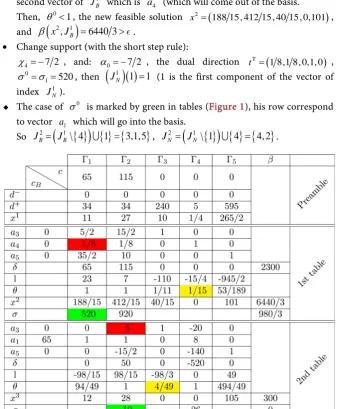
In this section, a linear problem will be resolved with the Pivot Adaptive Method using the “short step rule”, and in parallel we will explain how to realize these calculations under the shape of successive tables as is given in Figure 1.
Consider the following linear problem with bounded variables:
( )
( )
T
max
.
F x c x
P Ax b
d− x d+
= = ≤ ≤
(52)
where: cT=
(
65,115, 0, 0, 0)
,(
)
T1, 2, 3, 4, 5
x= x x x x x ,
5 2 15 2 1 0 0 1 8 1 8 0 1 0 35 2 10 0 0 1
A
=
,
(
)
T240,5,595
b= , d 0R5
−= ,
(
)
T34,34, 240,5,595
d+= .
Put J=
{
1, 2, 3, 4, 5}
, =10−3.First phase (Initialization): Let
{
1 1}
, B
x J be the initial SF-solution of the problem (P) where;
(
)
T1
11, 27,10,1 4, 265 2
x = , 1
{
}
3, 4, 5 B
J = , so: J1N =
{ }
1, 2 ,(
)
1
3, 4, 5 3
B
A = a a a =I ,
(
)
1
1, 2
N
A = a a then The matrix Γ is given by: Γ = Γ Γ
(
B, N)
where:( )
Γ1 B=I3,( )
15 2 15 2 1 8 1 8 35 2 10 N
Γ =
.
Note that for the initial support we have chosen the canonical support, and for the initial feasible solution we took an interior point of the feasible region of the problem (P).
In the preamble part of the tables (Figure 1) which has four rows we put se-quentially: T
c ,
( )
d− T,( )
d+ T, 1DOI: 10.4236/ajor.2018.82008 107 American Journal of Operations Research
Second phase:
Starting with the SF-solution
{
1 1}
, Bx J , and the matrix Γ to resolve the
prob-lem (P) with the PAM using the short step rule.
In the first table of PAM (Figure 1) (represents the first iteration) there are 8 rows, in the first 3 rows we have the matrix Γ (indicating the vector formed
1
B
A in the first column of the tables), and in the rest rows we have
sequen-tially: δ, l, θ, x2, σ.
The support gradient T
(
( ) ( )
T T)
1 1 B
,
1 Nδ
=
δ
δ
where:( )
3T
1 B 0R
δ
= ,( )
T(
)
1 N 65,115
δ
= , and(
1 1)
, B 2300
x J
β
= >.1) Iteration 1:
• Change solution: we have:
( )
1(
34, 34)
Nχ = , and
( )
l1 N =(
23, 7)
,( ) (
l1 B= −110, 15 4 , 945 2− −)
,0
4 1 15
θ =θ = ,
( )
1( )
2 4 B
J = (4 is the second
component of the vector of index 1
B
J ).
The case of θ0 is marked by yellow in tables (Figure 1), it correspond at the second vector of 1
B
J which is a4 (which will come out of the basis.
Then, 0
1
θ < , the new feasible solution 2
(
)
188 15, 412 15, 40 15, 0,101
x = ,
and
(
2 1)
, B 6440 3
x J
β
= >.• Change support (with the short step rule):
4 7 2
χ = − , and: α = −0 7 2 , the dual direction
(
)
T 1 8,1 8, 0,1, 0t = ,
0
1 520
σ =σ = , then
( )
1( )
1 1 N
J = (1 is the first component of the vector of
index 1
N
J ).
The case of σ0 is marked by green in tables (Figure 1), his row correspond to vector a1 which will go into the basis.
So 2
(
1{ }
)
{ } {
}
\ 4 1 = 3,1,5
B B
[image:16.595.204.542.288.698.2]J = J , JN2 =
(
J1N \ 1{ }
)
{ } { }
4 = 4, 2 .DOI: 10.4236/ajor.2018.82008 108 American Journal of Operations Research For have the 2nd table (Figure 1), we applied the pivoting rule where the pivot is marked by red. The new support gradient T T 0
(
( ) ( )
T T)
2 1
t
2 B,
2 Nδ
=
δ
−
σ
=
δ
δ
where:
( )
3T
2 B 0R
δ
= ,( )
T(
)
2 N 520,50
δ
= − , and(
2 2) (
2 1)
0 0, B , B 980 3
x J x J
β
=β
+σ α
= .As
(
2, 2)
B
x J
β
> , we go to another iteration, we compute then:( ) ( )
(
)
2 2 B, 2 N
Γ = Γ Γ where:
( )
Γ2 B =I3,( )
120 5
8 1
140 15 2 N
−
Γ = − −
.
2) Iteration 2:
• Change solution: we have: χ =N
(
0, 34)
, and( )
l2 N =(
0, 98 15)
,( ) (
l2 B= −98 3, 98 15, 49−)
,0
3 4 49
θ =θ = ,
( )
2( )
1 3 B
J = (3 is the first
component of the vector of indice 2
B
J ).
Then, 0
1
θ < , the new feasible solution 3
(
)
12, 28, 0, 0,105
x = , and
(
2, 1)
300B
x J
β
= >.• Change support (with the short step rule): χ = −3 30, and: α = −0 30, the
dual direction tT=
(
0, 5,1, 20, 0−)
, 02 10
σ =σ = , then
( )
2( )
2 2N
J = (2 is
the second component of the vector of index 2
N
J ).
So 3
(
2\ 3{ }
)
{ } {
2 2,1,5}
B B
J = J = , 3
(
2 \ 2{ }
)
{ } { }
3 4, 3N N
J = J = .
The new support gradient T T 0
(
( ) ( )
T T)
3 2
t
3 B,
3 Nδ
=
δ
−
σ
=
δ
δ
where:( )
3T
3 B 0R
δ
= ,( )
T(
)
3 N 10,320
δ
= , and(
3 3) (
3 2)
0 0, B , B 0
x J x J
β
=β
+σ α
= .Then
{
3 3}
, Bx J is the optimal SF-solution of the problem (P), and
( )
34000
F x = .
7. Brief Numerical Comparison between the PAM and the
Simplex Method
To realize a numerical comparison between the Simplex algorithm implemented in the function “linprog” under the MATLAB programming language version 7.14, 0.739 (R2012a) and our algorithm (PAM), an implementation for the later with the short step rule, has been developed.
The comparison is carried on the resolution of the Klee-Minty problem which has the following form [7]:
( )
1 2
1 2 1
1
1 2
3 1 2 3
1
1 2 1
max 2 2 2
5
4 25
8 4 125
2 2 4 5
0
n n
n n
n n n
n n
x x x x
x
x x
P x x x
x x x x
x
− −
−
−
−
+ +…+ + ≤
+ ≤
+ + ≤
+ + + + ≤ ≥
(53)
where x=
(
x x1, 2,,xn)
. (P3) has n variables, n constraints and 2DOI: 10.4236/ajor.2018.82008 109 American Journal of Operations Research
For a fixed n, to write (P3) in the form of the problem (P) given in (1), we
added to each of the n constraints of (P3) a spread variable, and we found, for
each of the 2n variables of the result problem, a lower born and an upper born. Then the problem (P3) can be done as a linear problem with bounded variables
as follows:
( )
1 2
1 2 1
1 1
1 2 2
1 2 3 3
4
1
1 2 1 2
1 2
1 2 2
max 2 2 2
5
4 25
8 4 125
2 2 4 5
0 5; 0 25; ; 0 5 ;
0 5; 0 25; ; 0 5 .
n n
n n
n n
n
n n n
n n n
n n
n
n n n
x x x x
x x
x x x
x x x x
P
x x x x x
x x x
x x x
− −
−
+
+
+
−
−
+ +
+ + + + + =
+ + =
+ + + =
+ + + + + =
≤ ≤ ≤ ≤ ≤ ≤
≤ ≤ ≤ ≤ ≤ ≤
(54)
The Simplex algorithm chosen here takes as a starting solution the original, then in our implementation of the (PAM) we impose the same initial feasible solu-tion. For the initial support we had taken the canonical one JB=
{
n+1,n+2,, 2n}
,then Γ =A.
We have considered problems with matrix A of size n×n , where
{
3,5,7,10,12,15,17,20,23,25,27,30,33,35,37,40,42,45,47,50}
n∈ , for each size,
we obtained the number of iterations, and the time of resolution, where the time is given into milliseconds.
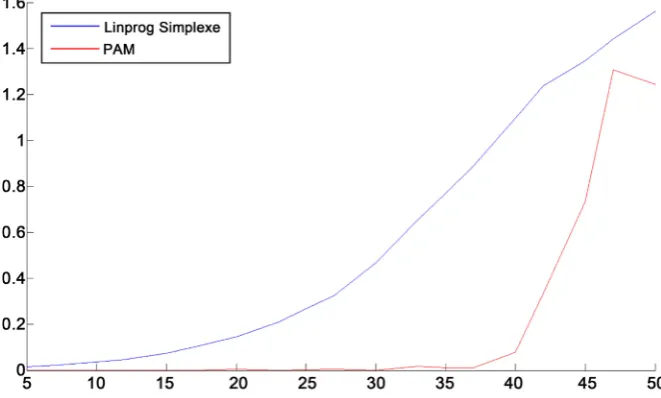
This results are reported in Figure 2, and in Figure 3, where “Simplex(it)”, “PAM(it)”, “Simplex(tm)”, “PAM(tm)” represent respectively the number of iterations of the Simplex algorithm, the number of iterations of the Pivot Adap-tive Method, the time of the Simplex algorithm, the time of the Pivot AdapAdap-tive Method. The time is given into milliseconds.
Size Simplex (it) PAM (it) Simplex (tm) PAM (tm) Size Simplex (it) PAM (it) Simplex (tm) PAM (tm)
3 × 3 7 3 8.1 0.65 27 × 27 461 8 325.4 4.8
5 × 5 15 3 15.2 0.65 30 × 30 647 3 467.4 0.83
7 × 7 27 3 22.1 0.66 33 × 33 867 24 654 17.6
10 × 10 51 3 36.6 0.66 35 × 35 1041 9 769.8 12.4
12 × 12 69 3 47.8 0.71 37 × 37 1258 18 888.7 12.6
15 × 15 103 5 75.6 2 40 × 40 1560 81 1095.8 77.9
17 × 17 142 5 101.9 2 42 × 42 1721 367 1236.6 335
20 × 20 204 10 147.1 5.5 45 × 45 1851 825 1346.7 734
23 × 23 291 5 209.7 2.1 47 × 47 1993 1354 1442.1 1307
[image:18.595.208.539.483.691.2]25 × 25 371 5 268.8 2.2 50 × 50 2169 1185 1561 1211.1
DOI: 10.4236/ajor.2018.82008 110 American Journal of Operations Research Figure 3. Time comparison between Linprog-Simplex and PAM for the Klee-Minty problem.
We remark that the (PAM) is better than the Simplex algorithm in computa-tion time, and in necessary number of iteracomputa-tions to solve the problems. Recall that the optimal solution of the problem (P3) is given by x=
(
0, 0,, 5n)
.8. Conclusions
The main contribution of this article is a new variant of the Adaptive Method that we have called “Pivot Adaptive Method” (PAM). In this variant, we use the simplex pivoting rule in order to avoid computing the inverse of the basic matrix in each iteration. As was recognized in this work, the algorithm saves our time compared to the original algorithm (AM), and allows us to present the resolu-tion of a given problem under the shape of successive tables as seen in an exam-ple.
We have implemented our algorithm (PAM) ((PAM) with the short step rule, and (PAM) with the long step rule) using MATLAB, and we have done a brief com-parison with the primal simplex algorithm (using linprog-simplex in MATLAB) for solving the Klee-Minty problem. Indeed, the (PAM) is more efficient in number of iterations, and in computation time.
In a subsequent work, we shall do a more thorough comparison between the Simplex algorithm of Dantzig and the (PAM), and we shall extend the (PAM) to the problems with a large scale using the constraint selection technique.
References
[1] Dantzig, G.B. (1951) Minimization of a Linear Function of Variables Subject to Li-near Inequalities. John Wiley, New York.
[2] Minoux, M. (1983) Programmation mathématique, Théorie et al gorithmes, Tome 1, Dunod.
[3] Culioli, J.C. (1994) Introduction à l’optimisation, Elipse.