© Associated Asia Research Foundation (AARF)
A Monthly Double-Blind Peer Reviewed Refereed Open Access International e-Journal - Included in the International Serial Directories.
Page | 9
DETECTION OF ARRHYTHMIA USING AUTOMATIC
DIFFERENTIATION METHOD
Shruti Jain
Department of Electronics and Communication Engineering, Jaypee University of Information Technology, Solan
ABSTRACT
ECG records the electrical activity with the help of electrodes placed on different leads and
chest leads. There are different types of leads consisting of unipolar leads, bipolar lead, and
chest lead which form 12 lead system. In this paper pre-processing was done on the data
available from MIT arrhythmia. Different features are extracted using the db4 wavelet with 4
levels. Out of 28 features, best 15 features are selected using Particle swarm optimization
algorithm. Lastly, Back Propagation algorithm is used for the classification where best
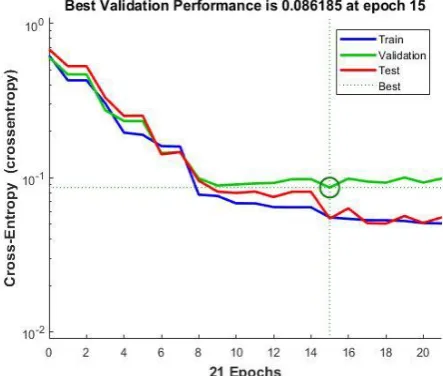
performance analysis graph is plotted among Epochs and cross entropy.
Keywords : Electrocardiography, Arrhythmia, Neural Network, Back Propagation, Particle
Swarm Optimization
I. Introduction :
Electrocardiography is the method of recording the electrical activity using electrodes placed
on the skin [1, 2]. These electrodes observe the electro physical pattern of repolarising and
depolarizing of every heart beat. For the normal beat, in Sinoatrial Node (SA) node, electrical
activity associated with each cardiac cycle generates in a cell in right atrium. SA Nodal cells
spontaneously depolarize at a rate that is dependent on the relative balance of sympathetic
and parasympathetic tone [3, 4, 5]. From SA node the wave of depolarization propagates in
an orderly timed fashion to the remaining atrial tissue, to the Atrioventricular Node (AV International Research Journal of Natural and Applied Sciences
ISSN: (2349-4077) Impact Factor- 5.46, Volume 5, Issue 7, July 2018
Website- www.aarf.asia, Email : [email protected] , [email protected]
© Associated Asia Research Foundation (AARF)
A Monthly Double-Blind Peer Reviewed Refereed Open Access International e-Journal - Included in the International Serial Directories.
Page | 10
Node), then to the left and right ventricular myocardium [6, 7]. The AV node conducts
relatively slowly, thereby allowing the atrium to fully contract before ventricular contraction
starts. At rest, vagal (parasympathetic) tone predominates and the SA node spontaneously
depolarizes, on average, 60-100 times per minute. During exercise, there is both increase in
sympathetic nervous system activity and withdrawal of vagal tone and the SA node may
depolarize at a much faster rate, depending on age [7, 8].
This paper stresses on the analysis of ECG signal which includes four steps [8 – 16] :
denoising, feature extraction [10, 11, 12], feature selection and classifier block [13 - 16].
Section 2 is materials and methods which explain feature extraction of an ECG signal using
different transform techniques, feature selections by best optimization technique (PSO) and
classification using different classifiers. Section 3 explains the results and discussions in
which different parameters/features were extracted using best wavelet technique out of which
best parameters were selected using PSO and Algorithm decomposition is used as the
classifier.
II. Materials and Methods
Before starting with the feature extraction block we have done pre-processing where removal
of the high-frequency noise (power line interference and muscle contraction) is done [4, 5].
2.1Feature Extraction of an ECG signal: When we record ECG signal then it contains a lot
of noise and artifacts present in it so its quality gets degrade and making exact
interpretation of a signal is more difficult. There are mainly two types of FE techniques:
Morphological features (MF) and Signal processing features (SPF) [ 8, 9]
a)Morphological Feature: Morphological image processing could be an assortment of
non-linear operations associated with the morphology of options in a picture.
Morphological operations lies on the relative ordering of pixel values, not on their
numerical values, and thus are particularly suited to the process of binary pictures.
Morphological operations can even be applied to grey scale pictures such their
light-weight transfer functions are unknown and thus their absolute element values are of no
© Associated Asia Research Foundation (AARF)
A Monthly Double-Blind Peer Reviewed Refereed Open Access International e-Journal - Included in the International Serial Directories.
Page | 11
known as a structuring component. The structuring component is positioned the least
bit attainable locations within the image and it is compared with the corresponding
neighborhood of pixels.
b)Signal Processing Methods: Signal process issues the analysis, synthesis, and
modification of signals that are generally outlined as functions conveyance, signal
process techniques are used to improve signal transmission fidelity, and subjective
quality, and to emphasize or observe parts of interest in a various measured signal. This
is further classified as
i) Fast Fourier Transform: A Fast Fourier Transform (FFT) rule computes the separate
Fourier transform of a sequence, or its inverse (IFFT). An earlier technique used for
analysis of EKG is in time domain, however, this methodology is not comfy for study
all characteristics of ECG signal. So a replacement technique FFT was developed.
Fourier transform might be a regular technique that transforms time domain signal to
the frequency domain to induce the frequency coefficients. The whole method
consists of the subsequent steps: (i) To get an ECG sample as an input signal, (ii)
Compress the ECG input signal by removing the low-frequency components and (iii)
to obtain the original signal by using IFFT. But the disadvantage of FFT is it failed to
provide the information regarding the accurate location of frequency components in
time.
ii)Short Time Fourier Transform (STFT): It is related to a Fourier transform which is
used to determine the sinusoidal frequency and phasor content of a local section of a
signal as it varies with a time. To overcome the problem of an FFT a technique called
the windowed-Fourier transform, i.e. STFT far-famed later as Gabor transform was
introduced. STFT compares both time and frequency information. The STFT is a
quick and straightforward technique compared to other time-frequency analysis. A
window operation is applied to a section of knowledge followed by Fourier
Transform. This can be referred to as the spectrograph or STFT. For a sign x (t), the
definition of STFT is given by the equation.
© Associated Asia Research Foundation (AARF)
A Monthly Double-Blind Peer Reviewed Refereed Open Access International e-Journal - Included in the International Serial Directories.
Page | 12
STFT {x (t )}(a, w)= X (a, w)=∫ x (t) w (t-a) dt (1)
where w(t) is a window, having duration T, centred at time location t, the Fourier
transform of the windowed signal x(t) w(t - a) is the STFT. But the limitation of STFT
is that its time-frequency precision is not optimal. Hence a more suitable technique is
opted to overcome this drawback known as Wavelet Transform.
iii)Wavelet Transform: Wavelet transform decomposes the signal into the reciprocally
orthogonal set of wavelets that is the main distinction from the continuous wavelet
transform (CWT), or its implementation for the separate statistic generally referred to
as discrete-time continuous wavelet transform (DT-CWT). Hence to beat the matter of
STFT that have mounted window size, therefore, it doesn't provide multi-resolution
information of the signal. However, wavelet transform contains a multi-resolution that
offers each time and frequency information of signal by the variable window size. A
rippling could be a little wave that has energy focused in time and provides a tool for
the analysis of transient, non- stationary or time-varying signals. There are different
types of wavelets: Biorthogonal, Haar, Coiflet, Symlet, Daubechies wavelets, etc. The
wavelet transform may be a time-scale illustration that has been used effectively in an
exceeding type of applications, especially signal compression. It may be a linear
method that decomposes the signal into the variety of scales related to Frequency
elements and analyzes every scale with an explicit resolution.
2.2 Feature Selection (Particle swarm optimization) : Particle swarm optimization
(PSO) is a metaheuristic global optimization method/ stochastic algorithm used for
optimization problem which was put forward originally by Doctor Kennedy and E
Eberhart in 1995. PSO is an evolutionary computation method similar to the Genetic
Algorithm (GA). It is based on the movement of bird and fish flock while searching for
food. The birds can easily smell the food when they are together or scattered, having the
better food resource information, yielding better development of the solution of swarm.
Better the information, optimistic will be its solution which can be worked out with PSO
algorithm. We can also work with complex optimistic problem with PSO. Simplicity and
easier implementation of PSO makes use of this algorithm in many fields such as the
© Associated Asia Research Foundation (AARF)
A Monthly Double-Blind Peer Reviewed Refereed Open Access International e-Journal - Included in the International Serial Directories.
Page | 13
neural network training, vague system control, automatic adaptation control and machine
learning etc. Many machine learning and deep learning algorithms can be applied to the
classification of Bioinformatics, cyst problem of uterus, cancer of kidney/ lung etc. There
are many other advantages of PSO. They are robust and fast in solving nonlinear,
non-differentiable and multi-modal problems. PSO can be applied into both engineering and
scientific research. PSO adopts real number code. The search can be carried out by the
speed of the particle. Non-linear programming can be easily done with PSO. After so
many advantages of PSO there are some disadvantages as it stuck in the local minima.
To improve the performance of PSO, the researchers proposed the different variants of
PSO. Some researchers try to improve it by improving initialization of the swarm. Some
of them introduce the new parameters like constriction coefficient and inertia weight.
Some researchers work on the global and local best particles by introducing the mutation
operators in the PSO. It has two approaches: one is called cognitive and another is called
social. The particles change its condition according to the three principles: (i) to change
the condition according to its most optimist position (pbest) (ii) to keep its inertia (iii) to
change the condition according to the swarm‘s most optimist position (gbest). The
position of each particle in the swarm is affected by the position of the most optimist
particle in its surrounding (near experience) and the most optimist position during its
movement (individual experience). In the partial PSO, the speed and position of each
particle change according to the equality expression in Eq. (2) and Eq. (3).
1
1 1 2 2
k k k k k k k k
id id id id d id
v v c r pbest x c r gbest x
(2)
1 1
k k k
id id id
x x v (3)
where v is the velocity, x is the speed of the particle i for k time in the d- dimension of
position. In order to avoid particle being far away from the searching space, the speed of the
particle created at its each direction is confined by vdmax (if the number of vdmax is too small,
the solution will be the local optimism, if the number vdmax is too big, the solution is far from
the best), c1 and c2 represent the speeding figure (if the figure is too small, the particle is
probably far away from the target field, if the figure is too big, the particle will maybe fly to
the target field suddenly or fly beyond the target field). The proper figures for c1 and c2 can
© Associated Asia Research Foundation (AARF)
A Monthly Double-Blind Peer Reviewed Refereed Open Access International e-Journal - Included in the International Serial Directories.
Page | 14
Usually, c1 is equal to c2 and equal to 2; r1 and r2 represent random fiction. Using Eq. (2)
particle evolution is divided into three parts: better, general and worse.
For better particles position evolution :
1
1 1
k k k k k
id id id id
v v c r pbest x
(4)
For general particles position evolution
1
1 1 2 2
k k k k k k k k
id id id id d id
v v c r pbest x c r gbest x
(5)
For worse particles position evolution
1
2 2
k k k k k
id id d id
v v c r gbest x
(6)
Let‘s consider fmin as the best fitness value, fmax as worse fitness value and aver as the average
value of all fitness. The particles between fmin and aver1 is expressed by Eq. (4) , aver1 and
aver2 is expressed by Eq. (5), aver2 and fmax are expressed by Eq. (6) are known as better
particles, general particles, and worse particles respectively.
2.3 Classification: Classification is the method of grouping the testing samples into the
corresponding categories. Classification is characterized into two varieties viz.
supervised classification and unsupervised classification. MIN-MAX normalization
procedure is used to normalize the extracted and selected features in the range [0, 1] in
order to avoid any bias by unbalanced features. There are various classification
techniques which classify the data into two classes or three classes according to its use.
a) k-Nearest-Neighbour Algorithm (k-NN): The k-NN rule measures the gap between a
question situation and a group of eventualities within the information set.
b) Artificial Neural Network (ANN): An artificial neural network is an interconnected
cluster of nodes, resembling the huge network of neurons of brain. An important
application of neural networks is pattern recognition. Once the network is employed,
it identifies the input pattern and tries to output the associated output pattern. The
ability of neural networks involves once a pattern that has no output related to it, is
given as an input. The system performance is sometimes quantified by means that of
two parameters: sensitivity and specificity or sensitivity and positive prognosticative
accuracy (PPA), once the definition of false negatives could also be questionable.
© Associated Asia Research Foundation (AARF)
A Monthly Double-Blind Peer Reviewed Refereed Open Access International e-Journal - Included in the International Serial Directories.
Page | 15
speed of true negative events for class, PPA finds the rate of true positive events
among all the classified events in class. There are various neural networks.
I. Feedforward Neural Network : Artificial Neuron: In this type of neural network
the information propagates only in one direction. The information is passed from
the input nodes to the output nodes. This type of neural network might or might
not have the hidden layers of neurons. In straightforward words, it is a front
propagated wave and no backpropagation by employing a classifying activation
operates sometimes.
II. Radial Basis Function Neural Network : RBF functions have 2 layers, initial
wherever the features are combined with the RB operate within the inner layer and
the output of those features are taken into consideration whereas computing an
equivalent output within the next time-step that uses large memory size. The
model depends on the most reach or the radius of the circle in classifying the
points into completely different classes. If the purpose is in or around the radius,
the chance of the new purpose begins categorized into that class is high. The gap
can be measured by Euclidean distance.
III. Kohonen Self Organizing Neural Network: It consists of one or 2 dimensions.
Once training the map the situation of the nerve cell remains constant however the
weights disagree reckoning on the worth. Each nerve cell price is initialized with a
tiny low weight and also the input vector. The nerve cell nearest to the purpose is
that the ‗winning vegetative cell‘ and also the neurons connected to the winning
neuron will move, the space between the purpose and also the neurons is
calculated by the geometer distance, the nerve cell with the smallest amount
distance wins. Through the iterations, all the points are clustered every nerve cell
represents quite cluster.
IV. Recurrent Neural Network(RNN) – Long Short-Term Memory: The RNN works
on the principle of saving the output of a layer and feeding this back to the input
to assist in predicting the end result of the layer. Here, the primary layer is made
like the feed forward neural network with the merchandise of the total of the
weights. The RNN method starts once this is often computed; this implies that
from just the one step to future every nerve cell can bear in mind some data it had
© Associated Asia Research Foundation (AARF)
A Monthly Double-Blind Peer Reviewed Refereed Open Access International e-Journal - Included in the International Serial Directories.
Page | 16
cell in playing computations. During this method, we want to let the neural
network to figure on the front propagation and bear in mind what data it desires
for later use. Here, if the prediction is wrong we have a tendency to use the
educational rate or error correction to create tiny changes so it'll step by step work
towards creating the proper prediction throughout the backpropagation.
V. Convolutional Neural Network (Conv Net): Convolutional neural networks are the
same as feedforward neural networks,wherever the neurons have learn-able
weights and biases. During this neural network, the input options are taken in
batch wise sort of a filter. This may facilitate the network to recollect the pictures
in components and might work out the operations. These computations involve the
conversion of the image from RGB or IHS scale to Gray-scale. Once we have this,
the changes within the component may be classified into completely different
classes. ConvNet has applied in techniques like signal process and image
classification techniques. PC vision techniques are dominated by ConvNet
attributable to their accuracy in image classification. The technique of image
analysis and recognition, wherever the agriculture and weather options square
measure extracted from the open supply satellites like LSAT to predict the longer
term growth and yield of a specific land are being enforced.
VI. Modular Neural Network: Modular Neural Networks are an assortment of various
networks operating severally and contributory towards the output shown in Fig 1.
Every neural network encompasses a set of inputs that are distinctive compared to
alternative networks constructing and acting sub-tasks. These networks don't act
or signal one another in accomplishing the tasks. The advantage of a modular
neural network is that it breakdowns an outsized computational method into
smaller parts decreasing the complexness. This breakdown can facilitate in
decreasing the quantity of connections and negates the interaction of those
networks with ones another, that successively can increase the computation
speed. However, the interval can rely on the number of neurons and their
© Associated Asia Research Foundation (AARF)
A Monthly Double-Blind Peer Reviewed Refereed Open Access International e-Journal - Included in the International Serial Directories.
Page | 17
Fig1: Modular Neural Network
VII. Fuzzy hybrid neural network :A fuzzy neural network or neuro-fuzzy system is a
learning machine that finds the parameters of a fuzzysystem
(i.e., fuzzy sets, fuzzy rules) by exploiting approximation techniques from neural
networks. The rule base of a fuzzy system is taken as a neural network. Fuzzy
sets considered weights whereas the input and output variables and therefore the
rules or sculptural as neurons. Neurons is enclosed or deleted within the learning
step. Finally, the neurons of the network represent the fuzzy object.
c) Support Vector Machines (SVM): SVMs have supervised learning models with
associated learning algorithms that analyze knowledge used for classification and
multivariate analysis. SVMs will expeditiously perform a non-linear classification
victimization what's known as the kernel trick, implicitly mapping their inputs into
high-dimensional feature areas When information doesn't seem to be tagged,
supervised learning isn't potential, and an unattended learning approach is needed,
that makes an attempt to seek out natural agglomeration of the information to teams,
so map new information to those shaped teams. The agglomeration rule that provides
Associate in Nursing improvement to the support vector machines is termed support
vector agglomeration and is usually employed in industrial applications either once
information doesn't seem to be tagged or tagged as a preprocessing for a
classification.
d) Back-Propagation: Backpropagation Neural network has two phases. In first phase
training is provided to network‘s input layer. The network propagates the input from
layer to layer until the output pattern is generated by output layer. In the second
© Associated Asia Research Foundation (AARF)
A Monthly Double-Blind Peer Reviewed Refereed Open Access International e-Journal - Included in the International Serial Directories.
Page | 18
propagated backward from output layer to input layer. Then weights are modified as
the error is propagated. Backpropagation may be a special case of an older and
additional general technique known as Automatic Differentiation. Within the context
of learning, backpropagation is usually utilized by the gradient descent optimization
rule to regulate a load of neurons by shrewd the gradient of the loss operate. This
method is generally known as the backward propagation of errors, as a result of the
error is calculated at the output and distributed back through the network layers.
Backpropagation needs a notable, desired output for every input value—it is so
thought of to be a supervised learning methodology. Backpropagation is additionally a
generalization of the delta rule to multi-layered feedforward networks. It is closely
associated with the Gauss-Newton rule and is an element of continuous analysis in
neural backpropagation. Backpropagation will be used with any gradient-based
optimizer, like L-BFGS or truncated Newton
3 RESULTS and DISCUSSIONS:
We have used Physio BIT MIH database for Arrhythmia patients. Initially pre-processing is
done to remove the noise present in the signal. Out of different FE techniques discussed in
section 2.1 we have used wavelet transform in this paper. Discrete wavelet transforms
method where we discarded the first detail component. The output from denoising block is
passed through low pass and high pass filters. The output of low pass filter is further passed
until enough decomposition is reached. The output of each filter is down sampled by factor 2.
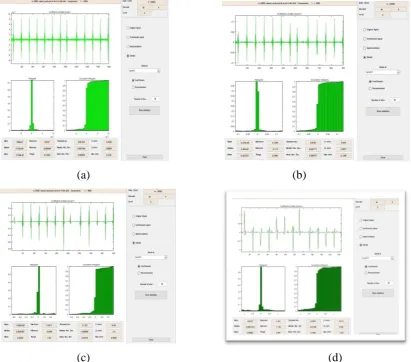
The extraction centered through R-peaks of ECG signal. Fig 2 shows the detail coefficient of
level 4. Here we can see that noise is still at level 3 as ECG signal is not clear enough. Noise
has been removed at level 4, now ECG signal can be analyzed and different features of the
© Associated Asia Research Foundation (AARF)
A Monthly Double-Blind Peer Reviewed Refereed Open Access International e-Journal - Included in the International Serial Directories.
Page | 19
(a) (b)
[image:11.595.103.515.37.399.2]
(c) (d)
Fig 2 : Detail Coefficient of signal (a) at level 1 (b) at level 2 (c) at level 3 (d) at level
4.
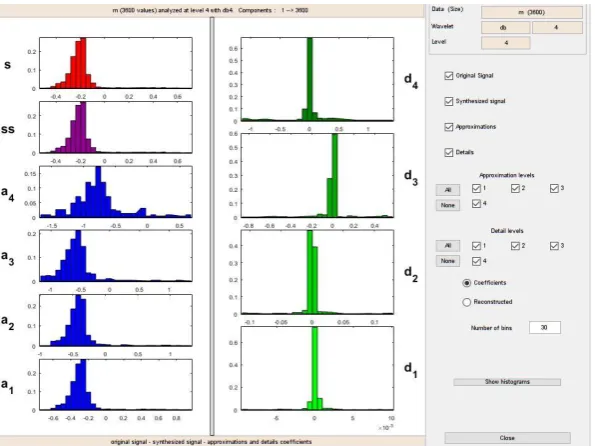
Fig. 3 shows the histogram of signal at level 4. From histogram we can infer that as noise is
removed from level to level histograms of approximation coefficients start expanding. While
the detail coefficient‘s histogram starts shrinking. Synthesized signal has been obtained by
© Associated Asia Research Foundation (AARF)
A Monthly Double-Blind Peer Reviewed Refereed Open Access International e-Journal - Included in the International Serial Directories.
Page | 20
Fig 3 :Histogram at different levels.
[image:12.595.151.449.34.257.2]© Associated Asia Research Foundation (AARF)
A Monthly Double-Blind Peer Reviewed Refereed Open Access International e-Journal - Included in the International Serial Directories.
[image:13.595.177.429.37.222.2]Page | 21
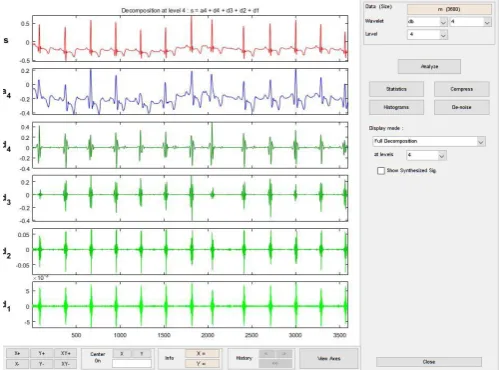
Fig. 5 : decomposition of signal at different levels.
For Feature Extraction, we have chosen db4 wavelet at level 4.While selecting a wavelet for
feature extraction we should keep in mind that wavelet should match with our signal. The
closer the wavelet matches with the signal the better and accurate will be the results. Here
db4 wavelet best match with the ECG signal and at level 4 as a level below 4 we are not able
to get the complete details of the signal whereas above level 4 signals starts deteriorating, so
level 4 is the best where we can get all the details of the signal in Fig 5. d4 refers to the
details coefficient at level 4 and a4 refers to the approximation coefficient at level 4. As we
can see at level 1 detail coefficient contain some noises which are removed further at level 4.
Various features Mean, Median, Standard deviation, Variance, Kurtosis, Skewness,
root-mean-square error (RMSE) and the combination of features with each other were extracted
for 95 images. Out of 28 features, the best features were selected using PSO algorithm. Using
MATLAB 2013a we get, 15 features are the best suites for further computation.
Later the data is divided into testing and training dataset. Confusion Matrix (CM) is used to
outline the performance of a classification model on a particular set of data provided to the
classification model. In CM
a) True Positives (TP): These are the cases in which we forecasted 1(they have an arrhythmia
).
b) True Negatives (TN): These are the cases in which we forecasted 0 (they do not have an
arrhythmia).
c) False Positives (FP): We forecasted 1 and actually they do not have an arrhythmia.
© Associated Asia Research Foundation (AARF)
A Monthly Double-Blind Peer Reviewed Refereed Open Access International e-Journal - Included in the International Serial Directories.
Page | 22
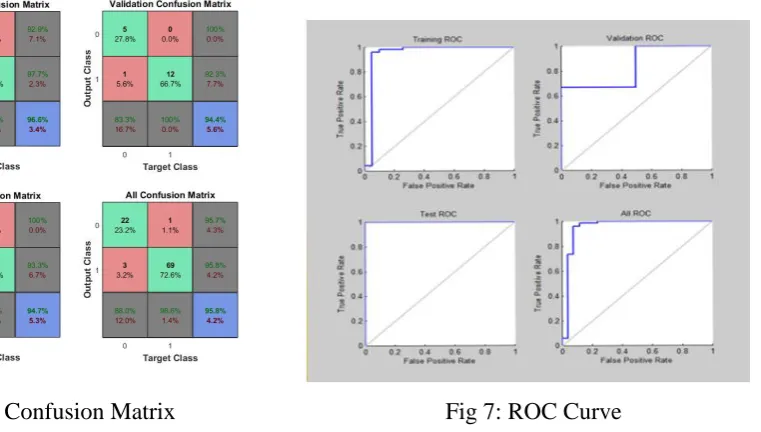
Fig 6: Confusion Matrix Fig 7: ROC Curve
Results we obtained after Training Validating and Testing shows that out of 95 Samples we
were able to predict correctly 22 samples which do not have arrhythmia & 69 samples which
have an arrhythmia. Also in 4 samples, our predictions turn out to be wrong. For training data
set classifier block made a total of 58 predictions. Out of 58, these predictions classifier block
is able to predict that 43 samples have arrhythmia present whereas 13 samples do not have
arrhythmia present shown in Fig. 6. Overall we achieved 95.8% accuracy in predicting
arrhythmia with a 4.2% error rate. From ROC curve (shown in Fig 7) and histogram we can
interpret that at a certain point neural network is unable to predict right response and if we
remove this point from the data set neural network can learn more efficiently. The true
positive rate of a confusion matrix is plotted against the function false positive rate. A ROC
curve reflects the efficiency of a neural network. As we can see in ALL ROC curve which
includes a combined result of Training, Validation, and Testing shown in Fig 7.The graph lies
towards True Positive rate more as we have achieved an overall success rate of 95.8%. An
epoch describes the number of times the algorithm sees the entire data set. So, each time the
algorithm has seen all samples in the dataset, an epoch has completed. As we can see that at
[image:14.595.137.518.46.262.2]© Associated Asia Research Foundation (AARF)
A Monthly Double-Blind Peer Reviewed Refereed Open Access International e-Journal - Included in the International Serial Directories.
[image:15.595.180.402.42.230.2]Page | 23
Fig 8: Performance Analysis Graph
CONCLUSION
ECG signal has been through the pre processing block where the different type of noises i.e.
baseline wandering noise, power line interference, burst noise is removed. Then the pre
processed signal is passed through the feature extraction block from where different features
of signal i.e. mean, median, kurtosis, skewness, variance, standard-deviation, rmse are
extracted. In classification block data set is provided for ECG signal classification. Their
using Backpropagation neural network algorithm training, validation, and testing are
performed. From the classifier block, we have achieved a 95.8% accuracy in predicting the
arrhythmia along with a 4.2% error rate which is shown in the confusion matrix.
References
1. Carr J. J., John M.Brown,‖Introduction to Biomedical Equipment Technology‖.
2. Thakor N.V., ―Electrocardiographic monitors,‖ in Encyclopedia of Medical Devices
and Instrumentation,
3. John G. Webster, Halit Eren. ,‖Measurement, Instrumentation and Sensors
Handbook‖.
4. Prashar N. et al, "Removal of electromyography noise from ECG for high
performance biomedical systems," Network Biology, vol. 8, p. 12, 2018.
5. Prashar N. et al, ―Review of Biomedical System for High Performance Applications‖,
4th IEEE International Conference on signal processing and control (ISPCC 2017), Jaypee University of Information technology, Waknaghat, Solan, H.P, India, pp
© Associated Asia Research Foundation (AARF)
A Monthly Double-Blind Peer Reviewed Refereed Open Access International e-Journal - Included in the International Serial Directories.
Page | 24
6. Ishbeata A, Kalbouneh M. ―ECG Circuit Analysis and Design‖: Jan 11, 2012
7. Gupta R., Singh S., Garg K., Jain S., ―Indigenous Design of Electronic Circuit for
Electrocardiograph‖, International Journal of Innovative Research in Science,
Engineering and Technology, 3(5), 12138-12145, May 2014
8. Dhiman A, Singh A, Dubey S, Jain S., “Design of Lead II ECG Waveform and
Classification Performance for Morphological features using Different Classifiers on
Lead II ”, Research Journal of Pharmaceutical, Biological and Chemical Sciences
(RJPBCS),7(4), 1226- 1231: July-Aug 2016.
9. Jain S., "Classification of Mitogen Activated Protein Kinase using Different Wavelet
Transforms (Discrete and Gabor)," Asian Journal of Microbiology, Biotechnology
and Environmental Sciences, vol. 20, pp. 569-574, 2018.
10.Jain S., "Classification of Protein Kinase B using discrete wavelet transform,"
International Journal of Information Technology, vol. 10, pp. 211-216, 2018.
11.Bhusri S., Jain S., Virmani J., "Breast Lesions Classification using the Amalagation of
morphological and texture features," International Journal of Pharma and
BioSciences, vol. 7, pp. 617-624, 2016.
12.Rana S., Jain S., Virmani J., "Classification of focal kidney lesions using
wavelet-based texture descriptors," International Journal of Pharma and Bio Sciences, vol. 7,
pp. 646-652, 2016.
13.Bhusri S., Jain S., Virmani J., "Classification of breast lesions using the difference of
statistical features," Research Journal of Pharmaceutical Biological And Chemical
Sciences, vol. 7, pp. 1365-1372, 2016.
14.Sharma S., Jain S., Bhusri S., " Two Class Classification of Breast Lesions using
Statistical and Transform Domain features," Journal Of Global Pharma Technology
Methodology, vol. 9, pp. 18-24, 2017.
15.Jain S, Bhooshan S.V., Naik P.K., ―Mathematical modeling deciphering balance
between cell survival and cell death using insulin‖, Network Biology, 1(1):46-58,
2011.
16.Afkhami R. G., Azarnia G., Tinati M. A., "Cardiac arrhythmia classification using
statistical and mixture modeling features of ECG signals," Pattern Recognition
Letters, vol. 70, pp. 45-51, 2016.