2019 International Conference on Computer Science, Communications and Big Data (CSCBD 2019) ISBN: 978-1-60595-626-8
Optimization of High-speed Railway Emergency Plan
Based on Safety Big Data
Pu WANG, Ping LI and Jin-zi ZHENG
*China Academy of Railway Sciences Corporation Limited, Beijing, China, 100081
*Corresponding author
Keywords: Big data, High-speed Railway, Emergency plan, Optimization method.
Abstract. This paper investigates the optimization of the emergency plan for High-speed Railway based on the analysis of big data. We introduce the current situation of emergency management, construct the framework of the emergency plan system and life cycle management of the emergency plan. By analyzing the management process of existing emergency plans in detail, we put forward the optimization plan. Finally, we analyze the emergency plan optimization scenario and the source of safety big data, and carry out case study of High-Speed Railway emergency plan optimization based on typical case data. This paper provides an important basis for departments at all levels to deal with emergencies.
Introduction
With the rapid development of High-speed Railway, it not only brings convenience to people's life, but also brings new challenges to railway transportation command, especially emergency command. Ensuring the safety of High-speed Railway and passengers has been elevated to the strategic height of national security development. To implement this development concept, the railway needs to improve its emergency command capacity in an all-round way. In response to railway emergencies, on the one hand, it is necessary to further strengthen the coordination between railway emergency organizations and continuously improve the ability to deal with railway emergencies. On the other hand, a sound emergency linkage mechanism should be established to form a joint force to deal with major railway emergencies [1].
Emergency management of High-speed Railway is a process of effective early warning, control and treatment of High-speed Railway emergencies in order to reduce the harm of High-speed Railway emergency and achieve the goal of optimization decision, which is based on the analysis of causes, processes and consequences of High-speed Railway emergencies and effectively integrate relevant resources of internal and external aspects of the railway[2]. In essence, High-speed Railway emergency management is the management of the entire railway emergency life cycle. In general, High-speed Railway emergency management manages all processes before, during, and after the railway emergencies. The prevention stage before the emergency is the starting point of the entire railway emergency life cycle. During the emergency control stage, the emergency situation can be controlled and the loss can be reduced by taking corresponding emergency actions and relevant measures. After the emergency, it is the stage to recover the affected objects. By applying the experience and lessons to the construction of railway emergency management system, it can pre-judgment and prevent the next emergency.
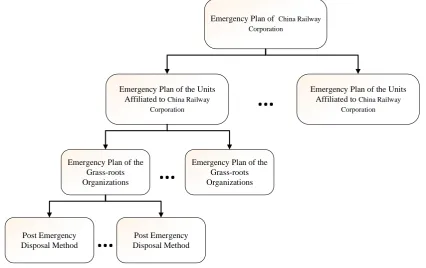
levels of railway safety production. It is China Railway Corporation emergency plan—the emergency plan of the unit of the China Railway Corporation—the emergency plan of the grass-roots organization—the post emergency disposal method. The number of plans in the 18 railway administrations under China Railway Corporation is different, and the number of plans of grass-roots organizations in each railway administration is even more different. By 2017, nearly 14,000 emergency plans at all levels have been prepared.
In the construction and operation of China’s High-speed Railway, there are great differences with existing railways, such as advanced equipment and high speed of operation. At the same time, the whole line is usually built with a large scale of viaduct. These characteristics all put forward new requirements for the methods and technologies of High-speed Railway emergency plans and emergency rescue. In addition, most of the existing railway emergency plans are qualitative and lack quantitative indicators. With the accumulation of accident case data of High-speed Railway and the application of big data technology, the optimization of High-speed Railway emergency plans with big data analysis means and methods is a new direction of emergency management development.
Overview
In terms of railway emergency management, Jia Limin et al[3, 4] proposed a railway emergency management system from five aspects of emergency management system, mechanism, legal system, plan and guarantee system. Chen Zhensong[5] put forward a new framework of railway emergency management system. On this basis, the sub-system of railway emergency plan is constructed from the top-level design of emergency plan, risk analysis, emergency capacity evaluation, emergency plan system and other aspects. Xu Jianguang[6] built a railway emergency response management system based on the four stages of prevention and early warning, emergency preparedness, emergency response and recovery of the emergency management process.
High-speed Railway Emergency Plan
Emergency Management Process
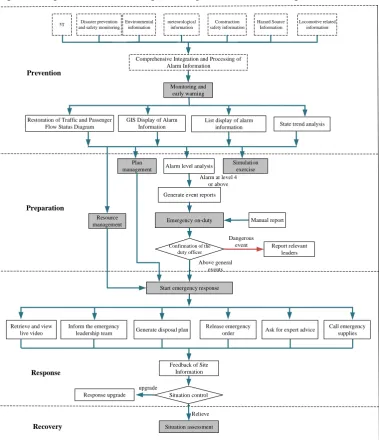
In order to realize the whole life cycle management concept of railway emergency management, that is, the entire process management from prevention-preparation-response-recovery, the specific information processing method at each stage is designed, as shown in Figure 1.
5T Disaster prevention and safety monitoring
Environmental information meteorological information Construction safety information Prevention Preparation Locomotive related information Dangerous event Hazard Source Information
Comprehensive Integration and Processing of Alarm Information
Confirmation of the duty officer
Situation control
Generate disposal plan Release emergency
order Ask for expert advice Inform the emergency
leadership team
Situation assessment Retrieve and view
live video Above general events Response upgrade Call emergency supplies Response Recovery
Restoration of Traffic and Passenger Flow Status Diagram
GIS Display of Alarm Information
Alarm at level 4 or above List display of alarm
information Monitoring and
early warning
State trend analysis
Alarm level analysis
Generate event reports
Emergency on-duty
Start emergency response
Relieve upgrade
[image:3.595.109.489.151.592.2]Feedback of Site Information Manual report Plan management Resource management Report relevant leaders Simulation exercise
Figure 1. Specific contents of railway emergency management life cycle management.
High-speed Railway Emergency Plan System
divided into four categories: natural disasters, accident disasters, public health and mass incident emergency plan; (4) According to the construction period and operation period of High-speed Railway, it can be divided into two categories: construction period emergency plan and operation period emergency plan.
National Special
Emergency Plan National Emergency Plan for Handling Railway Traffic Accidents
Emergency plan of Station/Base
Emergency Plan of China Railway Departments
Emergency Plan of High-speed Railway/ Passenger
Dedicated Company
(Subordinate to four categories)
Emergency plan of Station/Base
Emergency Plan for Railway Flood Control
Emergency Plan for Railway Destructive Earthquakes
Emergency Plan for Railway Hazardous Chemicals Transportation Accidents
Emergency Plan for Handling Railway Traffic Accidents by the Ministry of Railways
Emergency Plan for Railway Fire Accidents Emergency Plan for Railway Geological Disasters
Emergency Plan for Railway Network and Information Security Accidents
Emergency Plan for Railway Public Health Emergencies
Emergency Plan for Railway Disposal of Mass Incidents
Emergency Plan for Safety Accidents in Railway Construction Projects
General Plan for Corporate Public Emergencies
Special Plans for Various Natural Disasters of the Company
Company Infectious Epidemic Emergency Plan Emergency Plan for Casualty Accidents of Company Operators Emergency Plan for Construction and Equipment Failure of the
Company
Company Train Accident Disaster Emergency Plan
Company Food Safety Accident Emergency Plan
Emergency Plan for Corporate Terrorist Attacks
Emergency Plan for Corporate Mass/Large Passenger Flow Incidents
Company Computer System/Network Security Plan
Railway Rain and Snow Freezing Disposal Scheme
Interior Disposal Scheme of Train System
Disaster Disposal Scheme for Buildings Operator Safety Related Disposal Scheme Disposal Scheme of Locomotive, Electric and
Vehicle Equipment failure
[image:5.595.145.450.68.582.2]Communication Signal Failure Disposal Scheme
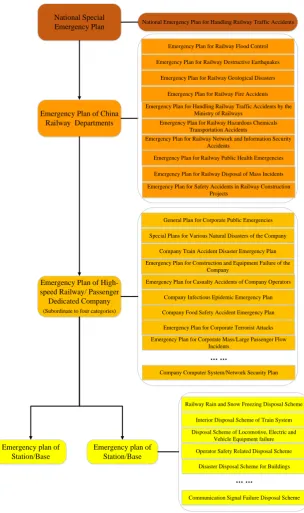
Figure 2. Emergency plan system for High-speed Railway operation period.
All the above-mentioned High-speed Railway emergency plans have optimization room in terms of start-up conditions, response process, emergency response time, and accident classification.
Life Cycle Management of Railway Emergency Plan
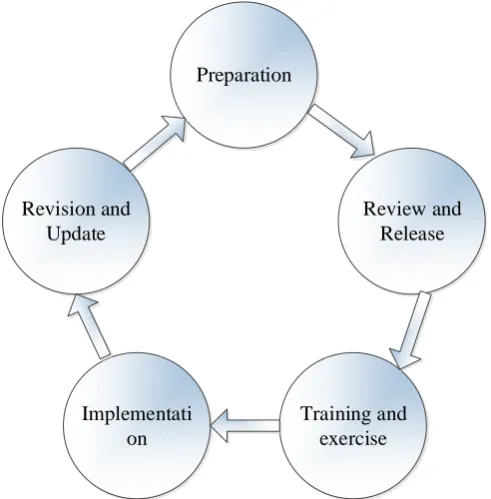
Emergency plan, also known as emergency scheme, is a plan or scheme formulated in advance for possible accidents or disasters in to ensure rapid, orderly and effective implementation of emergency, rescue operations and reduce accident losses. It is an operational guide for emergency response. The contents of emergency plan generally include basic information, general rules, organizational command system and responsibilities, prevention and early warning, emergency response, post-disposal, propaganda of safeguard measures, training and exercises, supplementary rules etc., to guide the whole process management of emergency prevention, preparation, response and recovery.
affiliated to the China Railway Corporation, the emergency plan of the grass-roots organizations and the post emergency disposal method. According to the content of the plan, the emergency plan of the China Railway Corporation and its affiliated units can be divided into general plan, special plan and department plan. Besides the emergency plan of grass-roots organizations can be divided into general plan, department plan and on-site plans. The number of plans in the 18 railway administrations under China Railway Corporation is different, and the number of plans of grass-roots organizations in each railway administration is even more different. By 2017, nearly 14,000 emergency plans at all levels have been prepared. Emergency plan management is the core content of emergency management. Considering that the railway emergency plan covers a large amount of information, and the types and quantities of plans are numerous, how to effectively manage the emergency plan is an important part of the current railway emergency management work. This paper will discuss the management of emergency plan from the perspective of the whole life cycle to improve the practicality and disposal efficiency of the plan.
Emergency Plan of China Railway Corporation
Emergency Plan of the Units Affiliated to China Railway
Corporation
Emergency Plan of the Units Affiliated to China Railway
Corporation
Emergency Plan of the Grass-roots Organizations Emergency Plan of the
Grass-roots Organizations
Post Emergency Disposal Method Post Emergency
Disposal Method
...
...
[image:6.595.85.512.259.527.2]...
Figure 3. Railway emergency plan system.
Preparation
Revision and Update
Review and Release
Implementati on
[image:7.595.175.421.71.321.2]Training and exercise
Figure 4. Life Cycle management of emergency plan.
High-speed Railway Emergency Plan Optimization
High-speed Railway Emergency Plan Optimization and Analysis Scenario
Based on the real historical event data and big data analysis technology, typical features are extracted, such as the occurrence time, interruption time, location/regional geological conditions, seasonal/meteorological factors, the cause of the accident, responsibility unit, accident categories/types/nature, etc. Besides, event portraits are developed to provide decision-making support for the formulation of emergency disposal plans of High-speed Railway. The optimization of High-speed Railway emergency plan based on big data can be roughly divided into four scenarios:
(1) Analyze the categories/types/nature of High-speed Railway emergencies and provide decision-making support for classification of High-speed Railway emergency plans.
(2) Analyze the interruption time of High-speed Railway emergency and provide decision-making support for the scheme of resuming operation in corresponding plans.
(3) Analyze the location/regional geological conditions, seasonal/meteorological factors, and cause of the accidents of the High-speed Railway emergency, and provide decision-making support for the High-speed Railway emergency plan disposal method based on the scenario analysis method;
(4) Based on the High-speed Railway safety information database, explore other data analysis dimensions to provide decision-making support for security early warnings.
Optimization of Data Sources of High-speed Railway Emergency Plan
The optimization of High-speed Railway emergency plan needs to collect data, improve the high-speed rail safety information database, and provide data support for decision analysis firstly. From the perspective of data sources, High-speed Railway safety early warning related data can be divided into four categories.
(1) The basic data mainly includes risk category, risk level, risk hazard degree, hidden danger level, accident type, fault type, over-limit type, security nature, business department and station name.
investigation materials, safety supervision and inspection, key work and leadership Listing Supervision and other data, as well as safety-related standards and documents.
(3) Relevant professional data, vehicle, locomotive, electricity and other professional data. For example, the passenger train delay information, the real-time monitoring and alarming information of dangerous goods and dramatic drugs in the field of freight transportation, as well as the real-time monitoring and alarming information of the freight measurement security detection and monitoring system, etc.
(4) Other data, weather forecast data along the railway and external environment data such as wind, rain, snow and earthquake.
Optimization Case of High-speed Railway Emergency Plan Based on Big Data
Traffic Interruption Time
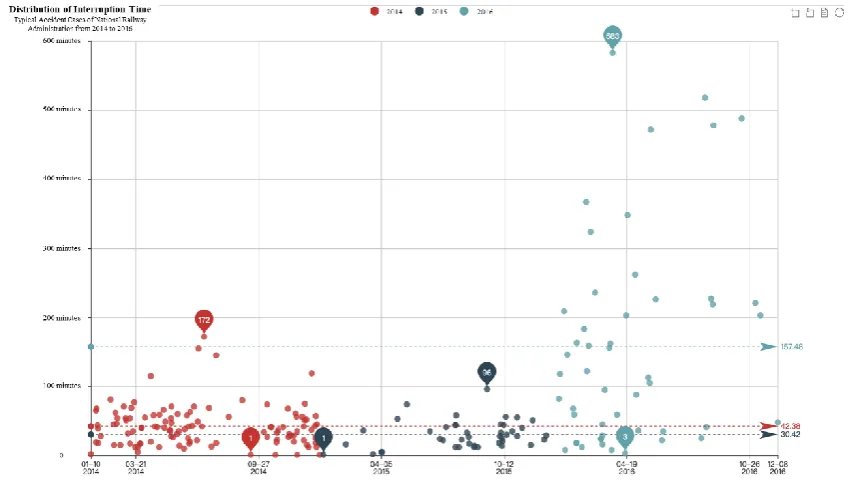
The accident case data of various professions from 2014 to 2016 are collected from the National Railway Administration, among which 605 cases are valid and 210 cases are recorded the traffic interruption time. The case attributes are sorted out, including event name, occurance location, event category, event level, date, location, train number, start time, end time, disposition time, interruption time (minutes), number of cranes used, number of injured, number of deaths, event source, event type, event profile, incident handling, remedial measures, cause of the incident, Responsibility investigation, experience lessons learned, etc.
[image:8.595.86.511.383.629.2]Based on the above data, the analysis of the interruption time is carried out, and its distribution is shown in Figure 5.
Figure 5. Distribution of interruption time.
Big Data Analysis for Security
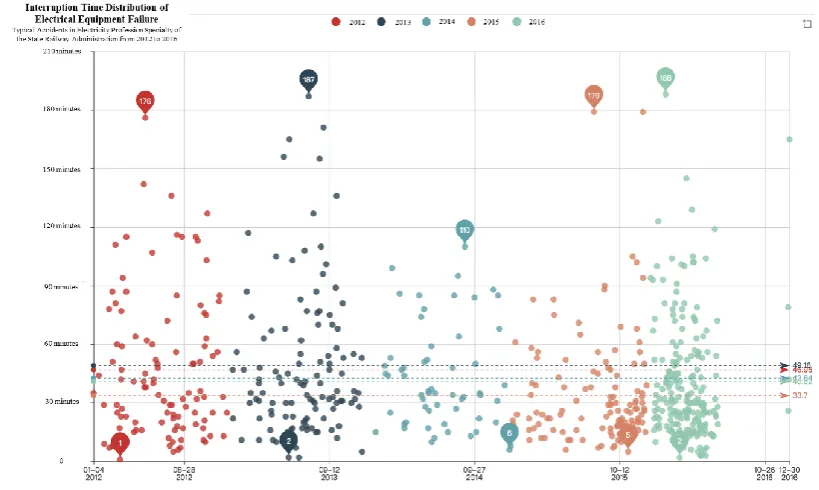
[image:9.595.93.503.202.447.2]The failure data of the electrical profession in the Safety Section of the Electrical Affairs Department of a railway administration are analyzed. The main attribute information includes occurrence time, repair time, failure delay time (minutes), occurrence process and cause (In case of material failure, fill in the equipment manufacturer, model, date of leaving the factory, date of going on the road, etc.), the cause of the fault, fault location, impact, assessment delay (minutes), type, responsibility workshop, responsibility team, date of failure occurrence, etc. Distribution of interruption time of electrical equipment failure events in this Railway Administration is shown in Figure 6.
Figure 6. Distribution of interruption time of electrical equipment failure events in a Railway Administration.
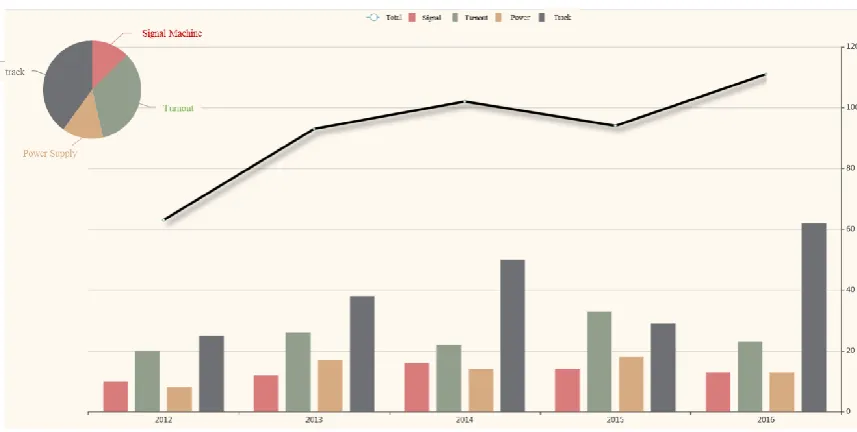
The average interruption time from 2012 to 2016 is 46.95, 49.16, 42.64, 33.7 and 40.92 minutes respectively. Based on the above data, it can be seen that the interruption time caused by electrical equipment failure is generally longer than that caused by comprehensive accidents. Therefore, it is necessary to focus on formulating the emergency plan for the electrical profession to reduce the interruption accident.
Figure 7. Distribution of electrical equipment failure events in a Railway Administration.
Summary
The optimization of High-speed Railway emergency plan based on the application of High-speed Railway safety early warning big data is another hot direction after the simulation optimization and algorithm optimization. Based on the analysis of big data, the composition, start-up, response conditions and disposal methods of various types of emergency plans in the emergency plan system can be optimized. The analysis of interruption time based on typical cases can provide data support for accident classification in the plan. With the gradual establishment and improvement of High-speed Railway safety early warning big data application system, more support will be provided for the optimization of emergency plan.
Acknowledgement
This research was financially supported by the "Advanced rail transport" special on the national key Research Program of China (NO. 2018YFB1201403, and the Science and Technology Research Project of the Railway Corporation of China (NO. K2018T003).
Reference
[1] Du Jian. Discussion on railway information construction based on GIS [J]. Railway Freight, 2009, 27 (2): 12-13, 15.
[2] Wang Fuzhang. Emergency Management of Railway Emergencies [M]. Beijing: China Railway Press, 2010:6.
[3] Jia Limin, Qin Yong, Cheng Xiaoqing, et al. Modern Railway Emergency Management [M]. Beijing: Science Press, 2011.
[4] Wang Yanhui, Jia Limin, Qin Yong, et al. Railway Emergency Management Theory and Method [M]. Beijing: China Railway Press, 2011.
[7] Yang Liang, Tan Guowei, Yan Ming, et al. Research on optimization method of urban rail transit emergency plan based on simulation technology [C]//New urbanization and traffic development—Proceedings of the 2013 China Urban Transport Planning Annual Conference and the 27th Symposium. Beijing, 2014.
[8] Wang Moli. Research on Emergency Plan for Emergency Operation of Subway Operation [D]. Nanjing: Southeast University, 2016.
[9] Cao Haifeng. Research on optimization method of grassroots emergency plan based on risk analysis of total disasters [J]. China public safety, 2017(1): 39-44.