0095-1137/11/$12.00
doi:10.1128/JCM.02311-10
Copyright © 2011, American Society for Microbiology. All Rights Reserved.
Comparison of Clinical Performance of Abbott RealTi
m
e High
Risk HPV Test with That of Hybrid Capture 2 Assay
in a Screening Setting
䌤
F. M. Carozzi,
1* E. Burroni,
1S. Bisanzi,
1D. Puliti,
1M. Confortini,
1P. Giorgi Rossi,
2C. Sani,
1A. Scalisi,
3and F. Chini
2ISPO, Cancer Prevention and Research Institute, Florence, Italy
1; Laziosanita
`, Rome, Italy
2; and ASL, Catania, Italy
3Received 17 November 2010/Returned for modification 15 December 2010/Accepted 8 February 2011
Randomized trials have produced sound evidence about the efficacy of screening with human papillomavirus
(HPV) DNA tests in reducing cervical cancer incidence and mortality. We evaluated the clinical performance and
reproducibility of the Abbott RealTi
m
e High Risk (HR) HPV test compared with that of the HR hybrid capture 2
(HC2) assay as assessed by a noninferiority score test. A random sample of 998 cervical specimens (914 specimens
of cervical intraepithelial neoplasia less severe than grade 2 [<CIN2] and 84 specimens of cervical intraepithelial
neoplasia grade 2 or more severe lesions [
>
CIN2]), collected in the Florence and Catania cervical Cancer Screening
Programs from women aged 25 to 64 and already tested by HR HC2, were retested with the Abbott RealTi
m
e HR
HPV test. Absolute specificity was 92.3% (95% confidence interval [CI], 90.4 to 94.0) and 92.6% (95% CI, 90.7 to
94.2) for the Abbott RealTi
m
e HR HPV test and the HR HC2, respectively. Absolute sensitivity was 96.4% (95% CI,
89.9 to 99.3) and 97.6% (95% CI, 91.7 to 99.7) for the Abbott RealTi
m
e HR HPV test and the HR HC2, respectively.
The noninferiority score test revealed that the clinical sensitivity and specificity of the Abbott RealTi
m
e HR HPV
test were not inferior (
P
ⴝ
0.004 and 0.009, respectively) to those of HR HC2. Overall agreement between the two
assays was 96.5%, with a
k
value of 0.86 (CI 95%, 0.82 to 0.91). We evaluated the intralaboratory reproducibility by
retesting 521 samples at least 4 weeks after the first test; the crude agreement between the first and second test was
98.5%, with an overall
k
value of 0.97 (CI 95%, 0.95 to 0.99). This test fully satisfies the requirements of a primary
cervical cancer screening test. This assay differentiates between HPV16, HPV18, and non-HPV16/18 types in every
specimen, but how to use this information in a screening setting still is unclear.
The etiologic link between persistent high-risk human
pap-illomavirus (HR HPV) infections and cervical cancer and its
immediate precancerous lesions has been widely
demon-strated. A recent IARC classification reports solid evidence for
a causal link to cervical cancer for only 12 HPV types (16, 18,
31, 33, 35, 39, 45, 51, 52, 56, 58, and 59), which are defined as
high-risk HPV (2).
Large randomized trials produced sound evidence about
the efficacy of screening with an HPV DNA test in reducing
cervical cancer incidence (19) and mortality (20). According
to trial results, an HPV test used as a cervical cancer
screen-ing test has three advantages: a higher long-term negative
predictive value (NPV) that permits extending the screening
interval without increasing the interval risk of cancer, a
clinical sensitivity of 90 to 95% for cervical intraepithelial
neoplasia grade 2 or 3 (CIN2/3) (1, 3, 6, 7, 13, 17, 18), and
a marked reduction of CIN2/3 and cancer among
test-neg-ative women in the subsequent screening round (19).
Several studies (12, 21) suggest that infections supported by
HPV16 and HPV18 are associated with a higher risk for the
progression of cervical cancer. Consequently, the genotyping
of HPV16 and HPV18 has been proposed to guide the
man-agement of HPV-positive women throughout the follow-up
procedures (12). Usually, viral tests are used to understand the
etiology of symptomatic diseases. However, the HR HPV test
in screening is aimed at preventing cervical cancer in an
asymp-tomatic population, therefore it is useful only when it is able to
detect clinically relevant infections. In other words, HPV
test-ing for screentest-ing purposes needs optimal balance between
clinical sensitivity and specificity. At present, the HPV assays
considered clinically validated for screening purposes are the
hybrid capture 2 HPV test (HC2) and the GP5
⫹
/6
⫹
-PCR
enzyme immunoassay (EIA) (24). New candidate assays
should prove their value in large prospective screening studies
or should prove to be noninferior to a validated reference assay
in clinical equivalence studies on specimens from a cervical
screening cohort. An international consortium recently
pub-lished guidelines (14) defining the appropriate study design
and sample size to measure the sensitivity, specificity, and
reproducibility of a new HPV DNA test to validate it for
screening.
In accordance with those guidelines, the aim of this study
was to assess the clinical specificity and sensitivity compared
to the hybrid capture 2 (HC2) HR HPV assay and the
intralaboratory reproducibility of the Abbott RealTi
m
e
High Risk HPV, a new method that is able to detect 12 HR
HPV types (16, 18, 31, 33, 35, 39, 45, 51, 52, 56, 58, and 59)
and 2 uncertain-risk HPV types (66 and 68).
Moreover, because the Abbott RealTi
m
e HR HPV test
al-lows partial typing (HPV16 and HPV18 versus other risk
types), we evaluated the accuracy of typing test results in
sam-ples with infections of known types.
* Corresponding author. Mailing address: Analytical Cytology and
Biomolecular Unit, ISPO, Cosimo Il Vecchio 2 Street, 50139 Florence,
Italy. Phone: 3905532697852. Fax: 3905532697879 E-mail: f.carozzi
@ispo.toscana.it.
䌤
Published ahead of print on 16 February 2011.
1446
on May 16, 2020 by guest
http://jcm.asm.org/
MATERIALS AND METHODS
Study population.The study was based on a sample of 998 women collected in the Florence and Catania Cervical Cancer Screening Programs, which regularly invite all resident women aged 25 to 64 years.
To assess the noninferiority of the specificity of the Abbott RealTime HR HPV test (i.e., relative specificity was not lower than 98%), 914 samples (median subject age, 44.6 years) without CIN2 or with more severe lesions were tested. The samples were randomly selected, according to Meijer and colleagues (14), from a population-based screening population recruited in two short periods, June to September 2008 in Catania and November 2009 to January 2010 in Florence, during which women were tested with the HR HC2 test. According to the screening protocol, women were always directly referred to colposcopy if the HR HC2 was positive (ⱖ1 relative light unit [RLU]) or cytology was atypical squamous cells of undetermined significance (ASCUS) or more severe.
To assess the noninferiority of the sensitivity (i.e., the relative sensitivity was not lower than 90%), 84 cervical scrapes (median subject age, 35 years) with histologically confirmed cervical intraepithelial neoplasia grade 2 or more severe lesions (ⱖCIN2) were tested. All of the samples came from a representative set of women of the same screening population, specifically from women referred to colposcopy for an abnormal Pap test (ASCUS or more) between January 2007 and January 2010 in Florence and in Catania. In both cases, suspicious areas were biopsied, and histology was read locally and was not blind to cytology or HPV results.
The intralaboratory reproducibility was determined by retesting 521 samples, 234 (44.9%) of which were HR HPV positive, 4 to 5 weeks after the first test. These samples came from the same screening programs, recruited between January 2007 and January 2010, to have a sufficient number of HR HC2-positive samples, as suggested by Meijer et al. (14).
During the entire study period (2007 to 2010 in Florence and 2008 in Catania), informed consent was obtained from all study participants, and this study fol-lowed local ethical guidelines.
All of the samples were selected to evaluate the sensitivity, specificity, and reproducibility of the new test by closely following the recommendations re-ported by Meijer et al. (14).
Laboratory procedures.At enrollment, cervical specimens were collected us-ing a broom-like device (cervical sampler; Digene Corporation, Gaithersburg, MD) and put in specimen transport medium (STM; Digene Corporation). An aliquot of 800l of STM was used for HR HC2, while 200l of each STM specimen was stored at⫺80°C in the ISPO biological bank for future studies (8). HC2 test.At enrollment, all samples were tested by HR HC2 assay (Qiagen, Gaithersburg, MD), according to the manufacturer’s protocol, in the same lab-oratory in Florence. We used only probe mix B, which is specific for 12 high-risk HPV types, 16, 18, 31, 33, 35, 39, 45, 51, 52, 56, 58, and 59, and for 1 uncertain-risk (IR) HPV type, HPV68, which was classified (2) as probably carcinogenic. HC2 is a sandwich capture molecular hybridization assay that utilizes chemilu-minescent detection to provide a semiquantitative result. Briefly, after denatur-ation, the single-stranded HPV DNA present in the sample was hybridized with a mixture of single-stranded full-genomic-length RNA probes specific for 13 HR HPV genotypes. The RNA-DNA hybrids then were captured on the surface of an antibody-coated microtiter plate. Immobilized hybrids are detected by adding an alkaline phosphatase-conjugated antibody to RNA-DNA hybrids, followed by the addition of a chemiluminescent substrate that is cleaved by the action of alkaline phosphatase to produce light. The emission of light is measured semi-quantitatively as RLU in a luminometer. The assay is calibrated to detect ap-proximately 4,700 genome equivalents (or 1 pg/ml) of HPV target, represented by an RLU measurement of greater than or equal to the cutoff value calculated in each run by a series of standards. Measurements below the cutoff were scored as negative. Positive and negative controls (provided by the manufacturer) were included in each run.
Abbott RealTime HR HPV test.The Abbott RealTime HR HPV test (Abbott, Wiesbaden, Germany) was performed in a Florence (ISPO) laboratory. The Abbott RealTime HR HPV test is a qualitativein vitrotest for the detection of DNA from 12 high-risk human papillomavirus genotypes, 16, 18, 31, 33, 35, 39, 45, 51, 52, 56, 58, and 59, and from 2 HPVs recently classified as uncertain-risk types: HPV68 has been classified as probably carcinogenic to humans and HPV66 as possibly carcinogenic by the IARC Monograph Working Group (2). For each sample, 25l was added to 475lmLysisDNA(AbbottmSample
Preparation SystemDNA; Abbott, Wiesbaden, Germany), of which 400l was used for DNA extraction.
DNA was isolated using the Abbottm2000sp. automated sample preparation system using magnetic particles to capture the nucleic acid (AbbottmSample Preparation SystemDNAfor RealTime HR HPV; Wiesbaden, Germany). The
Abbottm2000sp. automatically prepares the master mix and transfers DNA isolated from samples and a master mix volume to a 96-well optical reaction plate. The master mix (Abbott RealTime HR HPV amplification reagent kit; Wiesbaden, Germany) contains a modified GP5⫹/6⫹primer mix consisting of three forward primers and two reverse primers targeting the conserved L1 region of HPV and an internal control primer pair targets a human beta-globin se-quence. The Abbott RealTime HR HPV test provides four results: the qualita-tive detection of 14 HPV types (12 HR HPV and 2 uncertain risk [IR] HPV), HPV16 and HPV18 genotyping, and the evaluation of an internal control (hu-man beta-globin). HPV16- and HPV18-specific probes and a probe for hu(hu-man beta-globin are labeled with different dyes, while the other HR HPV probes (for HPV types 31, 33, 35, 39, 45, 51, 52, 56, 56, and 59) and uncertain-risk probes (HPV66 and HPV68) are labeled with the same dye.
One positive control (linearized DNA plasmid with HPV16, HPV18, HPV58, and human beta-globin sequences) and one negative control (plasmid DNA with human beta-globin sequences) are included in each run and are processed using the same sample preparation procedures as those for the specimens. The system will validate the run only if the negative control shows a signal in the Cy5 signal channel and the positive control shows four different signals for HPVs and the internal control.
After the plate is sealed, it is placed manually on an Abbottm2000rtfor PCR amplification.
The HPV target cutoff (32.00 cycle threshold [Ct]) as well as the internal control target cutoff (35.00 Ct) is already established by the manufacturer, and samples with insufficient content of cervical samples are automatically invali-dated.
HPV typing.All HPV-positive samples (positive by HR HC2 or by Abbott RealTime HR HPV test) were typed according to the manufacturer’s instruc-tions using GP5⫹/6⫹primers (Ampliquality HPV HS BIO, variantSingle Step; Ab Analitica, Padua, Italy) that amplify a broad spectrum of HPV genotypes by targeting a 150-bp fragment within the L1 open reading frame (ORF) of the HPV genome. All PCR products were genotyped, regardless of gel result, by reverse-line blot hybridization for the detection of 12 high-risk HPV types (16, 18, 31, 33, 35, 39, 45, 51, 52, 56, 58, and 59), 7 uncertain-risk HPV types (26, 53, 66, 68, 70, 73, and 82), and 10 low-risk HPV types (6, 11, 40, 42, 43, 44, 54, 61, 72, and 81) according to the manufacturer’s instructions (Ampliquality HPV type; Ab Analitica, Padua, Italy).
All PCR- and reverse line blot (RLB)-negative samples were amplified with a nested PCR with the MY09/11 primer pair and GP5⫹/6⫹inner primer pair, followed by reverse-line blot hybridization as reported above (16). All untyped samples (PCR-positive but RLB-negative samples) underwent direct Sanger sequencing of the GP5⫹/6⫹PCR product using BigDye Terminator 1.1 chem-istry (Applied Biosystems) on an ABI 310 genetic analyzer (Applied Biosystems) to identify a specific HPV type probably not included in our set of probes. A sequence was considered a match if it had⬎90% nucleotide similarity to an HPV sequence in GenBank. The HPV16 E7 PCR assay (25) was used for samples with discordant HPV16 results between the Abbott RealTime HR HPV test and HPV genotyping. The final results of these typing processes were considered the gold standard to measure the analytical accuracy of the Abbott RealTime HR HPV and HR HC2 tests.
Analytical sensitivity of Abbott RealTime HR HPV test.The analytical sensi-tivity to HPV16 of the Abbott RealTime HR HPV test at a cutoff value estab-lished by the manufacturer was further evaluated in our laboratory using the HR HC2-positive calibrator (high-risk HPV calibrator [1pg/ml]; cloned HPV16 DNA and carrier DNA in STM with 0.05% [wt/vol of sodium azide, equivalent to 100,000 copies of HPV16/ml) at three different dilutions (500 HPV16 copies/test, 400 HPV16 copies/test, and 320 HPV16 copies/test) using five replicates in five different experiments. The HR HC2 calibrator permits the analysis of the whole procedure of the Abbott RealTime HR HPV assay, from extraction to DNA amplification.
Statistical analysis.To compare the clinical sensitivity and specificity for ⱖCIN2 of the Abbott RealTime HR HPV test to that of HR HC2, a noninfe-riority score test (P⬍0.05) was performed (22). The thresholds used for non-inferiority were 90 and 98% for relative sensitivity and specificity, respectively. The thresholds were recommended by previously published guidelines (14) and guarantee much higher negative predictive value than cytology and a limited number of false-positive test results. The level of agreement was determined using kappa statistics (Cohen’sk) (5). All estimates are presented with their 95% confidence intervals.
Receiver operating characteristic (ROC) curves were elaborated to evaluate the effect of the cycle number cutoff setting on test performance for the detection ofⱖCIN2 samples.
on May 16, 2020 by guest
http://jcm.asm.org/
RESULTS
Clinical sensitivity and specificity.
Absolute specificity was
92.3% (844/914; 95% CI, 90.4 to 94.0) and 92.6% (846/914;
95% CI, 90.7 to 94.2) for the Abbott RealTi
m
e HR HPV test
and HR HC2, respectively. The relative specificity was 99.8%,
and the probability of being less than 98% is 0.009.
Absolute sensitivity was 96.4% (81/84; 95% CI, 89.9 to 99.3)
and 97.6% (82/84; 95% CI, 91.7 to 99.7) for Abbott RealTi
m
e
HR HPV test and HR HC2, respectively. The relative
sensi-tivity was 98.8%, and the probability of being less than 90% is
0.004.
Overall agreement between the two assays was 96.5% (963/
998), with a
k
value of 0.86 (95% CI, 0.82 to 0.91). Agreement
on the 914 control samples without high-grade lesions was
96.3% (880/914), with a
k
value of 0.73 (95% CI, 0.65 to 0.82),
while the agreement on the 84 cervical samples with
histolog-ically confirmed cervical intraepithelial neoplasia grade 2 or
more severe lesions was 96.4% (81/84), with a
k
value of 0.79
(95% CI, 0.40 to 1.00) (Table 1).
Among HR HC2-negative samples (
⬍
1 relative light unit/
cutoff [RLU/CO]), the Abbott RealTi
m
e HR HPV test showed
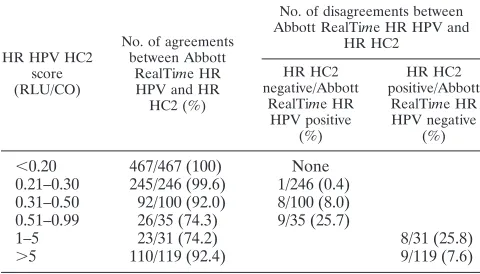
a gradual increase of positivity rate in samples, with higher
RLU/CO for the HR HC2 test (Table 2).
Intralaboratory reproducibility.
We evaluated the Abbott
RealTi
m
e HR HPV test reproducibility with 521 specimens,
44.9% of which tested positive by the HR HC2 test. These
samples were repeated at least 4 to 5 weeks after the first test.
The crude agreement between the first and second test was
98.5% (513/521), with an overall
k
value of 0.97 (CI 95% 0.95
to 0.99). The crude agreement between positive and negative
samples was similar, 97.9% (234/239) and 98.9% (279/282),
respectively (Table 3).
Evaluation of specimen adequacy.
All specimens tested by
the Abbott RealTi
m
e HR HPV test had valid beta-globin
results (under 35 Ct), suggesting that specimen collection,
preparation, and processing (sample extraction and
amplifica-tion efficiency) were satisfactory. As a result, we did not
ex-clude any result obtained or reprocess any sample.
Results of HPV genotyping with GP5
ⴙ
/6
ⴙ
RLB
hybridiza-tion in samples positive by HR HC2 and Abbott RealTi
m
e HR
HPV tests.
Table 4 shows genotyping results of 168 HR
HPV-positive samples (HR HC2 HPV-positive and/or Abbott RealTi
m
e
HR HPV positive). Among the 150 HR HC2-positive cervical
samples, the genotyping results by RLB confirmed HR HC2
HPV target types in 138 (92.0%) samples. Among the 151
RealTi
m
e HR HPV-positive cervical samples, genotyping
con-TABLE 2. Agreement and disagreement among 998 specimens
between the Abbott RealTi
m
e HR HPV and the HR HC2
results by HC2 signal intensity ratio
HR HPV HC2 score (RLU/CO)
No. of agreements between Abbott
RealTime HR HPV and HR HC2 (%)
No. of disagreements between Abbott RealTime HR HPV and
HR HC2
HR HC2 negative/Abbott
RealTime HR HPV positive
(%)
HR HC2 positive/Abbott
RealTime HR HPV negative
(%)
⬍
0.20
467/467 (100)
None
0.21–0.30
245/246 (99.6)
1/246 (0.4)
0.31–0.50
92/100 (92.0)
8/100 (8.0)
0.51–0.99
26/35 (74.3)
9/35 (25.7)
1–5
23/31 (74.2)
8/31 (25.8)
[image:3.585.43.284.91.205.2]⬎
5
110/119 (92.4)
9/119 (7.6)
TABLE 3. Results of reproducibility between Abbott RealTi
m
e HR
HPV first and second tests among 521 samples
bSecond test
First test (no. of samples) Total (no.
of samples) Positive Negative
Positive
234 (44.9)
a3 (0.6)
237 (45.5)
Negative
5 (1.0)
279 (53.5)
a284 (54.5)
Total
239 (45.9)
282 (54.1)
521 (100)
a
The agreement between the first and second test was 98.46%, with an overall kvalue of 0.97 (CI 95%, 0.95 to 0.99).
b
[image:3.585.300.541.93.163.2]Values in parentheses are cell percentages.
TABLE 1. Comparison of the Abbott RealTi
m
e HR HPV and the
HR Hybrid Capture 2 findings stratified for controls and cases
Sample
Assay result (no. of samples)
Total Abbott
RealTime HR HPV
HR HPV HC2
⫹ ⫺
Controls
⫹
52
c18
70
⫺
16
828
c844
aTotal
68
846
b914
Cases (
ⱖ
CIN2)
⫹
81
f0
81
d⫺
1
2
f3
Total
82
e2
84
aAbsolute specificity for the Abbott RealTime HR HPV test was 92.3% (95% CI, 90.4 to 94.0).
bAbsolute specificity for HR HC2 was 92.6% (95% CI, 90.7 to 94.2). cOverall agreement for controls was 96.3% with akvalue of 0.73 (95% CI, 0.65 to 0.82).
dAbsolute sensitivity for the Abbott RealTime HR HPV test was 96.4% (95% CI, 89.9 to 99.3).
eAbsolute sensitivity for HR HC2 was 97.6% (95% CI, 91.7 to 99.7). fOverall agreement for cases was 96.4% with akvalue of 0.79 (95% CI, 0.402 to 1.00).
TABLE 4. Typing with GP5
⫹
/GP6
⫹
RLB hybridization in positive
HR HPV samples stratified by type of test
Classification No. (%) HR HC2 positive (out of 150)
No. (%) Abbott RealTime HR
HPV positive (out of 151)
HR positive
a,b139 (92.0)
147 (97.3)
False positive
11 (7.3)
4 (2.6)
Uncertain-risk HPV
c7
3
LR HPV
d2
1
Negative
2
0
a
HR HPV types included in HC2 probe B were 16, 18, 31, 33, 35, 39, 45, 51, 52, 56, 58, 59, and 68.
b
HR HPV types included in the Abbott RealTime HR HPV test were 16, 18, 31, 33, 35, 39, 45, 51, 52, 56, 58, 59, 66, and 68.
c
Uncertain-risk HPV types were 26, 53, 67, 70, 73, 82, and 85 (IARC classi-fication).
d
Low-risk (LR) HPV types were 6, 11, 40, 42, 43, 44, 54, 55, 61, 72, 81, and 84 (IARC classification).
on May 16, 2020 by guest
http://jcm.asm.org/
[image:3.585.300.540.561.661.2] [image:3.585.42.282.589.726.2]firmed Abbott RealTi
m
e HR HPV target types in 148 (98.0%)
samples.
Among all 998 samples analyzed, 35 (3.5%) showed
discor-dant results by the two HPV methods (HR HC2 and Abbott
RealTi
m
e HR HPV tests). Among 18 (1.8%) HR
HC2-nega-tive/Abbott RealTi
m
e HR HPV-positive samples, the
propor-tion of Abbott RealTi
m
e HR HPV target types was 83.3%
(15/18). Among 17 (1.7%) HR HC2-positive/Abbott RealTi
m
e
HR HPV-negative samples, HR HC2 HPV target types were
identified in 41.2% of samples (7/17). It is interesting that two
ⱖ
CIN2 specimens that were HR HPV negative with the
Abbott RealTi
m
e HR HPV test and with HR HC2 were HPV
positive only in nested PCR; typing by RLB showed HPV52
and HPV58, respectively. The
ⱖ
CIN2 specimen that was HPV
negative by the Abbott RealTi
m
e HR HPV test and positive by
HR HC2 was HPV negative by all PCR systems used for
typing.
Table 5 compares the results of partial genotyping by Abbott
RealTi
m
e HR HPV test with GP5
⫹
/GP6
⫹
RLB hybridization
typing. Among 49 HPV16 infections (both single infections
and those with other HR HPV) identified by Abbott RealTi
m
e
HR HPV partial genotyping, 48 (98.0%) were confirmed by
RLB. Similarly, all HPV18 samples positive by the Abbott
RealTi
m
e HR HPV test were confirmed by RLB. Among 91
samples classified by the Abbott RealTi
m
e HR HPV test as
other HR HPV types, 81 (89.0%) were confirmed as other HR
HPV types by RLB, 5 samples were identified by RLB as
coinfections with HPV16 and other HR HPV types, and one
sample was classified by RLB as HPV16; HPV16 in these six
samples also was confirmed by typing with HPV16 E7-specific
primers.
The analytical sensitivity of HPV16 and HPV18 Abbott
RealTi
m
e HR HPV typing was 88.1% (59/67) (95% CI, 77.8 to
94.7), while the analytical specificity of the partial genotyping
of Abbott RealTi
m
e HR HPV with HPV-positive samples was
98.8% (85/86) (95% CI, 93.7 to 100).
Abbott RealTi
m
e HR HPV test ROC curves.
Considering
CIN2 or more severe lesions as the final outcome, the ROC
curve analysis indicates that the percentage of samples
classi-fied correctly was higher with a 32 Ct cutoff (accuracy, 94.4%)
than with a 30 Ct cutoff (accuracy, 93.7%). Indeed, in changing
the cutoff cycle number from
ⱕ
32 to
ⱕ
30 there is a slight gain
in specificity, 93.4% versus 92.3%, that leads to a reduction in
false-positive samples from 18 to 11 and a reduction in
sensi-tivity from 96.4 to 94%. These data suggest that there is no
increase in test performance by decreasing the cutoff to 30
cycle numbers to increase test performance for the detection of
ⱖ
CIN2 lesions.
Abbott RealTi
m
e HR HPV analytical sensitivity.
Five
repli-cates for every HR HC2 calibrator dilution (500 HPV16
cop-ies/test, 400 HPV16 copcop-ies/test, and 320 HPV16 copies/test)
have been tested in five different experiments. The samples
containing 500 HPV16 copies/test showed 100% detection of
HPV16 in all five experiments, while samples with 400 HPV16
copies/test and 320 HPV16 copies/test showed a
reproducibil-ity of less than 95%.
DISCUSSION
The aim of the present study was to compare the clinical
accuracy of the Abbott RealTi
m
e HR HPV test with a
clini-cally validated reference HPV test, hybrid capture 2, on
sam-ples from women enrolled in an organized screening program.
The results show that the clinical sensitivity of the Abbott
RealTi
m
e HR HPV test and specificity for
ⱖ
CIN2 are almost
identical to those of HR HC2. In fact, the Abbott RealTi
m
e
HR HPV test showed 98.8% relative sensitivity for
ⱖ
CIN2 and
a 99.8% specificity relative to that of HR HC2. For the relative
sensitivity and specificity for
ⱖ
CIN2, the Abbott RealTi
m
e HR
HPV test has probabilities of 0.996 and 0.991, values that differ
by less than 10 and 2%, respectively, from the thresholds fixed
by the guidelines for HPV DNA test requirements for primary
cervical cancer screening (14), confirming previous studies (7,
11, 23). It must be noted that relative specificity may be slightly
underestimated. Since the management of the women in the
screening program was driven by the HR HC2 test and
cytol-ogy and not by the Abbott RealTi
m
e HR HPV, some of the
HR HC2-negative/Abbott RealTi
m
e HR HPV-positive women
in the specificity sample may have an undetected
ⱖ
CIN2.
Nev-ertheless, the rationale of the guidelines of Meijer et al. is to be
conservative in the estimates. This does not apply to the
rela-tive sensitivity estimate, since the
ⱖ
CIN2 all were cytology
positive independently from the HR HC2 result.
[image:4.585.43.542.90.190.2]Another requirement of a screening test, especially if it is
applied as the primary test in large programs, is
reproducibil-ity. The Meijer et al. guidelines also recommend evaluating
TABLE 5. Comparison between the Abbott RealTi
m
e HR HPV-positive samples (cases and controls together) and typing by
GP5
⫹
/GP6
⫹
RLB hybridization
dAbbott RealTime HR HPV finding
GP5⫹/GP6⫹RLB hybridization findinge(no. of samples)
HPV16 HPV16⫹other HR HPV HPV18
HPV18⫹other HR HPV
HPV16⫹ HPV18
Other HR HPV
Uncertain-risk
HPVb LR HPVc Negative
HPV16
36
0
0
0
0
0
0
0
0
HPV16
⫹
other HR HPV
4
8
0
0
0
1
0
0
0
HPV18
0
0
8
0
0
0
0
0
0
HPV18
⫹
other HR HPV
0
0
2
0
0
0
0
0
0
HPV16
⫹
HPV18
0
0
0
0
1
0
0
0
0
Other HR HPV
1
a5
a0
0
0
81
3
1
0
a
All were confirmed to be HPV16 by PCR with HPV16 E6/E7 primers. b
Uncertain-risk HPV types were 26, 53, 67, 70, 73, 82, and 85 (IARC classification). c
Low-risk (LR) HPV types were 6, 11, 40, 42, 43, 44, 54, 55, 61, 72, 81, and 84 (IARC classification). d
Other HR HPV types included in the Abbott test were 31, 33, 35, 39, 45, 51, 52, 56, 58, 59, 66, and 68. e
Numbers in boldface are concordant samples; underlined numbers are discordant samples.
on May 16, 2020 by guest
http://jcm.asm.org/
intra- and interlaboratory reproducibility on at least 500
spec-imens, 30% of which tested positive for a clinically validated
test. The Abbott RealTi
m
e HR HPV test showed good
repro-ducibility of results, with a
k
value of 0.97, much above the
k
value of 0.5 indicated by the guidelines.
Moreover, if the Abbott RealTi
m
e HR HPV assay is used
for cervical cancer screening, the contemporary amplification
of an internal control target sequence will be very important
for the HPV-negative women who will be advised to repeat the
test after 3 to 5 years. This added value could be essential if
screening by self-sampling is introduced in the cervical cancer
screening for nonscreened women.
Overall, high agreement (96.5%) for HR HPV detection was
observed between the two assays, as observed in previous
stud-ies (9, 15). The agreement on misclassified cases indicates that
HPV DNA-negative
ⱖ
CIN2 are not due simply to a technical
malfunctioning of the test that randomly reduces analytical
sensitivity but probably share characteristics reducing the
prob-ability of detecting DNA by any means. On the other hand, the
agreement on misclassified controls is expected according to
what we know about the natural history of the disease, and it
reflects all of the infections that do not cause any high-grade
lesions.
Even though several studies evaluating the clinical
perfor-mance of the Abbott RealTi
m
e HR HPV test have been
pub-lished recently (7, 9, 10, 11), our study is, to our knowledge, the
first application of Meijer’s guidelines to this new HPV
detec-tion system. Cuzick et al. (7), for example, compared the
Abbott RealTi
m
e HR HPV test to other tests, including the
HR HC2, in women with abnormal cervical cytology smears,
but the subjects were not from a screening population. Their
results suggested that the Abbott RealTi
m
e HR HPV test is a
promising candidate for use in primary screening, but further
study is needed to evaluate its performance directly in a
screening contest.
Compared with the results of our typing gold standard,
Abbott RealTi
m
e HR HPV showed higher clinical specificity
than HC2 for HR HPV infections; the high clinical specificity
has been observed already by Poljak et al. (15). High analytical
specificity is one of the only necessary conditions for high
clinical specificity and by itself does not guarantee good
per-formance in screening.
Abbott RealTi
m
e HR HPV assay also provides HPV16 and
HPV18 typing. Comparing Abbott RealTi
m
e HR HPV partial
typing results to our gold standard typing, the specificity for
HPV16 or HPV18 was very high (98.8%), but the sensitivity
was lower (88.1%). In particular, we observed less sensitivity of
the Abbott RealTi
m
e HR HPV test for HPV16 when HPV16
was a coinfection with other HR HPVs. In fact, out of 13
women infected with HPV16 and other HR HPV types
accord-ing to gold standard typaccord-ing, only 8 were correctly identified by
the Abbott RealTi
m
e HR HPV test; the other 5 samples were
classified as other HR HPV types by the Abbott RealTi
m
e HR
HPV test. These samples probably had a lower HPV16 viral
load, below the Abbott RealTi
m
e HR HPV cutoff, compared
to those of the other HPV types that were identified. It is
interesting that none of these five samples was
ⱖ
CIN2,
possi-bly confirming that the established cutoff correlates with
clin-ical results. Our results about analytclin-ical sensitivity for HPV16
are extremely consistent with those obtained by Huang et al.
(10) with similar methods. This is not surprising, since the
analytical accuracy of many HPV DNA tests have been
dem-onstrated to be highly consistent among laboratories (4).
Recently, Kjær et al. (12) showed that the main predictor of
the subsequent risk of CIN3 or worse was HPV16 persistence,
indicating the potential value of partial genotyping in cervical
cancer screening, although several issues remain to be resolved
before HPV16 persistence can be used in a primary screening
program.
In conclusion, the Abbott RealTi
m
e HR HPV test showed
relative sensitivity and specificity for
ⱖ
CIN2 that were very
close to those of the HR HC2 test, and it had good
reproduc-ibility. This test fully satisfied the requirements for a primary
cervical cancer screening test. Further investigations are
needed to understand the clinical utility and accuracy of
iden-tifying HPV16 and HPV18 types in a screening setting.
ACKNOWLEDGMENTS
The Abbott RealTi
m
e High Risk HPV tests performed in this study
were funded entirely by Abbott–Molecular Division, Italy. The HR
HC2 results reported in the present study were funded by a grant from
the Italian Ministry of Health.
We thank Giovanni Pontenani, laboratory technician, for help in
performing tests.
REFERENCES
1.Arbyn, M., et al.2006. Chapter 9. Clinical applications of HPV testing: a summary of metaanalyses. Vaccine24(Suppl. 3):S78–S89.
2.Bouvard, V. A., R. A. Baan, K. A. Straif, Y. Grosse, B. Secretan, F. El Ghissassi, L. Bebraim-Tallaa, N. Guha, C. Freeman, L. Galichat, and V. Cogliano, on behalf of the WHO International Agency for Research on Cancer Monograph Working Group.2009. Special report: policy. A review of human carcinogens–part B: biological agents. Lancet Oncol.10:321–322. 3.Bulk, S., et al.2007. Risk of high-grade cervical intra-epithelial neoplasia based on cytology and high-risk HPV testing at baseline and at 6-months. Int. J. Cancer121:361–367.
4.Carozzi, F. M., et al.2005. Reproducibility of HPV DNA testing by hybrid capture2 in a screening setting. Am. J. Clin. Pathol.124:716–721. 5.Cohen, J.1960. A coefficient of agreement for nominal scales. Educ. Psychol.
Meas.20:37–46.
6.Cuzick, J., et al.2006. Overview of the European and North American studies on HPV testing in primary cervical cancer screening. Int. J. Cancer 119:1095–1101.
7.Cuzick, J., et al.2008. Overview of human papillomavirus-based and other novel options for cervical cancer screening in developed and developing countries. Vaccine26(Suppl. 10):K29–K41.
8.Giorgi Rossi, P., S. Bisanzi, I. Paganini, A. Di Iasi, C. Angeloni, A. Scalisi, R. Macis, M. T. Pini, F. Chini, F. M. Carozzi, and the HPV Prevalence Italian Working Group.2010. Prevalence of HPV high and low risk types in cervical samples from the Italian general population: a population based study. BMC Infect. Dis.10:214.
9.Halfon, P., D. Benmoura, A. Agostini, H. Khiri, G. Penaranda, A. Martin-eau, and B. Blanc. 2010. Evaluation of the clinical performance of the Abbott RealTime High-Risk HPV for carcinogenic HPV detection. J. Clin. Virol.48:246–250.
10.Huang, S., et al.2009. Clinical performance of Abbott RealTime High Risk HPV test for detection of high-grade cervical intraepithelial neoplasia in women with abnormal cytology. J. Clin. Virol.45(Suppl 1):S19–23. 11.Kaliterna, V., S. Z. Lepej, and A. Vince.2009. Comparison between the
Abbott RealTime HighRisk HPV assay and the Hybrid Capture 2 assay for detecting high-risk human papillomavirus DNA in cervical specimens. J. Med. Microbiol.58:1662–1663.
12.Kjær, S. K., K. Frederiksen, C. Munk, and T. Iftner. 2010. Long-term absolute risk of cervical intraepithelial neoplasia grade 3 or worse following human papillomavirus infection: role of persistence. J. Natl. Cancer Inst. 102:1478–1488.
13.Mayrand, M. H. et al.2007. Human papillomavirus DNA versus Papanicolau screening tests for cervical cancer. N. Engl. J. Med.357:1579–1588. 14.Meijer, C. J., et al.2009. Guidelines for human papillomavirus DNA test
requirements for primary cervical cancer screening in women 30 years and older. Int. J. Cancer124:516–520.
15.Poljak, M., et al.2009. The Abbott RealTime High Risk HPV test: compar-ative evaluation of analytical specificity and clinical sensitivity for cervical
on May 16, 2020 by guest
http://jcm.asm.org/
carcinoma and CIN 3 lesions with the Hybrid Capture 2 HPV DNA test. Acta Dermatovenerol. Alp. Panonica Adriat.18:94–103.
16.Qu, W., et al.1997. PCR detection of human papillomavirus: comparison between MY09/MY11 and GP5⫹/GP6⫹primer systems. J. Clin. Microbiol. 35:1304–1310.
17.Ronco, G., et al.2006. Human papillomavirus testing and liquid-based cy-tology: results at recruitment from the New Technologies for Cervical Can-cer randomized controlled trial. J. Natl. CanCan-cer Inst.98:765–774. 18.Ronco, G., et al.2006. Human papillomavirus testing and liquid-based
cy-tology in primary screening of women younger than 35 years: results at recruitment for a randomised controlled trial. Lancet Oncol.7:547–555. 19.Ronco, G., P. Giorgi-Rossi, F. Carozzi, M. Confortini, P. Dalla Palma, A. Del
Mistro, B. Ghiringhello, S. Girlando, A. Gillio-Tos, L. De Marco, C. Naldoni, P. Pierotti, R. Rizzolo, P. Schincaglia, M. Zorzi, M. Zappa, N. Segnan, J. Cuzick, and the New Technologies for Cervical Cancer screening (NTCC) Working Group. 2010. Efficacy of human papillomavirus testing for the
detection of invasive cervical cancers and cervical intraepithelial neoplasia: a randomised controlled trial. Lancet Oncol.11:249–257.
20.Sankaranarayanan, R., et al.2009. HPV screening for cervical cancer in rural India. N. Engl. J. Med.360:1385–1394.
21.Sundstro¨m, K., et al. 2010. Prospective study of human papillomavirus (HPV) types, HPV persistence, and risk of squamous cell carcinoma of the cervix. Cancer Epidemiol. Biomarkers Prev.19:2469–2478.
22.Tang, N. S., M. L. Tang, and I. S. Chan.2003. On tests of equivalence via non-unity relative risk for matched-pair design. Stat. Med.22:1217–1233. 23.Tang, N., et al.2009. High-risk HPV detection and concurrent HPV 16 and
18 typing with Abbott RealTime High Risk HPV test. J. Clin. Virol. 45(Suppl. 1):S25–S28.
24.Van den Brule, A. J., et al.2002. GP5⫹/6⫹-PCR followed by reverse line blot analysis enabled rapid and high throughput identification of human papillo-mavirus genotypes. J. Clin. Microbiol.40:779–787.
25.Walboomers, J. M., et al.1999. Human papillomavirus is a necessary cause of invasive cervical cancer worldwide. J. Pathol.189:12–19.