Towards the automatic detection of the source language of a
literary translation
Gerard Lynch
1,2& Carl Vogel
1,2,3(1) School of Computer Science and Statistics1, Trinity College, Dublin 2, Ireland (2) Centre For Next Generation Localisation2,
(3) Centre for Computing and Language Studies3
[email protected], [email protected]
A
BSTRACTExperiments on the detection of the source language of literary translations are described. Two feature types are exploited, n-gram based features and document-level statistics. Cross-validation results on a corpus of twenty 19th-century texts including translations from Russian, French, German and texts written in English are promising: single feature classifiers yield significant gains on the baseline, although classifiers containing a combination of feature types outperform these, bringing L1 detection accuracy to ~80% using ten-fold training set cross validation. Average test set results are slightly lower but still comparable to the cross-validation results. Relative frequencies of a number of salient features are studied, including several English contractions (I’ll,that’s, etc.) and uncontracted forms; we articulate hypotheses, anchored in source languages, towards explaining differences.
1
Introduction
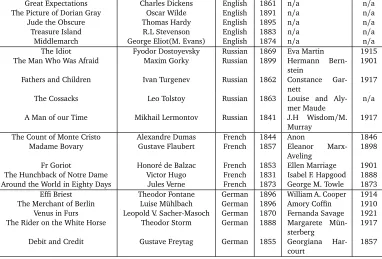
This study focuses on experimentation towards the detection of source language influence in literary translations into English from the late nineteeth and early twentieth centuries. We assembled a corpus of novels from this period, consisting of fifteen translations, five each from Russian, German and French, and five works written originally in English.1 We carry out cross-validation experiments to determine robust features which identify the L1 of the texts.
We use document-level metrics such as sentence length and readability scores together with n-gram features such as the frequency of sequences of POS tags and closed-class words, features which are not directly related to the topics and themes contained within the texts. The present experiments attempt to correctly attribute the L1 of texts; this entails correctly classifying a text as translated or not. In order to minimize the effect of authorial or translatorial style in this study, we have not selected more than one work by the same author or translator.
Four criteria for corpus selection were as follows. Firstly, text should be available in an machine-readable format and in the public domain. Secondly, from the previous point, this dictates that text will most likely stem from prior to the early twentieth century, due to US copyright law. Thirdly, each text should have a unique author and in the case of translations, translator, i.e. no repeated authors or translators. Finally, text should be of sufficient length, at least two hundred kilobytes in size, i.e. preferably a novel or novella. In many cases, particular translators had translated numerous works by a single author and indeed also occasionally by several authors. Thus, it was necessary to choose texts so that each author and translator remained unique.2 Table 1 lists the texts, all sourced from Project Gutenberg.3
Section 2 describes prior research. Section 3 explains our own experimental methodology. Section 4 details the results of experiments carried out on detection of the L1 of a corpus of texts translated from Russian, German and French together with texts in original English.
2
Previous research
Recent work in computational and corpus linguistics has focused on the analysis of comparable corpora4of translated and original text (see Kilgarriff (2001) on comparability assessment).
Olohan (2001) identifies patterns in optionalusage in comparable English corpora, citing examples such as the use of complementizerthat5 as discriminatory between translations and original texts, with translations containing a higher incidence of the complementizer construction, using t-tests to identify features which differ with statistical significance. This method depends on selective expert hypotheses about which features discriminate texts of L2 English.
Guthrie, Guthrie, Allison, and Wilks (2007) evaluated their general method of ranked feature differences on the problem of assessing whether translations of L1 Chinese newspaper texts
1We will henceforth refer to the source language of the text as the L1.
2This was more complicated for Russian, for example, with the translator Constance Garnett having translated works by Dosteyevsky and Turgenev, amongst others, resulting in the bypassing of a title of such repute asAnna Kareninafor the less well-known novellaThe Cossacksby Tolstoy, due to the fact that Garnett was already represented as the sole available translator of Turgenev.
3www.gutenberg.org, last verified August 2012
Title Author Source Pub. Translator T.pub.
Great Expectations Charles Dickens English 1861 n/a n/a
The Picture of Dorian Gray Oscar Wilde English 1891 n/a n/a
Jude the Obscure Thomas Hardy English 1895 n/a n/a
Treasure Island R.L Stevenson English 1883 n/a n/a
Middlemarch George Eliot(M. Evans) English 1874 n/a n/a
The Idiot Fyodor Dostoyevsky Russian 1869 Eva Martin 1915
The Man Who Was Afraid Maxim Gorky Russian 1899 Hermann Bern-stein
1901 Fathers and Children Ivan Turgenev Russian 1862 Constance
Gar-nett
1917
The Cossacks Leo Tolstoy Russian 1863 Louise and
Aly-mer Maude
n/a A Man of our Time Mikhail Lermontov Russian 1841 J.H Wisdom/M.
Murray
1917
The Count of Monte Cristo Alexandre Dumas French 1844 Anon 1846
Madame Bovary Gustave Flaubert French 1857 Eleanor
Marx-Aveling
1898
Fr Goriot Honoré de Balzac French 1853 Ellen Marriage 1901
The Hunchback of Notre Dame Victor Hugo French 1831 Isabel F. Hapgood 1888 Around the World in Eighty Days Jules Verne French 1873 George M. Towle 1873 Effi Briest Theodor Fontane German 1896 William A. Cooper 1914 The Merchant of Berlin Luise Mühlbach German 1896 Amory Coffin 1910 Venus in Furs Leopold V. Sacher-Masoch German 1870 Fernanda Savage 1921 The Rider on the White Horse Theodor Storm German 1888 Margarete
Mün-sterberg
1917 Debit and Credit Gustave Freytag German 1855 Georgiana
Har-court
[image:3.420.20.402.26.285.2]1857
Table 1: Corpus of texts
in L2 English could be identified in a set of L1 English news texts (35K words of Chinese translated to English and 50K words of English L1). Features focused on what we consider document-level features (ie. percentages of words in major grammatical categories, ratios of frequencies between grammatical categories, most frequent POS trigrams and bigrams, etc). Feature vectors are constructed to represent each text and its relative complement, with separate vectors for the percentages and ratios and the ranked frequency features. A derived vector records a score based on the Spearman rank correlation coefficient between the text and its complement for each of the sorts of frequency list. Two texts are compared by calculating the average differences between feature vectors and adjusting with the derived scores from the ranked frequency list differences. In each configuration of the evaluation, one translation was presented without annotation along with 50 L1 English texts, texts separated as 1000 word samples. The translated text appeared in the top three ranked positions, representing greatest anomaly, in 93% of experiments, and in the top ten positions in 100%. Our own work is comparable in the features analyzed, but uses a classification approach that labels the source language of each text. rather than giving each text a rank in its evidence of being a translation.
an evaluation exercise outperformed the ML system on all measures.
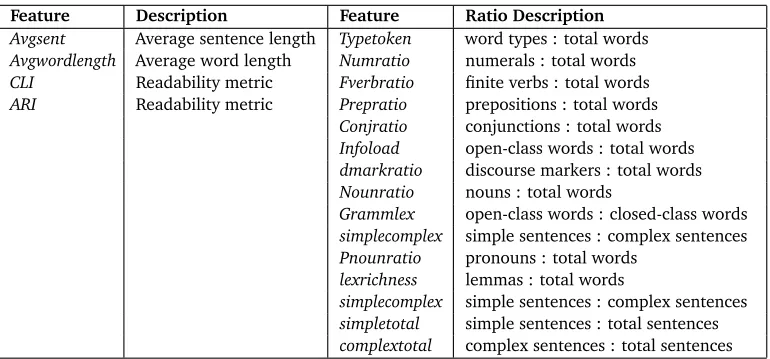
In previous work on detecting the L1 of translations using computational methods similar to those used in our study, van Halteren (2008) examined source language markers in the Europarl corpus, obtaining high accuracy in L1 detection(≥90%) across translations and original texts in multiple European languages, using features such as n-grams of words and POS tags alone. Frequent n-grams includedframework conditionsin the English corpus translated from German, and the n-gramcertain number, which occurred to a higher extent in the translations from French and Spanish than the German, Italian and Dutch texts. However more recent work by Ilisei, Inkpen, Corpas Pastor, and Mitkov (2010) on stylistics of translations in Spanish technical and medical translations motivated the use of features other than simple n-grams in our work. These comprise of a number of statistics calculated on a document level, features which are listed in Table 2 We also broaden the scope of our study to literary translations, which we believe will pose a greater challenge to the task of L1 detection than the Europarl corpus which is more homogenous in style and comprising only parliamentary transcriptions.
3
Methods
We use Weka (Hall et al. (2009)) as a machine-learning toolkit, coupled with the TagHelperTools package (Dönmez et al. (2005)) which provides support for processing natural language data in Weka. We calculated values for the document-level features (Table 2) using our own script which relies on the TreeTagger POS tagger (Schmid (1994)) for the tagging of text. Within Weka, we use the Ranker algorithm coupled with theχ2metric to rank the features by classification power. These rankings are then listed in Tables 4 and 5 For the experiments, we used the Weka SMO classifier, which is an implementation of a Support Vector Machine (SVM) classifier, the Simple Logistic classifier and the Naive Bayes classifier.
Feature Description Feature Ratio Description Avgsent Average sentence length Typetoken word types : total words Avgwordlength Average word length Numratio numerals : total words CLI Readability metric Fverbratio finite verbs : total words ARI Readability metric Prepratio prepositions : total words
Conjratio conjunctions : total words Infoload open-class words : total words dmarkratio discourse markers : total words Nounratio nouns : total words
Grammlex open-class words : closed-class words simplecomplex simple sentences : complex sentences Pnounratio pronouns : total words
lexrichness lemmas : total words
[image:4.420.19.404.322.502.2]simplecomplex simple sentences : complex sentences simpletotal simple sentences : total sentences complextotal complex sentences : total sentences
Table 2: Document-level features
3.1
Features and corpus treatment
(Coleman and Liau (1975)) were used. We also use n-gram features such as word-unigrams and part-of-speech bigrams. We remove any proper nouns in the word n-gram feature list, as any character or place-names could unambiguously distinguish a text. We do this after the word unigram features are calculated. The frequency of untranslated terms and titles from the source language, place-names or names of characters could prove highly useful in predicting the source language of a text, however these we would expect to vary depending on the topics and themes within the text.6We therefore focus on highly frequent n-grams, such as prepositions, determiners and frequent verb forms, which we expect to be more robust predictors of the source language of a text.
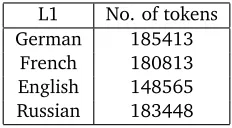
To balance the corpus for each source language, we selected a random contiguous section of 200 kb of text from each work in the study and divided this up into 20 chunks of 10 kb each. This results in 100 textual segments per source language. Corpus balancing is important when using metrics such as type-token ratio which vary with relation to text length. We trained on 360 of the text chunks retained a separate set of 40 chunks from the corpus divided evenly across the four languages and works7for test purposes.
3.2
Classification tasks
The features described are used to label texts written in English according to their source language. This is more refined than labelling a text as translated or not since we want to know not just whether it is a translation, but further, if it is a translation, the identity of its L1.
4
Experiments
4.1
Single and combined feature sets
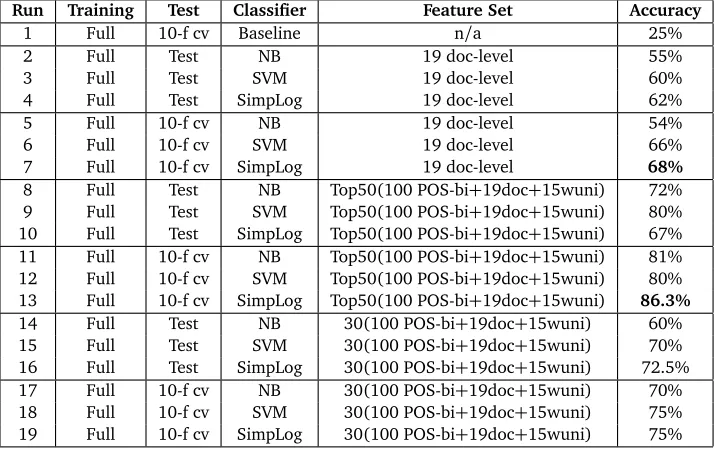
Using the SVM classifier we obtain 66% accuracy using ten-fold cross validation for the four categories using our 19 document level statistics only. The Naive Bayes classifier performs worse, giving 54% accuracy. The Simple Logistic classifier performs the best here, with 68% accuracy. Given that the baseline for this task is 25%, 68% can be deemed a promising result, although the results are lower for the hold-out set, at 62% for the Simple Logistic classifier. The merged feature sets produce better results in this task, the best performing combination being Run 13, which consists of the top 50 features as ranked by the chi-squared metric in Weka taken from: (i) the top one hundred POS bigrams; (ii) all 19 document-level features; (iii) the top fifteen word unigrams. This yielded an overall classification accuracy average after ten-fold cross validation of 86.3% using the Simple Logistic classifier, with a test set classification accuracy of 80% using the SVM classifier.
4.2
Discussion of distinguishing features
Table 9 shows that the German translations have a much higher frequency of the wordtoward as opposed to the other texts. A likely explanation for this is dialectal: two translators of the German texts were American,8while the other translations from German were published in the US, by translators whose nationality is not defined.
Table 7 displays the relative frequencies of boththat’sandit’sand the expanded versions of the same. Olohan (2001) has shown that these forms tend to be less prevalent in translated English
6A novel translated from French may be set in a Francophone locale and contain tokens likeMadame,Rue, etc. 7This consists of two segments from each work.
Run Training Test Classifier Feature Set Accuracy
1 Full 10-f cv Baseline n/a 25%
2 Full Test NB 19 doc-level 55%
3 Full Test SVM 19 doc-level 60%
4 Full Test SimpLog 19 doc-level 62%
5 Full 10-f cv NB 19 doc-level 54%
6 Full 10-f cv SVM 19 doc-level 66%
7 Full 10-f cv SimpLog 19 doc-level 68%
8 Full Test NB Top50(100 POS-bi+19doc+15wuni) 72% 9 Full Test SVM Top50(100 POS-bi+19doc+15wuni) 80% 10 Full Test SimpLog Top50(100 POS-bi+19doc+15wuni) 67% 11 Full 10-f cv NB Top50(100 POS-bi+19doc+15wuni) 81% 12 Full 10-f cv SVM Top50(100 POS-bi+19doc+15wuni) 80% 13 Full 10-f cv SimpLog Top50(100 POS-bi+19doc+15wuni) 86.3%
14 Full Test NB 30(100 POS-bi+19doc+15wuni) 60%
[image:6.420.32.389.15.240.2]15 Full Test SVM 30(100 POS-bi+19doc+15wuni) 70% 16 Full Test SimpLog 30(100 POS-bi+19doc+15wuni) 72.5% 17 Full 10-f cv NB 30(100 POS-bi+19doc+15wuni) 70% 18 Full 10-f cv SVM 30(100 POS-bi+19doc+15wuni) 75% 19 Full 10-f cv SimpLog 30(100 POS-bi+19doc+15wuni) 75%
Table 3: Summary of classification accuracy: Full corpus
in general, however in this case they may be less/more prevalent in translations from different languages. Russian has a much larger proportion ofthat’sandit’s, although it’s proportion ofit isis also relatively high. One possible explanation for this is that in French and German,that is andit isare two words,9whereas in the Russian language, one wordztoserves both purposes.
Table 8 displays the frequencies for the contractionsI’mandI’llin the four corpora. Again Russian contains the highest frequency for the two contractions among the languages. This may again be a source language artifact: In German there is no equivalent contraction,Ich binfor I am, and in Frenchje suis, both two word phrases. In RussianI amis corresponds toya,10with
9Ger.es istordas istand Fre.il estorqui est. 10Pronouncedyawith a short a sound.
Chi Rank Token Chi Rank Token
191.1184 1 toward 60.2458 11 though
101.8571 2 prepratio 56.4456 12 that’s 79.6687 3 nounratio 54.1083 13 RB-CC
78.6035 4 lexrich 52.0254 14 i’ll
78.1577 5 thousand 50.1781 15 PRP-CC
69.6095 6 it’s 49.9458 16 conjratio
66.4622 7 towards 49.868 17 nodded
62.1622 8 numratio 49.224 18 i’m
62.1324 9 fverbratio 48.7354 19 law
[image:6.420.82.336.436.561.2]61.1304 10 ari 48.6329 20 FW-FW
Chi Rank Token Chi Rank Token
48.3455 21 VBP-VB 33.2283 36 typetoken
47.5911 22 suddenly 33.1439 37 simpletotal
47.1891 23 scream 32.2981 38 complextotal
46.9136 24 CD-CD 30.9333 39 simplecomplex
46.7665 25 don’t 27.0928 40 what’s
46.6164 26 resumed 26.4912 41 somewhere
43.3339 27 got 26.2167 42 you’re
42.7951 28 drink 26.16 43 thought
37.8411 29 sense 25.7212 44 ain’t
37.8411 30 infoload 25.6271 45 gazed
37.8411 31 presently 25.6141 46 beneath
37.8409 32 he’s 25.3143 47 there’s
37.6963 33 whispered 25.2518 48 say
36.2862 34 avgsent 24.1848 49 won’t
[image:7.420.63.358.16.212.2]35.8047 35 anyone 24.125 50 now
Table 5: Features 21-50 for Table 3, run 13
L1 No. of tokens
German 185413
French 180813
English 148565
[image:7.420.152.268.242.306.2]Russian 183448
Table 6: Number of tokens in each L1 sub-corpus
I willalso being one word,budu.11 This is a possible reason for the abundance of contracted forms in the translations with Russian as L1.
Table 9 displays the frequencies for the next four words in the list. It is difficult to ascertain whether these are true source language artifacts, although the frequency ofdrink in the translations from Russian may reflect a rather unsavoury national stereotype. It is interesting also that the characters in the German translations tend to agree with an affirmative head movement more often than French or Russian. The high frequency ofthousandin the French corpus is likely as a result of references to large denominations of the Frenchfranc.
11Pronouncedboodoo.
Text it is it’s that is that’s English 0.002358 0.000361 0.000754 0.000538 German 0.002931 0.000194 0.001106 0.000116 French 0.003236 0.000092 0.001370 0.000167 Russian 0.003216 0.001058 0.001112 0.001052
Language I am I will I’m I’ll English 0.003112 0.000452 0.000318 0.000555 French 0.002500 0.001416 0.000061 0.000088 German 0.003463 0.001219 0.000092 0.000205 Russian 0.003598 0.000883 0.000627 0.000725
Table 8: Relative frequency of I’ll/I’m
Text drink nodded resumed thousand toward toward English 0.000194 0.000075 0.000048 0.000075 0.000000 0.000441 French 0.000083 0.000011 0.000227 0.000785 0.00002 0.00038 German 0.000129 0.000248 0.000027 0.000167 0.0006 0.000010 Russian 0.000627 0.000033 0.000016 0.000076 0.00015 0.00029
Table 9: Common word frequencies
Conclusion
Our hybrid approach towards detecting the source language of a literary translation resulted in high classification accuracies using ten-fold cross validation on our translation corpus and also comparably high accuracies on our test set from the same corpus. We have identified a number of trends in our corpus, such as the frequency of certain English contractions (I’m,it’s etc) which may be attributable to source language influence.
As noted at the outset, our work is comparable to research published by Guthrie et al. (2007). If one were to derive a classification of each item from the point at which their method achieved 100% inclusion of the translated item among the top ten items in terms of anomalies pointed out using the vectors of document level features, then precision is at 9%, but recall is at 100%, and accuracy is at 80%. However, note that this depends on two categories: L1 English or L2 English (translated from L1 Chinese). Our experiments provide a further label for which language provided the texts L1 source.
Comparing our results to the work by Baroni and Bernardini (2006), there are similarities, although the tasks were different, we focused on source language detection and they focused on detecting whether a text was a translation or original. Classification results for our task were lower than theirs, they obtained ca. 87.5% accuracy using an ensemble of classifiers and two categories, we obtained ca. 80% accuracy with four categories. Comparing discriminating features, we found optional contractions in English to be discriminatory amongst source languages, while they found optional items in Italian such as clitic pronouns to be markers of translationese.
Ongoing work focuses on corpora containing a variety of genres, as well as more source languages, and cross-validation experiments on unseen texts. We also wish to examine longer n-gram sequences such as bin-grams and trin-grams of words and parts-of-speech, with the possibility of supporting non-contiguous sequences or skip-grams, as used by van Halteren (2008).
Acknowledgments
References
Baroni, M., & Bernardini, S. (2006). A new approach to the study of translationese: Machine-learning the difference between original and translated text. Literary and Linguistic Computing,21(3), 259.
Coleman, M., & Liau, T. (1975). A computer readability formula designed for machine scoring.. Journal of Applied Psychology,60(2), 283.
Dönmez, P., Rosé, C., Stegmann, K., Weinberger, A., & Fischer, F. (2005). Supporting CSCL with automatic corpus analysis technology. In Proceedings of th 2005 conference on Computer support for collaborative learning: learning 2005: the next 10 years!, pp. 125– 134. International Society of the Learning Sciences.
Guthrie, D., Guthrie, L., Allison, B., & Wilks, Y. (2007). Unsupervised Anomaly Detection. In IJCAI, pp. 1624–1628.
Hall, M., Frank, E., Holmes, G., Pfahringer, B., Reutemann, P., & Witten, I. (2009). The WEKA data mining software: an update. ACM SIGKDD Explorations Newsletter,11(1), 10–18.
Ilisei, I., Inkpen, D., Corpas Pastor, G., & Mitkov, R. (2010). Identification of Translationese: A Machine Learning Approach.Computational Linguistics and Intelligent Text Processing, 503–511.
Kilgarriff, A. (2001). Comparing Corpora. International Journal of Corpus Linguistics,6(1), 97–133.
Olohan, M. (2001). Spelling out the optionals in translation: a corpus study. UCREL Technical Papers,13, 423–432.
Schmid, H. (1994). Probabilistic part-of-speech tagging using decision trees. InProceedings of international conference on new methods in language processing, Vol. 12, pp. 44–49. Manchester, UK.
Smith, E., & Senter, R. (1967). Automated readability index.. AMRL-TR. Aerospace Medical Research Laboratories (6570th), 1.