UNIVERSITY OF LANCASTER
MANAGEMENT SCHOOL
A NEW WORLD CLASS MANUFACTURING MODEL FOR
SMALL AND MEDIUM SIZED MAKE-TO-ORDER COMPANIES
By
Mohd Shaladdin Muda
ProQuest Number: 11003623
All rights reserved
INFORMATION TO ALL USERS
The qu ality of this repro d u ctio n is d e p e n d e n t upon the q u ality of the copy subm itted.
In the unlikely e v e n t that the a u th o r did not send a c o m p le te m anuscript and there are missing pages, these will be note d . Also, if m aterial had to be rem oved,
a n o te will in d ica te the deletion.
uest
ProQuest 11003623
Published by ProQuest LLC(2018). C op yrig ht of the Dissertation is held by the Author.
All rights reserved.
This work is protected against unauthorized copying under Title 17, United States C o d e M icroform Edition © ProQuest LLC.
ProQuest LLC.
789 East Eisenhower Parkway P.O. Box 1346
A NEW WORLD CLASS MANUFACTURING MODEL FOR SMALL AND MEDIUM SIZED MAKE-TO-ORDER COMPANIES
By
Mohd Shaladdin Muda
B.Sc., MBA
Submitted for the degree of Doctor o f Philosophy, April, 2001
ABSTRACT
There have been many attempts to build comprehensive models for performance
improvement, coming under a number o f banners including Total Quality
Management (TQM), Business Process Re-engineering (BPR) and World Class
Manufacturing (WCM). Comprehensive models o f this type are important because
they bring together many aspects o f Operations Management, and in so doing aid
companies to not only identify, but also prioritise the improvements needed.
However, although the diversity of the manufacturing sector is widely acknowledged,
most o f these models pay little attention to company type. Instead, generic,
universalistic models are built, which are aimed at all manufacturing companies. This
has tended to result in models that assume the manufacture o f fairly standard products
on a repeat basis, as is found in the more common Make-to-stock (MTS) sector of
industry. Thus the models suggest that performance improvements will include a
simplified shop floor cellular layout; a fairly constant customer base with easily
Where the assumption regarding repeat production does not apply, large parts o f the
universalistic models can be irrelevant. This is true for the Make-to-order (MTO)
sector that makes highly customised products in low volumes on receipt o f customer
orders. More importantly, the universalistic approach omits issues that are pertinent
to MTO companies. These include the flexibility o f process that often requires a job
shop layout; methods to control workloads/queues in that environment; systems for
determining the price and delivery to quote during the competitive bidding process in
which most MTO firms are engaged; and effective means o f producing designs for
new products.
This thesis describes a research project which aims to fill this gap in the literature by
developing a comprehensive WCM performance improvement model for the MTO
SME sector. The new model, which has been named the “SHEN” model, is therefore
contingent on company type. This thesis describes the research process followed to
develop this model. This included deductive research whereby the initial model was
developed using literature evidence and past experience o f the authors, followed by
inductive research in which case study data was collected from six MTO SMEs in
order to develop the model further. The model aims to help companies determine
which performance improvements are needed and how to prioritise them in the race to
be world class. The case study research was exploratory in nature and aimed to gain
further insights into the issues and solutions that are pertinent to MTO SMEs. The
results suggested that some o f our initial assumptions needed to be modified. For
example, it was initially assumed that MTO companies should aim for a high level of
worker flexibility, higher even than is achieved in the MTS sector, given the high
in this highly skilled sector and that it is often only necessary to have a few workers
trained for particular processes. Therefore, a training needs matrix should be devised
which establishes the number o f people that need to be trained in each skill. Any
further training is unnecessary and will soon be wasted as, without the experience of
using the new skill, it is likely to be quickly forgotten. The case study evidence also
suggested that the need for simple, movable equipment is less important because these
companies often need specialised machinery and maintain a flexibility o f process
through a traditional functional layout. As well as being important aspects o f the new
model, conclusions o f this type are important insights into best practice in MTO
SEMINARS AND PUBLICATIONS
Part of this work has been accepted for publication:
“Developing a New World Class Model for Small and Medium Sized Make-To-Order Companies”, International Journal o f Production Economics, (with L. C.
Hendry).
In addition, the following conference papers have been presented/accepted:
“Proposing a World Class Concept for the Make-To-Order Sector”, Working Paper presented at the British Academy Management (BAM) Annual Conference,
Manchester, England, Volume II, pp 1376-1377, 1-3 September 1999, ISBN No. 0 905304 27 6. (with L. C. Hendry).
“Applying World Class Principles for the non Make-To-Stock Sectors”, presented at the Eleventh International Working Seminar on Production Economics,
Innsbruck, Austria, Volume III, pp. 361-385, 21-25 February 2000. (with L. C. Hendry).
“THE SHEN MODEL: to aid performance improvement in MTO SM E’s”, accepted for presentation at the International Annual Conference - European Operations Management Association, EurOMA 2001, 3 to 5 June 2001. (with L. C.
ACKNOWLEDGEMENTS
First and foremost, I would like to express my deep gratitude to my supervisor, Dr
Linda Caroline Hendry, for being very supportive and helpful throughout my studies.
Her willingness to advise me at almost any time when she was extremely busy is very
much appreciated.
I am also most grateful to my wife Radziah la ’afar for her indispensable support
during my course. Not forgetting my three lovely children, Farah, Burhan and
Kushairi.
Lastly, I would like to thank Dr Brian Kingsman for his constructive comments and
TABLE OF CONTENTS
PAGE
Chapter 1: Introduction 1
1.1. The need to aspire to be World Class. 1
1.2. The relevance o f WCM research to the Make to Order sector. 4
1.2.1. The differences between Make to Stock 6 (MTS) and Make to Order (MTO)
1.3. The diversity o f the MTO sector 9
1.3.1. The difference between ATO and MTO/ETO 9 1.3.2. Amaro et a l 's (1999) taxonomy of MTO companies 12 1.3.3. Repeat Business Customisers (RBC) and Versatile 16
Manufacturing Companies (VMC)
1.3.4. Small and Medium Sized Enterprises (SMEs) in the 17 MTO sector
1.4. Research objectives and questions 17
1.5. Structure o f this thesis 19
Chapter 2: Research Methodology 21
2.1. Management Research Perspective 21
2.2. Methodological Triangulation 25
2.2.1. Deductive VS Inductive 25
2.3. Case Study Research 28
2.4. Why Case Studies? 29
2.5. Data Sources 31
2.6. Conclusion 33
Chapter 3: A Literature Review of the World Class 35 Manufacturing Concept
3.1.1. Superior Competitor 36
3.1.2. Customer Focus 37
3.1.3. Lean Production 3 9
3.1.4. Lists o f Criteria 41
3.1.5. Quality Concepts 42
3.1.6. Schonberger’s (1996) Sixteen Principles 46
3.2. The Contingent Approach 50
3.3. Conclusion 54
Chapter 4: The Relevance of Schonberger’s Model to MTO 55 Companies
4.1. The relevance o f the underlying concepts 55
4.2. The detailed steps o f the sixteen principles 59
4.3. Common assumptions that do not apply to MTO 64
4.4. The relevance o f the sixteen principles to MTO 71
4.4.1. Principles that are applicable to MTO 71 4.4.2. Principles that are applicable with minor modifications 75 4.4.3. Principles that need major modification 79 4.4.4. Principles that are not applicable to MTO 88
4.4.5. Summary 88
4.5. Issues relevant to MTO not included in Schonberger (1996) 90
4.6. Conclusion 95
Chapter 5: Initial ideas for a new WCM model labelled “SHEN” for 96 the MTO sector.
5.1. Overview o f SHEN 96
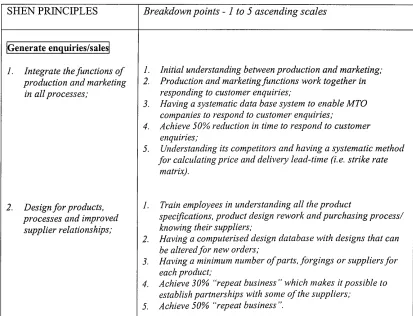
5.2. The five step improvement scale 104
5.3. Detailed explanation o f the first version o f SHEN 106
5.4. Summary Table 133
Chapter 6: Case Study Data Collection 137
6.1. Company A 139
6.2. Company B 141
6.3. Company C 142
6.4. Company D 144
6.5. Company E 145
6.6. Company F 147
6.7. Classification o f the companies and the replication logic 149
6.7.1. The replication logic 151
6.8. Conclusion 152
Chapter 7: Case Study Evidence from Small Sized MTO Companies 154
7.1. Case Study A 156
7.1.1. Initial assessment 156
7.1.2. The company response to the initial assessment 165
7.1.3. Final assessment 171
7.2. Case Study B 173
7.2.1. Initial assessment 173
7.2.2. The company response to the initial assessment 180
7.2.3. Final assessment 185
7.3. Conclusion 187
Chapter 8: Case Study Evidence from Medium Sized MTO Companies 190
8.1. Case Study C 190
8.1.1. Initial assessment 190
8.1.2. The company response to the initial assessment 198
8.1.3. Final assessment 204
8.2. Case Study D 207
8.2.1. Initial assessment 207
8.2.3. Final assessment 220
8.3. Case Study E 222
8.3.1. Initial assessment 222
8.3.2. The company response to the initial assessment 228
8.3.3. Final assessment 232
8.4. Case Study F 234
8.4.1. Initial assessment 234
8.4.2. The company response to the initial assessment 241
8.4.3. Final assessment 245
8.5. Conclusion 246
Chapter 9: Adjusting the SHEN model in the light of the case study 248 evidence
9.1. Issues that were verified. 249
9.1.1. Principle 1: Integrate the functions o f production and 249 marketing in all processes.
9.1.2. Principle 13: Gather customer feedback and benchmarking 250
9.2. Issues that were verified with changes in order/rank 252
9.2.1. Principle 3: Collaborate with customers. 252 9.2.2. Principle 4: Simplify the shop floor. 254 9.2.3. Principle 12: Improve quality and implement appropriate 257
performance measures.
9.3. Issues that were modified 260
9.3.1. Principle 2: Design for products, processes and improved 260 supplier relationships.
9.3.2. Principle 6: Improve scheduling and workload control to cut 264 flow times.
9.3.3. Principle 7: Cut the start up/changeover time and improve 266 preventive maintenance.
9.3.4. Principle 8: Improve information flow. 268 9.3.5. Principle 9: Make rapid improvements in skills and flexibility. 270 9.3.6. Principle 14: Promote/market/sell every improvement. 273
9.4. Issues that were merged 275
9.4.2. Principle 11: Everybody involved in change and strategic 276 planning - to achieve a unified purpose.
9.4.3 Conclusion for the merged principle (Principles 10 & 11) 279
9.5. Issues that were dropped 280
9.5.1. Principle 5: Seek simple, flexible, movable, low-cost 280 equipment in multiples.
9.6. The final version o f the SHEN model 281
9.7. Conclusion 285
Chapter 10: Conclusions 286
10.1. SHEN as a practical tool to develop company improvement plans 287
10.2. Significant contribution to knowledge on MTO best practice 292
10.3. Areas for further research 293
References 295
Appendix 1: Questionnaires used to collect case study data 306
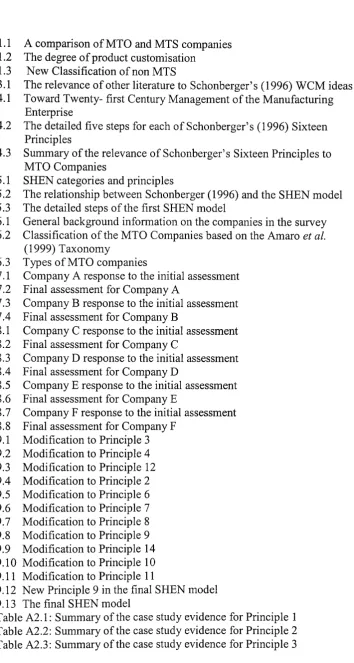
LIST OF TABLES
1.1 A comparison o f MTO and MTS companies
PAGE
8
1.2 The degree o f product customisation 13
1.3 New Classification o f non MTS 15
3.1 The relevance o f other literature to Schonberger’s (1996) WCM ideas 48 4.1 Toward Twenty- first Century Management o f the Manufacturing 56
4.2
Enterprise
The detailed five steps for each o f Schonberger’s (1996) Sixteen 60
4.3
Principles
Summary o f the relevance o f Schonberger’s Sixteen Principles to 88
5.1
MTO Companies
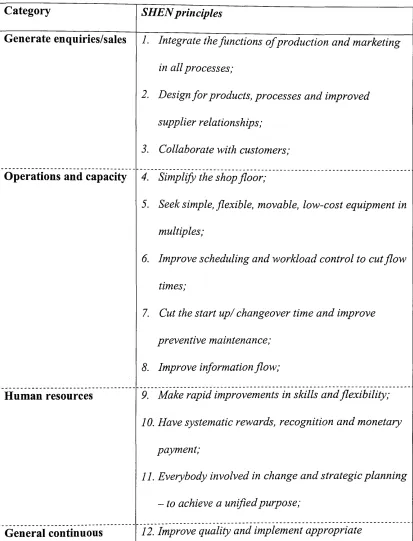
SHEN categories and principles 98
5.2 The relationship between Schonberger (1996) and the SHEN model 99 5.3 The detailed steps o f the first SHEN model 133 6.1 General background information on the companies in the survey 138 6.2 Classification o f the MTO Companies based on the Amaro et al. 149
6.3
(1999) Taxonomy
Types o f MTO companies 151
7.1 Company A response to the initial assessment 165
7.2 Final assessment for Company A 172
7.3 Company B response to the initial assessment 181
7.4 Final assessment for Company B 185
8.1 Company C response to the initial assessment 199
8.2 Final assessment for Company C 204
8.3 Company D response to the initial assessment 216
8.4 Final assessment for Company D 220
8.5 Company E response to the initial assessment 229
8.6 Final assessment for Company E 232
8.7 Company F response to the initial assessment 242
8.8 Final assessment for Company F 245
9.1 Modification to Principle 3 253
9.2 Modification to Principle 4 256
9.3 Modification to Principle 12 259
9.4 Modification to Principle 2 263
9.5 Modification to Principle 6 266
9.6 Modification to Principle 7 268
9.7 Modification to Principle 8 270
9.8 Modification to Principle 9 272
9.9 Modification to Principle 14 274
9.10 Modification to Principle 10 276
9.11 Modification to Principle 11 278
9.12 New Principle 9 in the final SHEN model 279
[image:13.507.56.411.74.738.2]9.13 The final SHEN model 282
LIST OF FIGURES
PAGE
2.1 Deductive vs. Inductive Research 26
5.1 The derivation o f the SHEN model 103
5.2 Marketing and Production divides 108
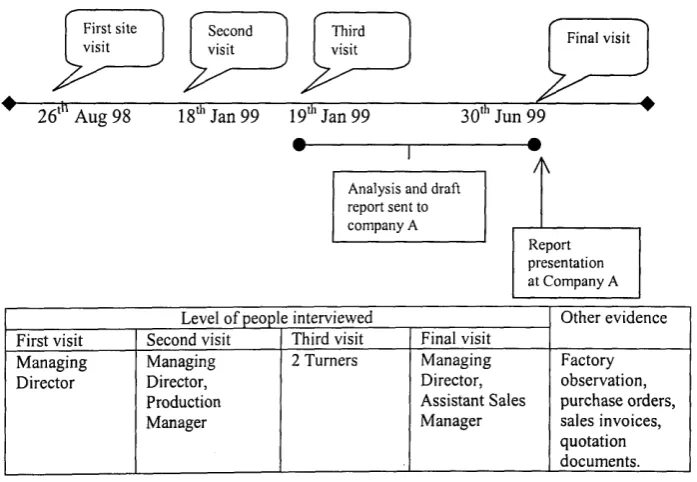
6.1 Time span between visits and the level o f people interviewed at 140 Company A
6.2 Time span between visits and the level o f people interviewed at 141 Company B
6.3 Time span between visits and the level o f people interviewed at 143 Company C
6.4 Time span between visits and the level o f people interviewed at 145 Company D
6.5 Time span between visits and the level o f people interviewed at 146 Company E
6.6 Time span between visits and the level o f people interviewed at 148 Company F
CHAPTER 1
INTRODUCTION
1.1. The need to aspire to be World Class
In response to the revolution in the world o f manufacturing, many companies have begun
to embark upon new ways o f manufacturing practice. This response has been perceived to
be necessary by manufacturers around the world, as it is thought that continuing to make
process innovation and improvements is essential for survival in the current competitive
environment (Heim et al. (1992), Prabhu et al. (2000)). These innovations and
improvements have been given many labels including Lean Manufacturing, World Class
Manufacturing (WCM), Total Quality Management (TQM) and Business Process Re
engineering (BPR). However, it is important to ask whether these labels are different
labels for the same phenomena or whether they are different labels that signify different
approaches. In other words, could they all come under one common banner, such as
World Class Manufacturing (WCM), or are they totally separate?
“Lean manufacturing” alone has received much attention in the last decade since the idea
was introduced by Womack, Jones and Roos (1990), (Jina et al. (1997)). According to
Morton (1994), Lean manufacturing builds on the thinking and systems evolved by the
deliver products with greater variety and superior quality using less resource and in a
shorter time than can be achieved by mass production methods” (Jina et al. (1997)). The
label o f Total Quality Management has also received much attention by many authors to
describe best practice innovation (Morton (1994), Oakland (1993), Shores (1994)). An
especially notable contribution to the total quality management literature is the work of
Masaaki Imai in his book Kaizen (1986) (Morton, 1994). Kaizen is a fundamental
philosophy o f Japanese manufacture which also includes Total Quality Control and Just-
In-Time (JIT) manufacturing. Together these philosophies provide a process for
continuous improvement o f everything in the business (Shores (1994)). Some authors
view recent manufacturing concepts in the West as an emulation o f the successful
Japanese model. This phenomenon has been labelled ‘Japanisation’ (see Schonberger
(1986), Morton (1994)). Morton (1994) argues that some o f the Japanese manufacturing
concepts and techniques can be adopted in Western Companies. A further label for the
new manufacturing era is BPR (Hammer and Champy (1993), Shores (1994)). In BPR, it
is thought that it is not the products but the processes that create products that bring
companies long-term success (Hammer and Champy (1993)). They claimed that BPR is
necessary for companies because o f the speed of growth o f the three ‘C ’s, customer
expectations, competition and change.
Some authors have claimed that all labels have the same purposes and can guide
companies to improve both methods o f operation and performance. For instance, Morton
(1994) claimed that Lean Manufacturing, TQM, BPR, WCM all seem to be aiming to
those labels are used to describe the world class concept. The term WCM has been used
by several authors including Shores (1994), Kanter (1995), Flynn et al. (1997),
Schonberger (1996), and Hendry (1998). Their ideas on WCM cover all the terms
described above such as lean manufacturing, TQM and BPR. The term WCM therefore
consists o f activities including quality management, lean manufacturing, Just-In-Time
(JIT), flexibility o f workers, human resources, flexibility o f machinery and many others.
It can therefore be concluded that this label is one of the most “comprehensive” because
it covers everything that has been described as best practice innovation mentioned above.
In the research discussed in this thesis, WCM will be used as a term to describe company
improvement programs, which have the aim o f assisting companies in remaining
competitive in the new manufacturing era.
However it is important to note that aiming to be ‘World Class’ in a more general sense is
a somewhat nebulous aim. It is very difficult to define the best practices in the world at
any point in time, and even if such a definition could be found, it would immediately
become out o f date. This thesis takes the stance that it is important to aim to be better,
and that any improvement will take an individual company further along the journey to
be world class. It does not try to help a company to identify whether or not it has reached
this goal. Global competition increasingly requires manufacturing companies to make
changes in terms o f both operations and performance in order to be able to maintain its
market position and to gain competitive advantage over its competitors. Therefore they
Nevertheless, to implement any o f the possible operations improvement as described
above is not an easy task. Whilst some such improvement activities are a great success,
others fail to achieve the expected changes and lead to the question o f whether they are
essential if the company concerned is to continue on its journey towards the world class
goal. If they are not essential for certain companies, then it may be that the various
different labels to describe the current best practice manufacturing system makes the
guidelines on which appropriate labels to follow is becoming somewhat confused. In
particular, it may be that some o f the ideas in the literature do not work as well as the
literature suggests in some circumstances. Alternatively, it may be that the root causes o f
failure in applying the WCM concepts are not that they are ineffective but the company
may have a lack o f understanding o f why these concepts are important and how to
implement them. Either way, proper guidance is needed for the company to determine
which o f the many innovations on offer are applicable to its particular manufacturing
environment.
1.2. The relevance o f WCM research to the Make to Order sector
The advice currently available on making company changes includes the universalistic
approach (Kanter (1995), Todd (1994), Shores (1994), Schonberger (1986, 1996),
Markland et al. (1998)), and the contingent approach (Sousa & Voss (1999), Jina et.al
(1996), Benson et al (1991), Hendry (1998)). The universalistic approach assumes that
the WCM advice is appropriate to all kinds o f companies; whilst the contingent approach
The idea that WCM is universally applicable assumes that all industrial sectors can be
treated the same and discusses the WCM concept in general terms without making any
explicit reference to company type. Authors such as Todd (1995) define WCM as being
the best in your field in the world; Hayes et al (1988) and Markland et al (1998)
emphasise the need to have the capability to be a superior competitor; Giffi et al (1990)
aver that customers and quality aspects are the focal points o f WCM; Defillipo (1997)
emphasises the customer as the primary focus o f WCM and Jesitus (1998) argues that
WCM levels require an overall willingness to establish closer connections with everyone
from customers and suppliers to workers; an unwavering commitment to self-analysis
and improvement, and an aggressive approach to technologies that can help turn
visionary strategies into gold-medal realities. Definitions o f this type are extremely
general, and whilst they might provide high level planning guidance, they do not aim to
provide detailed operations advice. Where the latter is attempted, this too tends to be
universalistic rather than being applied to any specific company type.
The idea that one WCM concept cannot be universally applicable is now being argued in
the literature by authors such as Sousa & Voss (1999), Jina et.al (1996) and Benson et al
(1991). For example, Sousa & Voss (1999) investigate whether there is a link between a
plant manufacturing strategy and the pattern o f use o f best practices related to quality
issues and found that the choice o f procedure was indeed contingent upon the type of
company. Jina et a l (1996) show that lean manufacturing procedures need to be adapted
producers. Benson et al. (1991) also cast doubt on whether aspects o f quality
management are applicable to all sectors. However, none o f these authors look at the
WCM concept in the broader context covered by more general authors such as
Schonberger (1986, 1996) and have therefore not attempted to produce a comprehensive
new concept for alternative manufacturing sectors. Hendry (1998) presents a more
thorough review o f the literature, illustrating areas in which the general advice available,
on becoming WCM and on other improvement programmes, does not apply to one
particular sector o f industry, the Make to Order companies. She argues that a
universalistic approach to WCM practice is unhelpful for companies in the Make to
Order sector. In order to explain why the universalistic approach may not be appropriate,
it is important to describe the characteristics o f the Make to Order sector and distinguish
between this sector and the more common Make to Stock sector.
1.2.1 The differences between Make to Stock (MTS) and Make to Order (MTO)
Given modem manufacturing philosophies and the ability to reduce lead times, the use o f
finished goods inventories is declining in some manufacturing sectors. This has meant
that the labels MTS and MTO are becoming a little confused as the MTS label is
somewhat inappropriate for some mass producers and mass customisers that now claim to
manufacture goods on a ‘make-to-order’ basis, holding little, if any, finished goods
inventory. However, the MTS operation remains distinct from MTO as the products in
MTS companies are designed by the company prior to receiving the customer orders.
it is economical to do so. The customer may purchase the product directly from inventory
at a retail outlet or at the factory distribution centre. In some cases, products can be
modified according to a customer requirement, and therefore are not produced until an
order is placed, but nonetheless there is a large degree o f similarity between products. In
contrast, the MTO company manufactures a wider variety o f products in relatively low
volumes. Products are always manufactured to customer design and specification and
therefore the production can only start after the customer places an order, as instruction
from the customer is required. Even where the company specialises in a type o f product,
the volumes are low even at the component production stage as the product size and
material specifications tend to vary enormously. To win an order, the company has to
compete with other companies on the basis o f price and the delivery date. Hendry et a l
(1993) claim that in some cases the customer may specify the price he is willing to pay
and ask whether the manufacturer can do it and what would be the delivery time, or the
customer may specify a delivery time and ask for a price, or ask for both. Table 1.1
compares some o f the characteristics o f the two groups MTO and MTS as set out by
Hendry et al. (1993), Hill (1993, 1995), and Amaro et a l (1999).
Given these distinct differences, it is clear that companies in the MTO sector will need to
use different operations processes than those in the MTS sector. Yet much o f the
universalistic literature assumes that all companies should adopt practices that apply to
MTS. Therefore there is a need to develop a set o f WCM advice that is aimed at the MTO
sector specifically. In order to do this, it is first necessary to develop an understanding of
Table 1.1: A comparison o f MTO and M TS companies
MAKE TO ORDER COMPANIES
CHARACTERISTICS MAKE TO STOCK COMPANIES
Few standard products Product or customer Product/family focus
families w
Few regular customer Customers w Having regular customers
Many suppliers Suppliers w Few suppliers
Multi-task machinery and flexible workforce
Resources Specialist machinery and workforce
w
Demand is volatile and can rarely be predicted
Based on receipt of customer orders. Cannot be planned in advance.
Product Demand
Capacity Planning
Demand for standard products can be forecast
Based on forecast demand. Planned well in advance. Adjusted later if necessary
w
w
Vital for customer satisfaction. Agreed with customer
Production lead times Unimportant to customer. Can be set internally
w
Negotiated with customer before production
[image:23.509.44.490.184.551.2]1.3. The diversity o f the MTO sector
MTO companies have many special characteristics and comprise a complex sector that
cannot just be grouped into one. The following section classifies MTO companies into
several types, and describes the characteristics o f each type.
1.3.1. The differences between ATO andM TO/ETO
One way to classify non MTS companies is by looking at the amount o f processing the
product required after the company receives the customer order. At one end o f the
spectrum is the Assemble-to-order (ATO) company. These companies manufacture a
fairly standard product or option module, according to its demand forecast and then
assemble a specific combination or package of modules after receiving the customer’s
order. At the other end o f the manufacturing spectrum is the MTO company. This
company does not begin processing the material for and components o f the product until
it has received an order from a customer.
In an ATO environment, the companies usually produce end items with many options
from relatively few major assemblies and components, after customer orders are
received. This approach addresses two competitive priorities, customisation and fast
delivery time. The classic example is the car manufacturer (see Markland et al. (1998)).
Operations hold the major assemblies and components in stock until a specific order
build schedule for the automobiles. The schedule is based on the options ordered by the
customers - engine types, transmission types, air conditioning, standard versus digital
control panel, leather cloth, interior options and so on. The many components of
assembling the automobiles would have been ordered or started into production before
receiving the dealers’ orders based upon demand forecasts (Markland et al. (1998)).
Hence, the major operation that remains after the order comes in is assembly.
In the MTO environment, the firm does not begin processing the material for and
components o f the products until after it receives the order. This approach provides a
high degree o f customisation. The company competes on the basis o f product
customisation and serves its customer base by providing unique and/or highly specialised
items. MTO operations cover a range o f activities. In the pure engineering-to-order
company (ETO), the order arrives before the design stage (Kingsman et al. (1993)). The
customer normally describes the functions and characteristics required in the product they
have. The company has to produce a design and specification. The customer order may
be for just the design stage or for both design and manufacture. These companies usually
make one-off products. Another type o f company is the sub-component MTO company,
where the customer may supply the design and it is only necessary to configure how to
make it with the machines and skills in the company (Kingsman et al. (1993)).
In these MTO/ETO companies, every order may be very dissimilar to the others. These
companies may sell a skill to perform certain types o f operations rather than selling actual
and the provision o f spares. Alternatively the company may offer a variety o f specialist
products and allow varying degrees o f customisation o f the components (e.g. safety doors
- bullet proof, sound proof). However every thing that is made by this type o f company
is only made after the order has been accepted.
However the general classification above is not enough to explain all types o f non-MTS
manufacturing operations. A more detailed classification o f the manufacturing operations
comes from Hill (1993) who categorised the non-MTS operations into five types as given
below:
“Design to order - new product response where companies design and
manufacture a product to meet the specific needs o f a customer;
Make to print - some customers require companies to make-to-print (i.e. make a
product in line with a given drawing). In such markets, lead-times only include
raw-materials purchase/ supply and manufacturing. They do not include design
but some customer -induced redesign during the process will often be involved;
Engineer-to-order - changes to standard products are offered to customers and
only made to order. Lead times include the relevant elements o f engineering
Make-to-order - concerns manufacturing a standard product (any customisation
is nominal and does not increase total lead-times) only on receipt o f a customer
order or against an agreed schedule or call off;
Assemble to order- components and sub-assemblies have been made to stock.
On receipt o f an order (or against an agreed schedule or call-off) the required
parts are drawn from work in progress/component inventory and assembled to
order.”
Unfortunately Hill (1993) uses the terms ETO and MTO with different meanings from
those more commonly used in the operations literature, which is a major disadvantage of
his framework (Amaro et al. (1999)). Hill’s (1993) definition o f MTO and ETO is
concerned with the manufacture o f standard products only on receipt o f a customer order
or against an agreed schedule, whilst most o f the literature describes MTO and ETO
companies as producing highly customised products.
1.3.2. Amaro et al. *s (1999) taxonomy o f M TO companies
Thus, Amaro et al. (1999) presented a more detailed taxonomy o f the non-MTS
companies based on three major dimensions as below:
1. The degree o f product customisation either; pure, tailored, standard and non
Table 1.2: The degree o f product customisation
Pure Make a new design
Tailored Change/modification to an existing
design
Standardised Choose from a set o f design options
Non-Standard Product Take existing design as is
Pure Customisation: A design developed from scratch for each customer. The
customer notifies the characteristics and specifications he wishes to have. The
company then has to produce a design based on specifications given by the
customer. Irani et al. (1997) claim that to produce these products a highly flexible
production capability is required, which implies versatile manufacturing
equipment and multiskilled employees, both o f which must be capable of
performing many different tasks. They do not have a standard product range but
maintain competitive advantage by selling their engineering capabilities
(Kingsman et al. 1993).
Tailored customisation: The products manufactured are based on modifications of
an existing design or original design. The customer typically needs to describe the
specification o f the product to the firm. The modification may be in the form of
changing the size or changing the processing capacity whereby the existing design
Standardised customisation: Under this category, final products are provided
through modular design in which various features can be added or removed from
the basic design. The customer has to select a design from existing design options
and then recapitulate any features he needed (either added or removed). In this
enviromnent, all processing work such as production routing, specification and
design have all been determined.
Non-customisation: Where the manufacturer only produces products based on an
existing design as is. An obvious reason for doing this after receipt o f a customer
order is that this is cheaper for expensive products for which there is an irregular,
low demand.
2. The second dimension is the company responsibility for design, specification and
the purchasing o f materials. In some cases the customer provides all the design,
specification and the purchasing. The term design refers to the fundamental idea o f the
product, often a rough set o f drawings. Specification means a detailed drawing to support
production and also the list o f both technical requirements and o f material to use.
3. Thirdly based on activities performed after receipt o f an order. The list covers
delivery, assembly, processing, routing, specification and purchasing. Routing means the
path the product will follow in the shop floor and which machines to use and in which
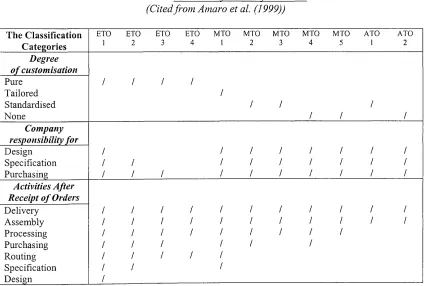
Based on the Amaro et al. (1999) taxonomy, MTO companies can be classified into
eleven types as shown in Table 1.3. To date, the Amaro et al. (1999) taxonomy on MTO
companies presents the most complete definition o f MTO, illustrating the types o f MTO
based on three dimensions. Therefore Amaro et al. ’s (1999) taxonomy will be used to
describe the MTO companies in this research. The MTO label, for the remaining sections
o f this thesis, will be used to describe the generic MTO manufacturers that cover ETOl
through to M T03; ranging from pure, tailored to standardised customisation. It does not
embrace any o f the ATO companies, nor any companies that manufacture a standard
[image:30.509.36.460.365.651.2]product, even if that product is produced after the receipt of a customer order.
Table 1.3: New Classification o f non MTS (Cited from Amaro et al. (1999))
The Classification Categories ETO 1 ETO 2 ETO 3 ETO 4 MTO 1 MTO 2 MTO 3 MTO 4 MTO 5 ATO 1 ATO 2 Degree o f customisation
Pure / / / /
Tailored /
Standardised / / /
None / / /
Company responsibility for
Design / / / / / / / /
Specification / / / / / / / / /
Purchasing / / / / / / / / / /
Activities After Receipt o f Orders
Delivery / / / / / / / / / / /
Assembly / / / / / / / / / / /
Processing / / / / / / / / /
Purchasing / / / / / /
Routing / / / / /
Specification / / /
1.3.3. Repeat Business Customisers (RBC) and Versatile Manufacturing Companies (VMC)
Amaro et al. (1999) also argued that MTO companies can be split again by another
dimension. This dimension is concerned with whether companies are involved in bidding
for one-off orders or for a series o f similar orders. “Repeat Business Customisers” (RBC)
is used to describe a MTO firm who has to enter a bid once only for a series o f similar
orders. “Versatile Manufacturing Companies” (VMC) is used to describe companies in
the alternative type o f market in which each order is for a one-off product or one-off
buying decision.
The RBC market “is the one where the competitive tender is to design and produce a
product to meet regular and repeated need for a reasonable period into the future” (Amaro
et al. (1999)). The competition and customisation is only during an initial customer
purchase decision. After that, based on the agreement to supply the contract, the customer
will place repeated orders with the same supplier. Generally RBCs are producing low
product variety and have a small number o f customers but high volumes per product.
In the VMC market, every order is considered as an individual independent buying
decision. The customers send every order as an enquiry to a group o f potential suppliers
regardless o f whether it is for a new design o f product or a standard product that has been
bought before. To win an order, the company has to determine a price and a delivery
lead-time to quote as an individual bid in response to each customer enquiry. “Each order
sequence. These companies have to show versatility in their marketing, production
planning, use o f resources etc. over time in order to survive” (Amaro et al.( 1998)).
Normally, VMC companies manufacture high product variety in low volumes.
In this thesis, the term MTO will be used to encompass both RBC and VMC companies.
1.3.4. Small and Medium Sized Enterprises (SMEs) in the MTO sector
Many MTO companies in the United Kingdom are categorised as SME (Tobin et al.
(1988)). O f course, there are also many large companies in this sector o f industry.
However, given that the needs o f SMEs are distinctly different to those o f larger
enterprises (Hsu et al. (2000), Knight (2000)), it was decided to narrow the focus o f the
research. According to a recent CBI trends survey, small and medium sized enterprises
outperformed the rest of the UK’s manufacturing industry in terms o f employment and
output over the past 4 months (Anonymous (1996)). Therefore, SMEs were chosen as this
is an important sector.
1.4. Research objectives and Questions
This study is undertaken with the objective o f developing a new WCM model that can be
implemented in the MTO sector. The model is concerned with the actions that a MTO
company must take if it is to take its operations process forwards towards the world class
manufacturing performance and practice, in order to continue to be competitive in a
global market.
The main research questions are:
What are the pertinent components o f a WCM model that would help companies in the
MTO sector to identify and prioritise ways to improve their company performance?
Given the diversity o f the MTO sector, is it sufficient to develop one WCM model, or is
more than one model needed to cover most o f the common characteristics o f MTO
companies'?
This research question arose because a study o f the literature (Hendry (1998)) showed
clearly that the models currently available did not meet the needs o f this sector o f
industry. This includes advice given in material readily available to companies such as
the UK DTI brochures and texts. Given the complex nature o f the MTO sector, it could
be argued that it is necessary to build more than one WCM model. However it was
decided that there are enough common threads to make it worthwhile to look for one
model for the whole sector initially. However, in doing so, it was decided that it would be
necessary to try and encompass issues for RBC and VMC companies whilst also covering
1.5. Structure o f this thesis
The thesis is structured as follows:
Chapter 2 addresses the methodology o f the research, in the context o f the many
alternative methodologies commonly encountered in the literature. This research relies on
the case study approach and therefore a review o f case study research will be brought into
the discussion.
Chapter 3 presents an overview o f the many general WCM concepts which have been
proposed in the literature. The discussions are based on general ideas o f WCM using the
universalistic approach and the contingent approach.
Chapter 4 reviews the WCM research presented by Schonberger (1996), in more detail.
This includes a discussion o f Schonberger’s (1996) principles showing which principles
are applicable to both MTS and MTO, which are applicable to MTO with some
modifications, which are applicable to MTO with major revision, and finally those that
are not applicable to MTO companies at all.
Chapter 5 presents the first version o f the new WCM MTO model developed in this
thesis. The MTO model proposed in this chapter was developed by combining several
Chapter 6 discusses the six MTO case study companies involved in the study. The
chapter categorises the companies using the classification by Amaro et al. (1999). The
case study evidence seeks to determine whether the initial version o f the new WCM
model, as discussed in chapter 5, includes the features required by the MTO sector.
Chapter 7 provides case study evidence from small sized MTO companies. For each
company, a two-stage analysis was performed. In the first stage, to verify the data
collected as much as possible, several people were interviewed at each company level
where appropriate. The second stage o f the analysis was to visit the company to discuss a
report which summarised the findings from the interviews. In this stage, only one
meeting was proposed at the senior management level. Chapter 8 provides similar case
study evidence from medium- sized MTO companies.
Chapter 9 presents the final version o f the new WCM MTO model once the
modifications suggested by the case study evidence have been incorporated. Finally
chapter it? presents the main conclusions o f the research, its contribution and suggestions
CHAPTER 2
RESEARCH METHODOLOGY
This chapter aims to describe the research approach and the framework used in the
study. The first part o f the discussion will be dedicated to the diversity o f research
methodology commonly encountered in the literature. This is followed by a
description o f the triangulation concept that is used in this research. This research
relies on the case study approach and therefore a review of case study research will be
brought into the discussion. Finally, the data sources used will be described.
2.1. Management Research Perspective
There is a long-standing argument about the most appropriate philosophical position
from which management research methods should be derived; positivism or
phenomenology. Easterby-Smith et al. (1997) argue that “the key idea o f positivism is
that the social world exists externally, and that its properties should be measured
through objective methods, rather that being inferred subjectively through sensation,
reflection or intuition”. It seeks facts or causes of social phenomena, with little regard
to the subjective state of the individual. Therefore “logical reasoning is applied to the
research so that precision, objectivity and rigour replace hunches, experience and
Positivism is founded on the belief that the study o f human behaviour should be
conducted in the same mode as the study o f the natural sciences. It is based on two
assumptions, firstly reality is independent o f us and exists regardless o f whether we
are aware o f it and secondly, that knowledge is only o f significance if it is based on
observations o f this external reality. Thus, this approach serves primarily to test a
theory, in an attempt to develop an understanding o f that phenomenon. Hussey et al.
(1997) outline the positivistic features as using quantitative data, large samples,
hypothesis testing, data is highly specific and precise, reliability is high and it is
possible to generalise from sample to population.
In contrast with the positivist, there is another school o f thought: namely the
phenomenological. According to Hussey et a l (1997), the phenomenological
methodology developed as a result o f criticisms o f the positivistic methodology. The
main criticisms o f the positivistic methodology as described by Hussey et al. (1997)
are as follows:
• It is impossible to treat people as separate from their social contexts and they
cannot be understood without examining the perceptions they have o f their own
activities;
• A highly structured research design imposes certain constraints on the results and
may ignore more relevant and interesting findings;
• Researchers are not objective, but part o f what they observe. They bring their own
• Capturing complex phenomena in a single measure is, at best, misleading. For
example, is it possible to assign a numerical value to a person’s intelligence?
Cited from Hussey et al. (1997)
Phenomenology is known as the science o f phenomena. Some researchers label it as
qualitative approach. A phenomenon is a ‘fact or occurrence that appears or is
perceived, especially one of which the cause is in question’ (Allen (1990)). It is
concerned with understanding human behaviour from a participant’s own frame o f
reference. The key features o f the phenomenological methodology, as described by
authors including Easterby-Smith et al. (1997), Gill et al. (1997), Hussey et al.
(1997), Saunders et al. (2000), are summarised as;
• Using qualitative data;
• Uses multiple methods to establish different views o f phenomena;
• Uses small samples; investigated in depth or over time;
• Concerned with generating theories - develops ideas through induction o f data.
The research presented in this thesis comes into the phenomenological category. It
will be based on methods associated primarily with qualitative data, as the research is
concerned with ‘how’ and ‘why’ of WCM. ‘How’ is associated with the way to
improve the manufacturing performance and practice and ‘w hy’ is to find out why
one method works for a particular company type but not for another. In particular, the
research looks at why some methods work for the MTO sector rather than the MTS
research. Some authors including Denzin (1970), Easterby-Smith et al. (1997), Gill et
al. (1997), describe this approach as triangulation. Triangulation refers to the
combination o f methodologies in the study o f the same phenomenon. Easterby-Smith
et al. (1997) categorised triangulation into triangulation o f theories, triangulation of
data, triangulation by investigators and methodological triangulation as follows:
• Triangulation o f theories means borrowing a theory or model from one
discipline and using them to explain phenomenon in another discipline;
• Data triangulation is where data is collected at different time frames or
from different sources to explain the phenomenon;
• Triangulation by investigators is where data is collected by different
people on the same phenomenon and the results are then compared;
• Methodological triangulation is where the researcher uses both qualitative
(inductive) and quantitative (deductive) techniques including
questionnaires, interviews, telephone surveys and field studies.
The triangulation used in this study is “methodological triangulation”, a mixture of
deductive theory development and the inductive approach in which the data is used to
inform the theory and to develop the theory further through case study research. The
2.2. Methodological Triangulation
There are good reasons for using different methodologies in the same study. One o f
the reasons is that the use o f different methods to study the same phenomenon can
lead to greater validity and reliability than a single methodological approach. Gills et
al. (1997) argue that “multiple and independent methods ..., if reaching the same
conclusions, have greater validity and reliability than a single methodological
approach to the problem”. It strengthens qualitative research findings by combining
interviews, documentary sources and participant observation (Hammersley and
Atkinson, 1983). Abrahamson (1983) points out that this kind o f research “prevents
the research becoming method-bound: the strength o f almost every measure is flawed
in some way or other, and therefore research design and strategies can be offset by
counterbalancing strength from one another”. Triangulation has fundamental
strengths, persuades productive research, enhances qualitative methods and allows
complementary use o f quantitative methods (Jick (1979)).
2.2.1. Deductive VS inductive
In this study the triangulation (the mixture o f deductive and inductive) approach is
used in the research as described in the next section. The deductive research method is
concerned with the development o f a conceptual method and theoretical structure
prior to its testing through empirical observation. In using this method, the researcher
will first need to start with a concept or framework, utilising existing theory, and then
the data matches that which has been predicted through the conceptual framework you
will have found an explanation” (Saunders (2000)).
In this research the initial WCM MTO model is developed using the deductive
approach. The model was developed using evidence from the literature and the
author’s experience, to determine the issues which were relevant to the MTO sector.
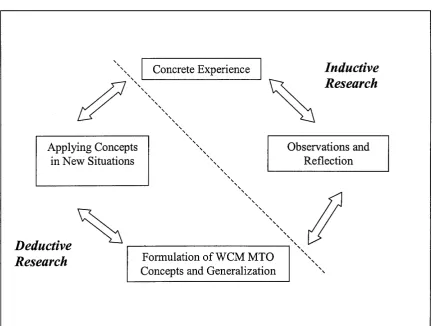
As illustrated in figure 2.1 to the left hand side o f the Kolb’s experiential learning
cycle, the work began with abstract conceptualisation and then moved on to applying
the concepts in new situations so as to create new experiences or observation.
Figure 2.1: Deductive vs. Inductive Research (Based on K o lb ’s experiental learning cycle, 1979)
Inductive
Research
Concrete Experience
Observations and Reflection Applying Concepts
in New Situations
Deductive
Research
Formulation o f WCM MTO [image:41.507.48.481.390.716.2]On the other hand the inductive method corresponds to the right-hand side o f Kolb’s
learning cycle in Figure 2.1. It is concerned with learning by reflecting upon
particular past experiences and through the formulation o f abstract concepts, theories
and generalisations that explain the past, and predict the future.
In contrast to the deductive approach, theory is the outcome o f inductive research.
Perhaps the most famous inductive view provided by Strauss and Corbin (1990) is
known as Grounded theory. In Grounded theory the qualitative researcher begins with
a research question and the theory develops during the data collection process.
Research data is collected to determine how the literature and data compare.
According to Strauss and Corbin (1990) Grounded theory is a qualitative research
technique that uses a “systematic set of procedures to develop an inductively derived
theory about a phenomenon”. Chetty (1996) avers that Grounded theory is ideal for
studying causality (cause and effect) because its questions are based on action and
process.
Nevertheless, the use o f the complete inductive approach is less appropriate for this
research. This is because in the inductive approach, the qualitative researcher needs to
begin with a research question and the theory develops during the data collection
process. This is in contrast with this research whereby an initial theory is developed
before the data collection process.
The inductive approach is used to modify the proposed model during the case study
process. The inductive methods o f research including case study observation,
2.3. Case Study Research
To further develop the model an inductive case study approach has been used
extensively. A case study is an extensive examination o f a single instance o f a
phenomenon o f interest and is an example o f the inductive approach. Bonoma (1985)
refers to case studies as research that investigates a phenomenon in its natural setting
to get information from groups, people or firms. Einsenhardt (1989) refers to the case
study as “a study that focuses on understanding the dynamic present within a single
setting”. A case study technique implies a single unit analysis, such as a group of
workers, a company, an event, a process or even an individual (Hussey et al. (1997).
It is concerned with gathering information about the unit o f analysis, frequently over a
very long period o f time, with a view to obtaining in-depth knowledge. Yin (1993)
claims that case studies have been used in many research contexts including business
and organisational issues, education, child development and youth policy, family
studies, international affairs, evaluation, technology development and research on
social problems. Yin (1993) defined the case study method as “ an empirical enquiry
that investigates a contemporary phenomenon within its real-life context, addresses a
situation in which the boundaries between phenomenon and context are not clearly
evident, and uses multiple sources o f evidence”. Case studies help researchers connect
the micro level to the macro level, or the actions o f individual people to the large
scale social structures and processes (Vaughan (1992)). Case studies “are often
described as exploratory research, used in areas where there are a few theories or a
deficient body o f knowledge” (Hussey et al. (1997). Neuman (1997) claims that these
those being studied. The investigator does this by getting to know a particular social
setting and seeing it from the point o f view o f those in it. The researcher also shares
the feelings and interpretations o f the people he studies and sees things through their
eyes (Neuman (1997)).
2.4. Why Case Studies?
In this research it was decided that case study research would be more appropriate
than a larger empirical study because explanation is needed as much as evidence. It is
not enough to discover what companies are currently doing and how they believe they
can improve. Rather, it is necessary to explore within the managerial level whether
certain improvements are possible, discovering the reasons for any issues in which the
initial model conflicts with the opinions o f company personnel. Also, given the
number o f issues involved in the study, a postal questionnaire would have been
prohibitively long and it was thought better to interview company personnel. In
commencing the collection o f case study evidence, it was expected that the results
would show areas in which the initial WCM model could be usefully modified to
make it more appropriate to the MTO sector.
Chetty (1996) argues that a single case study method has been used regularly and a
multiple-case study method has only become popular recently. Strauss and Corbin
(1990), Eisenhardt (1989) and Yin (1989) mention the importance o f multiple cases in
research work. For example Eisenhardt (1989) claims that the multiple case study
approach encourages the researcher to analyse patterns common to cases and theory
generate theory because they permit replication and extension among individual cases
(Eisenhardt (1991)). Chetty (1996) asserts that having multiple data collection will
give advantages as follows:
• It can prevent subjective bias. Any finding or conclusion in a case study is thus
supported by a chain o f multiple evidence from different sources, and is therefore
more convincing and accurate than a finding or conclusion from a single study;
• It allows the researcher to conduct a more thorough examination o f the
phenomenon than is possible with a single study.
In this study, it was decided that the multiple case study approach should be used and
six MTO companies were selected. According to Eisenhardt (1989) there is no ideal
number o f cases in the multiple case approach. She argued that a study o f between
four to ten cases works well. If the number of cases is less than four, theory would be
difficult to generate, but with more than ten cases the volume o f data is difficult to
cope with.
Conducting case study research involves selecting appropriate tools in order to collect
data efficiently. One o f the significant features o f the case study method is the
inclusion o f multiple forms o f data collection. These include documentation, archival
records, interviews, direct observation and physical artefacts. The forms o f data that
2.5. Data sources
The data collected for this case study research comes from several sources including
interviews, observations and documentation. As concluded by Benbasat et a l (1987),
almost all case study research uses interviews for data collection. H alf o f the studies
use interviews incorporated with other methods, such as documentation and
observations. The rest relied solely on interview.
For each case study company, interviews were carried out with top level management,
shop floor workers and intermediate management levels, such as the foreman or
works manager. Prior to the interview process it was always necessary for the author
to contact the company to present himself and the research topic to the contact person
within the company. Contact with companies was found to be a very difficult task.
This is because the interviews involved the top-level manager. So the process of
contacting a company normally started through a member o f staff o f the university,
and required telephone calls and letters explaining the research interests. Normally
some o f the key persons within the companies were identified during the initial
contacts. Whenever possible it was arranged with the first contact person for him/her
to introduce the research and the researcher to other key persons before the
interviews.
These interviews were based on a carefully prepared set o f semi-structured questions.
The benefit o f semi-structured questions is that it allows the researcher more freedom
to explore beyond the answers in order to extend the clarification on any answers
the interviewee to become known” (Easterby-Smith (1997)). Furthermore, “the semi-
structured interview can expand on issues raised by the interviewees” (Fielding
(1988)).
The semi-structured questions designed for the interviews are shown in Appendix 1.
These questionnaires were developed in two stages. Firstly an initial questionnaire
was carefully constructed to ensure that all the topics covered in the initial WCM
model were included in order to gain all the required information and explanation on
the companies’ current practice and their potential improvements. Secondly, the
questions were modified slightly after the interviews had been carried out at the first
case study company. This was necessary because the questions regarding performance
measurement did not lead to sufficient information on this topic. Therefore these
questions were modified so that adequate data was collected at the remaining
companies. For the first case study company, the missing data was collected at a
subsequent visit to the company and so that data set was complete also.
It is important to note that although pilot studies are recommended in the literature by
many authors, including Janesick (1994), Bryman (2001), Burton (2000), in this case
a pilot study was not carried out. As the data from the first case study was almost
complete, it was felt that it would be worthwhile collecting the missing data and using
this company as one o f the cases. Collecting such data at a later date did not lead to
any problem with the quality o f data or the subsequent analysis in this case. If there
had been more changes to the questionnaire after the first study, then the data from
this company would not have been used but rather would have constituted a pilot