A Policy based Management Architecture for large
scale active communication systems
Ian W Marshall and Paul Mckee
BT Adastral Park, Martlesham Heath, Ipswich, IP5 3RE
[email protected], [email protected]
Abstract. An initial design for a policy based management system combining conventional hierarchical control and significant local autonomy is described. A critical part of the design is a scheme of partial guarantees for policy distribution and execution. This scheme renders explicit the non-determinism that is implicit in policy based control schemes that include conflict resolution, and to some extent replaces the need for conflict resolution. Some preliminary implementations of the design are described, and implications for further work are discussed.
Keywords: Policy, Autonomy, Guarantees, Store, management requirements
1. Introduction
text based information, particularly where the information needs to be automatically processed. XML allows users to define representations specific to their own applications with a well defined formal syntax. In our approach we propose the definition of management data and concepts using XML DTD’s or Schema. The use of DTD’s or schemae gives a reference representation of information that has a consistent meaning in multiple systems. Ideally these representations would be standardised, but where this is not possible automated transformation may be used to transform policy and event formats to domain specific representations. XML based policies and events may be propagated between nodes in the system using commonly available Internet protocols ensuring the greatest possible reach of the proposed technology, but no single protocol is mandatory. Our current experiments have used XML to distribute policies that control the mobility of code in an active network application. Previous papers [5,6] have discussed the use of XML as a resource description approach and we are currently working on resource management monitoring using XML. One advantage of the use of XML and either DTD’s or schema is the automatic checking for well formedness and validity that occurs when an XML document is parsed, allowing early rejection of erroneous input. The use of XML as an intermediate representation still allows policies to be developed using any existing management tools - they will just be transformed prior to transmission.
In this paper we present for the first time the details of the policy handling architecture required by our XML based management system. The architecture relies on a novel categorisation of policies, that enables us to support both dependable and best effort management activity. This is crucial since we cannot provide guarantees that all requests for management action emanating from users can be satisfied by the available resources. The paper also describes a preliminary implementation of key aspects of the architecture. In the next section we summarise ALAN, the infrastructure we are attempting to manage. This is followed (sections 3 and 4) by a high level description of the management architecture, and how policies are handled within it. In section 5 we motivate and describe the policy categorisation scheme, and give examples of its application. Section 6 presents our initial implementation and results.
2. ALAN
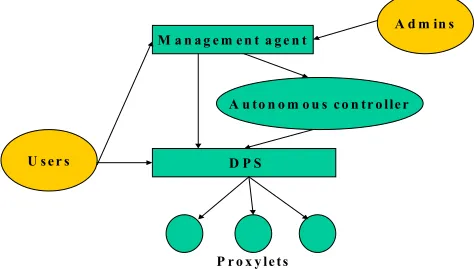
A u to n o m o u s c o n tr o lle r
D P S
P r o x y le t s M a n a g e m e n t a g e n t
U s e r s
[image:3.595.184.421.160.295.2]A d m in s
Figure 1. Schematic of proposed ALAN node design
We have designed and partially implemented an active management solution for multi-service networks based on role-driven policies [7,8] and Application Layer Active Networking (ALAN) [9]. The management system supports a conventional management agent interface that can respond to high level instructions from system operators [10,11]. This interface is also open to use by users (who can use it to run programs/active services by adding a policy pointing to the location of their program and providing an invocation trigger). Typically the management policies for the user programs are included in an XML metafile associated with the code using an XML container, but users can also separately add management policies associated with their programs using HTTP post commands. We refer to the metafiles as macropolicies since they may embed many statements concerning a range of entities. Individual IF-THEN-ELSE statements are referred to as atomic policies. For our purposes a policy must consist of one or more atomic policies referring to a single entity.
The agent can accept policies from other agents and export policies to other agents. Our system provides an extensible monitoring and configuration service that enables users to specify their configuration, monitoring and notification requirements to network devices using policies. Each policy specifies a subject (the policy interpreter), a target list (the objects to be changed if the policy is activated), an action list (the things to be done to each target) and the authorisation code, id and reply address of the originator. The policies can carry enclosures (e.g. the code required to execute an action, or a pointer to it), so we describe the management system as 'Active'. The enclosures can obviously be instances of active services. An event is simply a policy with a single action - "store the enclosed data", and an appropriate data enclosure. The policies are named using a universal policy name, which is also part of the policy. The names currently take the form upn:originator
id.subject.target_list.last_modified_time and are likely to be globally unique. The
decision. Roles are allocated using a public key infrastructure. A policy addressed to the management agent can also enclose a number of component policies, each of which specifies the subject (normally an object oriented program) intended to use it as part of their rule-base. The policy store has a table of policies for each registered subject and the local agent will store the component policies in the appropriate parts of the database.
Our approach avoids many information handling problems by using a lightweight scalable mechanism for policy transfer. The Information Management System [10] consists of a hierarchy of ‘store and forward’ policy stores, with policies being classified by their propagation characteristics and storage duration. Two types of these information stores are used, their selection depending on the complexity of querying required against storage availability. While simple but fast stores offer a load balancing and traffic controlling function, more complex stores permit management information analysis.
The DPS also has an autonomous control system that performs management functions delegated to it via policies (scripts and pointers embedded in XML containers). This autonomous control system is intended to be adaptive, and is integrated with the conventional agent by sharing policy stores.
Not shown in the figure are some low level controls required to enforce sharing of resources between users, and minimise unwanted interactions between users. There is a set of kernel level routines [12] that enforce hard scheduling of the system resources used by a DPS and the associated virtual machine that supports user supplied code. In addition the DPS requires programs to offer payment tokens before they can run. In principle the tokens should be authenticated by a trusted third party. At present these low level management activities are carried out using a conventional hierarchical approach. We hope to address adaptive control of the o/s kernel supporting the DPS in future work.
3. Management Architecture
Previous publications have described our overall architecture for the management of multi-service networks [5] and a proposed architecture for active server management [11]. This paper describes the design and partial implementation of an event service element designed to use XML as both an event description format and as a policy and object metadata format [6]. This event service element is designed to run on a single physical platform, or to form part of a larger distributed system on multiple platforms. This system provides an extensible monitoring and configuration service that enables users and managers of the system to specify their requirements to system components using policies. The basic building blocks of our current implementation are shown in the following diagram.
which the system is running will have a metadata file containing policies that control for example access to hardware resources. End users and remote mangers may both supply single policies via the communications adapters and other event service elements may pass policies to any other element. At this stage we are assuming nothing about the structure of any policy except that it has a header in the XML description that describes it as a policy.
C
om
m
un
ic
ati
on
s a
da
pte
rs
R
ou
te
r
PP
EC
EP
EP
EP
Event Processor Policy Handler
Forwarder
Communications adapters Policy Manager
Event logger
XML Store
Event Service Element
PP= policy provider EC=event consumer EP=event producer
Fig.2 Schematic representation of an event service element
Once identified as a policy the incoming information is routed to the policy handler where the policy will be parsed and checked against the document type definition (DTD) that describes its structure. Again this imparts flexibility for the introduction of a range of new policy definitions to a live system. The policy handler also determines whether the policy is destined to manage the operation of the event service element or should be stored in order to be able to handle detected events. Management policies within the event service element are used as a means of traffic management, events may be aggregated and filtered in the event processor, and the time scales for any locally stored events may be modified.
4. Autonomous controller
The system described above will rapidly generate large numbers of policies and as it grows, the need for user intervention will tend to grow even faster. It is thus imperative to combine the policy based management approach with a significant improvement in management automation. Given the nature of the problem domain this can only be done using adaptive control as described earlier. We have recently developed a novel bacterial GA described elsewhere [13] that forms the basis of the adaptation performed by the autonomous controller in our architecture. In this paper we aim to identify the role of autonomous control in our policy driven management system and describe how the autonomous controller is integrated and provide only a brief sketch of the bacterial algorithm.
One of the most distinctive features of bacterial genetics is the process of plasmid interchange, in which one bacterium accepts copies of genes exported by another. This process is in effect a learning mechanism, and enables bacteria to acquire new capabilities (such as antibiotic resistance) extremely rapidly. In our controller we treat policies as though they were genes, and policy exchange between entities as plasmid interchange. If the controller is programmed (like a bacterium) to autonomously export policies that improve its performance, and de-activate policies that degrade performance, useful policies will spread and poor policies will cease to be executed (until conditions change).
In fact the controller monitors all the policies that it controls in the policy database, and autonomously deactivates those that are generating the least revenue (as recorded in the payment log). In order for a policy to be autonomously controlled it must therefore include an action such as 'Get_Payment'. The controller also exports the policies generating the most revenue when the node fitness function (revenue/cost) is high. Exported policies are addressed to the autonomous controller so the policy receiver simply stores them as de-activated policies. Whenever the autonomous controller deactivates a policy it will examine all the deactivated policies and activate a random selection, to compensate. The autonomous controller has two further capabilities: it will shut down the DPS if fitness has been low for some time, and copy the DPS to a nearby vacant site if fitness has been high for some time. Policies that are never useful will tend to disappear completely, since nodes that possess them will be more likely to shut down. Policies that are useful for some demand but not for others will persist but may not always be activated.
access his service until he has paid the appropriate fee. Given that the number of DPSs will be large, and the number of proxylets unbounded, the correct configuration algorithm will be one that needs as little human/manual intervention as possible, as the manual optimisation of proxylet placement soon becomes untenable.
5. Policy Classification
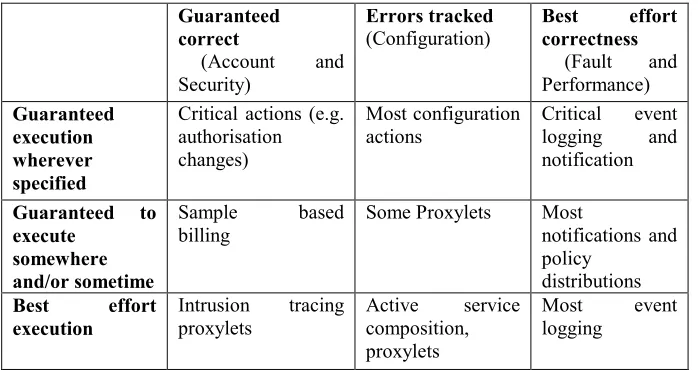
Clearly, to support the hybrid management system we have designed we must be able to classify policies such that those that are appropriate for autonomous or adaptive handling are clearly identified. It is obvious that in order to enable the autonomous controller to take control of those policies sent to it, as identified above, the policies cannot be atomic. Policies addressed to the autonomous controller must encapsulate atomic policies for the entities it is controlling. However, it is also necessary for administrators to have a thorough grasp of which atomic policies can be allocated to autonomous control in this way. One reason is that the level of guarantee offered by the autonomous controller is weaker than that offered by a completely deterministic system. In addition if we are to retain the spirit of XML it must be possible to write policies behind tags that can be ignored by receiving entities that do not support the tag for local policy reasons. With this in mind we have attempted to devise a scheme allowing policy authors to specify the grade of service their policy requires. These specifications could be expressed as constraints in the existing policy notation of Sloman et. al. [7]. We would prefer to express them as a top level categorisation since this makes it more efficient to store the policies in a structure based on level of guarantee. Such a storage approach simplifies the task of conflict identification considerably by reducing the number of entries that must be considered. The basic classification is illustrated in table 1, and deserves some explanation.
Guaranteed correct
(Account and Security)
Errors tracked
(Configuration) Best effort correctness
(Fault and Performance)
Guaranteed execution wherever specified
Critical actions (e.g. authorisation changes)
Most configuration
actions Critical event logging and notification
Guaranteed to execute
somewhere and/or sometime
Sample based
billing Some Proxylets Most notifications and policy
distributions
Best effort execution
Intrusion tracing
proxylets Active service composition, proxylets
[image:8.595.118.467.146.331.2]Most event logging
Table 1. Examples of management activities to which the different grades of policy handling might apply
The three columns represent grades of service for a more complex concept. Correctness can refer to execution, distribution or persistence. It is envisaged that the notion of correctness will be context dependent, i.e. it will depend on the target, subject and action specified in the policy, together with any constraints. For the case where the action requires storage of information, such as an event, the three classes can be interpreted as follows. The first column represents the event being treated as a transaction and stored using a distributed transaction controller. This grade should only be used for requirements (e.g. charging?) where accuracy and consistency are paramount. Policies in the second column will trigger an exception message to the policy owner if the storage or execution fails, but will make no attempt to rollback system state. This grade is ideal for many configuration management records, since existing processes already tolerate inconsistency arising from unavoidable human errors at installation time. Policies in the third column will simply fail, or store incorrect data. This is ideal for most non critical management information collection, particularly where the information is only used for off-line analysis or data mining. In cases where storage of results are not required, correctness could apply to persistence of the policy being correctly maintained for the time specified in the constraints, or alternatively to distribution of follow on actions to the correct targets.
A policy in the second row of the second column will thus guarantee to execute once and tell at least one owner whether or not it succeeded. On the other hand a policy in the second row of the first column will distribute messages wherever specified whenever it executes.
Given this very flexible specification of the events and policies that may be used in our system the roles of some of the event service element components may be expanded.
passed to the forwarder for onward transmission via the output communications adapters.
•= The policy handler examines any incoming policies and determines if they are intended to influence the operation of the event processor or event logger in which case they are routed accordingly. Or if they are intended to manage other installed software the policies are passed to the policy manager for eventual storage in the XML store.
•= The policy manager interacts with the XML store loading policies, and formulating queries in response to detected events passed by the event processor. •= The event processor examines incoming events and checks if it has a policy
defined to handle them. These policies will include actions such as pass to local store for a given period of time, discard as unimportant, aggregate if a large number arrive, query the policy manger for actions or in some cases pass on to another system.
•= The event logger stores a local event history, this is another traffic management aid. In any system there will be a number of normal system events that only become of interest in the case of a system failure or other major problem. Rather than sending these events to a centralised store they are stored locally reducing network load. It is possible that the local store may be queried for patterns of events that might be indicative of failure conditions.
•= The forwarder handles onward transmission of events, policies and any other messages received by the system.
6. Policy Store
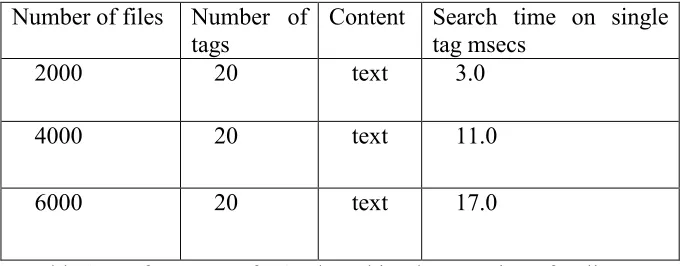
performance is a pre requisite and given that we currently are flexible in our policy specification some tests were carried out on XSet using dummy files.
Number of files Number of
tags
Content Search time on single
tag msecs
2000 20
text
3.0
4000 20
text
11.0
[image:10.595.124.464.181.314.2]6000 20
text
17.0
Table 2. Performance of XSet based implementation of Policy store
These results were obtained on a dual 300Mhz Pentium II PC running Windows NT version 4.0 service pack 4. This system had 256 megabytes of RAM, but use of memory was a limitation and it is highly likely that further optimisation will improve the memory usage, certainly the systems virus checking had to be disabled in order to obtain the above figures. These numbers of files seem adequate for a local store and search facility, and the performance is more than acceptable. Similar results were obtained on a single 450MHz Pentium II PC with 128mBytes of Ram running Windows 98.
Searching is only one of the performance components in XSet's operation, the other two are validation and indexing. Validation is the action of certifying the XML document against a DTD or XML Schema and indexing is the addition of a new XML document to the existing index. Indexing affects both insertions of new data into the index and recovery after a crash. Any queries requesting a document yet to be indexed will return null, so excessive indexing times may affect operation of the index. However for a production quality system with high reliability hardware the one off cost of validating and indexing a document will be far outweighed by the number of queries. Indeed in a well designed system validation and indexing may be performed in separate threads allowing uninterrupted query processing.
When used with the autonomous controller the policy store has to be able to deal with the three basic classifications of policy, guaranteed correct, errors tracked and best efforts correctness. Each of these three categories may be indicated by tags in the policy, an incoming policy will be routed to the policy manager via the policy handler. As it is inserted in the XSet store it is checked for well formedness, and validity against any supplied DTD or schema which confirms that it has an acceptable structure. This base level of operation is equivalent to the best effort correctness category of policy.
achieved with a digest or hash value of the XML object; the digest is a fixed length value, typically 128 or 160 bits that represents the tree [15]. Two trees are the same if their DomHash values are the same.
As the exchange of XML documents has such a key role in B2B e-commerce there are a number of available strategies for secure Internet B2B messaging to prevent information being stolen or modified during transmission. The XML security suite [16] recently made available by IBM provides security features such as digital signature, element wise encryption and access control. This secure communication can easily be accommodated in the communication adapter, and either of these approaches would satisfy the second class of policy, that of errors tracked.
The final most stringent class of policy that of guaranteed correct is a challenge for the current implementation. XSet was designed for speed and flexibility and does not in it’s current form support transactions. For our purpose there is no reason why the policy manger should not take part in a distributed transaction that ensures that the guaranteed correct class of policy are successfully inserted in the local XSet store. Using the secure communication provided for the lower policy class already offers the guarantee of correctness. The Java technology used in our prototype includes support for distributed transactions through two specifications [17] the Java Transaction API (JTA) and the Java Transaction Service (JTS). JTA is a high level, implementation independent, protocol independent API that allows applications and application servers to access transactions. JTS specifies the implementation of a Transaction Manager, which supports JTA and implements the Java mapping of the OMG Object Transaction Service (OTS) 1.1 specification at the level below the API. JTS propagates transactions using the Internet Inter-ORB Protocol (IIOP). Further development of our prototype will include this additional functionality.
7. Discussion
As far as we are aware existing work on policies does not consider the impact of policies being best effort, and indeed does not often recognise that best effort response is the result of most approaches to conflict resolution. Although many of the details of our approach are debatable we feel strongly that explicit recognition of the non-deterministic nature of policy based management systems will aid designers and users. We therefore hope that our work will stimulate debate and creative effort elsewhere in the management and systems community.
In the future we intend to carefully evaluate the costs and benefits of a variety of approaches to managing a large scale active services network.
8. Conclusion
evaluate the number of policies required in each class of service. The required system resources could then be compared with those of more conventional systems. We are confident that the proposals made in this paper offer significant advantages in terms of scalability, required resource and user satisfaction.
References
[1] M. Fry and A. Ghosh “Application Layer Active Networking” Computer Networks, 31, 7, pp. 655-667, 1999.
[2] E. Amir, S. McCanne, R. Katz, “An active service framework and its application to real time multimedia transcoding” Computer Communications review 28, 4, pp178-189, Oct 1998.
[3] P. Cao, J. Zhang and K. Beach, "Active Cache: Caching Dynamic Contents (Objects) on the Web", Proc middleware 1998 (Ambleside).
[4] G.Parulkar et.al "Active Network Node Project", Washington University [5] I.W.Marshall, C.Mallia, J.Bates, M.Spiteri, L.Velasco "Active management of multiservice networks" Proc IEE colloquium 99/147
[6] P.Mckee and I.W.Marshall "Behavioural specification using XML" Proc IEEE FTDCS '99 (Capetown), pp53-59
[7] Sloman M., "Policy Driven Management for Distributed Systems", Plenum press Journal of Network and Systems Management, Plenum Press
[8] Lupu E., Sloman M., " A Policy-based Role Object Model", Proceedings of the 1st IEEE Enterprise Distributed Object Computing Workshop (EDOC '97).
[9] I.W. Marshall et. al. "Application Layer Programmable Internetwork Environment", British Telecom. Technol. J., 17, 2, pp 82-94, April 1999.
[10] Bates J., Bacon J., Moody K., and. Spiteri M., “Using Events for the Scalable Federation of Heterogeneous Components”, Proceedings of 8th ACM SIGOPS
European Workshop, Sintra, Portugal. September 1998.
[11] I.W.Marshall, H.Gharib, J.Hardwicke and C.M.Roadknight, "A novel architecture for active service management" DSOM2000
[12] D.G. Waddington and D. Hutchison, "Resource Partitioning in General Purpose Operating Systems, Experimental Results in Windows NT", Operating Systems Review, 33, 4, 52-74, Oct 1999.
[13] C.M.Roadknight and I.W.Marshall, " Future Network Management - A Bacterium Inspired Solution", British Telecom Technol J. Oct 2000
[14] "XSet: A Lightweight XML Search Engine for Internet Applications", Ben Y Zhao, Anthony Joseph http://www.cs.berkeley.edu/~ravenben/xset/
[15] Digest Values for DOM (DOMHASH) Proposal, http://www.trl.ibm.co.jp/projects/xml/domhash.html
[16] XML Security Suite, http://www.alphaworks.ibm.com/tech/xmlsecuritysuite
[17] TRANSACTIONS AND JAVATM TECHNOLOGY,