Energy Efficiency of Wireless Sensor Network using
Reactive and Proactive Protocols
J. M. Bhattad
Asst. Professor ( E and Tc) Deptt Priyadarshini College of Engg, Nagpur
S.D. Chede,
Ph.D. Professor and Principal Om College of Engineering, WardhaABSTRACT
Data transfer between two or multiple nodes is a common but critical operation in many applications of wireless networks. One of the major constraints of wireless networks is limited energy available to sensor nodes because of the small size of the batteries used as source of power. Clustering is one of the routing techniques that have been used to minimize sensor nodes’ energy consumption during operation. In this paper the clustering algorithm is also used to minimize the energy used by the nodes in the network. In this paper the new method is developed for better energy distribution to save the energy.
Keywords
Wireless Network, clustering algorithm, Routing, Cluster Head
1.
INTRODUCTION
In last few decades advancement in communication technology has led to the development of lightweight, low cost, intelligent sensor nodes that cooperatively collect data from the place of deployment [1]. These nodes have the capability to communicate among them and with the base station. A sensor node consists of transceiver, communication, processing, sensing and power units [2]. Wireless sensor networks are commonly composed of hundreds to thousands of spatially distributed autonomous sensor nodes to cooperatively monitor an area of interest. These sensor nodes can sense, process and transmit the monitored data to certain remote sink node or base station in a multi-hop manner. These are used to acquire interested data, process, and communicate with other sensors within the networks, usually through radio frequency channel [3]. Wireless network have been used in many applications include home security, battle-field surveillance, monitoring movement of wild animals in the forest, earth movement detection, and healthcare applications [4]. Wireless networks can also be used in sensing ambient conditions such as light, sound and temperature. Depending on the area of applications, sensor networks can be randomly distributed, for instance in military applications, sensor nodes can be randomly dropped from war-plane into the battlefield to monitor enemies’ movement or manually placed.
One of the main advantages of wireless is the ability to operate autonomously in harsh environments where it may be dangerous or infeasible for human being to reach [5]. The nodes in wireless network are powered by batteries. It is expected that these batteries lasted for years before they can be replaced. Due to the cost and small size of the sensor nodes, they have been equipped with small batteries with limited energy source [6]. This has been a major constraint of wireless sensor networks which limits their lifetime and affects utilization of the wireless networks. Wireless sensor
Each battery-power sensor node is a constrained device with a relatively small memory resources, restricted computational power, and limited communication capability. Thus, to maximize the network lifetime, energy conservation is of paramount importance in the research of sensor networks. To extend lifetime of battery and networks utilization, constant changing the batteries when they run out of energy may not be practical, since these nodes in most cases are many (tens to thousands of sensor nodes), recharging the weaken batteries at all time may not be feasible. Therefore, there is a need to minimize energy consumption in wireless network. In recent time, many clustering algorithms have been proposed with different protocols by different researchers to prolong networks utilization. There still need to look for other techniques in which energy can be minimized in wireless networks.
2.
RELATED WORK
Many clustering algorithms in various contexts have also been proposed in the past, but to the knowledge, none of these algorithms aim at minimizing the energy spent in the system. Most of these algorithms are heuristic in nature and their aim is to generate the minimum number of clusters such that a node in any cluster is at the most d hops away from the cluster head. In the context, generating the minimum number of clusters might not ensure minimum energy usage. Clustering technique is one of the effective approaches used to save energy in wireless network [7]. Clustering means organizing sensor nodes into different groups called clusters. In each cluster, sensor nodes are given different roles to play, such as cluster head, ordinary member node, or gate way node. A cluster head (CH) is a group leader in each cluster that collects sensed data from member nodes, aggregate, and transmits the aggregated data to the next CH or to the base station [8][9]. The role of ordinary member node is to sense data from the environment where the nodes are deployed. Gate-way nodes are nodes belonging to more than one clusters and their role is to transmit data between two clusters. Furthermore, many different traditional clustering algorithms for wireless ad-hoc networks have been pro-posed by [10][11]. These clustering algorithms are not suitable for sensor networks because in ad-hoc networks, the primary concern is quality of service (QOS) and energy efficiency is the secondary. But in Wireless network, the primary concern is the energy efficiency [12].
2.1 LEACH Protocol
Each round consists of set-up phase and steady- state phase. During the set-up phase, sensor nodes are organized into different clusters based on the received signal strength and cluster heads are selected for each cluster as routers to the base station.
This algorithm saves energy, since only CHs are allowed to transmit data to the base station rather than all nodes. Basically, each node elects itself to be a CH in a given round. This decision is made by selecting a random number between 0 and 1. A node V becomes CH for the current round, if the number selected is less than set threshold value. The threshold formula is contained in [13]. LEACH achieves reduction in energy consumption 7 times compared with direct communication and between 4 to 8 times compared with minimum transmission energy (MTE) routing protocol [14].
Disadvantages of LEACH protocol
1. CHs are not uniformly distributed in LEACH, CHs may be chosen from one part of the net-work.
If this occurs, energy dissipation will be more than conventional protocols [15].Moreover, considering a single round of LEACH, CH selection based on probability will not automatically lead to minimum energy consumption during the steady state phase. Author V. Loscri proposed two-level LEACH (TL-LEACH) algorithm protocol [16]. It was enhanced to the LEACH algorithm. They adopted the same method of cluster heads selection and clusters formation. The algorithm selects two sensor nodes in each cluster as cluster heads, one node as primary cluster head and the other as the secondary cluster head. Both the primary and secondary cluster heads can communicate with each other and secondary cluster heads communicate with nodes in their sub-clusters. Secondary cluster heads collect sensed data from the other nodes, perform data fusion and transmit it to the primary cluster heads. Primary cluster heads further perform data fusion on the received data and transmit it to the base station. This protocol greatly reduces the number of data sent to the base station. However, the algorithm may not be energy efficient if the cluster heads are at distance from the base station. Lastlly, there is high probability of increase in overhead during the selection of primary and secondary cluster heads which will result to increase in energy consumption.
2.2 AODV Protocol
AODV is the Ad-hoc on Demand Vector protocol. AODV is a based on the Bellman-Ford distant vector algorithm. AODV determines a route to a destination only when a node wants to send a packet to that destination. Routes are maintained as long as they are needed by the source. Sequence numbers ensures the freshness of routes and guarantees the loop-free routing. AODV is an on-demand routing protocol as described in [22]. In a human mobility using AODV routing, a source node has to initiate a route discovery mechanism each time data is ready to be transmitted. The AODV route discovery process consists of flooding the network with a Route Request (RREQ) packet to be received by the intended destination node. The destination node then, sends a uncast Route Reply (RREP) to the source node thus establishing a route between the two nodes for data transmission. This process adds delay towards end-to-end data delivery. On the other hand, AODV provides a fresh route for data delivery as opposed to periodically pre-established routes.
Disadvantages of AODV protocol:
1. One of the disadvantages of AODV is unnecessary bandwidth consumption due to periodic beaconing.
2.3 DSR Protocol
DSR is the Dynamic Source Routing Protocol. DSR is an efficient and simple routing protocol designed specifically for use in multi-hop networks. The sender knows the complete hop by hop route to the destination node. The different routes are stored in a route cache. This protocol is of two mechanisms, route maintenance and route Discovery which work together to allow nodes to discover and maintain routes to arbitrary destinations in the network. The main advantage of DSR routing protocol is that routes are maintained only between nodes that needs to communicate, Route caching can further reduce route discovery overhead, and a single route discovery may yield many routes to the destination, because of intermediate nodes replying from local caches.
Disadvantages of DSR protocol:
1. The route maintenance mechanism does not locally repair a broken link. The routing overhead is directly proportional to the path length.
2. Stale route cache information could also result in inconsistencies during the route reconstruction phase.
3. The connection setup delay is higher than other protocols. Even though the protocol performs well in static and low-mobility environments, the performance decreases rapidly with increasing mobility.
2.4 DSDV Protocol
DSDV is the routing protocol adapted from the conventional Routing Information Protocol (RIP) to ad hoc networks routing. It adds a new characteristic and sequence number to each route table entry of the conventional Routing Information Protocol. Using the newly added sequence number, the mobile nodes can distinguish stale route information from the new and thus prevent the formation of routing loops. Every mobile node of an ad-hoc network maintains a routing table in DSDV, which lists all available destinations, the next hop and metric to each destination and a sequence number generated by the destination node. By use of such routing table stored in every mobile node, the packets are transmitted between the nodes of an ad-hoc network. Each node of the ad-hoc network updates the routing table with information periodically or whenever significant new information is available to maintain the consistency of the routing table with the dynamically changing topology of the ad hoc network.
Disadvantages of DSDV protocol:
1. DSDV arises different route fluctuation because of its criteria of route updates. Routes are always preferred if the sequence number is new, whereas routes with old sequence numbers are discarded.
3.
CLUSTURING ALGORITHM
Clustering is a good method in wireless networks for effective data communication and towards energy efficiency [18]. It involves grouping of sensor nodes together so that nodes communicate their sensed data to the CHs. CHs transmit, aggregate and collect the aggregated data to the processing centre called base station for further analysis [19]. Clustering provides resource utilization and minimizes energy consumption in wireless network by reducing the number of sensor nodes that take part in long distance transmission [20] [21]. Cluster based operation consists of various rounds. These involve cluster formation, cluster heads selection and transmission of data to the base station. The operations are explained below.
3.1 Algorithm for Cluster Head Selection
For a node to become cluster head in a cluster the following assumptions were made.
1. All the nodes have the same initial energy.
2. There are S nodes in the sensor field.
3. The number of clusters is K.
Based on the above assumptions, the average number of sensor nodes in each cluster is M where
𝑀 =𝐾𝑠 (1)
After M rounds, each of the nodes must have been a cluster head (CH) once. To each node a unique identifier i, Mi for all i =0, 1, 2,3,4….,S-1.Variable i is used to test whether it is the turn of a node to become a CH. Originally, all nodes are the same, i.e. there is no CHs in each cluster, j = 0 where j is CHs counter. A node q is selected among all nodes and continuously executes the following steps:
Firstly, q increments i by 1 and check if i is even, if yes that node is selected as the CH for that round and announces its new position to all member nodes in the cluster. Else if i is odd, it cannot be a CH for that round, it will wait for the next round and be ready to receive advertisement message from the new CH. A predetermined value is set (threshold value) for the new CH to transmit for that round. When the value has reached, j will be incremented by 1 and the process of selection of new CH begins. It tests if the following two conditions hold.
1. That a sensor node has not become cluster head for the past 1
𝑝 − 1 rounds [16].
2. That the residual energy of a node is more than the average energy of all the sensor nodes in the clustering.
Thus, the probability of a node becoming new cluster head is given as
𝑃𝑖 =𝐸𝑟𝑒𝑚 𝑖 ∗𝐾
𝐸𝑎𝑣𝑔 𝑖 ∗𝑀 (2)
Where 𝐸𝑟𝑒𝑚 the remaining energy in node (i), is the average energy of all the nodes in a cluster.
It continues until j = K. The algorithm stops when j = K. The new CHs collect sensed data from member nodes, aggregate them, and transmit the compressed data to the next cluster head or base station.
3.2 Cluster Formation
The next step in the clustering phase is cluster formation. Following steps gives the description of new cluster formation.
Step 1: The new cluster heads selected broadcasts advertisements (ADV) message to all non-cluster nodes in the network using Carrier Sense Multiple Access (CSMA) MAC Protocol.
Step 2: Each sensor node determines which clusters it will join So this is done by choosing CH that requires minimum communication energy.
Step 3: Each non-cluster node again uses CSMA to send message back to the CHs to inform them about the cluster it wants to belong.
Step 4: After CHs have received messages from all nodes, Time Division Multiple Access (TDMA) scheduling table will be send it to all nodes. This message contains time allocated to each node to transmit to the CH within each cluster.
Step 5: Each sensor node uses TDMA allocated to it to transmit data to the CH with a single- hop transmission and to avoid a single node transmitting data multiple times in one round, need to set a threshold value G. G is the total time of all nodes in the cluster forwarding the data to the CH in one round.
Step 6: CHs will issue new TDMA slots to all nodes in their clusters when allocated time for G has elapsed, for each node to know exact time it will transmit data to avoid data collision during transmission that can increase energy consumption.
Step 7: CH transceiver is usually turn-on to receive data from each node in its cluster and prepare them for inter clusters transmission.
4.
PROPPOSED METHOD
The proposed method is going to apply the clustering techniques to improve the energy efficiency of the wireless network. Here performed two different approaches to save energy for the communication between source node and destination node in two different clusters.
1) The first approach is going to select the head nodes from the clusters which are trying to communicate. The source node from the cluster which tries to communicate with the destination node of the other cluster is going to communicate with the help of head nodes of the both clusters. Head nodes of the clusters are selected according to highest energy node from the cluster.
Figure 1: Proposed method 1
.
Figure 2: Path of communication between source and destination node
[image:4.595.55.290.85.258.2]2) Second approach defines the roles to the different nodes of the cluster. Node with the highest energy in the cluster set to be the Head node (i.e. CH1), the node with the second highest energy will be set to the CH2 node, nodes with moderate energy age set to routing node (i.e. R1,R2,..) and node with the lowest energy will be set to the sink node. For the communication between two nodes in the clusters communication is done according to role assigned to the nodes in the cluster. Figure 2 shows the overall path of the communication between nodes. Figure 3 shows the two clusters with the source and destination nodes.
Figure 3: Clusters with source and destination nodes
[image:4.595.324.548.185.373.2]Figure 4 shows the path of communication between node1 and node 6 from two different clusters. In the cluster node with highest energy is set CH1, node with second highest energy is set CH2 , node with moderate energy is set to routing node (R1,R2,…) and node with the lowest energy set be sink node. Now source node communicate with the nearest routing node, routing node communicate with the head node and reverse in the destination cluster.
Figure 4: path of communication between source and destination
3) The third approach is going to use the multichannel cached communication in the wireless network. The approach is going to store the route information of the path followed by the nodes between the source and the destination in the cache memory of the communication system.
Figure 5 show the network follows multiple paths to transfer the data between source and destination. The path or route of the communication is stored in the cash memory of the communication system to follow the previously decided path. This will reduce the delay time required to find the path for the communication between the nodes. Because of the optimized delay time the energy required to transfer the data between nodes is also reduced. Because of use of multichannel communication, the throughput of the network is increased.
Figure 5: Multichannel communication
5.
RESULTS
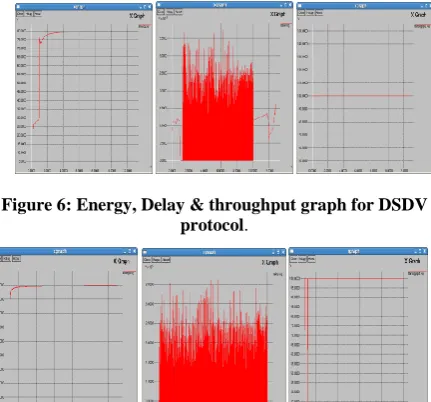
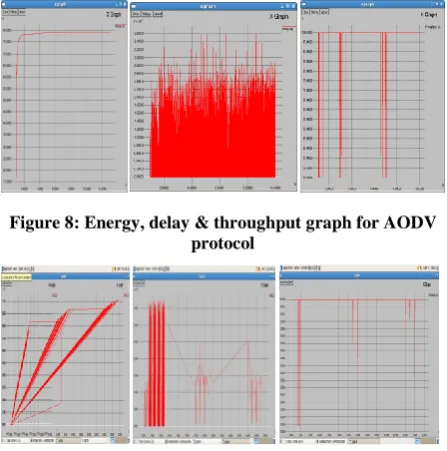
Energy, delay & throughput graphs for DSDV, DSR , AODV protocol & Energy, delay & throughput graphs for LEACH protocol with the concept of DSDV, DSR & AODV respectively.
[image:4.595.74.284.416.507.2][image:4.595.321.537.455.656.2]
Figure 6: Energy, Delay & throughput graph for DSDV protocol.
Figure 7:Energy, delay & throughput graph for DSR
[image:4.595.326.542.455.544.2] [image:4.595.319.535.548.687.2]Figure 8: Energy, delay & throughput graph for AODV protocol
Figure 9: Energy, delay & throughput graph for DSDV protocol with the concept of LEACH
Figure 10: Energy, delay & throughput graph for DSR protocol with the concept of LEACH
[image:5.595.55.281.72.167.2]In this paper three parameters are calculated for three different reactive & proactive protocols such as AODV, DSR & DSDV & LEACH. A graph for this parameter is as shown in above figures. From the results one can say that AODV performs better in case of energy among three protocols. In case of delay DSR is found to be better while in case of throughput DSDV gives better results.
Table 1: Performance parameters for three different protocols
Proto cols
Energy Delay Throughput
AODV 77mJ at 1sec
1.3 msec at 2 sec
At different instant throughput is different
DSDV 75 mJ at 1sec.
1.2 msec at 2sec
100%
DSR 63 mJ at 1 sec
1.15 msec at 2sec.
At different instant throughput is different
6.
CONCLUSION
The results of the simulations are analyzed & discussed in this section. Study provides an optimal result which is fully based on simulation & analysis. This paper provides an overview of MANETs & discusses how energy is one of the most important constraints for these types of networks. The
the proposed work is to develop an energy efficient routing algorithm in a way which allows researchers to choose most appropriate routing algorithm. The performance evaluation of proactive (DSDV) & reactive (AODV, DSR) routing protocols for stationary & mobile nodes are studied by varying the node using network simulator ns-2.32. A comprehensive simulation study has been presented to talk about the comparison of the above stated routing protocols AODV performs better than DSR & DSDV in case of energy. Still energy is a big issue in these protocols & this approach compares this routing protocol using a varying workload such as delay, energy & throughput of ad-hoc network. When it will lead to save energy or can say manage energy in a efficient way.
7.
REFERENCES
[1] W. Wang, et al., “CEDCAP: Cluster-Based energy-Effie- cient Data Collecting and Aggregation Protocol for Wireless network,” Journal of Information Technology Research, Vol. 3, No. 2, 2011, pp. 93-103.
[2] D. Zhicheng, Z. Li, B. Wang and Q. Tang, “An En-ergy-Aware Cluster-Based Routing Protocol for Wireless Sensor and Actor Network,” Journal of Information Technology, Vol. 8, No. 7, 2009, pp. 1044-1048.
[3] Azat Rozyyev, H. Hasbullah and F. SubhanIndoor, “In-door Child Tracking in Wireless Sensor Network Using Fuzzy Logic Technique,” Research Journal of Informa-tion Technology, Vol. 3, No. 2, 2011, pp. 81-92.
[4] I. F. Akyildiz, W. Su, Y. Sankarasubramaniam and E. Cayirci, “A Survey on Sensor Networks,” IEEE Commu-nication Magazine, Vol. 40, No. 8, 2002, pp. 102-114.
[5] K. Sohrabi, J. Gao, V. Ailawadhi and G. J. Potie, “Proto-cols for Self-Organization of a Wireless Sensor Net-work,” IEEE Personal Communications, Vol. 7, No. 5, 2000, pp. 16-27.
[6] A. Gao, W. Wei and X. Xiao, “Multiple Hash Sub- Chains: Authentication for the Hierarchical Sensor Net-works,” Information Technology Journal, Vol. 9, No. 4, 2010, pp. 740-748.
[7] X. Guan, W. H. Yang and D. G. Bi, “EEHCA: An Energy Efficient Hierarchical Clustering Algorithm for Wireless Sensor Networks,” Information Technology Journal, Vol. 7, No. 2, 2008, pp. 245-252.
[8] J. Yang and D. Zhang, “An Energy-Balancing Unequal Clustering Protocol for Wireless Sensor Networks,” In-formation Technology Journal, Vol. 8, No. 1, 2009, pp. 57-63.
[9] D. Wei, S. Kaplan and H. A. Chan, “Energy Efficient Clustering Algorithms for Wireless Sensor Networks,” Proceeding of the IEEE International Conference on Communications Workshops, 19-23 May 2008, Beijing, pp. 236-240.
[10] Z. Li, R. Li, Y. Wei and T. Pei, “Survey of Localization Techniques in Wireless Sensor Networks,” Information Technology Journal, Vol. 9, No. 8, 2010, pp. 1754-1757.
[image:5.595.37.289.544.691.2][12] J. Chen, J. Fan, X. Cao and Y. Sun, “GRFR: Greedy Rumor Forwarding Routing for Wireless Sensor/Actor Networks,” Information Technology Journal, Vol. 7, No. 4, 2008, pp. 661-666.
[13] W. B. Heinzelman, A. P. Chandrakasan and H. Balak- rishnan, “An application-Specific Protocol Architecture for Wireless Microsensor Networks,” IEEE Transactions on Wireless Communications, Vol. 1, No. 4, 2002, pp. 660-670.
[14] K. Akkaya and M. Younis, “A Survey on Routing Proto-cols for Wireless Sensor Networks,” Ad Hoc Networks, Vol. 3, No. 3, 2005, pp. 325-349.
[15] M. Ahmad, M. Habib, M. Z. Shah, F. Ullah and S. Hus-sain, “Energy Aware Uniform Cluster-Head Distribution Technique for Hierarchal Wireless Sensor Networks,” International Journal of Computer Science and Network Security, Vol. 10, No. 10, 2010, pp. 97-103.
[16] V. Loscri, G. Morabito and S. Marano, “A Two-Level Hierarchy for Low-Energy Adaptive Clustering Hierar-chy,” 62nd IEEE Vehicular Technology Conference, Vol. 3, No. 2, 2005, pp. 1809-1813.
[17] G. Smaragdakis, I. Matta and A. Bestavros, “SEP: A Stable Election Protocol for Clustered Heterogeneous Wireless Sensor Networks,” 2nd International Workshop on Sensor and Actor Network Protocols and Applications, Boston, 22 August 2004, pp. 56-66.
[18] K. Zhou, L. Meng, Z. Xu, G. Li and J. Hua, “A Dynamic Clustering-Based Routing Algorithm for Wireless Senor Networks,” Information Technology Journal, Vol. 7, No. 4, 2008, pp. 694-697.
[19] A. D. Amis, R. Prakash, T. H. P. Vuong and D. T. Huynh, “Max-Min D-Cluster Formation in Wireless Ad-Hoc Networks,” Proceedings of the IEEE 9th Annual Joint Conference of the IEEE Computer and Communications Societies, Tel Aviv, 26-30 March 2000, pp. 32-41.
[20] Y. He, W. S. Yoon and J. H. Kim, “Multi-level Cluster-ing Architecture for Wireless Sensor Networks,” Information Technology Journal, Vol. 5, No. 1, 2006, pp. 188-191.
[21] W. Liu and J. Yu, “Energy Efficient Clustering and Routing Scheme for Wireless Sensor Networks,” Proceeding of the IEEE International Conference on Intelligent Computing and Intelligent Systems, Shanghai, 20-22 November 2009, pp. 612-616.
[22] Perkins, C. and Royer, E. and Das, S., “Ad hoc On demand Distance Vector (AODV) routing," RFC 3561, Jul. 2003.