http://dx.doi.org/10.4236/cm.2014.51003
How to cite this paper: Shariatifar, A., Riazi, M., Ebnolelm, M. and Jahromy, M.H. (2014) Effects of Nigella sativa L. Seed Ex-tract on Fatigue, Blood Biochemical Parameters and Thyroid Function in Male Mice. Chinese Medicine, 5, 16-21.
http://dx.doi.org/10.4236/cm.2014.51003
Effects of
Nigella sativa
L. Seed Extract on
Fatigue, Blood Biochemical Parameters and
Thyroid Function in Male Mice
Azadeh Shariatifar, Mahdieh Riazi, Mona Ebnolelm, Mahsa Hadipour Jahromy*
Department of Pharmacology, Medical Sciences Research Center, Tehran Medical Sciences Branch, Islamic Azad University, Tehran, Iran
Email: *[email protected]
Received 3 January 2014; revised 8 February 2014; accepted 24 February 2014
Copyright © 2014 by authors and Scientific Research Publishing Inc.
This work is licensed under the Creative Commons Attribution International License (CC BY).
http://creativecommons.org/licenses/by/4.0/
Abstract
Nigella sativa L. (Black seed), is a traditional herbal medicine that has been used for many pur-poses. The present study was designed to investigate the effects of hydro-alcoholic extract of ni-gella sativa L. (NS) on performance of Forced Swimming Test (FST), blood biochemical parameters related to fatigue and thyroid functions. Therefore, Blood Urea Nitrogen (BUN), Creatine Kinase (CK), Lactic Dehydrogenase (LDH), and Total Protein (TP), triiodothyronine T3, thyroxin T4 and TSH tests were investigated. Thirty five male adult mice were randomly divided into five groups: three NS-fed groups, one fluoxetine treated group and one control group. Three NS experimental groups received hydro-alcoholic extract of NS at doses of 50, 100 and 200 mg/kg orally for two weeks. Immobility time decreased in all NS groups compared with control group. Administration of NS significantly increased the concentration of T3 and T4 of the treatment groups. On the con-trary, the amount of BUN, CK, LDH, TP and TSH decreased. In conclusion, black seed extract at the experimented doses showed anti-depressant, anti-fatigue and hyperthyroid effects.
Keywords
Nigella sativa Hydro-Alcoholic Extract; Black Seed; Thyroid Functions; Forced Swimming Test; Blood Biochemical Parameters Related to Fatigue
1. Introduction
The genus Nigella is an annual plant that belongs to the Renunculaceae family and comprises about eight species [1].
*
Nigella sativa L. is one of the spices that commonly known as black seed. It is native to many areas such as southern Europe and western Asia [2] which has been used as an herbal medicine for more than 2000 years.
Compound of black seed contains fixed and essential oils alkaloid, steroids, proteins, carbohydrates, fatty ac-ids, and flavonoids. Also, it contains many bioactive constituents such as thymoquinone, thymohydroquinone, pinene, p-cymene, dithymoquinone [3] [4] that have been shown to possess biological, pharmacological and bi-ochemical actions, including antibacterial [5], bronchodilator [6]. Besides it has activity against diabetes [7] and prevents lipid peroxidation [8]. Moreover, in some studies, NO exhibits anti-oxidant and immune-potentiating effects [9] [10].
Forced Swimming Test (FST) is a behavioral test for rodents, which evaluates the efficacy of antidepressant treatment and physical stamina [10]-[13]. Blood urea nitrogen (BUN), lactic dehydrogenase (LDH), creatine ki-nase (CK), and total protein (TP) are blood biochemical parameters related to fatigue. The BUN test is a routine test used primarily for evaluating renal functions. Serum CK and LDH in the body normally exist in muscle, and an increase in the amount of serum CK and LDH in the blood indicates that muscle damage has occurred [14]. TP is a rough measure of serum protein. Protein measurements can reflect the nutritional state, liver disease, kidney disease, and many other conditions [15]. Serum levels of Triiodothyronine (T3), thyroxin (T4) and thy-roid stimulating hormones (TSH) are usually used to assess thythy-roid functions. Regarding NS, different kinds of extraction have been used on different animals and effects on blood biochemical parameters and thyroid func-tion have been reported. So far however, the results are controversial [16]-[18].
The present study was undertaken to determine the effects of Nigella sativa L. hydro-alcoholic extract on FST performance, plasma concentration of BUN, CK, LDH, TP and thyroid functions.
2. Materials and Methods
2.1. Animals35 Male adult mice Balb/c weighing 23 ± 5 g (Pasteur Institute, Karaj Production and Research Center, Iran) were used in this study. The animals were randomly divided into 5 groups of 7 each and treated according to the experimental protocol for 2 weeks. Animals housed under the following laboratory conditions: temperature 22˚C ± 1˚C, humidity 40% - 60%, 12 h Light/Dark cycle, lights on at 07:00 h. Mice were maintained in polyethylene cages with enough food and water available ad libitum. All measurements were performed between 10:00 and 14:00 h in the animal testing room. Mice were treated by the current law of Medical Sciences Research Center, Tehran Medical Branch, Islamic Azad University, Tehran, Iran, in accordance with the National Institutes of Health (NIH) Guide for Care and Use of Laboratory Animals. Control Group administrated distilled water orally. One group ad-ministered Fluoxetine, 10 mg/kg/day and three other groups adad-ministered NS at doses 50, 100 and 200 mg/kg/day.
2.2. Drugs
Black seeds were purchased from a local herb market, cleaned, dried, mechanically powdered, extracted with 70% ethanol and dried, with rotary evaporator to render the extract alcohol free and kept in refrigerator at 4 degree centigrade until used. The NS seeds extract was provided at doses of 50, 100, 200 mg/kg.
2.3. Forced Swimming Test
FST is generally used for evaluating anti depressive effects. Recently, the FST has also been used as an anti-fa- tigue test. During the FST, the animals were placed in a Plexiglas cylinder with 25 cm height and 10 cm width, which was filled with water (25˚C ± 0.5˚C).
The total duration of immobility was measured during a period of 4 min, after a delay of 2 min [19]. Each mouse was consider to be immobile when it ceased struggling and remained floating in the water, making only these movements necessary to keep its head above water.
2.4. Sample Collection
nutes and placed in plain Containers and stored at −10˚C until analysis.
2.5. Hormones Estimation
T3, T4 and TSH levels were measured by electrochemiluminescence method (Elecsys2010). In order to clarify its anti-fatigue mechanisms, we assessed the levels of several blood biochemical parameters in mice after FST. Contents of BUN, LDH, CK and TP were determined by an auto analyzer (Hitachi 747, Hitachi Japan).
2.6. Statistical Analysis
To evaluate significance differences among treatment groups with control groups, one-way analysis of variance (ANOVA) was applied. The data were expressed as mean ± standard error of the mean (SEM). A value of p < 0.05 or less was considered to show statistical significance.
3. Results
3.1. Forced Swimming Test
Immobility time or exhaustion of the control and Fluoxetine group was measured 95.28 ± 19.81 s, 31.66 ± 2.94, respectively. Data of the FST test (Figure1) demonstrated that administration of NS were significantly decrease the immobility time of the treatment groups which were 49.00 ± 6.03 s, 40.83 ± 6.17 s, 50.66 ± 3.88 s respec-tively (p < 0.01, F = 36.89).
3.2. Effect of NS on Biochemical Parameters
In order to clarify its anti-fatigue mechanisms, we assessed the levels of several blood biochemical parameters in mice after FST (Table1). All the biochemical parameter such as BUN, LDH, CK and TP levels significantly tended to decrease in compared with control group (p < 0.001).
3.3. Thyroid Function Tests
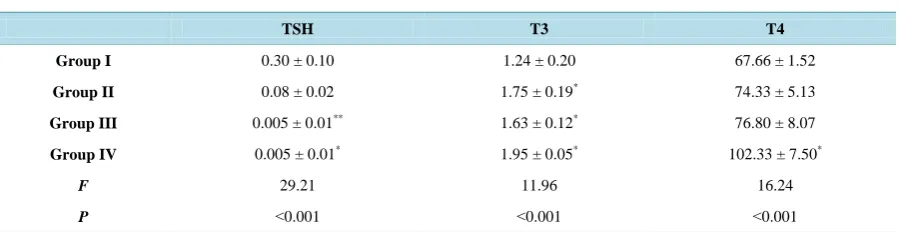
[image:3.595.157.469.481.674.2]These results of T3, T4 and TSH serum level of control and treatment groups are shown in Table2. The plasma concentration of T3 and T4 are significantly (P ≤ 0.001) increased and TSH serum level significantly (p < 0.001) decreased in treatment groups compared with control groups.
Table 1. Effect of NS on blood biomedical parameters in mice treated with NS after FST.
BUN (mg/dl) TP (mg/dl) CK (U/l) LDH (U/l)
Group I 42.44 ± 3.18 11.61 ± 1.99 1058.50 ± 427.72 5288.50 ± 2288.27
Group II 29.93 ± 7.96** 8.04 ± 1.97** 481.42 ± 334.58* 2561.28 ± 392.66*
Group III 23.42 ± 2.36** 6.75 ± 0.49** 55.16 ± 12.38** 1659.20 ± 346.36**
Group IV 16.26 ± 3.80** 6.05 ± 1.25** 90.14 ± 87.02** 1198.66 ± 370.65**
F 31.33 13.97 18.10 13.97
P ˂0.001 ˂0.001 ˂0.001 ˂0.001
Values are the means ± S.D. (n = 7). *p < 0.05 indicates significant difference from the control group and **p < 0.001 indicates significant difference from the control group. Group I: control mice administered distilled water, Group II: administered NS 50 mg/kg/day, Group III: administered NS100 mg/kg/day, Group IV: administered NS 200 mg/kg/day.
Table 2. Thyroid function tests before and after supplementation of NS.
TSH T3 T4
Group I 0.30 ± 0.10 1.24 ± 0.20 67.66 ± 1.52
Group II 0.08 ± 0.02 1.75 ± 0.19* 74.33 ± 5.13
Group III 0.005 ± 0.01** 1.63 ± 0.12* 76.80 ± 8.07
Group IV 0.005 ± 0.01* 1.95 ± 0.05* 102.33 ± 7.50*
F 29.21 11.96 16.24
P ˂0.001 ˂0.001 ˂0.001
Values are the means ± S.D. (n = 7). *p < 0.05 indicates significant difference from the control group and **p < 0.001 indicates significant difference from the control group. Group I: control mice administered distilled water, Group II: administered NS 50 mg/kg/day, Group III: administered NSv100 mg/kg/day, Group IV: administered NS 200 mg/kg/day.
4. Discussion
First, we investigated the effect of NS on FST, which is commonly accepted an experimental exercise model used for assessing anti-depressive and anti-fatigue effects. Increases in concentrations of NS treated mice showed significant improvement in the swimming test. It suggests that the decreased duration of immobility in mice is related to change of certain metabolites in the system. These results agree with Roshan, who reported feeding NS could protect neural cell against oxidative stress [20]. In addition, there is evidence suggesting that the anti-depressant effect of NS was most probably related to its anti-oxidant effects [8] [17].
In order to investigate its mechanisms, we assessed biochemical serum markers after FST. BUN, CK, LDH and TP levels are related to fatigue. In the present study, CK level which is known to be an accurate indicator of muscle damage tended to decrease and less leakage of CK occurring during the swimming exercise. These re-sults indicated that muscle damage in the treated groups, as reflected by the serum CK levels, was minimized by NS. Moreover, LDH is known to be an accurate indicator of muscle damage [21]. Therefore, the LDH serum level increases after exercise. In this study, however, the LDH level tended to decrease; thus, our results indicate that NS could influence the fatigue metabolism. Also, NS could significantly reduce BUN level which may be due to inhibition of stimulation of sympathetic nervous system. In fact, further studies are needed to clarify the detailed mechanisms involved in the anti-fatigue-like properties of NS in order to support present results.
[image:4.595.89.539.264.380.2]5. Conclusion
In brief, in the present study, swimming time in NS-fed groups increased during FST. NS also increased the blood concentration of T3 and T4, leading to the decrease of TSH serum level. Taken together, it is suggested that NS not only has anti-depressive effect and anti-fatigue like effects that might be useful in the development of physical strength, but also leads to hyperthyroidism in mice, so it can be tested in thyroid function disorders.
References
[1] Mozaffarian, V.A. (1998) Dictionary of Iranian Plants Names. Moaser Publisher, Tehran Farhang.
[2] Boskabady, M.H., Shirmohammadi, B., Jandaghi, P. and Kiani, S. (2004) Possible Mechanism(s) for Relaxant Effect of Aqueous and Macerated Extracts from Nigella sativa on Tracheal Chains of Guinea Pig. BMC Pharmacology, 4, 3.
http://dx.doi.org/10.1186/1471-2210-4-3
[3] Winkler, C., Houcher, B., Schoroechsnadelk, S.H. and Fuchs, D. (2005) Nigella Sativa Seeds (Balck Cumin) Conteract Cytokine Induced Neopterinproduction and Tryptophan Degradation in Vitro. Pterins, 16, 152-153.
[4] Liu, X., Abd El-Aty, A.M. and Shim, J.H. (2011) Various Extraction and Analytical Techniques for Isolation and Iden-tification of Secondary Metabolites from Nigella Sativa Seeds. Mini-Reviews in Medicinal Chemistry, 11, 947-955.
http://dx.doi.org/10.2174/138955711797068472
[5] Hanafy, M.S.M. and Hatem, M.E. (1991) Studies on Theantimicrobial Activity of Nigella Sativa Seed (Black Cumin). Journal of Ethnopharmacology, 34, 275-278. http://dx.doi.org/10.1016/0378-8741(91)90047-H
[6] El-Tahir, K.E.H., Ashour, M.M.S. and Al-Harbi, M.M. (1993) The Respiratory Effects of the Volatile Oil of the Black Seed (Nigella Sativa) in Guinea-Pigs: Elucidation of the Mechanism(s) of Action. General Pharmacology, 24, 1115- 1122. http://dx.doi.org/10.1016/0306-3623(93)90358-5
[7] El-Dakhakhny, M., Mady, N., Lembert, N. and Ammon, H.P. (2002) The Hypoglycemic Effect of Nigella Sativa Oil Is Mediated by Extrapancreatic Actions. Planta Medicine, 68, 465-466. http://dx.doi.org/10.1055/s-2002-32084
[8] Perveen, T., Haider, S., Kanwal, S. and Haleem, D.J. (2009) Repeated Administration of Nigella Sativa Decreases 5-HT Turnover and Produces Anxiolytic Effects in Rats. Pakistan Journal of Pharmaceutical Sciences, 22, 139-144.
[9] El-Kadi, A. and Kandil, O. (1987) The Black Seed (Nigella Sativa) and Immunity: Its Effect on Human T Cell Subset. Federation Proceedings, 46, 1222.
[10] Estrada-Camarena, E., Contreras, C.M., Saavedra, M., Una-Baltazar, I. and López-Rubalcava, C. (2002) Participation of the Lateral Septal Nuclei (LSN) in the Antidepressant-Like Actions of Progesterone in the Forced Swimming Test (FST). Behavioural Brain Research, 134, 175-183. http://dx.doi.org/10.1016/S0166-4328(02)00023-2
[11] Griebel, G., Simiand, J., Serradeil-Le Gal, C., Wagnon, J., Pascal, M., Scatton, B., Maffrand, J.P. and Soubrie, P. (2002) Anxiolytic- and Antidepressant-Like Effects of the Non-Peptide Vasopressin V1b Receptor Antagonist, SSR149415, Suggest an Innovative Approach for the Treatment of Stress-Related Disorders. Proceedings of the National Academy of Sciences of the USA, 99, 6370-6375. http://dx.doi.org/10.1073/pnas.092012099
[12] Tejani-Butt, S.M., Kluczynski, J. and Paré, W.P. (2003) Strain-Dependent Modification of Behavior Following Anti-depressant Treatment. Progress in Neuro-Psychopharmacology & Biological Psychiatry, 27, 7-14.
http://dx.doi.org/10.1016/S0278-5846(02)00308-1
[13] Koo, H.N., Um, J.Y., Kim, H.M., Lee, E.H., Sung, H.J. and Kim, I.K. (2008) Effect of Pilopool on Forced Swimming Test in Mice. International Journal of Neuroscience, 118, 365-374. http://dx.doi.org/10.1080/00207450701593145
[14] Koo, H.N., Lee, J.K. and Hong, S.H. (2004) Herbkines Increases Physical Stamina in Mice. Biological & Pharmaceut- ical Bulletin, 27, 117-119. http://dx.doi.org/10.1248/bpb.27.117
[15] Dorchy, H. (2002) Sports and Type I Diabetes: Personal Experience. Revue Médicale de Bruxelles, 23, A211-A217.
[16] Farah, K.M., Atoji, Y., Shimizu, Y., Shiina, T., Nikami, H. and Takewaki, T. (2004) Mechanism of Hypoglycemic Im- mune Potentiating Effects of Nigella sativa L. Oil in Streptozotocin-Induced Diabetic Hamster. Research in Veteri- nary Science, 77, 123-129. http://dx.doi.org/10.1016/j.rvsc.2004.03.002
[17] Hosseini, M., Zakeri, S., Khoshdast, S., Yousefian, F.T., Rastegar, M., Vafaee, F., Kahdouee, S., Ghorbani, F., Rakh-shandeh, H. and Kazemi, S.A. (2012) The Effects of Nigella Sativa Hydro-Alcoholic Extract and Thymoquinone on Lipopolysaccharide-Induced Depression Like Behavior in Rats. Journal of Pharmacy and Bioallied Sciences, 4, 219- 225.
[18] Sharif, S.H., Elmahdi, B.M., Ali Mohammed, A.M. and Mohammed, A.H. (2012) The Effects of Nigella Sativa L. Ethanolic Extract on Thyroid Function in Normal and Alloxan-Induced Diabetic Rats. Thyroid Research and Practice,
9, 48-54. http://dx.doi.org/10.4103/0973-0354.96044
Antidepres-sants. Archives Internationales de Pharmacodynamie, 229, 327-336.
[20] Roshan, S., Abdullah, K., Tazneem, B. and Sadath, A. (2010) To Study the Effect of Nigella Sativa on Various Bioche- mical Parameters on Stressed Induced in Albino Rats. International Journal of Pharmacy and Pharmaceutical Sci- ences, 4, 185-189.
[21] Coombes, J.S. and McNaughton, L.R. (2000) Phys. Fitness. Journal of Sports Medicine, 40, 240-246.
[22] Khalawi1, A.A., Al-Robai, A.A., Khoja, S.M. and Shaker, A.S. (2013) Can Nigella Sativa Oil (NSO) Reverse Hypo-thyroid Status Induced by PTU in Rat? Biochemical and Histological Studies. Life Science Journal, 10, 802-8011.
[23] Meral, I., Yener, Z., Ozbek, H. and Ustun, R. (2001) Effects of Nigella sativa L. on Serum Concentrations of Thyroid Hormones, Thyroid Stimulating Hormone and Glucose in Alloxan-Induced Diabetic Rabbits. Journal of Veterinary Medicine. A Physiology, Pathology, Clinical Medicine, 48, 593-599.