Munich Personal RePEc Archive
Rating philosophy and dynamic
properties of internal rating systems: A
general framework and an application to
backtesting
Cornaglia, Anna and Morone, Marco
IntesaSanpaolo
23 January 2009
Online at
https://mpra.ub.uni-muenchen.de/14711/
RATING PHILOSOPHY AND DYNAMIC PROPERTIES OF
INTERNAL RATING SYSTEMS: A GENERAL FRAMEWORK
AND AN APPLICATION TO BACKTESTING
1Marco Morone
Intesa Sanpaolo, Via Monte di Pietà, 26, Torino, 10121 Italy Tel: 39 0115557194
Email:[email protected]
Anna Cornaglia
Intesa Sanpaolo, Via Monte di Pietà, 26, Torino, 10121 Italy Tel: 39 0115556427
Email:[email protected]
First Draft: January 23rd, 2009
1
EXECUTIVE SUMMARY
The paper draws a general framework for asset and default dynamics, separating the influence of the economic cycle into a component which is embedded in the rating system and an unobservable risk factor that determines the movements of defaults around the ex ante estimated PDs.
The two components – the sensitivity of ratings to credit cycle and conditional asset correlation - can be quantified through a Maximum Likelihood approach, giving a measure of the cyclicality of the rating system, and allowing for a number of applications: among those the modified binomial test proposed here.
KEYWORDS: rating philosophy, rating dynamics, cyclicality, asset correlation, migration
1. Introduction
A rating system should be able both to distinguish risk in relative order, that is to discriminate
among credit quality of risky borrowers, and to quantify risk in absolute terms.
How these tasks are fulfilled depends on the rating system’s underlying philosophy, which in
practice cannot be either pure Point in Time or pure Through the Cycle but is somewhere in
between these two extremes. Understanding the ratings dynamics is thus crucial in order to assess
if the system is well functioning and if it is well suited to encompass for stressed economic
conditions.
Aim of this paper is to draw a general framework of asset dynamics: asset value is in fact
influenced by systemic factors and idiosyncratic risk, the last one being specific for each firm. As
far as the systemic part, which mostly interests us, is concerned, we can ideally separate it into a
component which is taken into account, explicitly or implicitly, by the rating model, and an
unobservable set of risk factors. Both components contribute to explain the default dynamics, but
the first one also determines ratings dynamics, while the second one causes, together with
idiosyncratic risk, the movements of defaults around the ex ante estimated PDs. This framework
allows us to describe cyclicality in a rating system as the ratio between the sensitivity to
macroeconomic conditions which is embedded in the rating and the total sensitivity of defaults: if
an appropriate tool is found to quantify the ratio, a rating system underlying philosophy can thus
be exactly identified.
Let’s in fact think about a pure Through the Cycle rating: no systemic component will be taken
into account by the estimated PDs, while conditional asset correlations2 are maximized, as they
should account for the whole systemic risk. On the opposite, a pure Point in Time system captures
into the rating all economic conditions, so that conditional asset correlation are zero: realized
defaults do not match exactly the default probabilities only because of idiosyncratic factors.
The two components of default sensitivity can both be quantified through a Maximum Likelihood
approach: the estimation technique is in fact similar, but as far as the part of cyclicality which is
embedded into the rating is concerned we used a multinomial model, while for the component
which determines the difference between forecasted and realized defaults we estimated a binomial
one-factor model.
In order to quantify the internal rating sensitivity to the economic cycle we used in fact a transition
matrix approach: migrations among internal risk buckets are observed through time and used to
estimate an underlying single risk factor whose volatility can be interpreted as the named
2
sensitivity. It is in fact well known that counterparts under Point in Time ratings system tend to
migrate frequently, in response to changing economic conditions (while default rates for each
rating bucket will remain stable over time): the estimated sensitivity is thus bigger the more PIT
the system is. This exercise is useful to understand where the internal rating system is positioned,
in particular if compared to other systems and to agencies’ ratings. The same quantification was in
fact replicated on Standard and Poor’s migration matrices, revealing a lower sensitivity of ratings
to the economic cycle, which is consistent with the common perception that agencies’ ratings
approach is Through the Cycle.
The second component needed to quantify defaults’ sensitivity to economic conditions is the one
which is not embedded into the ratings, or the conditional (to rating) asset correlations. We
estimated them through a Bernoulli mixture model, maximizing the probabilities to observe
historical default data for each rating class. The assumption underlying this conditional
independence technique is that a single systemic risk factor influences, with different sensitivities
for each rating group, all counterparts: realized defaults are thus independent from each other.
Even in this case, rating philosophy matters: as we said before, in a pure PIT model asset
correlation tends to zero, being all economic information useful to predict defaults already
captured by score variables; conversely, a significantly different from zero value of asset
correlation indicates that realized defaults will be correlated, as it happens in Through the Cycle
rating systems, and that default rates per rating bucket will thus vary over time. An important
application of asset correlation measurement concerns PDs backtesting against realized Default
Rates: statistical tests generally used suffer in fact from an implicit independence assumption, or
that PDs are able to assess the current state of the economy so that default events among
borrowers may be considered stochastically independent. In the present document we propose a
modified binomial test built on a distributional form for default rate which accounts for asset
correlation: the test is less strict than the standard one, which would be appropriate only for a pure
PIT rating system.
As the two ingredients of default response to economic cycle (the part that is already taken into
account by the rating and the one which determines default movement around rating) can be
consistently quantified, an omni-comprehensive measure of the rating cyclicality which
characterize a specific rating system can be calculated as the amount of the first on the total of the
two. This has the advantage to range between 0 (pure TTC models) and 1 (pure PIT models), so
that the positioning of a rating system can be immediately perceived: in the present application we
found for instance a cyclicality of the internal rating of about 60%, far much higher than the value
The proposed framework, which is detailed in the next paragraph, describes cyclicality in
sufficiently general terms. Paragraph 3 then explains the methodology underlying the transition
matrix approach, which is useful to quantify the sensitivity of a rating system to the credit cycle,
while paragraph 4 enters into the details of the Bernoulli mixture model. The following paragraph
presents the results of an application of the proposed methodology to an internal rating and
Standard and Poor’s sample, quantifying and comparing the level of rating response to economic
cycle of both systems. Paragraph 6 describes one possible empirical application of the asset
correlation values, which is dependent on rating philosophy: we suggest in fact a modified
binomial test which can be more realistically used for validating a non pure PIT system. Finally,
paragraph 7 draws some conclusions and indicates some next steps.
2. A general framework for cyclicality
Our analysis starts from the description of the dynamic of one-year asset value , which
derives from Basel II IRB framework and can be defined as one factor model
i t
A+1
3 .
The following equations explain the main features of asset growth value, conditional on
information set at time t:
t Y i t W i
t W Y
S =β ⋅ +β ⋅ [2.1]
i t c t
c t i t i t i i
t t S w y X
A+1 =α + , + ρ ⋅ +1+ 1−ρ ⋅ε +1 [2.2]
(
)
Y ti t W i i
t t w y
A
E +1 =α +β ⋅ +β ⋅
(
Ati+1t)
=1 σi t
S is the normalized credit score of the i-th firm, which depends on obligor specific
characteristics and on the macroeconomic factor : this is in fact the full set of information
available to a bank for assessing the credit quality of obligor i at date t
i t
W Yt
4
. We assume here that
and are uncorrelated standard normal variables, and that, because of its idiosyncratic nature,
is also uncorrelated across obligors.
i t
W
t
Y
i t
W
Equation [2.2] represents the asset process conditional on rating model information, where−αi is
the long run debt threshold removed in order to set the default status when Ati+1t<0.
3
Capitol letters indicate the risk variables and lower-case letters the realizations.
4
1
+
t
X is the “state of the economy” variable, or the single systemic factor common to all firms, that
cannot be observed by a bank at date t. Conversely, is the idiosyncratic risk, specific for each
firm. and are orthogonal, time independent and both follow a standard Normal
distribution.
i t+1
ε
1
+
t
X εti+1
t
Ati+1 expected value is αi +Sti wti,yt: the information set underlying the score, that is the linear
combination of and , can be thought as being independent of both and because
we assume that the rating model maximizes all available information at time t to predict default
events in t+1 (or future asset values).
i t
W Yt Xt+1
i t+1
ε
The factor loading ρc , assumed for now fixed for all firms
5
, can be interpreted either as the
sensitivity to systematic risk or as the (square root of) conditional asset correlation: the term
“conditional” refers here to the portion of asset volatility explained given all available information
about the score Sti in t.
( )
j ct i t j t i t j t i t con t A t A t A E t A E t A t A E j i ρ σ σ ρ = ⋅ ⋅ − ⋅ = + + + + + + ) ( ) ( ) ( ) ( ) ( , 1 1 1 1 1 1
The above formula is used to calculate conditional asset correlation between firm i and firm j.
Finally, it’s worthwhile pointing out that all the coefficientsβW, βYandρc involved in the
framework are greater than zero, being each risk factor positively related to credit quality;
furthermore, we set 2
1 Y
W β
β = − in order to grant istandard deviation equals to one.
t
S
A value of ρc near zero implies that, conditional on information at time t, defaults at time t+1 are
independent because all the economic information useful to predict the default event is captured
by the score variables. This is consistent with a Point In Time philosophy, that considers the rating
model ( ) to be the best estimate of obligors default likelihood, reflecting all cyclical and
systematic information.
i t
S
Conversely, a value of ρc significantly different from zero means that defaults are correlated
among firms; rating score is thus not able to catch all systemic information at time t, whose
residual and not predictable part will anyway arise in t+1 through . Two situations are
consistent with a non-zero
1
+
t
X
c
ρ : a “pure” Through The Cycle model withβY =0, where reflects
only non-cyclical indicators, or a Hybrid one, which incorporates features of both TTC and PIT
model. i t S 5
In order to evaluate the degree of “pitness” for the stylized model described above, we need to
introduce the concept of unconditional asset correlations: these can be interpreted as the
correlations between firms when rating model does not include the systemic contribution , as it
happens under TTC philosophy. Unconditional correlations should be larger than the conditional
ones because in this case the rating model would be stable over the cycle, implying a greater
volatility of defaults around unconditional default probabilities.
t Y i t c t c t Y i t W i i t i
t w w Y X
A+1 =α +β ⋅ +β ⋅ + ρ ⋅ +1+ 1−ρ ⋅ε +1 [2.3]
( )
(
)
1 ) ( ) ( ) ( ) ( ) ( , 2 2 1 1 1 1 1 1 + + = ⋅ ⋅ − ⋅ = + + + + + + Y c Y j t j t i t i t j t j t i t i t j t j t i t i t un w A w A w A E w A E w A w A E j i β ρ β σ σρ [2.4]
Equation [2.4] expresses unconditional asset correlation (ρun) in relation toρc: it becomes thus
very easy to prove the inequalityρun ≥ρc. The level of cyclicality embedded in the rating model
(τ ), which we have defined as degree of “pitness”, is the contribution of the variable to the
total systemic asset variance:
t Y c Y Y ρ β β τ +
= 2 2 [2.5]
In a PIT model, where ρc tends to zero, τ is near one, while in a TTC one, where ρc is much
[image:8.595.53.535.515.626.2]bigger than βY, it approaches zero.
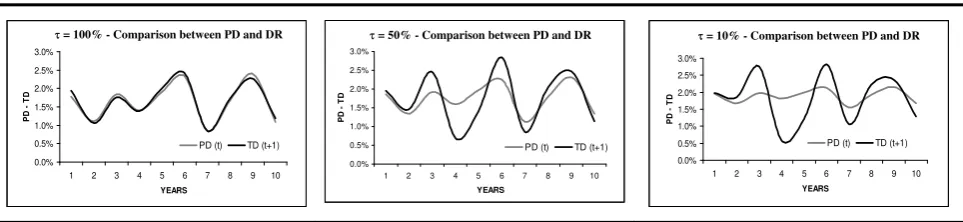
FIGURE 1 Examples of rating system with different τ values. Each graph come from a 10 years simulation comparing average PD (calculated at the beginning of the year using the rating score) and DR (at the end of the year) for 20’000 counterparties.
τ = 100% - comparison between TD and PD
0.0% 0.5% 1.0% 1.5% 2.0% 2.5% 3.0%
1 2 3 4 5 6 7 8 9 10
YEARS
PD
T
D
PD (t) TD (t+1)
τ = 50% - comparison between TD and PD
0.0% 0.5% 1.0% 1.5% 2.0% 2.5% 3.0%
1 2 3 4 5 6 7 8 9 10
YEARS
PD
T
D
PD (t) TD (t+1)
τ = 10% - comparison between TD and PD
0.0% 0.5% 1.0% 1.5% 2.0% 2.5% 3.0%
1 2 3 4 5 6 7 8 9 10
YEARS
PD
T
D
PD (t) TD (t+1) τ = 100% - Comparison between PD and DR τ = 50% - Comparison between PD and DR τ = 10% - Comparison between PD and DR
Until now, we outlined a general framework for cyclicality. Our next task will be to quantify τ ,
through a building block approach: it considers separately the internal rating sensitivity βY and
the conditional asset correlations ρc using for both a maximum likelihood estimation technique:
In the first step, rating sensitivity calculation is based on historical transition matrix: we maximize the migration rates likelihood among internal performing risk classes, relating
in the second step, conditional asset correlations ρc and long run PDΦ
(
−αi)
(groupedby rating grades) are estimated using a Bernoulli mixture model, where the probability of
observing the sample default rates for each rating class and sample year are maximized.
3. Internal rating sensitivity through a transition matrix approach
In the proposed framework, we assume that the bank’s internal rating model produces a score
based on financial and behavioral ratios and grouped into homogeneous risk classes6.
Let be the score of each borrower which is, as it was defined before, made up by an
uncorrelated and time independent specific part and a systematic part ; at the beginning of
year t, scores are grouped in G performing rating (score) grades. Following the CreditMetrics
approach described by Gupton, Finger, and Bhatia (1997), we assume that one-year transitions
between grades reflect an underlying, continuous credit-change indicator (asset) explained in this
case by ,a normally distributed “credit rating cycle” variable:
i t
S
i t
W Yt
t
[image:9.595.161.424.390.584.2]Y
FIGURE 2 Illustration of Yt impact on migration rates for rating grade 4.
Worsening in credit portfolio quality
Average long-run
distribution
i t
S
Figure 2 illustrates the distribution of a score initially in grade g (in the example grade 4). The
score movement is caused by the common cyclical variable Y . On the x-axis, long run bins are
defined so that the probability (assumed to be normal) that falls within a given interval equals
t i
t
S
6
the corresponding historical average transition rate observed for grade g. Theoretical migration rate Pˆ
(
Sg,k,Sg,k−1,Yt)
(from class g to class k) can thus be calculated in the following way:(
, , 1) (
, , 1)
,
Pr ,
, ˆ
ˆ = − = < i < gk−
t k g t k g k g k g
t P S S Y S S S
P
(
, , 1)
(
, 2 , 1)
1 Pr
, ,
ˆ − = < ⋅ + − ⋅ i < gk−
t Y t Y k g t k g k g S W Y S Y S S
P β β [3.1]
This relation can be transformed into the following one:
(
)
⎟⎟ ⎠ ⎞ ⎜ ⎜ ⎝ ⎛ − ⋅ − Φ − ⎟ ⎟ ⎠ ⎞ ⎜ ⎜ ⎝ ⎛ − ⋅ − Φ = ⎟ ⎟ ⎠ ⎞ ⎜ ⎜ ⎝ ⎛ − ⋅ − < < − ⋅ − = − − − 2 , 2 1 , 2 1 , 2 , 1 , , 1 1 1 1 Pr , , ˆ Y t Y k g Y t Y k g Y t Y k g i t Y Y k g t k g kg S Y S Y S Y
W Y S Y S S P β β β β β β β β
where and are the long run thresholds which delimit the grade k range when starting
from the initial rating g. Φ is the normal cumulative density function.
k g
S , Sg,k−1
Y
β is estimated maximizing the probability of observing historical migration rates, which are,
conditional to migration probability as in [3.1], independent and multinomial distributed. The
following equation indicates the unconditional likelihood of transition matrix at time t:
( )
(
)
∫∏
( )
( )
( )
ℜ = ⋅ ⋅ ⋅ ⋅ ⋅ ⋅ ⋅ ⋅ = = = = t n G G t n g t G g G g t g t g t G G t G g t g t g t ty P P dF Y
n n n n N n N P L g t g
t,1 , ,1
1 , 1 , 1 , , , 1 , 1
, ˆ ˆ
! !
! ,...,
β [3.2]
where
∑
= = G i i g t g t n n 1 ,is the total number of observations in rating state g and F is the cumulative normal density
function of factor common to all transitions. The first term of the product is called multinomial
coefficient and explains all possible combination of firms across all G rating classes, each one
containing (i from 1 to G) counterparties. From a statistical point of view, [3.2] quantifies the
probability of an experiment repeated times where is the number of times (migrations) the
different outcomes occurred with probability . The integral operator is used to generate all
possible scenarios over .
t Y g t n i g t n , g t
n ntgi
,
i g t
Pˆ ,
i g t
Pˆ , Yt
Due to the time independency assumption of , the probabilities of jointly observing all historical
migration rates are calculated by the product
t Y
( )
∏
( )
= = T t t y y L L 1 β β( )
∑
[
( )
]
=
= T
t t
y y LnL
LL
1
β β
This expression, made of one-dimensional integrals sum, should be maximized over βY.
Unfortunately, there is no analytical solution to this problem because the usual procedure – setting
the first derivatives of the likelihood to zero – is not feasible; this expression is in fact tractable
only through a numerical approach such as the gaussian-quadrature we choose7.
To sum up, this method allows us to give an estimate of how much cyclical the rating model is:
Y
β in fact quantifies the sensitivity of rating scores to the common factor, usually identified with
or explained by macroeconomic variables.
4. Asset correlation estimation: a Bernoulli mixture model with rating effect
Estimating (conditional) asset correlations is difficult in practice because of the historical data
scarcity and the large number of parameters to be found. A natural solution is to impose some
restrictions on parameters: in this case we used an exponential functional form for long run PDs
and correlations, which in some way provides for the data span shortness. The method adopted
here, called Bernoulli mixture model with rating effect, follows a maximum likelihood estimation
technique similar to the one described in the previous paragraph: it determines long run PDs and
asset correlations such that the probability of observing historical default data for each rating class
is maximized.
The main hypothesis here is that, once the score has been assigned and grouped in G rating
grade, it exists an unobservable systemic risk factor , shared by all firms and rating groups
with different sensitivities, which allows for independence among all realized defaults
(conditional independence technique). In addition, the G risk classes are homogeneous enough to
assign the same long run PD
i t
S
1
+
t
X
( )
−αgΦ and correlations g to all firms within a given risk grade.
c
ρ
In the remainder of the paragraph, we assume the historical performance data for the bank’s rating
system to be available. For each one of the T years and G rating grades, we observe the number of
obligors at the beginning of the year ( ), classified using a mapping function based on score
value, and the number of those obligors that default by year-end ( ).
g t
N Sti
g t
D+1
Conditional on systemic risk , firm’s defaults are independent in grade g and can be described
as the outcome of a Bernoulli trial with success (default) probability 1
+
t
X
7
⎥ ⎥ ⎦ ⎤ ⎢ ⎢ ⎣ ⎡ − ⋅ − Φ = + + g c t g c g t g X X PD ρ ρ α 1 1
1 [4.1]
simply recovered analyzing and solving g-grade asset process in the following way:
(
1 0)
(
1 1 1 0)
1 = + < = + ⋅ + + − ⋅ + <
+ ti
g c t g c g g t t g X P A P X
PD α ρ ρ ε
where
( )
gg PD 1 − Φ = α g
PD and are respectively the long run (unconditional) default probability and conditional
asset correlation to be estimated. At time t, when scores are properly classified, they determine
the distribution of obligors across rating grades: consequently, the score variables do not appear
any more in the process , but influence in describing the distribution of defaults number
and thus also estimate. The g-grade number of defaults follows in fact a binomial distribution
g c ρ i t S g t
A+1
g t N g c ρ
(
+1 t+1)
g t XD
L , with probability stated in [4.1]:
(
)
(
)
gt g t g
t N D
t g D t g g t g t t g
t PD X PD X
D N X
D
L 1 1
1 1 1 1 1 1 + + − + + + + + ⎟⎟⋅ ⋅ − ⎠ ⎞ ⎜⎜ ⎝ ⎛
= [4.2]
Since defaults are also conditionally independent across grades thanks to the uniqueness of
systematic riskXt+1, the joint likelihood + =
∑
+g g t
t D
D 1 1 is just the product of the G conditional
ones (Bernoulli distributions) defined in [4.2]:
(
)
∏
(
)
= − + + + + + + + ⋅ − ⋅ ⎟⎟ ⎠ ⎞ ⎜⎜ ⎝ ⎛ = G g D N t g D t g g t g t t t g t g t gt PD X
X PD D N X D L 1 1 1 1 1 1 1
1 1 [4.3]
The unconditional likelihood is thus calculated integrating equation [4.3] over all possible
outcome of Xt+1
(
)
∫∏
(
)
(
)
ℜ + = − + + + + ⎟⎟⋅ ⋅ − ⋅ ⎠ ⎞ ⎜⎜ ⎝ ⎛ = + + 1 1 1 1 1 1 1 1 1 t G g D N t g D t g g t g tt PD X PD X dF X
D N D L g t g t g t
where is the normal cumulative density function. If we maintain the hypothesis that X is
time independent, we can represent the probability of total sample default as in the following
equations:
(
Xt+1F
)
( )
∏∫∏
(
)
(
= ℜ = +
− + + + ⋅ − ⋅ ⋅ ⎟⎟ ⎠ ⎞ ⎜⎜ ⎝ ⎛
= T + +
t t G g D N t g D t g g t g t X dF X PD X PD D N D L g t g t g t 1 1 1 1 1 1 1
1 1
)
[4.4]( )
∑
∫∏
(
)
(
)
= ℜ = +
− + + + ⎟ ⎟ ⎠ ⎞ ⎜ ⎜ ⎝ ⎛ ⋅ − ⋅ ⋅ ⎟⎟ ⎠ ⎞ ⎜⎜ ⎝ ⎛
= T + +
t t G g D N t g D t g g t g t X dF X PD X PD D N D LL g t g t g t 1 1 1 1 1 1 1 1 1
[4.5] indicates the Maximum Log-Likelihood (LL) function we have to maximize over and
parameters, given the observed values of and
g
PD
g c
ρ g
t
N Dtg8.
Rather than directly estimate and , we can express these parameters in a more
parsimonious way, through a monotonous function such as the exponential. We propose in fact
two alternative ways for estimating:
g
PD ρcg
hp1: g g and c
e
PD = α1+β1⋅ ρ constant across grades as in the [2.2] asset equation;
hp2: g and PDgdepending on credit quality and thus allowing for a
“rating effect”.
g
e
PD = α1+β1⋅ g
c e
⋅ + = α2 β2
ρ
In the first case, only three parameters need to be estimated: the intercept α1, the slope β1 defining
long run PD and the conditional asset correlation ρc. In the second, α2 defines the level and β2 the
relationship between asset correlations and long run PDs. β2 is expected to be negative, as
suggested by both empirical evidence and economic consistency: to a higher borrower’s risk is
associated a stronger idiosyncratic component, meaning that default probability depends less on
the overall state of the economy and more on individual risk drivers.
In order to explore the reliability of the estimated parameters, we simulated their sample
distribution through a Monte Carlo technique. The main purpose of the simulation is to check the
robustness and significativity of parameters and in particular to test the hypothesis of ρc > 0 and
β2 < 0. A second issue to be analyzed is the entity of asset correlation (downward) bias, which
typically occurs in small-sample estimation9. Assuming that the model is correctly specified, LL
estimators will in fact be asymptotically consistent in the sense that the estimated parameters will
approach the true ones as the number of T years of performance data gets increasingly large:
unfortunately, in real-world applications, we have to deal with data span shortness, as it is very
infrequent to observe a default dataset covering a sufficient number of years, particularly when
referring to internal rating models.
Thus, as there is no guarantee that LL will produce unbiased parameter estimates, it was decided
to check the magnitude of the bias and verify if it can be considered as negligible.
So as to perform the Monte Carlo simulation, we drew several historical default paths and
maximized the Log-Likelihood function for each year, over α1, β1, ρc in hp1 and over α1, β1, α2,
β2 in hp2. It was thus necessary to:
1. specify a probability distribution apt to describe empirical default data: in this case,
equations [4.1] – [4.4] with LL parameters;
8
Also in this case we solved the integral numerically, as explained in the previous paragraph.
9
2. randomly draw a hypothetical dataset from the distribution specified in step 1: for each
year, draw the time independent Xt+1 systemic factor, calculate g-grade conditional
probability PDg Xt+1 and finally extract the number of defaults from a binomial
distribution where g
t
N is the fixed number of firms at the beginning of year t;
3. determine the LL estimators (α1, β1, ρc or α1, β1, α2, β2) on the basis of the simulated
data from step 2;
4. repeat steps 2 and 3 several times to trace the parameters sample distribution.
5.
Empirical evidence: application of the methodology on an internal rating
model and comparison with S&P ratings
The dataset used to estimate contains about 61’000 Italian firms belonging to the corporate
segment and covers seven years of defaults data, from 2000 to 2006. Each firm is evaluated
through an internal rating model, based on balancesheet and behavioral ratios combined with a
logistic approach: the output is a credit score, finally grouped in 15 homogeneous classes of
increasing risk level built by cluster analisys.
First of all we estimated the rating sensitivity βY as described before, obtaining a value of 1.99%.
The implied systemic factor (“credit cycle”), calculated through the minimization of the
quadratic distance between theoretical and observed one-year transition rates, shows the following
trend:
t
[image:14.595.146.446.535.700.2]Y
FIGURE 3 Trend over time of Yt
Dynamic of Yt implicit factor
-2.00 -1.50 -1.00 -0.50 0.00 0.50 1.00 1.50 2.00
2000 2001 2002 2003 2004 2005 2006
Year
S
.Dev. of
What emerges from the graph is a negative fluctuation in 2001-2002 (twin towers, financial crisis)
and a positive economic growth in 2003-2004-2005 followed, in 2006, by a downturn which is
[image:15.595.60.529.168.267.2]likely to continue in the following years.
TABLE 1 Hp1: Bernoulli mixture model in the case of asset correlations not differentiated per rating class. Statistics are generated simulating 5000 sample of 7 years default paths.
Estimates Mean Median σ Δ%Bias P2.5% P5% P95% P97.5%
α1 -8.121 -8.134 -8.127 0.223 0.16% -8.587 -8.512 -7.768 -7.712
β1 0.433 0.434 0.434 0.013 0.20% 0.409 0.413 0.457 0.461
c
ρ 1.299% 1.092% 0.957% 0.707% -15.97% 0.13% 0.21% 2.44% 2.86%
11.397% 9.884% 9.784% 3.385% -13.27% 3.57% 4.56% 15.61% 16.91%
c
ρ
As far as conditional asset correlations are concerned, we present the results of LL optimization
under Hp1, where a single ρc is estimated. Table 1 summarizes LL estimates in the first column, and the statistics deriving from simulation in the following ones: mean, median, standard error,
bias (defined as percentage ratio between mean and LL estimates) and some percentiles of the
bootstrapped samples.
Long run PD parameters α1 and β1 show a low standard error and are significantly different from
zero: in particular, the slope β1 indicates that the rating model discriminates quite well among
rating grades; moreover, the upward bias we found seems to be rather small and probably would
disappear when increasing the number of simulations. ρc assumes a low value and presents a
huge standard deviation, in relation to the average, which anyway becomes lower considering
c
ρ , or the sensitivity, as represented in figure 4.
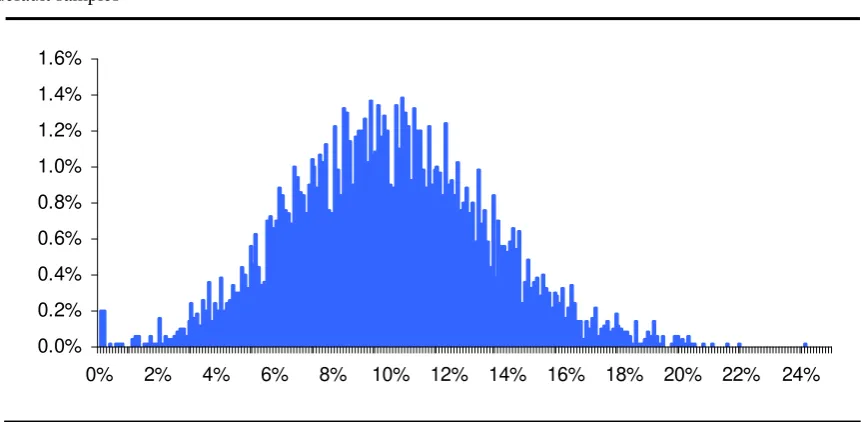
FIGURE 4 Empiricaldistribution of conditional asset sensitivity ρc , derived from 5000 trials of 7-years default samples
0.0% 0.2% 0.4% 0.6% 0.8% 1.0% 1.2% 1.4% 1.6%
[image:15.595.77.510.557.768.2]As it is shown in the graph, the hypothesis of zero asset correlation can be refused, since the
probability of observing a null value is about 0.4%. Furthermore, 2.5th and 5th percentiles are
0.13% and 0.21% forρc, 3.57% and 4.56% for ρc ; in other words, the independence
assumption which would support a pure PIT philosophy seems not to be justified.
The skewed shape of the distribution in figure 4 suggests the existence of a downward bias,
mainly due to the historical data series shortness (T)10. It is anyway in line with the evidences
presented in previous studies11, and could be taken into account through a prudential (e.g.
13.27%) add-on on estimated sensitivity12, in order to get a simulated mean roughly
corresponding to the value we think to be the “true” one.
Combining the results for rating sensitivity (βY) and for conditional asset correlation (ρc) we
obtain a value for τ , or the level of cyclicality embedded in the rating model, equal to 60% (see
table 3).
The same type of analysis was also applied on Standard & Poor’s data13, in order to compare the
level of cyclicality of the two rating systems.
The comparison is anyway not completely fair because of some differences in the dataset, as for
instance: the data span, which, being for Standard & Poor’s much longer (from 1981 to 2003) and
thus covering more than one credit cycle, is probably linked to a less stable default rate; the
number of rating classes, as transition matrices were calculated for S&Ps on coarse rating grades
(7 performing risk buckets). Furthermore, the internal portfolio is the result of customers selection
for credit quality and of diversification strategies, which leads to a lower default volatility.
The analysis on S&Ps data leads to a rating sensitivity βY of 1.34%, while the following table
summarizes the estimates for ρc and the related statistics. We notice that the ρc’s downward bias
between simulated mean and estimate is lower than for the internal model, due to the longer time
series.
10
This phenomenon is in fact negatively related to long run PD level and tends to disappear when the number of years
T increases.
11
See for instance Gordy & Heitfied (2002), Dullman & Scheule (2003), Demey et al. (2005)
12
This is consistent with what Loffler & Posch (2007) suggested.
13
TABLE 2 Bernoulli mixture model applied on S&P data from 1981 to 2003. Asset correlations are not differentiated among rating class and statistics are generated simulating 5000 sample of 23 years default paths
Estimates Mean Median σ Δ%Bias P2.5% P5% P95% P97.5%
α1 -12.175 -12.204 -12.193 0.389 0.24% -12.987 -12.862 -11.589 -11.468
β1 1.570 1.574 1.573 0.052 0.27% 1.477 1.492 1.661 1.681
c
ρ 5.205% 4.951% 4.788% 1.684% -4.89% 2.114% 2.472% 8.002% 8.750%
22.814% 21.923% 21.881% 3.802% -3.91% 14.540% 15.724% 28.287% 28.287%
c
ρ
Table 3 compares the parameters for the two rating models: consistently with expectations,
correlations are higher and rating sensitivity is lower for S&P. τ - the level of cyclicality
[image:17.595.73.516.312.376.2]embedded in the rating model - is thus much lower for S&Ps data, with a value of about 20%.
TABLE 3 Estimated parameters for equation [2.4] – [2.6] to assess the degree of cyclicality τ. Comparison between internal and agency models.
c
ρ βY ρun ρ un τ
Internal model (2000-2006) 1.29% 1.99% 3.23% 17.97% 60.51%
S&P (1981-2003) 5.21% 1.34% 6.46% 25.41% 20.52%
As far as the component of asset correlation is concerned, we estimated the parameters also for
the second hypothesis referred to in the previous pages, or the one which considers asset
correlation as negatively dependent on PD. This was done only on internal data, in order to use
the results for the binomial test application. Table 4 summarizes the parameters values and the
[image:17.595.61.527.534.634.2]related statistics, while figure 5 plots the results for PDs and asset correlations.
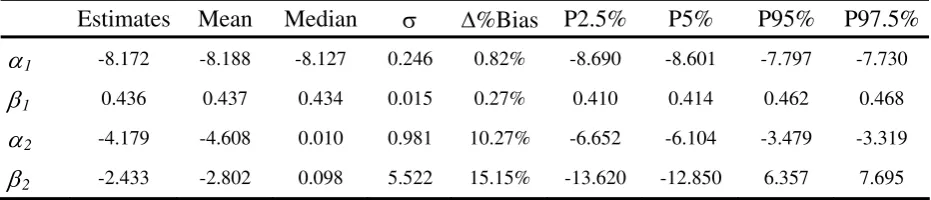
TABLE 4 Hp2: Bernoulli mixture model where asset correlations depend on rating class. Statistics are generated simulating 5000 sample of 7 years default paths
Estimates Mean Median σ Δ%Bias P2.5% P5% P95% P97.5%
α1 -8.172 -8.188 -8.127 0.246 0.82% -8.690 -8.601 -7.797 -7.730
β1 0.436 0.437 0.434 0.015 0.27% 0.410 0.414 0.462 0.468
α2 -4.179 -4.608 0.010 0.981 10.27% -6.652 -6.104 -3.479 -3.319
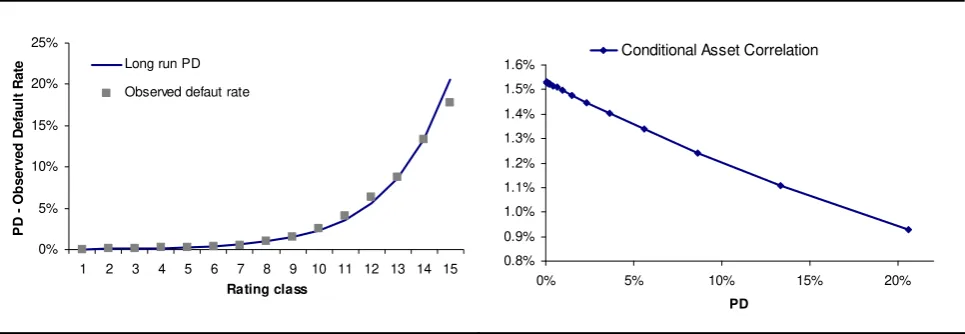
FIGURE 5 Hp2 estimation results. Long run PD compared with sample default rates using α1 and β1 parameters on
the left, conditional asset correlation using α2 and β2 on the right side.
0% 5% 10% 15% 20% 25%
1 2 3 4 5 6 7 8 9 10 11 12 13 14 15
Rating class
P
D
O
b
ser
ved
D
e
fau
lt
R
at
e Long run PD
Observed defaut rate
0.8% 0.9% 1.0% 1.1% 1.2% 1.3% 1.4% 1.5% 1.6%
0% 5% 10% 15% 20%
PD
Conditional Asset Correlation
Applying α2 and β2 coefficients, we found asset correlation ranging from 1.53% to 0.95% (the
related sensitivity goes from 12.36% to 9.75%); β2 slope is negative as expected but not
significantly greater than zero (2.5th and 97.5th percentiles are in fact -13.62 and 7.6 including
zero value).
Finally, if we compare the level of the asset correlation with those settled for corporate
risk-weight supervisory formula14, we find that our estimates are considerably lower. Basel II
corporate sensitivities, which depends negatively on PD and firm size, lie in fact within a range of
about 35%-45%, compared to the internal ones that range from 9.75% to 12.36%. This strong
difference is of course influenced by the fact that Basel II correlations are unconditional: however,
even if we had used the internal sensitivity derived from unconditional asset correlation presented
in table 3, we would not have joined the supervisory lower bound. The main reasons that could
explain this gap are that:
Basel II correlations incorporate a certain degree of conservatism because they are derived
for capital purposes and thus calculated at a stressed level;
the historical period for internal estimation might be too short (2000- 2006) so that default rates appear to be more stable than they would have been over a longer time window;
as already said, the internal portfolio is selected, thus showing better credit quality, higher diversification and lower default volatility than average.
6.
Backtesting hybrid PD through a correlated binomial distribution
If up to now the effort to define and quantify the degree of cyclicality of a rating system may seem
to be a pure theoretical theme, some practical applications of this exercise can be found in a
14
number of fields, like backtesting, benchmarking, stress testing. In the following we will just
explore one among the different issues, i.e. the backtesting as a tool for validation.
As stated in the WP14, supervisors and risk managers: “will need to understand how a bank
assigns risk ratings and how it calculates default probabilities in order to accurately evaluate the
accuracy of reported PDs”; “will not be able to apply a single formulaic approach to PD validation
because dynamic properties of pooled PDs depend on each bank’s particular approach to rating
obligors. …. will have to exercise considerable skill to verify that a bank’s approach to PD
quantification is consistent with its rating philosophy”; “to effectively validate pooled PD’s, ….
will need to understand the rating philosophy applied by a bank in assigning obligors to risk
buckets”.
The same idea that validation techniques should take into account the underlying rating
philosophy turns up also in the Capital Adequacy Directive, where it is said that “credit
institutions shall have sound internal standards for situations where deviations in realised PDs,
LGDs […] from expectations become significant enough to call the validity of the estimates into
question. These standards shall take account of business cycles and similar systematic variability
in default experience.”
Statistical tests generally used for backtesting, or to assess the distance between PD and DR
(binomial, Hosmer-Lemeshow, and Mean Square Error), suffer from the independence
assumption. They are in fact implicitly assuming that PDs are able to reflect the current state of
the economy, so that default events among borrowers may be considered stochastically
independent and so driven by orthogonal specific factors. From the point of view of the regulator
(as it is for instance expressed in the Working Paper 14) this kind of tests go in the desired
prudential direction: e. g. the binomial test is a one-side test, apt to detect if the ex ante PDs
underestimate the realized defaults, but not a mis-calibration in terms of overestimation of PDs.
Furthermore, from a statistical point of view this approach is very conservative in stating the
distance between PDs and DRs. This framework can in fact only reasonably be used with PIT
rating when conditional asset/default correlations are zero, while in all other cases the probability
of rejecting the correct calibration hypothesis is higher than the “true” one. At the other extreme,
there is the stylized TTC model, where unconditional correlations reach their highest level, thus
maximizing the bias of the standard binomial confidence intervals with respect to the “true” ones,
or those that would be calculated if correlations were taken into account.
In the following paragraphs, we will illustrate an example of how the conditional asset correlation
standard binomial test: the aim is to get the best-suited confidence intervals according to the
cyclicality degree, even if we still apply a one-side approach.
Generally, in the standard binomial test used for backtesting model calibration, we test the null
hypothesis (Hp0) that stand-alone PD of a rating category is correct against the alternative (Hp1)
of a default rate underestimation. This is a one-side test and can be represented, given a
confidence level α (e.g. 95%), as in the following:
(
)
∑
( ) (
)
= − + ⎟⎟⋅ ⋅ − ⎠ ⎞ ⎜⎜ ⎝ ⎛ = ≤ g t g ind g t N k i i N g i g g t g ind gt PD PD
i N k
D
P 1 1 [6.1]
( )
α =min{
(
+1 ≤)
≤1−α}
* g ind g t g ind g
ind k P D k
k [6.2]
(
g)
ind g t k
D
P +1 ≤ is the cumulative binomial distribution of future theoretical default, is the
number of firms in g-grade at the beginning of period t,
g t
D+1 g
t
N
( )
α*
g ind
k is the maximum number of
default we observe for α confidence level, under the assumption of independence. In this case, the
null hypothesis is rejected if the observed number of default is greater than or equal to g*
( )
α .ind
k
Once we introduce asset dependency according to the parameterization shown in table 4, [6.1]
becomes
(
)
∫∑
(
)
(
ℜ + = − + + + ⎟⎟⋅ ⋅ − ⋅ ⎠ ⎞ ⎜⎜ ⎝ ⎛ = ≤ 1 0 1 11 1 t
k i i N t g i t g g t g cor g
t PD X PD X dF X
i N k D P g cor g t
)
[6.3]where is calculated as in [6.2] but through a numerical integration method or Monte Carlo
simulation
( )
α* g cor k 15 .
A further interesting method for backtesting is the validation of total default rate, also viewed as a
joint test on rating class PDs. In this case, a copula approach is needed (usually called factor
gaussian copula model), in fact, resorting to conditional independence assumption:
(
)
⎟⎟ ⎠ ⎞ ⎜ ⎜ ⎝ ⎛ − ⋅ ⋅ ⎟⎟ ⎠ ⎞ ⎜⎜ ⎝ ⎛ = ⎟⎟ ⎠ ⎞ ⎜⎜ ⎝ ⎛ = ≤∑
∏∑
= = − + + = + G g k i i N t g i t g g t G g g cor cor t g cor g t X PD X PD i N E k k D P 1 0 1 1 1 1 1(
)
(
11 0
1 1
1
1 1 +
ℜ = =
− + + = + ⎟⎟⋅ ⎠ ⎞ ⎜ ⎜ ⎝ ⎛ − ⋅ ⋅ ⎟⎟ ⎠ ⎞ ⎜⎜ ⎝ ⎛ = ⎟⎟ ⎠ ⎞ ⎜⎜ ⎝ ⎛ =
≤
∑
∫ ∏∑
G tg k i i N t g i t g g t G g g cor cor
t PD X PD X dF X
i N k k D P g cor g t
)
[6.4]At this stage, the aim is to calculate the observed total portfolio number of defaults and then
compare it with the theoretical k*
( )
α at a given a confidence level. Under the assumptions of15
The latter consists in generating the Xt+1variable contained in t+1
g
X
independence or correlation we’ll call it respectively kind*
( )
α andkcor*( )
α . For the latter we sketchthe algorithm below:
1) generate a realization xt+1of Xt+1;
2) for each g grade, substitute xt+1 into g t+1
X
PD where g
and
(table 4 parameters);
g
e
PD = α1+β1⋅ g PDg
c e
⋅ + = α2 β2
ρ
3) generate g-grade independent kcorg defaults from the binomial distributions (inside the
[6.3]) and sum up the portfolio default number
∑
;= = G
g g cor cor k
k
1
4) repeat step 1 to 3 many times;
5) compute the whole distribution and calculate kcor
( )
α =min{
kcor P(
Dt+1 ≤kcor)
≤1−α}
. Under the independence assumption, we adopt the same methodology starting from point 3 butwith a consistent estimation of long run PD, using [4.5] without asset correlation parameters and
thus removing integral treatment16. This slightly different PD calibration is also applied to
stand-alone test.
Next step is to build a real case study in order to compare standard binomial with binomial test
accounting for estimated correlations. For the purpose of illustration, we propose a realistic
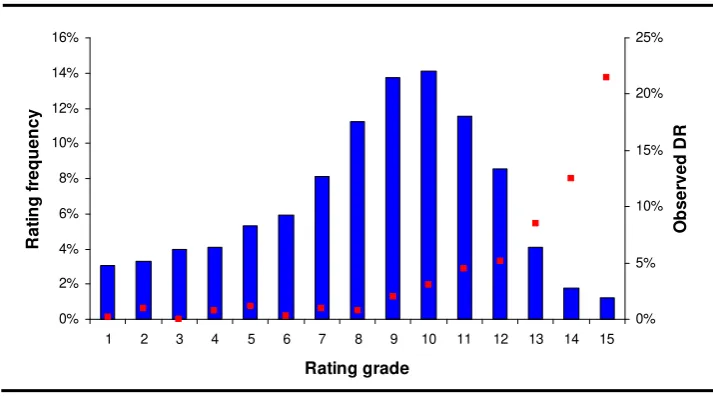
corporate portfolio at year t composed by 16’000 firms, with the following rating and t+1 defaults
[image:21.595.114.471.507.708.2]distribution:
FIGURE 6 Corporate rating distribution at the beginning of year t (left y axis) and observed defaults (right axis).
0% 2% 4% 6% 8% 10% 12% 14% 16%
1 2 3 4 5 6 7 8 9 10 11 12 13 14 15
Rating grade
R
a
ti
n
g f
re
q
ue
nc
y
0% 5% 10% 15% 20% 25%
O
b
se
rv
ed
D
R
16
This estimation leads to α1=-8.025, β1=0.429 and LL(D)=-258.41 while in table 4 we found α1=-8.172, β1=0.436
Average PD calculated under correlation assumption (table 4 parameters) is 2.36%, whereas the
average PD in the case of asset independency is 2.50% (the two values are different as PDs are
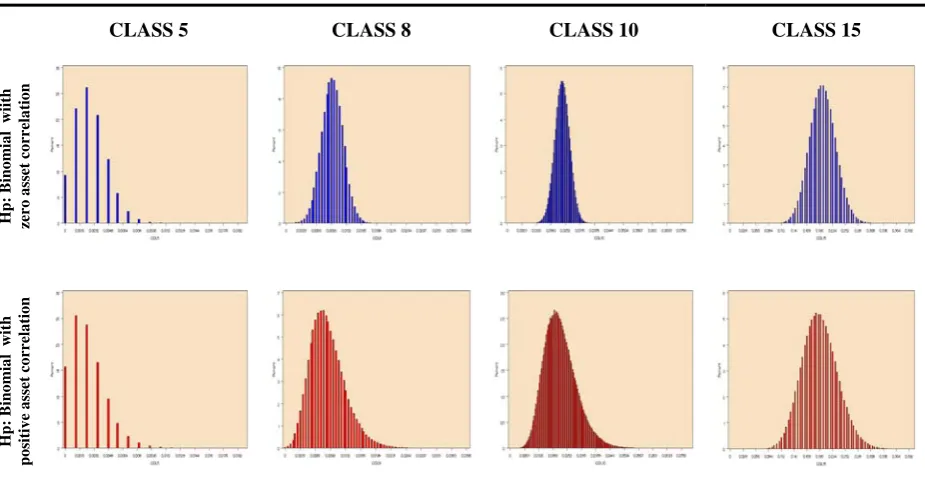
endogenously estimated according to different calibrations). Figure 7 outlines the difference in
shape between simulated stand-alone default rate distribution for some rating classes (classes
[image:22.595.59.522.196.442.2]5-8-10-15), according to the two assumptions (thus of the using [6.1] and [6.3] with 500’000 trials):
FIGURE 7 Comparison between independent (blue) and correlated (red) binomial default rate distribution.
CLASS 5 CLASS 8 CLASS 10 CLASS 15
Hp:
Bino
mia
l wii
th
zero asset correla
tion
Hp:
Bino
mia
l wi
th
positive asset corr
elation
Furthermore, next figure compares in the same way the portfolio default distribution we traced
according to the above explained algorithm for copula implementation:
FIGURE 8 Comparison between independent (blue) and correlated (red) portfolio default rate distribution.
When the whole default distribution is calculated, the granularity-effect, related to the
independency assumption and due to the compensation of specific risk among risk grades, is
stronger: this can be noticed in the shape of the blue distribution, which is more compressed
around its mean than in the single class cases.
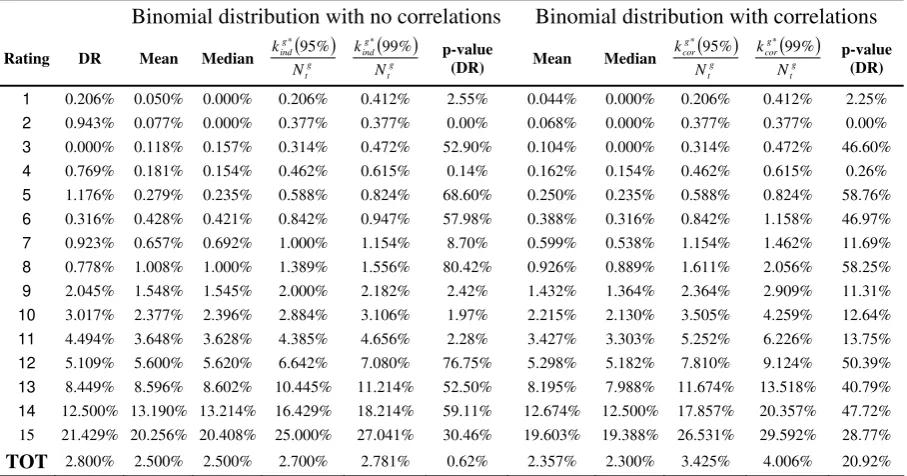
Since our intention is to evaluate the reasonability of PD forecast, we build table 5, where
[image:22.595.58.534.513.659.2]distribution: in the right part of the table, statistics are based on the estimated coefficients shown
in table 4 for Bernoulli mixture model, while in the left one binomial distributions without
correlation assumption are computed for comparison. In the last row, figures refer to the whole
[image:23.595.68.522.190.428.2]portfolio distribution.
TABLE 5 Summary statistics on defaults rates distributions under different correlation assumptions. To make comparison homogeneous, all numbers are computed by Monte Carlo simulation with 500’000 draws.
Binomial distribution with no correlations Binomial distribution with correlations
Rating DR Mean Median (g )
t g ind
N
k * 95% ( ) g t g ind
N k * 99%
p-value
(DR) Mean Median
( )
g t g cor
N
k * 95% ( ) g t g cor
N k * 99%
p-value (DR)
1 0.206% 0.050% 0.000% 0.206% 0.412% 2.55% 0.044% 0.000% 0.206% 0.412% 2.25% 2 0.943% 0.077% 0.000% 0.377% 0.377% 0.00% 0.068% 0.000% 0.377% 0.377% 0.00% 3 0.000% 0.118% 0.157% 0.314% 0.472% 52.90% 0.104% 0.000% 0.314% 0.472% 46.60% 4 0.769% 0.181% 0.154% 0.462% 0.615% 0.14% 0.162% 0.154% 0.462% 0.615% 0.26% 5 1.176% 0.279% 0.235% 0.588% 0.824% 68.60% 0.250% 0.235% 0.588% 0.824% 58.76% 6 0.316% 0.428% 0.421% 0.842% 0.947% 57.98% 0.388% 0.316% 0.842% 1.158% 46.97% 7 0.923% 0.657% 0.692% 1.000% 1.154% 8.70% 0.599% 0.538% 1.154% 1.462% 11.69% 8 0.778% 1.008% 1.000% 1.389% 1.556% 80.42% 0.926% 0.889% 1.611% 2.056% 58.25% 9 2.045% 1.548% 1.545% 2.000% 2.182% 2.42% 1.432% 1.364% 2.364% 2.909% 11.31% 10 3.017% 2.377% 2.396% 2.884% 3.106% 1.97% 2.215% 2.130% 3.505% 4.259% 12.64% 11 4.494% 3.648% 3.628% 4.385% 4.656% 2.28% 3.427% 3.303% 5.252% 6.226% 13.75% 12 5.109% 5.600% 5.620% 6.642% 7.080% 76.75% 5.298% 5.182% 7.810% 9.124% 50.39% 13 8.449% 8.596% 8.602% 10.445% 11.214% 52.50% 8.195% 7.988% 11.674% 13.518% 40.79% 14 12.500% 13.190% 13.214% 16.429% 18.214% 59.11% 12.674% 12.500% 17.857% 20.357% 47.72%
15 21.429% 20.256% 20.408% 25.000% 27.041% 30.46% 19.603% 19.388% 26.531% 29.592% 28.77%
TOT 2.800% 2.500% 2.500% 2.700% 2.781% 0.62% 2.357% 2.300% 3.425% 4.006% 20.92% Looking at stand alone rating class, the standard binomial test would reject the hypothesis of
correct calibration for seven grades (1,2,4,5,9,10,11) at 95% confidence level and for three grades
(2,4,5) at 99%. We are facing a situation slightly less conservative when we introduce correlation
parameters, because the test rejects the null for four grades (1,2,4,5) at 95% and for two grades
(2,4) at 99%. However, the most relevant difference concerns the test performed on the entire
portfolio: here, as far as default independency is concerned, we would not accept the bank’s
forecast as adequate because the probability to observe a default rate greater than 2.8% is only
0.62% (“p-value DR” in table 5). This probability becomes much less extreme in the case of asset
dependency (20.92%), suggesting that the model and the calibration are not yet to be revised. This
remark is deemed convincing only if a bank can explain somehow the dependency structure of its
portfolio, for example by statistical evidence based on historical defaults, as we did. If in such a
situation the standard binomial test was applied, the proper size of type I errors (rejection of the
null hypothesis when it is true) would be higher than the α-level of confidence indicated by the
7.
Conclusion
The paper presents a general framework of asset and default dynamics, which separates the
cyclicality effect into a component which is embedded into the rating system and another one
which explains the fluctuation of realized defaults around the ex-ante calculated probability of
default. This framework allows us to detect the point where the rating system is situated in
between the two purely theoretical extremes of Point In Time and Through The Cycle.
Understanding and quantifying the philosophy which characterizes a system, and the implied
rating dynamics, is crucial for a number of issues, like validation, pricing, stress testing, economic
and regulatory capital. In this paper some results were presented regarding validation, and
specifically a method to estimate asset correlations was suggested which can be usefully applied
by banks to modify the standard tests that suffer from independence assumption.
Still there are applications to other fields that can benefit from the cyclicality framework we
sketched and that are still to be explored. As far as migration analysis is concerned, it is directly
applicable to stress testing: in the proposed framework the cyclical (systemic) variable is not
identified, so that scenarios can only be expressed in terms of percentiles. Further work could
anyway go in the direction of explaining this factor, at least partially, by macroeconomic
variables, in order to better understand its contribution and to describe expected scenarios. A
foreseeable problem in this case could be the shortness of the historical series of internal
migrations, which doesn’t guarantee the necessary robustness of the estimated relationship
between macro variables and the implicit cyclical factor.
References
Aguais S., “Designing and Implementing a Basel II Compliant PIT-TTC rating Framework”, January 2008
Blochwitz S., “Validation of banks’ internal rating systems: a challenging task?, The Journal of Risk Model Validation, Winter 2007/08
Demey P., Jouanin J.F., Roget C., Roncalli T., “Maximum likelihood estimate of default correlations”, Cutting Edge – Credit Risk. 2004.
Duellmann K., Scheule H. “Determinants of Asset Correlations of German Corporations and Implications for Regulatory Capital”, 2003
Gordy M., Heitfield E., “Estimating Default Correlation from Short Panels of Credit Rating Performance Data”, 2002
Heitfield Erik A., “Dynamics of rating system”, Studies on the Validation of Internal Rating System (WP14), May 2005
Koyluoglu Ugur H., Wilson T., Yague M., “The Eternal Challenge of Understanding Imperfections”, 2004
McNeil A.J., Frey R., Embrechts P., “Quantitative Risk Management”, Concepts Techniques Tools
Rosh D., “An Empirical Comparison of Default Risk Forecasts from Alternative Credit Rating Philosophies”, International Journal of Forecasting
Tasche D., “Rating and probability of default validation”, Studies on the Validation of Internal Rating System (WP14), May 2005