IJPSR (2013), Vol. 4, Issue 8 (Research Article)
Received on 29 March, 2013; received in revised form, 02 May, 2013; accepted, 18 July, 2013; published, 01 August, 2013
ANTIBACTERIAL ACTIVITIES AGAINST PYOGENIC PATHOGENS
Sujata Singh 1,Mayuri Khare 1, Rakesh Kumar Patidar 1, Swati Bagde 1, K.N. Sahare 1, Deepak Dwivedi 2 and Vinod Singh*1
Department of Microbiology, Barkatullah University 1, Bhopal, Madhya Pradesh, India Minor Forest Produce Processing Center 2, Van Parisar, Barkheda Pathani, Bhopal, India
ABSTRACT: Pyogenic infection refers to bacterial infection that leads to the production of pus. Antibiotics to treat these pyogenic bacterial infections are routinely prescribed, toxicity of which is serious threat and makes chemotherapy more difficult. Management of pyogenic infections consists of aspiration or surgical drainage followed by appropriate antibiotics. A total of 50 samples were examined, 36 bacterial strains were isolated, 20 Gram positive, Staphylococcus aureus (8), Staphylococcus epidermidis (7), Corynebacterium pyogenes (5) and 16 Gram negative, Escherichia coli (4), Pseudomonas aeruginosa (4), Neisseria meningitidis (4). Morphological and biochemical tests confirmed the isolated microorganisms. The study was carried out using in vitro Kirby Bauer’s disk diffusion method. The percentage resistance of different Gram positive isolates against different antibiotics, penicillin, amoxicillin, ofloxacin, cefazolin, cefuroxime, erythromycin, chloramphenicol, ciprofloxacin, azithromycin and tetracycline was C. pyogenes (76%), S. aureus (61.25%) and S. epidermidis (48.55%). Results for Gram negative bacteria, N. meningitidis (62.5%), E. coli (61.6%) and P. aeruginosa (52.28%), against norfloxacin, gentamycin, ofloxicin, cefixime, cefuroxime, amicacin, nalidixic acid, cefotaxime and ceftriaxone were also observed. Most of the isolates were resistant and some were moderately affected by different antibiotics for both Gram positive and Gram negative bacteria. The ability to inhibit the growth of bacterial isolates indicates effective use of antibiotics as antibacterial agents depending on their antimicrobial activity, efficacy in infections and low toxicity.
INTRODUCTION: Pyogenic infections are characterized by severe local inflammation, usually with pus formation. It’s an invasion by and multiplication of pathogenic microorganism in a bodily part or tissue, which may produce subsequent tissue injury and progress to overt disease through a variety of cellular or toxic mechanism, generally caused by one of the pyogenic bacteria.
QUICK RESPONSE CODE
DOI:
10.13040/IJPSR.0975-8232.4(8).2974-79
Article can be accessed online on: www.ijpsr.com
DOI link: http://dx.doi.org/10.13040/IJPSR.0975-8232.4(8).2974-79
Impetigo, osteomyelitis, sepsis, septic arthritis, spondylodiscitis, otitis media, spondylitis, cystilis, meningitis are some common diseases processes caused by pyogenic infection. Pyogenic infections destroy neutrophil through release of leukocidins forming abscess formation which is marked as typical characterization of S. aureus infections 1. Complications arising from cutaneous and soft tissue infections with S. aureus are a major clinical problem owing to the high incidence of these infections and the widespread emergence of antibiotic-resistant bacterial strains. Therefore leukocidins producing bacteria are usually referred to as pyogenic bacteria 2. Varieties of microorganisms that cause inflammation and suppuration are the pyogenic bacteria.
Keywords:
Antibiotics, Antimicrobial Drugs, Antimicrobial Resistance, Antimicrobial Susceptibility,
Pyogenic Infections Correspondence to Author: Dr. Vinod Singh
Associate Professor, Department of Microbiology, Barkatullah
University, Bhopal, Madhya Pradesh, India
The group includes great number of species, which have now been differentiated and are widely distributed in the human body. The most commonly includes Staphylococcus aureus, Staphylococcus epidermidis, Streptococcus pyogenes, Escherichia
coli, Streptococcus pneumoniae, Klebsiella
pneumoniae, Salmonella typhi, Pseudomonas
aeruginosa, Neisseria gonorrhoeae,
Mycobacterium tuberculosis etc 3.
Pyogenic infections are still frequently seen in the developing countries and the treatment is a considerable challenge despite advances in microbiological techniques, antibiotics and surgical treatment. To ensure an adequate and efficient therapy, it is necessary to identify and treat the focus of inflammation 4. Pyogenic infections can be treated orally and topically. Topical ointment, in many cases has shown itself to be as effective as oral therapy and less likely to be associated with unwanted effects.
The availability of two forms of therapy – oral and topical means treatment can be tailored according to the preference of the patient. In recent years drug therapy is more likely and appropriately used for the treatment. Evidences prove a shift from narrow to broad spectrum use of antibiotics towards microorganisms and their resistance to the site of infection. Such a shift enhances the activity of the drug and brings the use of the therapy towards the pyogenic infections more in practice.
This study was aimed to identify the bacteria isolated from the clinical pus samples obtained from the suspected patient with pyogenic infection and to detect the drugs of choice against the infection. Information regarding the drug susceptibility of the microorganism involved can be useful in the choice of an effective drug therapy.
MATERIALS AND METHODS:
Sample Collection: Pus sample were randomly collected from patients of People’s Dental College and Hospital and Gandhi Medical College and Hospital, Bhopal, using sterile cotton swab from the infection site and were transferred aseptically in test tubes containing normal saline. A total of 50 samples were accumulated for the study.
Isolation and identification of Microorganisms from clinical samples: The mixed samples were inoculated on Nutrient agar media under aseptical conditions and incubated for 24 hours at 37oC. The inoculums on the plates were streaked out for discrete colonies with a sterile wire loop following the standard procedures on differential media such as MacConkey agar, Eosin Methylene Blue agar, Mannitol salt agar, Blood agar, Chocolate agar etc.
[image:2.612.70.544.488.718.2]Figure 1 depicts the pure cultures of the microorganisms. Microscopic examination was done by various staining methods.
Confirmation of the isolated colonies was done by different biochemical tests, IMViC, catalase, coagulase, urease, oxidase and carbohydrate fermentation test.) The entire tests were carried out following the standard procedures.
Antibiotic susceptibility testing: Antimicrobial susceptibility tests were carried out following Kirby-Bauer disc diffusion method 5.
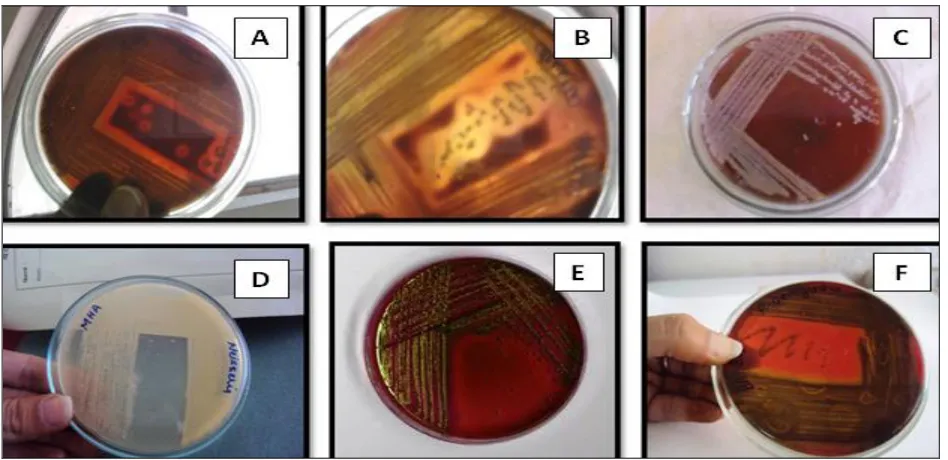
The isolated microorganisms was inoculated and streaked aseptically on Muller-Hinton agar plates. The antibiotic discs of the different antibiotics for Gram positive and Gram negative were placed on them and incubated at 37°C for 18-24 hours. The plates were observed for standard zone sizes of inhibition for sensitivity/resistance against different antibiotics 6(Figure 2).
FIGURE 2: ANTIMICROBIAL ACTIVITY OF GRAM POSITIVE AND GRAM NEGATIVE PATHOGENS AGAINST SELECTED ANTIBIOTICS (A) S. aureus (B) S. epidermidis (C) C. pyogenes (D) E. coli (E) P. aeruginosa (F) N. meningitidis
RESULTS: The bacterial strains identified, S. aureus was the commonest among all, followed by
S. epidermidis, C. pyogenes, E. coli, P. aeruginosa
and N. meningitidis. All the Gram positive bacteria were resistant to penicillin; maximum was shown by S. aureus (87.5%), S. epidermidis (85.7%) and
C. pyogenes (80%). Certain other antibiotics also
[image:3.612.57.560.171.422.2]had resistant effect on the same microorganisms. The percent resistance of Gram positive bacteria towards penicillin, amoxicillin, ofloxacin, cefazolin, cefuroxime, erythromycin, chloramphenicol, ciprofloxacin, azithromycin and tetracycline is mentioned in Table 1.
TABLE 1: ANTIMICROBIAL RESISTANCE PATTERN OF GRAM POSITIVE BACTERIA FOR PYOGENIC INFECTION
Antibiotic Bacterial Strains Resistance (%)
S. aureus (8) S. epidermidis (7) C. pyogenes (5)
Penicillin 87.5 85.7 80
Amoxicillin 75 57.1 100
Ofloxacin 62.5 71.4 100
Cefazolin - - 40
Cefuroxime 75 85.7 60
Erythromycin 50 - 100
Chloramphenicol 62.5 42.8 80
Ciprofloxacin 75 - -
Azithromycin 37.5 85.7 100
[image:3.612.64.549.585.746.2]Similarly amongst the three Gram negative bacteria, E. coli (71.4%), P. aeruginosa (80%), N. meningitidis (75%) were maximum resistant to antibiotic amikacin and Table 2 shows the
resistance towards norfloxacin, gentamycin, ofloxacin, cefixime, cefuroxime, nalidixic acid, ciprofloxacin, cefotaxime and ceftriaxone.
TABLE 2: ANTIMICROBIAL RESISTANCE PATTERN OF GRAM NEGATIVE BACTERIA FOR PYOGENIC INFECTION
Antibiotic Bacterial Strains Resistance (%)
E. coli (7) P. aeruginosa (5) N. meningitides (4)
Norfloxacin 85.7 - 100
Gentamycin 71.4 80 50
Ofloxicin 42.8 40 50
Cefixime 85.7 60 75
Cefuroxime 57.1 60 50
Amicacin 71.4 80 75
Nalidixic acid 85.7 60 75
Ciprofloxacin - - 75
Cefotaxime 57.1 85.7 50
Ceftriaxone 57.1 57. 1 25
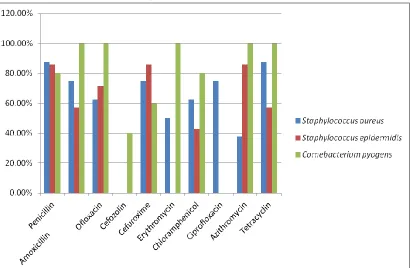
The isolates of both Gram positive and Gram negative showed high degree of susceptibility to different drugs. In this study cefazolin, erythromycin, chloramphenicol, ciprofloxacin and azithromycin showed highest results. C. pyogenes
(60%) showed maximum towards cefazolin, S.
aureus (62.5%, 50% and 25%) towards
azithromycin, erythromycin and ciprofloxacin and
S. epidermidis (57.2%) towards chloramphenicol.
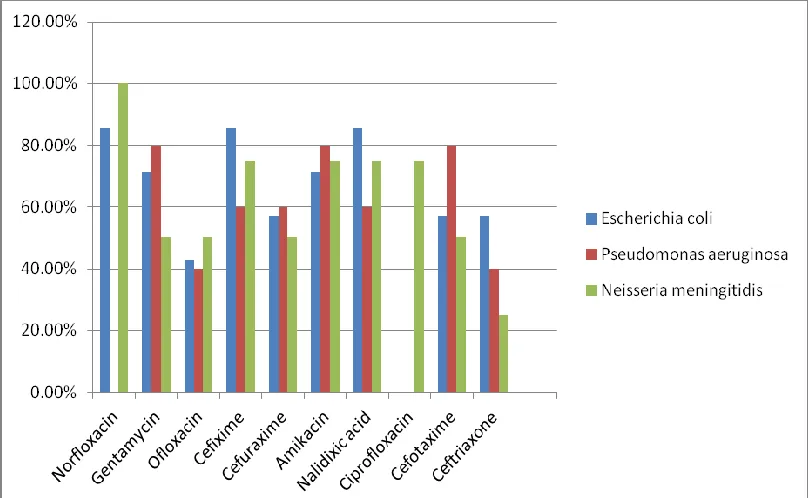
[image:4.612.55.561.127.274.2]Gram negative microorganisms too showed similar results towards norfloxacin, ofloxicin, cefuroxime, ciprofloxacin and ceftriaxone drugs. The highest susceptibility depicted towards ofloxacin was by P. aeruginosa (60%), N. meningitidis (50%, 50%, 50%, and 75%) gave the results for norfloxacin, cefuroxime, ciprofloxacin and ceftriaxone respectively (Figure 3 and Figure 4).
[image:4.612.104.514.413.681.2]FIGURE 4: DETERMINATION OF SUSCEPTIBILITY OF GRAM NEGATIVE BACTERIA AGAINST DIFFERENT ANTIBIOTICS. P. aeruginosa is most susceptible towards ofloxicin, N. meningitidis towards norfloxacin, cefuraxime, ciprofloxacin and ceftriaxone.
DISCUSSION: Antibiotic resistance among pyogenic pathogens has been gradually rising, so it is important to have knowledge about the pattern and antimicrobial susceptibility to choose the correct treatment regimen. This study revealed the resistive and susceptible property of all the Gram-positive and Gram negative bacterial isolates towards the antibiotics, penicillin, amoxicillin, ofloxacin, cefazolin, cefuroxime, erythromycin, chloramphenicol, ciprofloxacin, azithromycin, tetracycline, norfloxacin, gentamycin, ofloxacin, cefixime, cefuroxime, nalidixic acid, ciprofloxacin, cefotaxime and ceftriaxone.
Identification of the causative microorganisms and its susceptibility to antimicrobials is important, so that proper drug is chosen to treat the patient in early stages7. All the β –lactam antibiotics and their generation antibiotics drugs kills bacteria by causing their cell walls to stop growing, so the cell dies8. It inhibits synthesis of the bacterial cell wall by interfering with the enzymes required for the synthesis of the peptidoglycan layer9. These antibiotics inhibit peptide chains formation, killing the cell. Amoxicillin inhibit cross- linkage between the linear peptidoglycan polymer chains that make-up the major component of cell wall. The results depicted in the study revels such effect on the microorganisms. Aztreonam inhibits muropeptide synthesis in the bacterial cell wall.
Cefotaxime inhibits bacterial cell wall synthesis by binding to one or more of the penicillin-binding proteins (PBPs) which in turn inhibit the final transpeptidation step of peptidoglycan synthesis in bacterial cell walls, thus inhibiting cell wall biosynthesis. Cephalosporins are bactericidal and have the same mode of action as other β - lactam antibiotics such as penicillins but are less susceptible to penicillinases. Cephalosporins disrupt the synthesis of the peptidoglycan layer of bacterial cell walls. The peptidoglycan layer is important for cell wall structural integrity 10. The final transpeptidation step in the synthesis of the peptidoglycan is facilitated by transpeptidases known as penicillin-binding proteins (PBPs). PBPs bind to the D-Ala-D-Ala at the end of muropeptides (peptidoglycan precursors) to crosslink the peptidoglycan and inhibit the cross linking of peptidoglycan.
S. aureus and P. aeruginosa is the most common causative organism in pyogenic infection. Most patients have a history of skin infection, gynecological infection, and respiratory tract infection. In vitro susceptibility pattern to various antimicrobial agents record the current status of response of all the microorganisms to commonly used antibiotics 12 were resistant to penicillin and susceptible to amoxicillin.
CONCLUSION: Pyogenic infections are still frequently seen in the developing countries and the treatment is a considerable challenge despite advances in microbiological techniques, antibiotics and surgical treatment. To ensure an adequate and efficient therapy, it is necessary to identify and treat the focus of inflammation. Management of several pyogenic infections consists of aspiration or surgical drainage followed by appropriate antibiotics. Wound infections have been a problem in the field of surgery for a long time. Advances in control of infection have not completely eradicated this problem because of the development of drug resistance.
Drug resistance of pyogenic bacteria has been found to increase along with the frequency. This resistance can increase complications and costs associated with procedure and treatment. Routine isolation, identification and susceptibility testing of bacteria present several difficulties leading to defects in the determination of local susceptibility patterns which will guide empirical treatment protocol. This study was carried out to identify the bacteria isolated from the clinical material pus obtained from the suspected patient with pyogenic infection and to detect the drugs of choice against several antibiotics.
ACKNOWLEDGEMENT: Authors extend immense gratitude towards Department of Microbiology, Barkatullah University, Bhopal for laboratory facility. Also would like to acknowledge the staff members of People’s Dental Hospital and
Gandhi Medical College and Hospital, Bhopal for providing clinical samples.
REFERENCES
1. Lloyd S Miller, John S Cho: Immunity against Staphylococcus aureus cutaneous infections. Nature Reviews Immunology 2011; 11: 505-518.
2. Qureshi AH, Rafi S, Qureshi SM, Ali AM: The current susceptibility patterns of methicillin resistant Staphylococcus aureus to conventional anti-Staphylococcus antimicrobials at Rawalpindi. Pakistan Journal of Medical Sciences 2004; 20: 361–364.
3. Efstrtiou Androulla: Outbreaks of human infection caused by pyogenic streptococci of Lancefield groups C and G. Journal of Medical Microbiology 1989; 29: 207-219. 4. Lim Vui Heng Chong and Kian Soon: Pyogenic liver
abscess as the first manifestation of hepatobiliary malignancy. Hepatobiliary Pancreat Dis Int 2009; 8: 547-550.
5. Bauer AW, Kirby WMM, Sherris JC: Antibiotic susceptibility testing by a single disc method. American Journal of Pathol 1966; 45: 493-496.
6. Smith SI, Opere B, Goodluck HT, Akindolire OT, Folaranmi A, Odekeye OM, Omonigbehin E: A Antibiotic susceptibility pattern of Staphylococcus species isolated from telephone receivers. Singapore Medical Journal 2009; 50: 208-211.
7. Bano Kalsoom, Khan Jafar, Rifat, Begum Hasina, Munir Shahzad, Aakbar Noor ul, Ansari Jamil Ahmad, and Anees Muhammad: Patterns of antibiotic sensitivity of bacterial pathogens among urinary tract infections (UTI) patients in a Pakistani population. African Journal of Microbiology Research 2012; 6: 414-420.
8. Sanders CC: In vitro activity of fourth generation cephalosporins against Enterobacteriaceae producing extended-spectrum β-lactamases. Journal of Chemotherapy 1996; 8: 57–62.
9. Rahman M, Khan HA, Shahjahan M, Paul KD, Hassan P: Antibiotic Susceptibility and R-Plasmid Mediated Drug Resistance in Staphylococcus aureus. Medical Journal of Islamic World Academy of Sciences 2005; 15: 111-116. 10. Salem-Bakhit MM, Moussa IMI, Muharram MM, Alanazy
FK, Hefni HM: Prevalence and antimicrobial resistance pattern of multidrug-resistant enterococci isolated from clinical specimens. Indian Journal of Medical Microbiology 2012; 30: 44-51.
11. Zimmerli W, Zarth A, Gratwohl A, Speck B: Neutrophil function and pyogenic infections in bone marrow transplant recipients. Blood: Journal of the American society of hematology 1991; 77: 393-399
12. Asavamongkolkul A, Keerasuntonpong A, Kuagoolwongse C: Pyogenic sacroiliitis and adult respiratory distress syndrome: a case report. Journal of Orthopaedic Surgery 2007; 15: 226-229.
All © 2013 are reserved by International Journal of Pharmaceutical Sciences and Research. This Journal licensed under a Creative Commons Attribution-NonCommercial-ShareAlike 3.0 Unported License.
This article can be downloaded to ANDROID OS based mobile. Scan QR Code using Code/Bar Scanner from your mobile. (Scanners are available on Google Playstore)
How to cite this article: