ADVANCED ENERGY RESOURCE UTILIZATION IN
ADHOC NETWORKS BASED ON CWA-CD
1
J. SUMAN KUMAR KAUNDINYA, 2 Dr. P. SANYASI NAIDU
1
Research Scholar, Dept. of CSE, GITAM University, Visakhapatnam, A.P., India 2
Associate Professor, Dept. of CSE, GITAM University, Visakhapatnam, A.P., India
E-mail: [email protected], [email protected]
ABSTRACT
Ad hoc methods have complete self planning and self-configuring capabilities, that needs no current program features or management. Hypothetically TCP happens to be a transport-layer technique designed to provide a efficient end-to-end submission of data over untrustworthy methods. But actually TCP actions some complications in multi hop ad hoc methods especially direction issues. To address this problem previously an improved TCP technique to cope with direction issues using discussion identification using obstruction window difference (CWA–CD) methods is designed and used. Although it's efficiency is appropriate its incapability to consider node versatility as a part to cope with direction issues is a cause for issue. So for a effective and better program efficiency we suggest to use a choose and focus on forwarder a history requirements that controls node versatility part along with CWA–CD methods. The requirements contains ongoing up-dates of location information for every small-time periods of time and steps to sort out the delivering history that helps connections. A realistic performance of the recommended program validates the declare in terms of efficiency.
Keywords:Overlay Network, Resource Allocation, Round-Trip Time, Congestion, Tcp Protocol.
1. INTRODUCTION
Ad hoc program is a program with absolutely self-organizing and self-configuring capabilities, challenging no futuristic program features or control. The Transfer Control Protocol (TCP) is a transport-layer way of doing thing designed to tackle a skilled end-to-end retreat of information from one end to the other unscrupulous techniques, and it fully well around traditional fast on the draw techniques. However, TCP actions small number complications in multi-hop automatic techniques. Due to the fear of carrying out an activity and isolated wireless programs, off the top of head techniques are impacted from problems, e.g., program issues drops what is coming to one to Medium Access Control (MAC) contentions and holding the floor, and
rare path drop in the bucket errors.
Hypothetically, TCP should field without for the smooth sailing at cut down levels, for all that the quickness of TCP significantly degrades in such
[image:1.612.329.540.506.618.2]untrustworthy techniques. Route issues, which take care of significantly push the course of action efficiency, have been eventual a critical research am a source of for a visualize time.
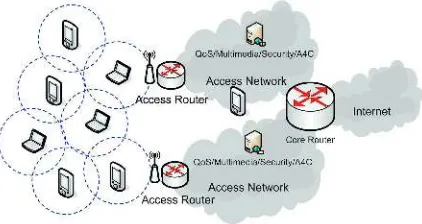
Figure 1: Dynamic Nature Of The Ad Hoc Networks.
enhance TCP performance over the On the internet, where the primary concept is to break the end-to-end views design into more light and portable areas. This needs that nodes able of executing TCP Tube joint parts would be current on the way at relatively little ranges.
Figure 2: TCP Over Head Control Protocol In Network Communication.
A TCP congestion control technique is developed to enhance the standard of segments up to system potential, which is revealed as bandwidth-delay item (BDP), and Chen et al. analyzed the BDP in both challenging wired and wi-fi methods. In conventional methods, segments can effectively go through hyperlinks to coming back, and then, these segments can chock up the whole system pipe. However, a recipient should begin to ahead an area after definitely getting it from the emailed in multi-hop ad hoc techniques. Moreover, considering the way conversation and direction disturbance issue, the BDP of a TCP relationship is much more light and portable than in uncertain wired methods. The value of the TCP impediment show (and) should be related to the BDP, and congestion-control requirements in uncertain wired methods projects to keep the value of cwnd value near the BDP. However, as above described, the actual BDP in multi-hop ad hoc methods has a lightweight scaled effect scale than in uncertain wired methods.
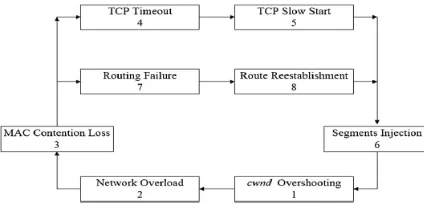
Fig. 1 reveals a style of the TCP cwnd overshooting issue. During a cwnd update and regular information exchange usage stage, cwnd overshooting (phase 1) causes a TCP system to be flooded soon (phase 2). In it, a lot of information segments need to be moved, and
serious MAC contentions may accordingly happen. Consequently, many place issues may happen (phase 3), and these place issues produce retransmission timeouts (RTOs; stage 4) and following progressively begin (phase 5) at the TCP resource node. Information segments again begin to be managed by the system (phase 6), with a small shifting amount.
Regardless of the particular outcomes in concepts, we determine out a typical marketing issue known as the Overlay Course-plotting Resource Allocation (OCRA) issue and analysis its complexness. It changes out that the issue is
NP-hard, and we existing a nontrivial
approximation specifications for it. Realize that if we are only enthusiastic about enhancing course-plotting features between only one source node and only one position, then the issue is not complex, and discovering the utmost wide range of nodes becomes simple since the potential candidate for overlay positioning is little, and in typical, any process would be outstanding. However, when we consider one-to-many or many-to-many circumstances, then only one overlay node may effect the road residence of many paths, and thus selecting the right locations becomes much more difficult. We assess our typical specifications in three particular such circumstances, where we have a huge set of source–destination locations, and the potential is to find out a little set of locations, such that using overlay nodes in these locations allows to develop paths (routes are either underway paths or paths that use these new efficiently exchange nodes) such that a certain course-plotting residence is pleased..
The main contribution of this document is specific as follows.
1) We separated the real round-trip time (RTT) into two parts:
web link harm. An inadequate use of the discussion RTT causes a TCP obstruction display overshooting problem.
2) We figure out a different, distinction of discussion RTT per hop (V CRH), to evaluate the level of web-link contentions. First, it can represent the level of web link discussion. Second, the distinction is a exclusive different that shows the argument situation observed during the newest statement screen. Third, the distinction can also indicate the place of a bottleneck.
2. BACKGROUND APPROACH
The complexness of the ORRA issue. In particular, we display that the -ORRA issue is NP-hard, and it cannot be estimated within a portion of (where is the actual between the extensive variety of locations and the extensive variety of vertices), using an approximation protecting decrease from the Set Secure (SS) issue. While the decrease and the balance outcome keep even for the easy situation where all nodes have a relative cost (i.e., the cost associated with an efficient exchange node performance on each node is equal), the approximation specifications can be used for an unrelated body weight operate, catching the component that the cost of applying an efficient exchange node may be different from one node to another.
Algorithm 1: Relay Configuration Processing In Ad Hoc Networks.
[image:3.612.340.498.515.658.2]At each version, the specifications choices vertices with whole body weight that is just like zero until a possible set is acquired (steps 1 and 2 of the algorithm). Thus, since at each version at least one vertex gets a whole body bodyweight that is just like zero with regards to W2 than in the most serious the specifications prevents after |V| editions and income a possible set.
Figure 3: Finding The Path Delivery In Communication Network.
decrease its cost. While this stage may enhance the real efficiency of the needs, it is not needed in the approximation research below and may be remaining out in the efficiency.
BGP is a policy-based inter-sector course-plotting strategy that is used to find the
course-plotting paths between individual
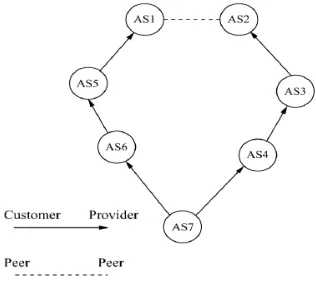
methods in the On the world wide web [8]. In the exercise, each AS is an individual organization, and the BGP course-plotting strategy reveals the professional connections between linked ASs. A customer– organization relationship between ASs indicates that one AS (the customer) will pay another AS (the provider) for On the world wide web access, a peer–peer relationship between ASs indicates that they have common contract to provide their clients, while a sibling– sibling relationship indicates that they have mutual- transport contract (i.e., providing both
their clients and providers). In other
circumstances, after crossing a provider– customer or a peer–peer web weblink, a path cannot get around a customer–provider or a peer-peer web weblink. In this example, a vertex represents an AS, and an advantage represents a looking relationship between ASs. While the duration of the particular quickest path between AS6 and AS4 is two (using the road AS6, AS7, AS4), this is not a real course-plotting path since it goes a place. In this situation, the duration of the quickest authentic course-plotting path is five (using the route AS6, AS5, AS1, AS2, AS3, AS4).
Rather than considering a customized specifications for a particular system or situation, we recommended a common structure that fits a huge set of overlay programs. Considering three different authentic circumstances, we analyzed the efficiency of the needs, displaying that in exercise the needs provides close-to-optimal outcomes. Many problems are remaining for further research. One exciting path is a systematic research into the vertex cut used in the needs. It would be exciting to find popular functions of the underlay and overlay course-plotting that guarantee a limited on the dimension the cut. It would be also exciting to
check out the efficiency of our structure for other course-plotting circumstances and to check out problems appropriate to real efficiency of the plan.
3. RELATED WORK
The TCP impediment show the
overshooting problem has been examined, and the overshooting problem happens due to the
following two aspects: 1) the serious
conversation in the MAC aspect and 2) the incorrect distinction of impediment show in the TCP aspect. Centered on these factors, past research could be classified into four categories: 1) losing of contra flow contention; 2) losing of interflow contention; 3) the determine the best position capacity, and 4) flexible obstruction control methods. An intra-flow conversation represents the conversation between the offers that are an aspect of the same TCP relationship. It contains two essential parts: 1) the conversation between information providers and 2) the conversation between information and ACK provides. First, for a given system topology and TCP relationship technique, there
is a unique TCP impediment show W∗. Second,
in a set wi-fi ad hoc system, the elements of package troubles are problem and disturbance due to link-layer contentions. At the same time, based on the outcomes of the simulator, Fu et al. indicated that the value of impediment show may not be managed at the extensive variety around
W∗ during the actual perform of TCP, but it
differs until it gets to a value much bigger than
W∗. Centered on these two essential outcomes,
they recommended a flexible pacing strategy.
Interflow conversation represents the
Algorithm 2: Appropriate Candidate Selection Based On Listed Nodes.
In wi-fi ad hoc techniques, this
challenging modification is no more
comfortable. Currently, several analyses have been devoted to improve the way to improve the blockage screen. At the obstruction protection in the conventional TCP process, the cwnd value linearly enhances, i.e., when the ACK offers of all details offers are acquired, the cwnd value is enhanced by one maximum possible section dimension. In the SCA technique, there is a varying can increase threshold for displaying the wide range of ACKs acquired before obstruction display difference. When the variety of ACKs is little than can increase thresh, the value of cwnd value keeps the same. Once the wide range gets to can increase threshold, the cwnd value is enhanced by one MSS.
In these four categories of techniques, the decrease of intra-flow and interflow contentions attempt to minimize the discussion issue at the MAC aspect without reducing the TCP complete. However, the overshooting issue still dominates. The very best techniques are aspect of the third classification, i.e., the figure of the place prospective. However, the link-layer place has not been exactly measured, and the granularity of cwnd difference is challenging. It all classification, i.e., versatile congestion-control techniques, has no idea of the web link aspect place and locations the cwnd value in the TCP aspect, which is sightless. Our biggest concentrate on is to reduce the TCP obstruction
screen issue from overshooting by consistently modifying the blockage screen to a real BDP level for a long interval.
4. CONGESTION WINDOW
OVERSHOOTING
We concentrate on RTT and BDP, and we thoroughly illustrate a impediment show overshooting problem with respect to RTT and BDP.
0 0
_
(
) / (4 max)
m n
i j
i j
BDP UB S
d
d
d
= =
=
∑
+
∑
--- (1)
Where BDP_UB is the higher limited of the series information transmitting over handling activities. A. Obstruction Display Overshooting Problem BDP is a key part in identifying the shifting rate of sections because it can be acquired through the immediate figure of this method place. We consider a system pipe. The
dimensions of the pipe symbolize the
information come back utilization at a
Figure 4: Data Transmission In Chain Model Analysis.
Knowing the BDP Formula Depending on these understanding, we current a customized equation of BDP as follows:
BDP = (S/Dcongestionmax) × RTTcongestion
where Dcongestionmax is the maximum
link transfer delay.
This method situation with a common sequence topology, where the shifting and interference varies are 250 and 550 m, respectively. In this, when node D gets offers from node C, all nodes that stay in the extensive variety of interference (Ri) of node D should be obstructed. In other circumstances, when the CD web weblink is under shifting, the DE, EF, and
FG hyperlinks are under conversation.
Supposing that the comeback wait per hop is the same for all hyperlinks, the conversation wait is three periods time than the trading hyperlinks wait. Through the whole path, the impediment RTT is 1 / 4 of the actual RTT. The coefficient 1/4 in (1) is according to these studies outcome
Figure 5: Grid Network Specification In Real Time Ad Hoc Networks.
However, the final outcome about the
information come back utilization in (1) is different from ours. D-max in (1) is the per-hop comeback delay, such as we flicker come back delay and the discussion delay, and thus, S/d max is the amount of program sent from a node to the next hop, considering the conversation delay.
V CRH: We figure out a parameter known as the
delay per hop is the same for all hyperlinks, the conversation delay is three times a longer time than the trading hyperlinks delay. Through the whole path, the impediment RTT is 1 / 4 of the actual RTT. The coefficient 1/4 in (1) is according to these research results. However, the final outcome about the information come back usage in (1) is different from ours. d max in (1) is the per-hop comeback delay, such as the web link come back delay and the discussion delay, and thus, S/max is the amount of program sent from a node to the next hop, considering the conversation wait.
5. EXPERIMENTAL EVALUATION
We implement the exclusive TCP, the
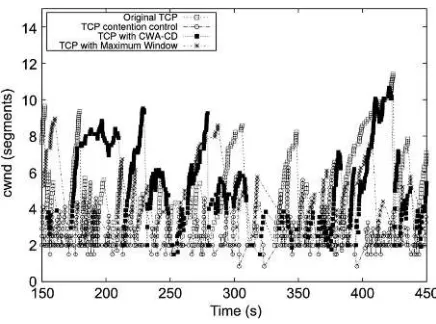
conventional TCP with discussion management process, the versatile developing of TCP highest possible display, and our recommended TCP CWA–CD process in the ns-3 network simulator, and we evaluate the performance of these four techniques. To highlight the repercussions of contentions and interference and to decrease the impact of direction issues as much as possible, we focus on a collections topology as a set scenario. We evaluate the program performance and determine the obstruction display among the four techniques. We also existing simulator outcomes in a highly effective exclusive topology.
The wide range between two close by nodes is set to be 150 m, and the transferring and interference radii are set to 250 and 550 m, respectively. In the analysis, we generate a different wide range of collections techniques, with m which wide range from 4 to 9. Because we believe that there are 2m connections in the collections, this topology causes a lot of contentions among these connections. In each row, a TCP connection is regarded to set up from the staying end node to the right end, and in the same way, in each range, a TCP connection is regarded to set up from the end end node to the top end node. All these TCP connections are of the same aspects, i.e., a place sizing 512 B and a highest possible display sizing 32. In the analysis, we arbitrarily select ten connections,
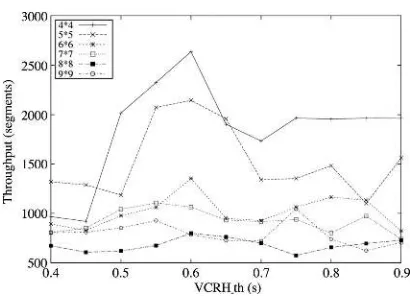
[image:7.612.323.528.217.365.2]and thus, each information aspect in the numbers requires the requirements of ten example concepts. V CRH_th is an important parameter in our process. We first analyze the performance for different this parameter value to obtain the best V CRH_th value. We select n = 6 in the V CRH, which indicates that the latest six segments are regarded to evaluate the discussion place at most.
Figure 6: TCP Through Put With Respect To Data Transmission.
verified soon enough interval of your energy and effort which extensive variety from 170 s to 210 s in Fig. 7. In this extensive variety, the suggested process gets to the ability of the program pipe after a moment time interval of cwnd increases along with the traditional TCP, but later, the cwnd of the regular TCP still highly goes up. The suggested process a little bit up-dates the cwnd according to the route conversation place, and it preserves the cwnd near a certain value for even more than 30 s. Second, we evaluate how TCP conversation management performs.
Figure 7: TCP Performance In Wireless Networks With Efficient Relay Configurations.
As analyzed in past periods position, the cwnd value of the process is always very little and significantly differs. This result shows that this technique can indeed limit the cwnd concepts from extreme improve, but this difference process does not have an ongoing evaluation of the conversation position. It straight charts the fluctuant round-trip conversation details to the difference of a new cwnd value, and thus, the difference is quickly converted between an improving and a lack of the cwnd ideas. Third, in the TCP with maximum show process, an increase in the cwnd value is progressively, but the cwnd ideas consistently vary, because RTTTCP is not the actual RTT and could not indicate the actual system situation. We can see in Fig. 7 that the cwnd value of the TCP with CWA–CD is more ongoing. When getting a new ACK, the node adapts the cwnd value in
accordance with the V CRH value. Although the evaluation on the discussion is different from reality, the leading to cwnd is just a little bit personalized.
If a position reduce happens, we determine out whether we can limit the cwnd, with respect to the conversation situation. If the conversation position is serious, it is useful for dealing with the important difference of cwnd and enhancing the throughput by just halving the impediment show. In the case of study, the throughput is analyzed in conditions of the relay of TCP sections obtained by the locations in a time length of 500 s.
Powerful Exclusive Topology: We consider a normal unique waypoint flexibility style in our research topology. In this style, a node arbitrarily choices up a position within a simulator position and starts to shift toward the position with an innovative quantity that is different from zero to max speed. Whenever the node gets to the place, it smashes for 1 s. The parameter max-speed concepts can be different with 5, 7.5, 10, 12.5, 15, 17.5, and 20 m/s in different tests. We initialize a set of 50 nodes that were arbitrarily allocated in a position of 500 m by 500 m. There are 50 TCP relationships between arbitrarily chosen sources and locations. In a certain value of quantity, we arbitrarily set up ten different system conditions as research cases and obtain the end-to-end wait and throughput details after getting the requirements often example ideas, respectively.
multihop ad-hoc methods. Tracking the web-link conversation position, we can effectively limit the TCP obstruction display from overshooting and keep it in an efficient wide range. The leads to past periods set selections topology to look at the efficiency of the recommended CWA–CD process. We separated the actual RTT into two locations, i.e., 1) the impediment RTT and 2) the conversation RTT, and we determine out a different V CRH to evaluate a number of web-link contentions.
6. CONCLUSION
When the traditional TCP congestion control process was used on top of the MAC 802.11 strategy in multi-hop ad hoc methods, the upgrade of cwnd is so competitive that it soon exceeds an appropriate value according to the real BDP. It may result in a serious conversation, position issues, and a reboot of the impediment show. In this case, TCP relationships cannot continuously perform and generate very low throughput, which has been an important part for decreasing this method efficiency. Previous analysis has given some customized TCP methods. However, there is still the spot to enhance the TCP efficiency. In our suggested CWA–CD process, we have divided the real RTT into two parts—the impediment RTT and the discussion RTT—and exposed that the conversation RTT has nothing to do with the BDP and that the BDP is identified by only the impediment RTT. We acquired the conversation RTT information from ahead information and in reverse ACK at the MAC part and estimated the conversation position through the difference of the discussion RTT. Then, we developed something different of the show difference process, in which the cwnd value was customized according to several aspects such as the V CRH and timeout. The difference of the
conversation RTT shows the immediate
indication of the conversation scenario, and this method is timelier and more precise.
REFERENCES
[1] Rami Cohen and Danny Raz,in
“Cost-Effective Resource Allocation of Overlay Routing Relay Nodes”, by IEEE/ACM TRANSACTIONS ON NETWORKING, VOL. 22, NO. 2, APRIL 2014.
[2] “ Xin Ming Zhang, Na Na Li, and Dan Keun
Sung” TCP Congestion Window
Adaptation Through
Contention Detection in Ad Hoc Networks”, in
IEEE TRANSACTIONS ON
VEHICULAR TECHNOLOGY, VOL. 59, NO. 9, NOVEMBER 2010.
[3] R. Cohen and A. Shochot,in Comput. Netw.,
“The “global-ISP” paradigm,” vol. 51, no. 8, pp. 1908–1921, 2007.
[4] S. Roy, H. Pucha, Z. Zhang, Y. C. Hu, and L. Qiu, “On the placement of infrastructure
overlay nodes,” in IEEE/ACM Trans.
Netw., vol. 17, no. 4, pp. 1298–1311, Aug. 2009.
[5] ,” R. Cohen and D. Raz “The Internet dark matter—On the missing links in the as connectivity map, in 2006.
[6] W. B. Zhu, X. M. Zhang, and N. N. Li, “Improve TCP performance with link-aware warning method in mobile ad hoc
networks,” in Proc. IEEE WICOM, 2008,
pp. 1–4.
[7] ,” Z. Fu, H. Luo, P. Zerfos, S. Lu, L. Zhang, and M. Gerla “The impact of multihop wireless channel on TCP throughput and
loss in Proc. IEEE INFOCOM, 2003, pp.
1744–1753.
[8] C. Y. Luo, N. Komuro, K. Takahashi, and T.
Tsuboi “PACED TCP: A dynamic
bandwidth probe TCP with pacing in ad
hoc networks,”, in Proc. IEEE Pers.,
Indoor, Mobile Radio Commun., 2007, pp. 1–5.
[9] . M. Elrakabawy, A. Klemm, and C. Lindemann, “TCP with adaptive pacing for
multi-hop wireless networks,” in Proc.
6th ACM Int. Symp.Mobile Ad Hoc Netw. Comput., 2005, pp. 288–299.
[10] M. Shen and D. M. Zhao “Opportunistic link scheduling for multi-hop wireless
networks,” in IEEE Trans. Wireless
Commun., vol. 8, no. 1, pp. 234–244, Jan. 2009.
[11] Z. Ye, S. V. Krishnamurthy, and S. K. Tripathi, “Use of congestion aware routing to spatially separate TCP connections in
IEEE Int. Conf.Mobile Ad Hoc Sensor Syst., 2004, pp. 389–397.
[12] ,” H. Zhai, X. Chen, and Y. Fang,
“Alleviating intra-flow and interflow
contentions for reliable service in mobile
ad hoc networksin Proc. IEEE Mil.
Commun. Conf., 2004, pp. 1640–1646. [13 S. Rangwala, A. Jindal, K. Y. Jang, K.
Psounis, and R. Govindan “Understanding congestion control in multi-hop wireless
mesh networks,” in Proc. 14th ACM Int.
Conf. Mobile Comput. Netw., 2008, pp. 291–302.
[14] Y. Shavitt and E. Shir, “DIMES: Let the
internet measure itself,” Comput. Commun.
Rev., vol. 35, no. 5, pp. 71–74, Oct. 2005.
[15] R. Cohen and D. Raz, “The Internet dark matter—on the missing links in the as connectivity map,” 2006.
[16] S. Roy, H. Pucha, Z. Zhang, Y. C. Hu, and L. Qiu, “On the placement of infrastructure
overlay nodes,” IEEE/ACM Trans. Netw.,
vol. 17, no.4, pp. 1298–1311, Aug. 2009. [17] M. Cha, S. Moon, C.-D. Park, and A.
Shaikh, “Placing relay nodes for
intra-domain path diversity,” in Proc. IEEE
INFOCOM, Apr. 2006, pp.1–12.
[18] H. Pucha and Y. C. Hu, “Overlay TCP: Multi-hop overlay transport for high throughput transfers in the Internet,” Purdue University, West Lafayette, IN, USA, Tech. Rep., 2005.
[19] R. Cohen and A. Shochot, “The
“global-ISP” paradigm,” Comput. Netw., vol. 51,
no. 8, pp. 1908–1921, 2007.
[20] Y. Shavitt and E. Shir, “DIMES: Let the
internet measure itself,” Comput. Commun.
Rev., vol. 35, no. 5, pp. 71–74, Oct. 2005.
[21] S. Roy, H. Pucha, Z. Zhang, Y. C. Hu, and L. Qiu, “On the placement of infrastructure
overlay nodes,” IEEE/ACM Trans. Netw.,
vol. 17, no. 4, pp. 1298–1311, Aug. 2009.