5837
MODELING PERFORMANCE MANAGEMENT OVER
CORPORATE INFORMATION SYSTEM OPERABILITY
1WALDEMAR WOJCIK, 2NAIZABAYEVA LYAZAT, 3ORAZBEKOV ZHASSULAN
1 Lublin University of Technology (Poland)
2,3Institute of Information and Computational Technologies CS MES RK, Almaty, Kazakhstan 2,3Al-Farabi Kazakh National University, Almaty, Kazakhstan
E-mail: 1[email protected], 2[email protected], 3[email protected],
ABSTRACT
The article herein solves the system task of controlling the distributed computer system operability. We are studying the speed performance and enterprises and organizations’ Corporate information system properties, representing complicated organizational-technical complexes. Hereby there is considered the reaching the ways of intermittent and continuous speed monitoring and that of the stream volume, handled with Corporate information system’s subsystems, modeling the current Corporate information system’s components functionality. There is constructed the control conceptual model with the corporate information system’s components functionality capacity, supporting the corporation’s business processes. There is presented the organization’s corporate information system model. Organization’s corporate information system possesses the possibility of the information system’s content automatic adjustment to different users’ categories, being the representatives of the organization’s various structural subdivisions.
Keywords: Data Models, Corporate Information System, Business Process, Server, Database Control System (DCS)
1. INTRODUCTION.
Introducing the corporate information system into any size and activity profile enterprise gives it the following advantages: possibility to take more substantiated decisions, to raise the customers servicing quality; to perfect relationships with suppliers; increase in labor productivity; to reduce production cost; to upgrade the financial and commodity stocks and supplies account and, accordingly, to revenue enterprises profits. The contemporary society needs the processing quality and speed upgrading, in the first place, of the «big data» [1] and, in the second place, of the data in the distributed systems [2]. In this connection, there grows the importance of the storage distributed systems [3] and data processing systems [4], being the means of solving the problem thereof.
However, to achieve the increase in the enterprise’s performance activity, the information system selection shall be taken very seriously [1].
Selection of the corporate information system, to be introduced, is a complicated and important process, demanding a thorough analysis
both of current needs and financial potential of the enterprise and its perspective development plans. The maximum effect of the corporate information system introduction is achieved upon its complex roll-in and the enterprise’s management interest in the project success overall [2].
5838 that is, function not effectively. The reason is in availability of the factors, which are not envisaged in the technical task and in the design process. Distributed system designing is a complicated problem, and necessary transparency observation is an indispensable condition of the system operation. There are various types of transparency [5].
On the one hand, the problems are associated with the CIS’s optimal organizational structures designing, which shall satisfy scalability criterion, which is the key requirement from the view point of investment saving. It secures, that CIS shall satisfy the extensibility criterion, the essence of which consists in upgradeability; system’s facilities functioning, staying within the initially accepted development concept and technological basis, in compliance with users’ specific needs. On the other hand – the tasks, linked with satisfying the criteria of CIS performance, such as the time of information delivery, data transmission validity, reliability and cost. Account of multicriteriality problems of CIS designing might be reduced to the formation of separate restrictions in the form of the performance complex criterion [17].
So, the task for indentifying CIS efficient parameters, necessary for achieving the system’s maximal performance with minimal financial expenditures demands further investigations. The denoted task can be solved through CIS operation simulation [17].
Off-design conditions, affecting the corporate information system work are various and infinitely many.
Research of such a system is devoted to scientific work among scientists: Tsvetkov V. Yа., Lobanov A. A.[1], George Coulouris, Jean Dollimore, Tim Kindberg[5], Daryapurkar A., Deshmukh M. V. M [8], Tanenbaum A. S., Klint P., Bohm W.[14], James D. Mooney.[15], Martin D.[2], Tsvetkov V.Ya..[3], Shokin Yu.I..[4], Rodin A.V..[6], Babich A.V, Bessonov G.B [7], Maurice L[9], Rogov E.10], Bulgakov N.N. [11], Korotkov A.V,12], Barseghyan A.A., Kupriyanov MS, Stepanenko VV, Kholod I.I.[13], Davenport, T. H.[16].
2. STATEMENT OF THE PROBLEM
Let us consider the modern state of the distributed computer system’s operability assurance. Let’s formulate the system task of control over the distributed computer system operability.
A control process (performance control process inclusive) has a complicated nature. Therefore, it is necessary to define the system task
of the production. It follows from the demand of the business process, for support of which there will be created the corporate information system under consideration. The given business process owns certain attributes. On the second hand, the system’s performance is closely linked with more general task of operability. In respect of components quantity in the system [6] there are differentiated the distributed systems: cluster, corporate level distributed system, global system.
So there should be defined the performance problem role in operability task and the problem shall be formulated proceeding from the role thereof.
Let us assume that the considered corporate information system has the following peculiarities.
1.Business process multitasking: ZD{Zd1,Zd2,…,Zdi,…,Zdn},
where the applied task lifetime is set per every ZdiZD with the interval (tiS, tiF): tiS, tiF – start and final time Zdi.
2. Operation process multitasking: ZE = (Ze1, Ze2, Ze3,…, Zeh,…, Zem,), m=10,
reduced to a sequence:
ZEZe1, Ze2, Ze3,…, Zej,…, Zep or as a sequence
ZE
Ze1Ze2Ze3,…,Zej,…,Zep, Where the sequence of tasks, being solved, can be reduced to reduction of the sequence, consisting of one problem: ZEZej or Zej ZE.
3. Supported business-process quality is characterized with multicriteriality:
KT = (T(Np), Т(Оp), Т(Pl), Т(Тh), Т(Ef)), or W = {wi : i=1,5},
where: Т(Np) - continuity, Т(Оp) - efficiency, Т(Pl) - completeness, Т(Тh) - accuracy, Т(Ef) – performance.
Thus, a system task to maintain the business-process productivity for a corporate information system with prescribed peculiarities, is formulated as follows.
1. Let at the moment of tn=t the computing process execution quality level with a time interval [t1, t2] transfers to the level Wc = <w1c,w2c,…,wic,…,wnc>, which corresponds to qualitative requirements in the frame of at which the condition is С(t)СZ, where
wiW = {Т(Np), Т(Оp), Т(Pl), Т(Тh), Т(Ef)}.
5839 wiW = {Т(Np), Т(Оp), Т(Pl), Т(Тh),
Т(Ef)}.
3. Then, based on the resources reserve R(t) it is necessary to set such corporate information system’s condition, at which there is reached the meeting the requirements to the computing processes execution quality, problem solution, business-process fulfillment or the same as to the business-process quality requirement [3-4].
We assume that conditions of С(t) modules are apparent and measurable. Condition С(t) is more functional, that is, the value (t) is higher, in case the corporate information system in the condition thereof functions without risk or the probability of applied tasks qualitative solution in С(t) is higher than under other conditions.
The problem having been formulated defines the considered problem border, i.e. a type, models nature and corporate information system control module methods.
There is selected the strategy of its solution, which consists of three stages:
1. Infrastructural strategy, which assigns the rules of infrastructure development for the business-process efficiency raising and defines the performance task limit.
2. The business strategy, which assigns the business conduct rules and defines the requirements to the task solution process.
3. Technological strategy, which defines the rules (technologies) for quality and/or performance quality support of the corporate information system and assigns the rules/way/scheme of the efficiency task solution under an ideal case.
It is supposed, that corporate information system’s instrumental resources allow solving the performance task on the strategy, consisting of
sequentially performed stages:
Ф1Ф2Ф3…Фi…Фn, where Фi – i-is the 1st phase of the corporate information system performance backing up. Phases of the corporate information system performance backing up are:
VF = (IF, PP, CS, HC),
where VF – an integrated scheme, securing the corporate information system recovery,
IF – identification of the corporate information system’s functionality,
PP – planning the corporate information system’s control processes,
CS – the status control, i.e., transfer of the corporate information system’s condition from initial to selected,
HC – upgrading the distributed computer system’s control processes.
Each phase, in its turn, consists of several steps. Processes complexity in the phases depends on the corporate information system type features, being the object under control.
Processes in phases are independent as regard to performance recovery with own execution targets and criteria. Each phase has: prescription, presentation of the object models status, technological process, performance criterion, target outcomes, being received proceeding from the processes fulfillment. Let’s formulate the processes in phases as the tasks, which are the system problem’s decomposition.[5]
2.1 Task Of Corporate Information System Functional Status Identification.
Let at the time moment tn at the object there
is <
S
t
, SЦ
tek>, it is necessary to determine
availability or absence of violation with minimal expenditures by means of the following algorithm:
if (
Ц tek
S
t
S
,
) , then
Ц tekS
t
S
, else if(
Ц tek
S
t
S
,
) , then
Ц tekS
t
S
,where S
Ц tek or S
Ц
tek(t-n) – a current target situation,
corresponding to the functioning (and effective) status of the object operation; t-n – means until the time moment tn the beginning of the object status
t
nS
;S
Ц- countable set of all possible goal situations, corresponding to the object operation
normal modes; for S
Ц
tek and
S
Ц there is executedS
Ц
tek
S
Ц.2.2 Problem Of Corporate Information Systems Control Process Planning
а) to select such a goal situation of the corporate
information system
Ц Ц
j
S
S
, which, firstly, is achievable, secondly, meets the requirements of the
criterion
W
1 amongЦ Ц
l
S
S
, i.e.
Ц l Цj
W
S
S
W
1
max
1(1.1)
Ц Ц
l S
S
б) to take such managing decision (scenarios – decisions for the corporate information system’s
5840 providing, firstly, transfer of DIS status from
S
t
toЦ
j
S
, secondly, satisfying the requirements of
the criterion
W
2 amid
U
h
U
, i.e.
max
2
,
2
U
iW
U
hW
(1.2)
U Uh
2.3 Problem Of Corporate Information System Status Control
Q(TPh() - TPф()) min, (S
Ц
j - S(k))
min, (1.3)
where: (TPh() – scheduled trajectory transfer of the object from the current status to the selected goal situation, TPф() – actual execution (or current status situation -transfer) of the trajectory, Q() – deviation the functional of the object current status from the scheduled one.
The process of control (technology, procedure) by the state of the modules depends on their type. Knowledge Management (KM) (Knowledge Management) is the process of collecting, developing, disseminating and effectively using the knowledge of the organization [16].
Control process (technology, procedure) of the modules conditions depends on their type. In respect of modules status control there exist the following types of modules: two-position, discreet, continuous operation status.
Let’s present the control scheme over continuously operating module status.
General conception of problems solution (1.1 – 1.3), i.e., control schemes over the corporate information system performance is presented as follows.
Causes of the corporate information system performance reduction are as follows: = (1, 2, 3, 4, 5,…), where – problem types (one-type incidents group) bringing to performance loss; 1 – higher load; 2 – load deregulation; 3 – failure in the module; 4 – module fault; 5 – resources shortage for the current process; 6 – deadlock; 7 – queue at the network equipment, servers and working stations entry point. Problems of the load balancing. An important problem upon the distributed system designing is maintaining the effective balancing of the load on the system’s modules. Correctly selected load balancing strategy exercises a dominant influence at the overall performance and distributed system’s operation
speed. As of today, there exist a lot of approaches [7, 8] to the solution of the problem hereof.
The research shows other dozens of performance losses reasons (incorrectness) of the corporate information systems operation. At that, most reasons occur in the internal processes (mechanisms) of the computation, in particular, there appear the following intraprocess causes: the process A refrains the resource R and waits for the resource S; the process B pretends to the resource T; the process C pretends to the resource S; the process D refrains the resource U and waits for the resources S and T; the process E refrains the resource T and waits for the resource V; the process F refrains the resource W and waits for the resource S; the process G refrains the resource V and waits for the resource U.
At that, the corporate information system’s definite components might demand the performance increase, for example the following: = (1,2,3,…,i,…,m), where - types multitude of the corporate information system components, which differ with regard to efficiency, 1 – server (servers), 2 - networks, 3 – database server,i – applied software system, m – business application server.
3. SIMPLE MODEL OF THE DISTRIBUTED INFORMATION SYSTEM SERVER IN THE FORM OF M/M/1/
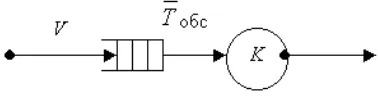
[image:4.612.324.513.571.621.2]Let’s consider the distributed information system (DIS), which consists of the certain type and class server, but for designing the simulation techniques we will consider, that here exists some kind of server. DIS might consist of several servers, but for simplicity we consider only one of them. Moreover, let us suppose that the load balancer distributes the load between all servers equally. The structure of the server model is presented as in Figure 1.
Figure 1: Single-channel server model
Let us assume that the given server is acceptable to a lot of users.
5841 The requests enter the server with a frequency of requests/s, they are put on the queue for processing, served with a speed д. requests/s., and further deleted. We shall compute relative time interval рк, when in the queue by the server maintaining there are k (k=0, 1, …) requests, an average requests quantity in the queue, average time of request processing, server usage coefficient and its productivity.
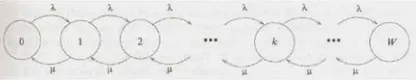
[image:5.612.316.516.285.403.2]In that case the system’s potential states are defined with integral numbers 0, 1, 2, ..., k, ... Taking into account the accepted in the considered example suppositions about infinite aggregate and final queue, we will obtain the infinite, but countable number of states. Now, we present a transition diagram in which each state will be represented as a circle (Figure 2).
Figure 2: A Transition Diagram Is An Infinite Collection Or An Infinite Queue
Incoming flow = Outgoing flow р1 = р0 (1.4) р2 = р1 (1.5) рk = рk-1 (1.6) Pay attention to the fact, that if to unite equations (3.14) – (3.16), we obtain:
,... 2 , 1 , 0 ... 2
1
k
k p k
p k
p k p
(1.7) Now we have the parameter рк in the form of t he function p0 for values k=1, 2, … We only need to find р0. The server at any moment shall stay in one of possible states. Therefore, the sum of relative time intervals, within which the server is in the states from 0 to , equals to unity element. Thus:
1 ...
...
0 0 0
2 1
0
k k
k k
k p p
p
р р
p
(1.8)
It follows:
1 1
0 0
k k
p
(1.9) It is obvious that the infinite total in the equation (3.19) represents the summing up of the geometrical progression, which converges (i.e. has a total amount) only at / 1. It means that the system’s equilibrium solution can be found merely for the case when an average frequency of the requests entry is lower than the speed of their processing. Figure 3 the ratio of the average server response time to the average query processing time for an infinite collection / infinite queue.
Figure 3: Server Utilization Ratio
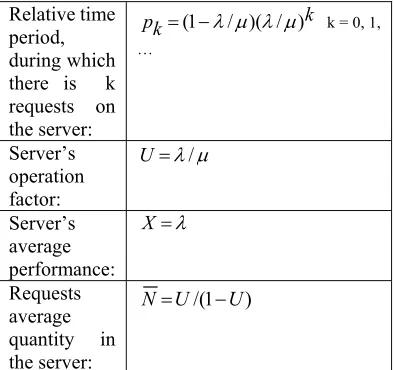
Main dependencies for the server with the infinite aggregate and finite queue are given in the Table 1: Prior to considering other cases let’s shortly enumerate the steps which have been executed for the set problem solution.
Table 1:Equations For The Case Of Infinite
Aggregate /Final Queue
Relative time period, during which there is k requests on the server:
k k
p (1/)(/) k = 0, 1, …
Server’s operation factor:
/
U
Server’s average performance:
X
Requests average quantity in the server:
[image:5.612.98.301.302.371.2] [image:5.612.322.519.533.718.2]5842 Average
time of response: ) 1 /( ) 1 /( ) / 1
( U S U
R
4. RESULTS OF EXPERIMENT ON THE SERVER MODEL OF TYPE M/M/1/.
Prescribed: Inquiries enter the server with a frequency of 30 enquiries/sec. Each inquiry processing lasts in average 0.02sec.
1st part of the experiment. It is required to define a relative time interval of the server presence in the status k (where k=0, 1, ...).
If a server in 1 second can process
inquiries, then, in average, every inquiry processing takes 1/ seconds. Therefore, inquiries processing frequency is a reciprocal variable for the inquiry processing average time value. Thus, =1/0.02=50 inquiries/second. Inquiries arrival rate constitutes
=30 inquiries/second. From here it follows, that a relative time interval of server idle time, i.e., р0, equals to 1-/=1–(30/50)=1–0.6=40%. Then a relative time interval of the server operation is 1-р0=/=60%. A relative time interval, within which there are k inquiries on the server is defined according to the formula:
k k
k
p (1/)(/) 0.40.6 , k = 0, 1, (1.4) As is clear from the dependence (1.4), the value рк upon increasing k promptly falls. It is the geometrical distribution.
5. MODEL OF DIS SERVER IN THE FORM OF M/M/1/N
[image:6.612.92.300.668.710.2]Let us further execute the steps, presented in the end of the previous section, for defining the parameters рk, U,
N
and R for the case of final queue. As the server rejects the received requests, if there are already W requests, then the system’s potential states will be 0, 1, ..., W. If upon a request receipt there are k requests in the system (k < W), then such a case causes transition to the state k+1 with frequency X. Request processing completion at the moment when the system is in the state k (k=1, ..., W), induces transition to the state k–1 with frequency . The transition diagram for the case described is shown in figure 4.Figure 4: Transition diagram infinite set final queue
Let’s once again consider the server, the parameters of which prescribed in, but assume that in the queue there might simultaneously be no more than 4 requests in the server, including the requests being processed. How to define the relative time interval, within which there are k requests in the database server (k = 0, 1, ..., 4).
Substituting parameters =30 requests/s, =50 requests /s and W=4 into the equation (1.10), we obtain: 43 . 0 5 ) 50 / 30 ( 1 ) 50 / 30 ( 1
0
p (1.11)
and рk=0.430.6k for k=1, …, 4.
Server’s operation factor is defined as relative time interval within which the server is not idle. Therefore, as before, U=1– р0, where р0 is defined according to the equation (1.12). Putting in necessary substitutions, we obtain:
1 ) / ( 1 ) / ( 1 ) / ( W W U (1.12) For the server with a final queue the important performance parameter is the percentage of rejected requests, which are lost due to the queue overflow. The parameter thereof equals to рW, as the requests are lost only in case of the system being in the state W. Thus, ploss=pW.
Average quantity of requests, being in the server is computed just as in the previous section. Therefore:
W k k W k k p k p k N
0 0 0(/) (1.13)
But taking into account that
2 ) 1 /( 1 ) 1 ( 2
0 a a
W a W W a W W k k a
k
, and the
formula for computing р0, presented in the equation (1.10), and executing needed mathematical transformations, we obtain:
) / 1 ( 1 ) / ( 1 1 ) / )( 1 ( 1 ) / ( ) / ( W W W W W N (1.14)
5843 relative occupancy duration represents its operation factor. Consequently:
1 ) / ( 1 ) / ( 1 ) 1 ( 0 U U WW
X
(1.15)
As well as in the previous case to compute the server’s response average time R, we apply the law of Little: response average time equals to N/X , where
N
and X are specified based on the equations (1.14) and (1.15) accordingly. Introducing necessary substitutions, we obtain:
1( / )
(1 / ) 1 ) / )( 1 ( 1 ) / ( / N X SW W WW W
R
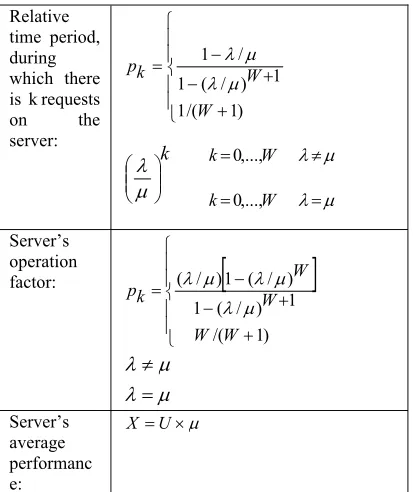
[image:7.612.91.298.471.717.2](1.16) And further, we introduce the parameter =/ and consider the case, when =, i.е. =1. At that, in just established equations for pk, U and X there appears the uncertainty of 0/0 type. To solve the uncertainty is possible by means of the known L'Hospital rule, which allows computing the limit pk, U and X, when 1. All equations for the case of infinite aggregate and final queue are given in the Table 2: Results for the case =1 can be found at the same place.
Table 2: Equations For The Case Of Infinite Aggregate /Final Queue
Relative time period, during which there is k requests on the server: ) 1 /( 1 1 ) / ( 1 / 1 W W k p k W k W k ,..., 0 ,..., 0 Server’s operation
factor:
) 1 /( 1 ) / ( 1 ) / ( 1 ) / ( W W W W k p Server’s average performanc e: U X Requests average quantity in the server:
2 / ) / 1 ( 1 ) / ( 1 1 ) / )( 1 ( 1 ) / ( ) / ( W W W W W WN
Average time of response:
X N
R /
6. OUTCOMES OF AN EXPERIMENT ON THE SERVER MODEL OF TYPE M/M/1/N.
1. Let’s again consider the server, the parameters of which have been prescribed in the previous experiment, but suppose, that in the queue to the server there could simultaneously be no more than 4 inquiries, including the inquiries being processed.
It is required: To define the relative time interval within which on the database server there are k inquiries (k = 0, 1, ..., 4).
Substituting the parameters =30 inquiries/s, =50 inquiries /s and W=4 in the model equation, we
obtain: 5 0.43
) 50 / 30 ( 1 ) 50 / 30 ( 1 0
p and рk=0.430.6k
for k=1, …, 4.
2. Values of inquiries getting frequency ratio and service rate equal to the corresponding parameters of the previous experiment. What minimal value shall have the maximum amount of the received inquiries in order the server rejects less than 1% inquiries?
Required: To compute such value of the parameter W, whereby pW p0(/)W 0.01. Applying values =30 inquiries/s and =50 inquiries/s, we obtain, р0 =0.4/(1–0.6W+1) as consistent with the model equation. We shall compute the value of W, at which
01 . 0 ) 1 6 . 0 1 /( 6 . 0 4 .
0 W W .
Subsequent to algebraic transformations and logarithms usage, we define that W8. It is seen from calculation, that along with W increase, the missed inquiries percentage reduces. It is obvious, that for smaller values W reduction will be sharper. The most influence at the inquiries execution performance provide input-output operations [9, 10].
5844 one-channel uninodal and multimode computer network operation with limited queue and absolute priority. First and second priority incoming loads
intensity accordingly equals to and . A stream #1 has an absolute priority over a stream #2. For one-channel uninodal computer network with limited queue and absolute priority there have been obtained the following correspondences, characterizing the network operation:
Rejection probability for the first priority inquiries due to queue restriction in the service:
(1.17)
where the first priority load; number of waiting spaces:
Service rejection probability for the second priority inquiries equals to plausibility of the fact that there are already first and second priority inquiries in the queue:
(1.18)
where second priority load. Average number of the first priority inquiries in the queue:
(1.19) Average number of the first and second priority inquiries in the queue is defined according to the formula:
(1.20) Average number of the second priority inquiries in the queue can be defined as the remainder between an average number of the first and second priority inquiries and an average number of the first priority inquiries.
(1.21) Average time of servicing waiting in the queue for the first priority inquiries:
(1.22) Average time of servicing waiting in the queue for the second priority inquiries:
(1.23) Exclusion of the second priority inquiries:
(1.24) To compute the above enumerated characteristics we have developed the algorithm of the problem solution
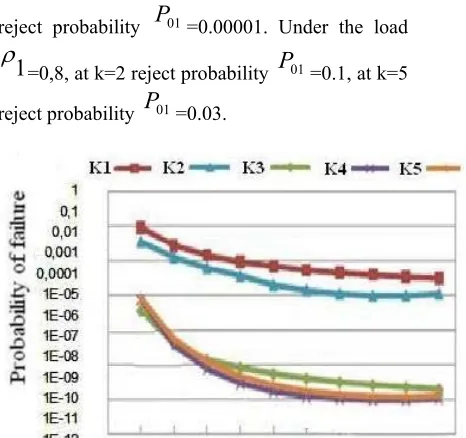
Figure 1 shows, that in a single -channel, single-priority network the influence of increasing the waited places quantity (k) at the probability of
rejects is sensible at the load’s low values ( ) and
at >0.8 it becomes insufficient. For instance,
upon the load =0,4 and k=2 the reject
probability =0.05, and at =0,4 and k=6 the
reject probability =0.00001. Under the load
=0,8, at k=2 reject probability =0.1, at k=5
[image:8.612.318.551.453.672.2]reject probability =0.03.
Figure 5: Dependency of the probability of denial of service for priority requests
The dispatching rule with an absolute
1
2
1
1 1 ) 1
1 1 1 1 01
ki i k
P
1
k
k
11 1 2 1
2 1 1 1 2 1 02
ki
i k
P
2
k
i
iP
R
1
01
1
k
i
iP
R
1
02
2
1
1 2 1
2 R R
R
1 1
1
R
2 2 2
R
2 ) 01 02 ( 1
2
P PP
1
1
1
01
P
1
01
P
1
01
P
5845 priority finds wide usage in the existing and being developed systems and complexes. In the work herein there is considered the CIS’s nucleus as the controlled object.
7. CONCEPTUAL STRUCTURE OF
CAPACITY CONTROL SYSTEMS (CCS)
CORPORATE INFORMATION
SYSTEMS’.
CCS functional structure shall be presented as such. An important stage for taking managerial
[image:9.612.112.511.228.464.2]solutions is diagnosing. Corporate information systems’ status diagnosing technology per segments by means of logical models is fulfilled by the CCS subsystem, the functional structure of which is given on the figure 6. Designations thereof are of the following sense: MCi – i-segment’s logical model, reflecting the functional status of the i–segment; SCi –i-segment’s current status, specified, using the model MCi.
Figure 6: Functional Structure Of The CISC Performance Management System
The article herein presents the approach to constructing the conceptual model of organizations corporate information systems, based on the formalized knowledge, gained from the outcomes of the current solutions analysis in the field of development, introduction and operation of the existing information systems of organizations. Hereby we present the formal definition of the dynamic corporate information system with feedback communication. There was considered the role of user’s experience in frame of the information receiving and transferring. We presented the model of the corporate information system user’s preferences.
Further we presented the conceptual model of the industrial enterprise’s corporate information system, usage of which allows increasing the performance of work with the information based on the applying the receipt and integration technologies. Industrial enterprises information
systems, as a rule, include several different levels subsystems [17].
The problems of the software cross-platform assurance are discussed in the multitude of published scientific papers, which show the main approaches and techniques, allowing creating transportable software [14, 15]. Corporate information systems’ conceptual model is in the figure 7.
5846 8. CONCISE ANALYSIS OF CONDUCTED
RESEARCHES ON CIS SIMULATION
Model construction of the CIS as a distributed database is based on: object-relational database, conceptual model of access control to the data, owner-member relationship and inclusion between the objects and data replication [18]. In the article [19] CIS is characterized as a total of information processes in the specialized information system in the frame of the enterprise. The article [20] suggests a conceptual model of attachments for corporation business processes upon creating the conceptual models of distributed corporate information systems of the organization. Hereby we lay out the outcomes of conducted researches of the object performance under different loads and modes of their operation. We studied the mutual influence of CIS components on productivity, variants of balancing the components performance of CIS’s structural features. We have presented the results of CIS’s main objects research.
CIS is a complicated multicomponent object from the view point of research. Accordingly, its models are as well multicomponent and complicated. Therefore there is needed the research technique, as for active experiment conduct, it will fulfill the leading function.
9. CONCLUSION
Following results have been obtained in the work. There has been offered a new conception of the corporate information system efficiency study. Formulated the efficiency tasks and the corporate information system’s components. Elaborated and studied the models and techniques of solving the tasks for the corporate information system’s efficiency upgrading. There has been solved a system problem for the distributed computer system’s operability control.
There is offered a general multilevel model of the corporate information system performance control processes organization. Elaborated the techniques and algorithms of decision making, securing the corporate information system’s components performance upgradingб based on simulation analysis. There have been studied the speed properties and characteristics of the corporate information systemsб belonging to enterprises and organizations, representing complicated organizational-technical complexes. There has been constructed the simulation model of the corporate
information system’s components performance efficiency control, which supports the corporation's business-processes. Proceeding from the results of the corporate information system’s modules and components performance simulation research, there have been offered the techniques of decision making on the streams speed characteristics upgrading.
Results, obtained in the work can be used for creating control system (CS) over corporate information system (CIS) capacity both at joint designing of CS and CIS, and in the period of their operation.
Thus, during CIS operation there occur a lot of problems, the solution of which will secure its functionality. Among them we can specify the following:
Maintaining sufficient reliability level, internal resources security, operation safety of distributed information system’s (DIS) separate elements, as well as of DIS in its entirety, also for the processes of supporting business-processes, operation correctness of both DIS elements and the DIS in whole; capacity (business process continuity behavior).
Organization’s corporate information system оowns the possibility of the information system content automatic adjustment to the categories of various users, being the representatives of the organization’s different structural subdivisions.
REFERENCES:
[1] Tsvetkov V. Yа., Lobanov A. A. Big Data as Information Barrier // European Researcher. 2014. Vol.(78). № 7-1. p. 1237-1242.
[2] Tsvetkov V. Yа., Lobanov A. A. Big Data as Information Barrier // European Researcher. 2014. Vol.(78). № 7-1. p. 1237-1242. [3] Martin D. Computing networks and
distributed data processing: Software, methods and architecture: [in 2 ed.]: Translation from English. Edition. 1. Finances and statistics, 1985.
[4] Tsvetkov V.Ya. Databases. Operation of information systems with distributed databases. М.: MIIGAiK, 2009. 88 p. [5] Shokin Yu.I et.al. Distributed
information-analytical system for search, processing and analysis of spatial data // Computing technologies. 2007. V. 12. # 3. P .p. 108-115. [6] George Coulouris, Jean Dollimore, Tim
5847 [7] Rodin А.V., Burtsev V.L. Parallel or
distributed computing systems? // Proceedings of scientific session, MIFI- 2006. V. 12 Informatics and management processes. Computer systems and technologies. P. p. 149-151.
[8] Babich А.V., Bersenev G.B. Dynamic load balancing algorithms in active monitoring distributed system // Herald of TulSU. Engineering sciences. 2011. #3. P. p251-261. [9] Daryapurkar A., Deshmukh M. V. M.
Efficient Load Balancing Algorithm in Cloud Environment // International Journal Of Computer Science And Applications. 2013. Т. 6. №. 2. p. 308-312.
[10] Maurice Lewis. Setting SQL Server 6.5 for inquiries processing with high performance. // SQL Server Magazine ONLINE, No 1, 2000 http://www.osp.ru/data/www2/win2000/sql/2 000/01/007.htm
[11] Rogov Ye. SQL or PL/SQL? — Perspective as regards performance.
[12] Bulgakov N.N., Miroshnikov V.I., Shibanov V.S. Multichannel system with limited queue and absolute priority. «Issues of radioelectronics», series TPS, 1974, edition.5. p. p.21-28.
[13] Korotkov А.V. Integrated information systems in business. - М. 2006.
[14] Barsegyan А.А., Kupriyanov М.S., Stepanenko V.V., Kholod I.I. Methods and models of OPLAP and Data Mining data analysis. – Proceedings б. Saint-Petersburg, 2004.
[15] Tanenbaum A. S., Klint P., Bohm W. Guidelines for software portability // Software: Practice and Experience. 1978. Т. 8. №. 6. С. 681-698.
[16] James D. Mooney. "Bringing Portability to the Software Process". Technical Report TR 97-1, Dept. of Statistics and Computer Science, West Virginia University, Morgantown WV, 1997.
[17] Davenport, T. H. Saving IT's Soul: Human Centered Information Management / Harvard Business Review 72 (2). – 1994. Pp. 119–131 [18] Lazdin S.V, Zemlyanskaya S.Y. Multi-criteria optimization of corporate information systems // Scientific works of DonNTU. Series "Computing and Automation" - Issue 12 (118). - Donetsk: DonNTU, 2007. - P. 74 - 82.
[19] Agibalov G.P, Skutin A.A Mathematical model and technology for the development of secure corporate information systems. Tomsk
State University /URL:
http://zhurnal.ape.relarn.ru/articles/2001/151. pdf
[20] Glamazdin E.S., Novikov D.A, Tsvetkov A.V. "Management of corporate programs: information systems and mathematical models." - M: Company Sputnik +, 2003. - 159 p.
[21] Loginov K.Y. Zmeev O.A, Moiseev A.N Implementation of classifiers on the application server in the three-tier client / server architecture. // All-Russian scientific-practical conference "New technologies and complex solutions: science, education, production".