IJPSR (2012), Vol. 3, Issue 08 (Research Article)
Received on 24 April, 2012; received in revised form 14 May, 2012; accepted 21 July, 2012
SCIENTIFIC VALIDATION OF JAWARISH-E-BISBASA - A UNANI FORMULATION
Rampratap Meena*1, D Ramasamy 1, S Mageswari 1, Syed Jameeluddin Ahmed 1, Samsul Arifin 2, Shamshad Ahmed Khan 2 and Syed Shakir Jameel 2
Regional Research Institute of Unani Medicine 1, Royapuram, Chennai, Tamil Nadu, India Central Council for Research in Unani Medicine 2, Janakpuri, New Delhi, India
ABSTRACT
The compound drug Jawarish-e-Bisbasa is a polyherbal Unani formulation. It is used in the ailments of general weakness of the stomach, flatulence in the stomach, indigestion, blind piles and nausea etc. Therefore the scientific validation for development of SOP, pharmacopoeial standards, TLC studies and safety parameter is very much essential to provide the quality medicine to the needy mass. The drug was prepared in different batches at laboratory scale using authenticated nine raw drugs. The present study was aimed to develop the SOP’s for the preparation of drug and to evaluate its pharmacopoeial parameters, estimation of heavy metals, microbial load, aflatoxins and pesticide residues. The obtained physicochemical data will help in laying down SOP’s and pharmacopoeial standards for this drug. Thin Layer Chromatographic studies of the drug will provide the finger prints which will help in quality control and detection of adulteration. The result of quality control parameters such as microbial load, aflatoxins, heavy metals and pesticide residue shows that the drug is free from toxic substances.
INTRODUCTION: Herbal drugs constitute a major part in all the traditional system of medicine 1 and there has been an increasing realization that TSM products are safer and this has lead to the spurt in the use of these plant based products in India.
Jawarish-e-Bisbasa is one of the polyherbal Unani compound formulations available in semisolid form in the market. The herbal formulation is being prescribed by Unani Physician for the treatment of weakness of the stomach, flatulence in the stomach, indigestion, blind piles and nausea 2.
The scientific standards like development of SOP’s which includes procurement of ingredients, authentication, removal of adulteration if any, powdering the raw drug up to the required fineness,
method of preparation, evaluation of physicochemical data and quality control parameters are essential to provide the quality medicine to the needy mass. The present study was designed to scientifically validate the drug by applying modern parameters such as microscopical, physicochemical, thin layer chromatography, microbial load, aflatoxin, heavy metal and pesticide residue.
MATERIALS AND METHODS: The raw drugs of the formulation were procured from local raw drugs dealers, Chennai with the knowledge of Unani Physician. The raw drugs were identified using pharmacognostical methods3 and evaluated their pharmacopoeial standards. The drug Jawarish-e-Bisbasa was prepared in different batches at laboratory scale as per the formulation composition. Keywords:
Jawarish-e-Bisbasa, Microscopy, Physicochemical,
TLC, WHO parameters
Correspondence to Author:
Rampratap Meena
Research Officer (Chemistry), Regional Research Institute of Unani Medicine (CCRUM), No. 1, West Madha Church Road, Chennai – 600 013, Tamil Nadu, India
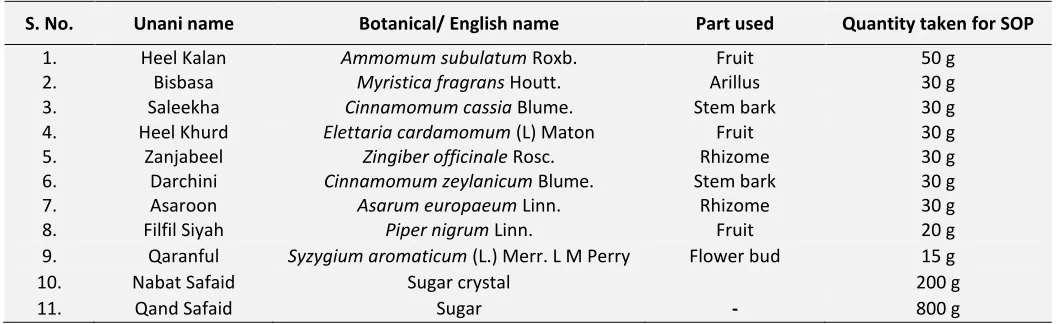
Composition of formulation: Jawarish-e-Bisbasa is a semi-solid preparation made with the following
[image:2.612.42.570.98.260.2]ingredients in the composition as given in Table 1.
TABLE 1: LIST OF INGREDIENTS OF THE JAWARISH-E-BISBASA FORMULATION
S. No. Unani name Botanical/ English name Part used Quantity taken for SOP
1. Heel Kalan Ammomum subulatum Roxb. Fruit 50 g
2. Bisbasa Myristica fragrans Houtt. Arillus 30 g
3. Saleekha Cinnamomum cassia Blume. Stem bark 30 g
4. Heel Khurd Elettaria cardamomum (L) Maton Fruit 30 g
5. Zanjabeel Zingiber officinale Rosc. Rhizome 30 g
6. Darchini Cinnamomum zeylanicum Blume. Stem bark 30 g
7. Asaroon Asarum europaeum Linn. Rhizome 30 g
8. Filfil Siyah Piper nigrum Linn. Fruit 20 g
9. Qaranful Syzygium aromaticum (L.) Merr. L M Perry Flower bud 15 g
10. Nabat Safaid Sugar crystal 200 g
11. Qand Safaid Sugar - 800 g
Method of Preparation: All the ingredients were taken of pharmacopoeial quality. Clean, dried and made the powders of the ingredients number 1 to 9 and sieved through 80 mesh and kept separately. Dissolved the specified quantity of ingredient number 10 and 11 in 1000 ml of water on slow heat and boiled the content, at the boiling stage 0.1% citric acid was added, mixed well and boiled to prepare the 76% consistency of Quiwam. Then the vessel was removed from the fire. While hot condition, the mixed powders of ingredients 1 to 9 were added and mixed thoroughly to prepare the homogenous product. The product was allowed to cool at room temperature and packed in tightly closed containers to protect from light and moisture.
Powder microscopy: The drug sample (5g) was weighed and mixed with 50ml of water in a beaker with gentle warming, till the sample completely dispersed in water. The mixture was centrifuged and decanted the supernatant. The sediment was washed several times with distilled water, centrifuged again and decanted the supernatant. A few mg of the sediment was taken and mounted in glycerin. Then few mg was taken in watch glass and added few drops of phloroglucinol and concentrated hydrochloric acid, mounted in glycerin. The microscopic salient features of the drug were observed in different mounts 4. Chemical analysis: Prepared minimum three batch samples were subjected for chemical analysis. Physicochemical studies like total ash, acid insoluble ash, water soluble ash, alcohol and water solubility, loss on drying at 105oC, microbial load and heavy metal
were carried out as per the WHO guidelines 5. Aflatoxin, pesticide residues were carried out by standard methods 6. The bulk density, sugar estimation and pH values for 1% and 10% aqueous solution were also carried out 7.
Thin layer chromatography:
Preparation of extracts for TLC: Drug samples (2g) were soaked in chloroform and alcohol separately for 18 hours, refluxed for ten minutes on water bath and filtered. The filtrates were concentrated on water bath and made up to 5ml in a standard flask separately.
Method of developing for TLC: Chloroform and alcohol extracts were applied on precoated silica gel 60 F254 TLC plate (E. Merck) as absorbent and
developed the plate using solvent systems, toluene: ethyl acetate 9:1 and 1: 1 respectively. After developing, the plates were dried and observed the color spots at UV-254, UV-366nm and vanillin-sulphuric acid spraying reagent8.
RESULTS AND DISCUSSION: Jawarish-e-Bisbasa is blackish brown in color, semi-solid, characteristic of its own odor and sweetish bitter in taste. Drug samples were spreaded in a petridish and observed. The samples did not show any filth, fungus or objectionable extraneous matter.
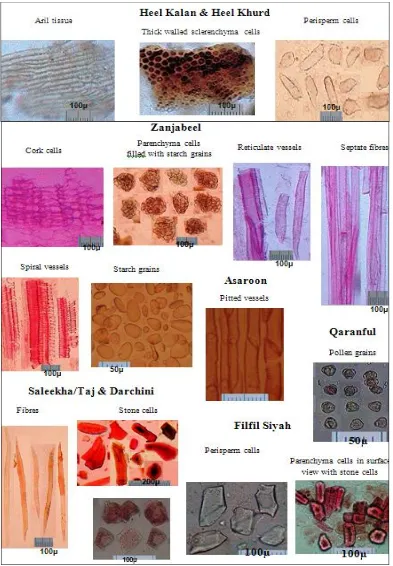
FIG. 1: POWDER MICROSCOPY OF JAWARISH-E-BISBASA
Perisperm cells with bulbous projections packed with starch grains and a few tiny prismatic crystal of calcium oxalate; fragments of aril tissue from testa; orange coloured sclerenchyma cells in surface view (Heel Kalan & Heel Khurd); large stone cells upto 300µ, stone cells with horse shoe shaped thickenings upto 100µ, numerous fibres with thick walled and very narrow lumen (Saleekha/Taj & Darchini); stone cells
view; parenchyma cells filled with abundant starch grains (Zanjabeel); vessels with pitted thickening of length upto 200µ and breadth upto 35µ with oblique end walls and simple perforation plate (Asaroon); pollen grains tetrahedral, spherical, biconvex measuring upto 20µ (Qaranful).
Chemical analysis: Moisture content of the drug shows 17.75%. Alcohol soluble extractive (58.38%) might be due to the extraction of polar chemicals constituents and the water soluble extractives 63.88% indicate the presence of inorganic constituents. The physico- chemical data of the drug are shown in Table 4. The microbial load is found within the permissible limit Table 5. The heavy metals such as lead, cadmium, arsenic and mercury are present within the permissible limit Table 6. The studies on other parameters, aflatoxins such as B1, B2, G1 and G2 and pesticide
residues like organo-chlorine group, organo-phosphorus group, alachlor, aldrin, chlordane, DDT, endosulfan, heptachlor, lindane and malathion shows that they are not detected in the drug samples Table 7 & 8.
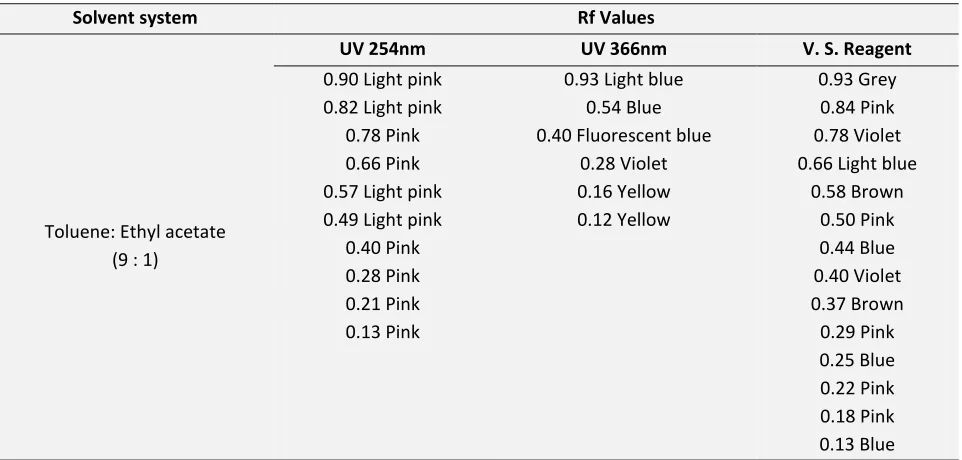
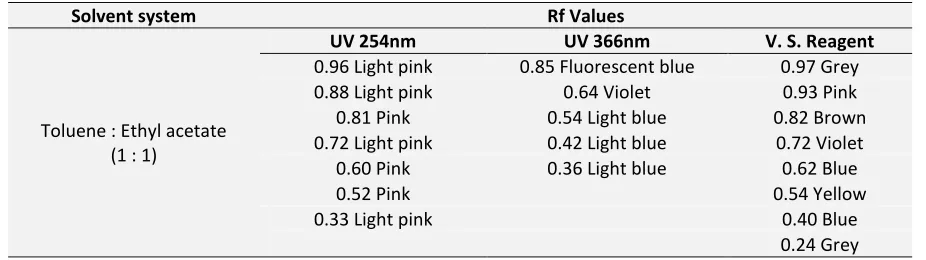
Thin Layer Chromatography Analysis: Thin layer chromatography studies of chloroform and alcohol extract of all the three batch samples showed identical spots in various detector ranges. The Rf values of the
chloroform and alcohol extracts are shown in Table 2 and 3. The plates were developed using vanillin-sulphuric acid and heated at 105º till appears colored spots in Fig. 2 and 3.
FIG. 2: THIN LAYER CHROMATOGRAPHY FOR CHLOROFORM EXTRACT
FIG. 3: THIN LAYER CHROMATOGRAPHY FOR ETHANOL EXTRACT
[image:4.612.392.509.46.213.2]Detector: V. S. Reagent, Track 1: Batch – I, Track 2: Batch – II, Track 3: Batch – III
TABLE 2: Rf VALUES OF CHLOROFORM EXTRACT
Solvent system Rf Values
Toluene: Ethyl acetate (9 : 1)
UV 254nm UV 366nm V. S. Reagent
0.90 Light pink 0.93 Light blue 0.93 Grey
0.82 Light pink 0.54 Blue 0.84 Pink
0.78 Pink 0.40 Fluorescent blue 0.78 Violet
0.66 Pink 0.28 Violet 0.66 Light blue
0.57 Light pink 0.16 Yellow 0.58 Brown
0.49 Light pink 0.12 Yellow 0.50 Pink
0.40 Pink 0.44 Blue
0.28 Pink 0.40 Violet
0.21 Pink 0.37 Brown
0.13 Pink 0.29 Pink
[image:4.612.390.508.253.423.2] [image:4.612.67.548.525.755.2]TABLE 3: Rf VALUES OF ALCOHOL EXTRACT
Solvent system Rf Values
Toluene : Ethyl acetate (1 : 1)
UV 254nm UV 366nm V. S. Reagent
0.96 Light pink 0.85 Fluorescent blue 0.97 Grey 0.88 Light pink 0.64 Violet 0.93 Pink 0.81 Pink 0.54 Light blue 0.82 Brown 0.72 Light pink 0.42 Light blue 0.72 Violet
0.60 Pink 0.36 Light blue 0.62 Blue
0.52 Pink 0.54 Yellow
0.33 Light pink 0.40 Blue
0.24 Grey
TABLE 4: PHYSICOCHEMICAL PARAMETERS
Parameters
Batch Number
I Mean
value II Mean value III
Mean value
Alcohol soluble matter
(% W/W) 58.28 58.36 58.44 58.36 58.72 58.80 58.92 58.81 57.88 57.96 58.08 57.97
Water soluble matter
(% W/W) 63.56 63.60 63.72 63.62 63.84 63.88 63.96 63.89 64.08 64.12 64.20 64.13 Total ash (% W/W) 0.81 0.83 0.88 0.84 0.91 0.95 0.98 0.94 0.78 0.82 0.85 0.81
Acid insoluble ash
(%W/W)
0.15 0.18
0.20 0.17
0.22 0.25
0.28 0.25
0.12 0.17
0.19 0.16
pH values 1% Aqueous solution
5.52 5.57
5.61 5.56
5.49 5.51
5.65 5.55
5.59 5.63
5.68 5.63
pH values 10% Aqueous solution
4.72 4.76 4.83 4.77 4.55 4.60 4.65 4.60 4.42 4.50 4.57 4.49 Sugar estimation Reducing sugar (% W/W)
43.45 43.49 43.55 43.49 43.47 43.52 43.58 43.52 43.60 43.76 43.82 43.72
Non reducing sugar
[image:5.612.47.571.220.582.2](% W/W) 3.42 3.51 3.65 3.52 3.60 3.72 3.81 3.71 3.97 4.09 4.18 4.08 Moisture (% W/W) 17.23 17.38 17.45 17.35 17.68 17.74 17.80 17.74 18.09 18.18 18.28 18.17 Bulk Density 1.3788 1.3809 1.3856 1.3817 1.3994 1.4009 1.4058 1.4020 1.3796 1.3895 1.3987 1.3892
TABLE 5: ANALYSIS OF MICROBIAL LOAD
S. No. Parameter Analyzed Results WHO Limits
1 Total Bacterial Count 3,000 CFU / gm 105 CFU / gm
2 Total Fungal Count Nil/gm 103 CFU / gm
3 Enterobacteriaceae Absent / gm 103 CFU / gm
4 Salmonella Absent / gm Nil
5 Staphylococcus aureus Absent / gm Nil
TABLE 6: ESTIMATION OF HEAVY METALS
S. No. Parameter Analyzed Results WHO & FDA Limits
1 Arsenic Nil 10 ppm
2 Cadmium Nil 0.30 ppm
3 Lead Nil 10 ppm
TABLE 7: ESTIMATION OF AFLATOXINS
S. No. Aflatoxins Results
1 B1 Nil
2 B2 Nil
3 G1 Nil
4 G2 Nil
TABLE 8: ANALYSIS OF PESTICIDE RESIDUES
S. No. Pesticide Residues Results
1 Organo Chlorine Group ND
2 Organo Phosphorus Group ND
3 Acephate ND
4 Chlordane ND
5 Dimethoate ND
6 Endosulphan ND
7 Endosulfan ND
8 Endosulfon ND
9 Ethion ND
10 Endosufon sulphate ND
11 Fenthion ND
12 Heptachlor ND
13 Lindane ND
14 Methoxychlor ND
15 Phorate sulfoxide ND
16 Phorate sulfone ND
ND – Not detected
ACKNOWLEDGEMENT: The authors are extremely thankful to The Director General, CCRUM, New Delhi, for his valuable guidance, encouragement and providing necessary research facilities to carry out the studies.
REFERENCE:
1. Pulok K Mukherjee. Quality control herbal drugs – An Approach to evaluation of Botanicals, Business Horizon, New Delhi, 2008: 13.
2. Anonymous. National Formulary of Unani Medicine, Part – I (English Edition), Govt. of India, Min. of Health & Family Welfare, New Delhi, 2006 (Reprint): 98 - 99.
3. Wallis RE. Text Book of Pharmacognosy, 5th Edition, CBS Publishers & Distributors, Delhi, 1997: 494 – 496.
4. Johansen DA. Plant Microtechnique McGraw Hill Book Company Inc. New York and London, 1940:181-186.
5. Anonymous. Quality Control Methods for Medicinal Plant Materials. World Health Organization, Geneva, 1998: 25-28. 6. Anonymous. Association of Official Analytical Chemists (AOAC),
17th Edition. 2000.
7. Anonymous. Physicochemical standards of Unani Formulations Part – II, CCRUM, Min. of Health & Family Welfare, New Delhi, 1987: 300-317.
8. Wagner H, Bladt S, EM Zgainski. Plant Drug Analysis, A Thin Layer Chromatography Atlas (2nd Edition). Springer-Verlag, Germany, 1984.
How to cite this article:
[image:6.612.29.300.155.386.2]