IJPSR (2017), Vol. 8, Issue 4 (Research Article)
Received on 10 September, 2016; received in revised form, 13 January, 2017; accepted, 20 March, 2017; published 01 April, 2017
COMPARATIVE EVALUATION OF ANTIMICROBIAL ACTIVITY OF DIFFERENT PARTS OF ABELMOSCHUS MOSCHATUS AGAINST MULTI-RESISTANT PATHOGENS
M. M. Rahman1, M. N. Haque 1, S. Hosen 1, J. Akhter 1, U.S.B. Kamal 1, E. N. Jahan 1, ASM S. Hossain 1, M. N. Uddin 1, M. B. Islam 3, M. R. Islam 2, AHM K. Alam 2 and A. Mosaddik *2
Department of Pharmacy 1, Varendra University, Rajshahi - 6204, Bangladesh. Department of Pharmacy 2, University of Rajshahi, Rajshahi - 6205, Bangladesh.
Drugs and Toxins Research Division 3, Bangladesh Council of Scientific and Industrial Research, Rajshahi - 6205, Bangladesh.
ABSTRACT: Now a day the exposure of multi-resistance human pathogens has challenged our existing defense to save human being. To minimize such alarming issue, identification of naturally-occurring antimicrobial agents from plant origin has become a realistic and powerful tool to the researchers. Therefore the aim of this study was to investigate the antimicrobial potential of the ethanolic extracts of different parts of Abelmoschus moschatus (A. moschatus) against some important human bacterial and fungal pathogens. Different parts (leaves, stem bark, fruits pulp and seeds) of A. moschatus were extracted with ethanol to get crude ethanolic leaves (LE), stem bark (SBE), fruits pulp (FPE) and seed extracts (SE). Antimicrobial activity of LE, SBE, FPE and SE were assessed by disk diffusion and serial dilution method. All the extracts showed moderate antimicrobial activity against all tested pathogens. Among the extracts LE was comparatively highly sensitive against all tested pathogens. In case of S. dyesenteriae and S. sonnei zone of inhibition of LE (26 and 28 mm diameter with MIC 31.25 and 62.5 µg/ml; respectively) was higher than the standard Gentamicin (24 and 26 mm diameter respectively). The MIC value of the extracts ranges from 31.25 to 125 µg/ml. All extracts except stem bark showed MIC=MBC against both S. aureus and E. coli. In conclusion, the spectrum of activity suggests that ethanolic extracts of A. moschatus could be a possible source to get noble and potential herbal medicines to treat infections, hence justified the ethnic uses of this plantagainst various infectious diseases.
INTRODUCTION: Antibiotic resistance has become an alarming issue globally due to exposure of new bacterial strains “Superbugs”, which are multi-resistant 1, 2, 3. Now a day’s such multidrug resistance properties of a pathogen have threatened the clinical efficacy of many existing antibiotics 4.
QUICK RESPONSE CODE
DOI:
10.13040/IJPSR.0975-8232.8(4).1874-80
Article can be accessed online on:
www.ijpsr.com
DOI link: http://dx.doi.org/10.13040/IJPSR.0975-8232.8 (4).1874-80
Due to increase the resistance of antibiotics, there is a continuous and urgent need to discover new antimicrobial agents with diverse chemical structures and noble mechanisms of action for new and re-emerging infectious diseases 5.
Among the potential sources of new agents, plants have long been investigated. Because, plants are
rich in secondary plant metabolites
(phytochemicals), such as tannins, terpenoids, alkaloids, flavonoids, phenols and quinines, which have been used globally in traditional medicine to treat several infectious diseases 6, 7, 8. It has been reported that natural products, either as pure Keywords:
Antimicrobial activity, Abelmoschus moschatus, Multi-resistance, Disk diffusion
methods, Infectious diseases Correspondence to Author: A. Mosaddik
Professor,
Department of Pharmacy, University of Rajshahi, Rajshahi - 6205, Bangladesh.
compounds or as standardized plant extracts have multi-antimicrobial properties 9, 10. While 25 to 50 % of current pharmaceuticals are derived from plants, none is used as antimicrobials 11. Therefore, researchers have shown their eminence effort to medicinal plants, looking for new leads to develop better drugs against microbial infections.
Abelmoschus moschatus (A. moschatus commonly
known as Mushkdana/Kasturi bhendi in
Bangladesh) belongs to the family malvaceae is a delightful, soft, herbaceous trailing plant, which is 0.5- 2.5 meters high with soft hairy stems and a long slender tap root with triangular lobes leaves. Flowers are regular, bisexual, hibiscus-like, usually watermelon pink but sometimes white or cream, always with a dark center. The roots, leaves, and seeds of A. moschatus have valuable folkloric uses as traditional medicines.
The seeds of this plant are used to reduce thirst, cure stomatitis, dyspepsia, urinary discharge, gonorrhea, leucoderma and itch. The seeds are also used against venomous reptiles 12. The leaf decoction is widely used to control vomiting and intestinal complications, where as tincture of leaf powder is applied for skin diseases. The roots and leaves are considered to cure gonorrhea 13, 14. Leaves and seeds of A. moschatus have been reported to act as antioxidant and anti-proliferative properties 15. Although, A. moschatus has folkloric reputations and has been used widely for several diseases, therefore we investigated several parts of this plant to evaluate the comparative antimicrobial activity against several pathogenic bacteria and fungus, which might be promising source of isolating new lead that can relief our human being from alarming issue “super bugs.
MATERIALS AND METHODS:
Plant collection: Leaves, fruits pulp, seeds and stem barks of A. moschatus were collected from Bangladesh Council of Scientific and Industrial Research (BCSIR), Rajshahi-6205, Bangladesh on January, 2016 and were identified by the Department of Botany, University of Rajshahi, where a voucher specimen (Voucher No. CN-15) was deposited. Plant materials were then washed separately with fresh water to remove dirt and other contaminants, and were shade-dried for several days with occasional sun drying. The dried
materials were ground into coarse powder by a grinding machine and the materials were stored at room temperature for future use.
Preparation of the extract: The extraction was performed according to Alam et al., (2002) 16. About 250 g of each powdered plant materials was taken in four amber colored extraction bottles and soaked with 500 mL of 80 % ethanol. The sealed bottles were kept for 15 days with occasional shaking and stirring. The extracts were filtered separately through a fresh cotton plug and finally with Whatman No.1 filter papers. The filtrates were concentrated with a rotary evaporator (Bibby Sterlin Ltd, UK) under reduced pressure at 50°C to afford concentrated leaves extract (LE), fruits pulp extract (FPE), stem barks extract (SBE) and seeds extract (SE).
Test Micro-organisms: Antimicrobial activity of different parts of A. moschatus were determined against two Gram positive (Staphylococcus aureus and Bacillus cereus) and three Gram negative bacteria (Escherichia coli, Shigella dysenteriae and Shigella sonnei). Antifungal activity was determined against three fungi (Aspergillus niger, Trichoderma viride and Trichoderma harizianum).
All the microorganisms were maintained at 4 °C on nutrient agar slants.
In-vitro antimicrobial screening:
Test for antibacterial activity: In-vitro
antibacterial activity was carried out on nutrient agar plate by disc diffusion method 17. The crude extracts of different parts of A. moschatus were separately dissolved in 1 ml of ethanol solvent and the filter paper discs (6 mm diameter) were impregnated with known amounts of test substances and prepared as 250 and 500 µg/disc. Discs were placed on agar plate culture of test organisms by sterilized forceps. The inoculated agar plates were left in refrigerator for one hour for proper diffusion. The plates were then allowed to incubate at 37 °C for overnight. Standard disc of Gentamicin (GN) (10 µg/disc) were used as positive control. The antibacterial activity of the test agents was determined by measuring the diameter of zone of inhibition, expressed in mm.
on sabouraud dextrose agar plate by disc diffusion method against three pathogenic fungi at a concentration of 250 and 500 µg/disc as described in antibacterial screening section. Standard disk of Clotrimazole (CM) (10 µg/disc) was used as positive control.
Determination of Minimum Inhibitory Concentration (MIC): The minimum inhibitory concentrations (MIC) were performed by a serial dilution technique according to the NCCLS protocol 18. The extracts were diluted to give the final concentrations of 1000, 500, 250, 125, 62.5, 31.25, 15.62, 7.81, 3.91 µg/ml. 10 μ l of 107
cell/ml of the tested microorganism was inoculated in tubes with equal volume of nutrient broth and plant extracts. MIC was measured in µg/ml after overnight incubation at 37 °C. Three control tubes were maintained for each strain (media control, organism control and extract control). The lowest concentration (highest dilution) of the extract that produced no visible growth (no turbidity) in comparison with control was defined as MIC.
Minimum Bactericidal Concentration (MBC) and Minimum Fungicidal Concentrations (MFC): MBC value was determined by sub culturing the test dilution (which showed no visible turbidity) on to freshly prepared nutrient agar media. The plates were incubated further for 18-42 h at 37 °C. The highest dilution that yielded no single bacterial colony on the nutrient agar plates was taken as MBC. If growth of bacteria is observed in the MIC tubes, it indicated the presence of bacteriostatic agents and in this case MBC>MIC. No growth of bacteria in the MIC tubes after dilution indicates the presence of bactericidal agent and in this case, MIC=MBC.
The minimum fungicidal concentrations (MFC) were determined by sub culturing the test dilution (which showed no visible turbidity) as well as MBC determination. The lowest concentration with no visible growth was defined as MFC indicating 99.5% killing of the original inoculums.
RESULTS: In the present antimicrobial screening, the inhibitory effects of ethanolic extracts of different parts (seeds, leaves, stem bark and fruits pulp) of A. moschatus were evaluated against both fungal and bacterial pathogens. Table 1 and 2
summarizes the microbial growth inhibition of different part extracts of the experimental plant species.
Antibacterial activity: The antibacterial potential of plant extracts was evaluated according to their zone of inhibition against various pathogens and the results (zone of inhibition) were compared with the activity of the standards; GN (10 µg /disc). The results revealed that all the extracts showed potent antibacterial activity against both the Gram positive and Gram negative bacteria but their activity was varied according to different parts of the plant species. A considerable increase in inhibitory effect was found with increased concentration of the sample. All the parts showed increase in activity at 500μg/disc than 250μg/disc shown in Table 1 and 2. Among the four parts of A. moschatus the LE was found to have the comparatively maximum antimicrobial effect against both the tested Gram positive and negative bacterial strain.
The maximum inhibition zone diameter was obtained against S. aureus with diameter 20 mm at 250µg/disc and 26 mm at 500 μg/disc by LE in comparison to standard 26 mm at 10 μg/disc. Whereas the SE, SBE and FPE showed 20, 18 and 12 mm zone diameter respectively at 250µg/disc. In case of B. cereus SE exhibited maximum inhibition zone diameter 16 and 24 mm at 250µg/disc and 500µg/disc respectively, whereas the standard GN 26 mm at 10 μg/disc. The descending order of susceptibility of B. cereus
against the extracts were GN> SE> SBE> LE> FPE. More specially, FPE showed very limited potentiality against B. cereus Table 1.
While the FPE and SE shows 24 mm and 22 mm diameter of zone inhibition at the same concentration. In case of S. sonnei at 250 µg/disc concentration, the antimicrobial activity of SE, LE,
SBE, FPE and standard GN (10 μg/disc) was 16, 28, 19, 22 and 26 mm respectively. In this case maximum zone inhibition by LE was higher than the standard Table 1 and Fig. 1(A-B).
TABLE 1: ANTIBACTERIAL ACTIVITY (ZONE OF INHIBITION, MM) OF VARIOUS PARTS OF
ABELMOSCHUS MOSCHATUS PLANT EXTRACTS AGAINST DIFFERENT MICROORGANISMS
Types of organism
Name of organisms
Zone of inhibition at 250 μg/disc Zone of inhibition at 500 μg/disc SE LE SBE FPE SE LE SBE FPE GN Gram positive Bacteria Bacillus cereus 16 10 12 8 24 22 20 14 26
Staphylococcusaureus 20 22 18 12 26 25 23 18 26
Gram negative Bacteria Escherichia coli 29 20 16 18 33 24 22 22 26
Shigelladysenteriae 22 26 27 24 24 30 31 28 24
Shigella sonnei 16 28 19 22 26 32 23 26 26
FIG. 1: ANTIMICROBIAL ACTIVITY OF DIFFERENT PARTS OF A. MOSCHATUS AGAINST: (A) S. DYSENTERIAE AND (B) E. COLI
Antifungal activity: Three fungi were used for antifungal activity test of the crude extracts. All tested fungi were promisingly inhibited by the different parts of A. moschatus except SBE which showed no inhibition against A. niger presented in Table 2. Among the tested fungi the T. viride was most susceptible against all parts of the mentioned plant. Where the activity of SE was remarkably comparable to standard and shows highest activity
[image:4.612.43.576.130.592.2]TABLE 2: ANTIFUNGAL ACTIVITY (ZONE OF INHIBITION, MM) OF VARIOUS PARTS OF ABELMOSCHUS
MOSCHATUS PLANT EXTRACTS AGAINST DIFFERENT MICROORGANISMS
Types of organism
Name of organisms
Zone of inhibition at 250 μg/disc Zone of inhibition at 500 μg/disc SE LE SBE FPE SE LE SBE FPE CM
Fungus
Aspergillus niger 14 22 NA 18 20 26 8 24 32
Trichoderma viride 25 24 24 16 30 29 28 24 26
Trichoderma harzianum 18 16 20 10 24 22 23 16 36
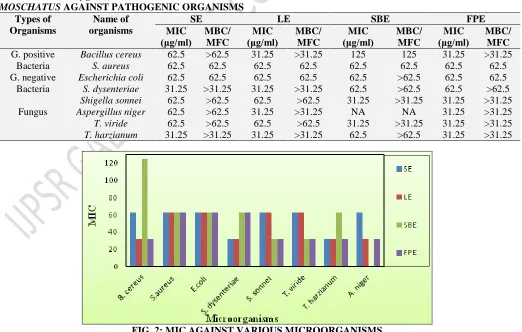
Determination of MIC, MBC and MFC values: The MIC, MBC and MFC values obtained for the ethanolic extracts against the tested pathogenic microorganisms was really remarkable as like their zone of inhibition activity. The results shown in Table 3 and Fig. 2 reported that ethanolic extract of different parts of A. moschatus posses potent antimicrobial agent. There was no remarkable variation of different parts of the plant species among their MIC values but their MBC and MFC values was characteristics in case of different micro-organisms. For instance, LE and FPE showed least MIC value 31.25 μg/ml against B. cereus and also the MBC value was higher than their MIC value in comparison to SE and SBE of the plant (Table 3 and Fig. 2). Interestingly, LE, SBE, FPE and SE exhibited equial MIC and MBC value except SBE of A. moschatus. MIC value
equal to MBC value represents their bactericidal activity against respective organisms. In case of S. dysenteriae and S. sonnei the MIC value was 31.25 - 62.5 μg/ml, where MBC value was higher than MIC.
The extracts of A. moschatus also showed potent antifungal activity as compared to their antibacterial efficacy. The antifungal MIC value was the range between 31.25 to 62.5μg/ml where the extracts antifungal activity was varied against different microorganisms but SBE of A. moschatus
was not responsive against A. niger as like their inhibitory effect. Among the tested fungus except SBE, all other parts of the plant species was highly effective against T. harzianum with their lowest MIC value of 31.25 μg/ml but MFC value was higher than their MIC value (Table 3 and Fig. 2).
TABLE 3: MIC (µg/ml), MBC AND MFC PERFORMANCE OF DIFFERENT EXTRACTS OF ABELMOSCHUS
MOSCHATUS AGAINST PATHOGENIC ORGANISMS
Types of Organisms
Name of organisms
SE LE SBE FPE
MIC (μg/ml)
MBC/ MFC
MIC (μg/ml)
MBC/ MFC
MIC (μg/ml)
MBC/ MFC
MIC (μg/ml)
MBC/ MFC G. positive
Bacteria
Bacillus cereus 62.5 >62.5 31.25 >31.25 125 125 31.25 >31.25
S. aureus 62.5 62.5 62.5 62.5 62.5 62.5 62.5 62.5
G. negative Bacteria
Escherichia coli 62.5 62.5 62.5 62.5 62.5 >62.5 62.5 62.5
S. dysenteriae 31.25 >31.25 31.25 >31.25 62.5 >62.5 62.5 >62.5 Shigella sonnei 62.5 >62.5 62.5 >62.5 31.25 >31.25 31.25 >31.25 Fungus Aspergillus niger 62.5 >62.5 31.25 >31.25 NA NA 31.25 >31.25
T. viride 62.5 >62.5 62.5 >62.5 31.25 >31.25 31.25 >31.25
[image:5.612.49.571.416.748.2]T. harzianum 31.25 >31.25 31.25 >31.25 62.5 >62.5 31.25 >31.25
[image:5.612.48.570.426.735.2]DISCUSSION: Antimicrobial screening from natural sources has received immense attention of researchers and the antimicrobial activity attributed to some plants in treating diseases has been beyond belief. Now the scientists have directed their efforts to identify compounds that can act as suitable antimicrobial agents to replace synthetic ones. Plant derived photochemical serves as arsenal in controlling the growth of microorganisms due to their availability, fewer side effects and reduced toxicity. These compounds have significant therapeutic application against human pathogens including bacteria, fungi or virus 19. Numerous studies have been conducted on the antimicrobial activity of different plant extracts. Many plants have been found to cure urinary tract infections, gastrointestinal disorders, respiratory diseases and cutaneous infections 20, 21.
In the present study, extracts of A. moschatus was evaluated for the exploration of their antimicrobial activity against certain Gram negative and Gram positive bacteria and fungus which was regarded as human pathogenic microorganism. In this study, for the first time we have attempted to compare antimicrobial activity of different parts of A. moschatus. Susceptibility of each part extracts was tested by serial microdilution method (MIC) and agar well diffusion method. Therefore, medicinal plants are finding their way into pharmaceuticals, neutralceuticals and food supplements.
Our preliminary findings showed that ethanolic extracts of different parts of A. moschatus were significantly active against some human pathogens like Escherichia coli, Staphylococcus aureus,
Bacillus cereus, Shigella dysenteriae and Shigella sonnei as well as few fungus. Previous studies only reported antimicrobial properties of methnolic extracts of flower, leaves and seed extract of A. moschatus 15, 22. Though our results support the previous findings of the antimicrobial results but our findings may consider as a potential candidate for antimicrobial agents on the basis of their antimicrobial comparison.
Furthermore, it was difficult to recognize individual part as highly active principle against all tested pathogens. There was varying degree of antimicrobial susceptibility against various strains of tested pathogens. However, among the four parts
mainly the leaf and seed part can be considered as potential extracts that showed significant antimicrobial activity against all tested pathogens. Though, the mechanism of action of these plant constituents is not yet fully known it is clear that the effectiveness of the extracts largely depends on the content and nature of their bioactive compounds that also depends on the type of solvent is used. It is reported that most of the antibiotic compounds already identified in plants are aromatic or saturated organic molecules which can easily solubilized in organic solvents 23, 24.
Our findings also indicate that the ethanolic extract of different parts mostly solubilizes the active
compounds which was bacteriostatic and
bacteriocidal in nature that shows significant antimicrobial properties. The MIC value of the plant extracts supports their zone of inhibition with the range of 31.25 to 125 µg/ml. In case of S. aureus and E. coli the MIC (62.5 µg/ml) value was equal to MBC (62.5) value of all parts except stem bark that suggests the presence of bacteriocidal effect. For other tested microorganisms the MIC value was lower than their MBC values (Table 1, 2 and 3) suggesting that the plant extracts were bacteriostatic at lower concentration but bactericidal at higher concentration against respective tested pathogens.
CONCLUSION: The current study reveals that ethanolic extracts of different parts of A. moschatus
showed a broad spectrum and strong anti-bacterial as well as antifungal activity. Different parts were
highly active against specific tested
microorganisms. The reason of this varying antimicrobial activity was the difference in nature and content of active phytochemicals present in the extracts of A. moschatus. The antimicrobial effect was increased by increasing the concentration of the phytochemicals, which could be used as an alternative for existing antimicrobial agents.
Therefore, further phytochemical and
pharmacological study is necessary to isolate and characterize the bio-active compounds that can appeared as a miracle healing agent for infectious diseases caused by globally concerning multi-resistant human pathogens.
University, Rajshahi - 6204, Bangladesh for laboratory and all logistic support. The authors also thank to Council of Scientific and Industrial Research (BCSIR) for some instrumental and chemical support. The authors also grateful to Md. Arshed Alam, Deputy chief technical officer, Department of Botany, University of Rajshahi for the identification of the plant.
REFERENCES:
1. Westh H, Zinn CS, Rosdahl VT: An international multicenter study of antimicrobial consumption and resistance in Staphylococcus aureus isolates from 15 hospitals in 14 countries. Microb Drug Resist. 2004; 10(2): 169-176.
2. Driscoll JA, Brody SL, Kollef MH: The epidemiology, pathogenesis and treatment of Pseudomonas aeruginosa
infections. Drugs. 2007; 67(3): 351-368.
3. Del Toro MD, Rodriguez-Bano J, Martinez-Martinez L, Pascual A, Perez-Canoa R, Perea EJ, Muniain MA: Epidemiology, clinical features and prognosis of infections due to Stenotrophomonas maltophilia. Enferm Infecc Microbiol Clin. 2006; 24(1):4-9.
4. Bandow JE, Brotz H, Leichert LI, Labischinski H, Hecker M: Proteomic approach to understanding antibiotic action. Antimicrob Agents Chemother. 2003; 47(3): 948-955. 5. Rojas R, Bustamante B, Bauer J, Fernández I, Albán J,
Lock O: Antimicrobial activity of selected Peruvian medicinal plants. J Ethnopharmacol. 2003; 88(2-3): 199- 204.
6. Leon J. Rojo E, Sanche-Serrano JJ: Wound signalling in plants. J Exp Bot. 2001; 52(354): 1-9.
7. Saad B, Azaizeh H, Said O: Tradition and perspectives of Arab herbal medicine: A review. Evid Based Complement Altern Med. 2005; 2(4): 475–479.
8. Kalemba D, Kunicka A: Antibacterial and antifungal properties of essential oils. J Curr Med Chem. 2003;
10(10): 813-829.
9. Bocanegra-Garcia V, Camacho-Corona M, Ramirez-Cabrera M, Rivera G, Garza-González E: The bioactivity of plant extracts against representative bacterial pathogens of the lower respiratory tract. BMC Res Notes. 2009; 2: 95.
10. Bakht J, Tayyab M, Ali H, Islam A, Shafi M: Effect of different solvent extracted sample of Allium sativum
(Linn) on bacteria and fungi. Afr J Biotechnol. 2011; 10(31): 5910-5915.
11. Cowan MM: Plant products as antimicrobial agents. Clin Microbiol Rev. 1999;12(4): 564-82.
12. Agharkar SP: Medicinal plants of Bombay presidency. Scientific Publ. Jodhpur: India 1991; First reprint p. 1-2. 13. Grieve: A Modern Herbal. Penguin 1984; ISBN
0-14-046-440-9.
14. Lindley J: Flora medica. New Delhi: Ajay Book Service; 1981. p. 456.
15. Gul MZ, Bhakshu LM, Ahmad F, Kondapi AK, Qureshi IA, Irfan A, Ghazi IA: Evaluation of Abelmoschus moschatus extracts for antioxidant, free radical scavenging, antimicrobial and antiproliferative activities using in vitro assays. BMC Complement Altern Med. 2011; 11:64.
16. Alam AHMK, Rahman MAA, Baki MA, Rashid MH, Bhuyan MSA, Sadik MG: Antidiarrhoeal principle of
Achyranthes ferruginea Roxb. and their cytotoxic
evaluation. Bangladesh Pharm J. 2002; 12:1–4.
17. Bauer AW, Kirby WM, Sherris JC, Turck M: Antibiotic susceptibility testing by a standardized single disk method. Am J Clin Pathol. 1966; 45(4):493-496
18. National Committee for Clinical Laboratory Standards: Methods for dilution antimicrobial susceptibility tests for bacteria that grow aerobically; approved standard fifth edition. Wayne (PA):NCCLS; 2000.
19. Ahmad I, Beg AZ: Antimicrobial and phytochemical studies on 45 Indian medicinal plants against multiple drug resistant human pathogens. J Ethanopharmacol. 2001; 74(2): 113-123.
20. Zakaria Z, Sreenivasan S, Mohamad M: Antimicrobial Activity of Piper ribesoides Root Extract against
Staphylococcus aureus. J App Biol Sci. 2007; 1(3): 87-90. 21. Somchit MN, Reezal I, Nur IE, Mutalib AR: In vitro
antimicrobial activity of ethanol and water extracts of
Cassia alata.J Ethnopharmacol. 2003; 84(1): 1-4. 22. Kutlu T, Yıldırım I, Kırbağ S: Comparison of
antımicrobial activity of methanol and ethanol extracts of
Abelmoschus moschatus dry flowers. Biol Chem Res. 2015; 123-127.
23. Preethi R, Devanathan VV, Loganathan M: Antimicrobial and antioxidant efficacy of some medicinal plants against food borne pathogens. Adv Bio Res. 2010; 4(2): 122-125. 24. Seyydnejad SM, Niknejad M, Darabpoor I, Motamedi H:
Antibacterial activity of hydroalcoholic extract of
Callistemoncitrinus and Albizia lebbeck. Am J App Sci. 2010; 7(1): 13-16.
All © 2013 are reserved by International Journal of Pharmaceutical Sciences and Research. This Journal licensed under a Creative Commons Attribution-NonCommercial-ShareAlike 3.0 Unported License.
This article can be downloaded to ANDROID OS based mobile. Scan QR Code using Code/Bar Scanner from your mobile. (Scanners are available on Google Playstore)
How to cite this article: