FAST SELECTIVE ENCRYPTION FOR VIDEO STREAM OF
HIGH EFFICIENCY VIDEO CODING STANDARD
MOHAMMED A. SALEH, NOORITAWATI MD. TAHIR, AND HABIBAH HASHIM Faculty of Electrical Engineering
Universiti Teknologi MARA(UiTM) 40450, Shah Alam, Selangor, Malaysia
ABSTRACT
In this paper, a lightweight encryption method is developed to protect the visual information of video. Due to the new video coding standards High Efficiency Video Coding (HEVC), and in order to meet the compression requirements a new enhancement for the existing encryption schemes is needed. This is because the lack of the ability of the current encryption methods to balance the security level with the compression efficiency of HEVC standard. Hence, we utilized the selective encryption for the sensitive syntax elements to secure video transmission and fulfill the attributes of HEVC standard. This is done via selection of sensitive syntax elements (Absolute Coefficient Levels) that are encrypted using Advanced Encryption Standard (AES) algorithm. On several video benchmarks, the analysis results obtained that the relevant security level of visual video perception is achieved, a trade-off between encryption reliability, flexibility, maintaining the HEVC bitstream format compliance, and computational complexity are provided. The protection level of this method is strong enough against plaintext and brute force attacks.
Keywords: HEVC/H.265, selective encryption, video security, AES, bin string encryption.
1. INTRODUCTION
Concurrently with the recent rapid increase in the use of internet and telecommunication technologies, security attacks have been increased due to the rapid growth in video sharing applications via smart devices. On the other hand, end users’ consciousness about the confidentiality of their sensitive information that can be shared through the enormous internet network. Cisco has forecasted that mobile video sharing will occupy more than 69% of smart mobile data traffic for the year 2019, with total global percentage of smart mobile traffic targeted to be at 97% [1].
Video compression technique is used to maintain the bandwidth requirements by minimizing the data size that represents the video information. It is started as the popular analog video phone system in the year 1960 up to the recent High Efficiency Video Coding (HEVC) which was introduced by ITU-T and ISO/IEC in 2013 [2]. As we are aware, video consist of large data size, therefore, to ensure the security of data transmission over internet network, the video streaming requirements have to be taken into account, such as data communications, data retrieval, video contents compression and hardware resource. Moreover, since a new video compression standard
HEVC was published lately, there is a demand for video streaming protection [3], [4]. Hence, in this study, we deemed further to design and develop an encryption method to secure HEVC video data.
There are two types of video data encryption techniques namely full encryption and selective encryption [5]. Due to high computational overhead generated by full encryption, only the selective encryption for video data will be considered here.
This method was proposed to secure all visual video information using Advanced Encryption Standard (AES). Hence the Context Adaptive Binary Arithmetic Coding (CABAC) in HEVC has been adopted to transform a video codec into a crypto coding module to achieve the encryption/decryption combined with encoding/decoding at the same time. In ensuring the robustness of encryption technique, sensitive syntax elements are selected for encryption purpose, while maintaining format compliance of video bitstream; the bit rate of the video stream; and computational complexity.
proposed selective encryption scheme is elaborated in Section 4. Then, the experimental implementation and results are presented and summarized in Sections 5. Finally, the conclusion of this paper is presented in Section 6.
2. HEVC ENTROPY CODING
The entropy coding techniques in the modern coding standards are Context Adaptive Variable Length Coding (CAVLC) and Context-Based Adaptive Binary Arithmetic Coding (CABAC) [6]. ITU-T Video Coding Experts Group (VCEG) and ISO/IEC Moving Picture Experts Group (MPEG) have developed the CABAC algorithm within the joint H.264/AVC standardization process. During the ITU-T VCEG meeting that was held earlier in 2001, the new entropy coding method CABAC was introduced as a standard contribution and was denoted as the first version [7]. CABAC was implemented as one of the two alternative approaches for entropy coding of the H.264/AVC standard [8], [9]. However, Context Adaptive Variable Length Coding (CAVLC) was specified in H.264/AVC as a low-complexity entropy coding method, which depends on usage adaptively switched sets of variable length codes [10]. CAVLC encodes with low implementation complexity and low encoding efficiency as compared to CABAC [11], [8], [12].
In HEVC, the CABAC is also part of the first test model HM1.0 (HEVC reference software) that is combined with the Low Complexity Entropy Coding (LCEC) as a subsequent of CAVLC [12], [10]. Lastly, after the HEVC standardization improvements, the latest versions of HMs include CABAC only.
In CABAC, bin string statistical properties are utilized to compress video data, thus, it is denoted as a lossless compression scheme [13]. The entropy coding represents the video syntax elements as codeword or bit string, where the number of bits of that codeword is logarithmically proportional to the probability occurrence of the syntax element [14]. In HEVC standard, the syntax elements describe each of the properties of the Coding Tree Unit (CTU), Prediction Unit (PU), and Transform Unit (TU). The related syntax elements of the CTU are specified as follow: to describe the parameters for the block partitioning of the CTU into coding units (CU), to determine whether the CU is spatially predicted (Intra-frame) or temporally predicted (Inter-frame) and to describe the quantization parameters of the CU [15]. In the syntax elements of PU, the intra prediction mode, and the motion data are described. In the TU, the syntax elements describe the sign and
magnitude of the quantized transform coefficients and non-zero coefficient map in TU.
The basic design of CABAC is a combination of three main phases that are: binarization; context modeling; and binary arithmetic coding. In Figure 1, CABAC encoding block diagram describes that phases as the main algorithmic building blocks. In binarization phase, the non-binary syntax elements are binarized into binary symbols (bins). In context modeling (regular coded), the probabilities of each bin are estimated based on some specific context. In the last stage (binary arithmetic coding), the bins compress to bits according to that estimated probability.
The proposed method in this work is based on the binarization stage in CABAC that responsible for formatting the non-binarized syntax elements into sequences of binary symbols called bins, which can also interpret in terms of a binary code tree. The binarization process is performed by different binarization methods namely Unary, Truncated Unary (TrU), kth order Truncated Rice (TRk), kth order Exp-Golomb code (EGk) or Fixed Length (FL) code binarization [9]. All of these methods are inherited from the binarization technique of H.264/AVC standard except the kth order Truncated Rice (TRk) method. The main idea of the binarization methods is how to represent the non-binary value N efficiently in a lesser number of bits.
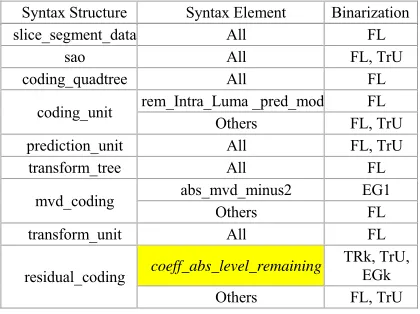
The non-binary syntax elements in the HEVC can be binarized with the single binarization method from one of the five binarization techniques listed above or by combining more than one method, for instance, the rem_Intra_Luma_pred_mode element is
binarized by FL while coeff_abs_level_remaining
(calr) is binarized by TrU, TRk, and EGk [10].
3. PREVIOUS PROPOSED SELECTIVE
ENCRYPTION METHODS ON HEVC
In order to reduce the computational overhead of the data encryption, the selective encryption is used. Whereas the determined parts of the compressed bit stream are encrypted to provide sufficient security [13]. There are different types of encryption algorithms that can be used for selective encryption for video or image data, for example, AES and Data Encryption Standard (DES) [16], [4]. It was found that previous research work on video encryption applied the encryption algorithms on the video data at different stages for instance prior to entropy coding or before transform coding.
encryption methods. Firstly, in 2014 Hofbauer et. al. [17] proposed a scheme on HEVC standard based on encrypting the sign bits in the luminance channel only. The limitation of this method is as reported in [3], which stated, the encryption for the sign bits is not able to provide higher security level. Later in 2014, Shahid [18] proposed a new selective encryption method for HEVC standard on the CABAC entropy codec. In his method, some of the syntax elements are selected and encrypted using AES where these elements consist of the sign bit of Quantized Transform Coefficient (QTCs), the suffix of TRp code, the suffix of EG0 code, the sign of MVDs and the suffix of EG1 code. The advantage of this method is that, it is able to provide highly efficient security. However, due to the percentage of the encrypted data, the computational complexity is increased. Furthermore, the bit rate is also increased by the padding function that was applied on the plaintext. Another relative encryption scheme was proposed by Memos in [19]. The author proposed to encrypt all video data in I frame by AES algorithm. Since the higher percentage of video information is in I frame, efficient security level is provided but in return it generates an increase in the computational complexity and bitrate. In [20], Saleh et al. proposed a new encryption approach to secure moving information in the video by encrypting the Motion Vector Difference (MVD) using AES.
4. THE PROPOSED SELECTIVE
ENCRYPTION FOR HEVC
As mentioned earlier, the latest version of HEVC standard only supports CABAC in all coding configurations. To avoid computational complexity, only some of bypassed syntax elements are selected as encrypted segment, Figure 1 shows the encrypted part of bypassed syntax elements in CABAC. The encryption process has been done on the selective syntax elements using AES, which denoted as the most robustness encryption standard. AES offers five encryption modes namely CBC, ECB, CTR, OCB, and CFB whilst Cipher Feedback (CFB) mode is known as the most suitable mode for streaming encryption [5]. Thus, the CFB mode has been used to encrypt the specific syntax elements. In this approach, entropy coding stage serves the purpose of encryption syntax elements without affecting the coding efficiency of video coding standard by completely maintaining the compliant of a bitstream with low computational power.
The selective syntax elements can be produced from the non-zero coefficients in the transform unit. However, the transform unit which does not contain
a non-zero coefficient whilst the zero coefficients in non-zero transform unit is not encoded. In the entropy coding stage, the sensitive syntax elements can be selected from CABAC as an important effective factor. As explained earlier, every non binary syntax element can be binarized by one or more method of the five binarization technique. Table 1 shows the main syntax elements and their binarization techniques with selected element highlighted. Recall that coeff_abs_level_remaining, is the remaining
absolute value of a transform coefficient level that is coded with Golomb-Rice code at the scanning position n and if coeff_abs_level_remaining is not
present, it is assumed to be nil [19] .
As for the CABAC coding process, the bins can be either regular (context) coded or bypass coded. In bypass coded, bins do not require regular encoding which allows these bins to be processed at a much high throughput than context coded bins [15], [20], [20].
[image:3.612.313.523.435.592.2]Further, the binarization for the absolute coefficient levels is based on concatenated application of three binarization processes specifically truncated unary (TrU), kth order truncated Rice (TRk) and kth order Exp-Golomb (EGk).
Table 1: Main Syntax Elements and Their Binarization Process
Syntax Structure Syntax Element Binarization
slice_segment_data All FL
sao All FL, TrU
coding_quadtree All FL
coding_unit rem_Intra_Luma _pred_mod FL
Others FL, TrU
prediction_unit All FL, TrU
transform_tree All FL
mvd_coding abs_mvd_minus2 EG1
Others FL
transform_unit All FL
residual_coding coeff_abs_level_remaining
TRk, TrU, EGk
Others FL, TrU
4.1 Selection and Encryption for Syntax Elements (Plaintext)
Since the calr represents the remaining absolute
value of the transform coefficient levels for every transform unit (TU), the TU is split into coded sub-blocks with each of them is a 4×4 pixel block and each of these blocks is scanned and the absolute coefficient levels syntax elements are generated.
1. Coefficient absolute levels greater than one
coeff_abs_level_greater1 (calg1);
2. Coefficient absolute levels greater than two
coeff_abs_level_greater2 (calg2);
3. Coefficient absolute levels remaining
coeff_abs_level_remaining (calr).
The first and second syntax elements are represented by one bit for each other while the calr is
represented by a series of bits. Due to the length of calg1 and calg2 (one bit), the encryption is useless
[3]. In this approach, the sequences of a specific number of calr syntax elements are denoted as the
plaintext stream input of the encryption algorithm Pi. Further, Figure 2 illustrated the encryption process in the proposed method using AES algorithm with the CFB mode for calr that will be encrypted if it is
binarized using Exp-Golomb and if the number of Transform Coefficient Count (TCC) (calr syntax
element in the TU) is more than four instead of each syntax elements. TCC represents the number of the non-zero coefficient value in any TU. This condition has been selected because the value four was found as an optimal value of the TCC, where if the value of TCC equal to or less than four gives a non encrypted video while if the TCC greater than four gives an encrypted video.
4.2 Decryption Process
At the decoder end upon completion of the arithmetic decoding process, the original plain text Pi (calr) is retrieved (decrypted) from the ciphertext Ci using the proposed algorithm and same encryption key. Note that the original plain text can be retrieved by applying the same procedure that is used for generating the cipher text. In other words, to substitute and generate the original syntax element of the absolute coefficient level, similar encryption key Ek of AES is used to generate the keys stream.
5. EXPERIMENTAL IMPLEMENTATION
AND RESULTS
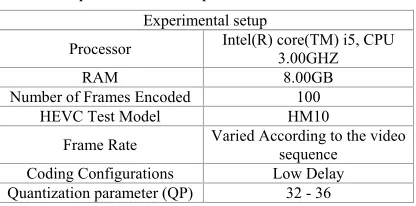
Using the HEVC test model HM10, the simulation is performed on a system as described in Table 2. All experimental and analysis are performed on several types of benchmark video sequences. The utilized video classes in terms of resolution and frame rate of each video sequences are tabulated in Table 3. The experimental results performed by encryption and decryption calr of the HEVC in case the number
of these elements in the transform unit are more than four. The used coding configuration of HEVC is Low Delay Main.
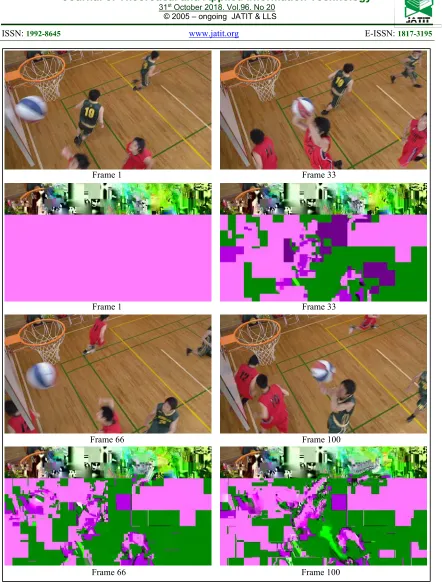
The visual distortion for the encrypted videos is conducted and the results are as observed in Figure 3 for BasketBallDrill video sequences. Furthermore,
[image:4.612.315.523.207.310.2]the bit rate and total data of encrypted and non-encrypted for various type of benchmark video sequences for quantization parameters 32 to 36 using Low Delay Main coding configuration are described in Table 4.
Table 2: Experiment PC Properties
Experimental setup
Processor Intel(R) core(TM) i5, CPU 3.00GHZ
RAM 8.00GB
Number of Frames Encoded 100
HEVC Test Model HM10
Frame Rate Varied According to the video sequence
Coding Configurations Low Delay
Quantization parameter (QP) 32 - 36
Table 3: The Set of Benchmark Video Sequences Used for Simulate the Video Encryption Method on HEVC
Class Sequence Resolution Frame Rate
A Traffic 2560×1600 30
PeopleOnStreet 2560×1600 30
B ParkScene 1920×1080 24
Kimono 1920×1080 24
C
BasketBallDrill 832×480 50
BQMall 832×480 60
PartyScene 832×480 50
RaceHorseC 832×480 30
D
BasketBallPass 416×240 50
BQSquare 416×240 60
BlowingBubbles 416×240 50
RaceHorses 416×240 30
E
Vidyo1 1280×720 60
Vidyo3 1280×720 60
[image:4.612.314.523.559.726.2]Vidyo4 1280×720 60
Table 4: Bitrate and Data Size for Non-Encrypted and Encrypted Video Sequences
Sequence Bitrate(kbps) Total size
Non-Encry. Encrypted Non-Encry. Encrypted
Traffic 5019.456 5113.320 209144 213055
PeopleOnStreet 11112.792 11183.208 463033 465967
ParkScene 2493.888 2540.294 129890 132307
Kimono 2111.174 2174.266 109957 113243
BasketBallDrill 1128.200 1139.600 28205 28490
BQMall 1738.176 1744.608 36212 36346
PartyScene 3783.760 3827.200 94594 95680
RaceHorseC 1647.672 1655.160 68653 68965
BasketBallPass 343.480 346.760 8587 8669
BQSquare 828.192 858.864 17254 17893
BlowingBubbles 573.680 570.680 14342 14267
RaceHorses 513.144 517.560 21381 21565
Vidyo1 1048.368 1057.296 21841 22027
Vidyo3 1237.584 1286.832 25783 26809
5.1 Video Quality Analysis
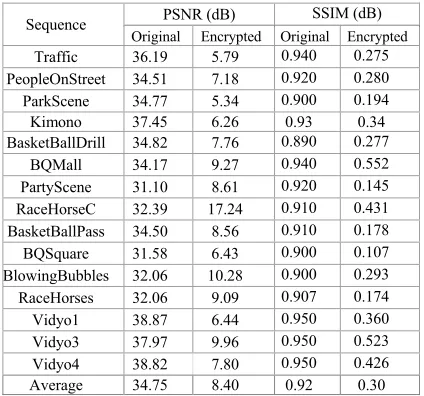
In order to evaluate the encryption performance of this proposed method, the video quality is tested using two video quality performance measures, Peak Signal-to-Noise Ratio (PSNR) [21] and Structural Similarity Index Metric (SSIM) [22]. Both PSNR and SSIM are used for evaluating and validating the quality of the original video as compared to the encrypted version of these videos.
Furthermore, Table 5 tabulates the comparison of analysis metric PSNR and SSIM of all encrypted and non-encrypted benchmark video sequences. The average value of PSNR for all non-encrypted benchmark video sequences is 34.75 dB whilst it is 8.4 dB for all encrypted benchmark video sequences. In addition to that, the results of SSIM upon evaluation of the quality difference between encrypted and non-encrypted benchmark video sequences are described, where the SSIM average value for the original encoded video is 0.92 dB and 0.30 dB for the encrypted video.
From the analysis results of PSNR and SSIM, it is proven that the proposed method is strong enough for distorting the video contents information (perceptual encryption) and suitable for each video sequences classes.
5.2 Computational Analysis
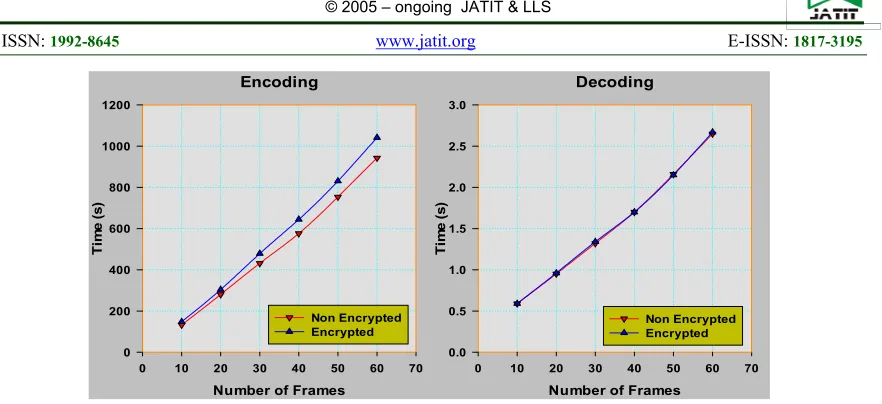
In any encryption method, the computational overhead and bit rate need to be taken into consideration. Here, Table 6 tabulate the encryption and decryption time as compared to the encoding and decoding time without encryption based on different benchmark video sequences. Also in Table 7, the time of encryption and decryption BasketBallPass sequence with different encoded frames is also tabulated. It is observed from the results that the delay is acceptable to use this method for the video streaming because the percentage of the encrypted data is low as compared to the overall video data, which directly proportion with the computational complexity and time delay, thus the generated computational complexity is low. The effecting of the encryption method on the encoding processor in terms of computational overhead is described in Table 8, where we have calculated the impact of the encryption process on the computational complexity using PC as detail in Table 2. The computational weight requirements are acceptable.
[image:5.612.312.524.117.315.2]Figure 4 (last page) shows the impact of the encryption process on encoding and decoding time for BasketBallPass video sequence.
Table 5: PSNR and SSIM Comparison for Encrypted and non-Encrypted Video Sequences
Sequence PSNR (dB) SSIM (dB)
Original Encrypted Original Encrypted
Traffic 36.19 5.79 0.940 0.275
PeopleOnStreet 34.51 7.18 0.920 0.280
ParkScene 34.77 5.34 0.900 0.194
Kimono 37.45 6.26 0.93 0.34
BasketBallDrill 34.82 7.76 0.890 0.277
BQMall 34.17 9.27 0.940 0.552
PartyScene 31.10 8.61 0.920 0.145
RaceHorseC 32.39 17.24 0.910 0.431
BasketBallPass 34.50 8.56 0.910 0.178
BQSquare 31.58 6.43 0.900 0.107
BlowingBubbles 32.06 10.28 0.900 0.293
RaceHorses 32.06 9.09 0.907 0.174
Vidyo1 38.87 6.44 0.950 0.360
Vidyo3 37.97 9.96 0.950 0.523
Vidyo4 38.82 7.80 0.950 0.426
Average 34.75 8.40 0.92 0.30
Table 6: Processing Time of Encoding and Decoding with and without Encryption for All Benchmark Video Sequences
Video Sequences
Time (Second)
Non-Encrypted Encrypted
Encode Decode Encode Decode
Traffic 5003.947 18.085 5274.270 13.020 PeopleOnStreet 8470.463 32.024 10423.230 21.651 ParkScene 2738.561 10.395 3283.287 10.563 Kimono 3954.820 14.428 4090.055 15.526 BasketBallDrill 656.453 2.652 692.055 3.644
BQMall 548.293 2.204 609.181 1.876 PartyScene 743.133 3.626 917.660 3.633 RaceHorseC 962.970 3.837 1155.304 3.975
BasketBallPass 432.587 1.347 478.655 1.351
BQSquare 137.044 0.715 171.183 0.717 BlowingBubbles 155.392 1.102 169.176 0.792 RaceHorses 237.220 1.045 307.861 1.035 Vidyo1 950.643 3.470 991.059 3.166 Vidyo3 1019.744 3.572 1061.568 2.874 Vidyo4 970.183 3.534 1006.974 3.512
Table 7: HEVC Encoding/Decoding Processing Time Comparison Encryption and without Encryption for the BasketBallPass Video Sequence
Frame Encoding Time (s) Decoding Time (s)
Original Encryption Original Encryption
10 132.35 148.05 0.59 0.59
20 280.33 303.76 0.95 0.96
30 431.57 478.66 1.32 1.34
40 576.04 644.35 1.70 1.70
50 753.70 830.48 2.16 2.15
60 942.92 1041.57 2.65 2.67
Table 8: Analysis of CPU Processing for HEVC Encoder and Decoder with Encryption and without Encryption
Original Encrypted Original Encrypted
BasketBallPass 19.38 19.66 0.09 0.07
BQSquare 21.74 17.62 0.11 0.06
BlowingBubbles 15.21 22.76 0.15 0.07
RaceHorses 19.93 19.08 0.12 0.35
Vidyo1 23.56 15.05 0.18 0.23
Vidyo3 14.48 22.12 0.12 0.44
Vidyo4 23.23 17.93 0.15 0.42
5.3 Security Analysis
In this section, the security of the encryption approach is analyzed and evaluated according to the following points:
Entropy, and local standard deviation; Encrypted video correlation
Effectiveness of an encryption key
Protection against the Key Plaintext and Brute Force Attacks
5.3.1 Analysis of entropy, and local standard deviation
Here, the proposed approach has been tested by measuring the frame data contents with the entropy via comparing the original frames with the encrypted frames. This analysis is performed by utilizing the statistical randomness to characterize the texture of frame. Therefore, the quality of the frame is measured using the image entropy H(X). Recall that as stated by Shannon [23] the original frame has higher entropy value and lower standard deviation value than the encrypted frame. In addition to frame entropy analysis, the local standard deviation σ(j) of the noise and interference of video frame for the encrypted frame has been analyzed by comparing it with the original frame. The frame entropy is retrieved as in (1) while the local standard deviation σ(j) is computed using (2).
i= 0 2
H (X ) ( ) lo g 2 ( ).
k
i i
p
(1)
1
1
( ) m ( )
i
j i p j
m p
(2)where αi is the frame gray levels, p(αi) is the probability of gray level, k is the number of bit per
pixels (i.e. in this test, k equal to 8), 𝑃 𝚥 is the
neighbor pixel's local mean, m is the pixel block size
to calculate the local mean and standard deviation, and M is the size of the frame.
By applying equation (1) on the original frame of
Vidyo3, the entropy is 6.9188 bits/pixel, where its
value of the encrypted frame is 2.4184 bits/pixel. Next, using equation (2), the mean local standard deviation value for the original frame of Vidyo3 is
59.1033 gray levels while the mean local standard deviation of the encrypted frame is 124.96 gray
levels. These results demonstrated that the proposed method is robust for protecting the encrypted video against statistical attacks.
5.3.2 Encrypted video correlation
As we are aware, the pixels in the frame are normally correlated with each other. Therefore, in the original frame, the correlation between pixels is high. Whereas, if the encrypted frame has high correlation pixels that indicated the frame can be detected, that is to say, the encrypted information contents of a frame can lead to retrieving the original image easily. In this proposed approach, low correlation pixels within the encrypted frame are produced where the correlation of a pixel with its neighbouring pixel is specified as in (3). 0 1 ( , ) ( )( ) 1 n
i i i i
x y
x x y y
corr x y
n
(3)where, 𝑥 represents the horizontal local mean, 𝑦 is the vertical local mean, n is the number of pixels (xi, yi), σx and σy represent standard deviation of x and y respectively. The normal value of the pixels correlation is 𝑐𝑜𝑟𝑟 𝑥, 𝑦 ≅ 1, the correlation of adjacent pixels in the original frame of Kimono video
sequence is 0.9997 and it is equal to 0.1461 in encryption frames of the same sequence. As noted, the results clearly showed major difference between the correlation of original and encryption frames pixels. Thus, from these results, the robustness of the proposed encryption method has been proven.
5.3.3 Protection against the key plaintext and brute force attacks
Here the proposed scheme against the Key Plaintext Attack (KPA) is analyzed. KPA is the retrieving for encrypted data based on the non-encrypted data. The non-encrypted data can be easily predicted using the KPA if the encrypted data is a single bit such as sign bits of transform coefficient or sign bits of Motion Vector Difference (MVD). In this approach, the encrypted data length is more than one bit, hence, it gives a robust encryption against the brute force attack. Using AES algorithm to encrypt
calr data, the ciphertext is not vulnerable to KPA as
has reported in [24].
6. CONCLUSION
In conclusion, enhancement method for video encryption is developed for High Efficiency Video Coding standard. This is done by encrypting the most significant syntax element in HEVC bit stream for the entropy coding of HEVC standard. Further, selective encryption of HEVC is performed using AES algorithm. The experimental results of the proposed scheme showed that the reliable perceptual security is attained along with the protection against both of the key plain text and brute force attacks while maintaining the HEVC bitstream format compliance with low computational complexity. Consequently, from the experiment results, it can be concluded that the proposed encryption method is suitable for the real-time application and limited resource systems.
ACKNOWLEDGMENT
The authors would like to thank the Ministry of Higher Education (MOHE) Malaysia for providing the grant 600-RMI/NRGS 5/3(5/2013), and Research Management Institute (RMI) of Universiti Teknologi Mara for supporting this research work.
REFERENCES
[1] Cisco, “Cisco Visual Networking Index: Global Mobile Data Traffic Forecast Update 2014–2019.” [Online]. Available: http://www.cisco.com/c/en/us/solutions/collat eral/service-provider/visual-networking-index-vni/white_paper_c11-520862.html. [Accessed: 29-Jul-2017].
[2] G. J. Sullivan, J. Ohm et al., “Overview of the High Efficiency Video Coding (HEVC) Standard,” IEEE Trans. Circuits Syst. Video Technol., vol. 22, no. 12, Dec. 2012, pp. 1649–
1668.
[3] Y. Wang, S. Member et al., “A Tunable Encryption Scheme and Analysis of Fast Selective Encryption for CAVLC and CABAC in H.264/AVC,” IEEE Transic. Circuits Syst. Video Technol., vol. 23, no. 9, Sep. 2013, pp.
1476–1490.
[4] S. Gupta, L. Kishor et al., “Comparative Analysis of Encrypted Video Streaming in Cloud Network,” Int. J. Comput. Sci. Inf. Technol., vol. 5, no. 4, Jul. 2014, pp. 5470–
5476.
[5] M. A. Saleh, N. Tahir et al., “An Analysis and Comparison for Popular Video Encryption Algorithms,” in IEEE Symposium on Computer Applications & Industrial Electronics (ISCAIE), 2015, no. 12–14, pp.
90–94.
[6] D. Marpe, H. Schwarz et al., “Context-based adaptive binary arithmetic coding in the H.264/AVC video compression standard,”
IEEE Trans. Circuits Syst. Video Technol., vol.
13, no. 7, Jul. 2003, pp. 620–636.
[7] Iain E. Richardson, The H.264 advanced video compression standard, 2nd Editio. JohnWiley
& Sons, 2010.
[8] D. Arpe, H. Schwarz et al., “Context-Based Adaptive Binary Arithmetic Coding,” IEEE Trans. circuits Syst. video Technol., vol. 13,
no. 7, 2003, pp. 620–636.
[9] D. Marpe, SchWarz et al., “Method and Apparatus for Binarization and Arithmetic Coding of a Data Value,” US 7,088,271 B2, 2006.
[10] G. J. S. Vivienne Sze, Madhukar Budagavi,
High Efficiency Video Coding (HEVC) Algorithms and Architectures. Springer, 2014.
[11] T. Davies and A. Fuldseth, “JCTVC-F162: Entropy coding performance simulations,” Jt. Collab. Team Video Coding, 2011.
[12] B. Peng, D. Ding et al., “A Hardware CABAC Encoder for HEVC,” in IEEE Symposium on Circuits and Systems (ISCAS), 2013, pp. 1372–
1375.
[13] T. Lookabaugh and D. C. Sicker, “Selective Encryption for Consumer Applications,” in
IEEE Conference Consumer Communications and Networking, 2004, pp. 124–129.
[14] T. Wiegand, G. Sullivan et al., “Joint Draft ITU-T Rec. H.264 | ISO/IEC 14496-10 / Amd.3 Scalable video coding,” Jt. Video Team JVT-X201, vol. 108, 2007, p. 563.
[15] V. Sze and M. Budagavi, “Reducing Context Coded and Bypass Coded Bins to Improve Context Adaptive Binary Arithmetic Coding (CABAC) Throughput,” US 2013/0272389 A1, 2013.
[16] A. Pande, P. Mohapatra et al., “Securing Multimedia Content using Joint Compression and Encryption,” IEEE Multimed., vol. 20, no.
4, May 2012, pp. 50–61.
[17] H. Hofbauer, A. Uhl et al., “Transparent Encryption for HEVC Using Bit-Stream-Based Selective Coefficient Sign Encryption,” in IEEE Conference on Acoustics, Speech and Signal Processing, 2014, no. 4–9 May, pp.
1986–1990.
[18] Z. Shahid and W. Puech, “Visual Protection of HEVC Video by Selective Encryption of CABAC Binstrings,” IEEE Trans. Multimed.,
vol. 16, no. 1, Jan. 2014, pp. 24–36.
media,” J. Real-Time Image Process., vol. 12,
no. 2, 2016, pp. 473–482.
[20] M. A. Saleh, N. M. Tahir et al., “Moving Objects Encryption of High Efficiency Video Coding (HEVC) using AES Algorithm,” J. Telecommun. Electron. Comput. Eng., vol. 3,
no. 2289–8131, 2016, pp. 31–36.
[21] C. A. Kim, Seung-Hwan. Kerofsky, Louis Joseph. Segall, “Golomb-Rice/EG Coding Technique for Cabac In HEVC,” WO 2013/153820 Al, 2013.
[22] J. Lou and L. Wang, “Method of Determining Binary Codewords for Transform Coefficients,” US 0202029 A1, 2013.
[23] A. Tanchenko, “Visual-PSNR measure of image quality,” J. Vis. Commun. Image Represent., vol. 25, no. 5, Jan. 2014, pp. 874–
878.
[24] Y. A. Y. Al-najjar and D. C. Soong, “Comparison of Image Quality Assessment: PSNR, HVS, SSIM, UIQI,” Int. J. Sci. Eng. Res., vol. 3, no. 8, Aug. 2012, pp. 1–5.
[25] C. E. Shannon, “Communication Theory of Secrecy Systems,” Bell Syst. Tech. J., vol. 28,
no. 4, Oct. 1949, pp. 656--715.
[26] A. Unterweger, “Post-Compression Multimedia Security,” Ph.D. thesis, Dept. Comp. Scin., University of Salzburg, Salzburg, Austria, 2014.
[27] A. Bogdanov, D. Khovratovich et al., “Biclique cryptanalysis of the full AES,” in
Conference on the Theory and Application of Cryptology and Information Security, 2011,
Figure 1. Block Diagram of CABAC
[image:9.612.92.522.291.476.2]
Figure 3: Encrypted video sequence of BasketBallDrill 832×480 using low delay coding configuration
Frame 1 Frame 33
Frame 66 Frame 100 Frame 1 Frame 33
Encoding
Number of Frames
0 10 20 30 40 50 60 70
Ti
m
e
(
s
)
0 200 400 600 800 1000 1200
Non Encrypted Encrypted
Decoding
Number of Frames
0 10 20 30 40 50 60 70
Ti
m
e
(
s
)
0.0 0.5 1.0 1.5 2.0 2.5 3.0
Non Encrypted Encrypted
[image:11.612.90.531.58.260.2]
Figure 4: Time taken by encryption for Absolute Coefficient Level of BasketBallPass video sequence