IJPSR (2016), Vol. 7, Issue 7 (Research Article)
Received on 23 February, 2016; received in revised form, 26 March, 2016; accepted, 27 May, 2016; published 01 July, 2016
FORMULATION AND IN-VITRO CHARACTERISATION OF SUSTAINED RELEASE MATRIX PELLETS OF NATEGLINIDE
S.M. Wairkar* and R.S. Gaud
Shobhaben Pratapbhai Patel School of Pharmacy & Technology Management, SVKMs NMIMS, Vile Parle (W), Mumbai, Maharashtra -400 056, India
ABSTRACT: Objective: Conventionally, sustained release pellets have been prepared in the form of reservoir systems by coating non-pareil pellets which is an expensive and tedious process. The aim of present study was to develop sustained release matrix (SRM) pellets of Nateglinide (NT), an oral antidiabetic
agent, commonly used in the treatment of Type 2 Diabetes mellitus. Methods:
The SRM pellet formulations of NT were prepared with different polymers like
HPMC K4, HPMC K15, Kollidon® SR (K-SR), Hydrogenated castor oil
(K-HCO) by extrusion spheronization process. The SRM pellet formulations were
characterized for micromeritics properties, aspect ratio, sphericity, friability, Kawakita analysis, Fourier transform infrared spectroscopy (FTIR), drug content and In vitro drug release studies. Results: The optimized formulation of SRM pellets (Batch F7) prepared by using K-SR (35%w/w) and K-HCO (15 %w/w) has shown desired sphericity and excellent micromeritics properties. The friability and drug content value were found in the range of 0.22- 0.81% and
96.8-99.7% respectively for all formulations. FTIR spectroscopy studies have
not revealed any chemical interaction between the NT and excipients. The
Kawakita plot of F7 showed good flow ability with ‘a’ value 0.4537 and ‘b’
value 0.0029. The sustained release profile showed 53.63% drug release at 6 hrs and 100% drug release within 12 hrs and Higuchi kinetic model was followed by drug release. Conclusion: Thus, Nateglinide sustained release matrix pellets can be explored for commercial manufacturing instead of conventional reservoir pellets.
INTRODUCTION: The multiparticulate dosage form has caught the attention of formulation scientists due to their tremendous potential as a multidimensional drug delivery system. The risk of dose dumping, intra- and inter-subject variability in gastric emptying times can be reduced if the drug is formulated into multiparticulate systems instead of reservoir/monolithic tablets 1-4.
QUICK RESPONSE CODE
DOI:
10.13040/IJPSR.0975-8232.7(7).2925-31
Article can be accessed online on:
www.ijpsr.com
DOI link: http://dx.doi.org/10.13040/IJPSR.0975-8232.7 (7).2925-31
Conventionally, sustained release multiparticulates have been prepared in the form of reservoir and matrix systems. In the reservoir type, drug solution or dispersion is sprayed on non-pareil pellets, followed by functional polymer coating 5-6. The entire coating process of reservoir pellets is expensive, tedious and time consuming. The manufacturing of matrix systems is relatively simple in which drug is uniformly dispersed into release controlling carrier to provide desired drug release kinetics. In addition, variations in the drug loading is adequately reduced in matrix pellets in contrary to the reservoir pellets systems 7-8.
Nateglinide is an insulin tropic agent belonging to family Meglitinide with structural name (–)-N -Keywords:
Sustained release matrix pellets, Nateglinide, Extrusio Spheronization,
Kollidon® SR, In vitro drug release
Correspondence to Author: Sarika M. Wairkar
Assistant Professor
SVKM’s NMIMS, Shobhaben Pratapbhai Patel School of Pharmacy & Technology Management, V.L. Mehta Road, Vile Parle (W), Mumbai. - 400 056, Maharashtra India.
[(trans4isopropylcyclohexane) carbonyl] – D -phenylalanine. It reduces the blood sugar by stimulating insulin secretion via ATP-dependent K+ channel on pancreatic beta-cells. The pharmacokinetics of NT is characterized by rapid absorption and elimination in the body, with elimination half-life of 1.5–1.7 hours. Thus, the frequency of dosing of NT is high, viz. 60-240 mg is administered thrice a day. Additionally, frequent administration of immediate release tablets leads to peak and valley response which is further associated with side effects like hypoglycemia and hepatic impairment 9-12.
The main objective of present study was to develop sustained release matrix (SRM) pellets of Nateglinide with commercially feasible extrusion-spheronization method. Thus, sustained release pellets will not only decrease dosing frequency but will also improve the therapeutic efficacy and safety of Nateglinide for chronic therapy of diabetes. In the present work, SRM pellets were prepared and characterized for their flow properties, particle size and shape image analysis, aspect ratio, friability, Kawakita analysis, FTIR, drug content, In vitro drug release.
MATERIALS AND METHODS:
Materials: Nateglinide was provided by Cipla Ltd., Goa, India as gift sample. Kollidon® SR (K-SR) and Hydrogenated castor oil [Kolliwax HCO (K-HCO)] were received as a gift sample from BASF ltd, India. All the other solvents, reagents and chemicals used were of analytical grade.
Manufacturing of SRM Pellets:
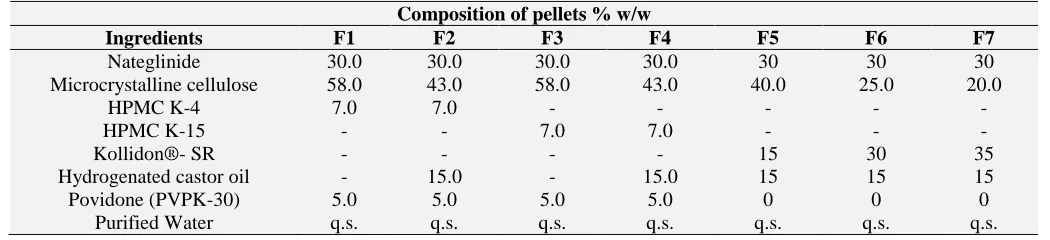
[image:2.612.44.569.452.572.2]SRM pellets were prepared by extrusion-spheronization method and composition is given in Table 1. Dry-mix was prepared as per formula by mixing NT, microcrystalline cellulose, povidone and polymers in planetary mixer for 10min at slow speed. Appropriate quantity of purified water was added gradually in dry-mix to form cohesive dough. This dough then pressed through an Extruder (UICE LAB, Umang Pharmatech, Mumbai, India) fitted with 1.0 mm screen at 100 RPM. Immediately, extrudates were rotated in Spheronizer (UICE LAB, Umang Pharmatech, Mumbai, India) at a speed of 1500- 2000 rpm for 10-15 min with compressed air supply of 0.5–1.5 bar. Subsequently, the spheronized pellets were dried in a hot air oven at 40⁰ C for 30 min and finally pass through the mesh to achieve desired pellet size of 800μm to 1200μm.
TABLE 1: COMPOSITION OF SRM PELLETS FORMULATIONS Composition of pellets % w/w
Ingredients F1 F2 F3 F4 F5 F6 F7
Nateglinide 30.0 30.0 30.0 30.0 30 30 30
Microcrystalline cellulose 58.0 43.0 58.0 43.0 40.0 25.0 20.0
HPMC K-4 7.0 7.0 - - - - -
HPMC K-15 - - 7.0 7.0 - - -
Kollidon®- SR - - - - 15 30 35
Hydrogenated castor oil - 15.0 - 15.0 15 15 15
Povidone (PVPK-30) 5.0 5.0 5.0 5.0 0 0 0
Purified Water q.s. q.s. q.s. q.s. q.s. q.s. q.s.
Characterization of SRM pellets: Pellet size and Sphericity:
SRM pellet size and shape was observed by microscopic image analysis technique using an optical digital microscope (DMB1 series, Motic Instruments, China) equipped with built-in 1/2’’ Microscope camera imaging accessory and computer-controlled image analysis software (Motic Images plus 2.0 ML, Motic, China). Randomly selected 20 pellets were analysed for particle size, and perimeter from each batch at magnification of one pixel. The particle size data
was further processed into the aspect ratio, circularity factor and the roundness using following equations 13-14.
--- (1)
--- (2)
Micromeritics properties:
Angle of repose (θ) of SRM pellets was assessed using fixed funnel free standing cone method. Bulk density (ρb) and tapped density (ρt) of the pellets was determined using Tap density tester (ETD-1020, Electrolab, India). Further, following equations were used to calculate Angle of repose, Carr’s index and Hausner ratio15
.
--- (4)
Where, h is the height and r is the radius of the powder cone.
--- (5)
--- (6)
Friability:
The friability of SRM pellets was carried out using Roche Friabilator (EF-1W, Electrolab, India). Accurately weighed 2 g pellets were placed in a friabilator and tumbled for 100 revolutions at 25 rpm. After friability testing, the dust was removed and remaining fraction was weighed. The % friability was calculated with the below equation.
---(7)
Where Wini was the initial weight of the pellets
before friability testing, and Waft was the weight of
pellets after friability testing.
Kawakita analysis:
The flowability and packability of NT and SRM pellets has evaluated by studying Kawakita plot. Bulk density apparatus was used to find out the reduction in volume of pellets after tapping and plot of number of tappings (n) versus degree of volume reduction (n/c) was obtained. The values of constants ‘a’ and ‘b’ were calculated from slope and ‘y’ intercept using following equation16
.
---(8)
--- (9)
Vini, initial volume of pellets before tapping; Vtap, volume after tapping.
Fourier transform infrared spectroscopy (FTIR):
FTIR spectra of Nateglinide, excipients and SRM pellet formulation were recorded using an infrared spectrophotometer (Spectrum Rx1, Perkin Elmer, USA). Approximately 2-3 mg samples were ground and mixed thoroughly with KBr, and the spectra were recorded at a spectral resolution of ± 4 cm–
1
over a range of 400 to 4000 cm–1.
Drug content:
Accurately weighed 2.0 g SRM pellets were finely crushed in mortar pestle and powder equivalent to 120 mg of NT was extracted in 100 ml methanol with 15 min of sonication on ultrasonicator. The drug content was determined after suitable dilution by UV-VIS spectrophotometer (Lambda 25, Perkin Elmer, USA) at 210 nm. The study was performed in triplicate and result was averaged 17.
In vitro drug release studies:
SRM pellets sample were studied for In vitro drug release studies using USP type I dissolution test apparatus (TDT-08L, Electrolab, India) with speed of 75 RPM at 37°C± 0.5°C. The study was initiated with 900 ml of pH 1.2 buffer as dissolution medium for 2 hours followed by phosphate buffer pH 6.8 till 12 hours. SRM pellets equivalent to 120 mg of NT were placed in the basket and 5 ml aliquots were withdrawn at specific time intervals and same amount of volume was replaced with fresh dissolution medium. The samples were filtered through 0.45 lm membrane filter and analyzed using UV spectrophotometer at λmax of
210 nm. To understand mechanism of drug release, the dissolution data was processed by using PCP disso V3 software (Bharati Vidyapeeth, Poona College of Pharmacy, Pune, India) where zero order, first order, Higuchi’s model and Korsmeyer-Peppas models were applied and correlation coefficient (R) and release exponent (n) were calculated from the slope of straight line 18.
RESULTS AND DISCUSSION:
all batches showed comparable particle size irrespective of polymer used. The image analysis was performed to check the influence of the formulation variables on the shape of the pellets and values of aspect ratio, circularity factor, and roundness are shown in Table 2. The pellets shape was observed from dumbbell shape, elongated spheroids to spheroids. The irregular shape was observed for the pellet formulations containing HPMC K4 and HPMC K15 which was improved by addition of K-HCO. On the other hand, formulation containing K-SR showed almost spheroid shaped pellets and further enhancement in
the sphericity was noted in the formulation containing K-SR along with K-HCO.
[image:4.612.41.575.255.352.2]The aspect ratio, circulatory factor and roundness are the essential parameters of sphericity of pellets.13 The aspect ratio of F7 was found to be 1.020 which was the closest to perfect value 1. Also, F7 showed roundness and circulatory factor value 1.0005 and 0.998 respectively. The shape of pellets can affect the micromeritics properties and hence to understand the effect of morphological parameters, flow properties were studied for all the formulations.
TABLE 2: PARTICLE SHAPE ANALYSIS FOR SRM PELLET FORMULATIONS
Formulation Code Shape Aspect ratio Roundness Factor Circularity factor
F1 Rod shaped 1.327±0.05 1.049±0.01 0.978±0.36
F2 Elongated spheroids 1.201±0.12 1.010±0.35 0.988±0.12
F3 Dumbbell 1.391±0.26 1.069±0.29 0.961±0.07
F4 Elongated spheroids 1.196±0.03 1.021±0.06 0.983±0.18
F5 Spheroids 1.032±0.01 1.0006±0.07 0.981±0.09
F6 Spheroids 1.025±0.06 1.0009±0.08 0.989±0.16
F7 Spheroids 1.020± 0.04 1.0005±0.23 0.998±0.11
All values expressed as mean± SD, n=3.
Micromeritics properties of SRM pellets:
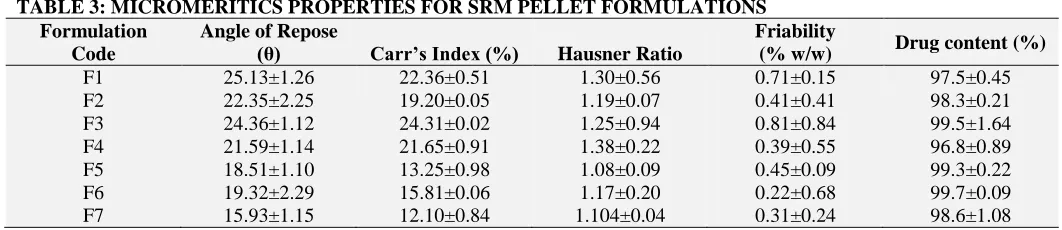
The results of flow properties like Angle of repose, Carr’s index, Hausner ratio of various batches of pellet formulations are shown in Table 3. Angle of repose (θ) for the pellets was observed in the range of 18.51° ± 1.1 to 25.13° ± 1.26 which indicated excellent flow properties of SRM pellet formulations. Similarly, values of Carr’s index and Hausner ratio were found in between 12.10 % ± 0.84 to 24.31% ± 0.02 and 1.104 ±0.04 to 1.38 ±0.22 respectively. Carr’s index and Hausner ratio
are commonly used parameters to predict flow characteristics and can be correlated with size, shape, surface area and cohesiveness of the substance. Pellets containing K-SR and K-HCO has shown lower values of Carr’s index as well as Hausner ratio and can be attributed to their regular and spherical shape19.Therefore, it is evident that K-HCO can improve the shape and size of K-SR pellets which further showed better micromeritics properties.
TABLE 3: MICROMERITICS PROPERTIES FOR SRM PELLET FORMULATIONS Formulation
Code
Angle of Repose
(θ) Carr’s Index (%) Hausner Ratio
Friability
(% w/w) Drug content (%)
F1 25.13±1.26 22.36±0.51 1.30±0.56 0.71±0.15 97.5±0.45 F2 22.35±2.25 19.20±0.05 1.19±0.07 0.41±0.41 98.3±0.21 F3 24.36±1.12 24.31±0.02 1.25±0.94 0.81±0.84 99.5±1.64 F4 21.59±1.14 21.65±0.91 1.38±0.22 0.39±0.55 96.8±0.89 F5 18.51±1.10 13.25±0.98 1.08±0.09 0.45±0.09 99.3±0.22 F6 19.32±2.29 15.81±0.06 1.17±0.20 0.22±0.68 99.7±0.09 F7 15.93±1.15 12.10±0.84 1.104±0.04 0.31±0.24 98.6±1.08 All values expressed as mean± SD, n=3
Friability:
The friability test was carried out on all formulation to ensure mechanical strength of pellets. All formulation have possessed good mechanical strength and friability was observed in the range of
[image:4.612.40.571.539.654.2]Kawakita analysis:
The Kawakita analysis values for NT and SRM pellet formulations are depicted in Table 4. The initial porosity and packability of the powders were represented by ‘a’ and ‘b’ respectively. The maximum value of ‘a’ was observed for pure drug
[image:5.612.47.568.158.235.2]and minimum value was shown by F7 formulation which indicates improved flowability. Whereas ‘b’ value was found to be maximum for F7 which can be attributed to regular spherical shape and good packing characteristics of the formulation
TABLE 4: KAWAKITA PARAMETERS FOR NT AND SRM PELLET FORMULATIONS
Parameters Nateglinide F2 F4 F7
Slope (m) 0.1750 0.9923 1.0727 2.2036
Intercept 291.8451 585.6797 634.6085 768.381
a 5.7137 1.007777 0.9322 0.4537
b 0.0006 0.0017 0.0017 0.0029
r 0.2149 0.3223 0.3135 0.7687
Fourier transform infrared spectroscopy (FTIR):
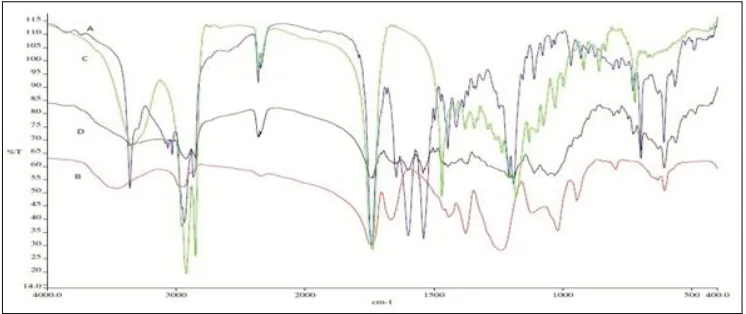
Fourier Transform Infrared spectra of Nateglinide, K-SR, K-HCO and pellet formulation were carried out to evaluate compatibility of drug and excipients, precisely polymers, and spectra were depicted in Fig. 1. Nateglinide showed characteristics bands of at carboxyl, carboxylate
groups at 1209-1384 cm-1 , C–NH bending vibration (amide band II) at 1540cm−1, C-H stretching between 2866-3030 cm-1 and C=O vibration at 1741 cm-1. Since there is no significant shift in the bands of Nateglinide in the pellet formulation, it can be concluded that the drug and polymers are compatible and not showing unusual molecular interactions 20.
FIG. 1: FTIR SPECTRA OF, (A): NT;(B): K-SR;(C): K-HCO;(D) FORMULATIONF7
Drug Content:
The drug content of all pellet formulations is given in Table 3. The Nateglinide content of batches was in the range of 95.52±0.15% - 99.86±0.05% which confirmed the uniform distribution of drug in the pellets.
In vitro Drug Release Study:
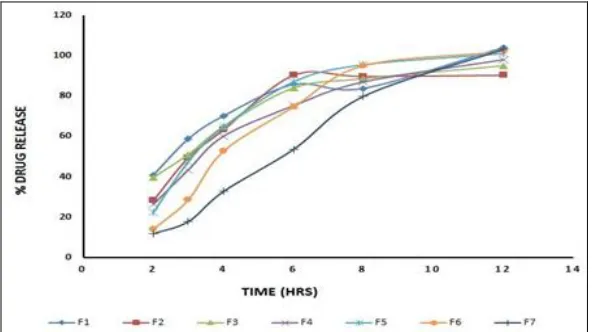
All formulation batches (F1-F7) were subjected to
In vitro drug release study to understand the release pattern and cumulative drug release profiles were depicted in Fig. 2. Faster drug release profile was observed in formulation F1, F2 and F3 in which around 80% drug was released within 6 hrs. This
[image:5.612.120.493.363.520.2]Further, the drug release data was fitted to kinetic models to investigate the drug release kinetics (Table 5). The In vitro drug release of optimized formulation F7 was best fitted to the Higuchi kinetic model, as the plot shows the highest linearity (R = 0.9869). The data showed that release
[image:6.612.159.455.147.313.2]exponent (n) of Korsmeyer-Peppas equation was found to be less than 0.45 for all batches and hence it can be concluded that the non-fickian diffusion mechanism was predominantly followed by drug release 21.
[image:6.612.47.578.353.468.2]FIG. 2: DISSOLUTION PROFILE OF SRM PELLETS FORMULATIONS
TABLE 5: KINETIC MODELING OF SRM PELLET FORMULATIONS Formulation
Code
R
Zero First order KorsemeyerPeppas HixonCrowel Higuchi ‘n’
F1 0.8713 0.92 0.777 0.9234 0.9869 0.0341
F2 0.6879 0.8085 0.6185 0.8065 0.7938 0.0427
F3 0.8328 0.9852 0.7693 0.9472 0.9119 0.0354
F4 0.8815 0.9686 0.7565 0.997 0.9489 0.0498
F5 0.7889 0.9564 0.649 0.9834 0.8804 0.054
F6 0.868 0.8745 0.7207 0.9405 0.9368 0.0767
F7 0.9773 0.8847 0.869 0.9234 0.9869 0.0924
R- Correlation coefficient; n- the release exponent obtained from Korsmeyer-Peppas equation
CONCLUSION: A sustained release matrix pellet formulations of Nateglinide were prepared by extrusion spheronization method. It was observed that the formulation comprising of combination of K-SR and K-HCO showed desirable pellets characteristics like micrometrics properties, morphology, and In vitro drug release studies. Thus, preparation of a sustained release matrix pellets of Nateglinide is a promising approach for commercial manufacturing.
ACKNOWLEDGEMENT: Authors are grateful to Cipla Ltd. Goa, India for the gift sample of Nateglinide and BASF ltd, India for gift samples of Kollidon® SR and Kolliwax HCO.
CONFLICT OF INTEREST: The authors report no conflicts of interest.
REFERENCES:
1. Ghebre-Sellassie I: Pharmaceutical Pelletization Technology. New York and Basel: Marcel Dekker Inc.; First Edition 1989.
2. Abdul S, Chandewar AV, Jaiswal SB: A flexible technology for modified-release drugs: multiple-unit pellet system (MUPS). Journal of Controlled Release. 2010; 147(1):2-16.
3. Swarbrick J: Encyclopedia of Pharmaceutical Technology. New York: Informa Healthcare USA. Inc; Third Edition 2006.
4. Dey NS, Majumdar S, Rao ME: Multiparticulate drug delivery systems for controlled release. Tropical Journal of Pharmaceutical Research. 2008; 7(3):1067-75.
5. Shamma RN, Basalious EB, Shoukri R: Development of novel sustained release matrix pellets of betahistinedihydrochloride: effect of lipophilic surfactants and co-surfactants. Pharmaceutical development and technology. 2012; 17(5):583-93.
6. Pai R, Kohli K: Extended release matrix pellets- preparation and compression into disintegrating tablet. International Journal of Drug Delivery. 2011; 3(2):329. 7. Siepmann F, Muschert S, Flament MP, Leterme P, Gayot
Gelucire-based matrix pellets: Experiment and theory. International journal of pharmaceutics. 2006; 317(2):136-43.
8. Gupta N, Gowda DV, Balamuralidhara V, Khan M: Formulation and evaluation of olanzapine matrix pellets for controlled release. Daru. 2011; 19(4): 249-256. 9. Campbell IW: Nateglinide-current and future role in the
treatment of patients with type 2 diabetes mellitus. International journal of clinical practice. 2005; 59(10):1218-28.
10. McLeod J: Clinical pharmacokinetics of Nateglinide-A rapidly-absorbed, short-acting insulinotropic agent. ClinPharmacokinet.2004; 43 (2): 97-120.
11. Sahoo RK, Biswas N, Guha A, Sahoo N, Kuotsu K: Development and in vitro/in vivo evaluation of controlled release provesicles of a nateglinide–maltodextrin complex. Acta PharmaceuticaSinica B. 2014;4(5):408-16.
12. Kaleemuddin M, Srinivas P: Lyophilized oral sustained release polymeric nanoparticles of Nateglinide. AAPS PharmSciTech. 2013; 14(1):78-85.
13. Podczeck F, Rahman SR, Newton JM: Evaluation of a standardised procedure to assess the shape of pellets using image analysis. International journal of pharmaceutics. 1999; 192(2):123-38.
14. Chatchawalsaisin J, Podczeck F, Newton JM: The preparation by extrusion/spheronization and the properties of pellets containing drugs, microcrystalline cellulose and glycerylmonostearate. European journal of pharmaceutical sciences. 2005; 24(1):35-48.
15. Sinko PJ: Martin’s physical pharmacy and pharmaceutical science. Philadelphia: Lippincott Williams and wilkins. Sixth edition 2011.
16. Kawakita K, Lüdde KH: Some considerations on powder compression equations. Powder technology. 1971; 4(2):61-8.
17. Jain S, Bhandari A, Purohit S: Spectrophotometric determination of nateglinide in bulk and tablet dosage forms. Asian J Pharm. 2014; 3(3): 218-221.
18. Fredenberg S, Wahlgren M, Reslow M, Axelsson A: The mechanisms of drug release in poly (lactic-co-glycolic acid)-based drug delivery systems-a review. International journal of pharmaceutics. 2011; 415(1):34-52.
19. Amrutkar PP, Chaudhari PD, Patil SB: Design and in vitro evaluation of multiparticulate floating drug delivery system of zolpidemtartarate. Colloids and Surfaces B: Biointerfaces. 2012; 89:182-7.
20. Liltorp K, Larsen TG, Willumsen B, Holm R: Solid state compatibility studies with tablet excipients using non thermal methods. J Pharm Biomed Anal. 2011; 55(3):424-8.
21. Bose A, Wong TW, Singh N: Formulation development and optimization of sustained release matrix tablet of Itopride HCl by response surface methodology and its evaluation of release kinetics. Saudi Pharmaceutical Journal. 2013; 21(2):201-13.
All © 2013 are reserved by International Journal of Pharmaceutical Sciences and Research. This Journal licensed under a Creative Commons Attribution-NonCommercial-ShareAlike 3.0 Unported License.
This article can be downloaded to ANDROID OS based mobile. Scan QR Code using Code/Bar Scanner from your mobile. (Scanners are available on Google Playstore)
How to cite this article: