http://eprints.leedsbeckett.ac.uk/873/ Document Version:
Monograph
c
Crown Copyright 2006. Published for the Department for Work and Pensions under licence from the Controller of Her Majesty’s Stationery Office by Corporate Document Services, Leeds.
Uploaded to this server in accordance with Office of Public Sector Information Click Use licensing.
The aim of the Leeds Beckett Repository is to provide open access to our research, as required by funder policies and permitted by publishers and copyright law.
The Leeds Beckett repository holds a wide range of publications, each of which has been checked for copyright and the relevant embargo period has been applied by the Research Services team.
We operate on a standard take-down policy. If you are the author or publisher of an output and you would like it removed from the repository, please contact us and we will investigate on a case-by-case basis.
Corporate Document Services
Phase 2 evaluation of
Multiple Provider
Employment Zones:
Qualitative study
The Policy Research Institute, Leeds Metropolitan University
First Published 2006.
ISBN 1 84712 112 8
ISBN13 978 1 84712 112 7
Views expressed in this report are not necessarily those of the Department for Work and Pensions or any other Government Department.
Contents
Acknowledgements ... vii
The Authors ... viii
Abbreviations and acronyms ... ix
Summary ... 1
1 Background ... 7
1.1 Introduction ... 7
1.2 Multiple Provider Employment Zones ... 8
1.2.1 Background and client group eligibility... 8
1.2.2 Payments and stages of participation ... 9
1.2.3 Recent changes to the MPEZ model ... 9
1.3 Summary of Phase 1 findings ... 10
1.4 Research aims, objectives and questions ... 11
1.5 Research methods ... 13
1.6 The client sample group ... 14
1.7 Structure of this report ... 16
2 Operation and performance ... 17
2.1 Key changes over the previous year ... 17
2.1.1 Lone parent provision ... 17
2.1.2 Organisation and operation ... 17
2.1.3 Jobcentre Plus perspectives ... 18
2.2 Development and operation of local and wider networks ... 20
2.2.1 Working arrangements with Jobcentre Plus ... 20
2.2.2 Partnership working ... 23
2.2.3 Labour market intelligence ... 25
2.2.4 Vacancies and submissions ... 26
2.3 Performance indicators and incentives ... 29
2.4 Summary of main points ... 32
3 Referral processes and practices ... 33
3.1 Referral processes and flows – general ... 33
3.2 Random allocation processes ... 35
3.3 Referral of lone parents ... 36
3.4 Summary of main points ... 39
4 Provision for different client groups: client, Provider and Jobcentre Plus perspectives ... 41
4.1 Introduction ... 41
4.2 Client perspectives: overview ... 42
4.3 Provider and Jobcentre Plus perspectives: overview ... 47
4.4 Lone parent experiences of MPEZ provision ... 48
4.5 Provision for lone parents: Provider and Jobcentre Plus perspectives ... 51
4.6 NDYP returners’ experiences of MPEZ provision ... 53
4.7 Provision for NDYP returners: Provider and Jobcentre Plus perspectives ... 54
4.8 Early entrants’ experiences of MPEZ provision ... 56
4.9 Provision for early entrants: Provider and Jobcentre Plus perspectives ... 57
4.10 Other client groups: Provider and Jobcentre Plus perspectives ... 57
4.11 Summary of main points ... 58
5 Provision for different client groups: key themes ... 61
5.1 Success factors ... 61
5.2 Innovation ... 63
5.3 Action planning ... 64
5.4 Choice ... 66
5.5 Barriers to work (individual and structural) ... 67
5.6 Client job aspirations and outcomes ... 70
5.7 Sustainability ... 73
5.8 Wider outcomes for clients ... 77
5.9 Wider labour market and strategic outcomes and issues ... 79
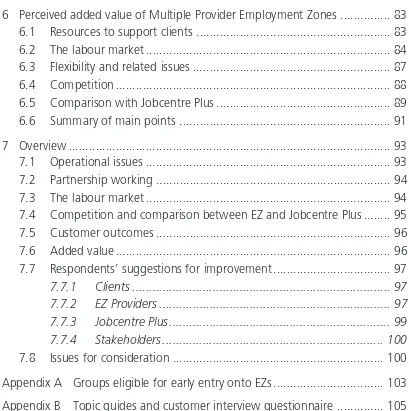
6 Perceived added value of Multiple Provider Employment Zones ... 83
6.1 Resources to support clients ... 83
6.2 The labour market ... 84
6.3 Flexibility and related issues ... 87
6.4 Competition ... 88
6.5 Comparison with Jobcentre Plus ... 89
6.6 Summary of main points ... 91
7 Overview ... 93
7.1 Operational issues ... 93
7.2 Partnership working ... 94
7.3 The labour market ... 94
7.4 Competition and comparison between EZ and Jobcentre Plus ... 95
7.5 Customer outcomes ... 96
7.6 Added value ... 96
7.7 Respondents’ suggestions for improvement ... 97
7.7.1 Clients ... 97
7.7.2 EZ Providers ... 97
7.7.3 Jobcentre Plus ... 99
7.7.4 Stakeholders ... 100
7.8 Issues for consideration ... 100
Appendix A Groups eligible for early entry onto EZs ... 103
Appendix B Topic guides and customer interview questionnaire ... 105
References ... 141
[image:6.595.89.498.107.518.2]Acknowledgements
The team would like to express its gratitude to Liz Such and Kris Chapman of the Department for Work and Pensions for their invaluable guidance and support in managing the research. We also acknowledge the input of the members of the Employment Zones Evaluation Steering Group who provided useful comments and suggestions on an earlier draft of this report.
The Authors
This report is based on research commissioned by the Department for Work and Pensions and is the product of the work of a team of researchers at the Policy Research Institute, Leeds Metropolitan University consisting of:
• Steve Johnson (Project Director); • Dr.Alex Nunn (Project Manager); • Dr.Tim Bickerstaffe;
Abbreviations and acronyms
DfES Department for Education and Skills
DWP Department for Work and Pensions
ESG Employment Strategy Group
ESOL English for Speakers of Other Languages
EZ Employment Zone
FTA Failure to Attend
HR Human Resources
IB Incapacity Benefit
IS Income Support
JSA Jobseeker’s Allowance
LMS Labour Market System
LSC Learning and Skills Council
MPEZ Multiple Provider Employment Zone
ND New Deal
NDLP New Deal for Lone Parents
NDYP New Deal for Young People
NVQ National Vocational Qualification
ODR Organisation Design Review
PA Personal Adviser
WFI Work Focused Interview
Summary
Background
Fifteen Employment Zones (EZs) were introduced in 2000, located in areas with high levels of long-term unemployment. These Employment Zones involved the mandatory referral of long-term claimants of Jobseeker’s Allowance (JSA), aged 25 and over, to private sector Providers of support and guidance. This was extended subsequently to young people (aged 18-24) claiming JSA, who would otherwise have returned to New Deal for Young People (NDYP), lone parents claiming Income Support and some groups deemed appropriate for ‘early entry’ onto EZs. (Section 1.2)
In 2004, six of the largest EZs (Birmingham, Brent & Haringey, Glasgow, Liverpool & Sefton, Southwark and Tower Hamlets & Newham) were converted into Multiple Provider Employment Zones (MPEZs) with up to three Providers delivering EZ services. Part of the rationale for MPEZs is notionally to test the impact of competition between Providers, with clients being allocated to Providers on a prearranged contractual distribution of market share. (Section 1.2)
This report presents the findings of a qualitative study of the operation and impact of the MPEZ initiative, building on earlier work by Cambridge Policy Consultants, which concentrated on issues related to the early establishment of the MPEZ initiative and the initial experiences of Providers, Jobcentre Plus districts and customers.
In total, the research involved interviews or group discussions with over 300 individuals, providing a range and depth of qualitative information that allows a detailed picture to be established of the way that MPEZs developed between mid-2005 and mid-2006, including the experiences of employers and the labour market destinations of MPEZ participants. (Sections 1.5 and 1.6)
The specific objectives of the evaluation (Section 1.4) were to:
• understand the relationships and networks linking Department for Work and Pensions (DWP) national officials, local Jobcentre Plus and Providers both within and across MPEZs;
• explore how Providers respond to performance competition within the same labour market;
• explore the relationship between the performance system and casework practices for both mandatory and voluntary clients;
• understand clients’ experiences of, and outcomes from, participating in MPEZs; and
• examine Provider strategies for dealing with client choice, how and why lone parents make choices about participation in EZs or New Deal for Lone Parents (NDLP) and the outcome of these choices.
Key developments since Phase 1
Many of the operational issues encountered during the start-up phase of the MPEZ initiative have been addressed to the satisfaction of EZ Providers and Jobcentre Plus. In particular, respondents reported that technical difficulties with the Random Allocation Tool (RAT) had been largely resolved. (Section 3.2)
Operational changes implemented by EZ Providers have also been driven by the process of learning from the early phase of MPEZ operation, including moves to work more effectively with Jobcentre Plus and increased training of Advisers. (Section 2.1)
Operational issues
The MPEZ initiative is ‘bedding down’ to some extent, with indications of changes that are in line with the objectives of the initiative. Working arrangements between EZ Providers and Jobcentre Plus were felt generally to have improved since the early implementation phase. However, relations and performance have been in some cases affected by changes at Jobcentre Plus, notably the Organisation Design Review and associated reductions in resources. (Section 2.2)
While the RAT was felt to be working correctly in a technical sense, some Providers expressed concern about the level and variability of mandatory client flows. There were also concerns expressed regarding the effectiveness of communication between Jobcentre Plus and EZ Provider personnel in some cases, for example regarding the hardest-to-help clients and those who are potentially violent.(Section 3.2)
EZ Providers operated a range of incentive structures for Advisers and other staff, including financial incentives in some cases. No clear pattern emerged from Provider responses on this issue, other than a feeling that financial factors were only one aspect of the picture in terms of employee motivation.
EZ Providers and other respondents felt, in general, that the incentive structure built into the EZ contracts provided sufficient incentive to Providers to focus attention on getting clients into jobs that will last for at least 13 weeks. The general feeling was that changes in the structure of payments for lone parents were appropriate and provided a greater incentive for EZ Providers to engage with this client group. (Section 2.3)
Some concerns were expressed about the perceived way in which the target system encourages Providers to get clients into jobs as quickly as possible, with some respondents feeling that this may not be appropriate for all clients. EZs are not contractually measured on longer term job sustainability, but some concerns were expressed about this issue. (Section 2.3)
Client experiences and issues
Clients discussed a range of issues affecting their entry into the job market, including lack of confidence, childcare or other caring responsibilities and skills or qualifications deficits. They described a range of experiences and outcomes in relation to their involvement with EZs. Where a choice of Provider was available, clients appreciated this, and there was an indication that a choice of Provider would be preferred by mandatory and early entry clients. (Chapters 4 and 5)
sustainable job entries, there was significant qualitative evidence of clients being moved closer to the labour market by participation in MPEZs, for instance through improved confidence, motivation and more positive attitudes to work. (Chapters 4 and 5)
Some clients expressed dissatisfaction at the quality of job matching, for example pointing out that the relatively low-level jobs taken were not necessarily different to those available through Jobcentre Plus. Overall, findings suggest that EZs are addressing a range of barriers to client job entry, but in some cases it appears that the barriers may be beyond the capacity of Providers to address. (Chapters 4 and 5)
Comments specific to the different client groups were as follows:
• Lone parents discussed the barriers they face, particularly difficulties with managing affordable childcare, a lack of confidence, or in some cases experiences of prejudice due to status. Providers emphasised the importance of a flexible approach, help regarding childcare, the need for training provision, and the need to accommodate children on site (including Health and Safety issues).
• NDYP returners face similar barriers to those of other groups, but with particular emphasis on lack of work experience, transport issues, lack of confidence and motivational issues. There was anecdotal evidence for NDYP returners being more receptive to MPEZs than other mandatory clients, but as having lower retention rates once they started work.
• Early entrants:The experiences and reports about early entrants were similar to those of other groups, except that they were much more likely to report that they did not understand the referral process, and there was some evidence that the Random Allocation Tool (RAT) acted as a deterrent from entry onto EZ. There was some evidence of innovative working practices in relation to early entrants.
• Most disadvantaged clients:Dealing with those with the most severe problems was seen as a challenge for EZ Providers, some of whom had contracted with specialist alcohol or drug dependency support or other specialist help.
• Other:English for Speakers of Other Languages (ESOL) clients had specific needs which Providers were seeking to meet, for example, through adapting their own provision. Older people were seen as needing interventions to build self-confidence and motivation.
Added value
do not want to. A business-like and personalised approach, which is attractive to employers, was described, as was the potential to provide in-work support to a greater extent than is the case for other labour market programmes. (Section 6.1)
Many employers clearly value their linkages with EZ Providers and, for some, EZ Providers are important sources of recruitment, although others preferred Jobcentre Plus provision or expressed no preference. Findings indicated that the clear focus on job outcomes, as opposed to the wider responsibilities of Jobcentre Plus, is useful. While there were other areas for which benefits associated with the EZ arose from the organisational separation from Jobcentre Plus, these appeared to be less important than resources and flexibility. (Section 6.2)
The added value of the Multiple Provider approach is less clear from the research findings, with the view expressed generally that it is too early to tell and that potential advantages need to be balanced against the fact that large numbers of clients are allocated randomly and have no choice about Providers. (Section 6.4)
The findings indicated some advantages, including the way in which healthy competition helps to keep Providers ‘on their toes’, and the development of innovative services, particularly for lone parents. However, findings also indicated disadvantages regarding the competitive element, including the way in which clients might become confused by the range of Providers and services, and the way in which competition might act as a barrier to partnership working. In principle, competition might enable Providers to specialise in particular client groups, employers or sectors, but this is constrained by the random allocation approach. (Section 6.4)
Issues for consideration
The study highlighted a number of key issues, which are set out in Section 7.8. There are issues regarding the client base, in particular an increasing proportion of ‘hardest-to-help’ customers, which is likely to continue in the future. Issues included drug or alcohol dependency, mental or other health issues, language and/or basic skills issues, participation in the grey economy, economic considerations (low paid work providing little more financially than benefits) or being embedded in second or third generation unemployed families and communities. Providers expressed some concern about their capacity to deal with these types of client issue and the limited availability of specialist support.
The research suggests that some customers across the different client groups may face difficulties beyond the 13-week period in terms of retaining jobs, indicating a possible need for EZ to be linked more closely to employer training and skills initiatives.
There are indications that some specialisation (for example in terms of client groups, services provided or sector focus) amongst Providers is starting to occur. This would clearly be boosted by choice for mandatory clients, but the implications for management, for example advertising, require attention. Providers indicated that, in principle, they would be happy for choice for mandatory clients to occur. Issues regarding how this might be achieved and the potential effects on Providers (including reductions in flows for some) will need to be addressed. There would also need to be attention to ensuring full provision of information to clients, and mechanisms to support accountability.
The research indicated a concern with wider strategic issues. There is evidence of good partnership working in a number of localities. In some instances there appears to be a need for greater ‘fit’ with local initiatives and partnerships – both greater participation by EZ Providers in partnerships, and better overall management and integration of initiatives. There is, in a minority of cases, a tension between locality-based initiatives and EZ provision.
1 Background
1.1
Introduction
This report presents the findings of a qualitative study of the operation and impact of the Multiple Provider Employment Zone (MPEZ) initiatives that have operated in four
cities (London, Birmingham, Liverpool and Glasgow) since 20041. The study builds
on earlier work by Cambridge Policy Consultants (Hirst et al. 2006), which concentrated on issues related to the early establishment of the MPEZ initiative and the initial experiences of Providers, Jobcentre Plus districts and customers.
The Phase 2 research took place approximately one year on from the Phase 1 study and focused on tracking developments in the operation of MPEZ as the initiative became more established. The study involved interviews with EZ Providers (managers and Advisers), Jobcentre Plus representatives (managers and Advisers) and customers (young people (aged 18-24) claiming Jobseeker’s Allowance (JSA), who would
otherwise have returned to New Deal for Young People (NDYP)2, lone parents
receiving Income Support and early entrants – see section 1.6 for full details). In order to gain a wider perspective, researchers also spoke to representatives of organisations that have employed MPEZ participants and a number of stakeholder organisations with a broad interest in local labour market policies and programmes in the MPEZ areas.
In total, the research involved interviews or group discussions with over 300 individuals, providing a range and depth of qualitative information that allows a detailed picture to be established of the way that MPEZs developed between mid-2005 and mid-2006, including the experiences of employers and the labour market destinations of MPEZ participants.
1 For further details on MPEZ see www.employmentzones.gov.uk.
2 For ease of exposition, this group of EZ clients is referred to throughout this
A central issue addressed in the research and in this report is the ‘multiple’ element of the initiative and the value that is added through the existence of more than one Provider in each MPEZ area. Questions of allocation, choice, specialisation, competition and innovation are considered from the perspectives of Providers, Jobcentre Plus, customers, employers and stakeholders and the final sections present some conclusions and issues for consideration in relation to these topics.
1.2
Multiple Provider Employment Zones
1.2.1 Background and client group eligibility
Fifteen3 Employment Zones (EZs) were introduced in 2000, located in areas with
high levels of long-term unemployment. These EZs involved the mandatory referral of long-term claimants of JSA, over the age of 25, to private-sector Providers of support and guidance. The EZ contracts included strong financial incentives to the private-sector Providers based on sustained job entries and were intended to bring new and innovative results-focused approaches to assist the unemployed into work. The 2002 Spending Review announced the intention to extend the client groups that were eligible for EZs. Young people (aged 18-24) claiming JSA, who would otherwise have returned to NDYP were introduced as a mandatory client group and lone parents were offered the choice of New Deal for Lone Parents (NDLP) or EZ. Certain other clients became eligible for ‘early entry’ to EZ (see Appendix A for a full list of early entry criteria).
Early entrants can choose to attend EZs, but once they have made this choice their participation is mandatory. For all mandatory client groups, non-attendance at the EZ can affect their benefit entitlement. In 2003, four of the largest EZs (in
Birmingham, Liverpool, London4 and Glasgow) were converted into MPEZs. MPEZs
involve up to three contractors delivering Employment Zone provision. Part of the rationale for MPEZs is notionally to test the impact of competition between Providers. However, for the vast majority of clients there is no choice over which
3 The original four London districts were subsequently amalgamated into two,
leaving thirteen EZ areas in total.
4 Strictly speaking, London contains three MPEZ areas (Southwark; Tower Hamlets/
Provider they attend, and clients are allocated to Providers on a prearranged contractual distribution of market share.
1.2.2 Payments and stages of participation5
Contract payments to the EZ Providers are outcome-related, based on clients first entering and then sustaining work. Payments are structured around the stages of client participation in the EZ:
• Stage 1 – This lasts for a maximum of four weeks and involves working with the client to identify barriers to entering employment and the drawing up of an Action Plan of activities and support to overcome this. Providers receive a set fee for this period (with the exception of lone parent clients, who enter Stage 2 directly).
• Stage 2 – This lasts for a maximum of 26 weeks and involves the delivery of the Action Plan with the intention of entering employment. Providers receive a single payment equivalent to 21 weeks of JSA. For lone parents, Providers receive engagement fees, which are received at intervals. During this period, the Provider is responsible for paying the client their benefit entitlement but can retain any surplus if they enter work swiftly. Providers also receive a payment for those clients who enter work.
• Stage 3 – This involves a period of support to clients who enter work. The aim is to sustain the client in work for a period of at least 13 weeks. The Provider receives a payment for five weeks’ sustained employment and is eligible for a substantial further payment, should employment be sustained for at least 13 weeks.
• Follow-on support – This lasts for a maximum of 22 weeks for mandatory clients who have not secured a job at the end of Stage 2, but who wish to continue the process. Providers receive no additional funding and must continue to bear responsibility for the client’s benefit payments but they can claim job entry and sustainability payments.
• Initially, all Providers were also able to achieve an aggregate performance bonus
based on achieving a negotiated target of clients that they helped to enter and sustain work.
5 Contractual issues are reviewed on a regular basis. The details presented in this
1.2.3 Recent changes to the MPEZ model
In essence, the MPEZ programme remained unchanged between Stage 1 and Stage 2 of the qualitative evaluation. A number of changes in the precise operation of the initiative did, however, take place and are relevant to this report. They are:
• Extension of lone parent provision to all Providers outside London: previously only one Provider in each of Birmingham, Liverpool and Glasgow was contracted to provide services for lone parents. Since November 2005, all Providers can provide services for lone parents. In London, NDLP provision was discontinued in April 2004, while NDLP continues in the other MPEZ districts.
• Changes in the level and structure of payments to Providers in relation to lone
parent engagement to encourage continuous engagement throughout Stage 2.
• Changes in the level and structure of payments to Providers in relation to job
sustainability so that these are now paid in three instalments: at job entry, after five weeks in work and after 13 weeks in work.
• Removal of the six month Performance Bonus.
1.3
Summary of Phase 1 findings
6Phase 1 of the MPEZ evaluation found that Providers were generally happy with the pricing structure for mandatory clients but less so for the price set for lone parents. Moreover, many Provider lone parent Personal Advisers (PAs) pointed to the fact that lone parents in MPEZs could not access longer-term vocational training or the fast-track process to in-work benefits that were available to those joining NDLP.
During this first phase of MPEZs, relations between MPEZ Providers and Jobcentre Plus managers were generally good but somewhat less so at the operational level between Providers and some local Jobcentre Plus offices. Lack of information concerning the services on offer to clients by Providers and the explicit direction by Department for Work and Pensions (DWP) not to make recommendations to clients, left many Jobcentre Plus staff feeling they had been placed in an invidious position. For their part, some Providers were not convinced that Jobcentre Plus were concentrating upon selling the MPEZ offer to clients.
As the MPEZ first phase developed, there were signs that the presence of multiple Providers had added an edge to the Providers’ delivery – making them more keen and innovative – with the new Providers demonstrating they could deliver effectively alongside their more established counterparts. After some initial teething problems,
6 For full details of the findings of the Stage 1 study, see Hirst, A., Tarling, R.,
the random allocation process was also seen to be working well – although the Providers did not agree with the process being extended to early entrants. Commercial logic suggested that any innovations in engaging early entrants would be devalued by the ‘sharing out’ of any benefits or marketing and outreach.
Of the lone parents engaged directly by Providers, not all were aware that they had a choice between different MPEZ Providers (in London) or between MPEZ and NDLP (outside London). In London, referrals from Jobcentre Plus represented the main route for lone parents starting MPEZ. Yet, outside London, the vast majority of lone parents continued to sign up to NDLP at their first Work Focused Interview (WFI). As a result, lone parent flows to MPEZs were low.
All Providers were seen to be experimenting with different approaches to providing client support, as well as adopting a diverse set of methods to engage and work with employers. Providers proved to be very effective at building confidence and motivation in many clients and channelling this into more effective job search and longer-term employment goals. They also used specialist staff to build relationships with employers, learn more about their recruitment needs and take advantage of future vacancy projections. However, clients’ perceptions of the range and quality of the vacancies on offer were mixed.
In dealing with young clients, Providers found them a challenge but in the main very responsive when successfully engaged and also very flexible.
Providers reported that many lone parents favoured education/training in preparation for work, rather than fully engaging with the work-first provision that was the cornerstone of the MPEZ model. Subsequently, Provider outreach activity tended to concentrate on those lone parents who would benefit from work-first provision. For their part, those lone parents interviewed reported more effective job search with specialist caseworkers and improved skills being the main benefit of MPEZ.
As the first phase of MPEZ progressed, the volumes of early entrants remained very low but of those who had gone through the programme, many reported improved confidence and skills as direct benefits of their involvement.
1.4
Research aims, objectives and questions
The specific objectives of the Stage 2 evaluation were to:
• understand the relationships and networks linking DWP national officials, local Jobcentre Plus and Providers both within and across MPEZs;
• explore how Providers respond to performance competition within the same labour market;
• explore the relationship between the performance system and casework practices for both mandatory and voluntary clients;
• examine Provider strategies for dealing with client choice, how and why lone parents make choices about participation in EZs or NDLP and the outcome of these choices.
These broad objectives were broken down further into a number of specific research questions:
Setting up and developing local and wider networks
• How do EZs develop an understanding of local labour markets?
• What external provision do EZs use? How do EZs monitor quality of external provision?
• Is there networking across EZs (between Providers/Jobcentre Plus)? What form does it take and does it change over time?
• How are relationships with Jobcentre Plus, DWP and employers managed? Are there changes over time? How do EZs attract vacancies and make submissions?
• How are performance indicators developed and monitored? How are incentives and disincentives of the EZ performance system identified and managed?
Random allocation and client choice
• How is the creation of a ‘level playing field’ via Random Allocation monitored?
• How does random allocation work in Jobcentre Plus offices? How are Jobcentre Plus PAs handling randomly allocating clients?
• How do mandatory clients assess the random allocation process?
• How do EZs market to lone parents and how does the referral process from a WFI operate?
• How and why do lone parents make the decision to participate in EZs? How do they feel about this decision once in an EZ? Do they feel empowered by having a choice?
• Is there evidence of lone parents ‘switching’ between EZ and NDLP provision or between different EZs?
• What is the role of Jobcentre Plus and EZs in encouraging/influencing ‘choice’?
Working with different client groups
• What are the key factors in explaining the success/lack of success in EZ for the different client groups? Do variations exist across EZs that provide examples of best practice?
• Is there evidence of innovation and flexibility in supporting participants into work? Is there evidence of change in EZ practices over time?
• What do EZ managers envisage are the key issues in incorporating the new groups successfully into EZs? Is provision client-specific? Do they refine their ideas over time?
• How do they network with relevant external Providers and employers? How do they market their clients to employers?
• How does the EZ influence work plans, skills, confidence and motivation towards employment? What impact do EZs have on the different client groups over time (beyond 13 weeks in employment), what impacts (if any) do EZs have on clients who do not enter work from the programme?
• How do EZs work with the ‘hardest-to-help’ young people such as those with
drug addiction problems, basic skills needs, etc?
Lone parents
• What systems do EZs have in place for a voluntary client group and are they distinct from those for mandatory clients?
• How do EZs deal with the specific barriers to employment faced by lone parents, e.g. childcare, health problems, confidence/skills? Do EZs help lone parents address/manage barriers to work?
NDYP returners
• How does EZ provision differ from NDYP e.g. focus on work-first rather than training, etc?
• How do young people view their experiences on the two contrasting employment programmes? On which programme do they feel they have more choice/flexibility and how is this manifested?
Early entrants
• How do EZs approach customers with a range of disadvantages? Is their approach different to other groups?
• Do EZs recruit specialist help?
1.5
Research methods
The fieldwork consisted of the following:
• Interviews with nine managers of MPEZ Providers across the four MPEZ areas (Glasgow, Liverpool, Birmingham, London).
• Nine focus groups with EZ Advisers in the same organisations.
• Interviews with eight Jobcentre Plus District Managers in the MPEZ areas.
• Ten focus groups with Jobcentre Plus Advisers in the same districts.
• Interviews with 60 employers that have employed people through MPEZ.
• Interviews with 18 stakeholders involved in labour market programmes within the MPEZ areas.
1.6
The client sample group
The DWP asked that qualitative work with clients be limited to three specific clients groups: early entrants, NDYP returners and lone parents, thereby excluding those mandatory clients aged 25+ and claiming JSA.
As part of the first phase of the evaluation, the research consortium carried out approximately 240 face-to-face interviews with EZ participants (cohort one). This first stage of interviews, held in March and April 2005, occurred whilst the participants were still on the programme – mainly in Stage 2 of the process (the majority of these cohort one participants started the programme in summer 2004).
The initial intention was to conduct a longitudinal study and that the second phase would include interviews with up to 120 of these cohort one interviewees to chart their progress since completing the programme. However, due to data protection concerns, only 90 cohort one participants’ contact details were passed on for follow-up. Of the 90 first cohort one interviewees, 45 agreed to take part in the follow follow-up. None of these were early entrants.
To achieve a final sample size of 120 client interviews, it was necessary to boost the cohort one numbers, which was achieved through the addition of new clients to the sample group from DWP databases. Where necessary these client respondents are referred to as cohort two. To ensure comparability of the data, it was intended that clients should have completed their participation on the EZ by the time they were interviewed, though in practice there were a small number of respondents who were still in Stage 3 or follow-up at the time they were interviewed.
The structure of the client sample was split between client groups, cohort groups, the six MPEZ districts and the different Providers.
All potential client respondents were contacted by letter, informing them of the research, along with a proforma to be completed and returned to the Policy Research Institute, inviting them to either opt-in or opt-out of the study. Those who opted in were contacted and, where possible, interviews were arranged. To make up the numbers in each area those customers who had not returned a proforma were then contacted by phone and invited for interview.
The interviews were held in ‘neutral’ venues at locations convenient to the
interviewees and all took place between 28February and 5April 2006. On average,
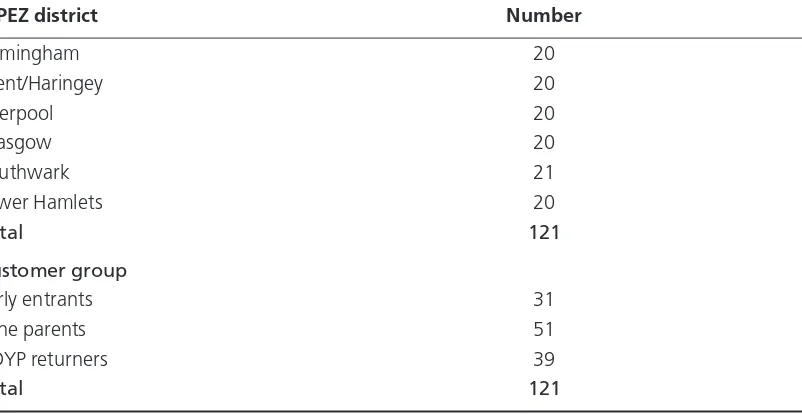
over the telephone. As such, 100 of the interviews were carried out face-to-face with 21 being conducted by telephone. Table 1.1 demonstrates the distribution of the client interviews by EZ and client group.
Table 1.1 Distribution of client interviews by Employment Zone and customer group
MPEZ district Number
Birmingham 20
Brent/Haringey 20
Liverpool 20
Glasgow 20
Southwark 21
Tower Hamlets 20
Total 121
Customer group
Early entrants 31
Lone parents 51
NDYP returners 39
Total 121
The interviews and focus groups followed a topic guide format (see Appendix B) that enables comparisons to be made between the responses of the different groups described above to identical or similar questions. The precise topics covered and questions asked varied between the different respondent groups but in general, the discussions followed a similar pattern with the following topics being addressed in most cases:
• Changes in MPEZ provision since Phase 1.
• The development and operation of wider networks.
• Performance indicators and incentives.
• The random allocation process.
• Referral processes and flows.
• Referral of lone parents.
• Working with different client groups.
• Specific issues: lone parents.
• Specific issues: NDYP returners.
• Specific issues: early entrants.
• Sustainability.
1.7
Structure of this report
This report continues by examining the operation and performance of MPEZs (Chapter 2), in particular, the relationship between EZ Providers in local and wider networks, their use of performance indicators and incentives and the views of respondents on the incentives provided through the payment structure.
Chapter 3 considers the processes by which customers are referred to EZ Providers, both in terms of the random allocation of mandatory customers and the mechanisms through which voluntary customers (primarily lone parents) are attracted to different Providers.
In Chapter 4, we describe and assess the ways in which Providers work with the main client groups and the services provided for different types of client, outlining the perspectives of clients, EZ Providers and Jobcentre Plus respondents. The focus is upon changes and developments since the Stage 1 research and on bringing in the perspectives of employers and stakeholders that were not covered in the earlier study.
Chapter 5 sets out some key issues arising from this review of provisions, including a discussion of the extent to which and ways in which MPEZ helped clients to progress in the labour market.
Chapter 6 summarises the views of respondents in relation to the added value of MPEZs and sets out some suggestions made by respondents for improving EZ provision.
2 Operation and
performance
2.1
Key changes over the previous year
2.1.1 Lone parent provision
For the Employment Zone (EZ) Providers, the most significant changes over the previous year related to the lone parent client group. In particular, the EZ Providers outside London that had not previously been able to supply services under EZ for lone parents were able to do so from November 2005. Changes in the tariff structure for lone parents, were also introduced in November 2005. Collectively, these changes were noted by some EZ respondents as having an impact on their operations and, in general, providing a greater incentive than previously to undertake activity designed to increase the number of lone parent clients. In some cases, EZ Providers were able to take on more designated staff and felt they were able to offer a better service overall to lone parents. The predominant view among EZ Providers was that these changes collectively meant that lone parents were now seen as a much more important client group and Providers had made significant changes in response to them. As such, some Providers had established separate facilities for lone parents and others had been forced to reconsider the arrangement of their offices in order to accommodate parents with children using them. Providers had also made significant efforts to market their services to lone parents, resulting in increased efforts to build relationships with Jobcentre Plus staff and to advertise in the local media. Where Providers were already providing services to lone parents, the changes in the financial structure meant that the services to this group could be improved.
2.1.2 Organisation and operation
large number of Advisers engaged in NVQ Level 3 in guidance. There is some indication that the training needs of Advisers are changing – several EZ Providers discussed an increase in ‘hardest-to-help’ referrals, including people with significant mental health problems and alcohol/drug dependency issues, and one contributor discussed a need for Advisers to be trained to deal with these cases. In another case, Advisers also noted an increased emphasis on counselling and communication skills development in their training, as a result of feedback provided on initial training offered by the Provider.
Some Providers had experimented with various methods of reorganising their resources, for instance in establishing dedicated in-work support or liaison posts to improve the working relationship with Jobcentre Plus. Providers in several areas had undertaken other measures to improve the relationship and mutual understanding with Jobcentre Plus, such as staff visits and briefing sessions.
2.1.3 Jobcentre Plus perspectives
Jobcentre Plus contributors discussed the way in which the performance of the EZ reflects the time and effort required to set up and effectively run a partnership initiative like the Multiple Provider Employment Zone (MPEZ). In some districts, individual Providers had already become known and established, and some contributors reported greater results from EZ partners over the past year. In general, work seemed to be going well, although in a couple of localities there was some evidence from Jobcentre Plus respondents that the Providers had perhaps not anticipated all that was needed and had had to change rapidly in order to deal with the flow of referrals. In general, building up of links and trust with partners and clients has taken time.
A further specific change mentioned by Jobcentre Plus contributors, included technical improvements in the operation of the Random Allocation Tool (RAT). Previously, the problems with the RAT had often failed or took a long time to allocate clients. This is no longer the case, though many Jobcentre Plus respondents still suggested that they allocated clients in their absence, a practice which was initially adopted because of previous problems with the RAT.
‘...early entrants are not done as a matter of course now…that did produce some good results but then the Department clamped down on early entrants – they are only supposed to be for those that really need early entry, rather than just to boost the numbers going through the programme.’
(Jobcentre Plus manager)
Jobcentre Plus respondents suggested that although in some localities significant improvements in Providers’ networking and partnership work had taken place, in certain instances, individual and organisational relations could still be improved upon. This view was also confirmed by some stakeholders.
For some Jobcentre Plus staff, recent significant reductions in general resources linked to the Organisation Design Review (ODR) – and the decrease in external provision in particular – were brought into sharp relief in the light of the flexibility available to Providers under the EZ contracts. For example, one Jobcentre Manager described the way in which:
‘We continue to be under-staffed and there is a reduction of staff in the offices, and we are waiting for the allocation for 2006-2007, especially as we are rolling out the IB pathways, which involves working closely with IB clients and we need more staffing…time is even more at a premium now for Personal Advisers partly because of the introduction of a new computerised system and changes across the benefit system which are taking time to bed down…EZ people have sometimes been drawn into dealing with this so we have had to juggle resources more and this has impacted on EZ work.’
Jobcentre Plus contributors described a wide range of impacts that resulted from budget cuts and restructuring. In some cases, these were making it difficult to efficiently manage liaison with EZ Providers. In one locality, the manager highlighted the negative impact of reorganisation on staff morale. In another, a staff member suggested that whilst the pressure to find jobs has been removed from Advisers,
Jobcentre Plus appears to have ‘lost control’ of the process of engaging and working
2.2
Development and operation of local and wider
networks
2.2.1 Working arrangements with Jobcentre Plus
Throughout all of the MPEZ areas, Providers were generally positive about their relationship with Jobcentre Plus, in terms of both district and local office levels. Factors that were seen as facilitating good relations included senior level contact via meetings and involvement in strategic employment partnerships, good informal links between individuals and a high level of mutual understanding of organisational processes and service delivery by Jobcentre Plus and EZ staff.
In one case, for instance, a contributor discussed a good working relationship with Jobcentre Plus which meant that any difficulties could be honestly addressed. In general, Providers reported that initial suspicions and tensions in the relationship had receded somewhat and that working relations were now generally effective. In some cases, contributors discussed improvements in relations over the last year, for example, as a result of programmes of information sharing and staff visits between Jobcentre Plus and EZ Providers.
Despite these generally good relations, it is clear from the research that the quality of the relationship between Jobcentre Plus and the EZ Providers is highly variable at office level. In some instances, EZ Advisers reported problems with communication, and interaction with different Jobcentre Plus staff. For example:
‘I have felt some distinct resentment from some Jobcentres here. We appear to be seen as the people with the money coming in to save the day, just at the same time when Jobcentre Plus is undergoing massive budget cuts. Understandable, I suppose, but hardly likely to help get long-term unemployed people into jobs.’
EZ respondents felt that the process of communication, information flow and the implementation of internal Jobcentre Plus procedures was not helped by frequent changes of personnel in Jobcentre Plus, cutbacks, and low morale throughout the organisation. Further, it was also reported that a culture of role specialisation in Jobcentre Plus meant that handling even basic queries was dependent on individuals being available. If those individuals were unavailable, unnecessary delays could occur. Providers also identified rigid and overly bureaucratic systems as contributing to tensions in communication between them.
In addition, some EZ respondents identified reductions in Jobcentre Plus budgets with a reduction in the external provision available to Jobcentre Plus Advisers with the consequence that EZ Providers were increasingly seen as solely responsible for training provision. It was also identified as being partly responsible for EZ referrals being increasingly hard to help.
Despite these problems, some Providers had made efforts to build personal connections with Jobcentre Plus staff. Events had been held to promote networking and there had been mutual visits of staff to each office. In one case, the introduction of competition in relation to lone parents had prompted the Provider to attempt to build closer relationships by providing regular feedback on the progress of clients referred to them in order enhance the likelihood of positive messages being given to clients by Jobcentre Plus staff.
In general, views and comments provided by Jobcentre Plus contributors centred upon how an initial slow start by the Providers had developed to a point whereby local networks and partnerships now appear to be quite well established. In all cases, monthly operational meetings, and quarterly strategy meetings between Jobcentre Plus and Providers take place. Meetings tend to cover operational issues such as performance, process issues and problems. There were variations in the effectiveness of this interaction and in one locality the District Manager is no longer attending on a regular basis and a Liaison Officer has taken up this role. Generally, though, these meetings are described as useful, for example, one contributor noted the way that they have been able to look at each Provider’s performance in a joint forum, although detailed operational information is not discussed due to commercial confidentiality issues. In some localities Jobcentre Plus managers also have regular meetings with individual Providers.
While Jobcentre Plus respondents acknowledged the general positive impact of activities designed to promote better relationships between Providers and Jobcentre
Plus offices, some were sceptical about the motivations of these: ‘they are nice to us
because they make an awful lot of money out of us’. On the other hand, the practice of certain Providers of appointing a dedicated Jobcentre Plus Liaison Officer drew particular positive mention by Jobcentre Plus staff in those MPEZ areas.
of internal processes, rules and procedures. Some Jobcentre Plus respondents highlighted the potential future impact of EZs on the delivery of Jobcentre Plus services. For example, one group of Jobcentre Advisers viewed EZs as a preliminary to further privatisation of Jobcentre services. As one Jobcentre Plus manager said:
‘There is a cultural barrier to EZ here where some people think that we are handing over our clients – that we could have worked with them if we had been able to offer incentives. There is resentment – we are having our resources cut and people are being handed over. This was a disincentive especially in the early days and we are still working with it. The bulk of Advisers are now coming around to seeing that EZ helps them although sometimes they are aggrieved that they cannot offer incentives.’
Managers seemed, in some cases, to be more positive about EZs than Advisers, for example:
‘At a high level, relations are excellent – open, honest and issues are addressed. AT a PA level we find that one of the Providers is less helpful on a day to day level – there are difficulties with getting the paperwork back. Some of the Providers are better than others, but they have improved overall.’
(Manager)
‘It is scandalous. We are giving money to another organisation when we could be doing the work. We have no money for training now.’
(Adviser in the same locality)
Other factors also impacted on the perceptions of the EZ Providers among Jobcentre Plus staff and their relationship. These included apparently high levels of EZ staff turnover, especially in the initial period, and a reported tendency of Provider staff to only contact Jobcentre Plus in relation to problems. Other Jobcentre Plus staff reported that they perceived EZ Provider staff to be excessively harsh with clients or that they lacked knowledge of the benefits system.
‘Often, a Provider will inform the Jobcentre Plus that a lone parent client has entered work, but it is obvious that they have not properly informed the client as to their responsibilities in terms of signing off, having an in-work benefit calculation, and so on…’
(Jobcentre Plus Adviser)
Jobcentre Plus staff also identified the commercial imperatives and motivations of EZ Providers as negatively impacting on the relationship between them:
‘...they are fine when I phone up, I get on with them but they are working for a business, so they can be a bit ruthless.’
While Jobcentre plus retains the responsibility for performance at district level, the management of EZ contracts is handled centrally. This means that despite having overall responsibility for job outcome performance, Jobcentre Plus managers at district level lack the capacity to effectively scrutinise or affect Provider delivery. The implication is that they have little influence over the availability or quality of local provision. This is more acutely felt as a result of the reductions in budgets for provision available to Jobcentre Plus.
2.2.2 Partnership working
MPEZ Providers in all districts stated that they were involved in partnership organisations at the local level. In one district, for example, the main public sector partnership organisation for all three Providers was the Employment Strategy Group (ESG), a sub-group of the Local Strategic Partnership. The ESG also had locally focused Area Employment Groups, with which all three Providers had linkages. In this locality one of the Providers also had a partnership with the local authority and Jobcentre Plus to provide recruitment support to large scale employment creation opportunities and was deeply embedded in a wide range of local partnership activity on employment. EZ Providers also discussed partnerships with a range of agencies where expertise was needed which was outside of their own provision, including drug and alcohol support agencies, Credit Unions, Housing Benefit staff in local authorities and English for Speakers of Other Languages (ESOL) Providers.
All EZ Providers placed significant emphasis on their linkages with employers. In some cases, Providers were developing partnerships with local recruitment agencies or were part of a group structure where other arms of the organisation operated as large-scale mainstream employment agencies.
Providers who engaged in outreach work were adopting a number of methods of partnership work to support this, including, for example, a partnership with local schools which included a large proportion of pupils from deprived backgrounds in order to engage lone parents. In another case, a Provider reported working out of the office of a recruitment agency specialising in accessing hard-to-reach clients. One Provider emphasised the importance of good links with community groups in an area with a large South Asian community, in order to support recruitment of clients from this group. However, it was also notable that Providers also found the frequently changing partnership context, with shifting area-based and time-limited funding streams a challenge to engage with, given the demands this made on their resources and the commercial imperatives that they operate under.
Interaction between EZ Providers and other stakeholders varied considerably, with some having little or no engagement and others engaged in regular and frequent contact. Stakeholders noted the different characteristics and cultures of Providers. Some Providers are seen as more ‘commercial’; others as more ‘community-focused’. The small number of organisations involved in the study means that it is not possible to identify the characteristics of the different perceived ‘types’ of Provider. However, two examples illustrate what respondents felt to be ‘community-focused’ as compared to more ‘commercial’ approaches:
One of the smaller Providers stressed the importance of community relations and knowledge. This Provider has a Kurdish immigrant on their staff in order to help with dealing with the large Kurdish community – not just for language issues, but in order to help bring understanding of the wider cultural and social issues that are pertinent to Kurdish clients and clients who have had to go through the asylum process, and to help to market the EZ through word-of-mouth.
Another Provider emphasised the way in which their client-centred approach (starting from the aspirations of the clients) includes exploring whether the client’s own networks might generate a job outcome.
Some EZ Providers are seen as being more proactive in local partnerships than others. Stakeholders identified tensions and problems as arising from a lack of communication and engagement on the part of EZ Providers, competition and mistrust between the Providers themselves and that commercial motivations and targets, inhibiting the potential for partnership working.
‘Communication between us and the EZ Providers is quite poor and we see ourselves as independent – to begin with there was a lot of competition – these systems take time to bed down. A lot of it is interpersonal – you need to develop and build trust. I’ve tried to work closely with them but it hasn’t happened. We expected more collaboration.’
(Local authority officer)
Some stakeholders also noted the impact on other work-based learning, training and support Providers of the MPEZ contracts. One of the EZs, in particular, was seen as ‘mopping up’ all of the provision contracts and internalizing provision. Competitive pressures were felt to potentially damage the scope for partnership activity to engage employers, especially where EZs were protective over employer relationships. Some stakeholders also felt that competition between EZ Providers at district level could detract from more locally focused activity to target pockets of worklessness, particularly where there was a lack of information flow about the potential for mutuality and additionality between services and interventions developed through different local initiatives and the EZs:
‘The EZ Programmes don’t fit in. When [EZ] was re-tendered all the EZ Providers came to talk to us about how we could join them – they wanted to work with [us] and they saw transitional employment as an opportunity, but since then we have not seen much of them.’
‘We know [Provider] very well. The relationship took a long time to develop and was very difficult at the beginning as they wouldn’t co-operate in the way we would like –there were issues about information sharing and [Provider]
were not happy with employers being allocated to different Providers, because they were very competitive. In the end our chief executive had a meeting with them and agreed things needed to change and the relationship has changed since then.’
(Local authority officer)
Many stakeholders also identified EZs as contributing to a general sense of local ‘initiative overload’:
‘We are awash with initiatives – the EZ was the first, now Action Teams, there are also various New Deals, plus our own [Council] programmes which seek to plug the gaps. I question the initiative approach and the fact it’s so fragmented – isn’t it time to do something about this – try and integrate it into a simpler set of programmes? For example the Welfare Reform White Paper proposes city-wide partnerships with better pooling and alignment of funding, better integration of DFES and DWP programmes, and better engagement with employers. We need better harmonization of Jobcentre Plus and the LSCs as well.’
(Councillor, local authority)
2.2.3 Labour market intelligence
The research revealed a variety of approaches amongst EZ Providers to the organisation of labour market intelligence, sourcing of vacancies and submission of clients to job opportunities. Some Providers – especially those working nationwide – utilised a central vacancies team. Many had dedicated staff who search for vacancies and labour market information, build links with employers, undertake research using the web (for instance, sites concerning the local economy), review vacancies in newspapers, and carry out exercises such as retail walks (where staff visit local shops and recruitment agencies). These centralised and formal systems were often augmented by Advisers’ own networks and contacts with local employers, built up through previous submissions activity. There were important variations in the extent to which Providers were embedded in local networks with employers. For instance, where a Provider already had a presence in a locality prior to the commencement of MPEZ contracts they tended to be more embedded, with stronger, closer and more stable relationships with employers.
that they cannot gain direct access to details on the Jobcentre Plus Labour Market System (LMS) about vacancies and must go through a third party.
Jobcentre Plus contributors noted that Providers were in some cases well ‘plugged-in’ to changes in the local labour market and there was a general feeling that the local labour market knowledge of Providers seems to have markedly improved from the early days of MPEZ, especially for Providers without a prior history of working in that locality. Most Jobcentre Plus Advisers reported regularly answering questions from Providers concerning clients, employers and general local labour market issues, though this had declined in some cases as Providers had become more established:
‘I use to share information at the start but used to end up giving them more information than I got out of them – I used to print off the latest vacancies and fax it to them and that went on for seven or eight months…so I thought “let’s leave it, I am printing this out for no reason”.’
(Jobcentre Plus Personal Adviser)
2.2.4 Vacancies and submissions
Employer contact with EZ Providers comes from a range of processes, including cold calling, attending events and personal contacts. Typically, employers deal with one EZ Provider, although there were some examples among employers (especially the larger ones) of dealings with more than one Provider. Most employers deal with both EZ and Jobcentre Plus in relation to vacancies, with some perceived differences between the two; for example, Jobcentre Plus is valued by some employers for its work on job fairs and large-scale recruitment initiatives; EZ is seen by some employers as more flexible and responsive than Jobcentre Plus.
Providers discussed a flexible approach to taking vacancies and making submissions. For instance, there was evidence of adapting the approach to the needs of employers, some of whom prefer a more tailored service based on relationships with specific Advisers and client case loads. Some Providers operated a mixed approach to relationships with employers, with traditional databases of vacancies being used to augment more innovative methods such as direct speculative contact and ‘cold calling’. An important feature of some Providers’ approaches to submissions activity was that they actively sought a network of employers who they could persuade to ‘buy into the welfare to work agenda’, so that they could become a sustainable source for submissions.
this led to enhanced pressure to engage in job matching, so that the quality of that relationship was maintained. There was, thus, a disincentive to submit clients to these jobs without them being job-ready.
In other cases, Providers reported more client-centred submissions processes, and all Providers subscribed, at least rhetorically, to the notion of starting from the basis of a client’s aspirations. However, it was less clear that this approach was dominant where Providers had large-scale relationships with a small number of employers.
Where the client aspiration-centred approach did appear to be more embedded, Providers reported that they relied much less on the sourcing of vacancies. In these instances, Provider Advisers would begin from the point of a ‘realistic’ job aspiration and then target employers offering these jobs and occupational roles. Clients were encouraged to think about their own social networks and how these might be used to secure a job entry close to the aspiration. The logic for this was first that it was perceived to be a highly successful way of achieving job entries and also that the same social networks would help to provide support for the client in sustaining their employment.
Additionally, suitable employers would be identified through searches of business directories for direct approaches through cold calling and in-person approaches by the client with the support of their Adviser. Advisers might, for instance, devote a day to accompanying the client on tours of targeted employers, armed with copies of CVs. Some Advisers also suggested that they steered clients away from the lowest paid or least secure employment.
Even where Providers appeared to have a more traditional emphasis on taking vacancies, they tended to report the importance of gradually involving the client in the submissions process. This was seen as an important means of building the client’s independence generally and specifically in relation to the job search process, with the hope that these skills could be used in the future. Indeed, notwithstanding the emphasis in the EZ model on the importance of achieving job entries as the focus of activity, increased capacity for independent job search might be seen as a useful intermediate outcome of the EZ approach.
Where these Providers thought the implication was negative was in the potential effect on clients, and they reported anecdotal and unsupported evidence of discouraged and demoralised clients as the result of feeling let down by their experience of temporary work. Similar anecdotes (again unsupported by other evidence) were offered in relation to clients having been offered employment with Providers themselves. The validity and scale of such activities could not be judged
during this research, but there is clear potential for such activity to take place.
One Jobcentre Plus contributor discussed the way in which EZs can ‘do away with
some of the forms’ and the ability they have to pressurise clients to get jobs, including getting them to apply for very large quantities of jobs, whereas the
Jobcentre Plus Personal Advisers (PAs) ‘have to be sensitive’. Whilst, generally,
discussions of EZ submissions by Jobcentre contributors were positive, there were some ongoing difficulties, for instance:
‘We have got to sell EZ to customers, but people don’t know what they are signing up to. The feedback we get from people is that EZ “better off” calculations are exaggerated – I challenged an EZ and they said that it was the “best case” scenario.’
(Jobcentre Plus Advisers)
Stakeholders held a range of opinions regarding the EZ process through which they make submissions. EZ Providers were felt to have an advantage in being closer in culture to employers than Jobcentre Plus or other partner organisations but some felt that the commercial focus of EZ Providers may hamper strategic development (e.g. the sharing of vacancy information). EZ Providers are seen as in a few instances as specialising in different sectors or types of employers.
2.2.5 Use of external provision
As noted above, a range of external agencies were used by EZ Providersto provide
training, for example ESOL, driving, childcare, LGV/HGV training, security training, IT, and construction. External agencies were also used to provide support services, for example, help with debt management and drugs and alcohol dependency. Several Providers noted that there had been quality issues with external Providers, and some now operated clear quality control mechanisms. For example, one
Provider wasdiscussing a partnership with a local authority-run employment service
to source the best external provision. As a result of concerns with the quality of provision, the use of external provision had, or was, being reviewed with some Providers looking to expand the delivery of in-house provision.
Some Advisers commented that training might be made more important in the EZ ‘offer’ though some thought this would be better provided after a client had started work and as part of an ongoing progression plan. They argued that what employers
want in the first instance, is a work history – ‘they want someone who they know can
and interview preparation. External provision then tended to be of a more specialist nature, such as forklift truck or LGV training, security industry training or care industry training. Providers also used ESOL training provision, but there was no clear pattern in terms of whether this was in-house or external. Some Providers reported developing similar in-house courses to ESOL but with an enhanced focus on work-based language.
Some Providers were worried that without ongoing development once in work, there was a danger of not progressing, becoming disillusioned and stuck in a cycle of entry level work and periodic unemployment. Availability and access to provision and support for clients with the most severe problems was also highlighted as a concern, although use of external provision was widely made. Many clients had mental health, drug or alcohol dependency problems which some contributors felt meant that they should not really be on JSA and were inappropriate for the Employment Zone. Provision for these clients was often more expensive and of a longer-term nature than could be supplied through the EZ.
According to Jobcentre Plus contributors, most Providers appear to have developed a good range of local provision. Details of this provision are often not made available to Jobcentre Plus due to perceptions of ‘commercial sensitivity’ – although there were also instances where collaboration occurred concerning external provision:
‘...a couple of them have very good links with security course provision and it is very well known but it is also very expensive but they have got a contract with them so if anyone wants security work they can pay…’
(EZ Personal Adviser)
Jobcentre Plus contributors did note that some EZ Providers rely more on external provision than others. One district stated that they regretted having no influence over the provision available through the MPEZ, how that provision is used, or what checks are in place to ensure its quality. Another Jobcentre Plus manager suggested that Jobcentre Plus has had access to a wide range of provision but that this had reduced substantially over time:
‘What we have been able to deliver in the past has reduced dramatically over the last couple of years and we are now looking to access things like the LSC provision…or to look at other funding streams that aren’t necessarily Jobcentre Plus and to make arrangements with other Providers – non-contracted provision.’
2.3
Performance indicators and incentives
There was no universal trend in the use of internal performance indicators and targets. For example, one Provider focused targets and indicators on the percentage of placement returns, referrals being placed, caseload sizes, time clients spent on the programme and the quality of provision. Another discussed the use of three indicators across the different client groups: individuals coming onto the programme, people entering work, and retention rates. Another set a target for Advisers of one job entry per week. Others used sustainability targets, such as 85 per cent of job entries to be sustained for 13 weeks.
Similarly, Providers operated a variety of different systems in relation to performance incentives. Only a small number of Providers use financial incentives for their own staff. There were mixed views about whether individual targets and performance payments are appropriate and successful motivators. Some EZ contributors thought t