A Monthly Double-Blind Peer Reviewed Refereed Open Access International e-Journal - Included in the International Serial Directories. International Research Journal of Mathematics, Engineering & IT (IRJMEIT)
Website: www.aarf.asia. Email: [email protected] , [email protected] Page 34
HYBRID SOFTWARE DEVELOPMENT MODEL
-PROTOTYPE CENTRIC (PC)
Nabil Mohammed Ali Munassar, University of Science & Technology - Yemen
ABSTRACT
Here in this paper we propose a Machine learning technique based Hybrid software
development process model called prototype centric, in short can refer as PC. The proposed
hybrid model works by considering any one or more traditional models as source models. We
also conduct empirical study to analyze the performance of the PC over other traditional
models that are most frequently quoted in literature.
Keywords Hybrid Software Development Method, Software Engineering.
I. INTRODUCTION
software, especially large pieces of software produced by many people, should be produced
using some kind of methodology. Even small pieces of software developed by one person can
be improved by keeping a methodology in mind. A methodology is a systematic way of doing
things. It is a repeatable process that we can follow from the earliest stages of software
development through to the maintenance of an installed system. As well as the process, a
methodology should specify what we‟re expected to produce as we follow the process. A
methodology will also include recommendation or techniques for resource management,
planning, scheduling and other management tasks. Good, widely available methodologies are
essential for a mature software industry. A good methodology addresses the following issues:
Planning, Scheduling, Resourcing, Workflows, Activities, Roles, Artifacts, Education. There
are a number of phases common to every development, regardless of methodology, starting
with requirements capture and ending with maintenance. During the last few decades a
number of software development models have been proposed and discussed within the
Software Engineering community. With the traditional approach, you‟re expected to move
forward gracefully from one phase to the other. With the modern approach, on the other hand,
A Monthly Double-Blind Peer Reviewed Refereed Open Access International e-Journal - Included in the International Serial Directories. International Research Journal of Mathematics, Engineering & IT (IRJMEIT)
Website: www.aarf.asia. Email: [email protected] , [email protected] Page 35
ii. HYBRID SOFTWARE DEVELOPMENT PROCESS MODEL
The proposed hybrid software development process model works as prototype centric with
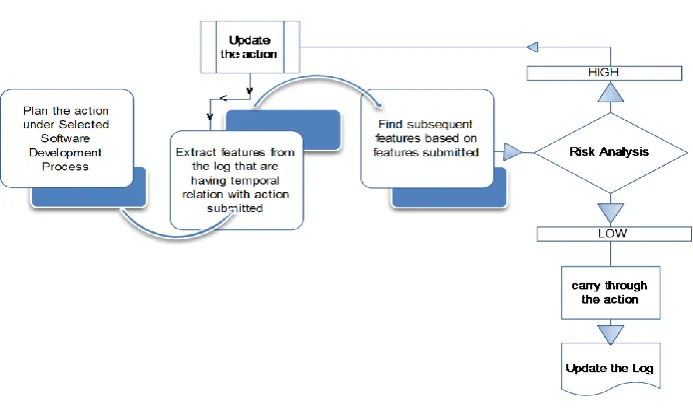
one or more traditional models as source. In short we there after refer as PC. The fig. 1
describes the proposed risk analysis process that mingles with each stage of the SDLC. Here
in PC the risk analysis is strategic and supports to predict the risk that influence the cost and
targeted outcomes. This prediction can help the experts involved to change the current action
to decrease the severity of the risk predicted. Fig 2 describes the risk analysis strategy
proposed as key aspect of the PC. Here in risk analysis process we opt to machine learning
technique called support vector machines in short SVM. The Risk analysis stage of the PC
targets the SDLC logs available as input to train the SVM for better predictions. The feature
extraction process that is part of SVM training process can be done with support of
mathematical model called Quantum particle swarm optimization.
A Monthly Double-Blind Peer Reviewed Refereed Open Access International e-Journal - Included in the International Serial Directories. International Research Journal of Mathematics, Engineering & IT (IRJMEIT)
[image:3.595.74.421.70.276.2]Website: www.aarf.asia. Email: [email protected] , [email protected] Page 36
Fig. 2: Risk Analysis Process
III. EMPIRICAL STUDY AND RESULTS DISCUSSION.
Feature wise performance analysis of existing and proposed software development process models
Here in the Table 1 we described our observations emerged as results to qualitative
and quantitative methods.
Feature Waterfall Model Prototype Model Spiral Model Iterative
Model
Prototype Centric(PC)
Requirement Specifications
Beginning Frequently
Changed
Beginning Beginning Dependent of Risk
Analysis report Understanding
Requirements
Well Understood Not Well
understood
Well Understood Not Well
understood
Well understood
Cost Low High Intermediate Low Moderate
Guarantee of
Success
Low Good High High Very high
Resource Control Yes No Yes Yes Yes
Cost Control Yes No Yes No Sure
Simplicity Simple Simple Intermediate Intermediate Moderate
Risk Involvement High High Low Intermediate Dependent of Source
Model Expertise
Required
High Medium High High Dependant of source
model Changes
Incorporated
Difficult Easy Easy Easy Moderate
Risk Analysis Only at beginning No Risk Analysis Yes No On each Stage of
source model
User Involvement Only at beginning High High Intermediate Dependent of Risk
Analysis report Overlapping
Phases
No Yes Yes No Dependant of source
model
Flexibility Rigid Highly Flexible Flexible Less Flexible Highly Flexible
A Monthly Double-Blind Peer Reviewed Refereed Open Access International e-Journal - Included in the International Serial Directories. International Research Journal of Mathematics, Engineering & IT (IRJMEIT)
Website: www.aarf.asia. Email: [email protected] , [email protected] Page 37
Simplicity : Data was obtained for a cost driver value of „multi-skilled and experienced‟. The data indicates that the waterfall and prototype models are most
suitable for projects in which simplicity is the main factor. The spiral and iterative
models have limited impact because they have intermediate with regard to simplicity
factor, while the agile model is unsuitable because of complex nature. Also because of
its complexity, more time and money is required to complete a software project [5].
Risk Involved: The data indicates that the Spiral model is most suitable for projects
because software projects using this model involve low risk, where as waterfall model is
unsuitable because high risk is involved in software projects.
Expertise Required: Data was obtained for a cost driver value of „range of development experience‟ The Prototyping models are most appropriate where only developers with a
range of experience are available. The waterfall, spiral and iterative models are slightly
less suitable because they require personnel with high level of expertise, whereas the
agile process model is inappropriate because it requires personnel with very high
expertise and experience. The strong positive value for the Prototyping model may
suggest the developers, instead of managers, are performing objective setting and
evaluation. The proposed Prototype centric PC can improvise the other models
performance even under resources with less expertise.
Changes Incorporated : From the analysis of data, it is observed that the prototype,
spiral and iterative models are most suitable of all as they requires less changes to be
incorporated after the project is complete. Because if model needs more changes during
usage, software projects takes more cost and also time for its updating etc. While the
Waterfall model and agile models are totally inappropriate because if it requires the
changes to be incorporated, then many difficulties do arise while incorporating changes
in the software project [6].
Risk Analysis: Data was obtained for a cost driver value of „risk involvement (expressed as „complex, difficult or challenging to implement‟ or „very complex or novel algorithm‟). Data shows waterfall model have risk involved only at beginning, while the prototype model and iterative model don‟t involves any risk analysis while
being used in any software projects. While on the contrary the spiral model and agile
A Monthly Double-Blind Peer Reviewed Refereed Open Access International e-Journal - Included in the International Serial Directories. International Research Journal of Mathematics, Engineering & IT (IRJMEIT)
Website: www.aarf.asia. Email: [email protected] , [email protected] Page 38
User Involvement: Data was obtained and it is observed that waterfall model has very
less involvement of the users because it requires user involvement only at the beginning
of project. Iterative model needs intermediate user involvement, whereas spiral model
and agile process models require high user involvement as a requirement of these
models [7].
M. Overlapping Phases: From the research it was seen that Waterfall model and
iterative model have no overlapping phases while the prototype model, spiral model
process models requires overlapping phases. In the point of prototype centric it is
obvious that the behavior of source model need to be considered.
Flexibility: Data was obtained for a cost driver value of „range of flexibility‟. Data
shows that PC process model and prototype models are highly flexible and are most
appropriate, spiral and waterfall models also performs much better when those
considered as source process models for PC. As an individual Waterfall model is rigid
but as a source model of PC performs better.
IV. CONCLUSION:
As of the reports emerged as results to the empirical analysis, we can conclude that regardless
of the source model the Prototype Centric is modest in all desired features, particularly in terms
of cost, resource utilization and balanced SDLC. It helps to work with any one or more
traditional models as source under any circumstances such as resource availability with less
expertise. As the methodology we fallowed to perform risk analysis, it is stable regardless of
the software application size.
REFERENCES
[1] Molokken-Ostvold et.al, “A comparison of software project overruns - flexible versus sequential development models”, Volume 31, Issue 9, Page(s): 754 – 766, IEEE CNF, Sept. 2005.
[2] Boehm, B. W.“A spiral model of software development and enhancement”, ISSN: 0018-9162, Volume: 21, Issue: 5, on page(s): 61-72, May 1988.
[3] Abrahamsson P. et.al, “Agile Software Development Methods: Review and Analysis”, ESPOO, VTT Publications 478, VTT Technical Research Centre of Finland. http:/www.fi/pdf/publications/2002/ P478 .pdf, 2002.
A Monthly Double-Blind Peer Reviewed Refereed Open Access International e-Journal - Included in the International Serial Directories. International Research Journal of Mathematics, Engineering & IT (IRJMEIT)
Website: www.aarf.asia. Email: [email protected] , [email protected] Page 39
[5] Cortes, C.; Vapnik, V.; Mach. Learn. 1995, 20, 273.
[6] Sun J, Xu W, Feng B, A Global Search Strategy of Quantum- Behaved Particle Swarm Optimization. In Proc. of the 2004 IEEE Conf. on Cybernetics and Intelligent Systems, Singapore: 291 – 294, 2004.
[7] Suykens, J. A. K.; Vandewalle, J.; Neural Process. Lett. 1999, 9, 293.
[8] Suykens, J. A. K.; van Gestel, T.; de Brabanter, J.; de Moor, B.; Vandewalle, J.; Least-Squares Support Vector Machines, World Scientifics: Singapore, 2002.
[9] Zou, T.; Dou, Y.; Mi, H.; Zou, J.; Ren, Y.; Anal. Biochem. 2006, 355, 1.
[10] Ke, Y.; Yiyu, C.; Chinese J. Anal. Chem. 2006, 34, 561.
[11] Niazi, A.; Ghasemi, J.; Yazdanipour, A.; Spectrochim. Acta Part A 2007, 68, 523.
[12] Millie Pant, Radha Thangaraj, and Ajith Abraham. 2008. A new quantum behaved particle swarm optimization. In <em>Proceedings of the 10th annual conference on Genetic and evolutionary computation</em> (GECCO '08), Maarten Keijzer (Ed.). ACM, New York, NY, USA, 87-94. DOI=10.1145/1389095.1389108 http://doi.acm .org/ 10.1145/1389095.1389108.
[13] Liu J, Sun J, Xu W, Quantum-Behaved Particle Swarm Optimization with Adaptive Mutation Operator. ICNC 2006, Part I, Springer-Verlag: 959 – 967, 2006.
[14] M. Barni, F. Bartolini, and A. Piva, "Improved Wavelet- Based Watermarking Through Pixel-Wise Masking," IEEE Transactions on Image Processing, Vol. 10, No. 5, IEEE, pp. 783-791, May 2001.
[15] Dennis, A., Wixom, B. H. and Tegarden, D. (2002), Systems Analysis and Design: An Object-Oriented Approach, John Wiley & sons, New York.
[16] Roger S. Pressman, “Software Engineering a practitioner‟s approach”, McGraw-Hill, 5th edition, 200.