http://dx.doi.org/10.4236/ojpm.2014.47062
Assessing the Intensity of Dog Walking and
Impact on Overall Physical Activity: A Pilot
Study Using Accelerometry
Elizabeth A. Richards
1, Philip J. Troped
2, Eunjung Lim
3 1School of Nursing, Purdue University, West Lafayette, IN, USA2Department of Exercise and Health Sciences, University of Massachusetts, Boston, MA, USA 3John A. Burns School of Medicine, University of Hawaii, Honolulu, HI, USA
Email: [email protected], [email protected], [email protected]
Received 14 May 2014; revised 13 June 2014; accepted 28 June 2014
Copyright © 2014 by authors and Scientific Research Publishing Inc.
This work is licensed under the Creative Commons Attribution International License (CC BY). http://creativecommons.org/licenses/by/4.0/
Abstract
Introduction: Despite a growing body of research indicating that dog walking contributes to meeting physical activity (PA) guidelines, this literature is limited by the use of self-report meas-ures of dog walking and overall PA. The objectives of this pilot study were to objectively assess dog walking with accelerometry, characterize the frequency, duration, and intensity of dog walking, and determine the contribution of dog walking to overall moderate-vigorous physical activity (MVPA). Methods: Sixty-five dog owners wore an Actigraph GT3X accelerometer for up to 7 con-secutive days and recorded start/end times for dog walks with daily log sheets. Each minute with an activity count ≥ 760 was classified as MVPA. Descriptive statistics were used to summarize all variables. Logistic regression was used to examine associations between dog walking MVPA bouts and meeting PA guidelines, controlling for age, education, income, and gender. Results: Partici-pants walked their dog an average of 1.2 ± 1.1 times/day, averaged 28.0 ± 15.6 minutes/walk, and accumulated 22.9 ± 17.5 minutes of MVPA/day during dog walks, of which 21.7 ± 17.9 minutes were accumulated in bouts ≥10 minutes. Seventy-eight percent of dog walking was classified as moderate-intensity and 3.5% was vigorous. Dog walking MVPA had a statistically significant posi-tive association with meeting PA guidelines (OR = 2.32; 95% CI = 1.06, 5.08). Conclusions: The majority of dog walking minutes were moderate-intensity and most minutes of MVPA during dog walking occurred in bouts. These findings suggest that dog walking is consistent with current PA guidelines for adults and should receive more consideration as a PA promotion strategy.
Keywords
1. Introduction
Participation in regular physical activity decreases the risk of many chronic diseases and conditions such as car-diovascular disease, type 2 diabetes mellitus, osteoporosis, obesity, breast and colon cancer, and falls in older adults [1]. Despite the well-known physical and mental health benefits of an active lifestyle, the proportion of US adults who meet physical activity guidelines remains low [1] [2]. Promotion of moderate-intensity physical activity, such as brisk walking, may be one the best types of physical activities to encourage, since it is inexpen-sive, does not require specific skills or abilities to perform, and has a low risk of injury [3]. Promotion of dog walking could be a promising strategy to increase walking and overall physical activity. Close to 50% of US households own a dog [4] and studies consistently show that this population has the potential to increase their physical activity via dog walking [5]-[7]. Approximately 40% - 60% of dog owners do not walk their dog at all or do not walk enough to meet US physical activity guidelines [6]-[8]. Furthermore, dog owners who do walk with their dog tend to be more active overall and are more likely to meet US physical activity guidelines than dog owners who do not walk with their dog [5].
Despite this evidence, little is known about how much of the physical activity obtained during dog walking is moderate-vigorous intensity physical activity (MVPA). One study examining dog behavior during walks sug- gests that a significant proportion of the dog’s time is spent sniffing, which may result in stationary or slow walking speeds for owners [9]. A key limitation of dog walking studies is the use of self-report measures. Limi-tations of self-report measures include the potential for social desirability bias which can lead to over-reporting [10]. Furthermore, recalling physical activity is considered a complex cognitive task which may limit its effec-tiveness in youth and older adults [10]. The use of objective measures of physical activity, such as accelerome-ters addresses some of the limitations of self-report physical activity assessment [11]. For several years, re-searchers have been recommending that studies objectively measure the duration, frequency, and intensity of dog walking and the contribution this makes to overall physical activity [5]. To our knowledge, no published studies have objectively assessed these parameters with accelerometers. Therefore, the proportion of dog walk-ing that is considered health-enhancwalk-ing, specifically activity that is at least moderate-intensity and occurrwalk-ing in bouts ≥ 10 minutes, is not known [1]. The objectives of this pilot study were to: 1) objectively assess the extent to which dog walking is comprised of moderate intensity bouts ≥ 10 minutes; 2) assess differences in dog walk-ing intensity, frequency, and duration by socio-demographic characteristics; and 3) objectively assess the con-tribution of dog walking to overall MVPA and meeting physical activity guidelines (150 minutes of MVPA/week accumulated in bouts ≥10 minutes) [1].
2. Methods
2.1. Participants
This observational study was conducted in the fall of 2012 at Purdue University in Tippecanoe County, Indiana [12]. Dog owners eighteen years of age and older were recruited via a university-wide e-mail newsletter sent to all faculty, staff, and graduate students at the university. The primary inclusion criterion was that participants reported dog walking at least once per week. Ninety-three adults provided contact information. Sixty-seven individuals met with research staff and provided informed consent. One participant left the study for personal reasons and one was excluded due to non-compliance with the study protocol, resulting in a final sample of 65 participants. Study pro-cedures were approved by the Purdue University Committee on the Use of Human Research Subjects.
2.2. Equipment and Data Collection
Participants wore an Actigraph GT3X [13] accelerometer, a lightweight monitor that captures acceleration in three planes. Accelerometers were initialized to collect data in 2-second epochs. Research staff met participants 1-3 days before monitoring to distribute accelerometers and describe study procedures. Participants received log sheets for the 7 monitoring days and were instructed to record the time they put the monitor on and took it off each day and the start and end times for each dog walk. Participants were instructed to wear the accelerometer on their right hip using an adjustable nylon belt, except when sleeping, bathing or swimming. After the moni-toring period, research staff met participants to collect the devices and review the log sheets.
Body mass index (BMI) was calculated using the following formula: weight (lb)/[height (in)]2 × 703 [14]. Par-ticipants were classified as overweight if BMI was 25.0 - 29.9 and obese if BMI was ≥ 30.0.
2.3. Data Processing
Accelerometer data were downloaded, re-integrated up to 1-minute, and screened for valid wear time using Ac-tiLife5® software [13]. Invalid wear time was defined as 60 minutes of consecutive zeros with a 2 minute spike tolerance [13]. Valid monitoring days were defined as having ≥ 600 minutes of valid wear time and participants were required to have ≥ 4 valid days to be included in the analysis [15]. Matthews’ 2005 cut-points were used to classify intensity for each minute: <100 = sedentary; 100-759 = light; 760-5724 = moderate; and ≥ 5725 = vi-gorous [16] [17]. These cut-points were chosen based on a recent validation study of free-living activity that compared the 2006 and 2010 Crouter algorithms, the National Health and Nutrition Examination Survey cut-points, and the Mathews cut-points for Actigraph data and which showed that among the four approaches the Matthews cut-points had the lowest mean bias in overestimating MVPA when compared to indirect calorimetry [16]. Using the times indicated for dog walking on the daily log sheets, each accelerometer minute was coded for dog walking. Bouts of dog walking and overall MVPA were calculated using National Health and Nutrition Examination Survey SAS code [18].
2.4. Statistical Analysis
Descriptive statistics were used to summarize all variables. One-way ANOVA was used to detect differences in dog walking outcomes (e.g., intensity, frequency, duration) by participant socio-demographic characteristics. Paired t-tests were used to compare the means of weekday versus weekend activity. Logistic regression was used to examine the association between dog walking MVPA bouts and meeting physical activity guidelines, controlling for age, education, income, and gender. Analyses were completed using SAS® 9.3 [19].Statistical significance was set at p < 0.05.
3. Results
3.1. Participant and Monitoring Characteristics
Participants’ mean age was 39.0 ± 13.0 years and 71% were female. Overall, participants were well educated and 45% were classified as overweight or obese. Fifty-nine percent (n = 38) had 7 days of valid monitoring; 26% (n = 17) had 6 days; 11% (n = 7) had 5 days; and 5% (n = 3) had 4 days. Valid wear time averaged 846.5 ± 68.8 minutes/day.
3.2. Physical Activity and Dog Walking
On average participants engaged in 106.8 ± 35.9 minutes/day of accumulated MVPA and 50.8 ± 29.9 minutes were obtained in bouts of 10 minutes or more (Table 1). Participants walked their dog an average of 1.2 ± 1.1 times per day and averaged 28.0 ± 15.6 minutes per walk. During dog walks, participants accumulated 22.9 ± 17.5 minutes of MVPA/day, of which 21.7 ± 17.9 minutes were in bouts ≥ 10 minutes. Mean daily minutes of dog walking were approximately 9 minutes longer on weekends versus weekdays, though there were no signifi-cant differences in the MVPA obtained during dog walks on weekends versus weekdays (Table 1).
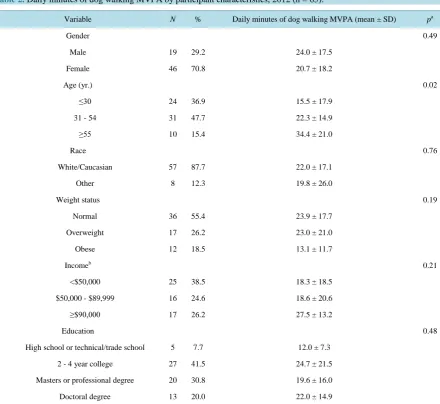
As shown in Table 2, there were no significant differences in dog walking MVPA by gender, race, income, education, or weight status. Daily MVPA from dog walking among adults 55 years of age and older was two-fold greater than that of participants thirty years old or younger (p = 0.02).
Overall, 3.8% of dog walking was classified as sedentary, 14.4% was light intensity, 78.3% was moderate in-tensity and 3.5% was vigorous inin-tensity. Of the MVPA obtained during dog walking, 95% of the minutes oc-curred in bouts ≥ 10 minutes. In addition, dog walking MVPA bouts accounted for 43% of all MVPA accumu-lated in bouts. MVPA during dog walking (in bouts) had a statistically significant positive association with meeting physical activity guidelines (OR = 2.32; 95% CI = 1.06 - 5.08).
4. Discussion
Table 1. Overall physical activity and dog walking, 2012 (n = 65).
Variable Overall Weekday Weekend pa
Mean ± SD Mean ± SD Mean ± SD
Total MVPA minutes/day
Accumulated 106.8 ± 35.9 104.5 ± 36.6 109.8 ± 48.5 0.20
Bouts ≥ 10 minutes 50.8 ± 29.9 47.5 ± 30.3 58.6 ± 42.8 0.01
Dog walks/day 1.2 ± 1.1 1.2 ± 1.1 1.2 ± 1.2 0.58
Minutes per dog walk 28.0 ± 15.6 26.1 ± 15.2 34.8 ± 24.2 0.01
Dog walking MVPA minutes/day
Accumulated 22.9 ± 17.5 21.8 ± 17.1 25.9 ± 25.1 0.11
Bouts ≥ 10 minutes 21.7 ± 17.9 20.5 ± 17.7 24.4 ± 25.6 0.12
MVPA = moderate-to-vigorous physical activity; SD = standard deviation; aT-test used to compare means on weekdays and weekends.
Table 2. Daily minutes of dog walking MVPA by participant characteristics, 2012 (n= 65).
Variable N % Daily minutes of dog walking MVPA (mean ± SD) pa
Gender 0.49
Male 19 29.2 24.0 ± 17.5
Female 46 70.8 20.7 ± 18.2
Age (yr.) 0.02
≤30 24 36.9 15.5 ± 17.9
31 - 54 31 47.7 22.3 ± 14.9
≥55 10 15.4 34.4 ± 21.0
Race 0.76
White/Caucasian 57 87.7 22.0 ± 17.1
Other 8 12.3 19.8 ± 26.0
Weight status 0.19
Normal 36 55.4 23.9 ± 17.7
Overweight 17 26.2 23.0 ± 21.0
Obese 12 18.5 13.1 ± 11.7
Incomeb 0.21
<$50,000 25 38.5 18.3 ± 18.5
$50,000 - $89,999 16 24.6 18.6 ± 20.6
≥$90,000 17 26.2 27.5 ± 13.2
Education 0.48
High school or technical/trade school 5 7.7 12.0 ± 7.3
2 - 4 year college 27 41.5 24.7 ± 21.5
Masters or professional degree 20 30.8 19.6 ± 16.0
Doctoral degree 13 20.0 22.0 ± 14.9
cating this activity could be a legitimate form of health-enhancing physical activity, particularly among older adults. Furthermore, over 40% of MVPA accumulated during bouts occurred during dog walking, suggesting participants may use dog walking as a form of structured exercise. These results, albeit on a small sample, indi-cate that promotion of dog walking could be a viable approach for increasing physical activity in the US since it is estimated that 47% of households own a dog and up to 60% of dog owners do not walk their dog at levels suf-ficient to achieve health benefits [4] [6].
Promotion of dog walking could also be an effective strategy to combat obesity on a population level through additional energy expenditure. One metabolic equivalent (MET) is defined as 1 kilocalorie (kcal) per kilogram of body weight per hour and approximates the energy cost of quiet sitting. The MET value for dog walking is 3.0 [20]. Assuming energy intake remains constant, an average US man (at 195.5 pounds) and average woman (at 166.2 pounds) would expend 931.1 kcal/week and 791.6 kcal/week, respectively, if they walked their dog 30 minutes each day [21]. Over one year, this amount of dog walking could yield a weight loss of 14.2 pounds for men and 12.1 pounds for women [22]. Thus dog walking could significantly contribute to weight loss and weight maintenance.
Strengths of this study include the use of an objective measure of physical activity. To our knowledge, this is the first study to assess physical activity during dog walking with accelerometers. Limitations of this study in-clude a small convenience sample that is predominantly comprised of white, well-educated females. Thus gene-ralization to other US dog owners should be made cautiously. Furthermore, this study was conducted in the fall when weather was favorable for walking. However, two studies have shown that dog walkers are more likely to participate in outdoor recreational walking during inclement and winter weather than non-dog walkers [23] [24]. This suggests that seasonal effects may not be as pronounced with dog walking compared to other forms of out-door recreational physical activity which tends to decrease during the winter months [25]. Also, the use of rela-tively lower activity cut-points for moderate physical activity may have led to overestimating moderate-intensity dog walking and the contribution this makes to meeting physical activity guidelines. However, as noted pre-viously, recent research indicates that these cut-points introduce the least amount of bias in overestimating physical activity when compared to indirect calorimetry [16].
Further dog walking studies using accelerometry are needed to confirm whether dog walking is primarily a moderate intensity activity and substantially contributes to overall MVPA. In addition, future longitudinal re-search is needed to explore whether dog walking typically increases individuals’ total physical activity or subs-titutes for other forms of physical activity, thereby not increasing total physical activity.
Though further research is needed to replicate the results in larger and more diverse populations, the findings from this small pilot study suggest that dog walking is a type of physical activity that merits greater attention from public health officials and practitioners. Increasing the prevalence of dog walking could help the US attain physical activity objectives within Healthy People 2020, specifically addressing the prevalence of leisure-time physical activity.
References
[1] Physical Activity Guidelines Advisory Committee Report (2008) US Department of Health and Human Services. http://www.health.gov/paguidelines/Report/pdf/CommitteeReport.pdf
[2] Centers for Disease Control and Prevention (2013) Early Release of Selected Estimates Based on Data from the 2012 National Health Interview Survey: Leisure-Time Physical Activity.
http://www.cdc.gov/nchs/nhis/released201306.htm#7
[3] Hootman, J. Macera, C., Ainsworth, B., Martin, M., Addy, C. and Blair, S. (2011) Association among Physical Activity Level, Cardiorespiratory Fitness, and Risk of Musculoskeletal Injury.American Journal of Epidemiology, 54, 251-258. [4] The Humane Society of the United States (2013) US Pet Ownership Statistics.
http://www.humanesociety.org/issues/pet_overpopulation/facts/pet_ownership_statistics.html#.Uqc4hE2A05s
[5] Christian, H.E., Westgarth, C., Bauman, A., Richards, E.A., Rhodes, R.E., Evenson, K.R., et al. (2013) Dog Ownership and Physical Activity: A Review of the Evidence. Journal of Physical Activity and Health, 10, 750-759.
[6] Reeves, M.J., Rafferty, A.P., Miller, C.E. and Lyon-Callo, S.K. (2011) The Impact of Dog Walking on Leisure-Time Physical Activity: Results from a Population-Based Survey of Michigan Adults. Journal of Physical Activity and Health, 8, 436-444.
http://dx.doi.org/10.1080/14635240.2013.802546
[8] Bauman, A.E., Russell, S.J., Furber, S.E. and Dobson, A.J. (2001) The Epidemiology of Dog Walking: An Unmet Need for Human and Canine Health. Medical Journal of Australia, 175, 632-634.
[9] Westgarth, C., Christley, R.M., Pinchbeck, G.L., Gaskell, R.M., Dawson, S. and Bradshaw, J.W.S. (2011) Dog Beha- viour on Walks and the Effect of Use of the Leash. Applied Animal Behaviour Science, 125, 38-46.
http://dx.doi.org/10.1016/j.applanim.2010.03.007
[10] Sallis, J. and Saelens, B. (2000) Assessment of Physical Activity by Self-report: Status, Limitations, and Future Direc- tions. Research Quarterly for Exercise Sport, 71, S1-S14.
[11] Troiano, R.P. (2005) Timely Meeting: Objective Measurement of Physical Activity. Medicine Science in Sports Exer- cise, 37, S487-489. http://dx.doi.org/10.1249/01.mss.0000185473.32846.c3
[12] United States Census Bureau (2014) Tippecanoe County, Indiana: State and County Quick Facts. http://quickfacts.census.gov/qfd/states/18/18157.html
[13] (2010) ActiLife 5 User’s Manual. Actigraph Corporation, Pensacola.
[14] Centers for Disease Control and Prevention (2011) About BMI for Adults.
http://www.cdc.gov/healthyweight/assessing/bmi/adult_bmi/index.html#Interpreted
[15] Troiano, R.P., Berrigan, D., Dodd, K.W., Masse, L.C., Tilert, T. and McDowell, M. (2008) Physical Activity in the United States Measured by Accelerometer. Medicine Science in Sports Exercise, 40, 181-188.
http://dx.doi.org/10.1249/mss.0b013e31815a51b3
[16] Crouter,S.E., DellaValle, D.M., Haas, J.D., Frongillo, E.A. and Bassett, D.R. (2013)Validity of Actigraph 2-Regression Model, Matthews Cut-Points, and NHANES Cut-Points for Assessing Free-Living Physical Activity. Journal of Phys-ical Activity and Health, 10, 504-514.
[17] Matthews, C.E. (2005) Calibration of Accelerometer Output for Adults. Medicine Science in Sports, 37, S512-522.
[18] National Institutes of Health (2013) SAS Programs for Analyzing NHANES 2003-2004 Accelerometer Data. http://appliedresearch.cancer.gov/tools/nhanes_pam/
[19] (2009) SAS/STAT 9.2 User’s Guide. 2nd Edition, SAS Institute, Cary.
[20] Ainsworth, B.E., Haskell, W.L., Whitt, M.C., Irwin, M.L., Swartz, A.M., Strath, S.J., et al. (2000) Compendium of Physical Activities: An Update of Activity Codes and MET Intensities. Medicine Science in Sports, 32, S498-S504.
[21] Fryar, C.D., Gu,Q. and Ogden, C.L. (2012) Anthropometric Reference Data for Children and Adults: United States, 2007-2010.Vital and Health Statistics Series, 11, 1-40.
[22] Hall, K.D. (2007)What is the Required Energy Deficit per Unit Weight Loss? International Journal of Obesity, 32,573-576. http://dx.doi.org/10.1038/sj.ijo.0803720
[23] Lail, P., McCormack, G. and Rock, M. (2011) Does Dog-Ownership Influence Seasonal Patterns of Neighbou- rood-Based Walking among Adults? A Longitudinal Study. BMC Public Health, 11, 148.
http://dx.doi.org/10.1186/1471-2458-11-148
[24] Temple, V., Rhodes, R. and Wharf Higgins, J. (2011) Unleashing Physical Activity: An Observational Study of Park Use, Dog Walking, and Physical Activity.Journal of Physical Activity and Health, 8, 766-774.
[25] Tucker, P. and Gilliland J. (2007) The Effect of Season and Weather on Physical Activity: A Systematic Review. Pub-lic Health, 121, 909-922. http://dx.doi.org/10.1016/j.puhe.2007.04.009
Abbreviations
BMI: body mass index Kcal: kilocalorie
MET: metabolic equivalent