An Improved Algorithm for Efficient Mining of Frequent
Item Sets on Large Uncertain Databases
Bala Yesu Chilakalapudi
M.Tech Student Gudlavalleru Engineering College, Andhra Pradesh
Narayana Satyala
Associate Professor Gudlavalleru Engineering College, Andhra Pradesh
Satyanarayana Menda
Assistant Professor Jayawant Engineering College
and Mgmt, Maharastra.
ABSTRACT
The data handled in emerging applications like location based services, sensor monitoring systems, and data integration, are often inexact in nature. In this paper, the important problem of extracting frequent item sets from a large uncertain database, interpreted under the Possible World Semantics (PWS) is presented. This issue is technically challenging, since an uncertain database contains an exponential number of possible worlds. By observing that the mining process can be modeled as a Poisson binomial distribution, an algorithm was developed, which can efficiently and accurately discover frequent item sets in a large uncertain database. The important issue of maintaining the mining result for a database that is evolving (e.g., by inserting a tuple) can be presented. Specifically, the proposed mining algorithm can enable Probabilistic Frequent Item set (PFI) results to be refreshed. This reduces the need of re-executing the whole mining algorithm on the new database, which is often more expensive and unnecessary. The proposed algorithm can support incremental mining and provides the accurate results on mining the uncertain database. The extensive evaluation on real data set to validate the approach is performed.
General Terms
Frequent item sets, uncertain data set, incremental mining
Keywords
PFI, PWS, S-PMF, CDF.
1. INTRODUCTION
The data bases used in many important and novel applications are often uncertain. For example, the locations of users obtained through RFID and GPS systems are not precise due to measurement errors [22], [28]. As another example, data collected from sensors in habitat monitoring systems (e.g., temperature and humidity) are noisy [17]. Customer purchase behaviors, as captured in supermarket basket databases, contain statistical information for predicting what a customer will buy in the future [3], [6]. Integration and record linkage tools also associate confidence values to the output tuples according to the quality of matching [16]. In structured information extractors, confidence values are appended to rules for extracting patterns from unstructured data [31]. To meet the increasing application needs of handling a large amount of uncertain data, uncertain databases have been recently developed [10], [16], [19], [20], [27]. Performing the data mining under the possible world semantics(PWS) can be technically challenging. In fact, the mining of uncertain data has recently attracted research attention [3]. For example, in [23], efficient clustering algorithm was developed for uncertain objects; in [21] and [32], naive Bayes and decision
tree classifiers designed for uncertain data were studied. Here ,the algorithm for finding frequent item sets (i.e., sets of attribute values that appear together frequently in tuples) for uncertain databases was developed. The proposed algorithm can be applied to two important uncertainty models: attribute uncertainty and tuple uncertainty, where every tuple is associated with a probability to indicate whether it exists [15], [16], [19], [27], [34]. The frequent item sets discovered from uncertain data are naturally probabilistic, in order to reflect the confidence placed on the mining results.
A probabilistic frequent item(PFI) is a set of attribute values that occurs frequently with a sufficiently high probability. A database induces a set of possible worlds, each giving a (different) support count for a given item set. Hence, the support of a frequent item set is described by a probability mass function (pmf). A simple way of finding PFIs is to mine frequent patterns from every possible world obtained by the possible world semantics (PWS), and then record the probabilities of the occurrences‟ of these patterns. This is impractical, due to the exponential number of possible worlds. To remedy this, some algorithm has been recently developed to successfully retrieve PFIs without instantiating all possible worlds [6], [30], [35]. These algorithm can verify whether an item set is a PFI in O(n2) time (where n is the number of tuples contained in the database). However, the experimental results reveal that they can require a long time to complete(e.g., with a 300k real data set, the dynamic programming algorithm in [6] needs 30.1 hours to find all PFIs). The support pmf of a PFI can be captured by a Poisson binomial distribution, for both attribute and tuple uncertain data. The proposed algorithm make use of this intuition to propose a method for approximating a PFI‟s pmf with a Poisson distribution, which can be efficiently and accurately estimated. This algorithm can verify a PFI in O(n2), and is thus more suitable for large databases. The algorithm can be used to mine the frequent item sets whose probabilities of being true frequent item sets are larger than some user defined threshold [6]. The algorithm only needs very less time to find all PFIs [33] when compared with the existing algorithm, which is four orders of magnitudes faster than the method used in [6].
1.1
Mining evolving databases
.be appended to the database for further analysis. Notice that these new tuples may induce changes to the mining result. A straightforward way of refreshing the mining results is to re- evaluate the whole mining algorithm on the new database. This can be costly, however, when new tuples are appended to the database at different time instants. In fact, if the new database D is similar to its older version, D, it is likely that most of the PFIs extracted from D remain valid for D+..Based on this intuition, The developed mining algorithm uses the PFIs of D to derive the PFIs of D+, instead of finding them from scratch. In this paper, The proposed mining algorithm for the method studied in [6], discovers the PFIs. The algorithm discovers PFIs, which can be extended to handle evolving data. As the experiments show, when the change of the database is small, running the mining algorithm on D+ is much faster than finding PFIs on D+ from scratch. In an experiment on a real data set, the mining algorithm addresses a fivefold performance improvement over its non counterpart. To summarize, an algorithm was developed, which can reduce the amount of effort of scanning the database for mining threshold− based PFIs. The algorithm can support both attribute and tuple uncertainty models. The time complexity of the proposed approach is presented. Experiments on the real data set reveal that the proposed method significantly improves the performance of PFI discovery, with a high degree of accuracy. The rest of the paper is organized as follows: in Section 2, we review the related works. Section 3 defines the problems to be studied. Section 4 describes efficient and accurate methods for computing s− pmf. In Section 5, The working method of the algorithm for discovering threshold− based PFIs is presented. Section 8 reports the experimental results. The paper will conclude in Section 9.
2. RELATED WORK
Mining frequent item sets is an important problem in data mining, and is also the first step of deriving association rules [4]. Hence, many efficient item set mining algorithm(e.g., Apriori [4] and FP− growth [18]) have been proposed. While these algorithm work well for databases with precise values, it is not clear how they can be used to mine probabilistic data. Here an algorithm for extracting frequent item sets from uncertain databases was developed. Although the algorithm is developed based on the Apriori framework, they can be considered for supporting other algorithm (e.g., FP− growth) for handling uncertain data. For uncertain databases, Aggarwal et al. [2] and Chui et al. [14] developed efficient frequent pattern mining algorithm based on the expected support counts of the patterns. However, Bernecker et al. [6], Sun et al. [30], and Yiu et al. [35] found that the use of expected support may render important patterns missing. Hence, they proposed to compute the probability that a pattern is frequent, and introduced the notion of PFI. In [6], dynamic programming based solutions were developed to retrieve PFIs from attribute uncertain databases. However, their algorithm compute probabilities, and verify that an item set is a PFI in O(n2) time. the algorithm avoid the use of dynamic programming, and are able to verify a PFI much faster (in O(n) time). Zhang et al. [35] only considered the extraction of singletons (i.e., sets of single items), the solution discovers patterns with more than one item. Recently, Sun et al. [30] developed an threshold based PFI mining algorithm. However, it does not support attribute uncertain data considered in this paper other works on the retrieval of frequent patterns from imprecise data include: [9], which studied frequent patterns on noisy data; [24], which examined association rules on fuzzy sets; and [26], which proposed the
notion of a “vague association rule.” However, none of these solutions are developed on the uncertainty models studied here. For evolving databases. A few mining algorithm that work for data have been developed. For example, in [11], the Fast Update algorithm (FUP) was proposed to efficiently maintain frequent item sets, for a database to which new tuples are inserted. the mining framework is inspired by FUP. In [12], the FUP2 algorithm was developed to handle both addition and deletion of tuples. ZIGZAG [1] also examines the efficient maintenance of maximal frequent item sets for databases that are constantly changing. In [13], a data structure, called CATS Tree, was introduced to maintain frequent item sets in evolving databases. Another structure, called CanTree [25], arranges tree nodes in an order that is not affected by changes in item frequency. The data structure is used to support mining on a changing database. To the best knowledge, maintaining frequent item sets in evolving uncertain databases has not been examined before. The proposed algorithm can also support attribute and tuple uncertainty models.
3. PROBLEM DEFINITION
Let V be a set of items. The algorithm adopt the following variant [6]: a database D contains n tuples, or transactions. Each transaction, 𝑡𝑗 is associated with a set of items taken from V. Each item v𝜖V exists in 𝑡𝑗 with an existential probability Pr 𝑣𝜖𝑡𝑗 𝜖 0, 1 , which denotes the chance that v belongs to 𝑡𝑗. Under the Possible World Semantics, D generates a set of possible worlds. Each world consists of a subset of attributes from each transaction, occurs with probability Pr(𝑤𝑖).
The probabilities are one, and the number of possible worlds is exponentially large. the goal is to discover frequent patterns without expanding D into possible worlds. Each transaction 𝑡𝑗 ∈ 𝐷 is associated with a set of items and an existential probability Pr 𝑡𝑗 ∈ (0, 1] which indicates that 𝑡𝑗 exists in D with probabilityPr(𝑡𝑗). Again, the number of possible worlds for this model is exponentially large. The problem of mining threshold− based PFIs is then described in Section 3.1. The below Table 1 summarizes the symbols used in this paper .
3.1 Mining Probabilistic Frequent Item Sets
Let 𝐼 ⊆ 𝑉 a set of items, or an item set the support of I, denoted by s(I), is the number of transactions in which I appears in a transaction database [4]. In precise databases, s(I) is a single value. This is no longer true in uncertain databases, because in different possible worlds, s(I) can have different values. Let 𝑆(𝑤𝑗, 𝐼) be the support count of I in possible world 𝑤𝑗. Then, the probability that s(I) has a value of i, denoted by 𝑃𝑟𝐼(𝑖), is
𝑃𝑟𝐼 𝑖 = Pr 𝑤 𝑗 𝑤𝑗∈𝑊,𝑆 𝑤𝑗,𝐼 =𝑖
(1)
Hence, 𝑃𝑟𝐼(𝑖)( i =1,…..,n ) form a probability mass function (pmf) of S(I), where n is the size of database D. Now, let minsup𝜖 (0, 1] be a percentage value, which is generally used to define minimal support in a deterministic database. An item set I is said to be frequent in a database D if s 𝐼 ≥ 𝑚𝑠𝑐(𝐷) where 𝑚𝑠𝑐 𝐷 = 𝑚𝑖𝑛𝑠𝑢𝑝 × 𝑛 is called the minimal support count of D[4].
Notation description
D An uncertain database of n tuples V The set of items that appear in D v An item, where v ∈ V
𝑡𝑗 The j-th tuple in D
W The set of all possible worlds
𝑤𝑗 A possible world wj ∈ W I An itemset, where I ⊆ V minsup A real value between (0, 1] msc(D) A minimal support count in D s(I) The support count of I in D minprob A real value between (0, 1]
𝑃𝑟𝐼(𝑖) Support prob. ( prob. I has a support count of i )
Prfreq(I) Frequentness probability of I
μI Expected value of XI in D d Delta database with nI tuples D+ New database with n+ tuples FD Set of all PFIs in D
𝐹𝑘𝐷 Set of all K-PFIs in D Ck
+
Set of size k candidates for D+ DB A database, can be D, d or D+ SDB(I) The support count of I in DB
𝑃𝑟𝑓𝑟𝑒𝑞𝐷𝐵 (𝐼) The frequentness probability I in DB
𝜇𝐼(𝐷𝐵) The expected value of 𝑋𝐼 in DB
For uncertain databases the frequentness probability of I, denoted by 𝑃𝑟𝑓𝑟𝑒𝑞(𝐼) is the probability that an item set is frequent [6]. Notice that 𝑃𝑟𝑓𝑟𝑒𝑞 𝐼 can be expressed as
𝑃𝑟𝑓𝑟𝑒𝑞 𝐼 = 𝑃𝑟𝐼 𝑖≥𝑚𝑠𝑐 𝐷
𝑖 (2)
Using frequentness probabilities, the proposed algorithm can determine whether an item set I is frequent. In this paper, the algorithm adopt the definition in [6]: I is a Threshold based PFI if its frequentness probability is larger than some user defined threshold [6]. Formally, given a real value
𝑚𝑖𝑛𝑝𝑟𝑜𝑏 𝜖(0, 1], I is a threshold− based PFI, if
𝑃𝑟𝑓𝑟𝑒𝑞 𝐼 ≥ 𝑚𝑖𝑛𝑝𝑟𝑜𝑏 (3) Here the minimum probability (minprob) is the frequentness probability threshold.
4. EVALUATING S− PMF
This section deals with the computing method of the probability of the item set which is presented in the dataset. The s-pmf s(I) of item set I plays an important role in determining whether I is a PFI. An interesting observation about s(I) is that it is essentially the number of successful Poisson trials[29]. To explain, let 𝑋𝑗𝐼 be a random variable, which is equal to one if I is a subset of the items associated with transaction 𝑡𝑗 (i.e., I is a subset of 𝑡𝑗) or zero otherwise. Given a database of size n, each I is associated with random variables 𝑋1𝐼, 𝑋2𝐼, … , 𝑋𝑛𝐼 . all tuples are independent. Therefore, these n variables are independent, and they represent n Poisson trials. Moreover,
𝑋𝐼 = 𝑋 𝑗 𝐼 𝑛
𝑗 =1
(4)
follows a Poisson binomial distribution. Next, observe an important relationship between 𝑋𝐼 and 𝑃𝑟𝐼(𝑖) (i.e., the probability that the support of I is i )
𝑃𝑟𝐼 𝑖 = 𝑃𝑟 𝑋𝐼= 𝑖 (5) This is simply because 𝑋𝐼 is the number of times that I exists in the database. Hence, the s− pmf of I, i.e., 𝑃𝑟𝐼 (𝑖) is the pmf of 𝑋𝐼, a Poisson binomial distribution. Using (5), it can rewrite (2), which computes the frequentness probability of I, as
𝑃𝑟𝑓𝑟𝑒𝑞(𝐼) = 𝑃𝑟 𝑋𝐼= 𝑖 (6) 𝑖≥𝑚𝑠𝑐 (𝐷)
= 𝑃𝑟 𝑋𝐼≥ 𝑚𝑠𝑐 𝐷 (7) Therefore, if the cumulative distribution function (cdf) of 𝑋𝐼 is known, 𝑃𝑟𝑓𝑟𝑒𝑞(𝐼)I) can also be evaluated. Next, an approach to this cdf, in order to compute 𝑃𝑟𝑓𝑟𝑒𝑞 𝐼 efficiently is presented.
4.2 Approximating s− pmf
From (7), it is possible to express 𝑃𝑟𝑓𝑟𝑒𝑞 𝐼 as𝑃𝑟𝑓𝑟𝑒𝑞 𝐼 = 1 − 𝑃r 𝑋𝐼≤ 𝑚𝑠𝑐 𝐷 − 1 (8) For notational convenience, let 𝑃𝑟𝑗𝐼 be Pr( 𝐼⊆ tj ) .Then, the
expected value of 𝑋𝐼 in D, denoted by 𝜇𝐼, can be computed by
𝜇𝐼= 𝑃
𝑗𝐼 (9) 𝑛
𝑗 =1
Since a Poisson binomial distribution can be well approximated by a Poisson distribution [8], (8) can be written as
𝑃𝑟𝑓𝑟𝑒𝑞 𝐼 ≈ 1 − 𝐹 𝑚𝑠𝑐 𝐷 − 1, 𝜇𝐼 (10)
Where F is the cdf of the Poisson distribution with mean μI ,
i.e., 𝐹 𝑚𝑠𝑐 𝐷 − 1, 𝜇𝐼 = 1 −Γ(𝑚𝑠𝑐 𝐷 ,𝜇 𝑚𝑠𝑐 𝐷 −1 !𝐼) expressed using the incomplete gamma function
Γ(𝑠, 𝑥) = 𝑡∞ 𝑠−1𝑒−𝑡𝑑𝑡
𝑥
Empirical results may be obtained using this function. To estimate can first compute 𝜇𝐼 by scanning D once and summing up 𝑃𝑗𝐼 ‟s for all tuples 𝑡𝑗 in D.
Then, 𝐹(𝑚𝑠𝑐 𝐷 − 1, 𝜇𝐼) is evaluated, and (10) is used to approximate 𝑃𝑟𝑓𝑟𝑒𝑞(𝐼). The following theorem can be used to support the proposed algorithm which can be presented as follows
Theorem 1. 𝑃𝑟𝑓𝑟𝑒𝑞 𝐼 , 𝑖𝑓approximated by (10), increases monotonically with 𝜇𝐼 .
Proof. The cdf of a Poisson distribution, 𝐹(𝑖, 𝜇) can be written as
𝐹 𝑖, 𝜇 =Γ(𝑖 + 1, 𝜇)
𝑖! =
𝑡∞ 𝑖+1 −1𝑒−𝑡𝑑𝑡 𝜇
𝑖!
Since minsup is fixed and independent of 𝜇, let us examine the partial derivative w.r.t. 𝜇
𝜕𝐹(𝑖, 𝜇)
𝜕𝜇
=
𝜕 𝜕𝜇
(
𝑡∞ 𝑖+1 −1𝑒−𝑡𝑑𝑡 𝜇
𝑖!
)
=𝑖!1𝜕𝜇𝜕 ( 𝑡∞ 𝑖𝑒−𝑡𝑑𝑡 𝜇 )
=1𝑖!(− 𝜇𝑖𝑒−𝜇)
= −𝑓 𝑖, 𝜇 ≤ 0 .
Thus, the cumulative distribution (cdf) of the Poisson distribution 𝐹 𝑖, 𝜇 is monotonically decreasing w.r.t. 𝜇, when i is fixed. Consequently, 1 − 𝐹( 𝑖 − 1, 𝜇) increases monotonically with 𝜇. Theorem 1 follows immediately by substituting 𝑖 = 𝑚𝑠𝑐(𝐷) .Intuitively, Theorem 1 states that the higher value of 𝜇𝐼, the higher is the chance that I is a PFI. Next, the fact of how this theorem avoids the costly computations of F, and improves the efficiency of finding threshold-based PFIs was presented.
5. MINING THRESHOLD BASED PFIs
It is very difficult to quickly determine whether an item set I is a threshold−based PFI. Since in typical PFI mining algorithm (e.g., [6]), candidate item sets are first generated, before they are tested on whether they are PFI‟s. In Section 5.1, The method of testing whether I is a threshold−based PFI, without computing its frequentness probability is presented below. The method can be enhanced in Section 5.2. The adaptation of these techniques in an existing PFI− mining algorithm was demonstrated in Section 5.3.5.1 PFI Testing
Given the values of minsup and minprob the algorithm can test whether I is a threshold− based PFI, in three steps. Step-1. Find a real number µm satisfying the equation: 𝑚𝑖𝑛𝑝𝑟𝑜𝑏 = 1 − 𝐹 𝑚𝑠𝑐 𝐷 − 1, 𝜇𝐼 (11) The above equation can be solved efficiently by employing numerical methods.
Step-2. Use (9) to compute 𝜇𝐼 Notice that the database D has to be scanned once.
Step-3. If 𝜇𝐼≥ 𝜇𝑚, The algorithm conclude that I is a PFI, otherwise, I must not be a PFI.
To understand this, first notice that the right side of (11) is the same as that of (10), an expression of frequentness probability. essentially, Step-1 finds out the value of µm that corresponds to the frequentness probability threshold (i.e.,.minprob). In Steps 2 and 3, if µI ≥ µm,, Theorem 2 allows us to deduce that the 𝑃𝑟𝑓𝑟𝑒𝑞 𝐼 ≥ 𝑚𝑖𝑛𝑝𝑟𝑜𝑏.
Hence, these steps together can test whether an item set is a PFI. In order to verify whether I is a PFI, once µm is found, The algorithm might not have to evaluate 𝑃𝑟𝑓𝑟𝑒𝑞(𝐼). Instead, it compute µI in Step 2, which can be done in O(n) time. This is a more scalable method compared with solutions in [6] and [35], which evaluate 𝑃𝑟𝑓𝑟𝑒𝑞(𝐼) in O(n2) time. Next, the process of how this method can be further improved is presented in below section .
5.2 Improving the PFI Testing Process
In Step 2 of the last section, D has to be scanned once to obtain µI , for every item set I. This can be costly if D is large, and if many item sets need to be tested. For example, in the Apriori algorithm [6], many candidate item sets are generated first before testing whether they are PFIs. next the process of how the PFI testing can still be carried out without scanning the whole database was explained. Let 𝜇𝑙𝐼= 𝑙𝑗 =1𝑝𝑗, where l
∈ (0, n]. Essentially, 𝜇𝑙𝐼 is the “partial value” of 𝜇𝐼 which is obtained after scanning l tuples. Notice that 𝜇𝑛𝐼 = 𝜇𝐼 Suppose that 𝜇𝑚 has been obtained from (11).
Corollary 1. An item set I cannot be a PFI if there exists I ∈ (0, µm ]such that
𝜇𝑛−𝑖𝐼 < 𝜇𝑚− 𝑖 (12)
The above equations can be used to improve the speed of the PFI testing process. Specifically, after a tuple has been scanned, The algorithm checks whether the s-pmf value of the item set exceeds the threshold value; if so, it immediately conclude that I is a PFI. After scanning 𝑛 − 𝜇𝑚 or more tuples, we examine whether I is not a PFI, by using Corollary 1. These testing procedures continue until the whole database is scanned, yielding µI , Then, the alogorithm execute Step 3 (Section 5.1) to test whether I is a PFI.
6. INCREMENTAL MINING
of d. The framework of the solution, discovers PFIs in D+, based on the PFIs found in D. this solution is extended to discover PFIs in Section 7.
6.1 Algorithm
The algorithm maintains frequent item set results in an evolving database. The proposed algorithm extracts frequent item sets in an “Apriori” fashion: it utilizes a bottom− up approach, where (k+1)− PFIs are generated from k− PFIs. The working process of the algorithm is shown in the below diagram.
Fig.1: PFI mining from the uncertain database
The algorithm contains three phases. These are given below, 1. Candidate generation. In the first iteration, size−1 item sets that can be 1− PFIs are obtained, using the PFIs discovered from D, as well as the delta database d. In subsequent iterations, this phase produces size (k+1) candidate item sets, based on the k− PFIs found in the previous iteration. If no candidates are found, the algorithm halts.
2. Candidate pruning. With the aid of d and the PFIs found from D, this phase filters the candidate item sets that must not be a PFI.
3. PFI testing. For item sets that cannot be pruned, they are tested to see whether they are the true PFIs. This involves the use of database D+, as well as the s− pmf‟s of PFIs on D. Notice that in Phases 1 and 2, only d and the PFIs of D are needed. Since these pieces of information are relatively small in size (compared with D or D+ ), they are usually not very expensive to evaluate. Phase 3 involves deriving the s−pmf‟s of item sets, with the use of D+
, and is thus more expensive than other phases. If Phase 2 successfully removes a lot of candidates from consideration, the cost of executing Phase 3 can be reduced.
The above discussion is formalized in the Algorithm-1, which uses the databases D and d, as well as the set of PFIs FD collected from D (e.g., using the method of [6]). The output of the algorithm is a set F+ of PFIs for D+ , where
𝐹𝑘+= {𝐹1+, 𝐹2+, … , 𝐹𝑛+} and Fk +
is the set of „k− PFIs‟ for D+ Let Ck+ be a set of size− k candidates found from D+. Initially k=1. The algorithm generates C1+(Phase 1). In the kth iteration, first the algorithm removes candidate item sets that cannot be k− PFIs, from Ck+ (Phase 2). if Ck+ is not empty, the algorithm performs testing on these candidates, in order to find out the true k− PFIs (i.e., Fk+,) Phase 3 generates size (k+1)−candidate item sets by using the k− PFIs. The whole process is repeated until no more candidates are found., The algorithm takes D, d, minsup, minprob as inputs and produces the output as a set of Probabilistic Frequent item sets (PFIs) in the function F, which is given as follows,
Algorithm- 1 For PFI mining
Input: Data base D, updated delta database d, minsup, minprob .
Output: PFI‟s of D+, Fk+ = { F1+ ,F2+,…,Fn+} // Fk+ is
the set of PFI‟s .
Method:
if (deltaDb is empty) then {
C(1).Generate( oldDb); k=1;
while(C(k)!=0) do {
C(k).prune(oldDb, F, 𝜇𝑚); if(C(k)!=0) then
F =C(k).Test( oldDb, d, F, 𝜇𝑚); else
break;
C(k+1).Generate( oldDb ) ; k=k+1;
} }
else //deltaDb is not empty {
C(1).Generate(deltaDb); k=1;
while(C(k)!=0) {
C(k).prune( deltaDb, F, 𝜇𝑚𝐼); if(C(k)!=0) then
F=C(k).Test(oldDb, d, F, 𝜇𝑚𝐼); else
break; C(k+1).Generate(d); k=k+1;
} }
return 𝐹𝑘+= {𝐹1+, 𝐹2+, … , 𝐹𝑛+}
7. RESULTS
Now the experimental results on the data set, called accidents, comes from the Frequent Item set Mining (FIMI) Data Set Repository. This data set is obtained from the National Institute of Statistics (NIS) for the region of Flanders (Belgium), for the period of 1991-2000. The data are obtained from the “Belgian Analysis Form for Traffic Accidents,” which are filled out by a police officer for each traffic accident occurring on a public road in Belgium. The data set contains 3,40,184 accident records, with a total of 572 attribute values. On average, each record has 45 attributes. The algorithm uses the first 10k tuples as the default data set as its input. The default value of minsup is 20 percent. To test the mining algorithm, it uses the first 10k tuples as the old database D, and the subsequent tuples as the delta database d. The default size of d is 5 percent of D. , it considers both attribute and tuple uncertainty models. For attribute uncertainty, the existential probability of each attribute is drawn from a Gaussian distribution with mean 0.5 and standard deviation 0.125. This same distribution is also used to characterize the existential probability of each tuple, for the tuple uncertainty model. The default value of minprob is 0.4. In the results presented, minsup is shown as a percentage of the data set size n. Notice that when the values of minsup or minprob are large, no PFIs can be returned; it do not show the results for these values. The experiments were carried out on the Windows XP operating system, on a machine with a 2.66
Updated database
D+
Data -base D
Candidate Generation
Candidate pruning
PFI Testing
GHz Intel Core 2 Duo processor and 2 GB memory. The programs were written in Java and compiled with J2SE runtime environment 1.6.0. The proposed algorithm is implemented under the java runtime environment. The algorithm extracts the probabilistic frequent item sets within a fraction of seconds.
8. DISCUSSION
Now the comparison of the performance of the PFI mining algorithms mentioned in this paper:1) APM, the Apriori algorithm used in [6] that employs the PFI testing method and 2) PA (Proposed algorithm), the proposed algorithm that uses the improved version of the PFI testing method is discussed here.
Since APM approximates s-pmf by a Poisson distribution, first examine that its accuracy with respect to AP, which yields PFIs based on exact frequentness probabilities. Here, the standard recall and precision measures [7] is used, which quantify the number of negatives and false positives. Specifically, let 𝐹𝐴𝑃𝑀 be the set of PFIs generated by APM, and 𝐹𝑃𝐴 be the set of PFIs produced by PA. To compare the existing algorithm with the proposed algorithm, The recall and precision were used. Both recall and precision have values between 0 and 1. The recall and the precision of APM, relative to PA, are defined as
𝑟𝑒𝑐𝑎𝑙𝑙 =| 𝐹𝐴𝑃𝑀 ∩ 𝐹𝐴𝑃 |
𝐹𝐴𝑃𝑀 (13)
𝑝𝑟𝑒𝑐𝑖𝑠𝑖𝑜𝑛=| 𝐹𝐴𝑃𝑀𝐹 ∩ 𝐹𝐴𝑃 |
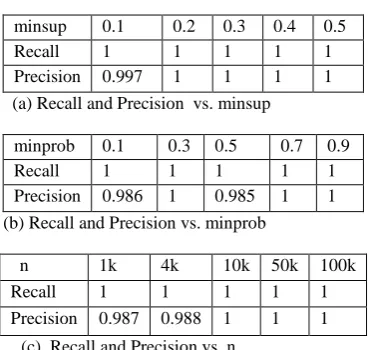
𝐴𝑃 (14) In these formulas, Also, a higher value reflects a better accuracy. Table 2 shows the recall and the precision of APM (Apriori algorithm), for a wide range of minsup, n, and minprob values. As it can observed that the precision and recall values are always higher than 98 percent. Since The proposed algorithm PA returns the same PFIs as APM, it is also highly accurate result. Both precision and recall are used to compare the performance of mining algorithms.
Table 2. Recall and Precision of APM
minsup 0.1 0.2 0.3 0.4 0.5
Recall 1 1 1 1 1
Precision 0.997 1 1 1 1
(a) Recall and Precision vs. minsup
minprob 0.1 0.3 0.5 0.7 0.9
Recall 1 1 1 1 1
Precision 0.986 1 0.985 1 1
(b) Recall and Precision vs. minprob
n 1k 4k 10k 50k 100k
Recall 1 1 1 1 1
Precision 0.987 0.988 1 1 1
(c) Recall and Precision vs. n
8.1 Efficiency of PA vs. APM
.
next compare PA and APM, which both yield PFIs. The given Figure 3(a) shows that PA is faster than APM over differentminsup values. minsup is taken on the X-axis and runtime is taken on the Y-axis. On increasing the minsup value the runtime decreases. Fig.3(b) examines the algorithms under a wide range of minprob values. Again, PA runs faster than APM. Fig. 3(b) examines the effect of using different minprob values. Minprob is taken on X-axis and running time is taken on the Y-axis. The details are of these distributions are listed in Table 3.
Fig.10(a) minsup vs. runtime
runtime
Fig.3(b) minprob vs. runtime
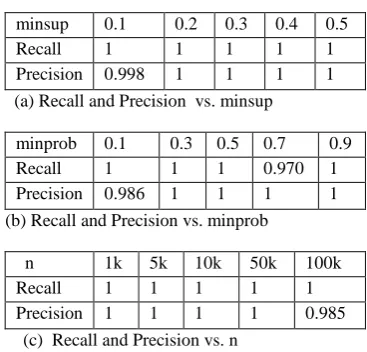
It is observed that the algorithm PA performs better than APM over different types of distributions. The consistently high performance gain demonstrated by AP can be explained. On observing the figure 3(a) the existing algorithm takes longer time than the proposed algorithm(PA), since the on increasing the minsup value against the runtime the curve gradually decreases in existing algorithm and also maintains constant behavior in the proposed algorithm. The graph given in the figure 3(b) depicts the difference in performs between the existing algorithm APM and the proposed algorithm PA. In this graph also the developed or proposed algorithm is faster than the existing algorithm. The below table 3 provides the details of the recall and precision of PA algorithm.
0 0.2 0.4 0.6 0.8 1
0 0.2 0.4 0.6
APM
PA
0 0.1 0.2 0.3 0.4 0.5
0.00 0.20 0.40 0.60 0.80 1.00
APM
PA runtime
minsup
[image:6.595.75.260.519.694.2]TABLE 3. Recall and Precision of PA
minsup 0.1 0.2 0.3 0.4 0.5
Recall 1 1 1 1 1
Precision 0.998 1 1 1 1
(a) Recall and Precision vs. minsup
minprob 0.1 0.3 0.5 0.7 0.9
Recall 1 1 1 0.970 1
Precision 0.986 1 1 1 1
(b) Recall and Precision vs. minprob
n 1k 5k 10k 50k 100k
Recall 1 1 1 1 1
Precision 1 1 1 1 0.985
(c) Recall and Precision vs. n
The experiments on the tuple uncertainty model and on the synthetic data set were also performed. Since they are similar to the results presented above, The most representative ones. For the accuracy aspect, the recall and precision values of approximate results on these data sets are still higher than 98 percent. Thus, the proposed algorithm can return accurate results.
9. CONCLUSIONS
In this paper, we propose a approach to extract threshold-based PFIs from large uncertain databases. Its main idea is to the s-pmf of a PFI by some common probability model, so that a PFI can be verified quickly. This approach supports retrieving PFIs from evolving databases. The experimental results show that the proposed algorithm is highly efficient and accurate. It supports both attribute- and tuple uncertain data approach to develop other mining algorithm (e.g., clustering and classification) on uncertain data. It is also interesting to study efficient mining algorithm for handling tuple. Another interesting work is to investigate PFI mining algorithm for probability models that capture correlation among attributes and tuples.
10. REFERENCES
[1] A. Veloso, W. Meira Jr., M. de Carvalho, B. Poˆ ssas, S. Parthasarathy, and M.J. Zaki, “Mining Frequent Itemsets in Evolving Databases,” Proc. Second SIAM Int‟l Conf. Data Mining (SDM), 2002.
[2] C. Aggarwal, Y. Li, J. Wang, and J. Wang, “Frequent Pattern Mining with Uncertain Data, “, Proc. 15th ACM SIGKDD Int‟l Conf. Knowledge Discovery and Data Mining (KDD), 2009.
[3] C. Aggarwal and P. Yu, “A Survey of Uncertain Data Algorithm and Applications,” IEEE Trans Knowledge and Data Eng., vol. 21, no. 5, pp. 609-623, May 2009.[4] R. Agrawal, T. Imieliμnski, and A. Swami, “Mining Association Rules between Sets of Items in Large Databases,” Proc.ACM SIGMOD Int‟l Conf. Management of Data, 1993.
[5 ] O. Benjelloun, A.D. Sarma, A. Halevy, and J. Widom, “ULDBs: Databases with Uncertainty and Lineage,” Proc. 32ndInt‟l Conf. Very Large Data Bases (VLDB), 2006.
[6] T. Bernecker, H. Kriegel, M. Renz, F. Verhein, and A. Zuefle,“Probabilistic Frequent Itemset Mining in Uncertain Databases,” Proc. 15th ACM SIGKDD Int‟l
Conf. Knowledge Discovery and Data Mining (KDD), 2009.
[7] C.J. van Rijsbergen, Information Retrieval. Butterworth, 1979.
[8] L.L. Cam, “An Approximation Theorem for the Poisson Binomial Distribution,” Pacific J. Math., vol. 10, pp. 1181- 1197,1960.
[9] H. Cheng, P. Yu, and J. Han, “ Frequent Itemset Mining in the Presence of Random Noise,” Proc. Soft Computing for Knowledge Discovery and Data Mining, pp. 363-389, 2008.
[10] R. Cheng, D. Kalashnikov, and S. Prabhakar, “Evaluating Probabilistic Queries over Imprecise Data,” Proc. ACM SIGMOD Int‟l Conf. Management of Data, 2003.
[11] D. Cheung, J. Han, V. Ng, and C. Wong, “Maintenance of Discovered Association Rules in Large Databases: An Updating Technique,” Proc. 12th Int‟l Conf. Data Eng. (ICDE), 1996.
[12] D. Cheung, S.D. Lee, and B. Kao, “A General Technique for Maintaining Discovered Association Rules,” Proc. fifth Int‟l Conf. Database Systems for Advanced Applications (DASFAA), 1997.
[13] W. Cheung and O.R. Zaı¨ane, “ Mining of Frequent Patterns without Candidate Generation or Support Constraint,” Proc. Seventh Int‟l Database Eng. and Applications Symp. (IDEAS), 2003.
[14] C.K. Chui, B. Kao, and E. Hung, “Mining Frequent Itemsets from Uncertain Data,” Proc. 11th Pacific-Asia Conf. advancesin Knowledge Discovery and Data Mining (PAKDD), 2007.
[15] G. Cormode and M. Garofalakis, “Sketching Probabilistic Data Streams,” Proc. ACM SIGMOD Int‟l Conf. Management of Data, 2007.
[16] N. Dalvi and D. Suciu, “Efficient Query Evaluation on Probabilistic Databases,” Proc. 13th Int‟l Conf. Very Large Data Bases (VLDB), 2004.
[17] A. Deshpande, C. Guestrin, S.Madden, J. Hellerstein, and W. Hong, “Model-Driven Data Acquisition in Sensor Networks,” Proc. 13th Int‟l Conf. Very Large Data Bases (VLDB), 2004.
[18] J. Han, J. Pei, and Y. Yin,“Mining Frequent Patterns without Candidate Generation,” Proc. ACM SIGMOD Int‟l Conf. Management of Data, 2000.
[19] J. Huang, “MayBMS: A Probabilistic Database Management System,” Proc. 35th ACM SIGMOD Int‟l Conf. Management of Data, 2009.
[20] R. Jampani, L. Perez, M. Wu, F. Xu, C. Jermaine, and P. Haas, “MCDB: A Monte Carlo Approach to Managing Uncertain Data,” Proc. ACM SIGMOD Int‟l Conf. Management of Data 2008.
[21] J. Ren, S.D. Lee, X. Chen, B. Kao, R. Cheng, and D.W. Cheung“ Naive Bayes Classification of Uncertain Data,” Proc. IEEE Ninth Int‟l Conf. Data Mining (ICDM), 2009.
[22] N. Khoussainova, M. Balazinska, and D. Suciu, “Towards Correcting Input Data Errors Probabilistically Using Integrity Constraints,” Proc. Fifth ACM Int‟l Workshop Data Eng. For Wireless and Mobile Access (MobiDE), 2006.
[23] H. Kriegel and M. Pfeifle, “Density-Based Clustering of Uncertain Data,” Proc. ACM SIGKDD Int‟l Conf. Knowledge Discovery in Data Mining (KDD), 2005.[24]
[image:7.595.74.258.97.273.2][25] C.K.-S. Leung, Q.I. Khan, and T. Hoque, “Cantree: A Tree Structure for EfficientMining of Frequent
Patterns,”. Proc. IEEE Fifth Int‟l Conf. Data Mining (ICDM), 2005.
[26] A.Lu, Y. Ke, J. Cheng, and W. Ng, “Mining Vague Association Rules,” Proc. 12th Int‟l Conf. Database Systems for Advanced Applications (DASFAA), 2007.[27] M. Mutsuzaki, “Trio-One: Layering Uncertainty and
Lineage on a Conventional DBMS,” Proc. Third Biennial Conf. Innovative Data Systems Research (CIDR), 2007.[28] P. Sistla, O. Wolfson, S. Chamberlain, and S. Dao, “Querying the Uncertain Position of Moving Objects,” Temporal Databases: Research and Practice, Springer Verlag, 1998.
[29] C. Stein, Computation of Expectations, Lecture Notes Monograph Series, vol. 7, Inst. of Math. Statistics, 1986. [30] L. Sun, R. Cheng, D.W. Cheung, and J. Cheng, “Mining
Uncertain Data with Probabilistic Guarantees,” Proc.
16th ACM SIGKDD Int‟l Conf. Knowledge Discovery and Data Mining, 2010.
[31] T. Jayram et al., “Avatar Information Extraction System,” IEEE Data Eng. Bull., vol. 29, no. 1, pp. 40-48, Mar. 2006.
[32] S. Tsang, B. Kao, K.Y. Yip, W.-S. Ho, and S.D. Lee., “Decision Trees for Uncertain Data,” Proc. IEEE Int‟l Conf. Data Eng. (ICDE), 2009.
[33] L. Wang, R. Cheng, S.D. Lee, and D. Cheung, “Accelerating Probabilistic Frequent Itemset Mining: A Approach,” Proc.19th
ACM Int‟l Conf. Information and Knowledge Management (CIKM), 2010.
[34] M. Yiu, N. Mamoulis, X. Dai, Y. Tao, and M. Vaitis, “Efficient Evaluation of Probabilistic Advanced Spatial Queries on existentially Uncertain Data,” IEEE Trans Knowledge and Data Eng., vol. 21, no. 9, pp. 108-122, Jan. 2009.