Solution of the Relativistic Bound State
Problem for Hadrons
H.P. Morsch
HOFF, Brockm¨ullerstr. 11,D-52428 J¨ulich, Germany
National Centre for Nuclear Research, Pl-00681 Warsaw,Poland
∗Corresponding Author: [email protected]
Copyright c⃝2013 Horizon Research Publishing All rights reserved.
Abstract
A second order extension of a generalised QED Lagrangian (including boson-boson coupling) has been used to describeqq¯hadrons. Assuming massless elementary fermions (quantons) this results in a finite theory without open parameters, which may be regarded as a fundamental description of the strong interaction. Two potentials are deduced, a boson-exchange potential and one, which can be identified with the known confinement potential in hadrons. This formalism has been applied the mesonic systems ω(782), Φ(1020), J/ψ(3097) and Υ(9460) with a good description of their masses. The most important results are: 1. The confinement of hadrons is not due to colour, but is a general property of relativistic bound states. 2. Massive quarks in the Standard Model (QCD) are understood as effective fermions with a mass given by the binding energy in the boson-exchange potential.Keywords
Bound state description of had-rons based on a second order Lagrangian with massless fermions (quantons) and boson-boson coupling, Confinement and boson-exchange potential, Quarks understood as effective fermions with masses given by bound state energies, Higgs-bosons and supersymmetry not neededPACS: 11.15.-q, 12.40.-y, 14.40.Cs
1. Introduction
To study fundamental forces, nature provides us with hadrons and leptons, which form the constituents of matter, but also with composite systems, nuclei, atoms, and gravitational states in form of solar and galactic systems. For the description of these stable and massive systems as bound states a relativistic theory is needed, since the elementary constituents of these states are relativistic. However, relativistic bound state problems are generally difficult to solve, see e.g. Salpeter and Bethe [1], and could not be tackled so far for particle bound states (see the discussion in ref. [2]).
αis not understood from first principles.
To understand the underlying mechanisms as well as the parameters needed in first order theories, a more fundamental theory should exist, in which these features are explained. If we demand further a real physical understanding of the development of particle systems in the universe, this theory should most likely be finite, since nature develops in a smooth way without singularities. Such a theory is expected to be based on a Lagrangian including higher order fields. This can be seen for example from the mass of light hadrons, which is much larger than the underlying quark masses.
However, in spite of an evident need for higher order theories, there is a strong belief that Lagrangians describing fundamental forces can be only first order. This is correct for divergent field theories, since the inclusion of higher order terms destroys the renormalisability of the theory. But this argument is not valid, if a finite theory is constructed. Another argument against the use of higher order theories is that in such theories Lagrangians with higher field derivatives [4] are required, which can lead to unphysical solutions (ghosts). But it should be realised that the problem is not the use of higher order theories in principle, but to find a form of the Lagrangian, in which all important criteria of relativistic theories are respected, like gauge invariance and energy-momentum conservation. Recently, a second order theory has been developed by extending the QED Lagrangian by boson-boson cou-pling [5]. This formalism fulfills the above criteria of a relativistic theory and can be regarded as a fundamental description of the electric force in light atoms. However, for hadronic bound states the requirements are still higher and ask also for massless elementary fermions (quantons). Then the mass ofqq¯bound states has to be entirely due to binding energy.
An interesting question is, whether in a fundamental theory of hadrons the colour degree of freedom is really needed (since hadrons are colour neutral). The answer depends on confinement. If it would be due to colour (as often assumed [6]), a non-Abelian theory with colour would be needed. However, already in the description of atomic systems a confinement potential has been found [5], suggesting that confinement is a basic property of bound states of relativistic particles. Preliminary results from an application to other fundamental forces can be found in ref. [7].
2. Theoretical framework
The Lagrangian may be written in the form L= 1
˜
m2Ψ¯ iγµD
µD
νDνΨ − 1 4FµνF
µν , (1)
where ˜m is a mass parameter and Ψ in general a two-component fermion field Ψ = (Ψ+ Ψo) and ¯Ψ = (Ψ− Ψ¯o) with charged and neutral part (here only charged fermions are considered). Vector boson fieldsAµwith generalised charge coupling g (of self-consistent amplitude) are contained in the covariant derivativesDµ=∂µ−igAµand the Abelian field strength tensorFµν =∂µAν−∂νAµ.
We insert Dµ =∂µ−igAµ andDνDν =∂ν∂ν−ig(Aν∂ν+∂νAν)−g2AνAν in eq. (1) and obtain for the first term ofL
L1=
1 ˜
m2Ψ¯ iγµD
µD
νDνΨ =
i
˜
m2Ψ¯ γµ∂
µ∂
ν∂νΨ +
g
˜
m2Ψ¯ γµA
µ∂ ν∂νΨ + g
˜
m2Ψ¯ γµ∂
µA ν∂νΨ +
g
˜
m2Ψ¯ γµ∂
µ∂
νAνΨ−
ig2
˜
m2Ψ¯ γµA
µA ν∂νΨ −ig2
˜
m2Ψ¯ γµA
µ∂
νAνΨ−
ig2
˜
m2Ψ¯ γµ∂
µA
νAνΨ−
g3
˜
m2Ψ¯ γµA
µA
νAνΨ. (2)
The gauge condition∂µAµ= 0 used for simpler Lagrangians (as in QED) is replaced in our case by∂(∂νAν) = 0. In eq. (2) the number of field derivatives and boson couplings varies between the first and last term. This shows that the various terms are related to different kinetic situations, pointing to a rather complex dynamics of the system.
diagrams. These can be written in the form M(p′ −p) = < g.s.| K(q) |g.s. >∼ ψ¯(p′) K(q) ψ(p), where ψ(p) is a fermionic wave function ψ(p) = m˜13/2Ψ(p1)Ψ(p2) andK(q =p′−p) a kernel, which is expressed by K(q) =
1 ˜
m2(n+1) [O
n(q)On(q)], where n is the number of boson fields and derivatives in eq. (2) (in the present case n=3). For the construction of stationary states we expect contributions mainly from terms of the Lagrangian (2), which contain static fields (without derivatives). This is the case only for the last termL1,8=−m˜12Ψ¯ g
3γ
µAµAνAνΨ and leads to a matrix elementM3g, which contains three boson fields on the right and left
M3g =−
α3
˜
m8 ψ¯(p
′)γ
µAµ(q)Aν(q)Aν(q)Aσ(q)Aσ(q)γρAρ(q)ψ(p), (3) where α = g2/4π. A comparable matrix element in a first order theory may be written in the form Mf.o. =
−α
˜
m4 ψ¯(p′)γµAµ(q)γρAρ(q)ψ(p), giving rise to a (boson-exchange) interaction of vector structurevv(q)∼αAµ(q)Aρ(q) (but only for equal times of the two boson fields, which means in the non-relativistic limit). Differently, in eq. (3) three interactions of scalar and vector structure Vν
µ(q) ∼ αAµ(q)Aν(q) are involved. In a dual picture the two boson fields, which appear twice (on the left and right side ofM3g) can be regarded (analoguous to the fermion
wave functionψ(p)) as bosonic (quasi) wave functions1 Wµν(q) =m1˜Aµ(q)A
ν(q). The fact that boson fields can be combined to wave functions leads quite naturally to a finite theory, in which the wave functions are normalised.
The physical picture ofM3gis that for the lowest energy state of a relativistic bound state system the fermions interact only inside the boson density (which leads to a boundary condition discussed below) and feel therefore three interactions. A single boson-exchange interaction is possible only in dynamical situations, see the terms 2-4 in eq. (2), which do not lead to a bound state potential.
Theγ-matrices can be removed (contracted) by adding a matrix element with interchangedµandρ(according to 1
2(γµγρ+γργµ) =gµρ). Further, an equal time requirement of the two boson fields (to reach overlap) allows
to replace all fermion four-vectors2 by three-vectors in momentum or r-space. Correspondingly, the boson wave
functionsWµν(q) and the remaining (boson-exchange) interactionVµν(q) are reduced tows,v(q) andvv(q)∼wv(q), which are two-dimensional. This yields
M3g= −
α3
˜
m5 ψ¯(p
′)ws,v(q)vv(q)ws,v(q)ψ(p). (4)
Writing the matrix element byM3g= ¯ψ(p′)V3g(q)ψ(p) we obtain a three-boson potential
V3s,vg (q) =−α
3
˜
m2 w 2
s,v(q)vv(q). (5)
Fourier transformation to r-space leads to a folding potential
V3s,vg (r) =−α
3¯h
˜
m
∫
dr′ws,v2 (r′)vv(r−r′). (6) Such a form has been used to describe elastic and inelastic hadron processes [9].
The bosonic part of eq. (4) can also be written in the form of a matrix element, in which the wave functions
ws,v(q) are connected byvv(q)
Mg= −α3 ˜
m2 ws,v(q)vv(q)ws,v(q). (7)
This matrix element shows binding of two bosons in the potentialvv(q), consequently∂2ws(q) is related to their kinetic energy. The contribution from the vector part∂2wv(q) cancels out as a consequence of the gauge condition.
Below it will be shown that this implies also the existence of a static two-boson potentialV2g(q).
From the general structure of the fermion matrix element in eq. (4) one can see that there are two fundamental s-states (with quantum numbers (Jπ= 1−)) with scalar and vector boson wave functionsw
s,v(r) and corresponding fermion wave functions3 ψs,v(r)∼ws,v(r) normalised by 4π
∫
r2dr ψs,v(r) = 1. Further, there are 0+ states with p-wave functionsψL=1(r), which are not considered in the present paper.
1leading to boson (quasi) densitiesW2(q) with dimension [GeV]2. 2in a (t, ⃗r) representation
To evaluate the potentials V3s,vg (r), the boson wave functions ws,v(r) have to be determined. To achieve this, a geometric boundary condition can be formulated by requiring that the interaction takes place inside the vol-ume of the strongest bound state. As a consequence, the corresponding boson-exchange potential (6) should be proportional to the densityw2
s(r), leading to
c ws2(r)∼ |V3vg(r)| . (8)
Another condition is orthogonality of the fermion wave functions. Both conditions can be satisfied by boson wave functionsws(r) andwv(r), which are approximated by
ws(r) =wso exp{−(r/b)
κ} (9)
and
wv(r) =wvo [ws(r) +βR
dws(r)
dr ], (10)
wherew(s,v)o = [2π
∫
rdr w2
s,v(r)]−1andβR=−
∫
r2dr w
s(r)/
∫
r2dr[dw
s(r)/dr] (elimination of spurious bosonic motion,< rws>= 0). The boson-exchange interactionvv(r) is given byvv(r) =−¯h wv(r).
To generate a stable bound state, the potential V3s,vg (r) is not sufficient to keep the bosons confined. The other terms of the Lagrangian (2) show kinematic situations, in which bosons and/or fermions are in motion. Nevertheless, term 6 may be written in the formL1,6=−ig
2
˜
m2Ψ¯ γµAµ(∂νAν)Ψ−ig
2
˜
m2Ψ¯ γµAµAν ∂νΨ and gives rise to another bound state potential.
The first term of L1,6 leads to
M2g=
α2
˜
m8ψ¯(p
′)γ
µAµ(q)(∂νAν(q))γρAρ(q)(∂σAσ(q))ψ(p). (11) Using the gauge condition we can write (∂νAν(q))(∂σAσ(q)) = 12∂ν[∂σ(AµAµ)σ]ν. After contracting theγ-matrices and reducing the fermion and boson vectors by one dimension as discussed forM3g, this yields
M2g=
α2
2 ˜m6ψ¯(p
′)ws(q)∂2ws(q)ψ(p). (12)
Since the two bosons are bound, see eq. (7),∂2w
s(q)/2 ˜mis related to their kinetic energy distribution. According to the virial theorem this implies also the existence of a static two-boson potentialV2g(q).
In a transformation to r-space the bosonic part of eq. (12) gives rise to a Hamiltonian of the form −α
2m < r˜ 2
ws > F2g
4
(d2w
s(r)
dr2 +
2
r dws(r)
dr
)
+V2g(r)ws(r) =Ei ws(r), (13) where the factor F2g is due to the Fourier transformation of the boson kinetic energy, < r2ws >the radius square
of the boson density andws(r) the Fourier transform ofws(q). The potential V2g(r) is given by
V2g(r) =
α2m < r˜ 2
ws > F2g
4
(d2w
s(r)
dr2 +
2
r dws(r)
dr
) 1
ws(r)+Eo , (14)
where Eo = 0 is used to make a connection to the vacuum (state without binding between the quantons and thereforeEvac = 0). A similar potential involvingwv(q) deduced from L1,7 yields negligible contribution to the
binding energy. All other terms of the Lagrangian (2) do not contribute to bound state potentials.
The implications of using massless fermions are very strong and can be summarized as follows: First, the vacuum of the theory is the absolute vacuum with average energyEvac= 0. This is consistent with the low energy density of the universe deduced from astrophysical observations. Second, the lowest energy solution in V2g(r) is
the vacuum and therefore Eo = Evac = 0. By this condition the absolute height of V2g(r) is fixed. Third, by
rewriting eq. (12) in the formM2g= α
2
2 ˜m6ws(q){ψ¯(p′)ψ(p)}∂2ws(q), one can see that fermion-antifermion pairs can
An important fact is thatV2g(r) can be identified with the confinement potential in hadron potential models [10].
This will be shown in a comparison with the confinement potential from lattice QCD simulations [11] and the discussion of quark masses.
V2g(r) can also be written in a different form
V2g(r) =
α2¯h2F2g 4 ˜m
(d2ws(r)
dr2 +
2
r dws(r)
dr
) 1
ws(r)+Eo. (15)
This leads to the condition
Rat= ¯h
2
˜
m2< r2
ws>
= 1. (16)
A last constraint is related to energy-momentum conservation in relativistic systems, indicating that for binding inVs
3g(r) the total energy of the system is not increased, the negative fermion and boson binding energiesEfs and
Eg have to be compensated by the root mean square momenta of the corresponding potentials
< q2V3g >1/2+< q2vv >1/2=−(Efs+Eg). (17) However, for the confinement potential V2g(r) this condition is not valid. Therefore, the constraint (17) can be
applied only for the binding potentials V(q) =V3g(q) and vv(q) with < qV2 >=fred
∫
dq q3V(q)/∫dq qV(q) and
fred=Efs/(Efs+Eg).
The fermion mass of the system is defined by the energy to balance binding
Mns,v=−Ef3g
s,v+E
2g
fn , (18)
whereEf3g
s,vis the negative binding energy inV
s,v
3g (r) (for these potentials only the lowest state is discussed here) and
Ef2g
n are positive binding energies for different (excited) states inV2g(r). This shows two types of mass generation,
binding in the Coulomb like potentialV3g(r) and dynamical mass generation inV2g(r).
In the whole formalism there are finally four constraints, orthogonality of the total wave functions and the boundary conditions (8), (16) and (17), by whichallopen parameters - shape parameterκ, slope (or size) parameter
b and the coupling constantα- are determined within rather small ambiguities. In addition, the different flavour states in the quark model4can be related by a vacuum sum rule similar to that applied in ref. [5], which indicates
that in principle a complete solution of the relativistic bound state problem for all states is achieved. Below it will be shown that the need for massless elementary fermions in the present formalism is entirely consistent with the requirement of finite quark masses in the SM.
3. Application to qq¯mesons
Within the above formalism calculations have been performed for qq¯ mesons of different flavour structure,
ω(782), Φ(1020), charmoniumJ/Ψ(3097) and bottonium Υ(9460) including excited states. The potentialsV3g(r) andV2g(r) have been determined by adjusting all open parameters,κ, slope parameterband the coupling constant
α, to fulfill the constraints discussed above. Remaining uncertainties have been reduced by fine-adjustment of the factorF2g in the confinement potentialV2g(r) to fit the spectrum of radial excitations.
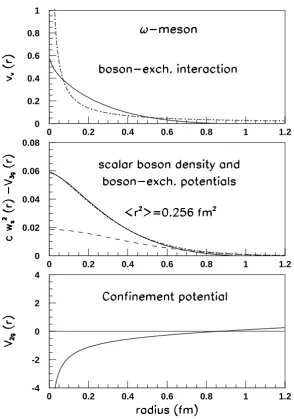
Results on the radial dependence of densities and potentials are given in fig. 1 for the ω(782) system. In the upper part the interactionvv(r) is given by the solid line. Compared to a Coulomb like potentialvcoul(r)∼¯h/r (dot-dashed line) there are no divergencies forr→0 and∞, in agreement with the demand of a finite theory.
In the middle part a comparison of the densityw2
s(r) (dot-dashed line) with the potentialsV3sg(r) (dashed line) and Vv
3g(r) (solid line) is made. We see that condition (8) for the vector potential is reasonably well fulfilled at larger radii. This indicates that the bosonic wave functionsws(r) andwv(r) are reasonably well described by the forms in eq. (9) and (10).
Table 1. Results for mesonic systems,ω(782), Φ(1020), J/ψ(3097), and Υ(9460) including excited states, in comparison with the data [3]. Masses and binding energies are given in GeV,bin fm, and the mean radius squares in fm2. α
eq is the equivalent coupling constant in a Coulomb like potential.
System Ms
1 M2s M3s M4s M1v M
exp
1 M
exp
2 M
exp
3
ω 0.78 1.42 1.93 1.36 0.782 1.42±0.03
Φ 1.02 1.68 2.20 2.04 1.02 1.68±0.02
J/ψ 3.10 3.69 4.16 4.58 9.63 3.097 3.686 4.16±0.02 Υ 9.46 10.02 10.46 10.8 27.2 9.46 10.023 10.355 System κ b α α∗eq Eg E3sg mquark < rw2s >
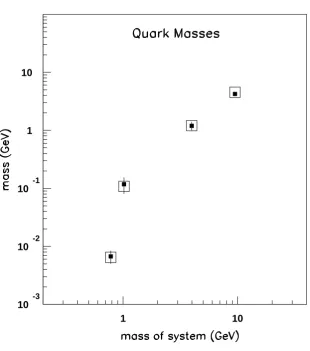
ω 1.4 0.589 0.65 0.05 -0.026 -0.013 0.0065 0.256 Φ 1.4 0.450 1.50 0.59 -0.43 -0.216 0.108 0.150
J/ψ 1.4 0.148 2.40 2.42 -4.82 -2.42 1.21 0.016
Υ 1.4 0.049 2.59 2.89 -18.4 -9.0 4.5 0.0017
*αeq=
∑
s,v
∫
dr V3s,vg (r)/∫dr Vcoul(r)
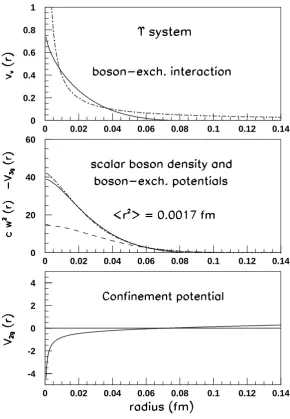
In the lower part of fig. 1 the deduced confinement potentialV2g(r) is shown. It is characterized by a close to linear form at larger radii, as expected from ref. [10, 11]. Resulting masses and parameters for different systems are given in table 1. Although the binding energies are quite different, in all cases a satisfactory agreement of the various quantities is obtained, which fulfill all boundary conditions. A similar plot as in fig. 1 is shown for the bottonium system in fig. 2. Apart from a very different radial extent of the two systems the only important difference is the relative size of the confinement potential, which is drastically reduced for the heavy system due to a very different dynamics.
It should be realised that the different systems in table 1 correspond to different flavours (in the quark model). Here they are characterised only by a different slope parameterb. This shows that the flavour degree of freedom of hadrons is naturally included in the present formalism. As detailed in ref. [5] for states in light atoms, the different flavour states can be related by a vacuum potential sum rule. A preliminary analysis has also been performed for leptons [12], in which the flavour degree of freedom could be described similarly. The direct consequence of these results is that a description of the flavour degree of freedom does not require another explanation, as the existence of supersymmetric particles proposed in supersymmetric extensions of the SM, see ref. [3].
A comparison of the deduced confinement potentialV2g(r) with the lattice QCD simulations of Bali et al. [11]
(solid points with error bars) is shown in fig. 3. This potential has the same form as the confinement potential
Vconf(r)∼ −α/r+l·rdeduced from potential models [10]. The fact that very similar results are deduced from theories with and without colour indicates clearly that the confinement of hadrons is not due to colour (as assumed in ref. [6] without clear understanding of the mechanisms involved), but represents a general property of relativistic bound states.
The question of a vector or scalar structure of the confinement potential can be studied by looking at the splitting of p-wave states in charmonium and bottonium, see ref. [13]. From the existing data neither a vector nor a scalar structure is found, supporting strongly a derivative structure of the potentialV2g(r), as found in the
present approach.
model the width is related to the dynamical structure of the system, given by kinetic energy distributions T2g(q)
andT3g(q), which are the Fourier transforms of the kinetic energy distributionsT2g(r) andT3g(r), which are given
byT2g(r) =V2g(r) andT3g(r) = 12 < r
2>(d2V
3g(r)/dr2+r2 dV3g(r)/dr).
The mass distributions T3g(q) calculated from the boson-exchange potential V3g(r) are rather bround, with
a width of about 1 GeV for ω(782) and 3 GeV for J/ψ(3097). Very different, the mass distributions T2g(q)
obtained from the confinement potential V2g(r) are extremely narrow and may be far below the experimental
widths. Unfortunately, in numerical Fourier transformations ofV2g(r) oscillations appear, which can be damped
only in a radial interpolation of logarithmic form, but in addition an extremely fine grid and expansion up to large radii is needed to obtain a peak comparable to the experimental width. Therefore, this problem should be studied in detail, possibly using better Fourier transformation techniques.
4. Discussion of quark masses
An important point is the need for finite quark masses in the SM (QCD), which should be understood in the present more fundamental approach. These masses have been estimated in different models, as e.g. in QCD inspired potential models [10] (more details can be found in ref. [3]). The empirical formVconf(r)∼ −α/r+l·rassumed in these models is consistent withV2g(r); therefore, the quark masses can be related directly to the binding energy
inV3sg(r). This leads to the relation5
mquark=− 1 2 E
s
3g . (19)
The resulting quark masses are given in table 1 and are compared with the extracted masses [3] in fig. 3. An excellent agreement is obtained. This is clear indication that the need for massive fermions (quarks) in the first order theory (QCD) is perfectly consistent with the assumption of massless elementary fermions in the present approach. Thus, the quarks can be understood aseffective fermionswith masses related to the binding energy in the bound state potentialV3sg(r).
Together with the results above this shows that both the flavour degree of freedom of hadrons as well as the quark masses are well understood in the present description. Therefore, there is no need to engage other mechanisms for their interpretation. In particular, the Higgs-mechanism (which demands an extra background field [14] adopted from the theory of supraconducters and ferromagnets in solids) is not needed. Similarly, also supersymmetric extensions of the SM, which predict a new regime of super-symmetric particles at high energies, are needless. This confirms the general view that a fundamental theory must have a very simple symmetry structure.
5. Conclusion
Although the SM yields an excellent description of many particle properties, it is an effective theory with parameters (as the quark masses), which are not understood. To get a correct insight into the nature of these parameters, a fundamental theory of hadrons is required, in which all parameters and assumptions of the effective theory can be understood. In the present approach the long standing relativistic bound state problem as well as the confinement problem is solved. The obtained results give clear insight into the mechanisms, in which bound states of relativistic particles are formed, with the surprising results that in a rather fundamental descriptions of hadrons the colour degree of freedom as well as Higgs and supersymmetric fields are not needed. This opens up the way to a new understanding of the structure of fundamental forces.
5this expression is independent of using an Abelian or non-Abelian structure of the Lagrangian. In an Abelian theory massive
Acknowledgements
The author is very grateful to many colleagues for fruitful discussions, valuable comments and the help in formal derivations. Special thanks to P. Decowski and P. Zupranski for numerous conversations and encouragements and B. Loiseau for his help with the formulation of the Lagrangian and matrix elements.
REFERENCES
[1] E.E. Salpeter and H.A. Bethe, Phys. Rev. 84, 1232 (1951)
[2] St.G. Glazek, Acta Phys. Polonica B 24, 1315 (1993); and refs. therein
[3] Review of particle properties, K. Nakamura et al., J. Phys. G 37, 075021 (2010);
http://pdg.lbl.gov/ and refs. therein
[4] J.Z. Simon, Phys. Rev. D 41, 3720 (1990); A. Foussats, E. Manavella, C. Repetto, O.P. Zandron, and O.S. Zandron,
Int. J. theor. Phys. 34, 1 (1995); V.V. Nesterenko, J. Phys. A: Math. Gen. 22, 1673 (1989); and refs. therein
[5] H.P. Morsch, arXiv 1104.2574 [hep-ph]
[6] see e.g. the discussion in J. Greensite, Prog. Part. Nucl. Phys. 51 (2003) 1 and arXiv: hep-lat/0301023
[7] H.P. Morsch, EPJ Web of Conferences 28, 12068 (2012), Hadron Collider Physics Symposium, Paris 2011 (open access)
[8] M.E. Peskin and D.V. Schroeder, “An introduction to quantum field theory”, Addison-Wesley Publ. Comp. (1995)
[9] H.P. Morsch, W. Spang, and P. Decowski, Phys. Rev. C 67, 064001 (2003)
[10] R. Barbieri, R. K¨ogerler, Z. Kunszt, and R. Gatto, Nucl. Phys. B 105, 125 (1976); E. Eichten, K.Gottfried, T. Kinoshita,
K.D. Lane, and T.M. Yan, Phys. Rev. D 17, 3090 (1978); S. Godfrey and N. Isgur, Phys. Rev. D 32, 189 (1985); D.
Ebert, R.N. Faustov, and V.O. Galkin, Phys. Rev. D 67, 014027 (2003); and refs. therein
[11] G.S. Bali, K. Schilling, and A. Wachter, Phys. Rev. D 56, 2566 (1997);
G.S. Bali, B. Bolder, N. Eicker, T. Lippert, B. Orth, K. Schilling, and T. Struckmann, Phys. Rev. D 62, 054503 (2000)
[12] H.P. Morsch, arXiv 1104.2576 [hep-ph]
[13] H.J. Schnitzer, Phys. Rev. Lett. 35, 1540 (1975)
0 0.2 0.4 0.6 0.8 1
0 0.2 0.4 0.6 0.8 1 1.2
0 0.02 0.04 0.06 0.08
0 0.2 0.4 0.6 0.8 1 1.2
-4 -2 0 2 4
[image:9.595.137.432.201.621.2]0 0.2 0.4 0.6 0.8 1 1.2
Figure 1. Self-consistent solution for the ω(782) meson system. Upper part: Interaction wv(r) in comparison with the Coulomb potential, given by solid and dot-dashed lines, respectively. Middle part: Bosonic density w2
s(r) and potential|V3vg(r)|given by the overlapping dot-dashed and solid lines, respectively, matched by the condition (8); |Vs
0 0.2 0.4 0.6 0.8 1
0 0.02 0.04 0.06 0.08 0.1 0.12 0.14
0 20 40 60
0 0.02 0.04 0.06 0.08 0.1 0.12 0.14
-4 -2 0 2 4
[image:10.595.127.418.224.644.2]0 0.02 0.04 0.06 0.08 0.1 0.12 0.14
-1.5 -1 -0.5 0 0.5 1 1.5 2 2.5
[image:11.595.135.435.243.602.2]0 0.2 0.4 0.6 0.8 1 1.2 1.4 1.6
Figure 3. Comparison of the confinement potential with lattice QCD calculations. V2g(r) calculated for the two mesonic systems
10
-3
10-2 10-1 1 10
[image:12.595.115.426.254.606.2]1 10