Journal of Chemical and Pharmaceutical Research, 2012, 4(4):2102-2108
Research Article
ISSN : 0975-7384
CODEN(USA) : JCPRC5
Comparative 2, 4 Dichlorophenoxyacetic acid (2, 4-D) Aqueous Phase
Adsorption Using Natural and Synthetic Adsorbents
A. S. Ghatbandhe
*, H. J. Jahagirdar
1and M. K. N. Yenkie
21
Department of Chemistry, S F S College, R. T. M Nagpur University, India
2
Department of Chemical Technology, Laxminarayan Institute of Technology R.T.M Nagpur
University, India
______________________________________________________________________________
ABSTRACT
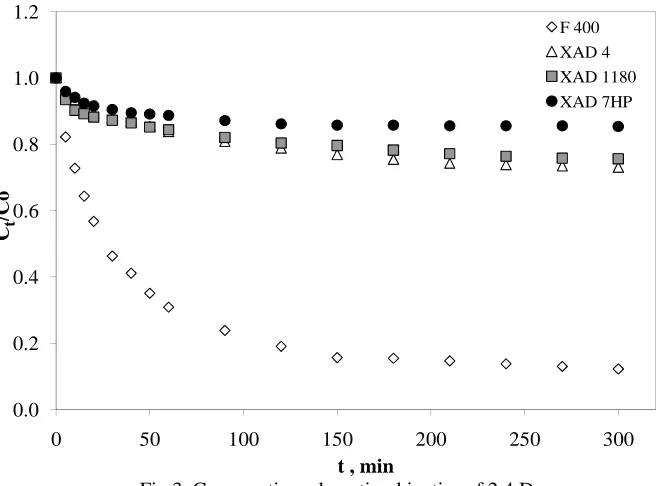
Adsorption equilibrium, kinetic of 2,4-dichlorophenoxy-acetic acid (2,4-D), one of the most commonly used phenoxy acid herbicides, onto different adsorbents such as granular activated carbon (GAC) and synthetic polymeric adsorbents XAD- 7HP, XAD-1180 and XAD-4 were studied in aqueous solution in a batch system. Langmuir isotherm model was applied to experimental equilibrium data of 2,4-D adsorption depending on adsorbents used. Equilibrium data fitted very well to the Langmuir equilibrium model in the studied concentration range of 2, 4-D for all the adsorbents studied. Adsorption using GAC is very rapid in the first hour of contact where 70 - 80 % of the adsorbate is removed by GAC followed by a slow approach to equilibrium, whereas in case of polymeric adsorbents 60-65 % of the adsorbate is removed in the first 30 min which is then followed by a slow approach to equilibrium. Comparative adsorption capacity of different adsorbents used is observed to be in following order:
F 400 > XAD-4 > XAD-1180 > XAD-7HP
Keywords: Adsorption, 2, 4-D, GAC, XAD-7HP, XAD-1180, XAD-4, Equilibrium, Kinetics, Batch adsorption.
______________________________________________________________________________
INTRODUCTION
[13], Peat moss [14], Paddy straw[15], Nilgiri leaves[16] and industrial solid wastes such as fly ash , coal, Red mud ,Fe (III)/ Cr (III) hydroxide andCopper ion[17].Amberlite XAD-4 polymeric resin, a macroporous styrene-divinylbenzene copolymer is found to be the best polymeric adsorbent for removing phenolic compounds from aqueous streams [18].
In the present investigation commercially available granular activated carbon (GAC) namely Filtrasorb-400 (F-400) and three grades of synthetic polymeric adsorbents namely Amberlite XAD-4, XAD-7HP and XAD-1180 (Rohm & Haas company, Pennsylvania, USA) were used Amberlite XAD-4 is a white insoluble polymeric adsorbent. It is a non-ionic cross-linked polymer, which derives its adsorptive properties
[image:2.595.226.369.283.391.2]from its patented macroreticular structure large surface area. Amberlite XAD-7HP and Amberlite XAD-1180 are also white insoluble polymeric adsorbent having micoreticular structure and large adsorptive surface area. The properties of GAC and polymeric adsorbents are reported in Table-1 & 2 respectively.
Table 1: Physico-chemical properties of adsorbent Filtrasorb-400
Properties F-400
N2-BET Surface area 998 m2/g Particle density 0.795 g/cm3 Pore volume 0.825 g/ cm3 Porosity 0.65 Phenol-BET Surface area 480 m2/g Moisture 1.9 wt % Ash 6.1 wt % Volatile matter 2.7 wt % Fixed carbon 89.3 wt % Mineral matter 6.71 wt %
Table 2 : Physico-chemical properties of adsorbent XAD Resin
Adsorbent Moisture N2-BET Surface area m2/g Specific gravity Porosity
XAD 4 54 – 60 % 750 1.01 – 1.03 0.50
XAD 7HP 61 – 69 % 380 1.06 – 1.08 0.50
XAD 1180 61 – 67 % 500 1.015 – 1.025 0.60
Table 3 Physico-chemical properties of adsorbate 2, 4 D
Mol. Wt. 163.1 Water solubility g/L at 30 o C 4.6
λ max (nm) 284
∈ (cm-1 mol-1 dm-1) 1893
EXPERIMENTAL SECTION
Adsorption equilibrium studies
A 500 ml round bottom flask containing 250 ml of distilled water was immersed in the thermostat bath. The content were constantly stirred at 800 + 50 RPM and allowed to attain the temperature of the bath. After the temperature was reached, a calculated quantity of the stock solution was introduced into the distilled water with the help of graduated pipette.. 0.25 + 0.001 g of the adsorbent sample was then introduced into the solution with the stirring speed at 800 + 50 RPM. Stirring was continued till the concentration of the aqueous phase showed no detectable change in UV absorbance.
Adsorption Kinetics
interval of time with the help of syringe and concentration of adsorbate in the aqueous phase was estimated by UV analysis.
Analytical method
The adsorbate concentration was determined by spectrophotometric method using UV-Visible spectrophotometer model GBC UV-VIS 911A from GBC Scientific Equipment Pvt. Ltd., Australia. Adsorbate 2,4 D used had very strong absorption band in the range 270 - 300 nm to and had high molar extinction coefficient value (∈). This naturally served as a very simple, reliable and rapid method for analyzing the adsorbate concentration in water. To begin with substrate of known concentration was scanned in the UV region (190-380 nm) to determine its wavelength of maximum absorbance (λmax).
RESULT AND DISCUSSION
Adsorption equilibrium
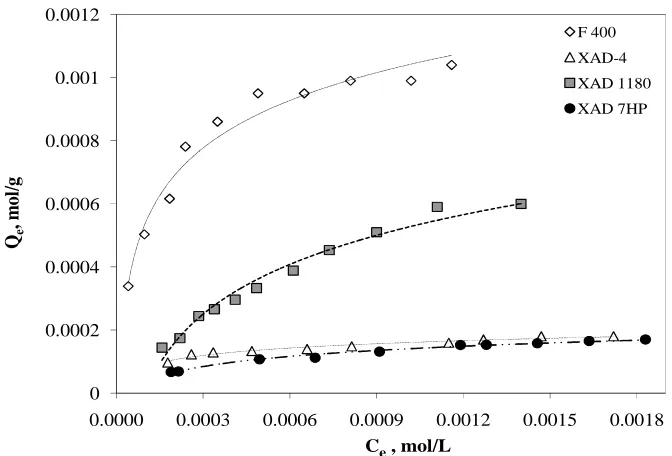
The equilibrium isotherms obtained for all the adsorbate-adsorbent systems in the studied concentration range and at various adsorbents had type I favorable isotherm characteristics, which is desirable for scavenging solute from its aqueous solution. The adsorption equilibrium isotherms for 2, 4 D with respect to all the adsorbents used in the present study are depicted in Fig.-1. These isotherms obeyed the Langmuir equation with very high regression coefficient above 0.98 indicating a very good linear fit in all the cases. The Langmuir expression is given as,
-
-
-
-
-
-
-
-
1
Q
Ce
Q
1
=
0+
0b
Qe
Ce
Langmuir isotherm plot for the adsorbate-adsorbent systems using different adsorbents are depicted in Fig.-2
0 0.0002 0.0004 0.0006 0.0008 0.001 0.0012
0.0000 0.0003 0.0006 0.0009 0.0012 0.0015 0.0018
Qe
,
m
o
l/
g
[image:3.595.117.453.405.633.2]Ce, mol/L
y = 887.1x + 0.101 y = 5026.x + 1.081 y = 928.48x + 0.9726
y = 847.79x + 0.0845
0 2 4 6 8 10
0 0.0003 0.0006 0.0009 0.0012 0.0015 0.0018
Ce /Qe
[image:4.595.111.457.93.346.2]Ce, mol/L
Fig 2 : Comparative Langmuir Adsorption isotherms of 2,4 D
F 400 XAD-4 XAD 1180 XAD 7HP
Adsorbate removal rate studies
A simplified interpretation of the kinetic data based on Langmuir theory has been used for interpreting the kinetic data. The plots of removal rate of 2,4 D using different adsorbents with respect to time are depicted in Fig-3.
0.0 0.2 0.4 0.6 0.8 1.0 1.2
0 50 100 150 200 250 300
Ct
/C
o
t , min
Fig 3 Comparative adsorption kinetics of 2,4 D
F 400 XAD 4
XAD 1180 XAD 7HP
[image:4.595.120.452.425.668.2]phase and the fraction of the vacant adsorbent surfaces. The fraction of the surface covered by the adsorbate, Q, will be proportional to the decrease in fluid phase adsorbate concentration, thus
dq / dt = ka Ct (1-Q) - kd Q --- (2)
and, Q = f ( Co - Ct ) --- (3)
Where, ka and kd are adsorption and desorption rate constants. Co, Ct and Ce are the fluid phase adsorbate
concentrations at zero, time t and at equilibrium respectively and f is proportionality constant. Substituting Eqn. (3) in Eqn. (2) and solving the resultant equation by applying the concept of steady state gives the final expression
ln [( Ct - Ce ) / (Ct + a)] = - ka Ce t + ln [(Co - Ce) / (Co + a)] ---(4)
where, a = (Co / bCe) and b = ka / kd
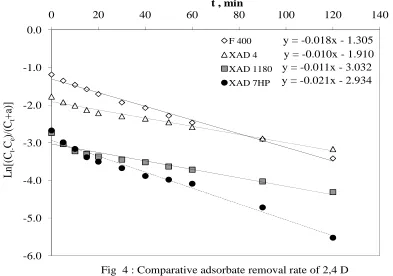
The adsorption rate constant ‘ka’ thus evaluated by plotting ln [(Ct-Ce) / (Ct+a)] against t. Fig. 4 depicts these plots for the adsorbate-adsorbent systems for all the adsorbents studied in the present work. The plot also show the rate expressions obtained by linear regression analysis of the kinetic data. The experimentally determined values of adsorbent monolayer capacity ‘Qo‘, Langmuir constant ‘b’ and the adsorption-desorption rate constant for all thje adsorbents used are summarized in Table-4.
y = -0.018x - 1.305 y = -0.010x - 1.910 y = -0.011x - 3.032 y = -0.021x - 2.934
-6.0 -5.0 -4.0 -3.0 -2.0 -1.0 0.0
0 20 40 60 80 100 120 140
L
n
[(
C
t-C
e)/
(C
t
+
a)
]
t , min
Fig 4 : Comparative adsorbate removal rate of 2,4 D
[image:5.595.104.497.329.605.2]F 400 XAD 4 XAD 1180 XAD 7HP
Table 4:Comparative adsorbent monolayer capacity and Langmuir constant for 2,4 D
No. Adsorbent Slope Intercept Qo x 104 C
e x 104 b
mol/g mol/L
1 F 400 887.12 0.102 11.27 0.41-11.6 8705.79 2 XAD 4 5026.9 1.081 1.99 1.78-17.2 4648.94 3 XAD 1180 928.48 0.973 10.77 1.58-14.1 954.64 4 XAD 7HP 847.79 0.085 11.80 1.89-18.3 10033.02
0
20
40
60
80
100
F 400
XAD 1180
XAD 4
XAD 7HP
CONCLUSION
The present work has led to some important conclusions as stated below.
• 2, 4 D adsorption using GAC F-400 is rapid in the first hour of contact where 65 - 75 % of the adsorbate is removed by GAC F-400 followed by a slow approach towards equilibrium.
• In case of polymeric adsorbents 55-65 % of the adsorbate is removed in the first 30 min of contact time which is then followed by a slow approach to equilibrium.
• The adsorption of 2, 4 D from aqueous solution on to granular activated carbon and polymeric adsorbents confirms to a Langmuir equation based on a monomolecular layer.
• Comparative adsorbent monolayer capacity of GAC F-400 is greater than all the three polymeric adsorbents used.
• The order of adsorptive capacity of 2, 4 D on different adsorbents used in the study is found to be in following order F-400> XAD-1180>XAD-4> XAD7HP
Application of adsorption of 2,4 D by the GAC and polymeric adsorbents in purification of wastewater for can be suitable for of wastewater treatment by using these kinetic parameters.
NOMENCLATURE
R = universal gas constant (JK-1 mol-1) T = temperature of the system (K) b = Langmuir constant
ka = adsorption rate constant (min-1)
C = concentration of the adsorbate in liquid phase (mol/L) Co = initial concentration of the adsorbate (mol/L)
Ce = equilibrium concentration of the adsorbate (mol/L)
Qo = adsorbent monolayer capacity (mol/g)
REFERENCES
[1]KA Matis, AI Zouboulis, GP Gallios, T Erwe, C Blocher, Chemosphere 2004, 55, 65. [2]JW Moore, S Ramamoorthy, Springer Verlag: New York, 1984.
[3]Clement, R. E.; Eiceman, G. A.; Koester, C. J. Environmental-analysis. Anal. Chem. 1995, 67, 221. [4]Kankyo Gijyutsu Kyokai and Nippon Fly Ash Kyokai., Eds. Coal Ash Handbook; Tokyo, 2000. [5]J. M. Brown, Environ. Sci. Technol., 1992 , 26 (6).
[6]M.Nageswara Rao; Y,Hanumantha Rao; Ch.Chakrapani;Ch.Suresh Babu;B.V.Rajeswara Reddy; P.Haritha and Kaza Somasekhara Rao. J.Chem.Pharm.Res. 2011, 3(5):363-375.
[7]P.L.Nigam; M. Banat ; D.Singh and R. Muchant. Process Biochemistry.1996, 31, 442. [8]J Samusolomon and P Martin Deva Prasath. J.Chem.Pharm.Res. 2011, 3(5):478-490 [9]ZY Xu, QX Zhang, CL Wu, LS Wang, Chemosphere 1997 , 35 (10) 2269-2276.
[10]ZY Xu, QX Zhang, CL Wu, LS Wang, GK Anderson, Chemosphere 1999 , 38 (9) 2003-2011. [11]C.Namasivayam, and K. Kadirvelu. Chemosphere. 1997, 34,377-399.
[12] C.Namasivayam; D.Prabha and M.Kumutha. Biores. Technol.1998, 66, 223-228.
[13]KS.Low and C.K. Lee. Pertanika. 1990, 13, 221-228.
[14]HM.Asfour; N.M. Nasser; O.A. Fadali and M.S. EL-Geundi. J.Chem. Technol Biotechnol.1985, 35, 23-34. [15] SS.Nawar, and H.S. Doma. Sci. Tot. Environ. 1989,79, 271-279.
[16] N.Deo and M. Ali. Indian J. Environ. Prot. 1993, 13, 496-508.
[17] UV Lathe; S.K.Wankhede; V.T.Patil and P.R.Patil, J.Chem.Pharm.Res. 2011, 3(2):670-675
[18] BL He, WQ Huang, Ion exchange and adsorption resin,. The science and education press of Shanghai, 1st Edition, Shanghai, China, 1992, 439-466.