Journal of Chemical and Pharmaceutical Research
__________________________________________________
ISSN No: 0975-7384 CODEN(USA): JCPRC5
J. Chem. Pharm. Res., 2011, 3(3):651-658
A new simultaneous RP-HPLC method for development and
validation of Lamotrigine tablets
Vidya Sagar. K*, Prsanth Naidu. Y, Suresh. S, Anusha. Ch, Somnath De and Aneela. S
Dr. Samuel George Insitute of Pharmaceutical Sciences, Markapur, Andhra Pradesh, India Acharya Nagarjuna University, Guntur, Andhra Pradesh
______________________________________________________________________________
ABSTRACT
A simple, rapid and precise method was developed for the quantitative determination of lamotrigine in tablets. The method was based on RP-HPLC. Chromatographic separation was performed on a Xterra C18 ( 4.6 X 100 mm ) column using a mobile phase of methanol and Potassium dihydrogen phosphate (50:50v/v) adjusted the pH . The following system conditions were maintained throughout development and validation i.e., flow rate 0.8ml/min, column was maintained at room temperature and the detected by a UV-wave length at 225 nm. The lamotrigine was well resolved on the stationary phase and the retention time was 3.8 minute. The method was validated and shown to be linear for lamotrigine in 5-25 µg /ml. the correlation coefficient for lamotrigine is 0.999 respectively. The method was validated for Precision, Accuracy, LOD and LOQ were determined.
Keywords: RP-HPLC, Method development and validation, Lamotrigine, Xterra C18 column. ______________________________________________________________________________
INTRODUCTION
tonic, clonic seizures as a single drug or as an adjuvant with other anti epileptic drugs.[4][16] The aim of the present study was to develop and validate a simple, isocratic RP-HPLC method for the
determination of lamotrigine in tablets. The developed method was validated using ICH guidelines for validation. [5] [16]
Today, RP-HPLC is the most popular analytical technique for separating complex mixtures in the chemical, pharmaceutical and biotechnological industry. RP-HPLC is the opposite of normal-phase chromatography, with a nonpolar stationary normal-phase and a polar, largely aqueous mobile phase. The most common stationary phases used are octadecyldimethyl (C 18 ) phases with silica as the solid support. Silica has a small pH range (3 to 8) where mixtures can be separated without degradation of the column performance. Above pH 8, silica supports dissolve and destroy the column. Below pH 3, the silicon-carbon bond is cleaved, and the column is destroyed. The separation is achieved by analytes having different interactions with the stationary phase. In RP-HPLC, solutes are separated using their hydrophobicity. A more hydrophobic solute will be retained on the column longer than a less hydrophobic one. Also, polar solutes will interact with the silica surface to cause peak tailing. The mobile phase is one of the two components involved in the separation process. Water is generally one of the components of a binary mixture in RP-HPLC. Water is considered to be the weak component of the mobile phase and does not interact with the hydrophobic stationary phase chains.
The RP-HPLC method reported in this study was validated in accordance with the International Conference on Harmonization (ICH) guideline[7] and best practice[8-10]. Specificity, linearity, precision (repeatability and intermediate precision), accuracy, robustness, limit of detection and limit of quantitation were evaluated
EXPERIMENTAL SECTION
Methanol ( HPLC grade) , Lamotrigine as the reference standard was purchased from Matrix laboratories , Potassium di hydrogen phosphate buffer pH=7(AR Grade/Merck) , Distilledwater was de-ionised by using a Milli-Q system (Millipore), Lamictal tablets and the chemicals of analytical reagent grade purchased from various sources, Pump (Waters Alliance 2695) , Detector (UV – Visible Model 2487 , Injector Autosampler (20µl), The chromatography[11][12][15] Column C18 XTERRA (150mm) , Elio PH – Meter, A & D – Digital Balance. The mobile phase
consisted of a mixture of methanol- phosphate buffer (50:50 v/v). The flow rate was set to 0.8 ml /min. The detection wavelength was set to be at 225 nm. RP-HPLC analysis was performed isocratically at room temperature.
Preparation of Standard Solution
Preparation of Sample Solution
Weighed 5 Lamotrigine Tablets and calculated the average weight. Accurately weighed and transfered the sample equivalent to 10 mg of Lamotrigine into a 100 ml volumetric flask. Added about 70 ml of diluent and sonicated to dissolve it completely and made volume up to the mark with diluent. Mixed well and filtered through 0.45µm filter. Further pipetted 1ml of the stock solution into a 10ml volumetric flask and diluted up to the mark with diluent. Mixed well and filtered through 0.45µm filter
RESULTS AND DISCUSSION
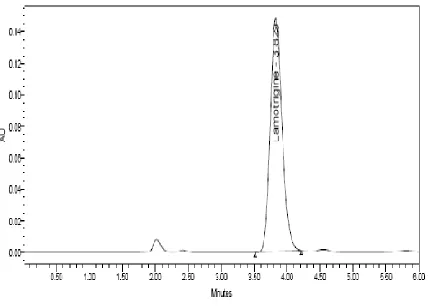
HPLC separation of Lamotrigine was carried out on a Xterra C18 column by an isocratic elution with methanol-phosphate buffer pH-7 (50:50 v/v) . The flow rate was constant at 0.8 ml/min and the column temperature was at room temperature (24±1°). The UV wavelength was set at 225 nm. No interference from diluents, impurities, or excipients present in the pharmaceutical formulation was observed at this detection wavelength. Before each run LC column was equilibrated with the mobile phase for about 15 min. A sharp, symmetrical peak was obtained for Lamotrigine when analyzed under these conditions a. This retention time enable rapid determination of the drug, which is important for routine quality control analysis.
System suitability[6] test was established from five replicate injections of a solution containing Lamotrigine 10µg/ml. The percent relative standard deviation (RSD) of the peak area was calculated. The peak tailing for drug was measured. A useful and practical measurement of peak shape, the peak tailing and theoretical plate count was determined. Column plate number was determined using the formula, N = 5.54(t R /w h ) 2 , where w h is the bandwidth at 50% of peak height. The proposed method met these requirements within the United States Pharmacopoeia (USP) accepted limits ( Tailing factor < 1.5, Theoretical plates > 2000) . The stability of Lamotrigine in solution was investigated in the method development phase. five solutions containing 10 µg/ml of Lamotrigine were tested . The solutions were stable during the investigated time and the RSD was < 1.0% for retention time (min), peak area and height. The solutions were shown to be stable with no significant change in Lamotrigine concentration over this period.
Appropriate amounts of Lamotrigine stock solutions were diluted with mobile phase to give concentration of 5, 10, 15, 20 and 25 µg/ml. Each solution was injected calibration plot was prepared. Linearity was evaluated by linear least-squares regression [14] analysis. Good linearity was observed over the concentration range evaluated (5-25 µg/ml) as shown in the linearity curve in figure-3 . The correlation coefficient was found 0.999.
Table 1: Separation characteristics of lamotrigin analysed under optimized conditions and method validation
Parameters Limit Observation
System suitability Theoritical Plates should not less than 2000.
Tailing factor should not more than 2.0
Theoritical plates: 2224 Tailing factor:1.16 Precision:
A)System Precision B).Method precision
RSD NMT 2.0% RSD NMT 2.0%
0.73 0.33
Linearity Correlation coefficient NLT 0.99 0.999
Accuracy %Recovery range98-102 % 101.84%
Robustness(Flow,Mobile phase) System suitability parameters should comply complies LOD S:N Ratio should be about 3 2.96
LOQ S:N ratio should be about 10 10.27
[image:4.595.80.520.304.364.2]The system is suitable for tailing factor, theoretical plate, and resolution.
Table 2: Recovery studies of lamitrigine from samples with known concentrations
%Concentration
(at specification Level) Area
Amount Added (µg/ml)
Amount Found
((µg/ml) % Recovery Mean Recovery
50% 1151058 6.18 6.29 101.78%
101.84%
100% 206474 11.1 11.3 101.80%
150% 3056211 16.4 16.72 101.95%
*n=3
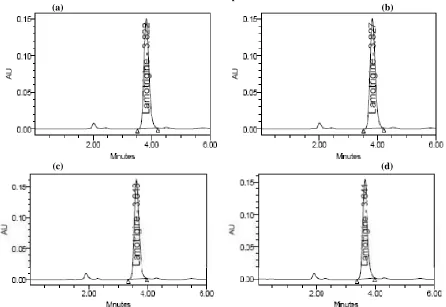
[image:4.595.83.511.405.713.2]Figure 2: Typical LC chromatograms obtained for precision (a),(b) are for precision (c),(d) are for intermediate precision
(a) (b)
[image:5.595.85.457.449.732.2](c) (d)
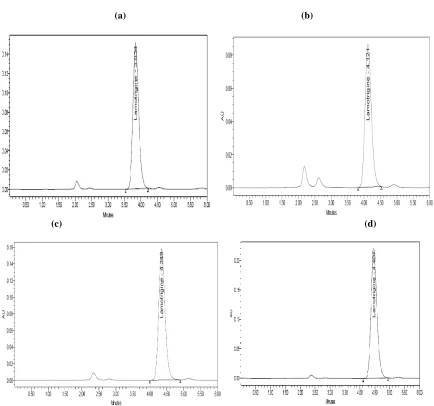
Figure 4: Typical chromatogram of accuracy for standard and sample, (a) standard; (b),(c) and (d) are for sample concentrations of 50%, 100% and 150% respectively
(a) (b)
(c) (d)
[image:6.595.165.438.581.697.2]The intra-day (n= 5) and inter-day (n= 3) %RSD are given in table. All the data are within the acceptance criteria of 2% .
Accuracy of the method was evaluated by fortifying a Lamotrigine sample solution (with respect to the target assay concentration) with three known concentrations of reference standard (5, 10, and 15 µg/ml). Percent recoveries were calculated form differences between the peak areas obtained for fortified and unfortified solutions. Good recoveries were obtained within the acceptance criteria (98.0-102.0%) as shown in Table-2. No significant differences were observed between amounts of Lamotrigine added and the amounts found.
The limit of detection (LOD) and limit of quantitation (LOQ) tests for the procedure were evaluated by serial dilutions of Lamotrigine stock solutions in order to obtain signal-to-noise ratios (s/n) of ≈3:1 and ≈10:1, respectively. The LOD value for Lamotrigine was found to be 0.008µg/ml (s/n = 3.2,) and LOQ (n =6) was 0.029 µg/ml (s/n = 10.38) as shown in Table-1[13].
Robustness of the method was evaluated by the analysis of Lamotrigine under different
experimental conditions such as changes in the organic composition of the mobile phase and flow rate. The percentage of methanol in the mobile phase was varied ±10%, the flow rate was varied ±0.2 ml/min. Their effects on the USP plate count, USP tailing at 10%, recovery and repeatability were studied. Deliberate variation of the method conditions had no significant effect on assay data or on chromatographic performance, indicating the robustness of method and its suitability for routine use and transfer to other laboratories. The results from robustness testing are presented in Table-3
A RP-HPLC method with UV detection for the assay of Lamotrigine was developed and validated. The results showed that the method is very selective, no significant interfering peak was detected; accurate, with the percentage recoveries > 99; and reproducible, with the %RSD < 1%. The method was sensitive; a little as 0.008µ g/ml could be detected with the LOQ of0.029µg/ml. The method involves use of a simple mobile phase with the buffer pH 7 and minimum sample preparation, encouraging its application in quality control for analysis of Lamotrigine in bulk samples, raw materials and final dosage forms.
Acknowledgements
We are grateful to G.N.V. Chandra Shekar, Pharma Train, Kukatpally, Hyderabad for authentication of drug and methodology, and Dr.Jaladi Rajeshekar for his great suggestions in process
REFERENCES
[1] M.J. Brodie, Lancet., 1992, 339, 1397-1400.
[2] DeSelms RH. UV-active phenol ester compounds. Washington, DC: Enigen Science Publishing; 2008.
[5] International conference on Harmonization (ICH), Draft guidelines on validation of analytical procedure- definition and terminology, Federal Register, 1995, 60, 11260- 11262. [6] M.D. Rockville, The “Unitesd states Pharmocopoeia”. XXIV, National Formulary, XIX, US Pharmacopoeial Convention, Inc., 2000, p. 1923.
[7] Validation of analytical procedures: Text and Methodology Q2 (R1), International Conference on Harmonization (ICH) of Technical Requirements for Registration of Pharmaceuticals for Human. Geneva, Switzerland, 2005.
[8] Shabir GA, Indian journal of Pharmaceutical Sciences 2010;72: (3)307-311
[9] Shabir GA, Lough WJ, Shafique AA, Bradshaw TK. J Liq Chromatogr Relat Technol
2007;30:311-33.
[10]Shabir GA, J Cromatogr A 2003;987;57-66.
[11]Chatwal Anand. High performance liquid chromatography and column chromatography. Instrumental analysis. 2004.
[12]Lloyd R Snyder, Joseph J, Kirkland Joseph, Glash, Chatwal anand. Mass spectrometry Practical HPLC method development. Instrumental analysis. 2007.
[13]US Pharmacopoeia (USP) 32, Chromatography Section 621. Rockville MD: United States Pharmacopeal Convention; 2009. p. 1776
[14]Guidance for Industry: Analytical Procedures and Methods Validation: Chemistry, Manufacturing and Controls Documentation; Draft Guidance. Rockville, MD. US FDA. 2000. [15]Raghunadha Reddy Seelam, Sarath Chandiran I, Koteswara Rao Divi, Jayaveera K.N,
International Journal of Pharmaceutical Sciences and Drug Research 2010; 2(3): 188-192.