Students Participation and Facilitation in PBL Tutorial Session
Alias Masek
a*, Sulaiman Yamin
b, Ridzuan Aris
ca,b
Faculty of Technical and Vocational Education, Universiti Tun Hussein Onn Malaysia, 86400 Batu Pahat, Johor, Malaysia
c
Department of Electrical Engineering, Merlimau Polytechnic, 77330 Merlimau, Melaka, Malaysia
Abstract
Students’ participation in the PBL group discussions has always been associated with the role of facilitator, who is responsible for the effectiveness of tutorial sessions. This paper examines the participation of first-year polytechnic students in PBL group discussions and proposes a method of facilitation.The PBL was implemented for ten weeks according to the fourteen-step PBL procedures. Students solved five problems in a two-week block period. Students’ participation was observed and videotaped. Students also responded using a fixed reflective journal while attending all the tutorial sessions held in the 10-week period. At the beginning of the discussion session, students felt awkward to communicate with other members of the groups. They liked to chat with their partners, and the groups generally lacked discussion skills. A serious discussion session only lasted for less than 10 minutes; as a result, no clear decision was made at the end of the discussion session. Therefore, several suggestions were proposed to develop a facilitation technique: to create an environment conducive to discussions and carry out monitoring every 10 to 15 minutes.
Keywords: Problem-based learning, facilitation, participation, tutorial session, engagement with PBL, electrical engineering
1.Introduction
A facilitator’s prescriptive tasks in a Problem Based Learning (PBL) environment require a long list of actions to be identified. Facilitators should apply their knowledge and skills of a subject matter expert or procedural expert in the tutorial class, especially in group discussion sessions (Wee, 2004). Among the important tasks, a facilitator is to guide students throughout the process of learning in order to fulfil the course learning outcomes. In addition, a facilitator has to deal with group dynamics, fostering a suitable climate for collaborative learning (Wee, 2004). In particular circumstances, a facilitator is responsible for resolving team conflicts through diplomatic and negotiation skills (Savin-Baden, 2003; Sabburg, Fahey and Brodie, 2006). One major responsibility of a facilitator is to ensure appropriate level of participation and the use of resources in order to increase group effectiveness (Justice and Jamieson, 2012).
Determination of students’ levels of participation in a PBL group discussion has been very subjective. Previous studies agreed that measuring participation can be done as a group property but not as an individual count (Paletz and Schunn, 2011). Some studies have examined individual participation rates in relation to communication of influence or persuasion of members of a team (Burgoon and Hale, 1987). In fact, some researches propose a matrix for measuring an individual’s participation (Paletz and Schunn, 2011): rubric, questionnaire, and informal self-assessment (Knight, 2011). It is argued that the level of participation can be observed from the pattern of interaction and contribution of members in a group, which are actions indicating an individual’s behaviour (active-passive), oral ability (silent-talkative), group skills (excellent-poor), and confidence (high-low).
Previous authors pointed out that behaviour, oral ability, confidence level and group skills are associated with one another; the combined effects of these four factors influence an individual’s participation in the group discussion (Remedios et al., 2008). A student’s active or passive behaviour in participating in group discussion has been explained in the Model of Learning and Teaching Styles (Kolb, 1984). When a student actively participates in a discussion session, the student talks, moves, and reflects on the subject matter; when a student switches to passive mode, the student watches and listens. However, a student’s actions of talking, moving, and reflecting within a group might end up in disaster without proper group skills. An appointed leader must function as an individual who coordinates a discussion orderly and effectively according to procedures. In order for everyone to attain success of learning, a group should comprise members with understanding of content matter and good communication skills; they should also demonstrate a high level of confidence in presenting views and opinions in the discussion session.
In this context, an ideal facilitator should have two sets of skills (Wee, 2004). Firstly, the facilitator must possess skills relating to PBL process and procedures, such as dealing with group dynamics and fostering suitable climate for collaborative learning. Secondly, the facilitator must be equipped with skills to stimulate students’ meta-cognitive ability, such as probing, questioning, provoking, and any other methods that can encourage students to think creatively. In certain circumstances, the facilitator must be capable of resolving team conflicts through diplomatic and negotiation skills (Savin-Baden, 2003; Sabburg, Fahey and Brodie, 2006).
Using PBL as a platform, a facilitator is the most important person who can influence students’ participation in a group discussion. Hung (2009) proposed a facilitation method based on students’ capability: minimal, moderate, or aggressive guidance
is provided for students depending on maturity levels of students. However, it is difficult to prescriptively define a set of procedures for effective facilitation and stimulation of active participation to ensure effective learning. Existing models of facilitation such as the pyramid model of facilitation (Hunter et al., 2009) are sometimes difficult to be applied in practical group environment, especially in educational context. In addition, specific methods of facilitating PBL group discussion sessions are dependent on individual skills of a facilitator. Therefore, this paper investigates the pattern of students’ participation and proposes a facilitation technique for effective learning in the PBL group discussion sessions. The findings reveal a pattern of participation and behaviour of the first-year students in the PBL group discussions.
2.Methodology
The data reported in this paper were a subset drawn from an experimental study among engineering students to compare the effects of PBL and Traditional Learning Approach in terms of knowledge acquisition, critical thinking ability and intrinsic motivation. While the comparative study provided a major finding from quantitative data, the combination of several qualitative data provided another significant finding. The qualitative data of the study consisted of an observation by the third author, video data, reflective journal, and field notes.
Participants comprised 27 first-year undergraduate students from the electrical engineering course in one of the polytechnics in Malaysia; 24 of them were male and the remaining 3 were female. These students had undergone ten weeks of PBL tutorial sessions in one of the compulsory modules, namely Electrical Technology. Data field notes were collected by a facilitator (the third author) during the PBL group discussion sessions according to descriptive and reflective methods (Emerson et al., 2011). In descriptive method, the observer records the natural setting, actions and conversation taking place in the tutorial session. In reflective method, the observer records ideas, thoughts and concerns based on observation or reflection of events taking place in the tutorial session.
At the end of the 10-week tutorial sessions, field notes of 20 sessions as well as 135 pages of fixed-reflective journals were analysed. Data from field notes and students’ fixed-reflective journal were transcribed digitally into a matrix form. The data from videotapes were repeatedly watched and used to double check students’ behaviour and participation during the discussion sessions.
2.1.Brief notes on PBL tutorial session
The instruction was based on the 14 steps of PBL procedures (Masek and Yamin, 2012). Briefly, during the first meeting, students were divided into groups according to previous test results such that higher-score and lower-score students were evenly distributed (heterogeneous group). A total of seven groups were formed: six groups each with four members and one group with three members. They were then asked to appoint a leader for each group and were briefed on the PBL procedures.
Students were given five PBL subject-focused problems (subject-centric) during the 10-week PBL tutorial sessions. One problem required a two-week block of time to complete one cycle of PBL procedures. In the two-week block, it was compulsory for students to attend two tutorial sessions. The first session was dedicated to problem delivery and group brainstorming, while the second session was devoted to group discussions (decision- making) and presentation.
Both sessions of group discussions were videotaped and recorded in field notes (by the third author). The video data were used to validate the data from the field notes jotted down by an observer regarding students’ participation during the PBL group discussions. The writing of reflective journal was implemented for each student at the end of the second session (one complete cycle of PBL procedures). The purpose of the reflective journal was to capture students’ participation in the PBL group discussions; the journal contained fixed questions such as “what is the most motivating thing in PBL session” and “what is the most frustrating thing in PBL session”.
3.Findings and discussions
[image:2.595.69.480.726.790.2]Several repeated patterns of interaction were identified in order to understand students’ participation during the discussion sessions. These patterns were set up as a base for critical comments and discussions regarding students’ participation during PBL group discussion sessions. These patterns include the students’ behaviour (active-passive), oral ability (silent-talkative), group skills (excellent-poor), and confidence (high-low) as described in Table 1:
Table 1: Themes from data matrix of extracted field notes and fixed reflective questions
TYPE DESCRIPTIONS
Behaviour Active-passive
Some group members actively participated in the discussion activities. They moved, talked and reflected on one another’s responses.
Oral
Silent-talkative
Some group members were talkative persons. They talked about relevant and irrelevant topics of discussion.
Some group members were quiet for at least 10 to 15 minutes during the discussion session.
Group skills Excellent-poor
Group skills were excellent for some groups. Procedural discussion was observed: chairman, secretary and contributors.
Group skill was poor for some groups. No procedural discussion was observed. Confidence
High-low
Some group members have high levels of confidence in action, behaviour, communication, contributing ideas and proposing solutions.
Some group members have low levels of confidence in action, behaviour, communication, contributing ideas and proposing solutions.
Table 1 indicates the pattern classifications of students’ behaviour, oral ability, group skills, and confidence level during discussion times in the PBL group tutorial sessions. These classifications can produce several combinations as listed below:
Active and talkative group: A number of groups were active during the discussion sessions (on topic or off topic); the members of these groups were talkative persons. Students who were talkative persons were involved in the discussion sessions and got along well with other members. Particularly, the PBL problem was discussed rigorously from many possible aspects, and several possible solutions were also identified. These active participation and spontaneous responses were reflected in excellent presentations with good contents and proposals having minimal errors. Interestingly, there were some students who were identified as quiet persons, but they appeared to be contributors of ideas for these particular groups.
Passive and quiet groups: This category usually has two distinct types of groups exhibiting different characteristics. Firstly, a successful group with passive members; the group was led by quiet but brilliant or hardworking members. Secondly, a failure group; some members did not cooperate and some other members were quiet participators who seldom talked (Remedios et al., 2008). Two occurrences can be observed in the successful group (first case): first, some students kept silent and only talked when they were prompted by other members; second, some students kept silent and only listened to others for the first 10 to 15 minutes. In the first PBL group discussion, it could be observed in both types of groups that several students were shy and felt awkward to participate in discussions, especially when there were female members in the group.
High confidence and poor group skills: Several groups were observed to have high levels of confidence in conducting group discussions. However, members lacked group skills in order to have an effective discussion session. Members contributed ideas and the discussions appeared organised and procedural, but no one took down notes.
Low confidence but excellent group skills: Several groups were observed to have low levels of confidence but they had good ideas and skills in problem solving. A member of the group was actually brilliant and creative, but members were hesitant to start the discussion of the topic given. The group wasted quite some time at the beginning before some members kick-started the discussion session.
4.Discussions and recommendations
Literature suggests that skills of facilitators are one of the three main input variables that influence tutorial group process, which in turn determines cognitive and motivational outcomes (Arts, Gijselaers and Segers, 2002). It is believed that by improving group process, individual participation will also increase; the key is that facilitators must play their roles appropriately according to the nature of individual groups. In considering these constructs, one might argue that variables such as student characteristics will substantially affect the amount of self-study and the level of students’ participation in learning. However, it must be noted that without a facilitator’s guidance, it is doubtful that group discussion can be effective since individual participation is minimal or perhaps none at all.
Premised on these findings, four constructs were derived based on the dynamics and variety of group nature and action in the PBL group discussion sessions as well as existing literature. Basically, several possible combinations can be created based on the four constructs, but four major combinations are highlighted for discussion in this paper. Therefore, several recommendations for facilitation techniques are proposed especially for those practising the concept of floating facilitator, which is mainly based on group nature.
Generally, for the active and talkative groups, the identified quiet individuals can be put together with those who are more talkative to encourage communication and effective discussion sessions. The quiet individuals appear to be good critical thinkers because they are capable of debating ideas proposed by other members as well as facilitators. This does not always happen because the quiet individuals sometimes are not in the same groups as talkative members. However, in order to maintain the level of control, autonomy as well as the inclusion of social aspects of students’ learning (Arts et al., 2002), facilitation techniques are proposed to deal with participants according to the identified group nature as defined above.
Active and talkative group: The top priority job is for the facilitator to frequently monitor discussion sessions and guide
However, it is suggested that the level of facilitator intervention be kept to the minimum to avoid disrupting the momentum of group discussions.
Passive and silent group: The facilitator should provide aggressive guidance to excite members so that the groups can take
off with warm and lively discussions. In this context, aggressive guidance means to encourage collaborative learning among members within a group, inside and outside of the tutorial class (Arts et al., 2002). In the tutorial class, the facilitator promotes warm and lively discussions amongst group members by injecting a hot topic, a controversial issue, or a particular concern relevant to the problem in hand. Another role of the facilitator is to monitor participation of individual students in brainstorming sessions. Outside the tutorial class, the facilitator encourages students to have independent group discussions and self-study sessions; this will provide opportunity for group members to speak and contribute ideas.
High confidence and poor group skills: The group requires less help from the facilitator to start on discussions. The
facilitator’s role is limited to suggesting members of the group to be chairman, secretary, and contributors in the discussion session. The facilitator has to monitor the discussion at the beginning before leading the group to work independently. Justice and Jamieson (2012) highlighted the necessity of group members’ function at appropriate levels of participation and the proper use of resources in order to have an effective group discussion. Minimal guidance from the facilitator is needed for this type of PBL group.
Low confidence but excellent group skills:The group members require some ideas from the facilitator to start on discussions.
Everyone is hesitant to contribute ideas although they have been thinking so much about the topic given. The main issue is that students are less confident to speak up. According to Schwarz (2002), group effectiveness can be increased by creating a discussion environment that is substantively neutral. It is suggested that the facilitator acts as a fellow learner within the group to create an informal discussion environment. The discussion in this case should be continuous similar to normal conversations and chats with friends.
5.Conclusion
Generally, in PBL tutorial sessions, it is facilitators’ responsibility to promote effective group discussions and to stimulate effectiveness of participants according to dynamic group nature. By increasing participation of individuals in the discussion session, one group might effectively operate under the facilitator’s supervision. Several steps are essential for smooth group functioning, such as allowing the group to appoint a leader that rotates for every single project and letting students decide who the first leader is. Facilitators are also responsible for monitoring groups every 10 to 15 minutes; the aim is to create a friendly environment, impart group skills, and update discussion progress every 10 to 15 minutes. Facilitators must also emphasise clear findings to increase effectiveness of group discussions.
References
Arts, J.A.R., Gijselaers, W.H. & Segers, M.S.R. (2002). Cognitive effects of an Authentic computer-supported, problem based learning environment. Instructional Science, 30, pp. 465-495.
Burgoon, J. K., & Hale, J. L. (1987). Validation and measurement of the fundamental themes of relational communication. Communication Monographs, 54, 19– 41.
Emerson, R.M., Fretz, R.I. & Shaw, L.L. (2011). Writing ethnographic field notes, 2nd edition. U.S: The University of Chicago.
Hung, W. (2009). The 9-step problem design process for problem based learning: application of the 3C3R model. Educational Research Review, 4, pp. 118-141. Hunter, D., Thorpe, S., Brown, H. & Bailey, A. (2009). The art of facilitation. New York: Willey.
Justice, T. and Jamieson, D.W. (2012). The Facilitator’s field book. Third edition. United States: HRD Press.
Knight, D.D. (2011). Assessing Class Participation: One useful strategy: Tips for encouraging students participation in classromm discussion. The Teaching Professor. United State: A Magna Publication. Pg 4.
KoIb, D.A., Experiential Learning:Experience as the Source ofLearning and Development, Prentice-Hall, Englewood Cliffs, N.J., 1984.
Masek, A. & Yamin, S. (2012). A Comparative study of the effect of Problem Based Learning and Traditional Learning Approaches on Students’ Knowledge Acquisition. International Journal of Engineering Education, Vol. 28 (5), pp. 1161-1167.
Paletz, B.F.S. & Shunn, C.D. (2011). Assessing group-level participation in fluid teams: testing a new matric. Behav. Research, DOI: 10.3758/s13428-011-0070-3.
Remedious, L., Clarke, D., and Hawthorn, L. (2008). The silent participation in small group collaborative learning contexts. University of Melbourne: PhD. Thesis
Sabburg, J., Fahey, P. & Brodie, L. (2006). Physics concepts: Engineering PBL at USQ. Proceeding of 17th National Congress. Brisbane: RiverPhys. pp. 105.
Schwarz, R. (2002). The Skilled Facilitator: A comprehensive resource for consultants, facilitators, managers, trainers, and coaches. San Francisco: Jossey-Bass Publisher.
Project Oriented Design Based Learning – Staff Perspectives
Sivachandran Chandrasekaran
a, Alex Stojcevski
b, Guy Littlefair
c, Matthew Joordens
daPhD Student in Engineering Education, Deakin University, Geelong 3216, Australia
bProfessor & Head of Electrical and Electronics Engineering, Deakin University, Geelong 3216, Australia cHead of School of Engineering, Deakin University, Geelong 3216, Australia
dAssociate Head of Teaching and Learning, Deakin University, Geelong 3216, Australia
Abstract
The focus of this paper is to get staff perception on design based learning in their respective disciplines and how they could be aligned to the newly proposed model, in project oriented design based learning (PODBL). In academia, students and staff are supposed to work together in order to achieve a balanced learning and teaching process. By using different teaching and learning approaches, teachers are aware of escalating the student knowledge to fulfill current technology needs. This paper is part of a continuing process of a research project, which analyses better teaching and learning approaches in engineering. As part of this research, face-to-face interviews with staff members of the school of engineering in Deakin University who are teaching engineering design were conducted. The interview questions are based on qualitative analysis. The questions covered here are designed to determine the staff level of experience from teaching engineering using design based learning approach as an educational model. From the analysed results, this research encourages the school to practice a unique pedagogy that will accomplish the students learning outcomes.
Keywords: Design based learning (DBL), Project oriented design-based learning (PODBL), engineering education.
1. Introduction
In engineering education, students are active learners while teachers are perceived as facilitators. All universities have the capability to produce qualified professionals by motivating and developing the skill set of students to become experts in a chosen field. Many educatorshave practiced different teaching and learning approaches to teach the students about engineering design, design process, engineering and technology, discipline related engineering practice. Especially when it comes to solving a design problem, which students have to experience in their future industry jobs. Students need to learn to solve design problems, they need to use design process as a methodology to approach a problem and they have to understand the user requirements for an end product. It is a vital role of an engineer to satisfy the need of user in every domain of designing an end product. This research project is part of a larger research project, which was concerned with improving teaching methods, and therefore requires face-to-face interviews with the staff members who teach and perform research in engineering design.
2.Different learning approaches
Project based learning – In this approach, the central focus is on projects. Projects are focused on questions or problems that initiate the student learning. Learning through projects is time consuming approach that is interpreted in terms of an assignment or task performed by the students (Chandrasekaran, 2012a). The common element in project based learning and problem based learning is learning processes which is a central principle to enhance students motivation. Project based learning are perceived to be student centred approaches to learning. It is predominantly task oriented and the tutor often sets project to the students. In project based learning, students are required to produce an outcome as a report supervised by the supervisors. Here students need to produce a solution to solve the problem where the result should be in the form of a report, presentation or design (A.Stojcevski, 2008; Bell, 2010; A. Kolmos, 1996).
*
Sivachandran Chandrasekaran.E-mail address: [email protected]
Problem based learning – is defined by open-ended and ill-structured problems. Ill-structured problems are those without a single correct solution. In this approach, learner chooses the problems and methods to be used. The project work concerns about both problem analysis and problem solution. The teacher acts as a facilitator to facilitate the learning process rather than providing the knowledge. Students have to work out their own learning requirements. Problem solving is a component of the problem-based approach. The goals of PBL include helping students to develop flexible knowledge, effective problem solving skills, self-directed learning, effective collaboration skills and intrinsic motivation (Erik De Graaff and Anette Kolmos, 2007; Erik De Graaff and Anettee Kolmos, 2003; Michel, 2009).
students to gain interdisciplinary knowledge and development of skills in order to tackle the sustainable design challenges. Kolmos (author of POPBL) states that most of the engineering institutions in Europe are changing their traditional curriculum due to the expectations of new engineering skills required by the Accreditation of European Engineering Programme s (EUR-ACE). The traditional model is lecture centred, discipline oriented, and based on basic and applied technical knowledge. This particular approach is used to change teaching mode to learning mode, which incorporates interdisciplinary, student-centred, self-directed learning in the new model. Kolmos also states that the task of the teacher is altered from transferring knowledge into facilitating the learning process of the students (Hung., 2008; Lehmann, 2008; Moesby).
Design based learning (DBL) – is a self-directed approach in which students initiate learning by designing creative and innovative practical solutions which fulfil academic and industry expectations. Integrating design and technology tools into science education provides students with dynamic learning opportunities to actively investigate and construct innovative design solutions. A design based learning environment helps a curriculum to practice 21st Century Skills for students such as hands-on work, problem solving, collaborative teamwork, innovative creative designs, active learning, and engagement with real-world assignments. By engaging students in learning design, DBL provides an opportunity to experience individual, inventive and creative projects that initiates the learning process in relation to their preferences, learning styles and various skills (Doppelt, 2009; S.M. Gómez Puente, 2011; Wijnen, 1999).
3. Project oriented design-based learning
Accrediting bodies such as the Accreditation Board for Engineering and Technology (ABET), Engineers Australia (EA), as well as the European Accreditation of Engineering Programs (EUR-ACE), all specify that Design is an essential element of graduate outcomes for an engineering program(ABET, 2012-2013; EA, 2012; ENAEE, 2008). Different types of problems exist in engineering and design problems are most important that attracts young, imaginative engineers. Design is not restricted to engineers, who are not only professional designers. Everyone designs who devises courses of action aimed at changing existing situations into preferred ones.
Studying engineering involves not only learning scientific knowledge and technological skills; it also involves learning the language, established practices, beliefs, and professional values of engineering culture that makes a student to be an engineer. The problem solving is one of the important skills for students. Therefore the goal of all engineering programs is to teach problem solving skills to educate students as professionals. Industry is looking for professionals with design knowledge, which is integrated with creative and innovative interdisciplinary thinking (University, 2012). The project-oriented design based learning framework will focus on skills such as innovation and creativity in the engineering discipline.
To deal with problems and to find the solution for the problems is an essential quality for a professional. Therefore curriculum needs to educate and prepare the students to be a problem solver. With different learning styles students are able to express their skills and talents through working on projects. By integrating design and technology tools into engineering education, the aim is to provide students with dynamic learning opportunities to actively investigate and construct innovative design solutions. The project-oriented design based learning approach is focused on curriculum renewal to practice innovation and creativity for students learning to solve design problems through projects in engineering education (Chandrasekaran, 2012b, 2012c, 2013). This approach aimed to have exposed noticeable changes within the performance and knowledge of students, especially when breaking out of traditional cultures and introducing creative ideas.
4. Methodology
This paper is a part of a continuing process of a research project, which analyses teaching and learning approaches in engineering education. The aim of this research paper is to investigate the staff perspectives in design based learning in engineering education. The face-to-face interviews are based on qualitative questions that are analysed and presented in quantitative form. The questions covered here are designed to determine the staff perspectives on design based learning through their level of experience from 1st year to final year. An interview question set was asked to each staff that teaches and performs research in engineering design. The research assistant who involved in the project conducted the interviews and data collected are anonymous and non-identifiable.
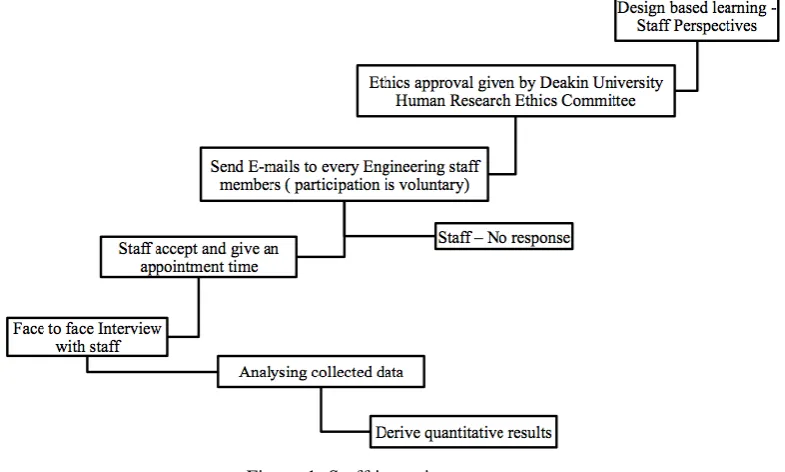
Figure 1. Staff interview process
Figure 1 shows the flowchart of the process of staff interviews conducted by the research assistant involved in this research. In line with the ethics approval process and procedures, research assistant send an individual E-mails to every staff member in the School of Engineering. When a staff given an appointment time, the research assistant will conduct the face-to-face interview. An interview question set was asked to each staff that teaches and performs research in engineering design. The data collected are anonymous and non -identifiable. The collected data are analysed to derive a quantitative outcome that shows the staff perceptions on design based learning.
The staff Interview questions is listed below:
Q1: Define design based learning (DBL)? Q2: What does engineering design mean to you?
Q3: Are aspects of engineering design taught in your unit? If yes, How?
Q4: Do you see engineering design as an essential learning element of an engineering program? If yes, why? Q5: What do you think of some of possible ways to teach design?
Q6: Does your curriculum involve design-based learning through projects?
Q7: Could you please list some of the skills attained by students through DBL in your unit? Q8: How can engineering design projects helps to collaborate with industry?
5. Results
Design based learning is one of the most important fields of engineering learning that the school of engineering at Deakin believes that it would enhance the learning experience for students. The school of engineering is currently using these methods at different levels in various units. There is a need to verify these methods and to identify the best practice in these methods to ensure the best possible learning experiences for the students. The staff members in the school of engineering participated in the face-to-face interview about design based learning. From the staff perspectives, it is possible to access the current levels of benefit to the engineering student. The results shown below helped the school to help the staff to improve their teaching experiences at the school of engineering at Deakin University.
[image:7.595.167.427.656.780.2]Figure 2. Staff perspectives on Design based learning
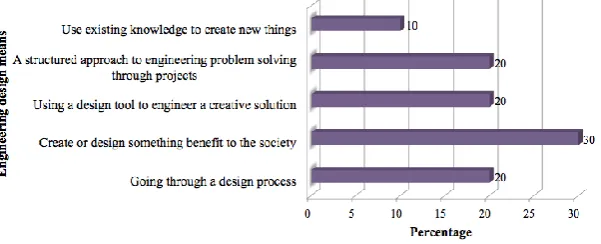
[image:8.595.148.449.164.286.2]Overall staff perceptions about design based learning shows that every staff member got a unique way of teaching and learning process, which focused on learning design in various aspects. As a part of the process towards identifying what DBL means to staff, it was important to find out how staff define engineering design means. Figure 3 shows that a large number of staff responses (30%) define engineering design is to create or design something benefit to the society, 20% define engineering design as a structured approach to engineering problem solving through projects, 20% defines that using a design tool to engineer a creative solution, 20% of staff defines engineering as going through a design process and 10% defined it as use existing knowledge to create new things.
Figure 3. Staff perspectives on engineering design
[image:8.595.136.456.346.476.2]In common, all engineering staff members express that engineering design is an essential element of an engineering program.
Figure 4. Aspects of engineering design taught by staff
When the staff are asked about aspects of engineering design taught in their units, figure 4 illustrates that 35% of staff say that they perform it by teaching application of design through projects, 30% mentioned it by teaching through design process with theory, 20% says aspects of engineering design taught by teaching concept development to design process and it is interesting to see that 15% teaching design methodologies (Design for X) and engineers without borders project.
Table 1. Staff perspectives on engineering design as an essential element
S.no Engineering design as an
Essential element
%
1 Agree 15
2 Mostly agree 85
[image:8.595.172.420.727.777.2]Table 1 show that 15% of staff member agree and 85% of staff member mostly agree that design as an essential element of an engineering program. These staff members are working in the School of engineering in Deakin University who teaches and performs research in engineering design. The staffs were also asked about their perception on possible ways to teach design. Table 2 illustrates staff perspectives about possible ways to teach design such as team based learning, activity based learning, analytical thinking and self-directed learning. From Table 3 it can be seen that majority of the staff strongly accepts that their curriculum involves DBL.
Table 2. Staff perspectives about possible ways to teach design
S.no Possible ways to teach design %
1 Team based learning 15
2 Activity based learning 35
3 4 4
Analytical thinking Self-directed learning
Table 3. Staff perspectives about curriculum involves DBL through projects
S.no Curriculum involves DBL %
1 In transition status 5
2 Possible yes 20
3 Strongly yes 75
Table 4 illustrates the staff perspectives on skills attained by students through DBL. Majority of the staff members mentioned that creativity, learning by doing, problem solving, self directed learning are the most important skills attained by students through design based learning in their curriculum. In addition Figure 4 shows staff perception on collaboration of academics with industry.
Table 4. Staff perspectives on skills attained by students
S.no Skills attained by students through DBL %
1 Team work & Communication 30
2 Learning by doing 45
3 4 5
Problem solving Self-directed learning
Creativity
45 40 70
[image:9.595.126.469.307.441.2]Figure 5 shows that majority 30% of staff members recommend that practicing and improving design projects in universities helps engineering design projects to collaborate with industry. The least 10% of staff says that collaboration of academics with industry will help students’ exposure to real world problems.
Figure 5. Staff perspectives on collaboration of academics with industry
Some of the qualitative comments from the Deakin University engineering staff members on design based learning (DBL) are listed below.
DBL is about where students taken a project or task to be active in their learning by finding a solution for a problem. Where the solution is known or not known but it is about going through a process of design to have a tangible outcome.
DBL is a part of learning and teaching process. It introduces a problem to design to get a solution for an end user and as well as the environment. DBL is to emphasize engineering principles through design.
DBL is the learning process that happens through the process of designing something or working through a project. Taking an idea something engineered and well defined. Teaching students the fact that an engineering product is well defined, well thought and processed thru many steps of refinement to get a stage for specific purpose.
DBL is using design principles whether that’s 7 steps or 8,9 steps design process to facilitate student learning via the conduction of the project (research or design project or project around learning itself).
Everything in engineering is DBL. Every learning exercise is design based or development based.
DBL is an active learning process where student given a design problem they need to solve which they have to come up with ideas or workout what they need to find out to actually able to solve it. Apply design processing in doing it to find out the solution.
DBL is something appropriate for engineering course, or engineering course focusing on some aspects of design or industrial design where the classroom tasks is centred around the designing something a product and the background knowledge required to pick up the whole things on.
5. Professional development
ability to teach subjects and at the same time are not willing to seek professional development activities. These professional development opportunities provide staff with valuable opportunities to enhance their personal teaching qualities, which helps them to achieve and follow a successful learning and teaching process. At Deakin University, staff are encouraged to practice teaching and learning approaches that influence, motivate and inspire students to learn. Deakin Learning Futures provides a range of opportunities, events and services for staff to enhance their capability to be effective educators. In order to enha nce continuing students engagement in learning and provide active learners in the classroom, teachers need to teach each other through professional development workshops (Malinda Schaefer Zarske, 2004).
6. Conclusion
The engineering teaching staff at Deakin University seem to have an adequate understanding of DBL, which are illustrated from the results shown above. This is encouraging to the School of Engineering, which will enhance student learning and staff teaching processes to better align with the learning and teaching model. This paper is a part of an ongoing research that helps to foster curriculum development in student understanding and engagement. Project Oriented Design Based Learning is set to have a positive effect on student content knowledge and the development of skills such as collaboration, critical thinking, creativity, innovation, and problem solving which increases their motivation and engagement. It is a challenging task for academic staff to implement a PODBL approach and integrate technology into projects in meaningful ways.
Acknowledgements
We wish to thank all staff members in the School of Engineering, Deakin University for participating in this study.
References
ABET, Accreditation board of engineering and technology. (2012-2013). Criteria for accrediting engineering programs.
Chandrasekaran, S., and Stojcevski, A., Littlefair, G., Joordens, M. (2012a). Learning through Projects in Engineering Education. Paper presented at the Eurpean Journal of Engineering Education Conferences (SEFI 2012), Thessaloniki, Greece.
Chandrasekaran, S., and Stojcevski, A., Littlefair, G., Joordens, M. (2012b). The Process of Design Based Learning: A Students' Prespectives. Australasian Association of Engineering Education (AAEE), Melbourne, Australia.
Chandrasekaran, S., and Stojcevski, A., Littlefair, G., Joordens, M. (2012c). Project Oriented Design Based Learning: Aligning Students’ Views with Industry needs. Paper accepted at International Journal of Engineering Education (IJEE).
Chandrasekaran, S., and Stojcevski, A., Littlefair, G., Joordens, M. (2013). Accreditation Inspired Project Oriented Design Based Learning curriculum for Engineering Education. Paper accepted at 2nd International Engineering and Technology Education Conference (IETEC), Ho Chi Minh City, Vietnam.
Doppelt, Y. (2009). Assessing creative thinking in design-based learning. International Journal of Technology and Design Education, 19(1), 55-65. EA. (2012). Engineers Australia. Stage1 competency standard for professional engineer. Australia.
EUR-ACE. (2008). European accreditation of engineering programmes. EUR-ACE Framework standards for the accreditation of engineering programmes. Gómez Puente, S. M., Van Eijck, M., and Jochems, W. (2011). Towards characterising design-based learning in engineering education: a review of the literature.
European Journal of Engineering Education. 36(2), 137-149.
Hung, W. Jonassen.D, H., Liu, R., (2008). Problem Based Learning. Handbook of research on educational communicationsand technology. Kolmos, A. (1996). Reflections on Project Work and Problem-based Learning. European Journal of Engineering Education, 21(2), 141-148. Kolmos, A., and Graaff E, De. (2007). Management of Change: Sense Publisher.
Kolmos, A., and Graaff E, De. (2003). Characteristics of Problem-Based Learning. Journal of Engineering Education, 19(5), 657-662.
Lehmann, M., Christensen, P., Du, X., Thrane, M. (2008). Problem-oriented and project-based learning (POPBL) as an innovative learning strategy for sustainble development in engineering education. European Journal of Engineering Education, 33(3), 283-295.
Michel, J. (2009). Management of Change-Implementation of Problem-based and Project-Based Learning in Engineering. European Journal of Engineering Education, 34(6), 606.
Moesby, E. (2005) Curriculum Development for Project-Oriented and Problem-Based Learning (POPBL) with Emphasis on Personal Skills and Abilities. Global Journal of Engineering Education, 9(2), 121-128.
Stojcevski, A., and Veljanoski, R. (2008). Electrical Engineering & PBL: From a Teacher-Centred to a Student-Centred Curriculum: Victoria University. Stephanie, B. (2010). Project-Based Learning for the 21st Century: Skills for the Future. A Journal of Educational Strategies, Issues and Ideas, 83(2), 39-43. University, Deakin. (2012). Deakin Design Forum : Industry and Academia needs: Deakin University, Australia.
Wijnen, W.H.F.W. (1999). Towards Design-Based Learning. Educational Service Centre: Technische Universiteit Eindhoven.