Technology (IJRASET)
Palm Authentication:A Review
Praveen Kaundal1, Dr.Sukhwinder Singh2
Department of ECE, PEC University of Technology
Abstract: A system which is basically used for pattern detection and identification on the bases of physical and behavioral traits is known as biometric system. Biometric recognition has been investigated over the past many years. Palm print recognition has been playing important role in biometric technology. The work done in past many years has discussed in this paper. Palm print recognition system consists of the following steps: palm print acquisition, preprocessing, feature extraction, enrollment (database) and matching. Because of tremendous information is present on human palm it act as an influential tool for person identification. The essential step in this recognition system extraction of feature vectors related to person input palm image and to perform matching based on parameters. Palm print recognition is a challenging problem mainly due to low quality of pattern, large nonlinear distortion between different impression of same palm and large image size, which makes feature extraction and matching computationally demanding.
Keywords: Biometric,Image Acquisition, Preprocessing, Feature Extraction, Matching
I. INTRODUCTION
Many years ago the method of distinguishing a person which is illiterate (not able to write name) from another person, was palm impression and thumb impression comparison. In 1858, Sir William Herschel, working for the Civil Service of India for the payment of the salary and other identification purpose of employees, he took the handprints on the back of the contracts. A Hungarian company builds first palm print based recognitions system.
Figure1: Graph between numbers of publication vs. year
In later stage, 1994 the experts from the United States studies the purposes model of Hungarian company and invited the company for International Association for Identification (IAI) conference in 1995.In 1997, US build a palm system in which finger print and palm identification technologies are embedded. After 1997, the palm print system became more popular and became the area of interest of many researchers. As shown in the graph (Figure1) the research in this field is gradually increasing year by year, that is why I have selected this topic for my research. The data of last 20 years (1996-2016) is collected from well know index which is known as Scopus index. A lot of work has to be done.Biometrics refers to the technologies which is for an individual’s identity establishment by measuring his/her physical characteristics or behavioural traits such as thumb impression, palm impression, retina, iris, hand geometry and face or some behavioral aspects such as , gesture and voice [1]. As the unlawful interventions are step up day by day we required more protective technique to enhance the reliability and security of the system. The application areas of biometrics are divided into three different group commercial (ATM, physical access control etc.), government (id card, passport
Figure 2: Biometric System
II. RECOGNITIONOFPALMPRINT
There are two type of recognition for low resolution and high resolution images. Majority of the work is done on palm print recognition uses the low resolution images [2].
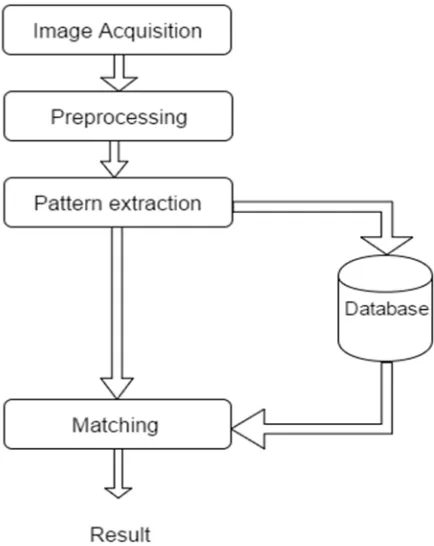
Figure 3: Generalized block diagram of Palm print Recognition
The palm print recognition system is categorized into four sub-parts as
A. Image Acquisition
Technology (IJRASET)
Figure 4: Palm print scanner
B. Pre-processing
Once the input data (palm image) is with us then pre-processing can be done on the image. Often noise is present in the captured image. To improve the quality of captured image need to separate the palm region of interest from the background region and the then percentage of noise up to some extend automatically decrease.
Basically ROI is help in feature extraction stage. This is divided in four steps. Binarize the palm image.
Trace the boundary of palm image to identify and fix key Point. Formation a coordination system., Central part Extraction.
Multiple methods are used to extract region of interest. The main focus is basically to extract middle area of palm because it covers all the features. And another reason is, it has approximately particular texture for different person. The most popular approach for detection of ROI firstly spot the knuckle point which lies between our finger like little finger, ring finger, middle finger and then joining these co-ordinates (points) are considered as our area of interest and a middle part of input image is develop .It could be in a circular or a squared shape which depends on the requirements.
C. Feature Extraction
Next step is feature extraction which consists of two different steps. One for verification of palm image and the other for identification palm image. In identification it searches the data of individual from all stored data in the system. The different type of approaches are Line based, sub-space based and statistical based, which are used for verification of palm features from the stored data. The purpose of this section is to identify the correct individual and to block the unauthorized access.In feature extraction phase features of palm are extracted like principal lines, orientation field, minutiae, density map, texture, singular points etc. Extracted features are stored in databasefor further process of matching.
Line based approachThis approach is used to detect edge and palm lines are distinguish on the bases of magnitude. This magnitude of the palm’s different line is projected in x and y coordinates forming histograms. Next step is to locate the end points and direction for that first order derivative is calculated. After that to identify the magnitude of lines second order derivative is calculated. Then the Euclidian distance is used for matching.
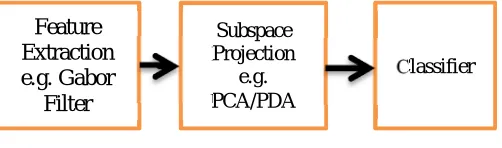
[image:4.612.189.440.609.683.2]Subspace based approach Sub-space based approach is known as appearance based approach. This approach generally involves Linear Discriminant Analysis (LDA), Principal Component Analysis (PCA) and Independent Component Analysis (IDA). The subspace coefficients are supposed as the features used for matching. To apply above mention techniques directly to the palm print, researcher also used different filters.
Figure 5: Architecture of subspace approach
Statistical approachThe two different approaches are used one is local and another global approach. In the local approach input image is changes in another domain. This changed image is now divided into small sub-images and these sub-images are expressed
approach involves density, center of gravity and moments. The main difference between the global and local approach is, global approach is applied complete palm on the other hand local approach divide the palm print in sub- regions.
Coding approaches This approach presents a new technique for extracting features from palm prints using the different Coding Scheme. The information about orientation is extracted from palm line by using multiple 2-D Gabor filter .This information is then stored in the form of feature vector and this is known as Competitive Code. The advantages of coding approach is the size of registered data is reduced and its also deal with non-linear distortion between palm print images.
D. Matching and decision making
Matching is next to the feature extraction phase.The templates of extracted feature are stored in the database. As we know each input template which is under consideration has salient features .This step basically compare the stored template with the input template which is under consideration and measure the degree of similarity between them.
E. Result
This stage gives the output. Applications
Intelligent door handles, door locks. Computer Logins.
POS (Point Of Sale) Authentication. Time Attendance Applications. Physical Access Control
III. CONCLUSION
In this paper we have discussed the different prevail approaches used for palm print recognition system and there is further possibility of advancement. The research in this field is increasing year by year, that is why I have selected this topic for my research. A lot of work has to be done. Still scope of development of new algorithm for matching as well as feature extraction. The aim of working on the palm print recognition system is to purpose a system with less cost, increased speed and accuracy.
REFERENCES
[1] Jain, R. Bolle and S. Pankanti (eds.), Biometrics:Personal Identification in Networked Society, Boston,Mass: Kluwer Academic Publishers, 1999.
[2] W.K. Kong, D. Zhang, “Palmprint texture analysis based on low resolution images for personal authentication”, IEEE Proceedingsof 16th International
Conference on Pattern Recognition, vol. 3, pp.807–810, 2002.
[3] Masaki Watanabe, Toshio Endoh, Morito Shiohara, and Shigeru Sasaki (2005) ‘Palm vein authentication technology and its applications’ proceeding of the biometric consortium conference.
[4] Modris Greitans, Mihails Pudzs, and Rihards Fuksis, “Object analysis in images using complex 2d matched filters,” in EUROCON 2009: Proceedings of IEEE
Region 8 conference. 2009, pp. 1392–1397, IEEE.
[5] Anouar Ben Khalifa, Lamia Rzouga, Najoua Essoukri BenAmara,“Wavelet, Gabor Filters and Co-occurrence Matrix for Palmprint Verification”, International
Journal of Image, Graphics and Signal Processing (IJIGSP), ISSN: 2074-9082, Vol. 5, No. 8, June 2013
[6] Apurva Puranik, Rahul Patil, Varsha Patil, Milind Rane, “Touchless, Camera Based Palm Print Recognition”, International Journal of Applied Research and
Studies (IJARS) ISSN: 2278-9480,Volume 2, Issue 4, April 2013.
[7] G. Seshikala, Dr. Umakanth Kulkarni, Dr. M. N. Giriprasad, “PalmPrint Feature Extraction Using Multi Scale Wavelet Edge Detection Method”, International
Journal of Advanced Research in Electrical, Electronics and Instrumentation Engineering, ISSN:2278 – 8875, Volume 1, Issue1, July 2012.
[8] K. P. Shashikala, K. B. Raja, “Palmprint Identification Based on DWT, DCT and QPCA”, International Journal of Engineering and Advanced Technology
(IJEAT) ISSN: 2249 – 8958, Volume-1, Issue-5, June 2012.
[9] Ashutosh Kumar, Ranjan Parekh, “Palmprint Recognition in Eigen-space”, International Journal on Computer Science and Engineering (IJCSE), ISSN :
0975-3397, Vol. 4, No. 05, PP. 788- 794, May 2012
[10] R. Gayathri, P. Ramamoorthy, “Multifeature Palmprint Recognitionusing Feature Level Fusion”, International Journal of Engineering Research and
Applications (IJERA), ISSN: 2248-9622, Vol. 2, Issue 2, PP.1048-1054, April 2012.
[11] Jian-Gang Wang, Wei-Yun Yau, Andy Suwandy, Eric Sung, "Fusion of Palmprint and Palm Vein Images for Person Recognition Based on Laplacianpalm
Feature", Computer Vision and Pattern Recognition 2007. CVPR '07. IEEE Conference on, pp. 1-8, 2007, ISSN 1063-6919.
[12] M. Watanabe, T. Endoh, M. Shiohara, and S. Sasaki. Palm vein authentication technology and its applications. In Proceedings of Biometrics Symposium, pages
Technology (IJRASET)
[13] B. Zhang, Y. Gao, S. Zhao, and J. Liu. Local derivative pattern versus local binary pattern: Face recognition with high-order local pattern descriptor. IEEE Transactions on Image Processing, 19(2):533 -544, 2010.
[14] G. K. O. Michael, T. Connie, and A. B. J. Teoh. Touch-less palm print biometrics:Novel design and implementation. Image and Vision Computing,26(12): 1551 - 1560, 2008
[15] T. Ahonen, A. Hadid, and M. Pietikainen. Face description with local binary patterns: Application to face recognition. IEEE Transactions on Pallern Analysis
and Machine Intelligence, 28:2037-2041, 2006. I
[16] M. Greitans, M. Pudzs, and R. Fuksis. Palm vein biometrics based on infrared imaging and complex matched filtering. In Proceedings of the 12th ACM Workshop on Multimedia and Security, pages 101- 106, ACM, New York, 2010. I
[17] T. Kailath. T he Divergence and Bhattacharyya Distance Measures in Signal Selection. IEEE Transactions on Communication Technology, 15(1 ):52 -60,
February 1967. 4
[18] B. J. Kang, K. R. Park, J. H. Yoo, and J. N. Kim. Multimodal biometric method that combines veins, prints, and shape of a finger. Optical
Engineering,50(1):017201-017201-13, January 2011.
[19] A. Kumar and K. V. Prathyusha, “Personal authentication using hand vein triangulation,” IEEE Trans. Image Process., vol. 38, no. 9, pp.