5
III
March 2017
Technology (IJRASET)
Importance of Knowledge Areas on Material
Management and its Influence over Project Life
Cycle
S. A. Santhosh1, Dr. G. Chitra2
1
PG Scholar, 2Associate Professor, Department of Civil Engineering Thiagarajar College of Engineering, Madurai-625015, Tamilnadu, India
Abstract: In Construction projects worldwide, nearly 50-60% of the project cost is estimated for materials involved in the project. This shows the importance of material management in construction industry. Proper management of materials and its supply is a major key to project success [3]. An efficient process of procurement and management of material resources based on good relationships with the suppliers will help increase the effectiveness and efficiency of the organization and achieving lasting success by meeting the expectations of all stakeholders [1]. This project studies the importance of material management through literature review and questionnaire survey. This project analyses the influence of knowledge areas on material management. Questionnaire was prepared based on the factors obtained through literature review. Questionnaire was send to project managers, engineers, vendors, material managers, etc. Through this questionnaire survey, major problems in material management were identified along with the stages of material management, where it was predominant. Also analysis of, which knowledge area has more influence in material management was also undertaken. This project also analyses the influence of material management over various stages of project life cycle. This was also obtained through questionnaire survey. From the questionnaire survey, the various factors of material management which affects the process in various stages of life cycle of project were identified. Through this which of the phases of life cycle of project has more issues related to material management were identified.
Keywords: Material Management; Knowledge Areas; Stages of Material Management; Project life cycle
I. INTRODUCTION
Materials Management is the process by which an organization is supplied with the goods and services that needs to achieve its objectives of buying, storage and movement of materials. Materials Management is related to planning, procuring, storing and providing the appropriate material of right quality, right quantity at right place in right time so as to co-ordinate and schedule the production activity in an integrative way for an industrial undertaking (The International Federation of Purchasing and Materials
Management)[11]. Most industries buy materials, transport them in to the plant, change the materials in to parts, assemble parts in to
finished products, sell and transport the product to the customer. All these activities of purchase of materials, flow of materials, manufacture them in to the product, supply and sell the product at the market requires various types of materials to manage and control their storage, flow and supply at various places. It is only possible by efficient material management.
The International Federation of Purchasing and Materials Management have given the definition of terms in materials management given below.
According to it, materials management is a total concept having its definite organization to plan and control all types of materials, its
supply, and its flow from raw stage to finished stage so as to deliver the product to customer as per his requirements in time[11]. This
involves materials planning, purchasing, receiving, storing, inventory control, scheduling, production, physical distribution and marketing. It also controls the materials handling and its traffic. The materials manager has to manage all these functions with proper authority and responsibility in the material management department.
Material planning, Vendor analysis, Material purchasing, Storing and inventory control, Supply and distribution are the stages of material management.
Technology (IJRASET)
hierarchy problems and it lead to communication problem of material handling and movement. These are considered to be a common and major problem in material management.
In this paper, identification of factors affecting the material management, Influencing factors of knowledge areas in material management was discussed. Data was collected from the questionnaire survey and ranking the factors was done based on Relative Importance Index (RII) method.
The work of paper is presented as follows: ‘problem formulation’ includes the identification of major factor influencing the material management, ‘methodology’ for ranking the factor through prioritizing. Results are taken and analyzed by considering questionnaire survey and likert scale which is described in ‘Results and discussions’ and ‘conclusion’ which concludes the work of this paper.
II. PROBLEM FORMULATION
The objective of the study is
Analyze the influence of knowledge areas on various stages of material management. Analyze the influence of material management over various stages of project life cycle. Attain proper material management through the project management.
A. Factor Identification
This project focused on ten knowledge areas of project management as a major factor, the sub factors of each main factor are identified and listed below through literature review and experts judgments (project owners, project sponsors, Vendors, material managers, store keeper, engineers) during survey interviews for every stages of material management. It also focus on stages of life cycle of project as a major factor and the sub factors of each main factor are identified and listed below through literature review and experts judgments.
B. Preparation of Questionnaire
The issues listed were compiled to form a questionnaire in order to categorize the problem which is more influencing factors. Further the factors were transposed into survey questions and circulated to the purposefully selected key industry players such as project engineers, project managers, project owners/sponsors, architects, site engineer etc.., from the construction industry to assess the significant factors causing the impacts in material management.
The approach used for data analysis was Relative Importance Index technique. It is used to rank the most influencing factors of IPD. This method is based on the evaluation of critical factors from the respondents (i.e. project sponsors, project manager, clients, consultants or contractors). The five-point likert scale ranged from 4 (very high contribution) to 0 (not applicable contribution) was adopted.
In the likert scale 4= Very High 3= High 2= Moderate 1= Low
0= Not Applicable
C. Material Planning
Table1. Main factors and sub-factors influencing material management
MAJOR FACTORS SUB FACTORS
Cost waste from uneconomical shape of material
Communication Misunderstanding of owner’s requirements by design engineer
Insufficient instructions about handling materials on site.
Unclear and in adequate details in material specification
Human Resource Poor use of advanced software
Poorly defined roles and responsibilities
Technology (IJRASET)
locating source of procurement
Forecasting materials price in market
storing materials in faraway stores
Poor store layout.
Risk Severe weather conditions
B. Vendor Analysis
major factors sub factors
Quality Manufacturing defects on materials.
Re Work Due To Poor Material Quality Used Before
Delay in performing inspection and testing by the consultant team
Cost financial condition of the company
competitiveness of price
Time timeliness of delivery
Communication Poor coordination and communication among the contractor and material
supplier.
D. Material Purchasing
major factors sub factors
procurement Project delay due to slow delivery materials
Lack of materials (due to closure).
Ineffective control of storage
Risk Local Issues causing material delays and un availability
Time Too early receiving of materials
Integration Usage of materials without systematic control
Communication Communication to previous stages
E. Storage and Inventory
major factors sub factors
Human Resource
Shortage of skilled labour for handling
Quality Poor storage of materials.
Risk Burglary, theft and vandalism
Scope Availability Of Modern Equipment & Methods for handling
F. Supply, Distribution and On Site
major factors sub factors
Risk Damage of material on site
Quality Use of incorrect material
Integration Using excessive quantities of materials
Lack of onsite materials control.
Technology (IJRASET)
Table II. Main factors and sub-factors influencing project life cycle
PHASE QUESTIONS
INITIAL PHASE Is Proper selection of sponsors is necessary?
Is source of material plays materials plays a vital role?
Distance between source and site affects project performance? Is feasibility study of transportation facilities to site is must?
Is separate material manager is necessary for proper flow of materials? Is material requirement data is important in initial phase?
PLANNING PHASE Does proper material requirement plan helps project performance both in cost and time?
Whether procurement cost affects largely in project budget? Does quality plan for every material is necessary to frame?
Did you collect quality standards for all materials from sponsors/end users? Is proper procurement plan helps in smooth flow of materials?
Is procurement team necessary?
PLANNING PHASE Does proper hierarchy for procurement team helps good communication and material
flow?
Is location of inventory plays a vital role?
Does u think inventory plan must be good enough to stack and supply of more materials?
Do you prefer planning of risk related to material storage and transportation? Does proper selection of vendor is important?
Whether you are following any contract types for procurement?
EXECUTION PHASE Whether regular checking of quality of materials is important?
Do you rely on training the new techniques and IT to store keeper and procurement in-charge helps in better flow?
Do you think proper communication between field engineers and procurement team is must?
Do you conduct regular meetings for all the employees including material team? Do you think proper agreement between vendors is important?
Do you ensure project team has regular input? MONITORING AND CONTROLLING
PHASE
Does regular monitor and control of material supply is important? Are you familiar with change management?
Do you inform the change in plan or any think to key stakeholders?
Do you change your vendor during the project period in case of any misbehaviour or anything?
Do you take any steps or framework to avoid delays? Do you check the quality of materials regularly?
Do you think feedback collection from employees is important? Whether you are using any alternative plan in controlling risk? Do you monitor the procurement process regularly?
Do you consider minor wastages as a huge impact on time, budget, and resource?
CLOSING PHASE Do you ensure the quality standards are satisfied?
Did you check whether procurement contracts are satisfied or not?
Technology (IJRASET)
[image:6.612.49.460.91.455.2]III. METHODOLOGY
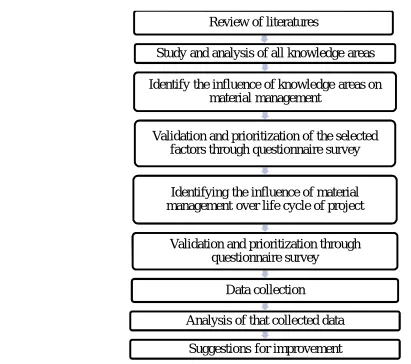
Figure 1.Steps Involved in Methodology
Fig.1 shows the steps involved in methodology of the project, were the major issues are identified through literature reviews and questionnaire surveys were conducted on influence of knowledge areas on material management are validated by the targets people like project owners, project sponsors, material managers, store keepers, project engineer/coordinator, architects, engineers etc., which is most sufficient for further analysis through RII method and prioritized the most influencing factors.
IV. RESULTS AND DISCUSSIONS
The factors identified were measured for their degree of impact on integrated project delivery in the construction industry. Respondents were requested to respond on five-point likert scale of very high, high, moderate, and low, not applicable. A scoring system was used to transform the likert scale into a quantitative variable, where very high scored 5 points and very low scored 1 point. Relative importance index (RII) was then computed for each factor to prioritize them.
A. Questionnaire Survey
The questionnaire is prepared and field survey, online survey is conducted. Totally 70 questionnaires were targeted to the project owners, project sponsors, project engineer/coordinator, architects, engineers etc., and obtained nearly 53 respondents, which is most sufficient for further analysis.
B. Prioritization of Factors
Relative Important index (RII) have been employed for ranking the most influencing factors of material management in the construction project. The RII was used to rank the different causes. These rankings make it possible to cross-compare the relative
Review of literatures
Study and analysis of all knowledge areas
Identify the influence of knowledge areas on
material management
Validation and prioritization of the selected
factors through questionnaire survey
Identifying the influence of material
management over life cycle of project
Validation and prioritization through
questionnaire survey
Data collection
Analysis of that collected data
Technology (IJRASET)
importance of the factors as perceived by the groups of respondents.
RII =∑
∗ Where
W = Weighting given to each factor by the respondents and ranges from 4 to 0 A = Highest weight (i.e. 4 in this study)
[image:7.612.177.436.168.407.2]N = Total number of respondents
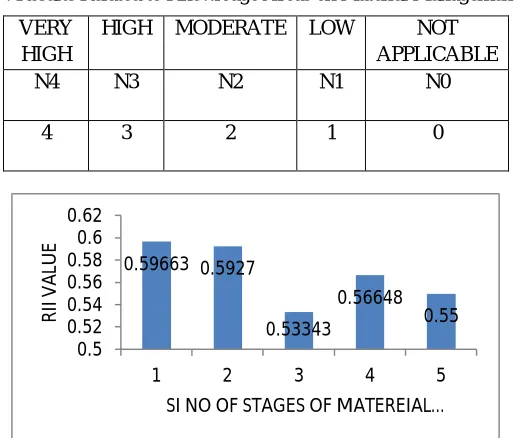
Table III. Ranking Criteria
Relative important index (RII) is calculated for all sub-factors and Relative important index mean is calculated for all factors, Ranking is given to all main factors according to the RII mean score.
[image:7.612.178.435.485.704.2]The detailed ranking of all the factors is given below
Table IV. Results Related to Knowledge Areas on Material Management Stages.
Fig 2. Knowledge Areas on Material Management Stages. 0.59663 0.5927
0.53343 0.56648 0.55 0.5 0.52 0.54 0.56 0.58 0.6 0.62
1 2 3 4 5
R
II
V
A
LUE
SI NO OF STAGES OF MATEREIAL … S.NO STAGES OF MATERIAL MANAGEMENT AVERAGE RII VALUE RANK
1 MATERIAL
PLANNING STAGE
0.59663 1
2 VENDOR
ANALYSIS STAGE
0.5927 2
3 MATERIAL
PURCHSING STAGE
0.53343 5
4 STORAGE AND
INVENTORY STAGE
0.56648 3
5 SUPPLY,
DISTRIBUTION AND ON SITE
STAGE
0.55 4
VERY HIGH
HIGH MODERATE LOW NOT
APPLICABLE
N4 N3 N2 N1 N0
Technology (IJRASET)
TABLE IV shows the influence of knowledge areas in stages of material management. From the available respondents through questionnaire the RII value are calculated and ranked through most prioritizing factor. Fig 2 shows the pictorial representation of the knowledge areas on various stages of material management, in x-axis si.no of table 4 are taken (stages in material management) and in y-axis the RII value are taken.
[image:8.612.131.484.172.525.2]The most critical stage among the five stages of material management are material planning stage, which gives the highest RII value of 0.596 and consider as the most important stage.
Table V. Results Related to Knowledge Areas on Material Management
KNOWLEDGE AREAS RII RANK
Cost 0.601064 2
Communication 0.567021 6
Human resource 0.560284 7
Procurement 0.571144 5
Risk 0.647606 1
Quality 0.528723 9
Time 0.590426 3
Scope 0.585106 4
Integration 0.542553 8
.
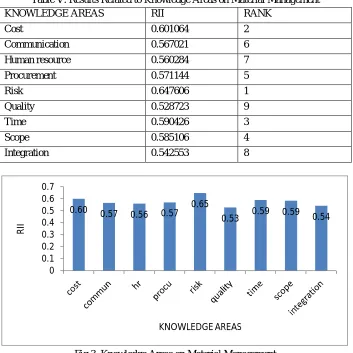
Fig 3. Knowledge Areas on Material Management
TABLE V shows the influence of knowledge areas on material management. From the available respondents through questionnaire the RII value are calculated and ranked through most prioritizing factor. Fig 3 shows the pictorial representation of the knowledge areas on material management, in x-axis knowledge areas are taken and in y-axis the RII value are taken.
[image:8.612.99.519.631.717.2]The most critical factor among the ten knowledge areas are risk, which gives the highest RII value of 0.65 and consider as the most important factor.
Table VI. Results Related to Influence of Material Management over project life cycle.
PHASES RII RANK
INITIATION PHASE 0.640224 5
PLANNING PHASE 0.641827 4
EXECUTION PHASE 0.655448 2
MONITOR AND CONTROL PHASE 0.65192 3
CLOSING PHASE 0.70312 1
0.60 0.57 0.56 0.57 0.65
0.53 0.59 0.59 0.54
0 0.1 0.2 0.3 0.4 0.5 0.6 0.7
R
II
Technology (IJRASET)
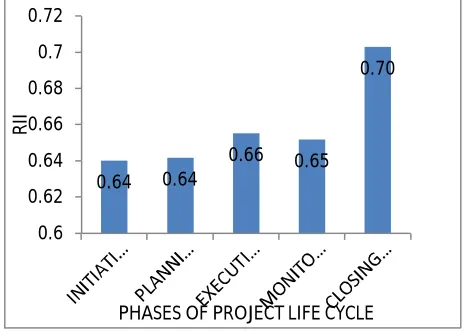
[image:9.612.189.422.80.246.2]Fig 4.Influence of Material Management over project life cycle.
Table VI shows the influence of material management over project life cycle. From the available respondents through questionnaire the RII value are calculated and ranked through most prioritizing factor. Fig 4 shows the pictorial representation of the influence of material management over project life cycle, in x-axis various stages of project life cycle are taken and in y-axis the RII value are taken.
The most critical phase among them are closing, which gives the highest RII value of 0.7 and consider as the most important phase
V. CONCLUSION
This research work provides methodology for prioritizing the knowledge areas influencing material management and material management over project life cycle. RII is calculated to rank the factor. Thus the critical factors that are significantly affecting the material management were identified.
VI. ACKNOWLEDGMENT
The authors are grateful to the principal and management of Thiagarajar college of Engineering, Madurai for providing all facilities for the research work.
REFERENCES
[1] Shamil Naoum and Charles Egbu et al(2005), “Critical review of procurement method research in construction journals” 8th Nordic Conference on Construction Economics and Organization
[2] Annrag Dubey and Sahajanand kamat (2016), “Relative importance of project management knowledge areas in successful completion of project” International conference on science and technology for sustainable development
[3] T. Phani Madhavi et al (2014) “Material Management In Construction – A Case Study” IJRET: International Journal of Research in Engineering and Technology.
[4] Albert P. C. Chan et al (2004), “Factors Affecting the Success of a Construction Project”.
[5] Annrag Dubey and Sahajanand kamat (2016), “Relative importance of project management knowledge areas in successful completion of project” International conference on science and technology for sustainable development
[6] F Caron and G Marchet et al (2000), “Project logistics: integrating the procurement and construction processes” International Journal of Project Management Vol. 16, No. 5, pp. 311-319, 1998
[7] C.K.Georgekutty and Dr.Georgemathew (2012), “ Hall Marks in Construction Material Management: A Literature Review” IOSR Journal of Mechanical and Civil Engineering (IOSRJMCE)
[8] Gheorghe CÂRSTEA et al (2014) “ Quality Management In Procurement And Management Of Material Resources,” in Proceedings Of The 7th International Management Conference "New Management For The New Economy"
[9] Jana Kostalova and Libena Tetrevova (2016), “Application of Project Management Methods to Tools with respect to the Project Life Cycle and the Project type”
[10] E.Kohilambal et al (2016), “ Evaluation of material procurement process in construction industry”
[11] Dr Patrick. X.W. Zou et al (2007), “Identifying Key Risks in Construction Projects: Life Cycle and Stakeholder Perspectives”
0.64 0.64
0.66 0.65 0.70
0.6 0.62 0.64 0.66 0.68 0.7 0.72
R
II