Technology (IJRASET)
©IJRASET 2013: All Rights are Reserved
818
Perfect Degree Support Product Graphs
Selvam Avadayappan1, M. Bhuvaneshwari2 1,2
Department of Mathematics, VHNSN College, Virudhunagar – 626001, India.
Abstract--For a graph G(V,E), the support s(v) of a vertex v is defined as the sum of degrees of its neighbours. A graph G is said to be balanced (highly unbalanced), if the support of all the vertices are same (distinct). Let k be any positive integer. A graph G is said to be a k – perfect degree support graph (k – pds graph) if for any vertex v in G, the ratio of its support and its degree is the constant k. A graph G is called a k – linear degree support graph (k – lds graph) if, for any two vertices in V with distinct degrees, the ratio of difference between their supports and the difference between their degrees is the constant k. The properties of k – lds graphs and k – pds graphs in various product graphs have been studied in this paper.
Keywords--Support, balanced graphs, highly unbalanced graphs, k – perfect degree support graphs, k – linear degree support graphs.
AMS Subject Classification code (2000): 05C (Primary)
I. INTRODUCTION
Throughout this paper, we consider only finite, simple, undirected graphs. For notations and terminology we follow [3]. A graph G is said to be r – regular, if every vertex of G has degree r. Let G1 and G2 be any two graphs. The graph G1◦ G2 obtained from one copy of G1 and |V(G1)| copies of G2 by joining each vertex in the ith copy of G2 to the ith vertex of G1 is called the corona of G1 and G2. The cartesian product of G and H is denoted by G H and their join is denoted by G H. The composition graph of G1 to G2 is denoted by G1[G2]. The concepts of support, balanced graphs, highly unbalanced graphs have been introduced and studied by Selvam Avadayappan and G. Mahadevan [1]. The support s(v) of a vertex v is the sum of degrees of its neighbours. That is, s(v) =
∑ ∈ ( )d(u). Note that the support of any vertex in an r – regular graph is r2.
[image:2.612.218.316.442.501.2]A graph G is said to be a balanced graph, if the support of every vertex in G is equal. It is easy to observe that the complete bipartite graphs Km,n and the regular graphs are balanced graphs. A graph G is said to be highly unbalanced, if distinct vertices of G have distinct supports. For example, a highly unbalanced graph is shown in Figure 1.
Figure 1
The following results have been proved in [1]:
Result 1 ∑ ∈ s(v) =∑ ∈ d(v)2.
Result 2 s(v) = (n – 1)2 for every v G if and only if G ≅ Kn.
Result 3 For any balanced graph G, (G) = 1 if and only if G ≅ K2 or K1,n.
Result 4 For any n ≥ 6, there is a highly unbalanced graph of order n.
Consequently the concepts of k – perfect degree support graph and k – linear degree support graph have been defined in [2].
A graph G is said to be a k – perfect degree support graph (or simply a k – pds graph), if for any vertex v in G, ( )( ) = k. For
Technology (IJRASET)
©IJRASET 2013: All Rights are Reserved
819
Figure 2
A graph G is said to be a k – linear degree support graph (or simply a k – lds graph), if for any two vertices u and v in G with d(u) ≠
d(v) in G, ( )( ) ( )
( ) = k, for some integer k. Or equivalently, a graph in which for any vertex v, s(v) = k d(v) + c for some constant c
is called a k – lds graph. Note that in a k – lds graph, s(u) – k d(u) = s(v) – k d(v). For example, the graph shown in Figure 3 is a 3 – lds graph.
Figure 3
In general any k – pds graph is a k – lds graph but not the converse. For example, the graph shown in Figure 3 is a 3 – lds graph but it is not a 3 – pds graph. In fact k – pds graphs are k – lds graphs with c = 0. All balanced graphs are 0 – lds graphs and any r – regular graphs are r – pds graphs and hence r – lds graphs.
Note that in a k – lds graph, two vertices of same degree have the same support. That is, d(u) = d(v) implies that s(u) = s(v). A few families of k – pds graphs and k – lds graphs with some constraints have been constructed in [2]. Also k – pds trees have been characterized in [2].
In this paper, many new k – lds and k – pds graphs have been generated using various graph products.
k – pds and k – lds product graphs
Regarding the properties of k – lds and k – pds graphs in product graphs, the following facts can be easily verified:
Fact 2.1 A disconnected graph is a k – lds graph if and only if each of its components is a k – lds graph.
Fact 2.2 Let G1 be a k1 – lds graph and G2 be a k2 – lds graph. Then G1 G2 is a k – lds graph if and only if k1 = k2.
By a (p, q) – graph, we mean a graph with p vertices and q edges.
Fact 2.3 Let G1 be a (n1,m1) - graph and G2 be a (n2,m2) - graph. Then we can easily verify the following:
(i) For any v V(G1 G2), we have
d ∪ (v) = d (v) and s ∪ (v) = s (v), if v V(G1) and
Technology (IJRASET)
©IJRASET 2013: All Rights are Reserved
820
(ii) For any v V(G1 G2), we have
d (v) = d (v) + n2; s (v) = s (v) + n2d (v) + 2m2, if v V(G1); d (v) = d (v) + n1; s (v) = s (v) +
n1d (v) + 2m1, if v V(G2)
(iii) For any (u,v) V(G1G2), we have
d ((u,v)) = d (u) + d (v) and
s ((u,v)) = 2d (u)d (v) + s (v) + s (u),
(iv) For any (u,v) V(G1[G2]), we have
d [ ]((u,v)) = n2d (u) + d (v).
(v) Let V(G1) = {v1, v2, … , v } and V(G2) = {u1, u2,..., u }.In V(G1 ◦ G2), let uij denote the vertex corresponding to uj in the ith copy of G2. Then we have,
d ° (vi) = d (vi) + n2 and s ° (vi) = s (vi) + n2d (v) + 2m2 + n2,
d ° (uij) = d (uij) + 1 and s ° (uij) = s (uij) + d (uij) + d (vi) + n2.
Now let us prove some results on k – lds and k – pds product graphs.
Theorem 2.4 If G is a k – lds graph of order n, then G G is a ( k + n ) – lds graph.
Proof Let G be any k – dsl graph of order n. Then for any two vertices vi and vj of distinct degrees, ( )( ) ( )
( ) = k. Now consider G G. Then the degree of every vertex gets increased by n and the support of any vertex gets increased by its degree times n. For any
two vertices of distinct degrees, ( ) ( )
( ) ( )=
( ) ( ) – ( )
( ) ( ) = k + n. Hence, G G is a (k + n) – lds graph. For
example, a 1 – lds graph P4 and the corresponding 5 – lds graph P4 P4 are shown in Figure 3. ■
P4 P4 Figure 3
Theorem 2.5 Let G be any (n, m) – graph. If G K1 is a k – pds graph, then = k – 1.
Proof Let G be a graph with n vertices and m edges such that G K1 is a k – pds graph. Let v be the vertex of K1. Then clearly v
is a full vertex with support s (v) =
∑ ( ) ( )
= ∑ ( ) ( ) = = k. Hence the proof.
Theorem 2.6 There does not exist a k – pds graph G such that G K1 is also k – pds.
Technology (IJRASET)
©IJRASET 2013: All Rights are Reserved
821
d (v) = k. Now by using Fact 5.8 (ii),
( ) ( )
( ) = k.That is,
( ) ( )
( ) = k, which implies dG(v) = k – n. Since G K1
is connected, we have k > n. In other words, sG(v) > n dG(v) which is impossible. Therefore such a graph G does not exist ■
Theorem 2.7 For an r – regular graph G of order n1 and a k – regular graph H of order n2, G ◦ H is a (r + k) – pds graph. Proof Let G and H be r – regular and k – regular graphs respectively. Then by Fact 2.3 (v), G ◦ H is a biregular graph. In
particular, s (v) = r + n2; s (v) = r2 + n2(r + k + 1), for any v V(G) and d (u) = k + 1; s (u) = k2 + k + r + n2, for all u
V(H). Therefore we get ( ) ( )
( ) ( ) = r + k. Hence G ◦ H is a (r + k) – pds graph. For example, K3,3 ◦ K2 which is a 5 – pds
graph is shown in Figure 4. ■
[image:5.612.165.362.527.648.2]K3,3 ◦ K2 Figure 4
Theorem 2.8 For any two regular graphs G and H, G[H] is a k – pds graph.
Proof Suppose G is an r – regular graph of order n1 and H is a k – regular graph of order n2. Then it is easy to note that G[H] is a (n2r + k) – regular graph and hence a (n2r + k) – pds graph. For example, C4[K2] which is a 5 – pds graph is shown in Figure 5.
■
C4[K2]
Figure 5
Theorem 2.9 If G is a k – lds graph, then G H is a ( k + 2r ) – lds graph, for any r – regular graph H.
Proof Let G be any k – lds graph and H be any r – regular graph. Then ( ) ( )
( ) ( )= k, for any two vertices vi and vj of distinct
Technology (IJRASET)
©IJRASET 2013: All Rights are Reserved
822
(vj, wl) = (k + 2r) {d × (vi,wk) – d × (vj, wl)}, which implies that G H is a (k + 2r) – graph.
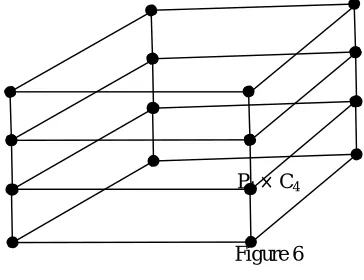
For example, a 1 – lds graph P4 and the corresponding 5 – lds graph P4 C4 are shown in Figure 6. ■
[image:6.612.172.354.148.288.2]
P4 × C4
Figure 6
REFERENCES
[1] Selvam Avadayappan and G. Mahadevan, Highly unbalanced graphs, ANJAC Journal of Sciences, 2(1), 23 – 27, 2003.
[2] Selvam Avadayappan and M. Bhuvaneshwari, Perfect degree support graphs, (Preprint).
![Figure 1 The following results have been proved in [1]:](https://thumb-us.123doks.com/thumbv2/123dok_us/8581498.861047/2.612.218.316.442.501/figure-following-results-proved.webp)
![Figure 4 Theorem 2.8 For any two regular graphs G and H, G[H] is a k – pds graph.](https://thumb-us.123doks.com/thumbv2/123dok_us/8581498.861047/5.612.165.362.527.648/figure-theorem-regular-graphs-g-h-pds-graph.webp)