Energy Optimization by
Efficient Ventilation Planning and Designing
Abhinandan R. Gupta#1, Dr.S.K.Deshmukh*2
#
Civil Engg. Dept,* Principal, C.O.E.T.A
Abstract— The unstoppable population growth has crossed 7 billion, with more serious issue for Asian countries like China, who shares 19 % and India sharing 18 % of total world population. This growth in population is also leading to increase in demand and thus creating huge gape in demand supply relation. To fulfil this gap there is constant exploitation of non renewable resources , creating scarcity of resources. Construction industry is one such major sector which consumes approximately 40 % of total energy. However, while considering construction industry , major emphasis is given to reduce energy consumption at time of construction , while neglecting the energy consumption done for the whole life time of structure . This energy which is required to structure after construction process is called as operational energy and is one of the key factor which is responsible for global energy consumption and resource depletion. This operation energy of the building is considered for study in this paper, the energy consumption effect for thermal comfort in building is studied for various ventilation schemes or cases. Analysis is done by IS code method as well as simulation for velocity particle flow path is achieved by application of software Ansys Fluent Flotran 3. From the analysis done for various cases and modelling , the importance of successful planning and designing is highlighted for making efficient utilization of natural ventilation system and reduction in artificial or mechanical ventilation system , thus resulting major amount of structures operational energy.
Keywords - Resource depletion, exploitation; life cycle time; operation energy, efficient natural ventilation; artificial or
mechanical ventilation system.
I. INTRODUCTION
Ventilation of the building is required to supply fresh air for respiration of occupants, to dilute inside air to prevent vitiation by body odours and to remove any products of combustion or other contaminants in air and to provide such thermal environments as will assist in the maintenance of heat balance of the body in order to prevent discomfort and injury to health of the occupants. IS 3362- 1977 and National Building Code of India highlights some of the important criteria’s and clauses for consideration of opening area , sill level height , outside obstruction , wind velocity , desirable wind velocity and minimum wind velocity required. Depending upon the purpose of the room, the Air charge per unit and wind velocity required are specified. For successful planning and designing, all this aspects needs to be considered. However, it has been found that huge change in indoor velocity is marked with change in location, size and shape of opening, even though the total opening area is kept constant. The flow of particle inside the room under air velocity action is dynamic and subjected to various uncertainties for which factors like room temperature, direction of wind, location of openings are responsible. In absence of proper provision or designing of ventilation, the need for mechanical or artificial ventilation is required to full fill comfort wind speed and thermal comfort within the room area.
II. LITERATUREREVIEW
A healthy building can be defined which having sound designing and planning for heat, ventilation and air is conditioning. The improper design of illumination or ventilation leads to poor indoor air quality and may lead to serious health problem of habitants. John D. Spengler (1) studied the various rules and regulations that are to be followed for having good HVAC system. The IAQ factor needed and the present ventilation system is also specified. Further the study was done for changing construction material used and its effect in indoor air quality, emissions from surfaces and its potential harmfulness.
Y.P.Kajale (4) suggested prefabrication of concrete elements as sustainable approach for future green construction. 3-s prefab for housing sector includes precaste RCC dense concrete slabs , autoclave light weight RCC slabs, floor and roof , light weight cellular building blocks , precast dense cement concrete columns , beams ,stairs , galvanized powder coated iron frames , door and windows etc. All this methodology leads to speedy, safe and strength construction practice. J.S.Chauhan (5) studied and presented various sustainable materials that can be used in buildings like solid concrete blocks fly ash mixed, hollow blocks, calcium silicate bricks and their adoptability in construction. K.D Sadhale , K.A.Sahakari & N.Dias (6) studied the use of precast technology for low cost housing. It is unavoidable to shift and rehabilitate project affected people due to infrastructure projects and at such time the rapid and sustainable method for construction should be adopted. This construction can be achieved by application of pre caste technology. For the case study under taken complete construction was based on precast members including lintels, chajja , brackets, slabs, panels , doors and windows , stairs and it has been estimated the saving of 30% economy in this technology followed.
B.W.Olesen,(7) conducted study of various International codes and found that the development of codes should be done on the basis of classes. Critical issues such as adaptation, effect of increased air velocity, humidity, type of indoor pollutant sources etc. are still being discussed, but in general the standards does not include this. It is nevertheless important to take into account people’s clothing related to regional traditions and season. And thus , there exist to revise codes and specifications considering all this aspects for proper IOQ
O.Boccia,et.al (8) compared the experimental and numerical results for the natural ventilation and energy efficient design of window with the name ventilated illuminating wall , the prototype with 1:1 scale model , consisting of precast removable window and room was tested for its feasibility. The internal, external temperature, external and indoor wind speed were checked with simulated model made in fluent/Airpak. The numerical analysis considers steady state condition however, the simulation model benefited with dynamic mode consideration too.
Alexander Kayne(9) carried out research work on computations fluid dynamics modeling of flows in buildings , as it has become matter of concern from last few decades. In 2009, buildings wee the second largest energy consuming sector in U.S, using upto 33.9% and 77.8% of electrical energy consumption. Thus, the research work was carried out to calculate indoor velocity using computation fluid dynamics method considering normal, forced mixed convection in 2D cases and 3D enclosures using simulation in FLUENT software.
Similar work is done by A. Peri. Et,al.(10) with considering the importance of air temperature, air flow, velocity in hospital ward so as to avoid infection and contamination due to improper ventilation designing. The simulation of various models with air flow and boundary parameter were designed and with concept of moving wall the thermal , air velocity pattern and graphs are obtained using CFD FLUENT simulation techniques so as to find most efficient ventilation design.
III.ASPECTSANDCONSIDERATIONS
A. Determination method and criteria’s
Ventilation is expressed as m3/h per m2 of floor area. This unit clearly reflects the parameters included in findings. Normally the Rate of Ventilation ‘Q’ is represented as product of Coefficient of effectiveness ‘K’ , Opening area ‘A’ in m2and outdoor wind speed ‘V’ in m/h. Thus , Q = K.A.V.
The another way of analysing and measuring ventilation is Air change per Hour , which can be defined as the amount of air passing into or out of a building or room in terms of the number of building volume or room volume exchanged. Various factors responsible for finding out indoor wind velocity are outer and inner temperature , humidity , material of walls and roofing , stack effect, dilution area etc.
Recommended values for Air change per hour for some of the important rooms are specified below:-
1) Living Room – 3-6
2) Bed Room – 2-4
3) Dinning and Kitchens – 8
4) Bathroom – 6-10 etc.
Another important aspect is thermal comfort within room in terms of wind velocity .
Is is dependent on outside temperature and relative humidity. IS code specifies to limits for consideration . one is minimum required and another is desirable values.
TABLEI
THERMAL COMFORT CONDITIONS AND MINIMUM WIND SPEED .
Source : (National Building Code -2005).
B. Location under consideration
Thus to deign efficient natural ventilation system to mitigate requirement of mechanical ventilation system the use of Ansys Fluent flotran is done for simulating of various cases.
Initially considering the IS 33621977 clauses the requirement of opening size is calculated considering the various parameters of Akola city for fixing values of constant like temperature, humidity, wind speed etc.
The data taken for finding efficient size of ventilation is from Indian metrological department and the Gazetteers Department of India.
INDIA METEOROLOGICAL DEPARTMENT
NWP MODELS BASED DISTRICT LEVEL WEATHER PREDICTION
ISSUED ON: 19-11-2014
DISTRICT : AKOLA STATE : MAHARASHTRA PARAMETERS ENSEMBLE FCST
DAY-1 DAY-2 DAY-3 DAY-4
DAY-5
20/11 21/11 22/11 23/11 24/11
--- --- --- ---
Rainfall (mm) 0 0 0 0 0
Max Temperature ( deg C) 31 31 31 31 31
Min Temperature ( deg C) 18 16 16 16 17
Total cloud cover (octa) 1 3 3 2 2
Max Relative Humidity (%) 36 38 37 38 44
Min Relative Humidity (%) 22 19 18 18 21
Wind speed (kmph) 007 003 003 005 007
Mean Wind Speed in Kilometres per Hour (AKOLA)
Jan. Feb. Mar. Apr. May June July Aug. Sept. Oct. Nov. Dec. Annual
1 2 3 4 5 6 7 8 9 10 11 12 13
4.5 5.1 6.0 7.4 12.1 12.7 11.4 10.5 8.2 4.3 4.2 4.0 7.5
IV.CASECONSIDERATION
The room of inner size 3.6x 4.5 x 3.1 m. is considered for study. Thus the volume will be = 50.22cum.
Floor Area = 16.2 sqm.
A. As per IS Aircharge /Hr required is minimum 3 and good is 5 .
If wind velocity taken is for Akola region on average is 4.2 Km/Hr.= 0.9282 m/sec. Air charge = Q/V , thus if air charge of 5 is required then,
5= Q/50.22
Q= 251.1cum for required air charge. But Rate of flow Q = Area x velocity 251.1= A x 4.2 x 1000
Or Area required A = 251.1/ (4.2 x 1000) = 0.059 sq m = 0.06 sq m.
B. For warm weather consideration :
Average temperature is 32 oc , Relative Humidity is less then 40 , however as per clause 5.1.1 of IS 3362 -1977 for hot dried region like Akola the stack effect can be neglected as the humidity in air content is less maximum time .
C. Desirable wind speed calculations:
Actual outdoor velocity = 4.2 Km/Hr. = 0.9282 m/sec.
Indoor velocity desirable for 32oc temperature is 0.46 m/sec.
Thus providing inlet on wall face of 4.5 x 3.1 and outlet parallel to it of size 1.8 x 1.5, For a inlet and outlet total will be 5.4 sqm.
From graph fig. 2 of IS 3362,
Area of opening / floor area = 5.4/16.2 x 100 = 33%. Thus, average indoor velocity = 35 % of outdoor
= 0.35 x 0.9282 = 0.324 m/sec. This is less then desirable,
To overcome this either mechanical ventilation can be adopted or the size of openings can be changed to cover up this by natural ventilation system only.
With sustainable approach the mechanical ventilation provision is omitted and thus changing geometry of openings.
Revised size of opening:
1.2 x 1.5 sqm window, 2 in numbers for inlet and same for outlet. Thus total area is 7.2 sqm.
7.2/ 16.2 * 100 = 45 %.
= 0.45 * 0.9282 = 0.43 m/sec.
Since wind velocity does not remains constant thus this value is acceptable and will satisfy thermal comfort.
Further the effect of geometry that is location of openings (Inlet & Outlet ) is tested for indoor velocity and circulation path of particles by creating simulations of various cases.
V. SIMULATIONFORVARIOUSCASES
domain and parameters value considered , the observations are made.
Domain considerations for simulation process: Outdoor temperature: 32 oc
Pressure : 1 atm
Fluid : AIR SI
Type of flow : case dependent
Boundary conditions:
Inlet velocity : 0.9282m/ sec
Outlet pressure : 0 defined
Alignment of opening : perpendicular to wind flow direction
Wall surface property: 0 velocity.
Finite Element Meshing : case dependent ( designer defined / auto generated)
Room size : 3.6 x 4.5x 3.1 m.
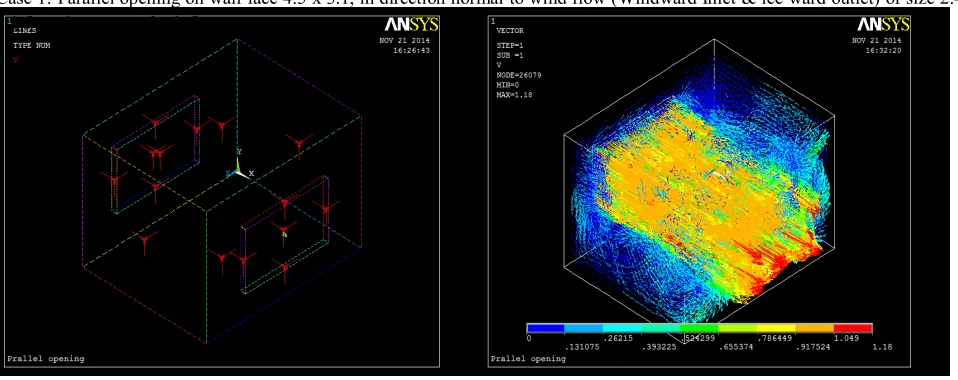
Case 1: Parallel opening on wall face 4.5 x 3.1, in direction normal to wind flow (Windward Inlet & lee ward outlet) of size 2.4 x 1.5 m size, one on both faces.
Fig1 : Simulated model for finding Velocity particle flow path and magnitude for case 1
Case 2: Parallel opening on wall face 4.5 x 3.1, in direction normal to wind flow (Windward Inlet & lee ward outlet) of size 1.2 x 1.5 m size, two on both faces.
[image:6.612.66.545.265.455.2]
Case 3: Two inlet and one outlet of total area equal and on opposite walls .
Fig3 : Simulated model for finding Velocity particle flow path and magnitude for case 3
Case 4: Two inlet and one outlet of total area equal and on adjacent walls .
Fig4 : Simulated model for finding Velocity particle flow path and magnitude for case 4
Case 5: inlet and outlet window of same size and on same wall .
Fig6 : Simulated model for finding Velocity particle flow path and magnitude for case 6
Case 7: Single Inlet and 2 outlets on different walls.
Fig7 : Simulated model for finding Velocity particle flow path and magnitude for case 7
Case 8: Single Inlet and a outlets on adjacent walls.
Case 9: Single Inlet and a outlets on adjacent away wall.
Fig 9 : Simulated model for finding Velocity particle flow path and magnitude for case 9
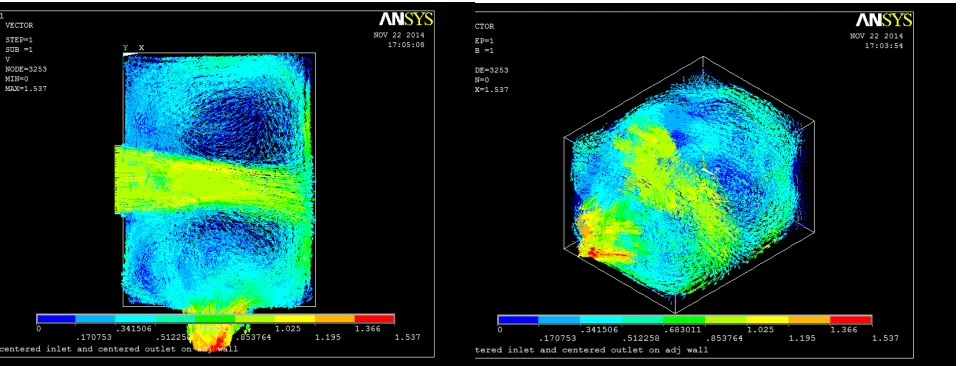
Case 10: Centered inlet and centered outlet on adjacent wall.
Fig 10: Simulated model for finding Velocity particle flow path and magnitude for case 10
VI.OBSERVATIONANDREMARK
[image:9.612.70.551.350.533.2]TABLEIII OBSERVATION TABLE.
Case no.
Inlet/outlet arrangement Inlet
Velocity Outlet Velocity (m/sec) Indoor prominent Deviation with required Min. indoor Max. indoor
(m/sec) velocity Pressure Pressure
1 Single inlet and single
outlet on opposite walls
0.9282 0.917 0.71 0.25 -0.01 0.436
2 Two inlets and two outlets
on opposite walls
0.9282 0.919 0.91 0.45 0 0.343
3 Two inlet and one outlet of
total area equal and on opposite walls
0.9282 0.834 0.83 0.37 -0.56 0.109
4 Two inlet and one outlet of
total area equal and on adjacent walls
0.9282 0.86 0.28 -0.18 -0.42 0.351
5 Inlet and outlet window of
same size and on same wall.
0.9282 0.907 0.3 -0.16 0.84 0.884
6 Inlet in corner and outlet
window centered on
opposite wall.
0.9282 0.81,0.97 0.405 -0.055 0 0.335
7 Single Inlet and 2 outlets
on different walls.
0.9282 0.71 0.62 0.16 0 0.884
8 Single Inlet and a outlets
on adjacent walls.
0.9282 0.62 0.305 -0.155 0.144 0.624
9 Single Inlet and a outlets
on adjacent away wall
0.9282 0.33 0.116 -0.344 0.87 0.923
10 Centered inlet and centered
outlet on adjacent wall
0.9282 0.34 0.255 -0.205 -0.102 1.46
When the observation is made for various cases it can be seen that the location of windows opposite to each other provide good ventilation in the room with excess value of velocity 0.25 m/sec more than required as in case 1. Similarly when the openings are provided in form of two parts , it increases the wind particle flow in the room and thus the velocity value is also almost double than required, such case may provide sufficient ventilation however, more wind velocity creates disturbance for occupants in the room as in case 2. With the provision of two inlets the amount of fresh air flow is evenly distributed in the room but providing one outlet window creates high pressure zone near outlet of warm air as in case3. When the provision of windows is made on adjacent walls like in case 4, 8 and 10, the circulation of wind does not take effectively in the room area and thus creates deficiencies in required indoor wind velocity. Such cases should be avoided if no boundary constraints are there. Worst ventilation case is developed in the case when single inlet on adjacent walls are provided and that too away from each other , as in case 9 .Such geometrical planning leads to deficient ventilation in the room area promoting need for mechanical or artificial ventilation system. Along with that it is also studies that the density of indoor air decreases due to inner temperature effect making it warm. Due to low density value, these quanta of air moves towards upward direction near roof and creates warm zone near upper zone. Thus provision of outlet for wind should be located at higher level as compared to inlet level.
VII. CONCLUSIONS
17 to 18 hours out o 24 hours .This clearly highlights the consumption of operational energy for cooling or thermal effect in day time too. This huge amount of energy can be saved to 50 % reduction with effective provision and planning of natural ventilation in the building. The study done in this paper reflects the effect of windows location and sizes on rooms thermal parameters. Even the effect of faulty provision of locations of doors and windows are shown, computed and analyzed. More emphasis should be given to promote natural ventilation system in the rooms so as to mitigate the high energy consumption made for thermal cooling effect in the house. Per capita consumption of house hold operational energy can re reduced from 45Kwatt to 20 KWatt/ per capita/per annum , which hold good contribution in overall reduction in demand of energy and thus sparing resources from unwanted exploitation.
REFERENCES
[1] Johan D.Spengler ,2000 , ‘Indoor Air Quality Factors In Desgning A Healty Building’ ,Annual Review Of Energy And The Environment , 25,pp567-600. [2] D.Bansal , 2012 ,‘Green Building Material –Quantification Of Embodied Energy Of Houses’ ,Role Of Infrastructure For Sustainable Development , IIT
Roorkee National Convention Proceedings, .pp 230-236.
[3] Himanshu Agrawal , 2010 ,‘ Building Envelops Insulation : A Key To Energy Saving And Sustainable Development ‘ , New Building Material & Construction World, pp 212-220.
[4] Y.P.Kajale , 2012 , ‘Prefab Building Technology For Sustainable Development : A Concrete Approach In India’ , Role Of Infrastructure For Sustainable Development , IIT Roorkee National Convention Proceedings .pp 94-109.
[5] J.S.Chauhan , 2012 ,‘Sustainable Development In Building Materials ‘, Role Of Infrastructure For Sustainable Development , IIT Roorkee National Convention Proceedings, .pp 161-168.
[6] K.D.Sadhale ,K.A. Sahakari & N.Dias , 2012 , ‘Use Of Precaste Technology For Low Cost Housing’ ,Role Of Infrastructure For Sustainable Development , IIT Roorkee National Convention Proceedings, .pp 190-199.
[7] Bjame W. Olesen , 2007, ‘International Standards For The Indoor Environment. Where Are We And Do They Apply World Wide?’ , International Centre For Indoor Environment And Energy, DTU, Denmark.
[8] O.Boccia,F.Chella,P.Zazzini , 2011 , ‘Ventilated Illuminating Wall : Natural Ventilation Numerical Analysis And Comparison With Experimental Results.’ Low-Energy Architecture (LEA)- World Renewable Energy Congress Sweden ,pp 8-13.
[9] Alexander Kayne , 2012, ‘Computational Fluid Dynamics (CFD) Modeling Of Mixed Convection Flows In Building Enclosures.’ , Dissertation Report, Washington University.