Analysing the Strength Parameters of Concrete by
Partial Replacement of Cement with Flyash
Er. Thakur Bhairav kumar Maganlal1, Er.S. Sriram2 1
Assistant Professor / Laxmi Institute of Technology, Valsad, Gujarat - 396001 2
Assistant Professor / The TIPSGLOBAL Institute, Coimbatore, Tamilnadu - 641107
Abstract: For the upcoming centuries, the production of cement goes on increasing which ensures for a comfortable living, the production of cement involves the emission of greater carbon di oxide, which is harmful to the environment in many of the ways. With the aim of having economy in construction and also providing a safer environment for the future generation, we have aimed for the reduction of cement usage in concrete by the partial replacement of fly ash with cement in concrete. The fly ash is a puzzolanic material which may also have a better binding property and so when replaced for cement it may give a better results. Pozzolans are either naturally or artificially produced materials that, when mixed in finely divided form in concrete, chemically react at normal temperatures with the Calcium Hydroxide (LIME) that it is produced during the hydration of the Cement. The mechanical properties of concrete are studied by partial replacement of cement with fly ash for M20 grade of concrete.
Keywords: Puzzolanic material, cement, Fly ash
I. INTRODUCTION
Fly ash is a burnt and powdery derivative of inorganic mineral matter that generates during the combustion of pulverized coal in the thermal power plant. The burnt ash of the coal contains mostly silica, alumina, calcium and iron as the major chemical constituents. Depending on the burning temperature of coal, the mineral phases in crystalline to non-crystalline structures such as Quartz (SiO2), Mullite (3Al2O32H2O), Hematite (Fe2O3), Magnetite (Fe3O4), Wustite (FeO) metallic iron, orthoclase (K2O Al2O3SiO2) and fused silicates usually occur in the burnt coal ash to Silica and alumina account for about 75 to 95 % in the ash. The classification of thermal plant fly ash is considered based on reactive calcium oxide content as class-F (less than 10 %) and class-C (more than 10 %). Indian fly ash belongs to class-F. The calcium bearing silica and silicate minerals of ash occur either in crystalline or non-crystalline structures and are hydraulic in nature; they easily reacts with water or hydrated lime and develop pozzolanic property. But the crystalline mineral phases of quartz and mullite present in the ash are stable structures of silica and silicates, and are non-hydraulic in nature. Usually the fly ash contains these two mineral phases as the major constituents. Therefore, the utilisation of fly ash in making building materials like fibre cement sheets largely depends on the mineral structure and pozzolanic property. Fly ash is broadly an aluminium-silicate type of mineral rich in alumina and silica. The conversion of these oxides of fly ash to hydrous silico-aluminate structures by chemical activation has been made under alkaline condition with lime. The effect of 2chemical transformation of ash in the development of binding property has been observed to find their suitability in manufacturing of fibre cement sheets. Further, it has been attempted to use high volume fly ash (35 to 40 % in formulation) in development of corrugated and flat fibre cement sheets with asbestos and non-asbestos fibres.
II. MATERIALS USED:
A. Properties Of Materials 1) Specific Gravity
MATERIAL SP.GRAVITY
CEMENT 3.1
FINE AGGREGATE 2.45
COURSE AGGREGATE 2.84
Table1. Properties of Materials- Specific Gravity
The initial and Final Setting time of cement is 30 minutes and 8 hours.
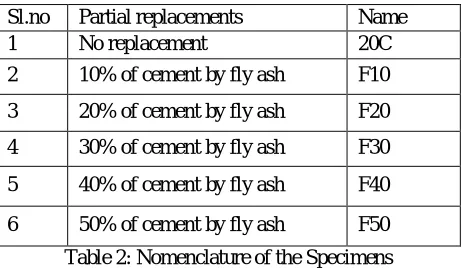
Sl.no Partial replacements Name
1 No replacement 20C
2 10% of cement by fly ash F10
3 20% of cement by fly ash F20
4 30% of cement by fly ash F30
5 40% of cement by fly ash F40
[image:3.612.192.423.75.209.2]6 50% of cement by fly ash F50
Table 2: Nomenclature of the Specimens
The cubes of size 150 X 150 X 150 mm were casted and cured for 28 days. The cubes are tested for compressive strength in compressive testing machine and tested for maximum ultimate load.
The cylinders of size 150 mm diameter and 300 mm height are casted and cured for 28 days. The cylinders are tested for Split Tensile Strength in Universal Testing Machine. The prism test was carried out with 50 x 50 x 150 mm were casted and tested for flexural strength for 28 days. Test results are tabulated as follows.
The below table shows the comparison of compressive strength, Split Tensile Strength and Flexural Strength at the age of 28 days for partial replacement of cement with fly ash.
% of Partial Replacements
First Crack Load (kN)
Ultimate Load (kN)
Compressive Strength N/mm2
(28 days)
0 460 600 26.12
10 460 585 26.12
20 420 620 27.55
30 300 600 26.66
40 350 615 27.33
[image:3.612.103.488.314.726.2]50 475 637 28.31
Table 3: Test Results of Compressive Strength at the age of 28 day
% of Partial Replacements
Ultimate Load
(kN) Split Tensile Strength N/mm
2
(28 days)
0 220 3.1
10 160 2.2
20 155 2.26
30 168 2.29
40 160 2.2
50 175 2.37
Table 4: Test Results of Split Tensile Strength at the age of 28 days
% of Partial Replacements
Ultimate Load
(kN) Flexural Strength N/mm
2
(28 days)
0 26.36 13.18
10 24.2 12.1
30 28.42 14.2
40 30.48 15.1
[image:4.612.146.469.76.127.2]50 32 16.2
Table 5: Test Results of Flexural Strength at the age of 28 days
III. TESTS ON FRESH CONCRETE
The fresh concrete while mixing and casting was tested for their workability. The tests carried on fresh concrete were
A. Compaction Factor Test
This test works on the principle of determining the degree of compaction achieved by a standard amount of work done by allowing
the concrete to fall through a standard height. The degree of compaction, called the compacting factor is measured by the density ratio i.e., the ratio of the density actually achieved in the test to density of same concrete fully compacted.
S. No Description Trial 1 Trial 2 Trial 3
1 weight of cylinder (W1)kg 7.108 7.108 7.108
2 Weight of cylinder + Partially
Compacted Concrete (W2) kg
18.24 18.3 18.25
3 Weight of partially compacted concrete (W2-W1) kg
11.22 11.19 11.14
4 Cylinder + weight of fully
compacted concrete (W3))kg
19.70 19.5 19.6
5 Weight of fully compacted
concrete(W3-W1)kg
12.59 12.39 12.49
[image:4.612.88.521.232.385.2]6 Average 0.89 0.9 0.89
Table 6: Result of Compaction Factor Test for Control Specimen
Similarly the Compaction factor was various replacements are tabulated below.
% of Partial Replacements Compaction Factor
0 0.89
10 0.87
20 0.86
30 0.88
40 0.87
[image:4.612.184.429.415.517.2]50 0.89
Table 7: Compaction Factor for Various Replacements
B. Slump Cone Test
Slump test is the most commonly used method of measuring consistency of concrete which can be employed in laboratory or at site of work. It is not a suitable method for very wet or very concrete. It does not measure all factor contributing to workability, nor is it always representative of the placability of the concrete.
Fig: 2 Slump Cone Test
% of Partial Replacements Slump Cone Test
0 70
10 50
20 75
30 85
40 85
50 87
C. Acid Test
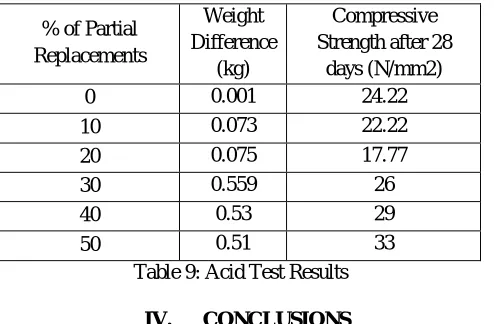
The response of different concrete mixes to sulphuric acid attacking both physical and chemical indicators of the degree of deterioration are experimented. An accelerated laboratory test program was conducted. The program involved alternate acid immersion and drying of test specimens, as well as continuous acid immersion of other test specimens. Changes in weight and thickness of the test specimens were used to evaluate the physical degree of deterioration of the concrete.
The procedure for conducting acid tests is
1) For acid tests, first the values of the weight of different specimens were noted and then it is immersed in the bucket containing 0.01N of HCL.
2) Acid of normality 0.1N is added that is1 litre 10 ml of conc. HCL is added.
3) The cube specimen after curing of 28 days is dried and its weight is noted as W1 (kg). The Specimen after drying is immersed in the 0.1 N of acid solution for the same 28 days. After 28 days of immersion the cube is dried and its weight is taken as W2 (kg). The weight difference is calculated by W2 - W1 (kg).
% of Partial Replacements
Weight Difference
(kg)
Compressive Strength after 28
days (N/mm2)
0 0.001 24.22
10 0.073 22.22
20 0.075 17.77
30 0.559 26
40 0.53 29
[image:5.612.186.433.258.420.2]50 0.51 33
Table 9: Acid Test Results
IV. CONCLUSIONS
A. The compaction factor test for the control specimen and for the replacement of fly ash with the cement does not show any greater change.
B. The slump cone test gives a greater difference of (10-15) mm, from the control specimen to replacements of fly ash in the increasing order to increasing percentage of fly ash which means that slump value increases with increasing percentage of replacement of fly ash.
C. The replacement of fly ash by 10% to cement decreases compressive Strength, flexural strength, Tensile strength by 13%,
25%, and 21.2% respectively.
D. The replacement of fly ash by 20% to cement decreases compressive Strength, flexural strength, tensile strength by 7.6%, 14.5%, and 18.4% respectively.
E. The replacement of fly ash by 30% to cement increases compressive Strength, flexural strength by 4.9%, 5.49% and decreases
Tensile Strength by 1.2%.
F. Acid test results show a decrease in compressive strength for the cubes of control
On the whole, from the above conclusion, it is clear that Workability increases with the increase in percentage of replacement of fly ash.
BIBLIOGRAPHY
[1] P. K. MEHTA, (1986) “Concrete Structure, Properties and Materials”, Prentice-Hall, Inc.
[2] Structural Engineering Research Institute in the report “Demonstration of utilizing high volume fly ash based concrete for structural applications” (2005), New Delhi, India.
[3] IS456-2000 Plain &Reinforced Concrete Code of Practice. [4] SHETTY.M.S (2009), “concrete technology”.
[5] SIDDIQUE R., DE SCHUTTER G, .NOUMOWE A., (2009) effect of used foundry sand on the mechanical properties of concrete.