Technology (IJRASET)
Performance evolution of turbo coded
MIMO-WiMAX system over different channels and
different modulation
Neha Pathak#1, Neha Bakawale*2#
Department of Electronics and Communication, Patel Group of Institution, Indore
Abstract— The wireless communication is highly affected with the channel behavior. The uses of Input Multiple-Output system and FEC code are most common in wireless standard for provide the fast and reliable communication. In this project Space-Time Block Coding (STBC) for Multiple-Input Multiple-Output (MIMO) set-up is used in wireless channels. In the special version of STBC called Alamouti code is used for exploiting the performance of MIMO in Adaptive modulation. The further improvement in error rate has been achieved using turbo code. The simulation of the system has been analyzed for different modulation schemes. The comparative result has been given in this paper.
Keywords— MIMO, OFDM, STBC, WiMAX, BER, etc.
I. INTRODUCTION
Wireless communications are an emerging field that has experienced a significant development over the last several years [1]. The availability of broadband networks offers high performance connectivity to over a billion of internet users around the world. Development of new wireless broadband standards and technologies is essential to increase wireless coverage rapidly. The demand for mobile data services and broadband network connectivity continues to increase. Conventional high-speed broadband services are based on wired-access technologies such as digital subscriber line (DSL). However this service is difficult to deploy in remote rural areas and it lacks support for terminal mobility. Mobile Broadband Wireless Access can be used as an alternative in such problematic situations in order to obtain a flexible and cost-effective solution [2].
Fig:1 Wireless communication system
Technology (IJRASET)
to each mobile station. Since multiple mobile stations are scheduled in one frame, a base-station transmits frame control information first at the beginning of each frame. The frame control information tells each mobile station in a cell whether it is scheduled in the current frame and how each mobile station decodes the data scheduled by a base station. The control channel message is short (in the range of 32 ~ 71 bits in comparison with data channel message, and a convolutional code is employed in 3GPP LTE and WiMAX. The control channel is critical to decoding the data channel, and hence is protected via using low code-rate. The average throughput requirement of control channel decoder is not comparable to that of data channel decoder. The throughput for control channel dictates the amount of buffering in OFDMA modem because of delay in decoding control message. Modem cannot process data scheduled for each mobile station till the end of control channel decoding. WiMAX is the upcoming wireless system which uses 802.16 IEEE standards. By using WiMAX technology we can overcome the limitations of the existing wireless communication like short coverage area, low data rate and lack of security. In our thesis, we have tried to improve the performance of WIMAX using adaptive modulation technique over MIMO system.
II. MULTIPLEINPUTMULTIPLEOUTPUT(MIMO)SYSTEMMODEL
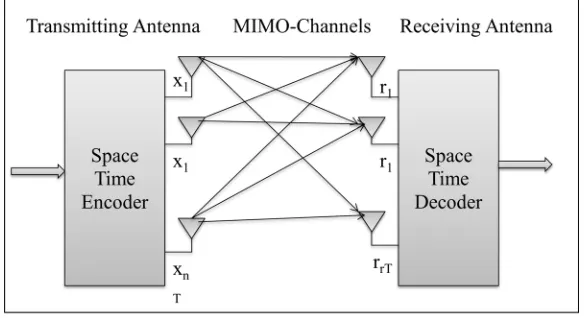
Multi-antenna systems can be classified into three main categories. Multiple antennas at the transmitter side are usually applicable for beam forming. In Transmitter or receiver side multiple antennas for realizing different diversity. For the third class includes systems with multiple transmitter and receiver antennas realizing spatial multiplexing (often referred as MIMO by itself).
In radio communications MIMO means multiple antennas both on transmitter and receiver side of a specific radio server. The case of spatial multiplexing different data symbols are transmitted on the radio link by different antennas on the same frequency within the same time interval. The Multipath propagation is assumed in order to ensure the correct operation of spatial multiplexing and since MIMO is performing better in terms of channel capacity in a rich scatter multipath environment than in case of environment with LOS. It is achieves this by higher spectral efficiency (more bits per second per hertz of bandwidth) and link reliability or diversity (reduced the effect of fading). The properties of MIMO is an important part of modern wireless communication such as IEEE 802.16
[image:3.612.161.455.438.597.2]The main feature of MIMO systems is space-time processing. Space-Time Codes (STCs) are the codes designed for the use in MIMO system. Space-Time Block Codes signals are coded in both temporal and spatial domains. The different types of STCs, the orthogonal Space-Time Block Codes (STBCs) possess a number of advantages over other types of STCs and are considered in this book.
Fig. 2 MIMO system
III.WIMAXSYSTEM
Technology (IJRASET)
[image:4.612.145.467.128.343.2]the potential lto serve customers not served or not satisfied by their wired broadband alternatives. IEEE 802.16 standard for Broadband wireless Access (BWA) and its associated industry consortium, WiMAX (Worldwide Interoperability for Microwave Access) forum promise to offer high data rate over large areas to a large number of users where broadband is unavailable
Fig. 3 WIMAX System
IV.QUADRATUREPHASESHIFTKEYING(QPSK)
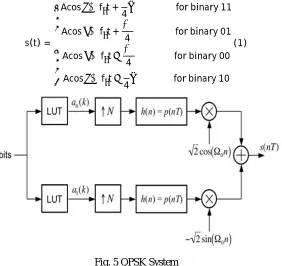
This is also known as four-level PSK where each element represents more than one bit. In the each symbol contains two bits and it
uses the phase shift of π/2, which means 90º instead of shifting the phase 180º. The principle equation 5 is.
s(t) =
⎩ ⎪ ⎪ ⎨ ⎪ ⎪
⎧Acos 2πf t +π4 forbinary11
Acos 2πf t +3π
4 forbinary01
Acos 2πf t−3π
4 forbinary00
Acos 2πf t−π
4 forbinary10 (1)
Fig. 5 QPSK System
[image:4.612.170.452.400.666.2]Technology (IJRASET)
V. BINARYPHASESHIFTKEYING(BPSK)This is also known as two-level PSK as it uses two phases separated by 180º to represent binary digits (0, 1). This kind of phase modulation is very effective and robust against noises especially in low data rate applications as it can modulate only one bits/symbol. The principle equation 3 is.
s(t) =
⎩ ⎨
⎧Acos(2πf t) forbinary1
Acos(2πf t +π) forbinary0
Acos(2πf t) forbinary1
−Acos(2πf t) forbinary0
− − − − (2)
Quadrature Amplitude Modulation (QAM)
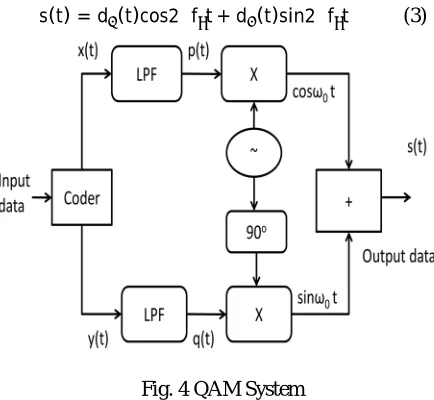
The QAM is popular modulation technique used in various wireless standards communication. It combined with ASK and PSK which has two different signals sent concurrently on the same carrier frequency but one should be shifted by 90º with respect to the other signal. The principle equation 4 is.
[image:5.612.195.412.248.448.2]s(t) = d (t)cos2πf t + d (t)sin2πf t (3)
Fig. 4 QAM System
VI.BITERRORRATECALCULATION
The BER of an uncoded system is obtained by averaging the BER of each subcarrier. Under the assumption of gray QAM mapping,
it is known that the BER and symbol error rate (SER) are related as BER ≈ . To estimate the BER, we consider an error event
with a correct vector, s, and an error vector s′ which satisfies E {S S∗
} = E{S S∗
} = I where denotes conjugate transposition, Es stands for the expected value . In this part of section, we will use H to represent the actual channel matrix if spatial multiplexing is used, and the effective channel matrix if STBC is used.
BER ≈ ≈ E {∑ P [s→s ∣H, s, s ]}
≥ E ∑| | P [s→s ∣H. s, s ]
VII. RESULTSANDDISCUSSION
There are various simulation has been carried out for Wimax system. The various results are as follows, The BER performance graphs for the simulated WiMAX physical layer and MIMO-OFDM with the implementation of channel coding under modulation schemes over Rayleigh and Rician multipath fading channels.
A. Case: 1
Technology (IJRASET)
2) FEC code : Turbo code [image:6.612.151.472.108.281.2]3) Modulation technique : QPSK
Fig. 6 BER performance of WiMAX for Rican channel
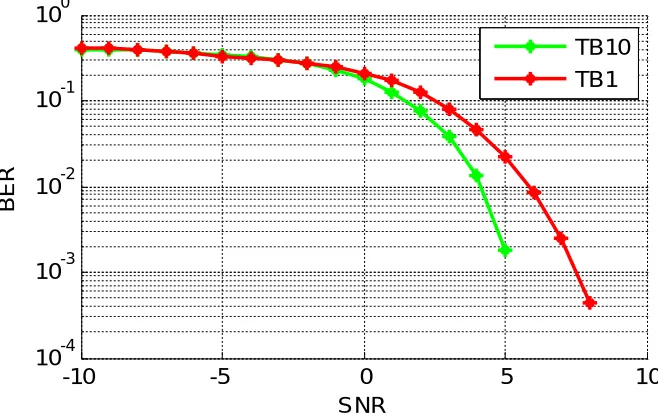
From the above graph it is clear that turbo 10 iteration showing better as compare to single iteration. Now going for the different modulation,
B. Case: 2
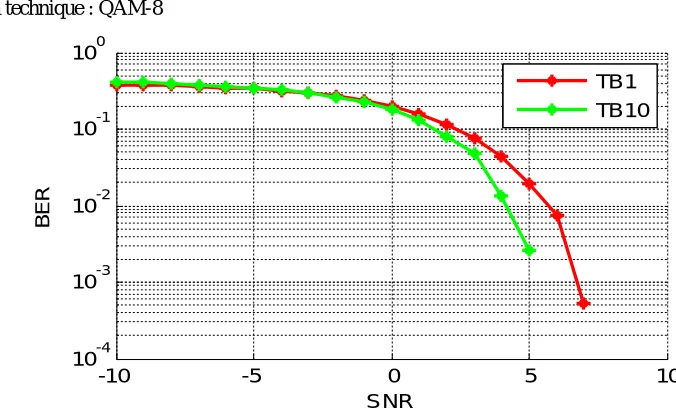
1) Channel : Rician 2) FEC code : Turbo code 3) Modulation technique : QAM-8
Fig. 7 BER performance of WiMAX-QAM for Rician channel
From the above graph it is clear that turbo 10 iteration showing also better as compare to single iteration for QAM8. Now we change the channel environment,
C. Case: 3
1) Channel : Rayleigh channel 2) Channel equalizer : MLSE 3) FEC code : Turbo code
-10 -8 -6 -4 -2 0 2 4
10-3 10-2 10-1 100 SNR B E R TB10 TB1
-10 -5 0 5 10
[image:6.612.134.472.390.598.2]Technology (IJRASET)
4) Modulation technique : QPSKFig. 8 BER performance WiMAX-QPSK for Rayleigh channel
D. Case: 4
1) Channel : Rayleigh channel 2) Channel equalizer : MLSE 3) FEC code : Turbo code
4) Modulation technique : QAM-8
Fig: 9 MLSE equalizer WiMAX system is showing similar behavior for turbo code.
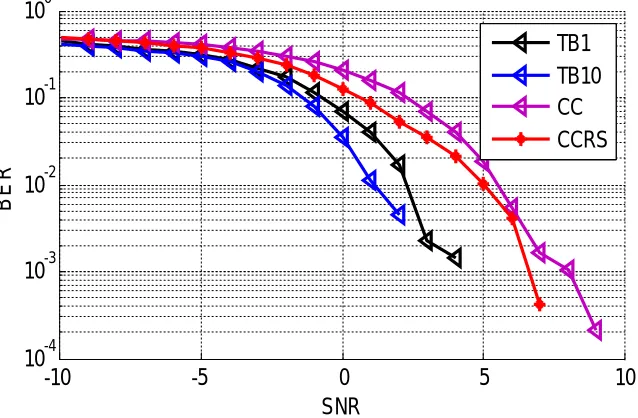
From the above graphs, it is clear that improvement using turbo code is valid for all channels. Further the performance of turbo code has also checked with the other FEC code,
-10 -5 0 5 10
10-4
10-3
10-2
10-1
100
SNR
B
E
R
TB10 TB1
-10 -5 0 5 10
10-4 10-3 10-2 10-1 100
SNR
B
E
R
[image:7.612.148.477.437.646.2]Technology (IJRASET)
Fig. 10 Turbo is behaving better compare to other FEC.
VIII. CONCLUSION
In this paper, performance enhancement of WiMAX-MIMO system is done with adaptive modulation. The uses of Multiple-Input Multiple-Output system and FEC code are most common in wireless standard for provide the fast and reliable communication. The BER for different adaptive modulation techniques are evaluated in slow frequency selective fading channel. Finally, performance of WiMAX system is evaluated using adaptive modulation. Using FEC code technique is improved bit error rate and low signal noise ratio.
REFERENCES
[1] Ajitabh Gupta & Siddharth Chaudhury, “Adaptive Modulation Selection Scheme In MIMO OFDM Wireless Systems”, ISSN (PRINT) : 2320 – 8945, Volume -1, Issue -3, 2013.
[2] Bozovic, R.R., "Analyse of BER performances of OFDM systems in terms of modulation type, length and type of guard intervals for different propagation conditions”, Telecommunications Forum (TELFOR), 2012 20th , vol., no., pp.354,357, 20-22 Nov. 2012.
[3] Anibal Luis Intini, “Orthogonal Frequency Division Multiplexing for Wireless Networks” Standard IEEE 802.11a, University of California Santa Barbara, December, 2000.
[4] Sami H. O. Salih, “Implementation of Adaptive Modulation and Coding Technique”, International Journal of Scientific & Engineering Research Volume 2, Issue 5, May-2011.
[5] IEEE 802.16e-2005, “IEEE Standard for Local and Metropolitan Area Networks, part 16,Air Interface for Fixed and Mobile Broadband Wireless Access Systems”, IEEE Press, 2006
[6] IEEE 802.16-2004, “IEEE Standard for Local and Metropolitan Area Networks Part16: Air Interface for Fixed Broadband Wireless Access Systems”, Rev. of IEEE 802.16-2001, 1 Oct.2001
[7] Mendes, L.L., Filho, R.B., "Clipping Distortion Performance of Nonsquare M -QAM OFDM Systems on Nonlinear Time-Variant Channels”, Vehicular Technology, IEEE Transactions on , vol.60, no.8, pp.4046,4051, Oct. 2011.
[8] R.Y., Hong-Yu Liu, Wu, C. M., "Correlation between ICI and the carrier signal in OFDM under Doppler spread influence”, Signal Processing and Communications Applications Conference, 2009. SIU 2009. IEEE 17th , vol., no., pp.1005,1008, 9-11 April 2009.
-10 -5 0 5 10
10-4 10-3 10-2 10-1 100
SNR
B
E
R