©IJRASET: All Rights are Reserved
1549
Irrigation System and Its Methods
Mrs. Amruta S. Jondhale1, Mrs. Varsha P. Bhosale2, Mrs. Vrushali S. Takate31,2,3 Instrumentation & Control, Pravara Rural Engg. College Loni, Maharashtra, India
Abstract: This paper provides information of “Irrigation system and its various methods”. There are many old and new techniques are now available for irrigation, which includes modern technology and automation i.e. the use of sensors, valves, indicators n pipes. On the earth good quality water is available in fewer amounts so it’s become necessary to use this water carefully, so that irrigation is important. Depend on used modern or smart technology it helps to conserve the water. Irrigation mainly used in agricultural crops. The aim of this paper is to provide various method used in irrigation, its importance and benefits.
Keywords: Smart irrigation, automation, sensors.
I. INTRODUCTION
In India the average of annual rainfall is 100cm which is not uniform throughout the country. In India rainfall is highly variable in place and time. India is a country where mainly three seasons are available, “summer, monsoon and winter”. Sometimes monsoon arrives early but sometimes become late and also not proper distribution of water, so proper water management and irrigation becomes necessary. Irrigation in short defines as artificially supply of distributed water for agriculture so that we can obtain high quality production of crops. There are many methods are available for irrigation, example- smart irrigation, surface irrigation, drip irrigation. Smart irrigation uses latest technique which consist sensors, helps to conserve and proper use of water. Different types of crop require different quantity of water for their growth. “SMART IRRIGATION” is the latest method of irrigation, automated and cost-effective. Irrigation means crop and soil management and monitoring. The proper use of water for agriculture requires understanding of evaporate transpiration process and use of efficient irrigation method. Irrigation is the study of available source of water, irrigation scheduling, when to apply and maintain it. It is the use of artificial or technical things for proper amount of water supply to water. For selection of proper irrigation system there are many factors which should need to understand: Available water, Soil, Topography, Climate and crop type, Soil infiltration rate & Capital cost.
Before applying irrigation system we should know, what is plant type (grass, tall, trees), Geometry & density (slopes, medians). India is an agricultural country and ranks second in worldwide in farm output, so irrigation is important concepts for Indian farmers.
II. METHODSOFIRRIGATION
A. Smart irrigation
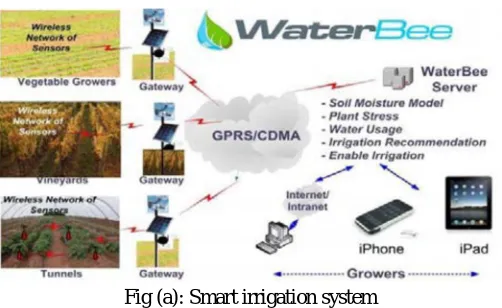
Fig (a): Smart irrigation system
[image:2.612.181.432.485.639.2]©IJRASET: All Rights are Reserved
1550
cost hardware so can affordable for Indian farmers. It saves energy and time, provides automatic control. When the field is wet system will get on and when the field gets dry it will turn on automatically.
B. Sprinkler irrigation
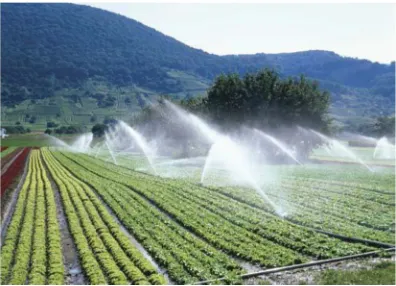
Fig (b): Sprinkler irrigation system
Sprinkler system also called overhead irrigation system because the water is piped to one or more central locations within the field and distributed by overhead high pressure sprinklers or gun. It refers application of water to crops in forms of sprays. The sprinkler system irrigates the field and used in sandy areas. It checks the wastage of water through evaporation and seepage. Sprinkler method is similar to natural rainfall, it uses pipes & pumps. Water under pressure is carried and sprayed over the crop by using overhead perforated pipes, nozzle lines. Nozzles are fitted to riser pipes attached to a system of pipe laid on the ground; nozzles are rotating or fixed type and used for suitable interval in the distribution pipes. Due to spraying method refreshing effect occurs on plant & it apply less water than intake of soil so no run-off occurs. Most of the time sprinkler system operates through electric or hydraulic technology. This irrigation system consists of pump unit, mainline, lateral line, sprinklers, nozzles. Pump unit are most of the time are centrifugal pump which are used to take water from source & provide pressure. Pipes either permanently installed or buried below ground. They are temporary moved to field to field; laterals are made of aluminium and portable. They deliver water to sprinklers. Sprinklers distribution arranged to wet the soil surface and the system used for small as well as large scale applications.
C. Drip irrigation
Drip irrigation also called as micro irrigation or trickle. Drip irrigation is the method in which water at a slow rate drop by drop through perforations in pipes or by nozzles attached to tubes spread over the soil to irrigate a limited area around the plant. Drip irrigation mainly consist head, heart, tail.
Fig (c): Drip irrigation
[image:3.612.226.424.128.271.2] [image:3.612.221.410.516.642.2]©IJRASET: All Rights are Reserved
1551
water source & provide right pressure to water for supply into pipes. Control head include valve which controls the discharge & pressure in whole system. Mainlines, sub mains & laterals supply water from control head to fields. Emitters control the discharge of water from lateral to the plant. This method is suitable for marginal area.
D. Centre pivot
Fig (d): Centre pivot irrigation system
Centre pivot irrigation system also called as waterwheel or circle irrigation. In this method of crops are watered with sprinklers. This system consist several segments of pipe which are joined together and supported by trusses, placed on wheeled towers with
sprinklers, machine moves in a circular path. Centre pivot method uses less water than any other methods and beneficial for undulating areas also high efficient. Main components used are turbine pumps, pipes and sprinklers.
E. Surface irrigation
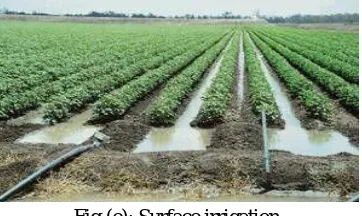
Fig (e): Surface irrigation
This is the most simple and easy method depends on suitable water source. It occurs over soil surface, while selecting type of surface irrigation these things should be taken into consideration: 1.characteristic of crops, 2.properties of soil, and 3.slop of field. Surface irrigation is the most old method and widely used because it’s simple, requires no energy. Water is supplied from main source to field area through a pipe. It Consist min canal, inter-farm, on farm. The aim of water application is to supply a proper water amount of water to selected area in the required time, distribute it uniformly entire area. Steam rate, water velocity, rate of its inflow to the soil is important. On field components are surface sprinklers or drip. As field characteristics change from irrigation to irrigation, crop to crop so this is hard to mange at high level performance. Water management is very important point in this irrigation system. This method also called as flood irrigation (example: rice farming). Well-known system can be operated without any high tech application. Surface irrigation allows full utilization of rain water and can achieve high efficiency. Mainly four types: basin irrigation, border irrigation, furrow irrigation and wild irrigation.
III.CONCLUSION
[image:4.612.215.400.141.276.2] [image:4.612.218.399.380.488.2]©IJRASET: All Rights are Reserved
1552
for water increments, alongside the need to ensure oceanic living spaces, water preservation rehearses for water system should be compelling and reasonable. Exactness water system will upgrade water system by limiting the misuse of water, and vitality, while amplifying crop yields. The most compelling technique for deciding the water requests of harvests is the in view of the continuous checking of soil dampness, and coordinate water application utilized as a part of conjunction with the data about soil hydrological properties.
REFERENCES
[1] Chandaan kumar sahu, Pramiti behera, “A Low Cost Smart Irrigation Control System”, IEEE Sponsored 2ND International Conference on Electronics and Communication System.
[2] Darshna, T. Sangavi,Sheena Mohan ,A. Soundhary, Sukanya Desikan, “Smart Irrigation Systems ”, IOSR Journal of Electronics and Communication Engineering (IOSR-JECE) e-ISSN: 2278-2834, p- ISSN: 2278-8735.Volume 10, Issue 3.
[3] H.T.Ingale , N.N.Kasa, “Automated Irrigation System”, International Journal of Engineering Research and Development e-ISSN: 067X, p-ISSN: 2278-800X, Volume 4, Issue 11 (November 2012), PP. 51-54.
[4] Ashwini Deshpande, Prajakta Pitale, Sangita Sanap, “Industrial Automation using Internet of Things (IOT)”, International Journal of Advanced Research in Computer Engineering & Technology (IJARCET) Volume 5 Issue 2, February 2016266 ISSN: 2278 – 1323.