ScholarWorks @ Georgia State University
ScholarWorks @ Georgia State University
Communication Dissertations Department of Communication
Summer 6-27-2012
"Doing it For The Dudes": A Comparative Ethnographic Study of
"Doing it For The Dudes": A Comparative Ethnographic Study of
Performative Masculinity in Heavy Metal and Hardcore
Performative Masculinity in Heavy Metal and Hardcore
Subcultures
Subcultures
John Ike Sewell Jr. Georgia State University
Follow this and additional works at: https://scholarworks.gsu.edu/communication_diss
Recommended Citation Recommended Citation
Sewell, John Ike Jr., ""Doing it For The Dudes": A Comparative Ethnographic Study of Performative Masculinity in Heavy Metal and Hardcore Subcultures." Dissertation, Georgia State University, 2012. https://scholarworks.gsu.edu/communication_diss/36
This Dissertation is brought to you for free and open access by the Department of Communication at ScholarWorks @ Georgia State University. It has been accepted for inclusion in Communication Dissertations by an authorized administrator of ScholarWorks @ Georgia State University. For more information, please contact
“DOING IT FOR THE DUDES”: A COMPARATIVE
ETHNOGRAPHIC STUDY OF PERFORMATIVE MASCULINITY
IN HEAVY METAL AND HARDCORE SUBCULTURES
by
J. IKE SEWELL
Under the Direction of Dr. Marian Meyers
ABSTRACT
This ethnographic study compares and contrasts performative masculinities of the
male-dominated heavy metal (HM) and hardcore (HC) subcultures. Conclusions derived from this
research indicate the following: identities associated with HM and HC conflate masculinity with
working-classness; HM and HC identities (and thus masculinities) are merging at present;
participation in HM and HC enclaves can serve to symbolically marginalize constituents, and
this symbolic marginalization can result in repercussions in the lived world outside of subculture;
the hegemonic masculinity of HM and HC subcultures is double-edged masculinity, meaning
that it supports the male-dominated structure of mainstream culture without empowering HM
and HC males in an extra-subcultural sense; and that despite these negative ramifications, HM
and HC participants still find the shared identities and community interaction of these enclaves to
be empowering.
“DOING IT FOR THE DUDES”: A COMPARATIVE
ETHNOGRAPHIC STUDY OF PERFORMATIVE MASCULINITY
IN HEAVY METAL AND HARDCORE SUBCULTURES
by
J. IKE SEWELL
A Dissertation Submitted in Partial Fulfillment of the Requirements for the Degree of
Doctor of Philosophy
in the College of Arts and Sciences
Georgia State University
Copyright by J. Ike Sewell
“DOING IT FOR THE DUDES”: A COMPARATIVE
ETHNOGRAPHIC STUDY OF PERFORMATIVE MASCULINITY
IN HEAVY METAL AND HARDCORE SUBCULTURES
by
J. IKE SEWELL
Committee Chair: Marian J. Meyers
Committee: Tomasz Tabako
Ted Friedman
Patricia G. Davis
Megan J. Sinnott
Electronic Version Approved:
Office of Graduate Studies
College of Arts and Sciences
Georgia State University
ACKNOWLEDGEMENTS
Topmost on my thank you list is Dr. Marian Meyers, who was brave enough to step at a
crucial juncture. Thank you, Dr. Meyers, for your righteous (but not self-righteous) insights,
patience, accessibility and positivity through what may probably seemed an arduous and
thankless undertaking. If karma points are ever handed out, you’ll get yours. But as we have
already established, no good deed goes unpunished.
Special thanks go to Dr. Tomasz Tabako, my first mentor at Georgia State who
introduced me to rhetorical theory and inspired me to take a different academic direction at the
beginning of my doctoral studies. Your intellect is so astounding that it’s almost scary—but you
temper this daunting brainpower with charm and style. I’ll never meet anyone else who is even
remotely like you, a stellar mind.
Thanks goes to Drs. Patricia Davis and Ted Friedman, both of whom were willing to step
in at the point where it was necessary to reconfigure the dissertation committee. I hardly knew
either of you when I asked that you join the committee—and both of you have gone beyond the
proverbial call of duty by joining. Your participation helped greatly to reinvigorate this project.
I thank Dr. Megan Sinnott from Georgia State’s Women’s Studies Institute for joining the
committee as an outsider. Your Feminist Theory class in 2009 was one of the most illuminating
experiences of my time at GSU. In that class, I felt as if I had been given a special key to access
women’s experience. I also especially appreciate your willingness to critique this dissertation
Special thanks go to my perfect parents, Rebecca and Ike Sewell. Both educators and
scholars, you knew what a difficult task doctoral study would be and unselfishly lavished me
with kind words and unending emotional support through this process. Thank you for your
patience and eternal love.
Of course, I would like to thank my perfect partner, Stacy Fentress. Without you I never
would have even started graduate school, let alone enter a Ph.D. program. Like my perfect
parents, you’re always there no matter what. Unlike my perfect parents, you’re a rock’n’roller,
my punk rock queen. You rule.
A host of individuals have somehow aided my writing this dissertation, many of whom
will unfortunately go unacknowledged. Writing this work was a long and laborious process, and
many who were not formally involved in this process such as library aides, Georgia State
University Department of Communication staff, and just people who were nice to me in
day-to-day interactions during the stressful period of writing this have somehow spurred me along my
way. Thank you.
I would like to thank all of the metal and hardcore kids who participated in this study.
And I would like to thank all the dudes. Finally and eternally, And I would like to thank
TABLE OF CONTENTS
ACKNOWLEDGEMENTS ... v
LIST OF TABLES ... x
1. INTRODUCTION ... 1
2. REVIEW OF LITERATURE ... 9
Culture and Ideology ... 9
From Culture to Subculture ... 17
From Subculture Studies to Fan Studies ... 25
“Secret realm devotion”: Heavy Metal and Hardcore as Carnivalesque Inversion . 30 “The Devil’s Crossroads”: Merging the Ethnographic with the Rhetorical ... 33
“The Kids Will Have Their Say”: Defining Hardcore ... 35
“Blood, Fire, Death”: Defining Heavy Metal ... 41
Intersectionality ... 46
Performative Masculinity in Heavy Metal and Hardcore ... 50
Compulsory Heterosexuality and Latent Homoeroticism in Heavy Metal and Hardcore ... 63
“Cometh Down Hessian”: Defining Whiteness ... 66
Middle-Class Simulation of the Working-Class Mien: Class in Heavy Metal and Hardcore ... 72
3. METHODOLOGY ... 84
4. FINDINGS AND DISCUSSIONS ... 106
Outing Myself: A Truncated Autobiography of 30 Years in Subculture ... 108
“The Unholy Trinity”: Three emergent Trends in Heavy Metal and Hardcore, Circa 2012 ... 111
“Caught in a Mosh”: The Moshpit as Proving Ground ... 113
Idealized Bodies and subculture-Specific Moshpit Practices of Heavy Metal and Hardcore ... 114
“Who Cares Unless It’s a Girl?”: Gender Distinctions in the Moshpit ... 117
Transgression and Conformity in the Moshpit ... 121
“The Brotherhood of Metal dudes”: Camaraderie in the Moshpit ... 124
“Small Man, Big Mouth”: Heavy Metal and Hardcore as Masculine Speech Communities ... 126
“Forged in Fire, Bonded by Blood”: Demographic Makeup of Heavy Metal and Hardcore Subcultures ... 129
“Brats in Battalions, Boys in the Brigade”: Heavy Metal and Hardcore as Male Hierarchies ... 131
Women’s Roles in the Male Hierarchies of Heavy Metal and Hardcore ... 132
“You Were Never My Age”: Identity Stigmatization and disempowerment In Heavy Metal and Hardcore ... 140
“The Wrecking Crew”: Heavy Metal and Hardcore Subcultures as Ideological Communities and Surrogate Families ... 147
“Iron Men”: Power, Privilege, Class and Working-Classness
in Heavy Metal and Hardcore ... 163
“Walk Like a Man”: For Whom is Moshpit Masculinity Performed? ... 164
“The Poorest, Ugliest Kids on the Block”: Class Issues in Heavy Metal and Hardcore ... 167
“United Blood”: Emergent Themes and Identities of Postmodern Hardcore/Heavy Metal Crossover ... 172
“Fractured Mirrors”: Heavy Metal and Hardcore as the Hyperreal ... 178
“Walk Together, Rock Together”: The Follow-Up Interviews... 183
5. CONCLUSIONS ... 189
“Going Nowhere Faster than You”: Ideological Entailments of Heavy Metal and Hardcore ... 189
“Always a Friend for Life”: Heavy Metal and Hardcore Participation as Empowerment,and the Agency of Refusal ... 201
In Summary ... 209
6. LIMITATIONS AND IMPLICATIONS FOR FURTHER STUDY ... 214
REFERENCES ... 215
APPENDICES ... 230
Appendix A ... 230
Appendix B ... 235
Appendix C ... 237
LIST OF TABLES
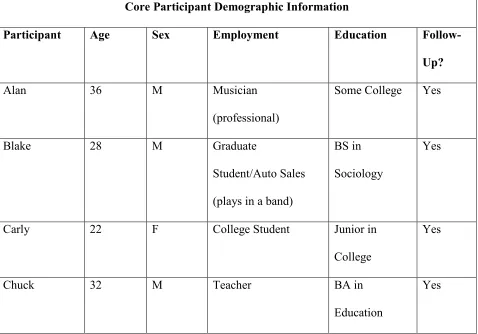
Table 4.1 Core Participant demographic Information ... 95
People often ask me why I do what I do I answer confidently, honestly and true It isn’t for the glory, it isn’t for the girls It isn’t for the booze I’m here to tell you brothers That I’m doing it for the dudes
— “Doing it for The Dudes” by The Retreads, 2002
1. INTRODUCTION
It is chaos as usual tonight in “Hell,” the cavernous, 600-person capacity basement room
of the Masquerade, a three-leveled nightclub in Atlanta, Georgia. A horde of longhaired,
sweat-soaked revelers, predominately white and male and clad in black T-shirts with ominous logos,
hurl their bodies into one another as tonight’s star performers aurally bludgeon them with a
deafening cacophony of heavy metal (HM) music. The featured act is Cannibal Corpse, a band
from Buffalo, New York, that has come to epitomize the death metal subgenre of HM because of
its hyperviolent lyrical content (Mudrian, 2004, p. 162). Songs on the band’s set list for tonight
include titles like “Hammer Smashed Face,” “Born in a Coffin,” “Necropedophile,” and “Post
Mortal Ejaculation.” Lead vocalist George “Corpsegrinder” Fisher delivers the malevolent lyrics
in a throaty rasp that approximates what the voice of a demon might sound like, all the while
headbanging wildly. Although Cannibal Corpse’s lyrics would probably be unintelligible to the
average listener, the fans at tonight’s concert have clearly memorized them—relishing the
opportunity to scream these tales of dismemberment and torture back at the band while thrashing
violently in front of the stage. The band plays on, delivering complicated, crushing guitar riffs at
over an hour. Oddly enough, the ritualized pandemonium at this show is just another night’s
work for the members of Cannibal Corpse, all middle-aged, married men with families to support
(Webster, 2009, part 3, para. 14). Indifferent to the criticism that their music promotes misogyny
and violence, the band’s members claim that their gory songs are merely fictions which provide
cathartic release for listeners—in this way thwarting real violence rather than promoting it
(Webster, 2009, part 1, para. 23). Watching the show, however, it is impossible to tell just how
the audience members are interpreting these messages. What is patently obvious, though, is that
the crowd is loving this stuff.
A mere five blocks away, a similar scene is unfolding at the Drunken Unicorn, a tiny
venue that might be more accurately described as a dive bar with a one-foot high, plywood stage
crammed in the backroom. Tonight the club is packed to well over its legal capacity of around
200 people for a double bill featuring two California-based bands: Trash Talk, a “new school”
HC band from Sacramento, and Off!, an “old school” HC band fronted by 56-year-old Keith
Morris, an alum of Black Flag, the groundbreaking band that delivered the archetypal template
for proto-HC in Los Angeles, circa 1979 (Azerrad, 2001, p. 14). Despite the obvious age
differences between the members of Off! and Trash Talk, the youngish crowd’s response to each
band’s show is the same—utter mayhem, or at least performed mayhem, erupts as the bands bash
out short, loud/fast sonic tantrums expressing distrust for authority, a sense of alienation and/or
disgust at the consumerist conformity that is symptomatic of America’s lookalike, prefab
suburbs. Although Off! is a bit more melodic than Trash Talk, both bands’ sonic oeuvres are
similar: distorted guitars, driven by machinegun drumming, and punctuated by vocals more often
screamed than sung. The hot room is packed so tightly that no one present can avoid being
dirty gymnasium permeated with farts. Thrashing HC fans, the majority of them white and male,
regularly traverse the miniscule boundary between the audience and the band to execute “stage
dives” into the crowd. During Off!’s set, vocalist Morris delivers an onstage rap about “the
assholes you see everywhere on the street” before the band charges into the anthem, “Fuck
People.” At the end of the show, the audience streams out of the club—smiling, sweaty and
satiated. Some of the audience members may be bruised or bloody nosed, but it’s all in fun.
At each of the aforementioned performances, the audience demographics, sounds and
performed behaviors are similar. In fact, some of the people that were present at the Masquerade
show later arrived at the Drunken Unicorn in time to catch most of Off!’s set. Each of the shows
featured a kind of staged chaos, a cabalistic celebration of white maleness. Still, there were
subtle (and sometimes not so subtle) ideological distinctions between the messages proffered at
each venue, as well as variations between the ways that maleness was performed in each show.
Just what is going on here?
Hardcore (HC) and heavy metal (HM) are distinctive genres of hard rock music, each
with accompanying subcultures marked by specific modes of behavior, generic and performative
particularities and structured social hierarchies. Both HM and HC are male-dominated,
homosocial subcultures (Blush, 2010, p. 38; Krenske & McKay, 2000, pp. 287-288, Arnett,
1996, p. 139; Weinstein, 2009, p. 17). Because of the correspondences that link these
subcultures, having access to observe each group from within its subcultural boundaries offers a
unique opportunity to evaluate, compare, and contrast performative masculinity as enacted in
strikingly similar yet also divergent communities. This dissertation is a comparative
ethnographic study of HM and HC subcultures conducted over a nine month period (2011 and
toolbox” used to unpack meanings in this project, the study is a cross-disciplinary venture that
might be defined, variously, as a “rhetorical cultural study” (Rosteck, 2001,p. 54), as “cultural
rhetoric” (Conquergood, 1992, p. 80), or as “critical-rhetorical ethnography” (Hess, 2011, p.
128). Comparative ethnography is employed to establish commonalities and differences in an
examination of how masculinity is enacted in HM and HC subcultures, while rhetorical methods
supply another means of decoding these meanings analytically. This study contributes to the
fields of masculinity studies, identity studies, ideological criticism, performance studies, fan
studies, and subculture studies.
Several pivotal studies (Arnett, 1996; Cagle, 1995; Hebdige, 1979; Muggleton, 2000;
Waksman, 2009; Walser, 1993; Wood, 2006) support the understanding that rock music
subcultures are communities that operate as sites for collective identity negotiation and group
resistance to the larger, mainstream culture within which they are subsumed, perhaps all the
while functioning to co-opt their own oppositionality through commodification and
incorporation. Hebdige (1979) asserts that style is the signifier of subculture, the visible
manifestation of transgression, a “symbolic challenge to a symbolic order” (p. 92). Hebdige
(1979) further contends that the commercialization of subcultural transgression into commodity
form sows the seeds for the subculture’s reabsorption into mainstream culture (p. 94). In a
similar study of the early 1970s glitter rock phenomenon, Cagle (1995) posits that such
commoditization needn’t necessarily dilute or skew the precepts upon which the subculture is
originally based (p. 47), and that savvy subculture participants may knowingly exploit their own
carefully acquired subcultural cachet as a means of enlarging the subculture’s ranks and for
personal profit (pp. 213-215). Muggleton (2000) advocates a postmodern understanding of
cobbling together of disparate (sub)cultural elements—noting that the stylistic markers of
subculture can both mark and mask identities and affiliations (pp. 39-40). For Muggleton, those
who engage subcultural affiliations as “style surfing” are “post-subculturalists,” dabblers who
move freely among subcultures without the burden of having to establish authenticity for
themselves (p. 47). All of the aforementioned authors, to varying degrees, agree that
popularization simultaneously serves to extend and erode subcultures.
Although the scholars studying HM and HC have oftentimes noted that these subcultures
are almost exclusively populated and dominated by males (Arnett, 1996, p. 12; Moore, 2010, p.
64; Walser, 1993, p. 109; Wood, 2006, p. 7), inquiries regarding how performative masculinity
operates within these collectivities has been secondary at best, and cursory at worst. Tellingly, in
his 1993 analysis of heavy metal culture, Running with the Devil, Walser posits that those
involved in HM propagate a discourse equating power with obligatory masculinity—yet
participants in HM actually hold little socioeconomic authority, if any (p. 109). While this
observation regarding the role of masculinity in HM certainly offers a crucial point of departure,
the author neglects to follow through with a thorough examination of masculinity’s function.
Arnett (1996) offers a more nuanced grasp of masculinity’s role in HM, stating that adolescent
males’ participation in that subculture provides a milieu for masculine rites of passage apart from
more conventional, parentally-sanctioned practices occurring in socializing activities such as
sports (pp. 12-14). Likewise, Wood (2006) posits that HC is a subculture of “latent male
oriented bias” which is somewhat benignly made manifest by continued references to the enclave
as a brotherhood, and, more offensively, in overtly sexist terminology which denigrates women’s
roles in the HC scene (pp. 75-76). While all of the aforementioned literature does acknowledge
the ways in which performative masculinity operates in the process of collective identity
negotiation for participants. As Moore (2010) contends, “with some exceptions, analyses of
music and subculture have generally failed to theorize the symbols, music and styles of
subculture in terms of masculinity and its social construction” (p. 29).
This comparative ethnographic study of HM and HC subcultures offers a host of
opportunities to address the primary research question of how masculinity is enacted in
subculture that expands upon preexisting scholarship (Arnett, 1996; Walser, 1993; Weinstein,
2000 & 2009, Kahn-Harris, 2007) via the practice of critical-rhetorical ethnography and through
a co-interpretive analytical strategy which engages participants not only in the field and in
interview settings, but also in the subsequent interpretation of these events and interviews. HM
and HC share many similarities, such as outsider status for participants, the demographic
correspondence that both enclaves are clearly male-dominated, and musical qualities of volume,
speed and distortion. There is, in fact, much crossover among the subcultures, a melding that is
most salient in the performances of both bands and audiences at shows (Waksman, 2009, p. 275).
Introduced most clearly by Judith Butler (1991) in her canonical article, “Imitation and Gender
Insubordination,” performativity is the enactment of socialized characteristics that, through
repetition, we come to understand as innate (p. 125). Butler (1991) contends that gender is not
reflective of essence, but is in fact a performative act (p. 127). Bearing this in mind, this
comparative study establishes both commonalities of masculine performativity shared by HM
and HC and gender-based particularities pertinent to each. While there are many scholarly
studies of HM (Arnett, 1996; Dee, 2009; Kelly, 2006; Walser, 1993) and scant studies of HC
(Haenfler, 2006; Wood, 2006) available, there are no studies comparing and contrasting the
both subcultures. Although HM and HC are both longstanding subcultures in America, neither
of these enclaves has been researched extensively. Canonical analytical works concerning HM
are those of Walser (1993) and Arnett (1996), both nearly 20 years old. Analyses of HC are even
scarcer, limited primarily to the works of Wood (2008) and Haenfler (2006, 2010). This study
addresses the aforementioned gaps: the relative absence of recent study of both subcultures, the
dearth of specific analytical focus on performative masculinity in HM and HC subcultures and
the lack of comparative study of the two enclaves. Ethnography is a process of establishing
meanings through interaction. As such, the research design and structuring of this study has
evolved as new parameters emerged during the course of the fieldwork (Emerson, Fretz, &
Shaw, 1995, pp. 157-159). This study of performative masculinity in HM and HC communities
provides clues as to how masculinity is deployed not only in these particular subcultures, but in
culture in general.
The format of this dissertation is developed in the following way: first, I will examine the
literature pertinent to this study; secondly, I will explain the applicable methods for the execution
and subsequent analysis of this project; next, I will offer a detailed narrative of my observations
made during fieldwork, supplemented by accounts and explanations of the core participants
offered during personal interviews; then I will offer an account of processes leading toward the
conclusion of this work through co-analysis with participants; and, finally, I will summarize and
contextualize the findings of this work. The conclusions derived from this ethnographic study
indicate that: 1.) the identities associated with HM and HC conflate masculinity with
working-classness; 2.) HM and HC identities (and thus HM and HC masculinities) are merging at present;
3.) participation in HC and HM subcultures can function to marginalize its constituents through
realizable sociopolitical potential; 4.) the hegemonic masculinity reinscribed in HM and HC
subcultures is a double-edged masculinity, meaning that it supports the male-dominant
structuring of the culture as a whole without necessarily empowering HM and HC males in an
extra-subcultural sense; and 5.) despite the abovementioned negative repercussions of adopting
HM and HC identities, participants still find their experiences in these subcultures to be
empowering because they provide a sense of belonging to a vibrant community, a voice within
2. REVIEW OF LITERATURE
Culture and Ideology
Before delving into HM and HC subcultures, their practices and processes, I first must
establish definitions for culture and subculture. Often considered the founder of the field of
social anthropology, Edward Burnett Tylor (1958) defines culture as “that complex whole which
includes knowledge, belief, art, morals, law custom, and any other capabilities and habits
acquired by a man as a member of society” (p. 1). This definition of culture provides the
bedrock understanding that culture encompasses expression, artifacts and learned behaviors, a
collectivistic rather than individualistically driven way of being and communicating that is
related to a specific group. Hoggart (1972) notes that culture is both process and product, a
dualistic ebb and flow where cultural artifacts represent the processes through which they were
conceived—and where the practices of a given culture are in turn affected by the cultural
artifacts which represent them. For Hoggart, culture “produce[s] a picture of the world and then
ask[s] its people to approve that picture and the values which stem from it” (p. 101). Hoggart’s
notion that any given culture affects and is affected by its constituency is contiguous with
Bourdieu’s (1977) scheme which explains how what is understood to be “reality” in a given
culture is in fact constructed in the cultural process (pp. 185-186). In this way, the goods created
in cultural production carry messages which reinforce the strictures of social order as well or
better than legal institutions or the economic system.
Raymond Williams (1961) notes the existence of three categories for defining culture: the
motifs and/or modes of being that influence not only art and folklore but also ordinary behaviors;
and the documentary category, which examines the creative works of a culture and leads to
judgment and criticism (p. 154). Williams asserts that the ideal and, especially, the documentary
categories may mislead analysts toward the notion that “culture” specifically concerns creative
expression and aesthetic judgment (p. 42). Williams is likewise critical of the social category for
its emphasis on art and folklore as mere side effects of sociopolitical influence. He alternatively
contends that the aforementioned categories should be understood as intersecting and/or
overlapping—that all three should be employed as a means of comprehending the “genuine
complexity” of culture (p. 43).
Levi-Strauss (1963) offers a conceptualization which differentiates cultures from one
another. For Levi-Strauss, culture “presents significant discontinuities in relation to the rest of
humanity” (p. 195). This emphasis on difference is useful not only for making distinctions
between cultures, but also for making distinctions within an individual culture. Through
Levi-Strauss’ structuralist lens, both continuities and incontinuities are the focus—the goal of the
researcher being to determine both differences among cultures and “invariants,” mores that span
all cultures and operate as universals (p. 195). Such invariants can be established both among
cultures and inter-culturally. The assemblages that Levi-Strauss defines as different “cultural
units” which exist among a greater, encompassing culture are comparable to what scholars of the
Birmingham School would later define as subcultures.
Hebdige (1979), the scholar most notable for his expansion of the Birmingham School’s
cultural studies approach into the analysis of subculture, asserts that culture is “a notoriously
ambiguous concept,” (p. 5), explaining that the (then) contemporary understanding of culture is
and actions (pp. 6-7). The first understanding of culture as a “high” standard, demarcated from
the “low” ways of being and expression symptomatic of the masses, has been complicated by
technology’s steady progress (Benjamin, 1936, pp. 6-7). The explosion of ways to reproduce
and distribute information enabled by technology has certainly served to skew the high/low
culture balance toward the latter. From modernity to the present, popular or mass culture has
become “the” culture. Strinati (2004) posits that the emergence of mass culture in modernity and
its present ubiquity has created a milieu of “atomisation,” whereby the individual is immersed in
and indivisible from the mass, lacking personal connection to others but nonetheless inseparable
from the whole (p. 6). Although the term “culture” certainly holds different meanings in various
contexts, any analysis of culture from modernity to the present requisitely includes the
examination of mass or popular culture (Strinati, 2004, pp. 9-10).
In his pivotal “The Study of Philosophy,” Antonio Gramsci (1971) notes that
participation in cultural activities impels a reciprocal relationship similar to that of the teacher
and student in that all who participate are simultaneously being instructed and instructing others
(p. 350). “Every relationship of a ‘hegemony’ is necessarily an educational relationship that
occurs not only within a nation, between the various forces of which the nation is composed, but
the international and world-wide field, between complexes of national and continental
civilisations” (Gramsci, 1971, p. 350). This is to say that through participation in culture, the
participant receives ideological indoctrination which, in turn, leads to behaviors that are in sync
with the status quo. As such, any anti-hegemonic struggle is necessarily political in nature (p.
352). For Gramsci (2006), hegemony is enabled by the continued circulation of ideology: the
family, church, schools, news media and the culture itself are all “ideological structures” whose
public opinion belongs to this ideological structure (p. 16). Althusser (2006) defines the
aforementioned structures as “ideological state apparatuses” (p. 79). While “repressive state
apparatuses” such as the police and the military operate overtly through violence and coercion,
ideological state apparatuses operate covertly, through the circulation of ideology (p. 81). As
participants in these structures, we are subtly hailed or interpellated into ideology (pp. 84-85).
“The existence of ideology and the hailing or interpellation of individuals as subjects are one and
the same thing” (p. 86). Through being hailed—and through accepting our identification as
subjects in this process—our very actions become ideological without our knowing it (pp.
86-87). In this way, through participation in the social processes of ideological state apparatuses,
our actions that seem to be non-ideological are in fact suffused with ideology (pp. 86-87).
Partaking in sociocultural activities necessarily involves immersion in ideology in ways that are
oftentimes imperceptible. As subjects who are hailed by ideology, we do not perceive ourselves
as being in ideology (p. 86). Hence, social institutions and the culture itself provide the means to
train us to accept our lot—and to understand the existing order as being natural and inevitable.
Interpellation occurs at the moment one joins an audience: When one acknowledges being a
member of the particular group being addressed (such as HM and HC participants), that person
becomes part of a collective ideological identity (Charland, 1987, p. 138). As I will expound
upon at great length in this dissertation, although they are not “state apparatuses” per se, HM and
HC enclaves operate in ways that nevertheless hail participants into ideology—in these cases, an
ideology of masculinity.
Scholars of the Birmingham School of British cultural studies asserted that culture was
best examined through a process which considers factors such as ideology, class, economic
by which the production of culture and cultural products could be examined from a materialist
perspective. Clark, Jefferson and Roberts (1975) explain that culture is defined not only by its
cultural products, but also includes the “maps of meaning” that underpin and shape cultural
products and the ways that they are perceived by individuals within a culture (pp. 10-11). Unlike
earlier Frankfurt School theorists, Birmingham School scholars saw the individual as having
agency and the (not always realized) potential to resist the dominant ideology which replicates
the material relations of production, favoring those in positions of power in the existing order.
The Birmingham School theorists were primarily concerned with meaning—with understanding
how the dominant ideology uses and shapes cultural products to reinforce the status quo and how
individuals use those cultural products, creating meanings from them that may, in fact, resist the
dominant meaning. Hall (1991) posits that individuals may make their own interpretations of
texts rather than passively receiving intended media messages (pp. 58-59) as explained by the
more pessimistic and elitist Frankfurt School theorists.
From a cultural studies perspective, culture can be viewed in a dualistic way, as
pertaining to product and process. Culture is both the values, ideals and beliefs of society that
instruct us on who we are and how to be and the outlooks, customs, ways of being and identities
of a society which shape the creative works of a particular social order. More simply put, culture
is the messages embedded in the totems of a society and the processes that shape the creation of
those totems—what makes us who we are, how who we are shapes what we make, and how what
we make, in turn, shapes who we are. Still, as Williams asserted in The Long Revolution (1961),
culture concerns not only cultural artifacts and what influences their creation—but is lived (p.
56). Regarding Williams’ conceptualization of culture, Hall (1996) categorizes it as an
interlinked in society (p. 19), meaning that culture is part and parcel of the day-to-day
performance of life, in public and in private, for ordinary individuals. For Williams, all
individuals take part in the creation and maintenance of culture in ordinary life, and what is
conveyed through artistic expression is exceptional because of its intensity, focus, and/or new
ways of connecting meanings—extraordinary renditions of what is also lived in the quotidian
existence of the proverbial common man (Literature and Society Group, 1972-3, p. 231).
Culture is lived in that it depends upon ordinary people, in social situations, creating shared
meanings that are rooted in broadly-based similarities of being (Hall, 1997a, p. 4).
In Understanding Popular Culture, Fiske (1989) differentiates “popular” from “mass”
culture by stating that mass culture is the body of works that are mass-produced by the culture
industry, whereas popular culture is the “active process of generating and circulating meanings
and pleasures within a social system” (p. 23). This is to say that popular culture is of the
populace, even when it involves externally-produced, ready-made cultural artifacts. The public,
through its appropriation of motifs and cultural products for its own uses, makes mass-produced
cultural products its own. Popular culture, thus, is inherently contradictory. That a subordinated
public produces popular culture from the resources provided by the very system of power that
subordinates them is key to this contradiction (Fiske, 2011, p. 1). Critics of this notion of
popular culture as set forth by Fiske and other Centre for contemporary Cultural Studies scholars
maintain, however, that it is shortsighted in that it fails to account for the ways that mass culture
inscribes ideology through the circulation of cultural products (Strinati, 2003, p. 234).
Nevertheless, Fiske’s account of popular culture draws strength from its idea that when mass
promote the forces of domination as well as those which resist those forces at the same time
(1989, p. 25). Fiske expounds:
All popular culture is a process of struggle, of struggle over the meanings of social
experience, of one’s personhood and its relations to the social order and of the texts and
commodities of that order. Reading relations1 reproduce and reenact social relations, so
power, resistance, and evasion are necessarily structured into them. (p. 28)
In this way, popular culture operates to communicate a multiplicity of messages at the same
time—and what one perceives the “message” of a given cultural product to be is based upon an
ever-evolving variety of contexts. Thus, an individual can “read” the same cultural artifact in a
number of different ways, all depending on the time, place and social situation when the reading
is made. Fiske (1996) likens culture (and thus, popular culture and cultural products alike) to a
river, contending that it is a large and continually moving body of force—one whose surface
likely masks numerous hidden undercurrents (pp. 8-9). Fiske’s concept that culture is an
intermingling of ideas, currents and forces is contemporaneous with the concept of polysemy,
that symbols and texts, like culture itself, carry a multiplicity of meanings and can be encoded
and decoded multiple ways (Condit, 1989, p. 106; Barker, 2004. pp. 146-147, Hall, 1991, p.
58-59).
Fiske (1989) claims that because of the aforementioned contradictions, popular culture is
a site for contestation in which power is unequally distributed on the basis of factors of identity
such as race, ethnicity and gender (p. 4). Conceding that popular culture circulates multiple
messages and/or ideologies at the same time, Fiske posits that this model accounts for the
1
inevitable contradictions of any culture. For Fiske, the “people” that are imbricated in popular
culture are neither dictated to by an all-powerful and irrepressible ideological system, nor are
they wholly autonomous in terms of how they decode popular culture messages (pp. 45-46).
Bearing in mind these contradictions, Fiske posits that the examination of popular culture texts
(such as the texts that are circulated in HM and HC subcultures, for example) requires a certain
analytical duality: The analyst must focus both on the ways that the forces of domination exert
power through the ideologies encoded in the texts and must also focus on how people use
cultural products, as ideologically tainted as they may be, to their own ends by “making do” (pp.
103-105). In this way, recipients of popular culture messages function both as subjects and as
agents. They are to a certain degree hailed by these messages, while at the same time they hold
at least a degree of agency in that they have the option of decoding these messages however they
see fit. Paradoxically, recipients of popular culture messages are still not altogether autonomous.
This conditional agency is “not that of voluntarism or free will, but social in that it is produced
and determined by the contradictoriness that is the core experience of the subordinate in
elaborate, capitalist societies” (p. 181). Plainly, the Western societies where HM and HC are
most popular would fall within Fiske’s category of “elaborate capitalist societies.”
Despite the fact that the receptive agency held by the decoder in Fiske’s scheme is
conditional, it is still a form of agency. Popular culture is constructed in relation to the system of
power from which its (cultural) resources flow, so, for Fiske there are only two possibilities
concerning people’s relationship to cultural messages; resistance or evasion (2011, p. 2). For
Fiske, people have agency in that they can choose just how they receive popular culture. Thus,
people can resist the dominant ideology, even if this resistance is only symbolic and personal.
no” to the messages imparted by ideological state apparatuses, or at least the means of opting
out. After all, refusal offers a certain agency in itself. As Fiske explains, “evasion [such as
opting out] is the foundation of resistance; avoiding capture, either ideological or physical, is the
first duty of the [subcultural] guerilla” (2011, p. 5).
From Culture to Subculture
Culture is the medium within which subculture is spawned. Within culture lies the
possibility for subcultural formations to emerge. In his canonical Subculture: The Meaning of
Style (1979), Hebdige explains subculture as interference or noise, as irregularities that are, both
by happenstance and sometimes by design, interwoven into the fabric of culture as a whole (p.
90). For Hebdige, style is the signifier of subculture, the visible manifestation of transgression, a
“symbolic challenge to a symbolic order” (p. 92). Understood in familial terms, subcultures are
both distinct from yet still linked to their “parent” cultures (Clarke et al., 1990, p. 14).
Generally, some form of distinctive social activity operates as the nucleus around which
subcultural accretion takes place. Subcultures exist not only in opposition to (or as variations of)
the parent culture, but also, in a semiotic sense, in contrast to other subcultures (Waksman, 2009,
p. 4). Participants in subcultures appropriate artifacts from the parent culture, adapting and
interpreting them for their own use in the process of establishing a new symbolic system. When
used in the subcultural context, appropriated objects are employed in ironic, contrarian ways that
express ideas and values modifying and/or juxtaposing those of the parent culture from which
they emerge (Jenkins, 1992, p. 39). Paying close attention to their social nature as “subversive
the reactionary behaviors carried out in subcultural performativity operate in ways that bond
participants (p. 9). Once immersed in a certain subculture, participants adopt a shared system of
meanings, adapting behaviors to follow the given subculture’s mores and accepted ways of
presenting/performing the self. As such, subcultures have their own orthodoxies, common
beliefs and ways of being which are, to varying degrees, schemes of ironic, reactionary and/or
oppositional behaviors.
Culture is necessarily a process of sociality. One cannot participate in culture without
having at least a dialogic interaction with others. Within the sphere of a given culture,
individuals acquire knowhow as a means of establishing credibility. Bourdieu (1986) defines
such credibility as “cultural capital,” insider knowledge which facilitates upward movement
within the social hierarchy of a given culture that is potentially convertible to economic capital
and/or rank (pp. 46-47). Cultural capital occurs in three forms: the “embodied state” in which
enduring temperaments are established, the “objectified state” in the form of totems, cultural
products, and mundane objects that nevertheless carry societal messages, and in the
“institutionalized state” which confers status to individuals along a ranked hierarchy (p. 47).
Participation in the social world of any culture spurs a process of reorganization where
insider/outsider distinctions are continually negotiated. Cultural capital operates as a kind of
possession that enables individuals-as-insiders to distinguish themselves from
outsiders/interlopers (Pinto, 1999, pp. 194-195). Crucially, Bourdieu (2001) posits that cultural
capital operates as a substantial asset during any moment of symbolic subversion where an
outsider group is atomizing itself as a separate, autonomous social entity or seeking to dissolve
cultural capital provides the means for making new groups or gaining a social foothold in a
pre-established group.
Subcultures are oppositional hierarchies—not to be conceptualized as binary opposites of
the culture as such, but as multiple divergent enclaves existing within the greater culture, all with
ways of being and ways of making meanings that somehow contradict the structure of mores,
meanings, and meaning-making of the parent culture. In her analysis of the British dance music
scene of the late 20th century, Sarah Thornton (1996) coined the term “subcultural capital” to
denote the status that an individual subculture participant might hold within that subculture’s
internal hierarchy (p. 11). Thornton posits that subcultural capital can be objectified by the
number of subculture-related products that a subculture participant might own, and that it can be
embodied by the ways that subculture participants present themselves in order to project an aura
of subcultural authenticity (pp. 11-12). In other words, subculture participants “prove” their
subcultural affiliation to other subculture participants through their collections, clothing, and
knowledge of subcultural history. Through the acquisition of subcultural capital, participants
show fealty to their chosen subculture, hopefully moving up in the subculture’s hierarchy in the
process. “Subcultural capital is therefore compensatory, allowing people who are outsiders in all
other aspects of society [but who are insiders in subculture] to feel superior because they are hip
or cool” (Moore, 2010, p. 138). Subcultural capital operates in a dichotomous way that
oftentimes is at odds with its own purposes. To attain subcultural capital, one must take on a
pre-established set of behaviors and self-presentational styles while at the same time being (or at
Kahn-Harris’ (2007) analysis of extreme metal2 subculture addresses this contradiction,
refining Thornton’s concept of subcultural capital by breaking it down into two principal
forms—mundane and transgressive (p. 121). Mundane subcultural capital is acquired through
participation in subcultural activities that maintain the status quo (p. 122). HM and HC
subculture participants gain mundane subcultural capital through practices that require a great
deal of commitment, such as knowing the intricate histories of the scene and its bands, writing
fanzines, tape trading and booking shows. Mundane subcultural capital requires active
participation in the scene and is obtained through activities that are more or less altruistic and
collectivistic (p. 124). In contrast, transgressive subcultural capital is accrued through radically
individualistic acts that criticize the scene, build iconoclastic perspectives and discursive
innovations, and/or somehow set the individual apart from the herd (p. 127). Transgressive and
mundane subcultural capital share a reciprocal relation with one another. The activities of HM
and HC subculture participants that are productive of mundane subcultural capital serve to
sanctify those of the transgressive: By chronicling and promoting iconoclastic artists, persons
with significant amounts of mundane subcultural capital function as the rank and file whose
work bolsters the structure which supports the few elite transgressors. Likewise, HM and HC
transgressors must maintain at least a degree of mundane subcultural capital in order to stay in
the scene. It is indeed possible to attain mundane and transgressive subcultural capital
simultaneously (p. 130). Hence, those acquiring subcultural capital in the HM and HC scenes
perform a balancing act. Still, one cannot be what one is not: Once the orthodoxies of HM and
HC are transgressed to a great enough extent, the transgressor can no longer claim allegiance to
these enclaves.
2
For Hebdige and other theorists from the Centre for Contemporary Cultural Studies
[a.k.a. the Birmingham School], subcultures have a relatively short half-life. Although they
emerge as contrarian entities existing in opposition to the dominant cultures within which they
are engulfed, subcultures are swiftly reabsorbed into the mainstream through the process defined
as “incorporation,” a process which involves the representation of the subculture in popular
media and the commercial exploitation through merchandising that occurs once the subculture
has been identified and portrayed through such conduits (Hebdige, 1979, p. 94; Muggleton,
2000, p. 21; Cagle, 1995, p. 40). In other words, once a subcultural way of being is identified,
consumerism emerges in its wake as eager capitalists scramble to manufacture and sell goods
and services associated with a particular subculture, providing the means to represent oneself as
a participant. An exemplary case of such incorporation would be the emergence of Hot Topic
clothing stores, which are now ubiquitous in suburban U.S. shopping malls. These stores offer a
wide array of punk rock, HM and HC accoutrements, enabling their primarily teenage consumers
to express their rebellion by donning prefabricated uniforms of their chosen subculture—offered
at prices affordable for upper middle-class purchasers. Oddly enough, while the
commodification of subcultures certainly serves to dilute their oppositional qualities for
participants, it also enables subcultural newcomers with the means to portray themselves as
outsiders—and thus perpetuates (for parents, outsiders and the “straight” world, that is) a sense
of outrage associated with subculture.
Subcultures thrive on controversy and aversion. That subcultures provoke aversion from
“the mainstream” spurs a certain dualism in the analysis of subculture itself—subculture is
predicated upon the notion of “straight” society that exists in binary opposition to it (Williams,
mod and rocker enclaves of the mid 1960s, Cohen (2002) foresaw that moral panics would
continue to be crucial stages in the lifespans of subcultures (p. 172). This is to say that
subcultures gain momentum from negative representations in popular culture in that, by being
portrayed as “deviant,” subcultures tend to solidify their transgressive or outsider appeal.
Hebdige (1979) explains that spectacular subcultures such as mods and rockers (and, ergo, HM
and HC subcultures as well) “consistently provoke hysterical outbursts” realized as moral panics
(pp. 96-97). Through commoditization, subculture-related products are sold to youths, enabling
their self-portrayal as being somehow delinquent and/or resistant. The more youths are
associated with a “deviant” subculture, the greater the alarm for the general public. Hence, the
commodity form of incorporation serves to exacerbate moral panics associated with subcultures,
contributing to the alienation of youth and reinforcing the separation of generations (Jenkins,
2006, 196).
When subculture-related styles become commodities, however, the subversive power of a
subculture is diluted (Hebdige, 1979, p. 95). The aforementioned process of incorporation is
nevertheless complicated by postmodernism. Cagle (1995) sets forth a postmodern explanation
of subculture, positing that while incorporation indeed occurs, its effect is not necessarily to
destroy the authenticity of the subculture. In his examination of the early 1970s’ glitter rock
phenomenon, Cagle argues that the commercial exploitation of a subculture need not inevitably
dilute or skew the precepts upon which the subculture was originally based (1995, p. 47). In
Cagle’s view, incorporation is executed not only by outsiders, but also by subculture participants
who are aware of the potential for both personal profit and for dissemination of whatever
that their subculture will also be misrepresented in mass media during this process (1995, pp.
213-215).
While the subculture studies approach employed by scholars from the Centre for
Contemporary Cultural Studies has provided the analytical lens through which most studies of
youth cultures have been examined for the last 40 years, this approach still has its detractors.
Key to this criticism is the idea that the concept of subculture has become outmoded in
postmodernity, that everyone in the present day is marked at least to a degree by their affiliation
and/or identification with certain niches of popular culture. Chaney (2004) argues that the
accepted concept of subculture is obsolete because the personal investment(s) described by
subculture theory are becoming universal (p. 37). “Cultural activities and concerns have become
more self-evidently important in the everyday lives of the majority of individuals, not merely for
those for whom [sub]cultural activities are accentuated through visual appearance or musical
preference” (p. 39). Bennett’s (1999) criticism of the concept of subculture follows suit with
Chaney’s with its claim that present day uses of the term “subculture” are reductive, identifying
any and all collective practices of youth as subculture (p. 605). While both Chaney and Bennett
certainly point to deficiencies in the traditional model of subculture, one could still counter that
subculture participants, in postmodernity, are differentiated from the majority of popular culture
dabblers (which means all of us) by the intensity of their devotion—and thus the old model is
still applicable for their study. That others may indeed misuse the term “subculture” does not
justify a wholesale rejection of subculture as a concept. Neither Chaney nor Bennett advocate a
wholesale rejection of the subculture concept, for that matter. They are, instead, seeking to
somehow re-conceptualize subculture in a way that is more applicable to the postmodern
postmodern context by conceptualizing subcultures as neotribes, loosely aggregated groups with
permeable boundaries whose interrelations are sutured by shared cultural affinities (p. 128). For
Muggleton, this approach allows analysts to understand subcultures as ever-evolving entities,
rather than as static and narrowly-defined communities.
Kahn-Harris (2007) is also somewhat critical of Hebdige’s subculture model because the
author’s orientation is one of omniscient remove. For Kahn-Harris, Hebdige’s model (which still
provides conceptual bedrock for many analysts including myself) is lacking because of its sole
reliance upon media report and the author’s readings of them. “The subcultural members
themselves are silent and lack any kind of reflexivity. They are ‘read’ as resistant, yet their own
meanings are absent” (p. 17). This study addresses Kahn-Harris’s criticism of Hebdige’s
approach through its extended involvement of subculture participants. Through the means of its
ethnographic approach, this study enables participants a voice.
In summary, subcultures are collectivities that employ ironic, contrarian communication
schemes which exist within the greater collectivity of mass culture. Participants in subcultures
adapt preexisting genres, motifs and ways of being as their own through the practices of pastiche
and cultural syncretism. Thus, we can view subcultures as alternative communities existing on
the micro level, within the macro level of mass culture. Using this definition, HM and HC are
distinct subcultures, both employing performative masculinity as a crucial means of displaying
From Subculture Studies to Fan Studies
Fan studies and subculture studies are disciplines whose areas of focus oftentimes, but
not always, overlap—especially in that the disciplines examine elements of identity in fan
communities and subcultures, respectively. While participants of HM and HC subcultures are
certainly drawn to these enclaves because they are venues for peer identification and social
interaction (Arnett, 1996, pp. 69-70; Nilsson, 2009, pp. 166-167; Wood, 2006, pp. 150-151;
Blush, 2010, p. 9), they are initially, in most cases, drawn to HM and HC because of the music.
Hence, participants of HM and HC subcultures are also fans of specific genres and artists. Gray
(2006) defines the social groups (fans) that accumulate around popular culture texts and/or
genres as interpretive communities (p.32), expounding that cultural (and, thus subcultural) texts
are polysemic, which is to say that they can be interpreted from a great variety of perspectives (p.
123). Although there is much potential for variation among the ways that texts are interpreted,
fan communities (and also subcultures) negotiate interpretations, thereby producing
understandings of andreading strategies for popular culture texts that are shared by the members
of these communities (Gray, 2006, pp. 123-134). As Gray contends, “the interpreting
community can bring together interpreting individuals to propose general, shared, and
socially-activated meanings” (p. 125).
Jenkins (1992) considers the knowledge of fans respective to the texts and/or genres they
follow, an area of expertise which is oftentimes disparaged as “trivia” by elitist outsiders, as a
source for hierarchic status for members of fan communities (p. 87). In this way, fan expertise is
similar to what Thornton (1996) defines as “subcultural capital” (p. 11). Jenkins’ (1992)
perception that fans see themselves “in highly individualistic terms, emphasizing their refusal to
that adolescents participate in subcultures as a means of establishing self-esteem through
channels that are not sanctioned by parents and institutions of primary socialization, providing
participants both a source of detachment from societal orthodoxy and a way to conform (p. 122).
Williams (2011) notes a parallelism among fan cultures and subcultures in that both are
grounded in non-normativity and share a dichotomously intense yet antagonistic relationship
with media and cultural products (pp. 176-177). Yet again, subculture and fandom occupy or
intersect upon similar sociological terrains.
Jenkins (1992) introduced the term “textual poaching” to describe fans’ appropriation of
content from preferred texts and/or genres and their subsequent reediting, rewriting or
re-contextualizing this content in their own ways to reflect their own desires, styles and manners of
being (p. 28, p. 44). Written at the dawn of the digital era, Textual Poachers was prophetic in
that it described an underworld of fans that produced and traded their own texts through forums
held at conventions (p. 47), postal mailing networks and Xeroxed fanzines (p. 41)—methods that
seem antiquated a scant 20 years after the book’s first publication. Jenkins noted that texts
produced after popular culture content had been “poached” or usurped by fans and then retooled
into new content were more than simulacra or quirky ephemera produced by overzealous
devotees: these new texts that are “built from the semiotic raw material the media provides”
contribute to the very cultures from which they emerged in novel and important ways (p. 49).
In his subsequent work, Fans, Bloggers, and Gamers, Jenkins (2006) explored the ways
that the infrastructures created by pre-digital fan communities (which he first examined in 1992’s
Textual Poachers) evolved and expanded in the digital age. With communicative
interconnectivity enabled by the worldwide web and an explosion of opportunities for regular
bloggers, social media, and “culture jamming,”3 phenomena which spurred an exponential
increase of methods for information to be shared, stored, sorted, recombined—and distorted in
revolutionary ways (p. 155). Jenkins posits that this revolution in digital media has catalyzed
moral panics and an ensuing division between computer savvy youth and suspicious, alarmed
parents and authority figures (pp. 196-197). Crucially, the digital revolution impacted fandom
itself. With interactivity, fan communities emerge and evolve at light-speeds, transforming fan
production and causing a reciprocal effect on the producers of the very popular culture texts
around which fan communities accrete (pp. 141-144). With digital media, the model of a single
sender creating cultural products and then broadcasting them one-way to multiple receivers is
rendered archaic. In cyber-culture, fans have become more included in the processes of making
and re-making, mixing and re-mixing popular culture content. This inclusiveness, of course, is
facilitated by technology: Today almost anyone can manipulate and redistribute most content
found on the internet with a few simple keystrokes. The digital era has impacted HM and HC
just as it has impacted all other facets of day-to-day life in both mainstream culture and in
subculture. Fanzines and music are now primarily distributed through the internet, and
participants also share ideas with each other about bands, performances, and the directions that
HM and HC are taking via digital channels. For present-day HM and HC participants, digital
media has become the primary medium where meanings are co-created in everyday life.
Certainly the face-to-face interaction of shows and social events where HM and HC participants
congregate are the periods when co-created meanings come to the fore most saliently; but with a
few keystrokes, and HM or HC participant can connect with peers 24 hours a day, seven days a
week. HM and HC kids are no different than other youths of today in that they are constantly
3
connected—even communicating with one another through digital devices during shows
themselves.
While the aforementioned, postmodern understanding that fan communities blur and/or
shatter the distinction between producer and consumer in the digital era is certainly important
and provocative, it does not adequately explain the quasi-religious zeal which is a tacit
component of fandom. Gray (2006) posits that fandom entails more than belonging to an
interpretive community of consumer/producers, but that it also involves “an emotional,
attitudinal element,” a way of understanding oneself and the world which is particular to a fan
community (p. 129). For example, fans that enjoy satirical, ironic popular culture content4 are in
fact likely to interpret their own life experiences in similar ironic ways (pp. 133-135). This is to
say that when one has a particular affinity for a particular type of content, one is likely to share
its worldview. As such, fans have a certain visceral, passionate affinity for their objects (or
texts) of devotion that says a lot about who they are and how they interpret their lives.
In his analysis of fan communities that emerged in the wake of the popular animated
sitcom, “The Simpsons,” Gray (2006) focuses on the concept of intertextuality, a construct he
defines as the interconnectedness of meanings of popular culture texts vis a vis the meanings of
other popular culture texts and the variety of modes of textual reading that occur and interweave
in community settings—all as analyzed, variably, through the lenses of ideology, genre, identity,
and audience reception (pp. 3-4). Gray chooses “The Simpsons” as the unit of analysis for his
research because he contends that the show is a text constructed with “intersectual intent” (p. 4).
Gray asserts that fans of “The Simpsons” are well aware that the show parodies not only
4
contemporary society, but also mass media saturation, the TV network (Fox) that broadcasts the
show, and even the show itself (pp. 55-56). Gray acknowledges that intertextuality is indeed a
complicated set of conditions and perspectives which intersect in various ways. “The text is
always in flux, being created by other texts and in turn creating other texts (p. 28).”
Although the earlier discussed literatures of fan studies provide valuable insights about
the experiences and processes of fandom in terms of interpretive communities, textual poaching,
emotional investments, shared worldviews and intertextuality, music fandom is not addressed per
se in their work. Furthermore, the interpretive communities of fan studies are parallel with but
not identical to HM and HC subcultures: Fan cultures are (more or less) cultures of followers,
mimickers and/or manipulators of other people’s content, whereas music subcultures such as HM
and HC are understood, explicitly, by their participants as being pop culture-associated ways of
life (Moore, 2010, pp. 79-80; Muggleton, 2000, pp. 153-154, Wood, 2006, p 70; Ellis, 2008, pp.
8-9). Members of many fan communities certainly share worldviews, but fandom does not
necessarily entail the degree of intense participation (as a lifestyle) in subcultural hierarchies
required for “true” participants of subcultures like HM and HC. Nevertheless, there are certainly
many overlaps among fan cultures and subcultures. Fandom is generally more associated with
the social communities centered around co-constructed criticism and/or reenactments of popular
culture texts, whereas subculture entails active participation in a community that creates new
texts—as well as, for participants of HM and HC subcultures, active participation in the
performances at concerts and shows (of which, subculture participants critique as fans). HM and
HC are not only genres that participants of their related subcultures enjoy, they are the axes of
identity around which the very lives of their participants orbit. Likewise, fan cultures operate as
entities the involve criticism. Although the element of sociality is critical to both fan cultures
and subcultures, fan cultures are more oriented toward criticism (Gray, 2006, pp. 32, 92) while
subcultures are more oriented toward co-creation of new texts within a social context. Referring
to fan studies provides a valuable supplement to this study, but the more direct approach to
subculture as executed in the analyses of Muggleton (2000) and, especially, Hebdige (1979) are
more in line with this study’s intent to find the meanings behind the exteriors of performative
masculinity in HM and HC.
“Secret Realm Devotion”: Heavy Metal and Hardcore as Carnivalesque Inversion
HM and HC are subcultures that at least purportedly transgress the conventions of
mainstream society in terms of behaviors, mores, and especially through the means of artistic
expression. In its contemporary conceptualization, transgressive artistic expression intermingles
dread with ecstasy and pleasure with pain, suspending the prohibitions of mainstream society
without erasing them (Julius, 2003, p. 23). Julius posits that artistic transgression may be
understood from two perspectives: the first regards the artist as heroically lawless, flouting
convention in the process of creation (p. 100). The second reveres the artist that creates beauty
as moral while reviling as immoral the artist who portrays and/or glorifies the ugly and profane
(p. 100). In the first conceptualization, the artist is above morality, whereas in the second
conceptualization, the “true” artist, one whose artistic motivation is only to uplift, is morally
superior. (p. 102). Julius asserts that transgressive art violates artistic conventions in three ways:
by stretching the convention of composition to or beyond its breaking point (as in cubism—or in