0095-1137/05/$08.00⫹0 doi:10.1128/JCM.43.4.1546–1551.2005
Copyright © 2005, American Society for Microbiology. All Rights Reserved.
Multilocus Variable-Number Tandem Repeat Typing of
Mycobacterium ulcerans
Anthony Ablordey,
1Jean Swings,
2,3Christine Hubans,
4Karim Chemlal,
5Camille Locht,
5Franc¸oise Portaels,
1and Philip Supply
5*
Mycobacteriology Unit, Institute of Tropical Medicine, Antwerp,1and Laboratory of Microbiology2and BCCM/LMG Culture
Collection,3University Ghent, Ghent, Belgium, and Laboratoire des Biopuces4and Laboratoire des Me´canismes
Mole´culaires de la Pathogene`se Bacte´rienne,5INSERM U629, Institut Pasteur de Lille, Lille Cedex, France
Received 5 October 2004/Returned for modification 19 November 2004/Accepted 6 December 2004
The apparent genetic homogeneity ofMycobacterium ulceranscontributes to the poorly understood epidemi-ology ofM. ulceransinfection. Here, we report the identification of variable number tandem repeat (VNTR) sequences as novel polymorphic elements in the genome of this species. A total of 19 potential VNTR loci identified in the closely relatedM. marinumgenome sequence were screened in a collection of 23M. ulcerans
isolates, oneMycobacteriumspecies referred to here as an intermediate species, and fiveM. marinumstrains. Nine of the 19 loci were polymorphic in the three species (including the intermediate species) and revealed eightM. ulceransand fiveM. marinumgenotypes. The results from the VNTR analysis corroborated the genetic relationships ofM. ulceransisolates from various geographical origins, as defined by independent molecular markers. Although these results further highlight the extremely high clonal homogeneity within certain geographic regions, we report for the first time the discrimination of the two South American strains from Surinam and French Guyana. These findings support the potential of a VNTR-based genotyping method for strain discrimination withinM. ulceransandM. marinum.
Buruli ulcer (BU) is an emerging necrotic skin disease caused byMycobacterium ulcerans. Several rural communities in West Africa have recorded dramatic increases in disease incidence over the past decade (7, 12). In some areas in West Africa, BU has replaced tuberculosis and leprosy as the most prevalent mycobacterial disease (1, 7). The foci of BU disease are usually associated with communities living near slow-flow-ing waters and swamps. On the basis of epidemiological ob-servations it is therefore suggested that aquatic environs could be sources ofM. ulcerans.Although several attempts to recover
M. ulcerans in pure culture from the environment have
re-mained unsuccessful (14), the identification ofM. ulcerans -specific DNA sequences in water and detritus in Australia (18, 23) and in aquatic insects in Ghana and Benin (15), along with recent evidence for association of this mycobacterium with aquatic plants in Ivory Coast (11), suggests thatM. ulceransis an environmental pathogen.
Other molecular techniques have been applied with rela-tively modest gains in further unraveling aspects of the ep-idemiology of the disease. The genetic relationships among
M. ulceransstrains from different geographical regions have
been inferred from comparisons of insertion sequences and 16S rRNA, housekeeping, and structural gene sequences. These markers have indicated restricted genetic variation
in M. ulcerans, especially among strains from the same
geo-graphic origin (5, 16, 21, 22), strongly hampering the determi-nation of the sources of infection at a local level.
Tandem repeat (TR) DNA sequences are important sources of polymorphism in the genome of many eukaryotes and pro-karyotes. Genomic regions showing polymorphism due to dif-ferent numbers of TR motifs in difdif-ferent strains or individuals are described as variable number tandem repeat (VNTR) loci. Allele-length polymorphism associated with VNTR loci can be indexed by PCR amplification. Especially in highly monomor-phic and clonal species such asMycobacterium tuberculosis(8, 13, 17, 19, 20, 25),Bacillus anthracis (9), andYersinia pestis (10), VNTR arrays represent polymorphism islets in the oth-erwise highly conserved genomic backbones and have there-fore been very useful in differentiating and studying the genetic relationships of strains of these species.
The main objective of this study was to investigate the exis-tence of VNTR loci inM. ulceransand to assess their utility for the discrimination of strains of this organism.
MATERIALS AND METHODS
Bacterial strains and DNA preparation.A total of 23M. ulceransisolates, 5M. marinumisolates, and one mycobacterial strain (ITM 00-1026) referred to as an intermediate species (4) were used in this study (Table 1). All isolates were from the culture collection of the Institute of Tropical Medicine, Antwerp (Ant-werp, Belgium). TheM. ulceransisolates were recovered from tissue fragments of patients suffering from BU. Among theM. marinumisolates, two were ob-tained from granulomatous lesions of patients from Belgium, one was obob-tained from a fish from Nicaragua, and one (ITM 7732) was obtained from a fish and one (ITM 1717) was obtained from an armadillo in the United States. The isolate from the intermediate species was recovered from a granulomatous lesion of a French patient (4).
DNA was extracted as described previously (26). Briefly, bacterial suspensions were prepared by scraping three to four loopfuls of colonies in TE (10 mM Tris-HCl, 1 mM EDTA [pH 8.0]) and digestion with lysozyme (1 mg/ml). After proteinase K (0.1 mg/ml) and sodium dodecyl sulfate (1%) treatment, the sus-pensions were incubated with 0.6 M NaCl and 0.27 MN-acetyl-N,N,N-trimethyl ammonium bromide. The DNA was extracted with chloroform-isoamyl alcohol and precipitated with isopropanol. Alternatively, the DNA was obtained by resuspending bacteria into 100 to 200l of TE followed by heat inactivation at
* Corresponding author. Mailing address: Laboratoire des Me ´can-ismes Mole´culaires de la Pathogene`se Bacte´rienne, INSERM U629, Institut Pasteur de Lille, 1, rue du Professeur Calmette, F-59019 Lille Cedex, France. Phone: (33) 320871154. Fax: (33) 320871158. E-mail: [email protected].
1546
on May 16, 2020 by guest
http://jcm.asm.org/
100°C for 10 min and by subsequent centrifugation (10,000⫻gfor 20 min at 4°C) to remove cellular debris.
Location of tandem repeats inM. marinum and M ulcerans.The unassembled
M. marinumgenome sequence available as of August 2003 at the Sanger Centre website (http://www.sanger.ac.uk/Projects/M_marinum/) was screened for the presence of TR loci by using the Tandem Repeat Finder program of the De-partment of Biomathematical Science of Mount Sinai School of Medicine (http://c3 .biomath.mssm.edu/trf.html).
BLAST searches were performed on theM. ulceransgenome sequences avail-able as of August 2003 on the BURULIST Web server of the Pasteur Institute (http://genopole.pasteur.fr/Mulc/BuruList.html) to establish the presence of ho-mologous TR loci in theM. ulceransgenome sequence. The sequences were also aligned with theM. tuberculosisgenome sequence available on the TUBERCU-LIST Web server (http://genolist.pasteur.fr/TubercuList/).
VNTR PCR.The primers for PCR amplification (Table 2) were designed on the basis of the flanking sequences of each TR locus ofM. marinumby the use of Oligo 5.0 software (National Biosciences). The PCR was carried out using a Hotstar Taq DNA polymerase kit (QIAGEN). Sample DNA (purified or crude extract) (3l) was added to 27l of a PCR mix containing 15.5l of water, 3l of 10⫻PCR buffer (containing 1.5 mM MgCl2at the final concentration),0.4M of each primer, 0.2 mM of each deoxynucleotide triphosphate (Roche), 1⫻ Q-solution, and 0.1l of HotstarTaq DNA polymerase (0.5 U).
The PCRs were run on a PTC 100 thermocycler (MJ Research, Waltham, Mass.) at 95°C for 15 min, followed by 40 cycles of 94°C for 30 s, 59°C for 1 min, and 72°C for 1 min 30 s and a final extension at 72°C for 10 min. A total of 3l of the PCR products was electrophoretically separated using a 3% small-frag-ment agarose gel (Eurogentec, Seraing, Belgium) in 0.5⫻TAE (20 mM Tris-acetate, 0.5 mM EDTA at the final concentration) buffer at 100 V, and the gel
was then stained with ethidium bromide. The sizes of the amplicons were esti-mated by comparison with a 50- and 100-bp stepladder (Promega, Leiden, The Netherlands).
Genetic distance analysis.The analysis of the genetic relationships on the basis of the VNTR amplicon size profiles was performed using the neighbor-joining algorithm included in the PAUP software package (D. Swofford, phylo-genetic analysis using parsimony, 4.0 beta version; Sinauer Associates, Inc., Sunderland, Mass.).
RESULTS
[image:2.585.46.542.82.390.2]Location of tandem repeat loci inM. marinumandM ulcer-ans.The presence of TR loci was initially investigated in se-quences of the closely relatedM. marinumgenome (21), be-cause the M. ulcerans genome sequences were not directly accessible for Tandem Repeat Finder analysis. Numerous tan-dem repeat loci of different sizes were found in theM. mari-numgenome. We focused on TRs of the minisatellite category, classically defined by a repeat unit size between 10 and 100 bp. This choice was motivated by the relative ease with which allelic differences can be resolved by agarose gel electrophore-sis and by the relatively large range of variability of sequences of this type inM. tuberculosis(13, 25). Among the 59 TR loci with period size ranges between 40 and 100 bp identified, 19
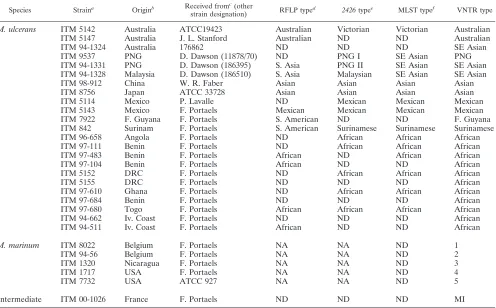
TABLE 1. Strain information
Species Straina Originb Received fromc(other
strain designation) RFLP type
d 2426typee MLST typef VNTR type
M. ulcerans ITM 5142 Australia ATCC19423 Australian Victorian Victorian Australian
ITM 5147 Australia J. L. Stanford Australian ND ND Australian
ITM 94-1324 Australia 176862 ND ND ND SE Asian
ITM 9537 PNG D. Dawson (11878/70) ND PNG I SE Asian PNG
ITM 94-1331 PNG D. Dawson (186395) S. Asia PNG II SE Asian SE Asian
ITM 94-1328 Malaysia D. Dawson (186510) S. Asia Malaysian SE Asian SE Asian
ITM 98-912 China W. R. Faber Asian Asian Asian Asian
ITM 8756 Japan ATCC 33728 Asian Asian Asian Asian
ITM 5114 Mexico P. Lavalle ND Mexican Mexican Mexican
ITM 5143 Mexico F. Portaels Mexican Mexican Mexican Mexican
ITM 7922 F. Guyana F. Portaels S. American ND ND F. Guyana
ITM 842 Surinam F. Portaels S. American Surinamese Surinamese Surinamese
ITM 96-658 Angola F. Portaels ND African African African
ITM 97-111 Benin F. Portaels ND African African African
ITM 97-483 Benin F. Portaels African ND African African
ITM 97-104 Benin F. Portaels African ND ND African
ITM 5152 DRC F. Portaels ND African African African
ITM 5155 DRC F. Portaels ND ND ND African
ITM 97-610 Ghana F. Portaels ND African African African
ITM 97-684 Benin F. Portaels ND ND ND African
ITM 97-680 Togo F. Portaels African African African African
ITM 94-662 Iv. Coast F. Portaels ND ND ND African
ITM 94-511 Iv. Coast F. Portaels African ND ND African
M. marinum ITM 8022 Belgium F. Portaels NA NA ND 1
ITM 94-56 Belgium F. Portaels NA NA ND 2
ITM 1320 Nicaragua F. Portaels NA NA ND 3
ITM 1717 USA F. Portaels NA NA ND 4
ITM 7732 USA ATCC 927 NA NA ND 5
Intermediate ITM 00-1026 France F. Portaels ND ND ND MI
a
ITM, Institute for Tropical Medicine. b
PNG, Papua New Guinea; DRC, Democratic Republic of Congo; Iv. Coast, Ivory Coast; USA, United States; F. Guyana, French Guyana. c
F. Portaels, Institute of Tropical Medicine, Antwerp, Belgium; J. L. Stanford, School of Pathology, London, United Kingdom; D: Dawson, Laboratory of Microbiology and Pathology, Queensland Health, Brisbane, Australia; P. Lavalle, Centro Dermatologico Pascua, Mexico City, Mexico.
d
RFLP, genotype designation determined by IS2404restriction fragment length polymorphism typing (6). S. Asian, South Asian; S. American, South American. NA, not applicable. ND, not done.
e
2426 type, genotype designation determined by2426-PCR (22). PNG I and PNG II, Papua New Guinea 2426 types I and II, respectively. f
MLST, genotype designation determined by multilocus sequence typing (21). SE Asian, Southeast Asian.
on May 16, 2020 by guest
http://jcm.asm.org/
loci with more than 95% nucleotide identity between individ-ual repeat units and with two or more copies of repeats were selected for experimental analysis. These two criteria were used on the basis of the observation that the presence of at least two identical or nearly identical repeats is necessary and sufficient to generate TR variability in the case ofM.
tubercu-losisminisatellites (25).
The loci were given numerical labels 1 to 19. A total of 13 of them were found to be polymorphic in a small collection ofM.
marinumstrains. Table 2 shows their locus information. Most
of them, with the exception of locus 18, contained repeats with complete consensus sizes plus one partial repeat, with lengths ranging from half to nearly complete units. An alignment of the sequences of each locus with the homologous sequences in
theM. ulceransgenome revealed complete identity of TR unit
sequences among both mycobacterial species at loci 8, 9, and 14. In the other loci, there were nucleotide deletions of from 2 to 17 bp and/or from 2 to 14 nucleotide substitutions in the
M. ulceransunits compared to those ofM. marinum. The
se-quences flanking the repeat sese-quences were found to be highly conserved in both species and homologous toM. tuberculosis open reading frames encoding products of diverse functional categories (Table 2). Most of the corresponding TR sequences were found in intergenic positions in these regions. At least one of these homologous regions (locus 13) corresponds to a known VNTR locus in M. tuberculosis, namely, the
senX3-regX3locus (25).
Typing of strains and cluster analysis. The size polymor-phism of the 19 TR loci was analyzed by PCR using a collection of 23M. ulceransisolates, 5M. marinumisolates, and an in-termediate isolate. This latter strain contains a low copy
num-ber of theM. ulcerans-specific insertion sequence IS2404, while many other of its phenotypic and genetic characteristics are similar to those of M. marinum (4). The amplification was robust and yielded reproducible results for all loci and all isolates. A total of 13 of these loci were polymorphic among
theM. marinumcontrol strains; nine were also polymorphic in
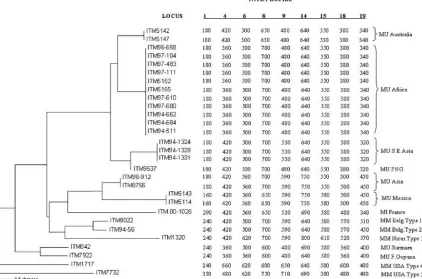
M. ulcerans(Fig. 1). (Only the results obtained for the nine
polymorphic loci in both species are shown).
For the M. ulcerans reference strain (ATCC 19423), the experimentally determined sizes were consistent with the pre-dicted sizes determined from the sequence, except for loci 4, 8, and 14. These discrepancies in the amplicon sizes could be due to inaccuracies in the incompleteM. ulceransgenome sequence available. In view of these discrepancies, the differences in re-peat unit sizes betweenM. ulceransandM. marinum, and the apparent involvement of incomplete repeat units in the varia-tion in some loci (see below), we used the experimentally determined amplicon sizes (Fig. 1) instead of repeat copy num-bers to generate profiles for indexing strain differences. For each locus, amplicon sizes of the different strains were found in most cases to differ by nearly exact multiples of complete re-peat unit lengths predicted for the respective loci inM. ulcerans
and M. marinum. However, smaller differences in amplicon
sizes were also observed in some loci, suggesting the involve-ment of shorter repeat variants in the variability of these loci. These features are consistent with polymorphisms associated with VNTRs.
[image:3.585.44.540.81.320.2]Eight differentM. ulcerans genotypes, fiveM. marinum ge-notypes, and a unique intermediate strain genotype were found by VNTR typing (Fig. 1). Although the test panel is of limited size, the results suggest differential variability among the nine
TABLE 2. Characteristics of VNTR loci inM. marinumandM. ulcerans
Locus Primer sequence (5⬘to 3⬘)a Repeat length (bp)b ORFc Functiond
1 F GGCAGTGGGTGACGTCTCAGT 57 Rv2188c Glycosyltransferase
R TCGAGGCGATCTACACCAAGGATTA FadD15 Long-chain fatty acid coenzyme A ligase
4 F GCCTTGCTTACCGTCGTGCCAA 61 Rv1864c Conserved hypothetical protein
R CGAGCCAAGTTGGACCGTCAACACAT NF NA
6 F GACCGTCATGTCGTTCGATCCTAGT 56 PfkA Phosphofructokinase
R GACATCGAAGAGGTGTGCCGTCT gatB Glutamyl-tRNA amidotransferase
8 F CGGATGACGTCGGAACTCTGA 58 cobB Cobalamine biosynthesis
R GGACGCGGTAGCACGTTTTGT cysG Cobalamine biosynthesis
9 F GGTGGATCTCCGCGTCATTTG 57 Rv3200c Transmembrane cation transporter
R CGACCGCCCTCGAGACAG nudC NADP pyrophosphate
10 F ACAAGCCACGGCGAGATATAG 71 NF NA
R GCGGGGCTTTTATCTGCTTA NF NA
13 F CAGGTATTCCAGGAGATCAAA 53 RegX3 TCS regulator
R GGCGACAAGGCTCGTT SenX3 TCS sensory protein
14 F CCTTGTATCCGAGTTTCAGTT 54 fgd1 Glucose-6 phosphate dehydrogenase
R GTCGACCAGATATGAGCAAT Rv0406c -lactamase-like protein
15 F GCCACCGGTCAGGTCAGGTT 54 MgtE Mg2⫹transmembrane transporter
R TCACCAACTACGACGGCGTTC fbA Fructose biphosphate aldolase
16 F CCAACGCTCCCCCAACCAT 59 NF NA
R GCTCACAGGCCTTCGCTCAGA Rv0238 Transcriptional regulator
18 F CCCGGAATTGCTGATCGTGTA 63 NF NA
R GGTGCGCAGACTGGGTCTTA NF NA
19 F CCGACGGATGAATCTGTAGGT 56 DeaD Cold shock protein
R TGGCGACGATCGAGTCTC IprE Lipoprotein
aF, forward primer, R, reverse primer.
bFor a full length consensus repeat inM. marinum.Lengths could not be determined in several loci of theM. ulceranssequence strain that only include a single copy of repeat element.
cORF, homologous open reading frame inM. tuberculosisH37Rv genome. NF, not found. dAs predicted from Tuberculist. TCS, two-component system; NA, not applicable.
on May 16, 2020 by guest
http://jcm.asm.org/
loci. Loci 18 and 19 were the most variable loci, with a total of seven and six alleles overall, respectively. Locus 19 was the most discriminatory at the intraspecies level, showing four dif-ferent alleles inM. ulceransand four inM. marinum(Fig. 2A and B, respectively). At the other extremity, locus 6 was among the least discriminatory, with only three alleles in total, of which two and three were found inM. ulceransandM. mari-num, respectively. Nevertheless, only loci 6 and 14 could be
used to differentiate between the Surinam and French Guyana
M. ulceransisolates (Fig. 1).
Genetic relationships of the M. marinum and M. ulcerans
isolates.A dendrogram (Fig. 1) of the VNTR profiles of the 29 isolates was built using the neighbor-joining algorithm.
[image:4.585.80.502.74.353.2]A first group in the dendrogram included one Australian genotype (alias Victoria) (22), two genotypes designated South-east Asian and Papua New Guinea of M. ulcerans, and one
FIG. 1. Dendrogram showing the genetic relationships of theM. marinumandM. ulceransisolates determined using nine VNTR loci. The dendrogram was built using the neighbor-joining algorithm and ITM 1717 and 7732 as outgroups, as described in Material and Methods. The VNTR amplicon sizes and the corresponding genotype designations are indicated at the right. The linkage distance scale and the VNTR locus numbers are indicated at the bottom. MM,M. marinum; MU,M. ulcerans; MI, intermediate isolate.
FIG. 2. PCR analysis of VNTR locus 19. (A)M. ulceransand the intermediate strain. Lanes: L, 100-bp DNA ladder; 1, ITM 5142; 2, ITM 5147; 3, ITM 94-1324; 4, ITM 9537; 5, ITM 94-1331; 6, ITM 94-1328; 7, ITM 98-912; 8, ITM 8756; 9, ITM 842; 10, ITM 7922; 11, ITM 5114; 12, ITM 5143; 13, ITM 00-1026; 14, 50-bp ladder (locus 19); 15, ITM 96-658; 16, ITM 97-111; 17, ITM 97-483; 18, ITM 97-104; 19, ITM 5152; 20, ITM 5155; 21, ITM 97-610; 22, ITM 97-648; 23, ITM 97-680; 24, ITM 94-662; 25, ITM 94-511; 26, negative control. (B)M. marinum. Lanes: L, 100-bp DNA ladder; 27, ITM 8022; 28, ITM 1717; 29, ITM 94-56; 30, ITM 1320; 31, ITM 7732; 32, negative control.
on May 16, 2020 by guest
http://jcm.asm.org/
[image:4.585.73.510.531.676.2]African genotype. The Australian genotype included two iso-lates from Australia (Victoria), while the Southeast Asian ge-notype comprised the third isolate from Australia (Queens-land), the Malaysian isolate, and one Papua New Guinea isolate (ITM 94-1331). The genotype of the other Papua New Guinea isolate (ITM 9537) was distinct from the Southeast Asian genotype by only one locus. Strikingly, the African ge-notype included the 11 M. ulcerans isolates from the seven different African countries tested; these isolates did not display any differences among the nine VNTR loci investigated. Sim-ilarly, the isolates from Japan and China had identical profiles at all the nine loci and constituted the Asian genotype. The two Mexican isolates had also identical profiles at all nine loci and were designated the Mexican genotype. This Mexican type was found to be closely related to the Asian type. The two South American isolates from Surinam and French Guyana both gave unique but closely related genotypes, referred to as the Suri-nam and Guyana genotypes, respectively. These strains ap-peared to be more distant from the otherM. ulceransstrains. The fiveM. marinumisolates had five unique genotypes but could be classified into two subgroups, showing some correla-tion with their source of isolacorrela-tion. These two groups included the two isolates from Belgium and the one from Nicaragua as one group and the two isolates from the United States as the other group. The isolate of the intermediate species (ITM 00-1026) was found to be distantly related to theM. ulcerans Asian-Mexican genotype.
DISCUSSION
M. ulcerans features low variability in house-keeping gene
sequences and other genetic elements, especially among iso-lates from the same geographic region (5, 16, 21, 22). Given the informative value of VNTRs for many other genetically homo-geneous organisms, the identification of VNTRs inM. ulcerans may be useful for phylogenetic and epidemiological studies of this pathogen. In this study, we have identified 9 VNTR loci in
M. ulceransand 13 inM. marinumand assessed their usefulness
as new molecular targets to study genetic relationships in these two species.
The set of nine VNTR loci revealed eight genotypes among the 23M. ulceransreference isolates tested. Using largely over-lapping sets of isolates, six genotypes have previously been found by multilocus sequence typing (MLST) analysis of eight structural and house-keeping genes (21) and by restriction fragment length polymorphism (RFLP) of IS2404(6), whereas nine genotypes were found with 2426-PCR, a repetitive-ele-ment PCR targeting IS2404 and IS2606 (22) (Table 1). In contrast, amplified fragment length polymorphism (AFLP) re-vealed only threeM. ulceranssubtypes (6). Although the dif-ferent typing methods were not applied to exactly the same strain collections, these results suggests that the typing method used on the basis of the set of nine VNTR loci described here is at least as discriminatory as the previous typing methods.
VNTR typing groupsM. ulceransisolates according to their geographic origin similarly to MLST results. Both methods cluster the Malaysian and Papua New Guinean isolates ITM 94-1331 as the Southeast Asian type. VNTR analysis provided additional resolution by discriminating one Papua New Guin-ean (strain 11878/70 or ITM 9537) genotype, but this genotype
was consistently closely related by a single-locus difference to the South East Asian genotype. Numerical analyses of the profiles generated by both methods indicate the closest evolu-tionary link between strains from Southeast Asia, Australia, and Africa and a comparatively more distant relation among genotypes from other regions. However, at variance with2426 -PCR results (22) but consistent with MLST results (21), multi-locus VNTR analysis shows the Asian genotype (Japan-China) to be much more closely related to the Mexican genotype than to the Surinam genotype. Considering that the most reliable method for determining genetic relatedness is sequence com-parison, the congruence between VNTR-based and MLST-based (21) groupings indicates that reliable phylogenetic infer-ences can be made from this set of markers over the scale of evolutionary divergence considered. Furthermore, such con-gruence is consistent with the clonal population structure of
M. ulceransapparent from MLST analysis (21).
It is particularly noteworthy that despite the resolution power of these markers, we did not find any size differences in any of nine VNTR loci tested among the 11 African isolates coming from the seven different countries. Consistent with the absence of any sequence variation among African strains iden-tified so far (21, 22), these findings highlight the extremely high clonal homogeneity ofM. ulceransin Africa and lend support to the hypothesis of a recent distribution of the organism across this continent (21). The level of genetic conservation is not so extreme within other geographic regions. In addition to discriminating the isolates from Papua New Guinea by one locus (see above), VNTR analysis could discriminate between the isolates from French Guyana and Surinam by two loci, in contrast to IS2404RFLP results (5) and AFLP results (6). This finding identifies for the first time two closely related but dif-ferentM. ulceransgenotypes in South America. Furthermore, the difference between these two isolates and the Mexican isolates, also apparent from MLST analysis (21), was much greater (at seven loci out of nine) than that between the two South American isolates. This is the most extensive difference amongM. ulceransstrains originating from a same continent observed so far by VNTR analysis and suggests that the cor-responding genotypes may have arisen independently in the Americas.
Beyond this comparison with the Mexican isolates, the South American isolates appeared distantly related to theM. ulcerans strains from the other geographic regions in general. Consis-tently, the isolate from Surinam appeared as the most distal geographical genotype among theM. ulceransisolates tested by MLST (21) and was distinct fromM. ulceransisolates from the other geographic regions by the sequence of the 3⬘-terminal end of its 16S rRNA gene, which is identical to that of M.
marinumstrains (16). Similarly, the isolate of the intermediate
species (ITM 00-1026) was found to be distantly related to the Asian-MexicanM. ulcerans genotypes and one of theM.
ma-rinumsubgroups. However, the analysis of more deep-rooted
relationships should be considered with some caution because of the limited degree of confidence inherent in investigations conducted using a set presently restricted to nine VNTR loci. In conclusion, this study supported the potential of a VNTR-based genotyping method for M. ulcerans and M. marinum. Since VNTR genotyping has also been successfully applied to
the M. tuberculosis (8, 17, 19, 20, 25) and M. avium (2, 3)
on May 16, 2020 by guest
http://jcm.asm.org/
complexes, it is likely that they can be used for the typing of other species of the mycobacterial genus as well. This method offers several practical advantages over AFLP- or RFLP-based typing methods, such as easier DNA extraction (from boiled colonies) suitable for typing and easier interpretation of the banding patterns. The panel of nine markers identified here permitted the discrimination of M. ulcerans isolates within some but not all geographic regions and offers a resolution power comparable to or slightly higher than that of these methods and of MLST. The identification of these nine loci can therefore be considered as a first promising step towards the potential use of VNTRs as markers for molecular epide-miological studies of BU within given geographic regions. This set of loci most likely represents only a fraction of the VNTR patrimony ofM. ulcerans, as numerous and diverse arrays of TRs identified inM. marinumhave homologs in M. ulcerans which have not been explored yet. Conversely, it is possible that inM. ulcerans, some VNTR loci, such as in the recently identified giant plasmid encoding its macrolide toxin (24), exist that have no counterparts in theM. marinumgenome and thus could not be detected by our homology-based strategy. Hence, the publication of the completeM. ulceransgenome sequence will provide an opportunity for the discovery of additional tandem repeat loci, which should enhance strain resolution. Higher resolution will be especially useful to further assess the genetic homogeneity of AfricanM. ulceransisolates.
ACKNOWLEDGMENTS
We thank P. Lavalle, W. R. Faber, and P. H. G. van Keulen for the donation of mycobacterial isolates. We are grateful to Juan Carlos Palomino, Leen Rigouts, Anandi Martin, and Pieter Stragier for their assistance and advice. We thank Pim de Rijk, Krista Fissette, and Cecile Uwizeye for the excellent technical work. We also thank the Sanger Center and The Pasteur Institute for making unpublished ge-nome sequences available.
This work was partly supported by a grant from the Fund for Sci-entific Research, Flanders (Flanders, Belgium) (F. W. O. Vlaanderen; contracts G. 0301.01 and G. 0471.03N), by the Institut Pasteur de Lille, and by INSERM. A.A. was supported by a grant from the Damien Foundation (Brussels, Belgium). P.S. is a Researcher of the Centre National de la Recherche Scientifique (CNRS).
REFERENCES
1.Amofah, G. K., C. Sagoe-Moses, C. Adjei-Acquah, and E. H. Frimpong.1993. Epidemiology of Buruli ulcer in Amansie West district, Ghana. Trans. R. Soc. Trop. Med. Hyg.87:644–645.
2.Amonsin, A., L. L. Li, Q. Zhang, J. P. Bannantine, A. S. Motiwala, S. Sreevatsan, and V. Kapur.2004. Multilocus short sequence repeat sequenc-ing approach for differentiatsequenc-ing amongMycobacterium aviumsubsp. paratu-berculosisstrains. J. Clin. Microbiol.42:1694–1702.
3.Bull, T. J., K. Sidi-Boumedine, E. J. McMinn, K. Stevenson, R. Pickup, and J. Hermon-Taylor.2003. Mycobacterial interspersed repetitive units (MIRU) differentiate Mycobacterium avium subspecies paratuberculosis from other species of theMycobacterium aviumcomplex. Mol. Cell. Probes 17:157–164.
4.Chemlal, K., G. Huys, F. Laval, V. Vincent, C. Savage, C. Gutierrez, M.-A. Laneelle, J. Swings, W. M. Meyers, M. Daffe, and F. Portaels.2002. Char-acterization of an unusual mycobacterium: a possible missing link between
Mycobacterium marinumandMycobacterium ulcerans. J. Clin. Microbiol.40: 2370–2380.
5.Chemlal, K., K. de Ridder, P. A. Fonteyne, W. M. Meyers, J. Swings, and F. Portaels.2001. The use of IS2404restriction fragment length polymorphisms suggests the diversity ofMycobacterium ulceransfrom different geographic areas. Am. J. Trop. Med. Hyg.64:270–273.
6.Chemlal, K., G. Huys, P. A. Fonteyne, V. Vincent, A. G. Lopez, L. Rigouts, J. Swings, W. M. Meyers and F. Portaels.2001. Evaluation of PCR-restriction profile analysis and IS2404restriction fragment length polymorphism and
amplified fragment length polymorphism fingerprinting for identification and typing ofMycobacterium ulceransandMycobacterium marinum. J. Clin. Microbiol.39:3272–3278.
7.Debacker, M., J. Aguiar, C. Steunou, C. Zinsou, W. M. Meyers, A. Gue´de ´-non, J. T. Scott, M. Dramaix, and F. Portaels.2004. Trends in Mycobacte-rium ulceransdisease (Buruli ulcer) patients as seen in a rural hospital of Southern Benin, 1997 through 2001. Emerging Infect. Dis.10:1391–1398. 8.Frothingham, R., and W.A. Meeker-O’Connell.1998. Genetic diversity in
Mycobacterium tuberculosiscomplex based on variable numbers of tandem DNA repeats. Microbiology144:1189–1196.
9.Keim, P., L. B. Price, A. M. Klevytska, K. L. Smith, J. M. Schupp, R. Okinaka, P. J. Jackson, and M. E. Hugh-Jones.2000. Multiple-locus-vari-able-number tandem repeat analysis reveals genetic relationships within
Bacillus anthracis. J. Bacteriol.182:2928–2936.
10.Klevytska, A., L. B. Price, J. M. Schupp, P. L. Worsham, J. Wong, and P. Keim.2001. Identification and characterization of variable-number tandem repeats inYersinia pestisgenome. J. Clin. Microbiol.39:3179–3185. 11.Marsollier, L., R. Robert, J. Aubry, J. P. Saint Andre, H. Kouakou, P.
Legras, A. L. Manceau, C. Mahaza, and B. Carbonnelle.2002. Aquatic insects as a vector forMycobacterium ulcerans. Appl. Environ. Microbiol.68: 4623–4628.
12.Marston, B. J., M. O. Diallo, C. R. Horsburgh, Jr., I. Diomande, M. Z. Saki, J. M. Kanga, G. Patrice, H. B. Lipman, S. M. Ostroff, and R. C. Good.1995. Emergence of Buruli ulcer disease in the Daloa region of Coˆte d’Ivoire. Am. J. Trop. Med. Hyg.52:219–224.
13.Mazars, E., S. Lesjean, A. Banuls, M. Gilbert, V. Vincent, B. Gicquel, M. Tibayrenc, C. Locht, and P. Supply.2001. High resolution minisatellite-based typing as a portable approach to global analysis ofMycobacterium tuberculosismolecular epidemiology. Proc. Natl. Acad. Sci. USA98:1901– 1906.
14.Portaels, F.1995. Epidemiology of mycobacterial diseases. Clin. Dermatol. 13:207–222.
15.Portaels, F., P. Elsen, A. Guimares-Peres, P. A. Fonteyne, and W. M. Meyers. 1999. Insects in the transmission ofMycobacterium ulceransinfection. Lancet 353:986.
16.Portaels, F., P. A. Fonteyne, H. de Beehouwer, P. de Rijk, A. Guedenon, J. Hayman, and W. M. Meyers.1996. Variability in the 3⬘end of 16S rRNA sequence ofMycobacterium ulceransis related to the geographic origin of isolates. J. Clin. Microbiol.34:962–965.
17.Roring, S., A. Scott, D. Brittain, I. Walker, G. Hewinson, S. Neill, and R. Skuse.2002. Development of variable-number tandem repeat typing of My-cobacterium bovis: comparison of results with those obtained by using exist-ing exact tandem repeats and spoligotypexist-ing. J. Clin. Microbiol.40:2126– 2133.
18.Ross, B. C., P. D. R. Johnson, F. Oppedisano, L. Marino, A. Sievers, T. Stinear, J. Hayman, M. G. K. Veitch, and R. M. Robins-Browne.1997. Detection ofMycobacterium ulceransin environmental samples during an outbreak of ulcerative disease. Appl. Environ. Microbiol.63:4135–4138. 19.Skuce, R. A., T. P. MacCorry, J. F. McCarroll, S. M. M. Roring, A. N. Scott,
D. Brittain, S. L. Hughes, R. G. Hewinson, and S. D. Neill.2002. Discrim-ination ofMycobacterium tuberculosiscomplex bacteria using novel VNTR-PCR targets. Microbiology148:519–528.
20.Smittipat, N., and P. Pallittapongarnpim.2000. Identification of possible loci of variable number of tandem repeats inMycobacterium tuberculosis. Tuber. Lung Dis.80:69–74.
21.Stinear, T. P., G. A. Jenkins, P. D. R. Johnson, and J. K. Davis.2000. Comparative genetic analysis ofMycobacterium ulceransandMycobacterium marinumreveals evidence of recent divergence. J. Bacteriol.182:6322–6330. 22.Stinear, T. P., J. K. Davis, G. A. Jenkins, F. Portaels, B. C. Ross, F. Oppe-disano, M. Purcell, J Hayman, and P. D. R. Johnson.2000. A simple PCR method for rapid genotype analysis ofMycobacterium ulcerans. J. Clin. Mi-crobiol.38:1482–1487.
23.Stinear, T. P., J. K. Davis, G. A. Jenkins, J. A. Hayman, F. Oppedisano, and P. D. R. Johnson.2000. Identification ofMycobacterium ulcerans in the environment from regions in Southeast Australia in which it is endemic with sequence capture-PCR. Appl. Environ. Microbiol.66:3206–3213. 24.Stinear, T. P., A. Mve-Obiang, P. L. C. Small, W. Frigui, M. J. Pryor, R.
Brosch, G. A. Jenkin, P. D. R. Johnson, J. K. Davies, R. E. Lee, S. Adusu-milli, T. Garnier, S. F. Haydock, P. F. Leadlay, and S. T. Cole.2004. Giant plasmid-encoded polyketide synthases produce the macrolide toxin of My-cobacterium ulcerans. Proc. Natl. Acad. Sci. USA101:1345–1349. 25.Supply, P., E. Mazars, S. Lesjean, V. Vincent, B. Gicquel, and C. Locht.2000.
Variable human minisatellite-like regions in theMycobacterium tuberculosis
genome. Mol. Microbiol.39:3563–3571.
26.van Embden, J. D. A., M. D. Cave, J. T. Crawford, J. W. Dale, K. D. Eisenach, B. Gicquel, P. Hermans, C. Martin, R. McAdam, T. M. Shinnick, and P. M. Small.1993. Strain identification ofMycobacterium tuberculosisby DNA fingerprinting: recommendations for a standardized methodology. J. Clin. Microbiol.31:406–409.