ISSN 2250-3153
Effects of Internal Plasticization on the Physical and
Mechanical Properties of Castor Oil - Based
Polyurethane Foams
A.K. Yusuf1, P.A.P. Mamza2, A.S. Ahmed3 and U. Agunwa4
1
Department of Chemistry, Al-Qalam University, Katsina 2
Department of Chemistry, Ahmadu Bello University, Zaria 3Department of Chemical Engineering, Ahmadu Bello University, Zaria 4National Research Institute for Chemical Technology (NARICT), Zaria
DOI: 10.29322/IJSRP.8.10.2018.p8213
http://dx.doi.org/10.29322/IJSRP.8.10.2018.p8213
Abstract - Flexible castor oil-based polyurethane foams were produced by the one-shot method of foam synthesis. Foam formulation involved pure castor oil/castor oil modified with heptachloroheptadecane (HCHD), a novel C-17 chlorinated hydrocarbon internal plasticizer, 80:20 mixture of 2,4 - and 2,6 - toluene diisocyanate (TDI) at room temperature (30 - 350C). Foam reaction took place in presence of stannous octoate and dimethylaminoethanol (DMAE) catalysts, methylene chloride (physical blowing agent) and silicone oil (surfactant). Isocyanate/polyol (NCO/OH) ratio was 1/1. Concentration of plasticizer used varied from 0.4 - 2.4 wt%. Foams obtained were tested for their physical and mechanical properties. Suggested mode of action and the influence of the incorporated internal plasticizer (HCHD) on these properties are discussed. Results indicate reduction in the density and compressive strength of the foams, but enhancement of their % creep recovery and water absorption as plasticizer concentration increased. These property changes suggest greater flexibility, extensibility and workability of foam. The most flexible foams were obtained at 2.4wt% concentration of the incorporated plasticizer. Areas of potential applicability or end-use of the new products are highlighted.
Index Terms - castor oil; plasticizer; flexible foam; properties.
INTRODUCTION
Polyurethanes (PUs) are polymers containing the urethane linkage (-NH-CO-O-) in the main chain. Polyurethane foams
(PUFs) can be produced by reacting a polyol with an excess of organic polyisocyanate (in presence of catalysts and other additives)
according to the generalized PU reaction.
R (OH)n + R1-(N=C=O)n Rl – ( NH.CO-O)n-R (1)
polyol polyisocyanate polyurethane
(where n > 2)
The replacement of petroleum-based polyols or petropolyols such as polyether and polyester polyols with polyols derived
from renewable materials of plant origin in the synthesis of PUFs has resulted in cheaper, safer, more environment friendly products
with excellent thermal stability and oxidation resistance. Superior thermal stability and oxidation resistance of plant oil polyols over
petropolyols are believed to be due to higher hydrocarbon content in the former (Javni et al., 2000, Petrovic et al., 2005; Badri; 2012).
al.; 2005); except in plant oils containing secondary hydroxyl groups, where so-called ‘dangling’ chains in the oil’s TAG molecules
are believed to exert steric hindrance to crosslinking (Xu, 2008; Fan, 2012). These crosslinked materials are characterized by high
mechanical strength, high hardness index, but low resilience (Randall, 2002; Bleys, 2012). The materials are therefore hard to melt
and reprocess, making them non-recyclable. Thus in the PUF industry where flexible PUFs used in cushioning, bedding and
packaging applications are the chief products, use of unmodified plant oil polyols is definitely not a viable option.
In recent years, researchers have resorted to the chemical modification of plant oils to obtain PUs of desired physical and
chemical characteristics. In castor oil-based PUF synthesis, a major attempt at remedying the situation involved the use of ‘mixed’
polyol formulations in which the conventional, commercial (polyether/polyester) polyol is mixed with low or moderate proportions of
castor oil to obtain flexible PUFs (Xu et al., 2008; Zhang, 2008; Xing, 2014; Sharma et al., 2014). However, despite cost-benefit
analysis of blending the conventional base polyol with castor oil indicating some level of cost effectiveness (Ogunfeyitimi et al.,
2012; Thorat and Patil, 2015), these mixed polyol recipes were not quite successful on grounds of low local content input (often no
more than 15-25% castor oil) that cannot support sustainability. Another drawback is the compatibility question arising from mixing
the two components.
The advent of inter-penetrating polymer networks (IPNs) presents another dimension to the modification of plant oils to
obtain PUs. These materials are obtained as a result of permanent entanglement between two or more distinctly crosslinked polymers
and the excellent properties they exhibit are belived to be as a result of the interlocking of polymer chains in their structure (Sperling,
1981; Islam et al., 2014).
Mention should also be made of the many other chemical modification recipes involving castor oil polyols
(transesterifiction, epoxidation, acrylation etc) that often result in improved and varied polymer characteristics and end-uses. These
have been adequately reported in literature (Ogunniyi, 2006; Del Rio, 2011; Mubofu, 2016). But one area in which very little has
been investigated and reported is the introduction of an internal plasticizer into the castor oil component prior to foam synthesis
(Murkherjea et al., 1978; Pandey and Vatsa, 2010). A plasticizer is an additive used to increase the flexibility and extensibility of a
material by lowering its glass transition temperature (Tg) and softening the final product, with attendant loss of material strength and
hardness, among others.
The present investigation reports on the application of heptachloroheptadecane (HCHD), a C-17 straight chain chlorinated
hydrocarbon, as an internal liquid plasticizer introduced into castor oil polyol component of foam formulation prior to foam synthesis.
The effects of this novel, oil-compatible plasticizer on the physical and mechanical properties of the castor oil-based PUFs
synthesized are also reported.
MATERIALS AND METHODS Materials
Mechanically extracted castor oil from wild Ricinus communis Linn seeds (Yusuf, 2016) was used as polyol. TDI (80:20),
silicone oil (surfactant), stannous octoate (gelation catalyst), DMAE (amine catalyst) and methylene chloride were the other
foam-making chemicals used. They were kindly supplied by Vitafoam Nig. Plc, Jos. Distilled water was used as chemical blowing agent.
2,5,6,7,8,11,15-heptachloroheptadecane (HCHD) (Fig. 1) was purchased from a local supplier in Nigeria and used as internal
plasticizer.
ISSN 2250-3153
Fig. 1: Structure of HCHD (C17H29Cl7)
Methods
Foam Preparation
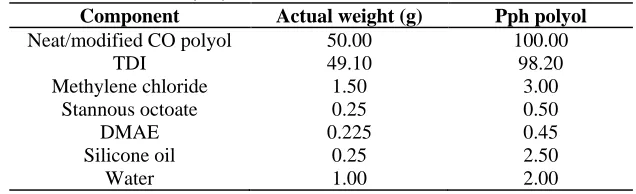
Foams were prepared by the one-shot method (ASTM D 7487) of foam synthesis. Foams were prepared in locally fabricated open
moulds of dimension 18x15x9 cm3 at room temperature, by the free rise method. Castor oil and all other foam-making chemicals (less
TDI) were accurately measured as per formulation (Table 1) into a plastic mug, with constant vigorous stirring using a high speed
(1000 rev/min) mechanical stirrer. This is the polyol component. 0.4, 0.8, 1.2, 1.6, 2.0 and 2.4 parts per hundred (pph) polyol portions
of the internal plasticizer (HCHD) were separately added as part of polyol component, with continuous stirring. TDI, measured out
separately in another container, was then rapidly added to this uniform mixture with continuous stirring, to ensure the formation of
[image:3.612.103.421.335.432.2]homogeneous foam. Solidifying foam product was kept in a fume cupboard for 24 hrs to cure completely, before demoulding.
Table 1: Foam formulation – NCO/OH (1/1)
Component Actual weight (g) Pph polyol
Neat/modified CO polyol 50.00 100.00
TDI 49.10 98.20
Methylene chloride 1.50 3.00
Stannous octoate 0.25 0.50
DMAE 0.225 0.45
Silicone oil 0.25 2.50
Water 1.00 2.00
Pph = Parts per hundred (polyol)
Determination of Physical Properties Density determination
ASTM D 1622-08 procedure was used to evaluate the apparent density (kg/m3) of foam samples based or mass/volume
measurements.
Water absorption
Water absorption test was performed in accordance with ASTM D590-98 and ASTM D2842-12. Water absorption of foam was
evaluated as.
% water absorption = 𝑊𝑒𝑖𝑔ℎ𝑡𝑜𝑓𝑤𝑒𝑡𝑊𝑒𝑖𝑔ℎ𝑡𝑓𝑜𝑎𝑚−𝑊𝑒𝑖𝑔ℎ𝑡𝑜𝑓𝑖𝑛𝑖𝑡𝑖𝑎𝑙𝑓𝑜𝑎𝑚𝑜𝑓𝑖𝑛𝑖𝑡𝑖𝑎𝑙𝑓𝑜𝑎𝑚 x 100 (2)
Determination of Mechanical Properties Compressive Strength
Compressive strength of plasticized and unplasticized castor oil-based PUFs was measured in accordance with ASTM
Creep recovery test for the plasticized and unplasticized foams was performed on a Creep Machine - TecQuipment (TQ) SM
1006 (Cell load 250N) - as per ASTM D2990-09 procedure. Creep recovery was evaluated as the difference between the total
extension (mm) on application of load and the relaxation (mm) on removal of load after 5 seconds. Percentage creep recovery was
then calculated as:
% creep recovery = 𝐶𝑟𝑒𝑒𝑝𝑟𝑒𝑐𝑜𝑣𝑒𝑟𝑦𝑜𝑟𝑟𝑒𝑠𝑖𝑙𝑖𝑒𝑛𝑐𝑒
𝐸𝑥𝑡𝑒𝑛𝑠𝑖𝑜𝑛𝑜𝑛𝑎𝑝𝑝𝑙𝑖𝑐𝑎𝑡𝑖𝑜𝑛𝑜𝑓𝑙𝑜𝑎𝑑 x 100 (3)
RESULTS AND DISCUSSION
Physical Properties of the Castor Oil-Based PUFs General physical features
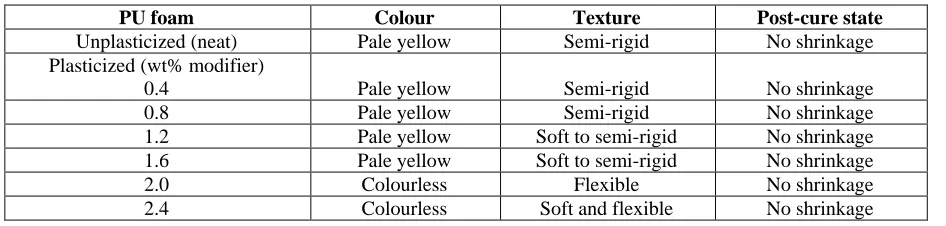
Synthesized foams were observed for colour, texture and shrinkage post-cure. No foam showed signs of shrinkage post-cure,
suggesting that the foams were of good dimensional stability. The colour of the (neat) foam was pale yellow while colour range for
the plasticized foams was pale yellow to colourless. Texture varied from semi-rigid (neat foam) to soft and flexible (plasticized
[image:4.612.73.546.318.431.2]foam).
Table 2: Observed general physical features of the PUFs
PU foam Colour Texture Post-cure state
Unplasticized (neat) Pale yellow Semi-rigid No shrinkage Plasticized (wt% modifier)
0.4 Pale yellow Semi-rigid No shrinkage
0.8 Pale yellow Semi-rigid No shrinkage
1.2 Pale yellow Soft to semi-rigid No shrinkage 1.6 Pale yellow Soft to semi-rigid No shrinkage
2.0 Colourless Flexible No shrinkage
2.4 Colourless Soft and flexible No shrinkage
Colour assumed by foam seemed to depend either on the natural colour of the base polyol - castor oil (yellow) or that of the
modifier (colourless) or both. On the other hand, changes in foam texture and feel are consistent with structural changes undergone by
the PUF as a result of increased plasticization.
Effect of plasticization on foam density
ISSN 2250-3153
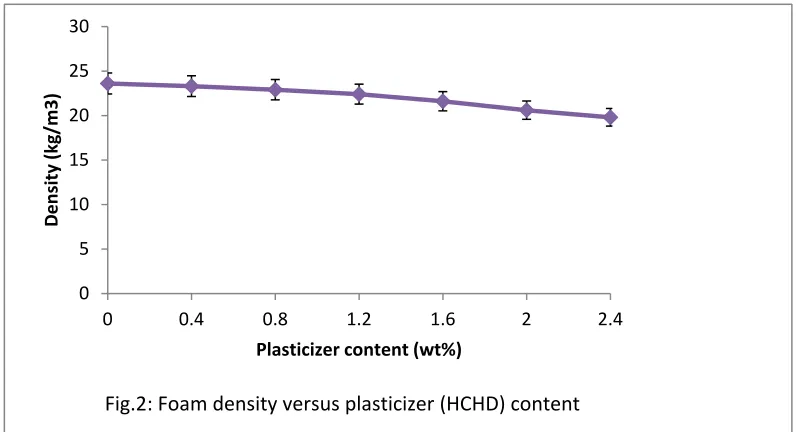
This development creates greater free volume between PU chains and weakens cohesive intermolecular forces of attraction
between them, resulting in greater segmental mobility within the PU matrix (Fig. 3). The C-17 HCHD chain molecules aligned
between the PU main chains tended to mask or block interaction sites for the formation of cohesive intermolecular forces of
attraction. Longer plasticizer chain means ability to block greater number of such interaction sites along the PU main chains. These
are consistent with the observed density decline and relatively more flexible and softer structural features of foam with increase in
HCHD content from 0.4 - 2.4 wt%.
[image:5.612.102.502.56.272.2]
Fig. 3: Schematic arrangement of reactive plasticizer molecules in PU matrix.
Effect of plasticization on water absorption
Greater free volume in PU foam matrix with increased HCHD content resulted in increased water absorption (Fig. 4). This
explains the observed greater water sorption in the plasticized foams which are structurally more porous compared to the control 0
5 10 15 20 25 30
0 0.4 0.8 1.2 1.6 2 2.4
De
nsi
ty
(k
g/
m
3)
[image:5.612.28.531.424.589.2]Plasticizer content (wt%)
Fig.2: Foam density versus plasticizer (HCHD) content
cohesive forces
slipping PU
chains
freevolume
(a) Unplasticized
0 20 40 60 80 100
0 0.4 0.8 1.2 1.6 2 2.4
Co m pr essi ve st re ng th (K N/ m 2)
Plasticizer content (wt%)
1.7
1.75 1.8
1.85 1.9
1.95 2
2.05 2.1
2.15 2.2
2.25
0 0.4 0.8 1.2 1.6 2 2.4
W at er a bs or pt ion (w t% )
[image:6.612.115.482.57.244.2]Plasticizer content (wt%)
Fig. 4: Water absorption versus plasticizer (HCHD) content
Mechanical Properties of the Castor Oil - Based PUFs
Effect of plasticization on compressive strength and percentage creep recovery
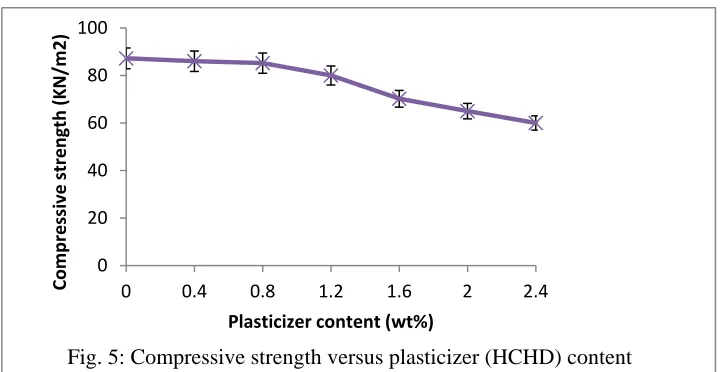
In Fig. 5, foam compressive strength declined steadily with increase in HCHD content. This is consistent with foam density
decline as HCHD content increased (Fig. 2). Mechanical properties of PUFs such as tensile strength, compressive strength,
compressive modulus, creep recovery etc are known to depend strongly on density (Saint-Michel et al., 2006; Song et al., 2009) as
well as on the material composition. Foam density therefore is a very important physical property which has great influence on the
mechanical properties of PUFs (Thirumal et al., 2008). For a foamed polymer generally, compressive properties are important
because they describe the behaviour of the foam when it is subjected to compressive load. HCHD plasticized PUFs exhibited lower
compressive strengths than the control (neat) PUF.
This is explained in terms of the C-17 HCHD chain molecules constituting a great impediment to inter-chain polymer interactions
that could produce rigid or semi-rigid foams, and at the same time offering substantial free volume in the PUF matrix for segmented
mobility.
[image:6.612.95.456.430.616.2]ISSN 2250-3153
Conversely, %creep recovery of foam was substantially enhanced with increase in plasticizer content (Fig. 6). Creep
recovery describes the extent to which a polymer under plastic deformation recovers its original shape over time. In other words,
creep recovery is a function of foam resilience.
Compressive strength is a support-factor that is related to foam load-bearing capacity or ‘firmness’, while creep recovery is
an indicator of foam resilience. These parameters are very important especially in PUF application that requires high energy impact
absorption such as packaging, furniture and beddings, foot wears etc.
Conventional (Standard) Flexible PUF Versus Plasticized Castor Oil-Based PUF
The ability of HCHD plasticization to produce fairly soft and flexible castor oil - based PUFs has prompted a comparison
[image:7.612.38.396.105.282.2]between their physical and mechanical properties, and those of conventional (standard) flexible PUFs (Table 3).
Table 3: Values of physical and mechanical properties of flexible castor oil-based PUFs versus international standards for the conventional flexible foam.
Property Observed Standard
Density (Kg/m3) 19.50 – 21.45 12.81 – 40.05 ASTM D 3574-11
Water absorption (wt.%) 2.24 – 2.26 <3 (ASTM D570-98
Compressive Strength (KN/m2) 48.80 – 51 >172 (ASTM D1621-10)
Creep recovery (%) 44.20 – 47.60 -
Divergent compressive strength and to a lesser extent density values between the two foam types might be as a result of the
application of reinforcing fillers in some formulations to enhance foam firmness in the commercial flexible PUF.
Scanning electron microscopic (SEM) analysis of the castor oil - based PUFs has shown that soft, flexible foams can be
produced at relatively higher plasticizer content in the formulation (Fig. 7). 0
10 20 30 40 50 60
0 0.4 0.8 1.2 1.6 2 2.4
Cr
eep
rec
over
y
(%
)
[image:7.612.70.543.505.595.2]Plasticizer content (wt%)
Fig.7: SEM image of HCHD plasticized castor oil-based PUF at 2.4 wt% plasticizer concentration, showing open-cell cellular structure.
CONCLUSION
The in-situ chemical modification of castor oil with a novel, oil-compatible C-17 chlorinated hydrocarbon internal plasticizer
(HCHD) prior to foam reaction with TDI has yielded soft, flexible castor oil-based PUFs with physical and mechanical properties
comparable to those of the conventional, standard flexible PUF. The new products should provide a number of advantages including
processability, mouldability, high impact absorption and provision of comfort if applied in furniture, beddings, foot wears etc. But
more importantly, having been obtained from almost 100% castor oil polyol, their availability could assist in reducing the importation
of commercial polyol by the foam industry in Nigeria, thereby conserving foreign exchange for the country. The control (neat) foam
showed typical characteristics of semi-rigid foam and therefore can be used in thermal insulation, refrigeration, packaging and
transportation.
Another major advantage of the new products is their fire retardancy (Yusuf et al., 2016). However, the use of low
concentrations (0.4 - 2.4 wt%) of HCHD in the foam formulations was in order not to drastically alter the polymerization and
foaming stages of the foam reaction that occur simultaneously, and to reduce the potential toxicity of the chlorinated hydrocarbon
plasticizer.
REFERENCES
American Society for Testing and Materials (ASTM) D1621-10. Standard test method for compressive properties of rigid cellular
plastics.
American Society for Testing and Materials (ASTM) D1622-08. Standard test method for apparent density of rigid cellular plastics,
2008.
American Society for Testing and Materials (ASTM) D2842-12. Standard test method for water absorption of rigid cellular plastics.
American Society for Testing and Materials (ASTM) D2990-09. Standard test methods for the determination of tensile and
compressive, creep and creep-rupture of plastics under specified environmental conditions.
Open window Open window
ISSN 2250-3153
American Society for Testing and Materials (ASTM) D3574-11. Standard test methods for flexible cellular materials - slab, bonded
and molded urethane foams.
American Society for Testing and Materials (ASTM) D570-98. Standard test method for water absorption of plastics.
American Society for Testing and Materials (ASTM) D7487. Standard practice for polyurethane raw materials: polyurethane foam
cup test.
Badri, K.H. (2012) Biobased polyurethane from palm kernel oil-based polyol, chapter 20, Licensee InTech
(http://creativecommons.org/licenses/by/3.0)
Bleys, G. (2012) High resilience flexible polyurethane foams containing castor oil.
http://purpatents.com/2012/12/04/high-resilience-flexible-polyurathane-foams-containing-castor-oil
Del Rio, E. (2011) New polyurethanes from vegetable oil-based polyols. Ph.D Thesis. Universitat Rovira I Virgili.
Fan, H; Tekeei, A. Suppes, G.J. and Hsieh, F. (2012) Properties of biobased rigid polyurethane foams reinforced with fillers:
microspheres. International Journal of Polymer Science (http://dx.doi.org/10.115/2012/474803.
Fox, J. (2008) Analysis of polymer additives in the packaging industry. (http://www.iopp.org/files/public/foxfloridaAdditives.pdf).
Gayki, B.K. Thorat, P.V. and Tayde, S.S. (2015) A review of synthesis and characterization of castor oil based polyurethane
adhesive. International Journal of Emerging Technology and Advanced Engineering, 5(3): 95-97.
Guo, A.; Cho, Y. and Petrovic, Z.S. (2000) Structure and properties of halogenated and non-halogenated soy-based polyols. Journal
of Polymer Science Part A: Polymer Chemistry, 38(21): 3900-3910.
Islam, M.R.; Beg, M.D.H. and Jamari, S.S. (2014) Development of vegetable-oil-based polymers, Journal of Applied Polymer
Science, 131(18): 40787. Doi: 10.1002/app.40787.
Javni, I.; Petrovic Z.S.; Guo, A. and Fuller, R. (2000). Thermal stability of polyurethanes based on vegetable oils. Journal of Applied
Polymer Science, 77(8): 1723-1734.
Klorfin, S.P. (2012) Surya parkash ([email protected])
Mubofu, E.B. (2016). Castor oil as a potential renewable resource for the production of functional materials. Chemical processes,
4:11.
Murkherjea, R.N. Saha, K.K. and Sanyal, S.K. (1978) Plasticizing effect of acetylated castor oil on castor oil-based, moisture-cured
polyurethane film. Journal of the American Oil Chemists’ Society. 55:653-654.
Ogunfeyitimi, O.S.; Okewale, A.O. and Igbokwe, P.K. (2012) The use of castor oil as a reactive monomer in synthesis of flexible
polyurethane foam. International Journal of Multidisciplinary Sciences and Engineering, 3(10): 10-14.
Ogunniyi, D.S. (2006) Castor oil: a vital industrial raw material. Bioresource Technology, 97: 1086-1091.
Pandey, D. And Vatsa, J.L. (2010) Castor oil derivatives as potential plasticizers. International Research Journal of Pharmaceutical
Sciences, 01(01):051.
Petrovic, Z.S.; Zhang, W. and Javni, I. (2005) Structure and properties of polyurethane prepared from triglyceride polyols by
ozonolysis. Biomacromelocules, 6 (2): 713-719.
Randall, D. and Lee, S. (2002) The Polyurethanes Book.Wiley Ltd: New York NY, USA, pp 169-188.
Somani, K.P; Kansara, S.S.; Patel, N.K. ; Rakshit A.K. (2003). Castor oil based polyurethane adhesive for wood-to-wood bonding.
International Journal of adhesion and adhesives, 23: 269-275
Song, B.; Lu, W-Y.; Syn, C. and Chen, W. (2009) The effects of strain rate, density and temperature on the mechanical properties of
polymethylene diisocyanate (PMDI)-based rigid polyurethane foams during compression. Journal of Materials Science,
44(2): 351-357.
Sperling, L.H. (1981) Interpenetrating polymer networks and related materials, Plenum, New York, p. 265.
Thirumal, M.; Khastgir, D.; Singha, N.K.; Manjunath, B.S. and Naik, Y.P. (2008) Effect of foam density on the properties of water
blown rigid polyurethane foam. Journal of polymer science, 108(3): 1810-1817.
Thorat, P.V. and Patil, N. (2015) Thermo-mechanical analysis of foam based on castor oil polyol. International Journal of Emerging
Technology and Advanced Engineering, 5(4): 210-212.
Xing, R. (2014) Polyurethane foams containing renewable castor oil replacement. M.Sc. Thesis. University of Missouri, Missouri -
Columbia.
Xu, Y.; Petrovic, Z.S.; Das, S. and Wilkes, G.L. (2008) Morphology and properties of thermoplastic polyurethanes with dangling
chains in ricinoleate-based soft segments. Polymer, 49: 4248-4258.
Yilgor, E.; Burgaz, E.; Yurtsever, E. and Yilgor, I. (2000) Comparison of hydrogen bonding in polymethylsiloxane and polyether
based urethane and urea copolymers. Polymer, 41(3): 849-857.
Yusuf, A.K. (2016). Structure-property relationships of castor oil-based polyurethane foams, Ph.D. Thesis, Ahmadu Bello
University, Zaria, Nigeria.
Yusuf, A.K.; Mamza, P.A.P., Ahmed, A.S. and Agunwa, U. (2016) Flame properties of filled and FR - treated castor oil-based
polyurethane foams. Nigerian Journal of Polymer Science and Technology, 11: 90-98.
Zhang, L. (2008). Structure property relationship of polyurethane flexible foam made from natural oil polyols. Ph.D Dissertation. The
University of Minnesota, Minneapolis, Minnesota, USA.
Zlatanic, A.; Petrovic, Z.S. and Dusek, K. (2002) Structure and properties of triolein-based polyurethane networks.
Biomacromolecules, 3(5): 1048-1056.
AUTHORS
First Author – A.K.Yusuf (Ph.D). Department of Chemistry, Al-Qalam University, Katsina, Nigeria. Email:
Second Author – P.A.P. Mamza (Ph.D). Department of Chemistry, Ahmadu Bello University, Zaria, Nigeria. Email:
Third Author – A.S.Ahmed (Ph.D). Department of Chemical Engineering, Ahmadu Bello University, Zaria, Nigeria. Email:
Fourth Author – U.Agunwa (Ph.D). National Research Institute for Chemical Technology (NARICT), Zaria, Nigeria.