Comparative Analysis of OSPF, Rip And EIGRP
Convergence Time Using Riverbed Modeler
Ledisi G. Kabari, Onwuka C. Ugochukwu
Department of Computer Science, Ignatius Ajuru University of Education, Port Harcourt Nigeria.
DOI: 10.29322/IJSRP.8.12.2018.p8469
http://dx.doi.org/10.29322/IJSRP.8.12.2018.p8469
Abstract: Routers have enhanced the way network devices communicate with each other in today’s modern age. This comparative analysis aims to determine the effectiveness of different routing algorithm with convergence time being the key performance indicator by simulating a fairly large network with Riverbed Modeler academic edition. It was concluded that the router information protocol, RIP which implements the direct vector algorithm is the performing and slowest for the simulated relatively fairly large network.
Keywords: RIP, OSPF, EIGRP, Convergence, Routing Algorithm, Routing Protocols, Router .
INTRODUCTION
Routing is the communication of information around the network involving a source and destination. It is the process of choosing a path for traffic in a network, or between or across multiple networks [7]. This is done using routing algorithms, implemented in the
design of routing protocols found on network routers.
It is how the information about the network links such as bandwidth, error rate and link failure are transmitted between the different routers in the network; including the processes involved in selecting the best route in a network, centered on various routing metrics used by different protocols. This paper simulates and compares the convergence time of different routing algorithms using Riverbed network modeling tool.
Routing Algorithm
Routing algorithm is a set of sequential processes utilized to direct network traffic effectively between its source and destination. As packets exits its source, there may be different paths available it may follow to arrive at its destination; routing algorithms mathematically determines the best path to take. Different routing algorithms use different methods to determine the best path. [3].
This formula is stored in the router's memory. It is a key performance factor in any routing arrangement, its main purpose is to make precise choices for the routers regarding best paths for data to be transmitted [4].
There are two categories of routing algorithms that can be used by routing protocols this includes
1. Distance Vector algorithm
The distance vector algorithms implements Bellman–Ford algorithm in calculating the shortest paths from a single vertex in a
weighted digraph to all of the other vertices [7]. This method allocates a cost number to all the links between each network node in the
network. Nodes conveys packets from various points e.g point A to B via the path that results in the lowest total cost.
The algorithm functions in an unsophisticated way; when a node switches on, its only aware of its direct neighbours and the shortest
cost of reaching them. these record of destinations, total cost to each destination and the next hop to transmit data to get there, forms
the routing table, or distance table. Each network node, on a constant basis sends to each neighbour node its own current valuation of
the total cost to get to all the destinations its aware of.
The neighboring nodes examine this evaluation and compares it to what they already 'know' and anything that seems to be an
improvement on what they already have, they incorporate it in their own routing table(s). Over time, all the network nodes learn the
best next hop for all destinations, and best total cost.
Distance vector routing is a simple routing protocol used in packet-switched networks that exploits distance to choose the best packet
forwarding path. Hop counts represents distance.
2. Link State algorithm
Link-state algorithms graphically represents the network using information from every available node then provides the whole network with information about all every other node it can interconnect with, every node then individually rebuilds this information into a map. With this map information, each router individually decides least-cost path to other nodes using Dijkstra's algorithm. The outcome is a graph tree, rooted at the current node, so that the path through from the root to any other node is the least-cost path to that node on the tree. This tree helps to form the routing table, stating the “best-next” hop to get from the current node to any other node.
Routing protocols
Routing protocols are sets of rules routers implements to ascertain the best paths to forward packets from source to its appropriate destinations. it governs how routers speak with other routers, distributing information that enables them to select routes between any two nodes on a computer network. Routers routing protocols gives out information about others connected to it, firstly amongst its proximate neighbors, then all over the network. In this manner, routers acquire complete awareness of the entire topology of the network.
The attributes of routing protocols also involve the way it avoids routing loops, how they choose preferred routes using hop costs, the time they attain routing convergence and scalability etc.
Although many routing protocols exist, Three (3) major classes are in widespread use on IP networks.
Routing Protocol Routing Algorithm
Used Example
1. Type 1 - Interior gateway protocols
Link state • Open shortest path first
2. Type 2 - Interior gateway protocols
Distance Vector • Routing Information Protocol (RIPv2) • Interior Gateway routing protocol (IGRP)
3. Exterior Gateway Protocol
[image:3.612.53.554.54.136.2]Path Vector • BGP (Border Gateway Protocol) • Path Vector Routing Protocol
Table 1: Routing Protocols Convergence
Convergence is the state a set of routers in a network assumes when they all have identical topological data about the internetwork in
which they are connected. A set of routers converges, when they have put together all obtainable topology information from each
other through the implemented routing protocol, this information they have collected must not contradict any other router's topology
information in the given set and as well, reflect the actual state of the network. [2]. A converged network has all its routers acquiesce
on the look of the entire network topology [1].
Convergence Time
Convergence time measures how quickly a set of routers in a given network reach convergence [1]. It changes with the size of the
network; bigger networks converge slower than smaller ones. Network convergence time is one of the expedient design goals for
network engineering and as well an important key performance indicator (KPI) for routing protocols, which implements a mechanism
that allows all routers running the protocol to accurately, quickly and reliably converge.
SIMULATION AND RESULTS Simulation Tool
Academic edition of the Riverbed Modeler 17.5 was used for the simulation; It replaced IT Guru Academic Edition for educational users who want to utilize simulation software for networking classes. Riverbed modeler integrates tools for different phases networking study including model design, simulation, data collection, and data analysis [6].
Simulation Setup
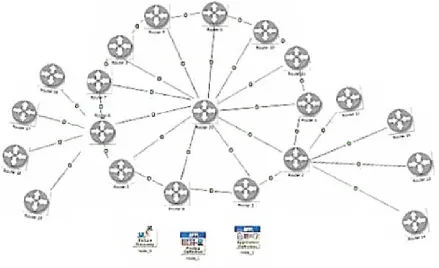
Figure 1: Mesh network architecture for testing for convergence.
Different routing protocol RIP, OSPF and EIGRP was configured and ran on the hybrid network architecture.
RESULTS
[image:4.612.85.538.465.691.2]Blue shows the convergence time of EIGRP, Green color shows the convergence time of RIP, and Red color shows the convergence time of OSPF.
COMPARISON OF CONVERGENCE TIME OF DIFFERENT ROUTING ALGORITHMS
Protocol Routing Algorithm Convergence time
EIGRP Path Vector 5.00 secs
OSPF Link-state algorithm 7.02 sec
RIP Direct vector algorithm 14.15 secs
Thus, it can be clearly seen with convergence time being a key performance indicator, its clearly seen that RIP which uses the Direct vector algorithm has the least performance.
Other Comparison of RIP, OSPF and EIGRP are as follows
Protocols OSPF RIP EIGRP
Hop Count No limit Maximum of
15 Maximum of 224
Security MD5 MD5 MD5
Metric used Shortest Path Hop Count Bandwidth, reliability, Delay, load and maximum transmission unit (MTU)
Subnetting Yes No Yes and classless inter-domain routing (CIDR)
Algorithm Link state Distance
vector Hybrid
Standard Open Open Cisco Propriety
Convergence faster slower fastest
Memory
requirement More less less
Easy of
configuration
Difficult to configure
Relatively
easy Relatively easy
CONCLUSION
REFERENCES
[1] Cisco (2004). CCNP 1 Advanced Routing Companion Guide. Indianapolis: Cisco Press. 2004. pp. 93f. ISBN 1-58713-135-8.
[2] CNET Networks (2014, November). "Understanding the protocols underlying dynamic
routing". CNET Networks, Inc. Retrieved from
http://www.techrepublic.com/article/understanding-the-protocols-underlying-dynamic-routing/ Retrieved 2014-11-26.
[3] Computerhope (2017, June), Routing Algorithm, Retrieved form
https://www.computerhope.com/jargon/r/routing-algorithm.htm
[4] Informit (2018, June). Routing 101: Routing Algorithms, Retrieved form
http://www.informit.com/articles/article.aspx?p=27267)
[5] Nikolaidis (2002), Cisco IP routing [Book Review] IEEE Network. 16, 2
[6] Riverbed (2018, June) Riverbed Academic Modeler Retrieved from https://splash.riverbed.com/community/product-lines/steelcentral/university-support-center/blog/2014/06/11/riverbed-modeler-academic-edition-release