www.ijsrp.org
Temporal changes of CD4 Count of HIV infected
children using curve fitting models
J. Prakash, Basavarajaiah D.M.
Department of Peadiatrics, Bangalore Medical College and Research Institute, India
Abstract- The CD4 count is a critical measure of immune system and is used as an important biomarker for describing the progress to AIDS in children’s and adults. Usually infants will be having better CD4 count with good immune system as age progresses the CD4
count start declining. .Present study aims to describe the trend of CD4 count with respect to different age group of children’s. A prospective and retrospective cohort data was collected from Government ART centers of Bangalore city. Total 100 HIV infected
patients alive on HAART were considered from March 2009- 2010. Demographic profile, mode of transmission, age, sex, CD4 count
at inception of HAART, follow up CD4 count like 6 months, 12 months and 24 months were recorded..Opportunistic infection,
duration of HAART, WHO clinical stage, type of regimen and adherence were documented. Collected data were analyzed by using
SPSS-16.50 version software. The mean age of the children was 8.19±3.62years, CI 95% 7.63-9.08, P>0.05. At the time of inception
of HAART CD4 count was fewer and negatively correlated (r= -0.02ns) with age of the children. the mean CD4 count at the time of 6
month was 573.99±288.73 µ/dL, CI 95% 572.36-576.28, P<0.05; CD4 count at 12 months was 654.68±269.09 µ/dl, CI 95%
653.26-655.89, P<0.05 and CD4 count at 24 months was 773.20±274 µ/dL. 87, CI 95% 772.64-775.03, P<0.05respectively.Duration of
HAART and follow up CD4 count was statistically significant (p<0.05) with age of the children .The majority of children’s have
better CD4 count after inception of HAART .HIV TB confection is the most common in older children(7-15.0years)
Early inception of HAART mainly helps the childrens to maintain better CD4 count with good immune systems and they are less
prone to OI’s.
Index Terms- CD4, HAART, WHO Stage, HIV
I. INTRODUCTION
AIDS is a scourge, more than 1.30 million children has been affected globally .In India more than a lakh children infected from
Mother to child and IUD’s. HAART have been initiated during 2004. The CD4 count is a critical measure of immune system and is
used as an important biomarker for describing the progress of AIDS in children and adults. Among Infected children over five years of
age there is continual loss of CD4-T cells, with a lower CD4 count indicating more sever immune deficiciency and higher risk of
developing opportunistic infections (OI’s) and AIDS defining illness .The CD4 count is also important biomarker for HIV infected
www.ijsrp.org higher cd4 count than older .With increasing age, the CD4 counts in infants decline and begin to approximate those of adults; a decline
in children’s CD4 count is therefore normal. The rate of CD4 count decline is often much more rapid in infected infants than in
infected adults1. Many authors have shown that HIV infants have lower CD4 counts than uninfected infants2.The present study aims to
describe the trend of CD4 count with respect to the different age group of children.
II. MATERIALS AND METHODS
A prospective and retrospective cohort data were collected from Government ART centers of Bangalore city. A Total of 100 HIV
infected alive and on HAART patients were considered for study evaluation for the period from March 2009- 2010.Informed consent
was obtained from the parents or guardian. Demographic profile, mode of transmission, age, sex, CD4 count at inception of HAART,
follow up CD4 count like 6 months, 12 months and 24 months were recorded. Growth parameters; weight, height and BMI was
systematically evaluated for each follow up period .Opportunistic infection, duration of HAART, WHO clinical stage, type of regimen
and adherence were documented. Collected data were analyzed by using SPSS-16.50 and Minitab 6.50 version software. Exponential
model, different polynomial predictive models were used to know the temporal changes of CD4 count over a period of time. Mortality
and survivability rate was determined by using Kaplanmeir mortality curve.
III. MODEL FORMULATION
Single exponential smoothing: CD4 count has been changes due to illness and co morbid condition of the patients. The impact of effective comprehensive care support and treatment of antiretroviral treatment, CD4 count can improve and more enable to develop
immunity and viralogical suppression in children’s. The forecasting is more essential to know the trend and seasonal changes of CD4
count. In this aspect we wish to forecast the predictive value of our time series data. We have assumed that =observed value at
time‘t ‘; our forecast was denoted by ,the predictive error of the model was given by. The method of single exponential forecasting
takes the forecast for the previous and adjusts it using the forecasting error .That is, the forecast for the next period was
, Where
Tab (1): Descriptive statistics of HIV infected children’s Demographic profile.
SL.No Defined variables Mean±SD CI-95% P-Value
I. Demographic profile
I(a). Age(yrs) 8.19±3.62 7.63-9.08 P<0.05
01 2-4 yrs 2.96±1.22
(05)
2.40-3.05 P>0.05
02 5-7yrs 6.32±0.98
(12)
www.ijsrp.org
03 7-9yrs 8.20±0.30
(15)
7.56-9.08 P<0.05
04 9-12 yrs 10.14±0.56
(19)
9.22-11.31 P<0.05
05 13-15 yrs 12.55±0.21
(22)
12.16-16.08 P<0.05
06 16 yrs 14.26±0.420
(27)
13.05-15.63 P<0.05
II Gender
01 02 Male Female 65.0% 35.0% 63.22-66.18 34.25-36.89 P<0.05 P<0.05
III Mode of transmission
01 Parintal transmission 88.90% 87-13-90.16 P<0.05
02 IUD’s 6.53% 5.81-7.01 P>0.05
03 Not known 4.57% 4.07-5.2 P>0.05
IV Parents HIV Status
01 1(a) 1(b) HIV +Ve Yes (Both) Single No 79.0% 15.0% 8.0% 78.06-80.55 14.50-16.11 7.01-9.50 P<0.05 P<0.05 P<0.05 02 2(a) 2(b) HIV –ve Yes Not known 90.0% 10.0% 88.26-91.56 8.56-11.56 P<0.05 P<0.05
IV Mode of transmission in
parents
01 Homosexuality 10.20% 9.04-11.53 P<0.05
02 Heterosexuality 76.33% 74.02-77.30 P<0.05
03 IUD’s 7.47% 6.56-8.01 P<0.05
04 Not Known
V Economic status
01 Higher income 14.0% 11.47-13.88 P<0.05
02 Mid income 28.0% 27.02-29.36 P<0.05
03 Low Income 58.0% 57.52-59.01 P<0.05
*Significant p<0.05
The mean age of the children’s was 8.19±3.62years, CI 95% 7.63-9.08, P>0.05. Male and female comprises 65.0% and 35.0%.The
mean of age of the different age groups of children was 2-4years 05(,2.96±1.22, CI 95 % 2.40-3.05) , P>0.05; 5-7yrs 12(6.32±0.98,
www.ijsrp.org 22 (12.55±0.21, CI 95% 12.16-16.08), P<0.05; 16 yrs 27 (14.26±0.420, CI 95% 13.05-15.63),p<0.05.HIV mode of transmission were recorded and Parintal transmission (89.0%), IUD’s (7.0%) and not known (4.0%).Both parents were get infected (79.0%),single
parents( 15.0%), and not infected (8.0%).Parents mode of transmission were obtained from white cards, Homosexuality (10.0%),
Heterosexuality(77.0%),IUD’s (8.0%) and Not Known (3.0%) ; High income (14.0%) , mid income(28.0%) and low income status
(58.0%).
Tab (2): Mean CD4 count and other defined variables of Infected children (N=100).
SL.No CD4 Count Mean±SD CI 95% P-Value 01. Age 8.19±3.62 7.63-9.08 P<0.05 02. CD4 count at base line 293.71±74.40a 291.99-295.63 p>0.05 03. CD4 count at six month 573.99±288.73b 572.36-576.28 P<0.05 04. CD4 count at 12months 654.68±269.09ab 653.26-655.89 P<0.05 05. CD4 count at 24 months 773.20±274.87b 772.64-775.03 P<0.05 06. Mean HAART duration 542.79±224.79b 540.89-226.03 P<0.05
VIII Co morbid condition
Yes 12.00% 10.99-13.58 P>0.05
No 88.00% 87.63-90.21 P<0.05
Death 8.00% 7.08-9.15 P<0.05
LFU 4.0% 3.50-4.23 P>0.05
Survivar 88.0% 87.85-90.52 P<0.05
XI HIV TB co infection
Yes 18.0% 17.53-19.08 P>0.05
No 82.0% 81.55-83.89 P<0.05
X Mean Duration of HAART 598.01±9.80 596.33-601.56 P<0.05
XI WHO clinical stage
Stage I 3.0% 2.56-3.06 P>0.05
Stage II 18.0% 17.35-19.22 P>0.05
Stage III 45.0% 44.56-46.21 P<0.05
Stage IV 65.0% 64.36-66.05 P<0.05
Superscript a, b significant mean differences, DMRT test.
At the time of inception of HAART CD4 count was fewer and negatively correlated (r= -0.02) with age of the children.
HAART should improve the CD4 count and it was found to be 573.99±288.73 µ/dL at the time of six month, CI 95% 572.36-576.28,
P<0.05; CD4 count at 12 months was 654.68±269.09 µ/dl, CI 95% 653.26-655.89, P<0.05 and CD4 count at 24 months was
773.20±274 µ/dL. 87, CI 95% 772.64-775.03, P<0.05respectively.The Mean duration of HAART was 542.79±224.79days, CI 95%
www.ijsrp.org
Fig 1(a): Trend of CD4 at base line Fig 1(b): Trend of CD4 count at after six months
Fig 1(c ): Trend of CD4 count at 12 months Fig1( d):Trend of CD4 count at 24 months
The trend of CD4 count was observed by different curve fitting methods.asper the model the mean predicted CD4 count at inception
[image:5.612.287.530.59.318.2] [image:5.612.82.282.60.316.2]www.ijsrp.org statistically significant (p> 0.05) at the time of HAART initiation. It was explained that R² 45.0% variation was observed from both
the variables. Fitted linear trend equation was 88.93 xs. After effective comprehensive treatment, palliative support, good adherence
and WHO clinical stage can improve the CD4 count and it was observed in Figures 1(b), 1(c) and 1(d). The Exponential model was
fitted to explain the variations among CD4 count changes in mean age at different follow up period.Asper the predicted model
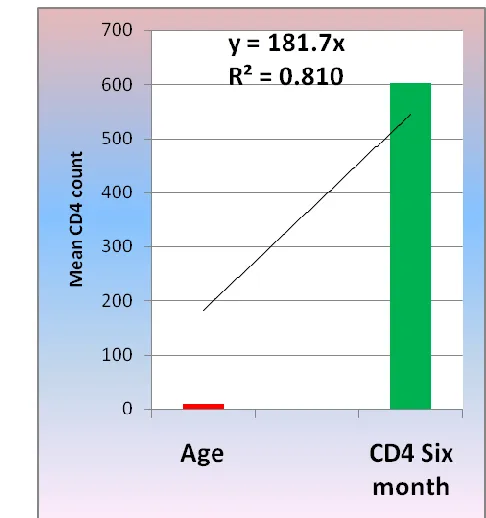
smoothing was positively associated with age of the children and follow up CD4 count .The predicted equation was found to be y =
181.7x, CD4 count at six months; 12 months was y = e3.013x R² = 0.891 and 24 months was y = e3.080x R² = 0.914 respectively.
Tab (3): KPM –Model for estimation of mean survival of HAART duration censored by mortality
SL.No
a Mean a Median
Estimate
Std. Error
95% Confidence Interval
Estimate
Std. Error
95% Confidence Interval Lower
Bound
Upper Bound
Lower Bound
Upper Bound 01 572.810 23.086 527.562 618.058 547.000 45.965 456.909 637.091
www.ijsrp.org
Fig 2(a): 1-Survival of Children’s Fig2(b): Survival of children’s
Over a period of time Mean HAART duration was 572.810±23.08 days with CI 95% 527.562-618.058 and median was 547.000±45.965 days with CI 95%456.909-637.091 days. The KPM –model was clearly showed that ,reduced mortality (7.98%) p=0.001, low risk , good prognosis , adherence, familial support, lower stigma ,effective strategic and comprehensive treatment would increase the survivability of the children.Psychosoial support and level of literacy were predictors of the survivability and it was documented as a indicator variables Tab(3)
Tab (4): Relation between OI’s and age of the children’s.
SL.No Variables B S.E. Wald Sig. Exp(B)
01 Age (Years) .007 .112 .003ns .953 1.007
Base line CD4 count(µ/dl)
At the time of inception of
HAART
.001 .006 .037ns .848 1.001
02 CD4 at Six month (µ/dl) -.001 .002 .648* .421 .999
03 CD4 at 12 month (µ/dl) -.002 .002 .988* .320 .998
04 CD4 at 24 month (µ/dl) .001 .002 .869* .351 1.001
05 WHO clinical stage 6.399 4.721 1.837* .175 601.007
06 Duration of HAART -.003 .002 1.880* .170 .997
07 Opportunistic infection -3.697 3.598 1.055* .304 .025
*2 Log likelihood-49.18, Cox & Snell R Square-0.064, Nagelkerke R Square-0.149
Inception of HAART at lower CD4 count (<100µ/dl) is more eager to acquainted with Oi’s .The relation was expressed by using
logistic regression. Different types of TB were found with different episode. Many studies showed that spectrum of TB was associated
with baseline CD4 count(<100µ/Dl), advanced WHO clinical stage(Stage IV) ; lower body weight, low BMI and adolescent were
influenced factors of TB . The Present study correlates with the age group and OI’s. Age and base line CD4 count was not statistically
significant (p>0.05). CD4 at Six month.648*(p=0.05) , CD4 at 12 month.(988*,p=0.05) , CD4 at 24 month .869*(p<0.05) , Duration
of HAART 1.880* p<0.05 ,WHO clinical stage 1.837,p=0.05 were statistically significant and -2 Log likelihood-49.18, Cox &
Snell R Square-0.064, Nagelkerke R Square-0.149.The co efficient were presented in Tab (4).
Tab (5 ): AUC-for age and base line CD 4 count of the children’s
SL variables
Area Std. Errora
Asymptotic Sig.b
Asymptotic 95% Confidence Interval
[image:7.612.86.528.688.744.2]www.ijsrp.org
Bound Bound 01 Age .506 .098 .954 .313 .699 02 Base line CD4
count (µ/Dl) .429 .118 .505 .198 .659
www.ijsrp.org
Tab (6): Specificity and sensitivity of OI’s with respect to different age groups and baseline CD4 count Age (years) Base line CD4 count(µ/dl)
Positive if Greater Than or
Equal Toa Sensitivity 1 - Specificity
Positive if Greater Than or
www.ijsrp.org
32. 14.50 .033 .000 288.00 .543 .625 33. 15.50 .011 .000 292.50 .467 .625
Receiver operating characteristic analysis (ROC) was used to compare with age and CD4 count in respect to OI’s .Study showed that
AUC for age was 0.506 ±0.098 (CI 95% 0.313-0.699) ;AUC for base line CD4 count was 0.429±0.118 ( CI 95% 0.198-0.659) Tab ().
The matrix of analysis were clearly pointed out 50.60 % of children’s with higher age (between 7-15 years) suffered HIV TB co
infection .In case of younger age group, with good CD4 count were not susceptible to HIV TB co infection.Asper the ROC model
Tab () age group between 1 to 6.95 years have better CD4 count with better sensitivity and specificity 98.90%,87.50% to 83.75% ,
87.50% respectively. In case of Older age group between 7-15 years had lesser CD4 count and very much susceptible to HIV TB co
infection. The specificity and sensitivity was 46.70%, 62.50% respectively Tab (6)
IV. DISCUSSION
The relevance of this finding is yet to be clarified, but suggests more effective immune reconstitution in children treated early in their
course. Fitted models allow us to predict long-term CD4 count based on age and different clinical parameters. Curve fitting models
were used to account for inter-individual variability and examine effects of HAART with respect to different age groups, sex, WHO
staging and HIV TB co infections. Early inception of HAART mainly helps the childrens to maintain better CD4 count with good
immune systems and they are less prone to OI’s and it also reduces the progression of disease, mortality and RNA plasma viral load.
The children with Low CD4 count at Pre-ART level initiated with HAART are more proned to OI’s , AIDS defining illness like
malignancies, low BMI, decreasing Body weight ,advanced clinical stage, poor phenotypic appearance , growth retardation and
lipoatrophy and dystrophy.
However, we observed that improvement in CD4 count was better among children with higher baseline CD4 count i.e. lesser degree of
immunosupression. Similar observations have been reported in adults by Lawn, et al. [11], but seldom reported in children. This could
be attributed to overwhelming opportunistic infections observed with higher degrees of immunosupression. Hence earlier detection
and higher baseline CD4 count might improve the outcome of antiretroviral treatment.
V. CONCLUSION
The majority of children have better CD4 count after inception of HAART and that the slope of rise was greater in older children in
www.ijsrp.org
ACKNOWLEDGMENT
Author’s acknowledge to Professor and Head, Department of Paediatrics, Bangalore Medical College and Research Institute, KSAPS, NACO –Ministry of Health and Family welfare, Government of India and Medical officers and Nodal Officers of ART centres in Bangalore City.
REFERENCES
1. Department of AIDS Control, Ministry of Family Welfare, Government of India. AnnualReport2008-2009.Availablefrom:
http://nacoonline.org/upload/Publication/Annual_ Report_NACO_2008-09.pdf. Accessed on 27 February, 2010.
2. Asnake S, Amsalu S. Clinical manifestations of HIV/AIDS in children in Northwest Ethiopia. Ethiop J Health Dev.
2005;19:24-8.
3. Shah D, Gupta P, Ghai OP. Nutrition and health. In: Gupta P, Ghai OP. Eds. Textbook of Preventive and Social Medicine. 2nd ed.
New Delhi: CBS Publisher and Distributors; 2004. p.100-54.
4. Shah N. Clinical diagnosis of pediatric HIV. In: Shah I, Shah NK, Manglani M. eds. IAP Speciality Series on Pediatric HIV. 1st
ed. Mumbai: Indian Academy of Pediatrics; 2007. p. 21-9.
5. Shah I. Antiretroviral therapy. In: IAP Speciality Series on Pediatric HIV. Shah I, Shah NK, Manglani M editors. 1st ed. Mumbai:
Indian Academy of Pediatrics; 2007. p. 63-9.
6. Agarwal D, Chakravarty J, Sundar S, Gupta V, Bhatia BD. Correlation between clinical features and degree of
immunosuppression in HIV infected children. Indian Pediatr. 2008;45:140-3.
7. Padmapriyadarshini C, Poornagangadevi N, Chadrasekaran K, Subramanian S, Thiruvalluvan C, Bhavani PK, et al. Prevelance of
underweight, stunting, and wasting among children infected with human immunodeficiency virus in south India. Int J Pediatr.
2009; 2009:837627.
8. Hamadache D. HIV testing guidelines for children of confirmed or suspected HIVpositiveparents.Available from
http://www.chiva.org.uk/health/guidelines/hiv-testing. Accessed on 27 February, 2010.
www.ijsrp.org 10. Shah I. Correlation of CD4 count, CD4% and HIV viral load with clinical manifestations of HIV in infected Indian children.
Ann Trop Paediatr. 2006;26:115-9.
11. Lawn SD, Myer L, Bekker LG, Wood R. CD4 cell count recovery among HIV-infected patients with very advanced
immunodeficiency commencing antiretroviral treatment in sub-Saharan Africa. BMC Infect Dis. 2006;6:59.
12. Universal Access to AIDS Treatment: Targets and Challenges. Available from http://www.avert.org/universal-access.htm.
Accessed on 27 February, 2010.
13. Pattanapanyasat K, Thakar MR. CD4+ T cell count as a tool to monitor HIV progression and anti retroviral therapy. Ind J Med
Res. 2005;121:539-49.
14.Lisse IM, Aaby P, Whittle H, Jensen H, Engelmann M, Christensen LE: T-lymphocyte subset in West African children: impact of age, sex, and season.J Pediatr 1997, 130:77-85.
15.Moodley D, Bobat RA, Coovadia HM, Doorasamy T, Munsamy S, Gouws E: Lymphocyte subset changes between 3 and 15
months of age in infants born to HIV-seropositive women in South Africa.Trop Med Int Health 1997, 2:415-421
16. World Health Organization: Scaling up antiretroviral therapy in resource limited settings: guidelines for a public health