Australian Monotypes
Thomas A. Middlemost
September 2012
A thesis submitted for the degree of
Doctor of Philosophy of the Australian
The following thesis is wholly the candidate's own original work.
Abstract
While much has been published on Australian printmaking, the monotype is generally dealt with in a cursory manner and has never served as the subject ofa detailed, dedicated study. This thesis sets out to fill this lacuna, both through a general history ofmonotypes in Australian art - with a comprehensive investigation of the various clusters of monotype artists that have appeared during the past 120 years of Australian art history- and through three case studies of prominent Australian artists for whom the monotype was an important part of their practice. The selected artists are Rupert Charles Wulsten Bunny ( 1864- 194 7), Margaret Rose Preston ( 1875-1963) and Bruno Leti (b. 1943). These case studies can be found in the Appendices.
Four conceptual threads or arguments for the unique nature of the monotype will be explored whilst documenting its history. In this thesis it is argued that there is an inner momentum unique to monotype clusters throughout Australian art history. Secondly, throughout the thesis it is argued that monotype gives an artist the freedom to express their individual sensibility, as a distinct voice, as opposed to other print mediums. Thirdly, the monotype is unique in printmaking because of its precarious balance on the cusp of both painting and printmaking, opening the door for painters to experience and feel comfortable using a print medium. Lastly, the individual economics of the monotype in printmaking practice is revealed. As a unique print and therefore separate from multiple originals in printmaking, monotypes are aligned with painting and drawing, muddying their identity as prints and rendering their identity in an art market as translucent as 'ghost prints'.
While the number of Australian artists who use the medium is extensive, this widespread use is rarely noted. The monotype has an almost invisible existence in general accounts of Australian art and even in histories of printmaking. The individual exhibiting histories are described in reference to the artist's oeuvre, their common a11 practice and their biographies. The purpose is to document an artist's inspiration for commencing or continuing to make monotype prints.
Documentation of Australian monotypes is poor even though Australian artists have played and continue to play a significant role in the history of international monotype art. Roger Butler, Senior Curator of Australian Prints, Drawings and Illustrated Books at the National Gallery of Australia (NGA) notes that the best and most complete international catalogue and exhibition on monotypes "is in no way definitive and does not include articles on the subject by the Australian artists Rupert Bunny and A. Henry
Fullwood".1 This thesis marks the beginning ofa process for an understanding of the great influence of monotype printmaking on Australian artists and their practice. Future research on monotypes in Australia can use this framework to build detailed studies of Australian artists' monotypes.
Table of Contents
Introduction Part I 1880-1923 Part II 1924-1940 Part III 1949-1959 Part IV The 1960's
Part V The 1970's- Current Conclusion
List of Illustrations
Appendix I H. Rasmusen, Printmaking with monotype ... Appendix II A. L. Baldry, Hubert von Herkomer. .. Appendix III John Sell Cotman, Breaking the clod .. . Appendix IV Ludwig Hirschfeld-Mack monotypes .. . Appendix V THE GEEBUNG POLO CLUB .. . Appendix VI Franck Gohier correspondence .. . Appendix VII Rupert Bunny
Appendix VIII Margaret Preston Appendix IX Bruno Leti
Bibliography
THE MONOTYPE IN AUSTRALIAN ART HISTORY
Introduction Part 1
While much has been published on Australian printmaking, the monotype is generally dealt with in a cursory manner and has never served as the subject of a detailed,
dedicated study. This thesis sets out to fill this lacuna, both through a general history of monotypes in Australian art - with a comprehensive investigation of the various clusters of monotype artists that have appeared during the past 120 years of Australian art
history - and through three case studies of prominent Australian artists for whom the monotype was an important part of their practice. The selected artists are Rupert Charles Wulsten Bunny (1864-194 7), Margaret Rose Preston (1875-1963) and Bruno Leti (b. 1943). These case studies can be found in the Appendices.
The lowly status of the monotype as an art medium in the hierarchies of art in general and printmaking in particular has resulted in its sketchy documentation in Australian and world art history. The monotype owes this low standing in part due to its ease of production; its use in children's art and rehabilitative art; and in part because of the
printmaking community's historic rejection of the monotype as a valid printmaking technique. Monotypes are generally the works left aside in dealers' rooms or artists' studios.
no way definitive and does not include articles on the subject by the Australian artists Rupert Bunny and A. Henry Fullwood".1
While the number of Australian artists who use the medium is extensive, this widespread use is rarely commented on. Possibly because the artists and specialist printmakers who have produced known bodies of work using the technique, such as Rupert Bunny, A. Henry Fullwood (1863-1930), Ludwig Hirschfeld-Mack
(1893-1965), Erwin Fabian (b. 1915), Tom Garrett (1879- 1952), Margaret Preston, Sidney Nolan (1917- 1992), Charles Blackman (b. 1928) and Bruno Leti, are few. Most monotype artists use the medium as an art-school foray or as a means of resolving problems associated with their art practice. A small minority continue to use the technique on a regular basis.
The monotype has an almost invisible existence in general accounts of Australian art and even in histories of printmaking. Throughout the thesis the most comprehensive account of the history of exhibiting monotypes in Australia is attempted. The individual exhibiting histories are described in reference to the artist's oeuvre, their common art practice and their biographies. The purpose is to document an artist's inspiration for commencing or continuing to make monotype prints.
The history of the monotype in Australia vaguely follows the history of printmaking in this country and worldwide. The prevalence of the Australian monotype is defined by its usefulness to artists and therefore is mainly passed on from artist to artist. The
diminished standing of monotype within the hierarchy of art mediums and as a printmaking medium has obscured the medium from the histories of Australian art. Monotype, however, in Australia has played a slight educational and institutional role from the turn of the century; including the development of dedicated art-school
programs and facilities in Adelaide with the programs of George A. Reynolds and through artists societies and groups, such as the 'WOG' Watercolour club in Brisbane, van Raaltes' Sketch Club in Adelaide or the Sydney Painter-Etchers' Society. Also, in the 1960s, with the rise of printmaking infrastructure, more mainstream artists had access to monotype as a medium and collaborative monotypes were made. The
extended reach of the mono type is also marked in the mid to late 1980s. Market forces
1
also assume a key role in the history of the mono type, with international, national, state, regional and, most importantly, commercial gallery prominence leading to an
abundance of monotypes in Australia at certain points in history.
Documentation of Australian monotypes is lacking even though Australian artists have played and continue to play a significant role in the history of international monotype art. The few dedicated publications that exist include articles by A. H. Fullwood published in The Studio magazine,2 G. M. Spencer's Margaret Preston's monotypes,3
Six memos on the art of Bruno Leti4 and Sasha Grishin's Bruno Leti 's monotypes5 a catalogue of the Rogowski Collection of Tom Garrett monotypes,6 John Peart
monotypes 1988: Crown Street Pres/ and Salsipuedes: monotypes 1986 I John
Walker,8 a chapter in one volume of the NGA projected three-volume Printed series9 and, notably, images and text within the 1960 international Printmaking with mono type by Henry Rasmusen. 10 Other than these sources, one may find Australian monotypes in print in state gallery collections, 11 one university art collection, 12 and in a handful of
extant pricelists and commercial exhibition flyers.13 This thesis marks the beginning of
a process to arrive at an understanding of the great influence of monotype printmaking on Australian artists and their practice. Future research on monotypes in Australia can use this fran1ework to build detailed studies of Australian artists' monotypes.
The term 'monotype' is poorly understood. Every catalogue, review and flyer relating to an exhibition that includes monotypes explains the technique anew, signalling
2
Albert H. Fullwood, '·The art ofmonotyping", The Studio, vol. 32, no. 136, July 1904, London, pp. 149
-50.
3
G. M. Spencer, Margaret Preston's monotypes, Ure Smith, Sydney, 1949.
-1 Sasha Grishin, Six memos on the art of Bruno leti, Beagle Press, Sydney, 2002.
5
Sasha Grishin, Bruno le1i 's monotypes, Transart, Melbourne, 1994.
6
Terry Ingram, Tom Garrett: The Rogowski Collection, Moorabbin, Vic., 1976. 7
John Peart monotypes I 988: Crom1 Street Press, Macquarie Galleries, Sydney; Powell Street Gallery, South Yarra, Vic., 1988.
8 Ted Gott, Salsipuedes: monotypes 1986 I John Walker, Powell Street Gallery, Melbourne. 1987. 9
Roger Butler, Printed images by Australian artists 1885- /955, National Gallery of Australia. Canberra. 2007.
10
Henry Rasmusen, Printmaking with monotype: a guide to transfer techniques, Chilton Co .. Philadelphia; Pitman & Sons, London, c. 1960.
11
Examples include Australian images: prints, drmrings and 1ratercolours from the collection, Art Gallery of ew South Wales, Sydney, 1980; Hendrik Kolen berg & Anne Ryan, Australian prints from
the gal/et)' 's collection, Art Gallery of New South Wales, Sydney. 1988; Kirst)' Grant & Cathy Leahy.
On paper: Australian prints and drml'ings in the National Gal/e,y of Victoria, National Gallery of
Victoria, Melbourne, 2003. 12
Thomas A. Middlemost, Mono uno, Charles Sturt University, Wagga Wagga. & Wagga Wagga Art Gallery, NSW, 2009.
13
Veda Swain & Frank Ford, Ecstasy, the penitence/ paintings by Clifton Pugh, Greenhill Galleries,
North Adelaide, 1989.
widespread ignorance about this specialist topic. A definition of the monotype is
included in an 1882 lithographic trade publication heralding an exhibition of Charles A. Walker's monotypes.14 Differing definitions of the monotype are included in A.H. Fullwood's exhibition catalogues and periodical articles. Definitions appear in exhibition publications on monotypes by Rupert Bunny, Margaret Preston and Tom Garrett. The definition of the monotype is again revised in this author's 2009 Mono uno exhibition of monotypes from the Charles Sturt University (CSU) Art Collection in Wagga Wagga, New South Wales (NSW), and on the didactic panel that accompanied the 2011 monotypes exhibition at The Left Hand Gallery in Braidwood, NSW. Within the 2009 publication the author argued for the definition: The monotype is a unique painted or inked impression transferred from an unincised and unregistered matrix.
Part 2 of the Introduction to this thesis gives detailed consideration of definitions of the monotype, arguing in favour of the above definition.
Four conceptual threads or arguments for the unique nature of the mono type will be explored whilst documenting its history. In this thesis it is argued that there is an inner momentum unique to monotype clusters throughout Australian art history. Secondly, throughout the thesis it is argued that monotype gives an artist the freedom to express their individual sensibility, as a distinct voice, differently than in other print mediums. Thirdly, the monotype is unique in printmaking because of its precarious balance on the cusp of both painting and printmaking, opening the door for painters to experience and feel comf01iable using a print medium. Lastly, the individual economics of the
monotype in printmaking practice is revealed. As a unique print and therefore separate from multiple originals in printmaking, monotypes are aligned with painting and drawing, muddying their identity as prints and rendering their identity in an art market as translucent as 'ghost prints'.
Monotype clusters occur throughout the history of Australian monotype art. The inner momentum or dynamism of these monotype clusters will be explored throughout this
thesis. Monotype clusters form around an individual who has 'discovered anew' the medium of monotype. This individual is commonly shown the medium by a
practitioner, teacher, or printmaker; to a lesser extent monotype is 'discovered' by the influence of monotype group exhibitions or more likely via a solo work by a senior
monotype practitioner.15 Since 1960 printers have introduced many Australian printmaking practitioners to monotype practice. As one artist then exhibits, or is working in their studio or shared workspace, others develop the medium and a cluster forms, grows and fades. Few artists continue with the medium after the cluster bubble
pops; some hardy practitioners such as Bruno Leti may work for the rest of their lives in the medium, although this is extremely uncommon. It is also the nature of these clusters that most artists dabble for a day or a week and do not form a body of work in the medium within a prescribed period. More uncommonly some prolific artists, such as Caroline Williams, may produce in a few sessions what would be a lifetime of mono type work for other artists 16.
The monotype admits into the creative process an element of chance, which is usually exploited by the artist to discover further ways of exploring their own imagery. Creative artists use monotype as a medium of discovery, a journey, road, or path, not as an end in itself. This is a contributing factor to the existence of a monotype cluster.
Because of the sporadic nature of monotype clusters a defined chronological history of monotypes is difficult. One could imagine a small speck on a timeline representing a monotype practitioner and larger specks representing a cluster of monotypists. At times along the line only a modicum of monotype activity is present, the work of one or two individuals. At other times, say from the early 1960s or mid to late 1980s, the specks or clusters are so tightly compacted that the artists would not be identifiable.
A monotype exhibits the traits of the artist" s sensibility or unique style. not the medium as such. A monotype has a Yoice or shape that is much more malleable than other print mediums. The voice of the monotype. lacking the structural constraints of many
printmaking techniques. is able to carry an artistic sensibility unlike any other print mediun1. Therefore the history of artists· printmaking runs in parallel \Vith the history of
the monotype. Artists· prints. as opposed to master printers· work. or book or
1
• otably the senior artists in monotype: Edgar Degas. William Blake. Henri Matisse. Paul Gauguin.
Paul Klee. Mark Tobey. Marc Chagall, Richard Diebenkom. Sam Francis. Jasper Johns. Michael Mazur. Sean Scully and John G. Walker are great inspirations to monorype artists both internationally and in
Australia.
16
Author"s visit to Caroline Williams· home on 25 May 2009: discovered two to three hundred monotypes made in the mid to late 1980s with the technical help of printmaker I eil Leveson at the Victorian Print Workshop.
newspaper illustrations, appear in monotype clusters throughout Australian art history:
painters in Paris and the United States at the tum of the century, aiiists in Adelaide,
those educated by Hube1i von Herkomer, a painter, and the painter-etchers in Sydney,
all produced some monotypes as artists' prints in clusters. Currently the monotype is
flourishing in V/estern art in our age of aiiistic individual freedom.
Freedom is given greater sway in monotype printmaking than in other forms of
printmaking. The act of painting or drawing directly onto a flat unincised surface, as one
does in monotype is perhaps closer to the creative spark kindled by the artist, the artist's
intention, and therefore more truly their personal mark or individual statement. Within
all other printmaking fo1ms there is a greater technical dissociation or barrier between
the initial aiiistic impulse and the artistic outcome. Colour and form must be created by
a less direct and somewhat tamed chemical reaction, or physically incised from the plate
within an etching, engraving or mezzo tint. In the case of screen print, the flatness of the
medium and the machinery involved considerably distances mark-making from its
initial inspiration. Digital printmaking further distances aiiists from their seen or
imagined inspiration by introducing technical impediments in the form of software or hardvvare. Eventually these labour saving devices may become second nature to some
artists, akin to drav,ring, although this is not the case at present. The direct nature of
monotype production as opposed to the many distancing mechanisms characteristic of
other methods of print production makes this medium closer to the sketch, the initial
idea.
It is of interest to note how an artist's familiai· medium interacts or creates differing
monotype techniques and styles. Commonly painters use the medium of monotype to
solve painterly problems, sketching ideas quickly onto inexpensive materials, perhaps
categorising the work as a study or drawing. The process of mono type has been cal led
"squashed oil painting",17 a bastard child of painting, printmaking and drawing. Some artists use techniques from lithography, photography, sculpture, film or any possible
artistic medium to form their unique prints in monotype - and their intentions towards
such media when producing monotypes can be examined within the finished artwork.
The artist Arthur Wicks, who first made monotypes in the 1960s, described his intentions in monotype whilst referring to performance and installation in their production, along with the traditional media of glass and ink:
I was interested in Tom Middlemost's notion of an edition of monoprints. My
response was a series rather like a film strip where, for example, an image of one of my motorised boats moved sequentially from one side of the page to the other as the sequence progressed. On a sheet of glass the boat image would be added
to & subtracted from - probably with fingers or a stick - progressively, & each
frame captured by dropping paper over the glass, sheet by sheet.18
Considering the 'painterly print' in Australian art history, in this thesis the author will explore numerous painters who have made the medium of monotype their own, or extended or expanded their practice with monotype. The investigation will interrogate
how painters confront the medium of monotype, the freedom involved in the painters'
monotype as opposed to the lithographers' mark-making in monotype, and all the media
in between. The limiting technical and visual constrains of materials will also be explored. Many artists continue making monotypes in the manner in which they were
first shown, which can involve a certain type of material, a brass plate, or zinc, a glass
pane or Japanese paper, and thick viscous ink. The intersection between these choices of
materials and tools with the artists' usual art practice as a painter or screenprinter, for example, is of great interest as it plays out on the paper.
The size of a monotype made by a painter is generally bigger than a similar print made
by a dedicated printmaker. Paintings by the same artists tend to be larger than
17
Joseph Pennell, Etchers and etchings, New York, N.Y., 1919, p. 309.
18 Email correspondence from Arthur Wicks to General Manager, Print Council of Australia, Damian
Kelly cc. Thomas A. Middlemost, 17 March 20 I 0.
monotypes because of restrictions on press sizes; however, the use of large presses in print workshops and professional editioning workshops, collaborative print endeavours, generally increasing press sizes and the use of industrial rollers, steam rollers and non-technical methods of rubbing have greatly extended the size of mono type printmaking. Although at their disposal, not all such methods are used by a printmaker. On the other hand, painters need not be involved in the printmaking process. They may see only the painting or making of the mark as important, in which case the intention of the finished artwork has little, if anything to do with printmaking and a professional technician or master printmaker is employed.
Monotype's similarity with painting and the great number of painters who practice the art form does not raise its standing within the field of fine art or the art market, since artists tend to undervalue the medium. In the hands of avant-garde European artists like Jean Dubuffet (1901-1985) or Paul Klee (1879-1940) the monotype is a medium of playful enquiry, but for Bruno Leti it invites magnificent gestural symbolism. Monotype emulates the painterly gesture; unlike stipple engraving, a method common in late
eighteenth-century England and designed as a copyist's tool to achieve the tonal variation of painting as opposed to the painterly mark.
The monotype as a drawing medium is uniquely tasked with resolving painterly problems in the studio in minimal time. Drawing, the most basic visual conception of the mind at play, is cunently being investigated, scrutinised and dissected by study groups and through exhibitions in terms of both rapid gesture and refined sketch.
Dra\Ying prizes nov,-abound v,orldwide. How does the monotype differ from this form? Monotype is a printmaking medium similar to etching. Whereas drawings may be made in a variety of mediums ranging from pencil, charcoal, pastel and paint to tar or blood, monotype is generally restricted to etching ink or oil. As such, the medium of monotype is a subset of drawing. But it is more than this.
Monotype printmaking deftly admits into a painterl) creative process the factor of chance. The chance factor intrinsic to printmaking and therefore to monotype is
described in reference to engraYing by Stanley William Hayier: "It is in the exposure of his (the artist's) idea and his plate to the accidents of method, to the imminent risk of destruction, that the greatest result may occur in the v -ork and the most valuable
experience in the artist."19 The painterly technique shared by monotype and painting uniquely and quickly gives rise to a fecundity of painterly discovery and innovation.
While the focus of this thesis is not the 'art economy' or the 'art market,' the peculiar economics of the mono type is, however, of some relevance. The mono type borders on the realms of drawing, painting or watercolour in its varying stages of completeness or readiness for exhibition, show or sale, depending on the artist's sensibility and practice.
The monetary and critical value of a monotype to the populace is generally higher than that of other forms of printmaking because of its original, unique nature. Within lean times in the Australian art market printmakers reduce their editions and can in tum increase prices for the works from those reduced editions owing to the uniqueness of the print. During such times numerous artists, including printmakers, make monotypes.
It is also true that the painter can spend an afternoon or a week working on a series of monotypes on a theme or visual idea and their dealer can hold onto those works,
charging less than the price of the associated painting but substantially more than most original prints, and sell numerous works slowly from the gallery. Some artists, such as Sydney artist David Serisier (b. 1958), reach a price point when their monotypes
become a continuous source of funds for themselves and their gallery. Size may also be part of this monetary equation.
Numerous reasons for continued sales of monotypes are presented throughout this thesis, including the availability of printmaking and sales infrastructure, their generally lower price point as opposed to paintings, the stylistic similarity between painting and the monotype, the fact that painters tend to make monotypes and the cachet afforded by this, and the uniqueness of the mono type as a printmaking medium.
The relationship between the rise of monotype activity and that of economic conditions is documented clearly in this thesis in two defined periods: The Wall Street Crash of
1929 and its aftermath, and the period from 1990 to 2007. During the Great Depression the popularity of printmaking and art generally fell from its boom-time highs. The monotype went against this trend in Sydney. Here the uniqueness of the monotype and
its cachet as an offshoot of the prestigious medium of painting, coupled with its low
19 Stanley William Hayter, Preface, New ways of gravure, Watson-Guptill, New York, N .Y ., 1981.
price compared to painting, kept the medium of monotype popular. Furthermore, the steady rise in the 'art market' from the end of the price bubble in 1990 to 2007
evidenced a continuous grov.1h of monotype art. V-lhilst the art market dipped sharply after 2007, monotype production and sales have been sustained. It is argued that
because of their malleable nature and relative obscurity in the art market, monotypes can be saleable in both good economic times and bad.
The first documented monotypes were produced by Giovanni Benedetto Castiglione, probably in Rome, in the mid to late l 630s.2
°
Castiglione's first dated monotype isinscribed 1645. lui historian Anthony Blunt, in studying Castiglione's drawings and monotypes states, "it is indeed probably from his [Van Dyck's] rapid oil sketches that
Castiglione derived the first idea for his O\,\TI oil drawings on paper".21 The oil dra\vings are similar in style to the monotypes. These early monotypes \11-ere produced as a by
-product of etching experimentation. In the 1630s Rembrandt van Rijn experimented \Vith retroussage22 to great effect. Castiglione viewed Rembrandt's etchings in Rome and applied his methods. Retroussage is also linked to the rebirth of monotype,
beginning in the 1870s, and its spread across Paris and into the United States from ) '
1unich.-J
It is generally believed2-1 that bet\yeen 1660 and the 1870s no important clusters of
monotypes existed, only the solitary figure of\~ illiam Blake. English print historian Antony Griffiths notes some minor exceptions in public collections in an article for
:::o Anthony Blunt, '·The dra\\·ings of Gio,anni Benedetto Castiglione'·, Journal oft he Warburg and C ow·tland Institutes, \·ol. 8. 19-+5, p. 162. Generally monotypes are not dated so it is of interest that one monotype, Tempora!is eternitas from the \Vindsor Drawings, is dated 1645 and another of an obscure classical subject is dated 1660. Blunt stylistically dates the monotype _\1an in a turban
from Castiglione's period in Rome and possibly from the late 1630s. This work is ,ery similar in subject to that of
Rembrandt and is executed mainly as a positive field monotype, with negative detail, touched by oil and watercolour.
:::i Blunt, ibid., p. 163.
:::: ·'Rerroussage (French: 'dragging up'). In intaglio methods of printmaking, a technique of gently passing a fine cloth o\·er an inked plate, thereby drawing out a little of the ink and spreading it over the
edges of the lines. It produces a soft effect in printing." See The Oxford Dictionary of Art, Ian Chilvers
(ed.). O-vord lJniwrsiry Press, 200-+, e~otes.corn. 2006. 19 October 2011 http: W\\ \\ .enores.com oxfo
rd-arr-enc\ c loped ia retr0ussa2:e.
:::3 Joann :.loser, Singular impressions: the monof)pe in America, Smithsonian Institution Press,
\\ ashington, DC, 1997. p. 32. [\\.ithin the Introduction to the first annual exhibition of the Philadelphia
Society of Etchers.]
SylYester R. Koehler links retroussage and monotype. Koehler's influential position as an an critic, curator of graphic arts at the Smithsonian Institution and managing editor of the American Art Re.-ie,r is
in part responsible for the etching re\·ival in the -nited States in rhe late 1870s.
::: .. Sue \\-elsh Reid, "\tfonotypes in the se,enteenth and eighteenth century·', The painterly print:
mono0,pesfrom the se.-enteenth to the nrentieth century, The Metropolitan Museum of Art, Boston, 1980, p. 5.
Print Quarterly. 25 Griffiths discovered a number of mono types produced at the time and in the style of Castiglione in the Gabinetto Nazionale, Rome and two in the British Museum.26 These include a work attributed to John Webber, dated between 1780 and
1784; three nineteenth-century monotypes on Indian subject matter attributed to George Chinnery; a pre- l 830s monotype originally attributed to Samuel Palmer but possibly by one of the Ancients (a group of artists that assembled around Palmer); and nine
monotypes by James Nasmyth dated 1876/77.
William Blake's extensive output of monotypes has not been given serious scholarly attention from the perspective of the medium. This inventive outsider of early English art did not share his monotype process or give it a name after 'discovering' it.27 In the 1 790s he produced seemingly luminous, detailed monotypes in ink and tempera invariably touched up with pen and watercolour from paste-board plates.
The American Charles A. Walker is also credited in some articles as working in the medium from 1877.28 It is likely that he was one of many in a cluster that produced monotypes simultaneously in Munich and Venice, then Paris, and took these skills back to the United States for exhibition.29 It is from this extensive Parisian cluster that the
25
Antony Griffiths, "Monotypes", Print Quarterly, vol. V, no. I, March 1988, England, pp. 56-60. 26
ibid., p. 57. Nineteen works, fifteen from the British Museum, London are listed in the article and five are illustrated: five mentioned as monotypes are in the style of Castiglione. Three of the five are 'of questionable attribution' and two 'Falsely attributed' by Paolo Bellini "on pages 110-12 of his
commentary on the monotypes of Castiglione (volume 46 in the Illustrated Bartsch series, published in
1985)". Of the three questionable works, two works in the British Museum were purchased from the Earl of Wicklow in 1874: attributed to a follower of Castiglione, Virgin and child with St. John the Baptist,
monotype, 15.5 x 12.2 cm (illustrated) (inv. no. 1874-8-8-1085); Anonymous Artist, possibly French, Adoration of the shepherds, monotype, 24.8 x 16.5 cm (illustrated), (inv. no. 1874-8-8-1084), the third questionable work is possibly by Castiglione, in Griffiths' opinion, and is within a collection in Bremen, the first record of which is documented by Bellini, and of the two falsely attributed both are in the Gabinetto Nazionale, Rome. These two are, in Griffiths opinion influenced by Castiglione but cannot be attributed to him; one work by John Webber (1752-1793) of the Hawaiian Chief Keneena within a
Christies, South Kensington sale catalogue dated 29 May 1987, lot. 201; three works by an Anonymous
Artist, possibly George Chinnery ( I 774-1852), Indian (?) landscape, monotype, 24 x 32 .5 cm (illustrated)
(inv. no. 1941-7-22-1 ), a work of"a low cottage", IO x 15.7 cm (inv. no. 1941-7-22-2) and "a ruined tower", 10.3 x 11 cm (inv. no. 1941-7-22-3); Anonymous Artist, Ploughmen, monotype, 12.6 x 17.4 cm
(illustrated), (in. no. 1929-4-16-7) (Attributed to one ofthe Ancients); nine works by James Nasmyth
(1808-1890), seven acquired in 1928 (inv. no. 1928-10-16-21 to 27), Seascape with cliffs, 1877,
monotype, 11.6 x 16.6 cm (illustrated), (inv. no. 1930-10-31-1) and Landscape with a ruined tower,
monotype, 11.7 x 21.5 cm, (inv. no. 1960-6-20-1 ).
27
Most printmakers and many other arts practitioners have 're-discovered' monotype techniques in their practice at some time.
28
William A. Coffin, "Monotypes", The Century Illustrated Monthly Magazine, vol. Lill series, vol.
XXXI, November 1896 to April 1897, The Century Company, New York, pp. 517-524.
29
Much of this history is documented in the three major publications concerning American involvement in monotype history: David W. Kiehl, "Monotypes in America in the nineteenth and early twentieth centuries", in John P. O'Neill (ed.) The painterly print, op. cit., pp. 40-48; Joann Moser, Singular
Australian Rupert Bunny emerges. The Canadian James Wilson Morrice worked with
French monotype practitioners in 1898 and had an artistic friendship with Robert Henri,
who in turn worked with John Sloan, all producing monochrome monotypes of note.
Artists are commonly introduced to the monotype process at the turn of the century
through similar American clusters of artists and possibly through monotype instruction
at the Academie Julian in Paris.
Monotypes by the Impressionist and Post-Impressionist French artists of the late
nineteenth- and early twentieth-centuries are the most researched. The extensive body of
monotypes by Edgar Degas from the late 1870s was thoroughly and skilfully researched
by Eugenia Parry Janis in the 1980s. These works were also exhibited extensively and
many contemporary Australian monotype artists refer to Degas as an inspiration at some point in their monotype practice because of this research, exhibitions and publications. Degas, with the initial assistance of Vicomte Ludovic-Napoleon Lepic, a pompous
hobbyist etcher and evangelical proponent of heavily inking etching plates, 'discovered'
the monotype process without the knowledge of former proponents. Degas' monotypes did not reach the public eye 'en masse' until the sale of his estate in 1918.
Degas produced over two hundred monotypes, seventy of which may have been
destroyed by Rene de Gas, the artist's brother.30
Degas' works were produced on a limited number of plates no wider than 60 centimetres. According to art historian Richard Thomson: "These images were not made on the spot, in a brothel; they are
artificial, created at a remove from life."31 While the initial monotype may be produced with speed, one can make innumerable images, refining each time - a culling process. The scene is not captured as in a photograph, or quickly set down at a certain hour.
These are refined processes, with cheap materials, unlike oil painting. Only the best
need leave the studio. Many of Degas' works were owned by artists, close friends and
dealers. After the estate sale many were bought by French and English dealers and then
slowly and discriminately sold. This underlines the sometimes shadowy or furtive
nature of the monotype.
impressions: the Monotype in America, op. cit.; and Carla Esposito Hayter, The monotype: the history of a pictorial art, Skira Editore, Italy, 2008.
30
Eugenia Parry Janis, Degas, Monotypes: essay, catalogue and checklist, Fogg Art Museum, Harvard University, Cambridge, Mass., 1968.
31
Richard Thomson, Degas, the nudes, Thames and Hudson, New York, N.Y., 1988, p. 100.
Sir Hubert von Herkomer, with his assistant H. T. Cox, developed a method of repeating
monotype-style images that he patented first as 'Spongeotype'32 and later as a further refined patent, 'Herkomer-gravure', in the late 1890s. This autographic engraving or painter engraving included processes of monotype, lithography, photo-etching and mezzo tint. Herkomer is an important figure in the acquisition of prints in Australia and will be discussed later in the thesis as his work interacts with that of Australian
monotypists through his teaching, writings and suggested acquisitions for collections.
"A beginning is a very delicate time."33 Monotype in the Australian context emerged
around the tum of the nineteenth century in Paris at a high point of the international etching revival. 3-t Many artists dabbled in monotypes "as a means of entertainment
during social evenings at the house of Anglo-American communities".35 These included
the Americans Otto Bacher, William Merritt Chase, Frank Duveneck, Augustus B. Koopman, Maurice Prendergast, Charles Alvah Walker and the Australian Rupert Bunny, amongst many others. It is also possible that formal instruction in the art of the monotype was taught at the Academie Julian.36 Some publications appeared on
monotypes at this time37 and numerous monotypes were also to be found in salons and commercial art galleries. Senior French artists, including Camille Pissarro and Edgar Degas, worked in the medium a decade before and during the prominence of this 32
A. L. Baldry, Hubert rnn Herkomer A study and a biography, George Bell & Sons, London, 190 I, pp.
80-83. Fu! I text of the process of Herkomer· s monotypes and his reproductive monotype process is given
in Appendix 2. The later method more similar to 'white ground· etching included the refinements of slO\\
drying inks and differing sizes of powder granules for more detail. Some of these works are further mezzotinted to give an extra refinement of line. '·Spongeotype: - The plate \.vas first covered, by means of a lithographic roller, with an ink made of graphite, German printing black oil, then out of this uniform black film the halftones and lights were wiped or scraped as they are in making a monotype. ext, this ink painting was dusted with a mixture of bath-stone, bronze powder asphaltum, which adhered to the sticky mixture and after being dried for about three days, the plate was put into an electrotyping bath in which copper was deposited on the dusted face of the picture. When this deposit was thick enough. it was
lifted off the plate and used to print from. It was an exact reproduction of the ink surface with all the granulation and relief of the original work from it a large number of impressions was obtainable.··
33
Agostino De Laurenti is. Producer & David Lynch, Director, Dune, Motion Picture. 1984, 137 min.
Extract from the opening lines of the David Lynch movie adapted from the Frank Herbert novel of 1965.
3
~ Maxime Lalanne. Traile de la gran,re
a
I 'eau-forre, Cadart. Paris. 1866, 2/1878: rev. and trans. S. R.Koehler as A treatise on etching. Boston, 1880. In the 1860s the British, European and American etching revival was sparked by Sir Francis Seymour Haden, the surgeon/etcher, Rembrandt print collector and
scholar. Haden made a series of works with James McNeil! Whistler at that time. The Great Depression in
the 1930s is usually seen as the end of the etching revival. The listed book by Lalanne was translated by S. R. Koehler and published in the United States in 1880. playing a significant role in the Etching Revival in Paris and later America. Notably a portion of Haden's print collection was purchased by the ational
Gallery of Victoria and subsequently had an effect on Australian artists and audiences. 35
David W. Kiehl. '·Monotypes in America in the nineteenth and early twentieth centuries··, in John P.
o·
eill (ed.). The painterly print, op. cit., p. 40. 36Cecily Langdale, The monotypes of Maurice Prendergast, Davis & Long. ew York. .Y ., 1979. p. 9. 37
"One of the most interesting of all of the minor forms of the graphic arts."· See William A. Coffin, "Monotypes·', The Century Illustrated Monthly Maga::.ine vol. Lill, series, vol. XXXI. November
1896-April 1897, pp. 517.
American cluster, while later, in 1894 and 1895, Paul Gauguin worked his unique magic in the medium with watercolour and possibly the first transfer or trace monotypes.38
Figure 1. Charles Abel Corwin, Portrait of James McNeill Whistler, 1880, monotype
These Americans are mentioned because they are integral to all histories of the monotype and formed part of the cluster of artists that inspired Bunny to work in the medium of monotype. The Americans were so influential that for a time monotypes
were referred to as 'Bacheretypes' ,39 a reference to Bacher's hand press used to produce
the work. James McNeill Whistler was associated with this group when the Americans were in Venice between 1878 and the early 1880s.40
It is likely that the core artists in
this cluster, Chase and Duveneck, initially made monotypes in Munich in the mid
1870s.41 Much of the discussion of this time will be encapsulated in the Bunny
Appendix. Bunny will be mentioned in Part I as his monotypes affect other Australians
practising in the medium.
Rupert Bunny was the first Australian artist to produce a dedicated body of monotypes.
Bunny was Degas' junior by thirty years and like Degas, produced his main body of
38
Richard S. Field, Paul Gauguin monotypes, Philadelphia Museum of Art, 1973.
Douglas Druick & Peter Zegers, Intimate encounters: Paul Gauguin and the South Pacific, The Edward
McCormick Blair Collection, The Art Institute of Chicago,
2003. The catalogue explains the process of both his watercolour monotypes and the transfer monotypes, the latter made with a coat of ink and uneven
pressure from a pencil or crayon.
J9 Kiehl, in O'Neill (ed.), op. cit., p. 41. 4
°
Kiehl, loc. cit. 41
Hubert von Herkomer, Etching and mezzotint engraving, Macmillan, London, 1892
, p. 105. Herkomer states that he remembers William Merritt Chase working in monotype in Munich.
[image:18.607.53.245.104.370.2]work in Paris. An academically trained painter who exhibited in the traditional salons,
Bunny's early subject matter was the aristocracy at play by the seaside and classical and religious mythology seen through a symbolist filter. He was greatly influenced by
Japanese art and woodblock prints, like many Paris-based artists of his time. Bunny used zinc plates and thick blotting paper for his monotypes and the extremely
rudimentary transfer process of rubbing with the back of a spoon - a common substitute for a barren. He had many American artist friends, including Augustus Koopman,42 who was best man at his wedding and one of the Americans who practised monotype
techniques in Paris at the turn of the century.
Although Rupert Bunny rarely dated his monotypes and exact dating of the works may never be known, generally his monotypes have been divided into two clearly defined periods - pre- and post-1920 - as aligned to the commission by Galeries George Petit
for 100 monotypes for the 1921 and 1924 exhibitions. It is likely that Bunny produced monotypes in dedicated phases from the 1890s to the 1920s. Marked stylistic changes occur for the 1921 exhibited commission.43 While the 1920s monotypes include
cloisonne blocks of in-filled colour not seen in the earlier works.
In this thesis two further periods of Bunny's monotype art are defined by examining stylistic differences in the earliest of Bunny's monochrome-brown, unsigned monotypes
and the 1902-1905 monotypes. The early monotype works, held mainly in private
collections, generally appear juvenile compared to those exhibited in 1898 and have not
received serious scholarly attention. Twelve monotypes were exhibited in 1905 at Galerie Henry Graves.44 The 1902- 1905 works are differentiated by subject matter
-family scenes and images of the artist's wife after his marriage in 1902.45
42
Moser, op. cit., p. 65. Koopman is noted to have introduced the American Robert Henri in October 1898 to the medium. It will be interesting to compare these early Henri monotypes and the Bunny monotypes: "Henri's choice of brown ink and his reliance on the tip of the brush to incise white lines in the ink surface to create forms, reflections and shadows are very different from Prendergast's colours and
his selective use of white lines for highlights and outlines."
43
David Thomas, "Rupert Bunny" in Quarterly, vol. 12, no. I, Art Gallery of New South Wales, Sydney,
October 1970, p. 555. Thomas also discusses possible dating by signature, noting that the monotypes being of a decorative nature were some of the first of his works to include the monogrammatic fonn of his
four initials R.C.W.B set within a square. Also CRWB is used in works dating from 1900- 1903.
44
David Thomas Email Correspondence 13 February 2010: "The catalogue to the 1905 Henry Graves exhibition lists 37 tableaux by title and "DOUZE MONOTYPES" without further detail. This, together with stylistic changes between the 1898 group and those identified as circa 1905 would be the reasons, I guess, why AGNSW has given the different dates."
45
"By 1905 when Bunny exhibited at the Galerie Henry Graves in Paris a change occurred in both his subject matter and method of executing monotypes." See Butler, Printed images by Australian artists
1885-1955, op. cit., p. 59.
Rupert Bunny's influence as a teacher of the monotype to Australians in Paris in the
1890s and the emergence of monotypes made by travelling expatriate Australian
painter-printmakers will also be considered. Artists such as Hans Heysen, who worked
in monotype from 1905 to 1907, and Emanuel Phillips Fox, who produced at least one
monotype,46 will be cursorily discussed. Those artists with continuing bodies of work in
the medium will be discussed in detail, for example, A. H. Fullwood, who wrote the
first published article by an Australian on monotypes in 190447
and produced
monotypes from that date through to the l 920s48
. Fullwood exhibited monotypes in
London in 191049
, 191450 and 1920. He made monotypes for group exhibitions at the
Gayfield Shaw Gallery in Sydney in December 1920 and March 1921 51 .
In addition to Bunny's periods of monotype production, the 1940s monotypes of
Margaret Preston (nee MacPherson) are also central to the history of monotype in
Australia. Preston is reported to have produced a number of monotypes after 1916
whilst working at the Seale Hayne Hospital in Dartmoor, England, a First World War
rehabilitation hospital;52 however, none is extant. Monotypes by Preston's friends at the time, Edith Collier and Gladys Reynell, do survive.
Sections of this thesis are dedicated to clusters of artists that formed in the mid 1920s in
Sydney at the height of an international popularity for etchings. In this thesis it will be
shown that during the 1925 to 1929 period monotypes found a noteworthy market in
Australia. Pivotal events of the time include the 1923 Tyrrell' s53 Galleries exhibition of
46
Ruth E. Zubans, Phillips Fox: his life and art, Melbourne University Press, 1995. p. 231. 47
Fullwood, loc. cit.
48
"Our artists abroad: a chat with Arthur Streeton", The Sydney Morning Herald, Monday, 31 December 1906, p. 7. '·Fullwood is doing some grand monotypes"; "Australians in England", The Sydney Morning Herald, Wednesday, 14 August 1907, p. 5. "Mr A Fullwood has a monotype exhibition in Grafton Street. He has received excellent notices of his work ... "; "The Studio", The Sydney Morning Herald, Saturday, 31 August 1907,p. 10.
49
A. H. Fullwood, Catalogue of colour-drawings, London, 1910. As quoted by Hendrik Kolen berg & Anne 50 Ryan, Australian prints in the Gallery's collection, AGNSW, Sydney, 1998, p. 36.
A. H. Fullwood, Catalogue of exhibition held in the Gallery of Gayfield Shaw, Penzance Chambers, 29 Elizabeth Street, Sydney, 14- 24 March 1921 [ 4 pages]. Includes four reviews in varying newspapers for the Walpole Gallery, 47 Albemarle St, London, 1914 exhibition and one for the 1910 Chenil Gallery, 183A Kings Rd, Chelsea. All mention monotypes.
51
ibid; "Etchings and monotypes: Mr. Fullwood's exhibition", The Sydney Morning Herald, Thursday, 17 March 1921, p. 10.
52
'·Monotypes were also popular, as they caused no excessive expenditure of energy. This craft was done with a small piece of plate glass, zinc or copper, a soft hair brush, a roller, a rag and some blotting paper." See Margaret Preston, "Crafts that aid", Art in Australia, 3rd
series, no. 77, November 1939, p. 30.
53
W. S. Ramson, "Tyrrell, James Robert (1875-1961)", Australian Dictionary of Biography, National Centre of Biography, Australian National University, http://adb.anu.edu.au/biography/
relief prints54 and the appointment of Rubery Bennett, in March 1924, as the manager of the Australian Fine Arts Gallery (formerly the Gayfield Shaw Gallery). The artists
discussed in this section of the thesis include the monotypists Percy Leason, Rubery Bennett, A. H. Fullwood, J. J. Hilder, Blamire Young and Thomas Garrett. Garrett was a prolific monotypist and exhibited the largest body of monotypes of this group of artists. These he produced before his first exhibition with Bennett in 1929 and he continued to make monotypes until his death in 1952. Leason executed the most
expressive works in the medium by an Australian artist at the time and was interested in caricature and portraiture, rather than gaudy colour effects and washed out watercolour-inspired landscapes. George Pitt Morison also produced monotypes in the 1920s, many of which are held in the Art Gallery of Western Australia (AGWA). Harold Frederick Neville (Hal) Gye held a solo exhibition of monotypes in Melbourne at the Fine Art Society Gallery in 1933 and worked in the medium until the early 1940s.
From the late 1930s to early 1940s in Melbourne, a great number of Bell/Shore School (1932- 1939)55 artists produced monotypes. George Fredrick Henry Bell was a student at the Academie Julian in Paris from 1904 to 1906 and a friend of Rupert Bunny. He
produced monotypes titled The joyous return and The chariot of burden, both dated 1949 and now in the NGA collection. He taught the technique in the 1930s and would invariably have made monotypes in Paris; however, none survives so this is speculative. Many of Bell's students produced monotypes as students. A small group, including Marjorie Woollcock, William (Bill) Coleman and Harry Rosengrave, continued to work in monotype throughout their careers.
Sidney Nolan and William Arthur Byram Mansell produced monotypes in the early 1940s in Australia and both were influenced by overseas trends and fashions in art. Nolan's first exhibition in 1939 in Melbourne included numerous abstract monotypes on
many layers of thin tissue paper, to be analysed later in the thesis. Mansell's colourful set of monotypes of coral grottos and the Barrier Reef were influenced by first-hand
robert-8894/text 15623, accessed 20 October 2011. Robert Tyrrell was a bookshop owner and operator in Adelaide and more prominently, Sydney, where he sold artwork, ran a gallery and operated a publishing company from the bookshop.
54
Tyrrell's Galleries, Catalogue of exhibition oj,roodcuts, Sydney, Tyrrell's Galleries, August 1923, n.p. 55
The art school run by George Fredrick Henry Bell and Arnold Shore is well documented. Mary Eagle & Jan Minch in include reminiscences and images of artists who attended the school plus the most
complete list, over three pages, of the students. Arnold Shore left the school in 1936 and Bell taught alone for the last three years of the school's existence. See Mary Eagle & Jan Minch in, The George Bell School: students,friends, influences, Deutscher Art Publications, Melbourne, 1981, pp. 152-253, 260.
experience of artwork in the United States and Europe. These monotypes and olan's continuing use of the medium will be also discussed later in the thesis.
The first section of Part III focuses on four of the artists who were deported from Europe to Australia in 1940 on the Dunera. The Dunera was a British passenger ship
used mainly as a troop transport during the Second World War. The artists Erwin
Fabian. Klaus Friedeberger, Ludv;ig Hirschfeld-Mack and Bruno Simon influenced numerous Australian artists and introduced the durchdruckzeichnung (press-through
dra\\-ing)56 style of monotype to Australia. Paul Klee and Hirschfeld-Mack experimented \\-ith this style of monotype at the Bauhaus in Weimar in 1921.
Monotypes were rarely accepted in print competitions and art prizes until the 1960s;
howeYer, in 1943 the first Australian print purchased for the 1 GV under Dr Ursula Hoff, then Assistant Keeper of Prints and Drawings and later the Gallery's Assistant
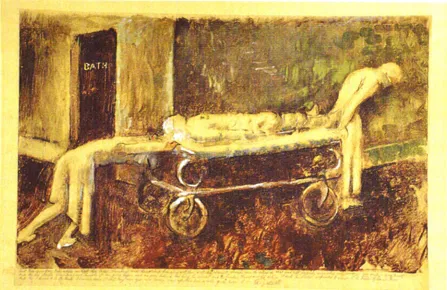
Director. was a mono type of the Hay internment camp entitled Shmrer-bath in camp, c.
19-+ 1 by En\-in Fabian.
In London in the late 19-+0s and early 1950s, monotypes \Yere commonly produced and
exhibited at the Redfern Galleries,57 among other galleries. The focus of the art \Yorld,
its purchasing p0\\-er and philosophical underpinnings was shifting from Europe to
e\\-Y ork after the American ,·ictory in the Second\,\ arid War. The monotype was the
perfect deliYery mechanism or sabot for conYeying the new American art of Abstract
Expressionism. Another factor influencing monotype numbers was the ·zenboom' ·s of
the 1950s. Popularised Zen philosophy influenced numerous American Abstract Expressionist a11ists \Yho made monotypes. The influence on Australian a11ists of the
American monotypes \\-as mainly second-hand through publications such as Art in
America and exhibitions seen b\-a select few.59
56
This is a more technically adrnnced sr:, le of transfer monor:, pe than that of Paul Gauguin: ··a sheet of paper is painted \\-ith black oil colouring and is used as a carbon. The reverse of the drawing is then worked \\-ith a needle.·· See "\'icholas Draffin. Tirn masters of the Weimer Bauhaus: Lyone/ Feininger.
Ludwig Hirschfeld _\fack. Art Galler: of New South Wales. Sydney, 197-t, p. -+2.
s· Redfern Galler:-. EXPOSITJOS au 1 Decembre au 31 Decembre 19-19 LES PELYTRES GRAVEURS. The Buchamp Press. London. l 9-t9. Within the mainly lithographic exhibition, fifty-si_,x of 162 British prints or thirr:,--fi \'e per cent \\ ere monotypes: two of the French prints were monotypes.
58
Helen \\-estgeest. Zen in the.fzfties: interaction in art benreen east and,rest, \ aanders Publishers, Zwolle. 1996. p. 53. \\'estgeest contrasts the influence of Japanese woodblock prints and the 'Japonistes' of the rum of the nineteenth cenrury on art in the nited States and France with a similar popular
philosophical influence on international art during the · zenboom · of the late 19-t0s and early 19 ·os. 59
Bernard Smith recalls:
··r
talked long into the night with Alan Da\·ie, one of the first artists in Britain to raw about Jackson Pollock's work after seeing it at Peggy Guggenheim's Galler:-in enice in 19-+8." See Bernard Smith. A parnnefor another time, Macmillan, Melbourne, 2002, p. 350.Part III of the thesis explores the methods of post-war travelling Australian artists, those Australians who experienced the flourishing of international monotype art first-hand. Sidney Nolan's monotypes will be discussed in detail along with the monotypes of Albert Tucker, James Cant, Margaret Preston, Charles Blackman and Margaret Olley. In this chapter, the beginnings of Grahame King's monotypes at The Abbey Art Centre and Museum60 in New Barnet, Hertfordshire in 1949 are analysed. At the Abbey both his future wife Inge King and the Scottish painter and musician Alan Davie61 also made monotypes. Guy Warren also travelled to London and made monotypes in the United
Kingdom in 1958 and later in New York and Sydney, from 1983 to 1985. Franz Kempf made trace prints in Europe in the mid 1950s, then produced monotypes in Australia and Israel from the late 1980s to the 1990s. Francis Lymbumer produced a dedicated body of monotypes whilst living in London from 1952 to 1964 and worked in the medium periodically later in his career. Frank Hinder also produced monotypes and
lithographs in the mid 1940s in Sydney and Canberra after his travels in the United States.
Margaret Preston is an important figure in Australian monotype art. Her practice in this thesis provides a link to the important female printmakers of the twentieth century and it is argued that her monotypes show the impact of the first generation of Abstract
Expressionist artists on Australian art. Preston's use of Australian Indigenous imagery as subject matter within her monotypes is discussed and - in relation to her monotype
output of c.1946 - her early travel experiences in Germany, France and Britain and her later privileged lifestyle, with increased access to travel and art publications are also subjects for discussion.
Preston produced all her known monotypes, over one hundred monotypes, in 1946-47. The short period of making artwork in the medium is consistent with the common
methods of making in the cluster theory. It is common with monotypes for an artist to work for a short time with the medium.
60
Bernard Smith lists his reminiscences of The Abbey Art Centre and Museum, ibid., p. 346.
61
Davie was interested in Eugen Herrigel's, Zen and the art of archery, Pantheon Books, New York, N.Y., 1953. Initially published in Germany in 1948 and translated to English in 1953; which, like its currently more popular Robert M. Pirsig, Zen and the art of motorcycle maintenance,.._ William Morrow & Co., Scranton, Penn., 1974, advocates the practice of performing simple motor tasks repetitively for many years to make that activity unconsciously effortless both physically and mentally. In his book Herrigal states (p. 10): "If one really wishes to be master of an art, technical knowledge of it is not enough. One has to transcend technique so that the art becomes an "artless art" growing out of the Unconscious." Monotype was one of the methods that Davie advocated for this spontaneous and unconscious process.
This productive period of Preston's monotype art is profusely illustrated and
documented in the 1949 monotype book published by Sydney Ure Smith. By the time
of its publication, all the monotypes illustrated had been sold and lists of the owners
were published.62 Preston's monotypes were also known to an American audience63
and her monotypes are mentioned and illustrated64 in Rasmusen's 1960 book Printmaking
with monotype; the first monographic publication dedicated to the monotype.
Preston's monotypes are formed from her skills as a woodblock printmaker. The artist's
sense of composition, bright colour, and interest in native plants and Sydney vistas are
evident in the monotypes and woodblock prints. The unique gift of the monotype is to
utilise skills, vision or technique from other media to more truly represent an artist's
personal vision. William Blake is credited by Margaret Preston as the inspiration for her
body of monotypes, even though their techniques are quite dissimilar.65
The simplicity of the medium allows each artist 'to discover' it anew and this makes attributions of
innovation difficult to substantiate. Preston states that the monotypes she published in
1949 were inspired by Blake, however, "they do not presume to have any relation to his
work; it is the principle in the method that is the connection".66
Blake, like Preston (and many others working in monotype), is said to have 'invented' the medium of monotype
afresh. Blake states: "I must create a system, or be enslaved by another man's, I will not
reason and compare: my business is to create."67
One theme running throughout this thesis is that monotype production grows with the
popularity of artists printing their own plates, forging artistic enquiry in a printmaking
medium. This is evident with a handful of Australians in France in the mid to late l 880s
and is evident in the work of Australians in monotype in the mid 1920s, early 1960s and
62
Sydney Ure Smith (ed.), Margaret Preston's monotypes, Ure Smith, Sydney, 1949, pp. 65-67. 63
Henry Rasmusen states: "Besides the European artists mentioned earlier, the names of several other
foreign workers in monotype have become known in this country, such as Margaret Preston of Australia,
Bella Leme, Lino Eneas Spilimbergo and Candido Portinari of Brazil and Demetrio
Urruchua of Argentina." See H. Rasmusen, Printmaking with monotype, Chilton, Philadelphia, 1960, p. 63. 64
ibid., pp. 66, 69. The works Billabong, and Scrub country, both 1946, are illustrated.
65
Preston, "My monotypes", in Sydney Ure Smith (ed.), op., cit., p. 11. Blake's work is held in the
National Gallery of Victoria and was available to Pretson in that collection and whilst she was travelling,
she also owned a book on Blake's monotypes, which is currently held in the Art Gallery of New South Wales collection. Australia's Anglo-Christian heritage and love of the outsider had made his work appealing to many Australian artists.
66
ibid. 67
William Blake, Jerusalem: the emanation of the Giant Albion, copy E, c. 1821, Yale Centre for British
Art: electronic edition, object 10, lines 21, 22. <http://www.blakearchive.org/blake/>, accessed I 0
February 20 I 0.
mid to late 1980s. Part IV examines the establishment of an artists' printmaking infrastructure in Australia through the prism of the monotype in the early 1960s. Dedicated printmaking departments were created in Australian art schools and in 1960 etcher/watercolourist Earle Backen68 joined the staff at the National Art School (NAS),
Sydney. Several important developments occurred in 1961: the trained lithographer David Strachan joined the NAS; the Mosman Art Prize included a print section; Willoughby Printmakers was established and the Sydney Printmakers ( est. 1960) held their first exhibition. The Print Council of Australia was formed in 1966. Most artists selling monotypes in the 1960s in Australia were predominantly painters and not dedicated printmakers, as discussed below ..
The printmaking machinery and knowledge available in the 1960s made it possible for a great number of artists to produce monotypes. The painters John Coburn, Russell
Drysdale, Ray Crooke, Leonard French, Jacqueline Hick, Sibyl Craig and Louis Kahan worked in monotype in the early 1960s. Clifton Pugh, Donald Laycock and Lawrence Daws also produced monotypes. Pugh's Mexican themed Penitence Series,69 which was exhibited in the United States with much of it sold, is an important high point of
monotype practice at this time. Many of these monotypes are documented in part IV of the thesis.
In the 1960s the rise of the middle class provided an audience and patrons for more affordable, democratic art forms such as printmaking. Monotype printmaking increased in popularity along with other forms of artists' prints. Knowledge about monotype printmaking also increased. The first book on the history and technique of mono type printmaking was published in 1960, where five examples70 of Australian monotype art were illustrated and all were drawn from the NGV's print collection.71 Possibly the 1958 Lefevre Gallery exhibition Degas: monotypes, drawings, pastels, bronzes72 and its accompanying publication informed and persuaded Australian artists visiting London of the benefits of monotype as a medium. The Degas monotype exhibition curated by
68
Earle Backen was fresh from Stanley William-Hayter's Atelier 17 print workshop. Stanley William-Hayter's workshop was open in Paris, 1927- 1940 and 1950- 1988; and in ew York 1940- 1955. 69
Swain & Ford, op. cit., p. 39. 70
Rasmusen, pp. 68-71. Composition by Leslie Clarke nee Lawson (b. 1930), Phoenix by Allen David,
Billabong NS. W. by Margaret Preston, Dead sea bird by Clifton Pugh and Forms in landscape by Henry Salkauskas.
71
These artists were most likely chosen because of the professionalism, access to images, reputation and
extensive collection of the institution.
72