An Action Research on Applying a Blended Learning
Program to Enhance Students’ TOEIC Listening
Program
Duong Duc Minh*, Luong Hanh Ngan**
* International School, Thai Nguyen University, Vietnam
** Center for Human Resource Development for Foreign Language Studies, Thai Nguyen University, Vietnam
DOI: 10.29322/IJSRP.9.05.2019.p89102 http://dx.doi.org/10.29322/IJSRP.9.05.2019.p89102
Abstract- This paper investigates the use of blended learning (BL) in an on-ground traditional face-to-face TOEIC course and seeks to determine the extent to which the blended TOEIC listening course significantly affects the improvement in students’ TOEIC listening performance, how students experience the teacher’s practice and behavior and measure the students’ perceptions of the blended learning environment with respect to its effectiveness. The purpose is to explore how to prepare English teachers to create a productive BL environment for their students. Both quantitative and qualitative research methods were used. In this case, the use of research may be directed by emphasizing on either quantitative or qualitative approaches in the mixed method research (Creswell, 2009). Qualitative and quantitative data were collected through the questionnaires at the end of the course. Quantitative data would also be collected and analyzed to evaluate the effect of the blended TOEIC listening course by continuous evaluation and the pretest and posttest at the beginning and the end of the course respectively. The results from the data revealed that the Blended TOEIC listening course significantly affected the improvement in students’ TOEIC listening performance. In addition, most of the students involved in the study are generally happy about the program and they recognize the benefits of the curriculum in enhancing interaction between them and their classmates as well as their teacher.
Index Terms- blended learning, TOEIC, listening, listening performance, listening improvement.
I. INTRODUCTION
With the emergence of online technology, the modern classroom is changing, nobody can deny the effectiveness of applying information communication and technology and the internet in foreign language teaching; therefore, living in the 21st century with a lot of new technologies coming into beings, teachers of English need to make use of these new technologies to apply in their English language teaching. The computer with the internet is the one among the achievements of the new technologies and computers have had a great marvelous impact in English language teaching, so merging these two fields – computers and English language is inevitable in a world where
many things are being automated and implemented into computer programs.
Listening ability is one of the important skills in foreign language learning and no one can deny its important role. However, listening skills in language learning have not received sufficient attention and listening remains one of the least understood processes in language learning. Hardly has anyone doubted nowadays that listening skills must be trained and practices regularly and continuously. The contemporary application of high-technology in language teaching and learning is listening online which can also be consolidated into traditional classroom listening to audio from cassettes or CDs. Researchers and language practitioners have also perpetuated that listening skills could be chosen by the learners for a long period of time and the present advantages of high technology allow the use of a combination of learning techniques in which the method blended learning of listening skills in English classrooms is employed and applied effectively. From our own experience as English teachers in teaching English in general and listening skill in specific, we have found that students encounter many difficulties when studying listening and since having a big gap in listening comprehension, when converging on the TOEIC syllabus they tend to be disheartened. Therefore, our study attempts to examine the practice of blended learning in the sense of its classic definition and present some evidence of its positive contribution to the students’ TOEIC listening performance.
From all these above reasons, this study aims to provide English teachers and students with productive blended learning environment in an intensive TOEIC Listening course. For the purposes of this study, a productive blended learning environment is defined as one in which students can learn necessary knowledge and skills and which issues them with a positive learning experience. A positive learning experience for students is defined as the knowledge and skills that meet their values, priorities and needs. More specifically, this study seeks to accomplish two goals. The first goal is to discover to what extent the blended TOEIC listening course affects the improvement in students’ TOEIC listening performance and the other one is to discover the attitudes of students about the blended learning environment during their TOEIC listening course.
II. LITERATURE REVIEW
1. Blended learning
In general, blended learning is defined as a combination of online and face -to-face education, but the definition somewhat varies according to different scholars. According to Sharma (2010), there are three definitions of “blended learning” that are pertinent in the world of education. The prototypical interpretation of the term is “the integrated combination of traditional learning with web based online approaches” (Oliver and Trigwell, 2005, p. 17). From the learner’s viewpoints, blended learning is effective in satisfying the learner’s satisfaction in that it enhances the learner’s convenience and accessibility (Cottrell & Robinson, 2003), meeting the various needs and learning styles (Dziuban, Hartman & Moskai, 2004), encourages interaction between learners (Osguthorpe & Graham, 2003), and it creates an environment where both real-time and delayed interaction are available. Blended learning also improves the learning achievement by fostering active interaction between learners, learners and teachers, and learners and lessons.
In the word of Osguthorpe and Graham (2003), teachers may be attracted to BL thanks to its benefits such as improving pedagogy, providing greater access to knowledge, and facilitating increased opportunities for social interaction. As different researchers focus on a multitude of variables, factors, and variants of instructional approaches in an attempt to gain knowledge about the usefulness of blended learning, leading to the result of somewhat muddied researches focusing in the area of blended learning; therefore, several researchers (Bliuc, Goodyear and Ellis, 2007; Shea, 2007; Vignare, 2007) call for more and better research that goes beyond to seek and to establish useful frameworks for the integration and application of BL in education. They also believe that research should focus on key aspects such as accessing, quality and blended learning environments.
2. Blended learning frameworks
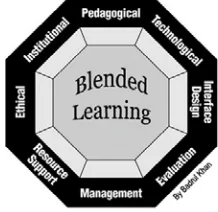
According to Hornby (1995), a framework is a structure giving shape and support to something. Frameworks for blended learning also varies for different learning goals. Alammary et al. (2014) presented three distinct design approaches for developing blended learning modules namely: low-impact approach in which online activities are added to an existing course, medium-impact approach which designs an online activity to replace an existing activity and high-impact approach which focuses on developing a blended module from the outset or redesigning a face-to-face or web-enhanced module as a blended learning module. However, according to Alammary et al. (2014), it can increase the teachers’ workload and be challenging for the teachers or lecturers to develop an appropriate online activity due to lack of time and incentives. Another framework for E-Learning’ was created by Badrul Khan (2003). Khan’s e-learning framework which is also referred to as Khan’s Octagonal Framework because of its octagonal shape representing the eight dimensions of the e-learning environment provides a framework that enables educators to select appropriate ingredients for flexible learning environments (Khan 2003). While Khan’s Octagonal Framework focuses primarily on e-learning, Singh (2003) adapted this framework to focus on blended learning. In the words of Singh, the framework created by Khan (2003) can serve as a guidance to outline, create, provide, organize and assess blended learning programmes. Khan’s framework consists of eight dimensions as be shown in Figure 1. The framework has eight dimensions
[image:2.612.389.498.144.250.2]namely: institutional, pedagogical, technological, interface design, evaluation, management, resource support and ethical. Each of these dimensions in the framework represents a category of issues that need to be addressed in order to create a meaningful learning experience (Singh 2003).
Figure 1. Khan’s Octagonal Framework adapted by Singh (2003)
The institutional dimension is involved in issues relating to organizational, administrative affairs, academic affairs and student services with reference to matters of education. Staff involved in designing and implementing blended learning programmes should consider the preparedness of the organization, availability and structure of content and infrastructure as well as the students’ needs. According to Singh (2003), a needs analysis should be conducted to ascertain the needs of the students. The pedagogical dimension refers to teaching and learning needs. This dimension addresses issues concerning content that has to be delivered, students’ needs and learning objectives. This dimension also includes the design, organization and methods and strategies of blended learning environments. In Singh’s view, the learning goals or learning outcomes need to be listed and the most appropriate delivery method is selected. The technological dimension considers issues related to technology infrastructure used in blended learning environments, particularly the e-learning aspects. This includes infrastructure planning such as servers that support the learning programme, bandwidth and accessibility, security and hardware and software. This includes creating a learning environment with the appropriate tools to be able to deliver a learning programme (Singh, 2003). This dimension also addresses the need for finding the most suitable learning management system that could manage multiple delivery types and a content management system that catalogues the learning content for the learning programme (Amalou, 2006).
The interface design directs to the overall look and feel of the blended learning programme. Teachers need to ensure that the user interface supports all the components and features of the blend. The interface design dimension includes page and site design, content design, navigation, and usability testing. The user interface needs to support all the elements of the blend. It has to be able to unite the different components of the blend, which will enable the students to use the different delivery types as well as switch from one delivery type to another. In the words of Singh, issues relating to content structure, navigation, graphics and ‘help’ features are also addressed in this dimension.
maintenance of learning environment and distribution of information, registration and notification and scheduling the different elements of the blend (Singh, 2003).
3. TOEIC listening test
In the TOEIC Listening Section, there are 100 questions and lasts for about 45 minutes:
In part 1, students see ten pictures. For each picture, they will hear four statements and they must select the statement that best matches the picture. Students should see the picture carefully and try to predict the vocabularies and statements they might hear. By first picking out the key focus of the picture and quickly brainstorming related vocabularies and possible statements, they are likely to be much better prepared when they actually listen. In part 2, students will listen to the questions or statements followed by three possible responses. They must choose the response that best matches the question. This part of the test is a pure listening challenge as there are no clues students can use to predict what they are going to listen to.
In part 3, students will listen to ten conversations and then answer three questions for each conversation. The students should answer questions as quickly as they can especially when the listening text is still being read. Moreover, students need to use the time between conversations to skim the next three questions, predict what they are going to listen to and isolate exactly what they should be listening for.
As in part 3, in Part 4 students will listen to ten monologues followed by three questions for each. The difference is that instead of a conversation, the listening features a single speaker giving a talk: a report, a speech, an advertisement, etc.
4. ICT Tools and Listening
According to Vandergrift (2011), information and communication technology (ICT) can be a great asset for listening development. Thanks to technology, ELT teachers can choose audios and videos from different sources according to their learners’ needs and use multimedia to improve their listening lessons (Lynch, 2009; Flowerdew and Miller, 2005). ESL as well as EFL listeners can also be supported by ICT in many ways. First, they can independently access the recording from their computers, mobiles or other audio devices. Second, they can carry the listening tasks at his/her own pace without having to depend on the pace of the class (Wilson, 2008). Third, thanks to multimodality, “the opportunities for processing input are amplified” (Rost, 2007, p.102). In fact, with multimedia devices the second language listener can control the audio, see images while listening and use subtitles and the transcript. Moreover, with the replay, pause and rewind options, the listener is no longer subject to the temporal and linear nature of speech.
III. METHODOLOGY
1. Research questions
The research was conducted to address the following two research questions:
1. To what extent does the blended TOEIC listening course affect the improvement in students’ TOEIC listening performance? 2. What are the students’ attitudes towards the blended learning environment during their TOEIC listening course?
2. Participants of the study
Since the study was designed to assess the effectiveness of applying a blended learning program to improve students’ TOEIC
listening performance, therefore, students’ role was put into great consideration. The total of 16 learners in a TOEIC class were chosen as the subjects of the study. They are at elementary level and enrolled in TOEIC 450 course. These learners were selected because they all belonged to one class to whom the researcher was in charge of teaching listening. All of the participants were willing to join the course and all of them confirmed that they have a sufficient amount of background on the information technologies and have ample computer skills. Most of the participants were students at colleges or universities in Thai Nguyen.
3. The blended TOEIC listening course
The blended TOEIC listening course was planned and designed by the researcher in order to provide an alternative instructional environment for the on-ground TOEIC listening course. The blended TOEIC listening course was organized as a combination of both face-to-face and online instructional assignments. The class meets face-to-face every week for two hours in the classroom and the rest of the activity was carried out online. In class, teacher would instruct the learner to discuss the previous online assignments, and learn different kinds of questions in the different listening parts. The learners would have chances to take part in pair works or group work to practice listening, discuss some topics or questions related to the lesson. Teacher also gave the learners feedback as well as tips for the listening task, some of which are also provided on the course web page as power point presentation. The TOEIC learners enrolled in a 12 - week TOEIC course and were asked to complete a variety of assignments both online and offline. Since the course is a mixture of face to face and online classes. The materials used were a combination of handouts with CDs and videos prepared by the teacher as well as various e-learning resources uploaded and linked through the Moodle system. A number of Moodle technology features are utilized such as discussion, forums, and online assignments.
4. Data collection instruments and data collection procedures The data to be analyzed principally came from three main sources, namely students ‘record, listening comprehension tests and student questionnaire.
Students’ record
Before and after each listening part, students would be given a mini listening test as it could shed some lights on students’ performance. To see the students’ performance of each listening part, the average of the students’ marks before and after studying each part would be calculated by Excel software and compared with each other.
TOEIC listening comprehension test
TOEIC, the Test of English for International Communication, has been used a certified English test around the world. To diagnose students’ listening proficiency and to compare test scores within the groups, two certified TOEIC test scores were submitted before the course started and later after it was completed. The pre- and the post-tests were the same form of the questions. The time allowed was 45 minutes with 100 multiple choices items and 4 different listening parts. The researcher did not use the same test for pretest and posttest, but they were two different tests with the same form and level to avoid students remembering the pretest and checking the answers.
course to compare their listening competence before and after the treatment. Beginning of the course teacher use the Practice Test one from the book “Longman Preparation Series for the New TOEIC Test – introductory course” - by Lin Lougheed (2006) to test the student’s entry level and use Practice Test Two to assess the progress of the student at the end of the course.
Student questionnaires
Three types of questions were included in the students’ questionnaire: rating scales, multiple choices and open questions. The Likert scales - strongly agree/agree/neither agree nor disagree/disagree/strongly disagree - were used with statements about the listening sessions, their effect so that the answers could be quantified and analysed easily (Mackey and Gass, 2005).
IV. FINDINGS AND DISCUSSIONS
1. The level of the blended TOEIC listening course in the improvement of students’ listening performance
To answer the first research question, the scores of TOEIC listening pre - test and post- test were analysed and compared. This comparison of the average marks of the pre and post-tests shows that there has been a significant improvement in the student’s performance in the post-test (see Figure 2).
Figure 2. Pre and Post Test Results
As can be clearly seen, there was a significant rise in the average score of the whole students. In the pre-test, the mean stood at 40,81. After 12-week training, this figure rose to 54,75, which is an indicator of the students’ general improvement.
As can be clearly seen, there was a significant rise in the average score of the whole students. In the pre-test, the mean stood at 40,81. After 12-week training, this figure rose to 54,75, which is an indicator of the students’ general improvement.
Table 1. Group’s performance in the pre-test and post-test
[image:4.612.313.579.56.151.2] [image:4.612.69.269.317.448.2]N Min Max Sum Mean SD Pretest 16 33.00 51.00 653.00 40.81 1.36 5.46 Posttest 16 47.00 65.00 876.00 54.75 1.48 5.92 Table 1 reveals that there is a significant difference between the mean scores of the studied samples in TOEIC listening performance on the pre-test and the post-test of the TOEIC listening test in favor of the post assessment. As illustrated in this table, the study samples indicated more improvement in their TOEIC listening performance in the post- test than that in the pre-test.
Table 2. Results of the Paired-Sample T-tests
Paired Differences t df Sig.
Mean S.D Std. Error
95% Confidence
Interval of the Difference Lower Upper Pretest -
Posttest -13.93 3.25 .81 -15.67 -12.20 -17.12 15 .000 As can be seen from the table 2, the p – value or the sig. level was
less than .05 (p≤ 0.0). It means that the result from the pre-test and
post-test was significantly different. Therefore, the TOEIC listening blended course did have positive effects on the studied students’ listening performance.
It can be concluded from the results that the participants’ listening performance was improved considerably in the TOEIC listening post - test than in the pre - test thanks to the application of the blended TOEIC listening course.
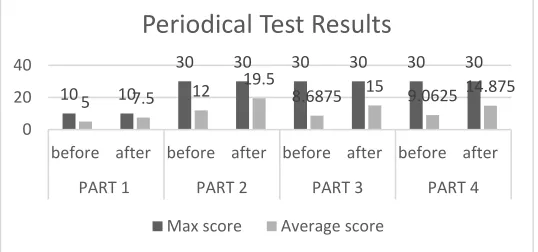
In addition, as mentioned above, before and after each listening part, students were also given a mini listening test as it could shed some lights on students’ performance. The difficulty level of listening sections in TOEIC listening is different. Specifically, listening parts 1 and 2 are less difficult than listening parts 3 and 4.
As can be seen from the Figure 3, through the results of the mini - tests before and after each listening part, it is found that results of the after tests are higher than those of the previous tests in most students. Figure 3 also illustrates that the students scored higher in listening parts 1 and 2 than in listening parts 3 and 4. However, the results in each listening section showed the improvement. To be specific, average score of listening part 1 increases from 5 to 7.5 and the second part is from 12 to 19.5 while listening parts 3 & 4 sees the increase from 8.7 to 15 and 9 to 14.9 respectively in their average results. Since the level of difficulty of the listening parts increased, the students’ average mark of listening part 3 and part 4 decreased gradually is understandable.
Figure 3. Periodical test results
In conclusion, the students’ improvement was evidently shown, which demonstrated the necessity and effectiveness of blended listening course to enhance students’ listening ability. In other words, blended learning is an effective teaching method to develop the students’ listening skill.
2. Learners’ attitudes towards the blended learning environment during their TOEIC listening course
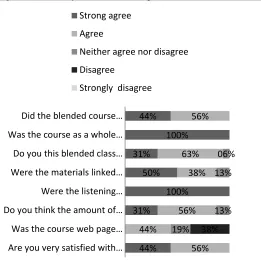
The 16 students’ response in the questionnaire was also constructive. All the students stated that they like the course, this blended course meet their learning needs. While 100% of the
Pre-test Post -test
max score 100 100
average
score 041 54.75
0 20 40 60 80 100 120
po
int
10 10
30 30 30 30 30 30
5 7.5 12 19.5 8.6875 15 9.0625 14.875
0 20 40
before after before after before after before after
PART 1 PART 2 PART 3 PART 4
Periodical Test Results
[image:4.612.313.582.479.605.2]students agree that the course as a whole was beneficial for them, 37,5 % of them had encountered difficulty when using the web page and did not find the course convenient for using.
Figure 4. Results of the Likert- scale questions
In relation to the volume of the assignments and activities assigned to the students, as shown in figure 3.3, the amount of listening assignment seemed to be appropriate for nearly 90% of students and more than 90% of the students thought that this blended course has improved their listening performance.
In order to evaluate student satisfaction, students were asked to respond to the question: “Did you enjoy doing the online assignments?” 93,75% of students replied “yes” and only 6,25% replied “no” (figure 4). This is a very positive outcome, particularly in light of the association between students’ motivation and learning success.
In conclusion, based on the data analysis, the implementation of blended learning in teaching listening was effective. Apart from some exceptions, the results from the blended TOEIC listening course questionnaire reveal that almost all participants are generally satisfied with the blended learning course. The students in the sample of the study expressed their positive attitudes towards this experience and they even want to study more English course in the same way and they also want to recommend the course to their friend in the future. Additionally, the participants realized the benefits of this model such as enhancing interaction between them and their instructor. This illustrates that the students feel that they can develop their English fluency and become more accurate comprehended of English if they receive good listening practice.
V. CONCLUSION
From the thorough analysis and discussions of the data collected from the survey questionnaires and score analysis, significant findings were identified.
Firstly, it was discovered that the TOEIC listening blended course did have positive effects on the studied students’ listening performance.
Secondly, from the questionnaires, it was found that most of students had positive view toward the implementation of blended learning model in listening class. Most students liked learning listening as a part in language skills. Based on students’ response toward the implementation of blended learning model, it could improve students’ listening skill. In addition, by the implementation of blended learning model, students could study by themselves in learning listening and when a lecturer gave students tasks in Listening comprehension via online, students could fulfill the task and respond lecturer’ task via online too. Last but not least, by implementing the blended learning model, students could improve their understanding and comprehension because they could find many learning sources via online
Analyze and understand all the provided review comments thoroughly. Now make the required amendments in your paper. If you are not confident about any review comment, then don't forget to get clarity about that comment. And in some cases there could be chances where your paper receives number of critical remarks. In that cases don't get disheartened and try to improvise the maximum.
REFERENCES
[1] Alammary A., Sheard J. & Carbone A. (2014). Blended learning in higher education: Three different design approaches. Australasian Journal of Educational Technology, 30.
[2] Amalou, D. (2006). Technical and pedagogical comparative study of E-Learning platforms for open and distance learning. Development Prọect Report. Vocational Teacher Education College. Jyvaskylan University [3] Bliuc, A.M., Goodyear P., & Ellis, R. A. (2007). Research focus and
methodological choices in studies into students' experiences of blended learning in higher education. Internet and Higher Education, 10(4), 231-244. [4] Brett, P. (1997). A comparative study of the effects of the use of multimedia
on listening comprehension. System. 25(1), 39-53.
[5] Cottrell, D. M., & Robinson, R. A. (2013). Blended learning in an accounting course. The Quarterly Review of Distance Education, 4(3), pp. 261-269. [6] Creswell, J. W. (2009). Research Design Qualitative, Quantitative, and
Mixed Methods Approaches (3rd ed.). Thousand Oaks, CA Sage Publications.
[7] Dziuban, C. D., Hartman, J. L., & Moskai, P. D. (2004). Blended learning. Education Center for Applied Research. NY.
[8] Flowerdew, J., & Miller, L. (2005). Second language listening: theory and practice. Cambridge University Press.
[9] Guichon, N., & McLornan, S. (2008). The effects of multimodality on L2 learners: Implications for CALL resource design. System, 36, pp.85-93. [10] Graham C. R., Allen, S., & Ure, D. (2003). Blended learning environments:
A review of the research literature. Unpublished manuscript, Provo, UT. [11] Hornby, J. (1995). Speaking skill. New York Publisher.
[12] Khan, B. (2003). A framework for E-learning. Educational Technology Publications.
[13] Lougheed, L. (2006). Longman Preparation Series for the New TOEIC Test. Longman
[14] Lynch, R., & Dembo M. (2004). The relationship between self regulation and online learning in a blended learning context. The International Review of Research in Open and Distributed Learning, 5(2), pp. 1–16.
[15] Mackey, A., & Gass, S. (2005). Second Language Research Methodology and Design. Lawrence Erlbaum Associates, Inc. Publishers.
[16] Oliver, M., & Trigwell, K. (2005). Can ‘Blended Learning’ Be Redeemed?
E-learning and Digital Media Journal, 2(1).
44% 31%
100% 50% 31%
100% 44%
56% 44%
56% 38% 63%
56%
19%
13% 13% 06%
38% Are you very satisfied with…
Was the course web page… Do you think the amount of… Were the listening… Were the materials linked… Do you this blended class… Was the course as a whole… Did the blended course…
Strong agree Agree
Neither agree nor disagree Disagree
[17] Osguthorpe, R. T., & Graham, C. R. (2003). Blended learning environment: Definitions and directions. The Quarterly Review of Distance Education, 4(3), pp. 227-234.
[18] Rost, M. P. (2007). Listening in action. Prentice Hall
[19] Sharma, P. (2010). Blended learning. ELT Journal, 64 (4), pp.456–458. [20] Shea, P. (2007). Towards a conceptual framework for learning in blended
environments. In Picciano A.G and Dziuban Ch. D. (Eds.). Blended learning: Research perspectives. Needham, MA.
[21] Singh, H. (2003). Building effective learning programs. Educational Technology, 43(6).
[22] Vandergrift, V. (2004). Learning to listen or listening to learn. Annual Review of Applied Linguistics, 24, 3-25.
[23] Vignare, K. (2007). Review of literature blended learning: Using ALN to change the class-room-will it work? In A.G. Picciano, & C. D. Dziuban (Eds), Blended learning: Research Perspectives (pp. 37-63), Boston: Sloan Consortium.
[24] Wilson, J. J. (2008). How to Teach Listening - A practical guide to the theory of listening in the English language. Pearson Longman.
AUTHORS
Duong Duc Minh – International School, Thai Nguyen University, Vietnam
Email: [email protected].
Luong Hanh Ngan – Center for Human Resource Development for Foreign Language Studies, Thai Nguyen University, Vietnam Email: [email protected].
Correspondence Author – Duong Duc Minh. Email: